tow MERCEDES-BENZ CLA-CLASS 2013 User Guide
[x] Cancel search | Manufacturer: MERCEDES-BENZ, Model Year: 2013, Model line: CLA-CLASS, Model: MERCEDES-BENZ CLA-CLASS 2013Pages: 352, PDF Size: 5.64 MB
Page 21 of 352
Securing from rolling away ............326
Towing away .................................. 308
Tow-starting ................................... 308
Transporting .................................. 311
Unlocking (in an emergency) ...........83
Unlocking (key) ................................ 77
Vehicle data ................................... 343
Vehicle data ....................................... 343
Vehicle dimensions ........................... 343
Vehicle emergency locking ................ 84
Vehicle identification number see VIN
Vehicle identification plate .............. 336
Vehicle maintenance see ASSYST PLUS
Vehicle tool kit .................................. 297
Vehicle weights ................................. 343
Video (DVD) ........................................ 215
Video DVD (on-board computer) ...... 215
VIN ...................................................... 336
W
Warning and indicator lamps ABS ................................................ 256
Brakes ........................................... 256
Distance warning signal .................264
ESP ®
.............................................. 258
ESP ®
OFF ....................................... 259
Fuel tank ........................................ 262
LIM (cruise control) ........................ 169
LIM (DISTRONIC PLUS) ..................174
LIM (variable SPEEDTRONIC) .........171
Overview .......................................... 32
PASSENGER AIRBAG OFF ................53
Reserve fuel ................................... 262
Seat belt ........................................ 255
SRS ................................................ 261
Tyre pressure monitor ...................265
Warning triangle ................................ 296
Washer fluid Display message ............................ 254
Wheel bolt tightening torque ........... 328
Wheel chock ...................................... 326
Wheels Changing/replacing .......................324
Changing a wheel .......................... 324
Checking ........................................ 317
Cleaning ......................................... 289
Cleaning (warning) .........................325
Emergency spare wheel .................331
Fitting a new wheel ........................328
Fitting a wheel ............................... 325
Important safety notes ..................316
Removing a wheel ..........................328
Storing ........................................... 325
Tightening torque ........................... 328
Wheel size/tyre size ......................329
Windowbag
Display message ............................ 236
Operation ......................................... 45
Windows
Cleaning ......................................... 290
see Side windows
Windscreen
Demisting ...................................... 132
see Windscreen
Windscreen washer fluid
see Windscreen washer system
Windscreen washer system
Notes ............................................. 342
Topping up ..................................... 286
Windscreen wipers
Display message ............................ 254
Problem (malfunction) ...................121
Replacing the wiper blades ............119
Switching on/off ........................... 118
Winter driving
General notes ................................ 318
Winter operation
Slippery road surfaces ...................168
Snow chains .................................. 319
Winter tyres
Limiting the speed (on-board com-
puter) ............................................. 223
M+S tyres ...................................... 318
Wiper blades
Cleaning ......................................... 291
Important safety notes ..................119
Replacing (windscreen) ..................119
Wooden trim (cleaning instructions) 293
Workshop see Qualified specialist workshop Index19ProCarManuals.com
Page 26 of 352
Do not connect any equipment to a diagnos-
tics connection in the vehicle.GWARNING
Objects in the driver's footwell can restrict the
pedal travel or obstruct a depressed pedal.
The operating and road safety of the vehicle
is jeopardised. There is a risk of an accident.
Make sure that all objects in the vehicle are
stowed correctly, and that they cannot enter
the driver's footwell. Fit the floormats
securely and as specified in order to ensure
sufficient clearance for the pedals. Do not use
loose floormats.
! If the engine is switched off and equip-
ment on the diagnostics connection is
used, the starter battery may discharge.
Connecting equipment to the diagnostics
connection can lead to emissions monitoring
information being reset, for example. This
may lead to the vehicle failing to meet the
requirements of the next emissions test dur-
ing the main inspection.
Qualified specialist workshop
A qualified specialist workshop has the nec-
essary special skills, tools and qualifications
to correctly carry out any necessary work on
your vehicle. This particularly applies to work
relevant to safety.
Observe the notes in the Service Booklet.
Always have the following work carried out at
a qualified specialist workshop:
R work relevant to safety
R service and maintenance work
R repair work
R modifications, installations and conver-
sions
R work on electronic components
Mercedes-Benz recommends that you use a
Mercedes-Benz Service Centre.
Vehicle registration
Mercedes-Benz may ask its Service Centres
to carry out technical inspections on certain
vehicles. The quality or safety of the vehicle
is improved as a result of the inspection.
Mercedes-Benz can only inform you about
vehicle checks if it has your registration data.
It is possible that your vehicle has not yet
been registered in your name in the following
cases:
R if your vehicle was not purchased at an
authorised specialist dealer.
R if your vehicle has not yet been examined
at a Mercedes-Benz Service Centre.
It is advisable to register your vehicle with a
Mercedes-Benz Service Centre.
Inform Mercedes-Benz as soon as possible
about any change in address or vehicle own-
ership.
Correct use
If you remove any warning stickers, you or
others could fail to recognise certain dangers.
Leave warning stickers in position.
Observe the following information when driv-
ing your vehicle:
R the safety notes in this manual
R the technical data in this manual
R traffic rules and regulations
R laws and safety standards pertaining to
motor vehicles
Implied warranty
! Follow the instructions in this manual
about the proper operation of your vehicle
as well as about possible vehicle damage.
Damage to your vehicle that arises from
culpable contraventions against these
instructions are not covered either by
Mercedes-Benz implied warranty or by the
New or Used-Vehicle Warranty.
24IntroductionProCarManuals.com
Page 37 of 352
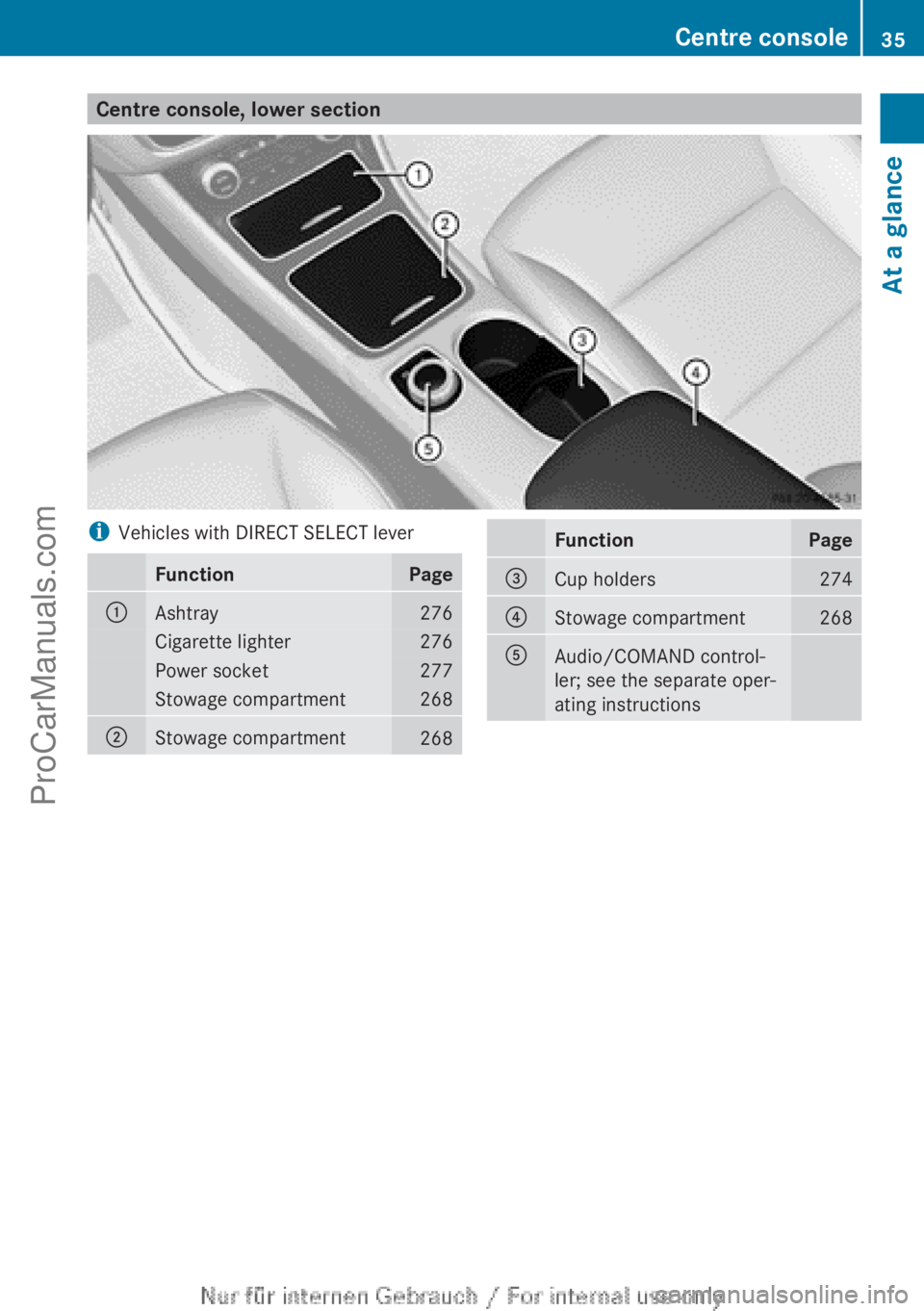
Centre console, lower sectioniVehicles with DIRECT SELECT leverFunctionPage:Ashtray276Cigarette lighter276Power socket277Stowage compartment268;Stowage compartment268FunctionPage=Cup holders274?Stowage compartment268AAudio/COMAND control-
ler; see the separate oper-
ating instructionsCentre console35At a glanceProCarManuals.com
Page 38 of 352
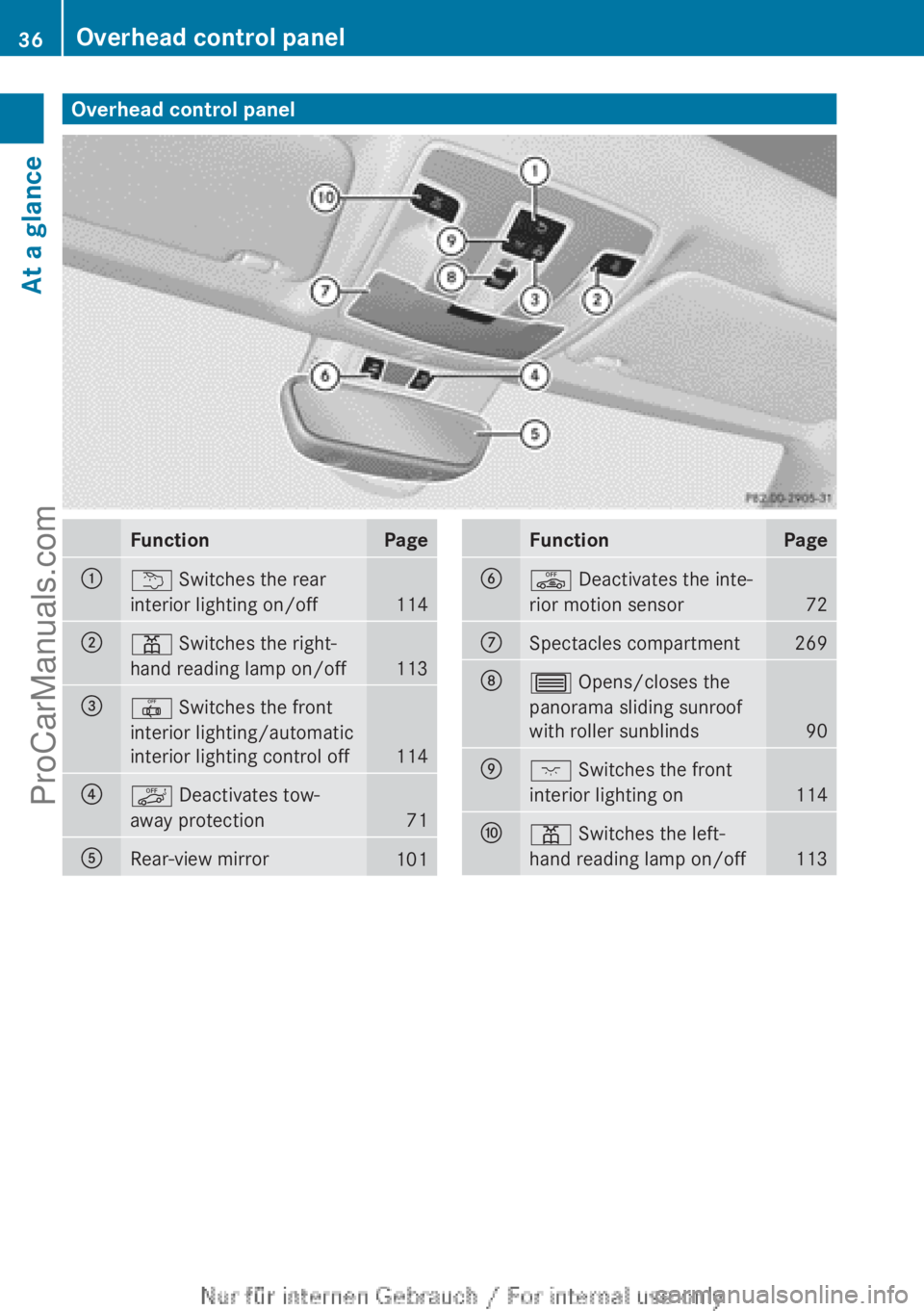
Overhead control panelFunctionPage:u Switches the rear
interior lighting on/off
114
;p Switches the right-
hand reading lamp on/off
113
=| Switches the front
interior lighting/automatic
interior lighting control off
114
?ë Deactivates tow-
away protection
71
ARear-view mirror101FunctionPageBê Deactivates the inte-
rior motion sensor
72
CSpectacles compartment269D3 Opens/closes the
panorama sliding sunroof
with roller sunblinds
90
Ec Switches the front
interior lighting on
114
Fp Switches the left-
hand reading lamp on/off
113
36Overhead control panelAt a glance
ProCarManuals.com
Page 43 of 352
Airbag deployment only provides increased
protection if the seat belt is worn correctly.
The seat belt helps, firstly, to keep the vehicle
occupant in the best position in relation to the
airbag. Secondly, in a head-on collision, for
example, the seat belt restricts movement of
the vehicle occupant towards the point of
impact.
SRS (Supplemental Restraint System)
Introduction
Supplemental Restraint System (SRS) with:
R the 6 SRS warning lamp
R airbags
R airbag control unit (with crash sensors)
R belt tensioners for the front seat belts and
the outer seat belts in the rear
R seat belt force limiters for the front seat
belts and the outer seat belts in the rear
SRS reduces the risk of vehicle occupants
coming into contact with parts of the vehi-
cle's interior in the event of an accident. It can
also reduce the forces to which vehicle occu-
pants are subjected during an accident.
SRS warning lamp
GWARNING
If SRS is malfunctioning, child restraint sys-
tem components may be triggered uninten-
tionally or might not be triggered at all in the
event of an accident with a high rate of vehicle
deceleration. There is an increased risk of
injury, possibly even fatal.
Have SRS checked and repaired immediately
at a qualified specialist workshop.
SRS functions are checked regularly when
you switch on the ignition and when the
engine is running. Therefore, malfunctions
can be detected in good time.
The 6 SRS warning lamp in the instrument
cluster lights up when the ignition is switched
on. It goes out no later than a few seconds
after the engine is started.
The SRS components are in operational read-
iness when the 6 SRS warning lamp goes
out while the engine is running.
A malfunction has occurred if:
R the 6 SRS warning lamp does not light
up when the ignition is switched on
R the engine is running and the 6 SRS
warning lamp does not go out after a few
seconds
R the engine is running and the 6 SRS
warning lamp lights up again
Triggering of belt tensioners and air-
bags
During the first stage of a collision, the airbag
control unit evaluates important physical
data relating to vehicle deceleration or accel-
eration, such as:
R duration
R direction
R magnitude
Based on the evaluation of this data, the air-
bag control unit pre-emptively triggers the
belt tensioners in the first stage.
If there is an even higher rate of vehicle decel-
eration or acceleration in a longitudinal direc-
tion, the front airbags are also deployed.
Your vehicle has adaptive, two-stage front air-
bags. The airbag control unit evaluates vehi-
cle deceleration or acceleration in the event
of a collision. In the first deployment stage,
the front airbag is filled with enough propel-
lant gas to reduce the risk of injuries. The
front airbag is fully deployed if a second
deployment threshold is reached within a few
milliseconds.
The belt tensioner and airbag triggering
thresholds are variable and are adapted to the
detected rate of deceleration or acceleration
of the vehicle. This process is pre-emptive in
nature. The triggering process must take
place in good time at the start of the collision.
Occupant safety41SafetyZProCarManuals.com
Page 45 of 352
OFF indicator lamp must be continuously
lit.
If the front-passenger seat of your vehicle
does not have automatic child seat recog-
nition, or your rearward-facing child
restraint system does not have a trans-
ponder for automatic child seat recogni-
tion, children must be secured in a child
restraint system on a suitable seat in the
rear. If you secure a forward-facing child
restraint system to the front-passenger
seat, you must move the front-passenger
seat as far back as possible.
R make sure there are no heavy or sharp-
edged objects in the pockets of clothing.
R do not lean forwards, e.g. over the cover of
the driver's/front-passenger front airbag,
particularly when the vehicle is in motion.
R do not put your feet on the dashboard.
R only hold the steering wheel on the outside.
This allows the airbag to be fully deployed.
You could be injured if the airbag is
deployed and you are holding the inside of
the steering wheel.
R do not lean on the doors from inside the
vehicle.
R make sure that there are no people, ani-
mals or objects between the vehicle occu-
pants and the area where the airbags are
deployed.
R do not place any objects between the seat
backrest and the door.
R do not hang any hard objects, e.g. coat
hangers, on the grab handles or coat hooks.
R do not attach accessories, e.g. cup holders,
to the doors.
It is not possible to rule out a risk of injury
being caused by an airbag, due to the high
speed at which the airbag must be deployed.GWARNING
If you modify the airbag covers or affix
objects, e.g. stickers to them, the airbags may
no longer function as intended. There is an
increased risk of injury.
Never modify the airbag covers and do not
affix any objects to them.GWARNING
Unsuitable seat covers may obstruct or even
prevent deployment of the airbags integrated
into the seats. The airbags may then fail to
protect the vehicle occupants as intended.
Operation of the automatic child seat recog-
nition may also be impaired. There is an
increased risk of injury, possibly even fatal.
Use only seat covers which have been specif-
ically approved for the respective seat by
Mercedes-Benz.
GWARNING
After the driver's airbag has been deployed,
the airbag parts are hot. There is a risk of
injury.
Do not touch the airbag parts. Have deployed
airbags replaced immediately at a qualified
specialist workshop.
Airbag deployment slows down and restricts
the movement of the vehicle occupant.
If the airbags are deployed, you will hear a
bang and a small amount of powder may also
be released. Only in rare cases will the bang
affect your hearing. The powder that is
released generally does not constitute a
health hazard and does not indicate that there
is a fire in the vehicle. The powder may cause
short-term breathing difficulties to persons
suffering from asthma or other pulmonary
conditions. In order to prevent potential
breathing difficulties, you should leave the
vehicle as soon as it is safe to do so. You can
also open the window to allow fresh air to
enter the vehicle interior. The 6 SRS warn-
ing lamp lights up.
The airbag installation locations are identified
by the AIRBAG symbol.
i After an airbag has been deployed, have
the vehicle towed to the nearest qualified
specialist workshop, even if your vehicle
can still be driven.
Occupant safety43SafetyZProCarManuals.com
Page 52 of 352
Belt tensioners, belt force limitersGWARNING
Pyrotechnic seat belt tensioners that have
been deployed are no longer operational and
are unable to perform their intended protec-
tive function. This poses an increased risk of
injury or even fatal injury.
Therefore, have pyrotechnic belt tensioners
which have been triggered immediately
replaced at a qualified specialist workshop.
! If the front-passenger seat is not occu-
pied, do not engage the seat belt tongue in
the buckle on the front-passenger seat.
Otherwise, the belt tensioner could be trig-
gered in the event of an accident.
i Vehicles with PRE-SAFE ®
: belt tensioners
that are triggered by an electric motor can
be deployed as often as desired and do not
need to be replaced.
The front seat belts and the outer seat belts
in the rear are equipped with belt tensioners
and belt force limiters.
The belt tensioners tighten the seat belts in
an accident, pulling them close against the
body.
Belt tensioners do not correct incorrect seat
positions or incorrectly fastened seat belts.
Belt tensioners do not pull vehicle occupants
back towards the backrest.
The belt tensioners can only be activated
when:
R the ignition is switched on
R the restraint systems are operational; see
" 6 SRS warning lamp"( Y page 41)
R the belt tongue is engaged in the buckle on
each of the front seat belts.
The belt tensioners on the outside seats in the
rear compartment are triggered independ-
ently of the lock status of the seat belts.
The belt tensioners are triggered depending
on the type and severity of an accident:
R if, in the event of a head-on or rear-end col-
lision the vehicle decelerates or acceler-
ates rapidly in a longitudinal direction dur-
ing the initial stages of the impact
R if, in the event of a side impact, on the side
opposite the impact the vehicle deceler-
ates or accelerates rapidly in a lateral direc-
tion
R in certain situations where the vehicle over-
turns and the system determines that it can
provide additional protection
If the airbags are deployed, you will hear a
bang, and a small amount of powder may also
be released. Only in rare cases will the bang
affect your hearing. The powder that is
released generally does not constitute a
health hazard and does not indicate that there
is a fire in the vehicle. The powder may cause
short-term breathing difficulties to persons
suffering from asthma or other pulmonary
conditions. In order to prevent potential
breathing difficulties, you should leave the
vehicle as soon as it is safe to do so. You can
also open the window to allow fresh air to
enter the vehicle interior. The 6 SRS warn-
ing lamp lights up.
If the seat belt is also fitted with a belt force
limiter and this is triggered, the force exerted
by the seat belt on the vehicle occupant is
reduced.
The belt force limiters on the front seats are
synchronised with the front airbags, which
take on a part of the deceleration force. This
results in the load being distributed over a
greater area.
Children in the vehicle
Child restraint systems
Important safety notes
GWARNING
To reduce the risk of serious or even fatal
injury to the child in the event of a sudden
change in direction, braking or an accident:
R Children less than 1.50 m tall and under
twelve years of age must always be secured
50Children in the vehicleSafety
ProCarManuals.com
Page 53 of 352
in special child restraint systems on a suit-
able vehicle seat. This is necessary
because the seat belts are not designed for
children.
R Do not transport children who are secured
in rearward-facing child restraint systems
on the front-passenger seat. Exception: if
the vehicle is equipped with automatic child
seat recognition on the front-passenger
seat and the child is secured in a child
restraint system with transponders for
automatic child seat recognition
R If you secure a forward-facing child
restraint system to the front-passenger
seat, you must move the front-passenger
seat as far back as possible. When doing
so, ensure that the shoulder belt strap from
the belt outlet on the vehicle is routed
towards the front to the shoulder belt guide
on the child restraint system. Set the belt
height adjustment so that the belt strap is
routed towards the front along the bottom.
R Children must never travel sitting on the lap
of another occupant. Due to the forces
which occur in the event of a sudden
change of direction, heavy braking or an
accident, it would not be possible to
restrain the child. The child could be thrown
against parts of the vehicle interior and be
seriously or even fatally injured.GWARNING
If the child restraint system is incorrectly fit-
ted on the seat position suitable for this pur-
pose, it cannot perform its intended protec-
tive function. In the event of an accident,
sharp braking or a sudden change in direction,
the child may not be held securely. There is
an increased risk of serious or even fatal inju-
ries.
Observe the manufacturer's installation
instructions and the correct use for the child
restraint system. Make sure that the entire
surface of the child restraint system is resting
on the seat surface. Never place objects
under or behind the child restraint system,
e.g. cushions. Only use child restraint sys-
tems with the original cover designed for
them. Only replace damaged covers with gen-
uine covers.GWARNING
If the child restraint system is fitted incor-
rectly or is not secured, it can come loose in
the event of an accident, heavy braking or a
sudden change in direction. The child
restraint system could be thrown about, strik-
ing vehicle occupants. There is an increased
risk of injury, possibly even fatal.
Always fit child restraint systems properly,
even if they are not being used. Make sure
that you observe the child restraint system
manufacturer's installation instructions.
GWARNING
Child restraint systems or their securing sys-
tems that have been damaged or subjected to
a load in an accident cannot perform their
intended protective function. In the event of
an accident, sharp braking or a sudden
change in direction, the child may not be held
securely. There is an increased risk of serious
or even fatal injuries.
Immediately replace child restraint systems
that have been damaged or subjected to a
load in an accident. Have the child restraint
securing systems checked in a qualified spe-
cialist workshop before fitting a child restraint
system again.
GWARNING
If children are left unsupervised in the vehicle,
they could:
R open the doors, thus endangering other
people or road users.
R get out and disrupt traffic.
R operate the vehicle's equipment.
Children in the vehicle51SafetyZProCarManuals.com
Page 54 of 352
Additionally, children could set the vehicle in
motion if, for example, they:
R release the parking brake.
R shift the automatic transmission out of
parking position P.
R shift the manual transmission into neutral.
R start the engine.
There is a risk of an accident and injury.
When leaving the vehicle, always take the key
with you and lock the vehicle. Never leave
children or animals unattended in the vehicle.
Always keep the key out of reach of children.GWARNING
If persons (particularly children) are exposed
to heat or cold for a prolonged period, there
is a risk of serious or even fatal injuries. Never
leave persons (particularly children) unatten-
ded in the vehicle.
GWARNING
If the child restraint system is placed in direct
sunlight, the parts could become very hot.
Children could be suffer burns by touching
these parts, in particular on the metallic parts
of the child restraint system. There is a risk of
injury.
If you and your child leave the vehicle, always
make sure that the child restraint system is
not in direct sunlight. Cover it with a blanket,
for example. If the child restraint system has
been exposed to direct sunlight, leave it to
cool down before securing the child in it.
Never leave children unattended in the vehi-
cle.
If a child is travelling in your vehicle, secure
the child using a child restraint system which
is appropriate to the size, age and weight of
the child. In order to correctly secure the child
in the child restraint system, always comply
with the child restraint system manufactur-
er's installation instructions. You should pref-
erably fit the restraint system to a suitable
rear seat. Make sure that the child is secured
for the trip.
Mercedes-Benz recommends that you use
the listed child restraint systems
( Y page 59). You can obtain further infor-
mation about the correct child restraint sys-
tem from any Mercedes-Benz Service Centre.
i It is advisable to use Mercedes-Benz care
products to clean child restraint systems.
You can obtain information about this at
any Mercedes-Benz Service Centre.
Child restraint system on the front-
passenger seatGWARNING
If the front-passenger front airbag is not dis-
abled:
R a child secured in a child restraint system
on the front-passenger seat could be seri-
ously or even fatally injured by the front-
passenger airbag deploying. This is espe-
cially a risk if the child is in the immediate
vicinity of the front-passenger front airbag
when it deploys.
R never secure a child on the front-passenger
seat in a rearward-facing child restraint sys-
tem. Only secure a rearward-facing child
restraint system on a suitable rear seat.
R and you secure a forward-facing child
restraint system to the front-passenger
seat, you must move the front-passenger
seat as far back as possible. When doing
so, ensure that the shoulder belt strap from
the belt outlet on the vehicle is routed
towards the front to the shoulder belt guide
on the child restraint system. Set the belt
height adjustment so that the belt strap is
routed towards the front along the bottom.
The front-passenger front airbag is not disa-
bled:
R on vehicles without automatic child seat
recognition on the front-passenger seat
R on vehicles with automatic child seat rec-
ognition on the front-passenger seat,
unless a child restraint system with trans-
52Children in the vehicleSafety
ProCarManuals.com
Page 55 of 352
ponders for automatic child seat recogni-
tion is fitted to the front-passenger seat
R on vehicles with automatic child seat rec-
ognition on the front-passenger seat, if the
4 PASSENGER AIRBAG OFF indicator
lamp is not lit.
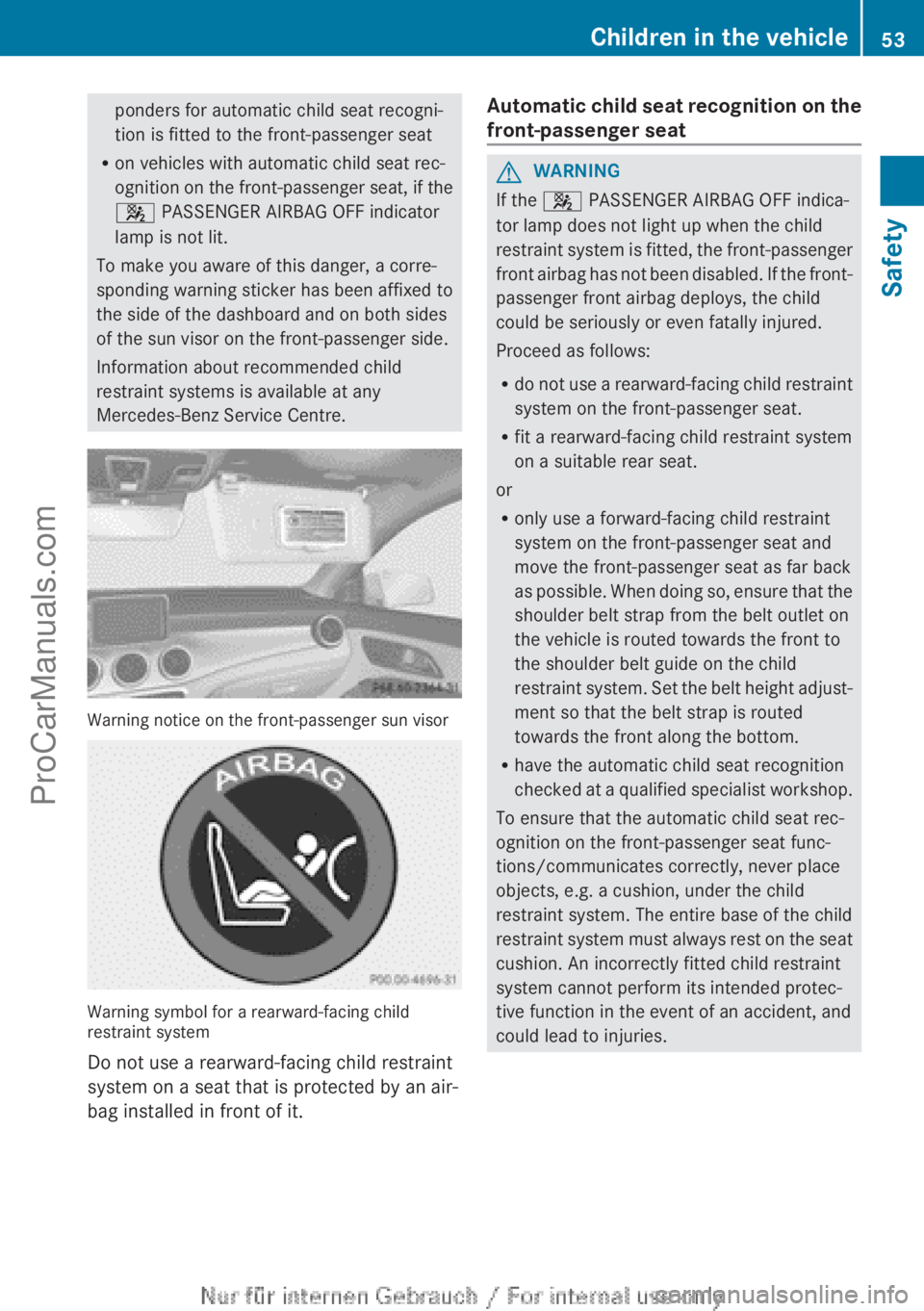
To make you aware of this danger, a corre-
sponding warning sticker has been affixed to
the side of the dashboard and on both sides
of the sun visor on the front-passenger side.
Information about recommended child
restraint systems is available at any
Mercedes-Benz Service Centre.
Warning notice on the front-passenger sun visor
Warning symbol for a rearward-facing child
restraint system
Do not use a rearward-facing child restraint
system on a seat that is protected by an air-
bag installed in front of it.
Automatic child seat recognition on the
front-passenger seatGWARNING
If the 4 PASSENGER AIRBAG OFF indica-
tor lamp does not light up when the child
restraint system is fitted, the front-passenger
front airbag has not been disabled. If the front-
passenger front airbag deploys, the child
could be seriously or even fatally injured.
Proceed as follows:
R do not use a rearward-facing child restraint
system on the front-passenger seat.
R fit a rearward-facing child restraint system
on a suitable rear seat.
or
R only use a forward-facing child restraint
system on the front-passenger seat and
move the front-passenger seat as far back
as possible. When doing so, ensure that the
shoulder belt strap from the belt outlet on
the vehicle is routed towards the front to
the shoulder belt guide on the child
restraint system. Set the belt height adjust-
ment so that the belt strap is routed
towards the front along the bottom.
R have the automatic child seat recognition
checked at a qualified specialist workshop.
To ensure that the automatic child seat rec-
ognition on the front-passenger seat func-
tions/communicates correctly, never place
objects, e.g. a cushion, under the child
restraint system. The entire base of the child
restraint system must always rest on the seat
cushion. An incorrectly fitted child restraint
system cannot perform its intended protec-
tive function in the event of an accident, and
could lead to injuries.
Children in the vehicle53SafetyZProCarManuals.com