tow MERCEDES-BENZ CLA-CLASS 2013 Owner's Manual
[x] Cancel search | Manufacturer: MERCEDES-BENZ, Model Year: 2013, Model line: CLA-CLASS, Model: MERCEDES-BENZ CLA-CLASS 2013Pages: 352, PDF Size: 5.64 MB
Page 59 of 352
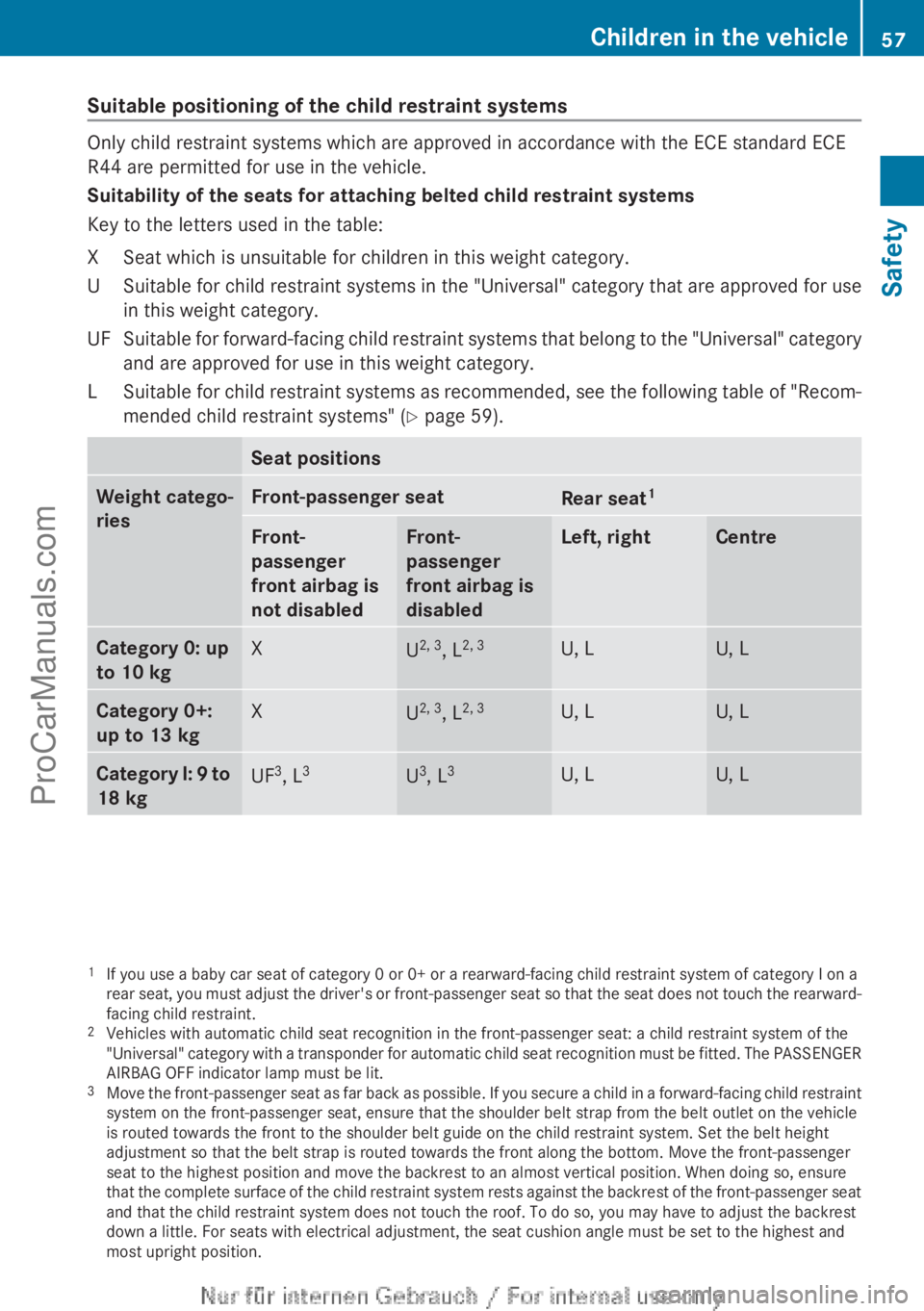
Suitable positioning of the child restraint systems
Only child restraint systems which are approved in accordance with the ECE standard ECE
R44 are permitted for use in the vehicle.
Suitability of the seats for attaching belted child restraint systems
Key to the letters used in the table:
XSeat which is unsuitable for children in this weight category.USuitable for child restraint systems in the "Universal" category that are approved for use
in this weight category.UFSuitable for forward-facing child restraint systems that belong to the "Universal" category
and are approved for use in this weight category.LSuitable for child restraint systems as recommended, see the following table of "Recom-
mended child restraint systems" ( Y page 59).Seat positionsWeight catego-
riesFront-passenger seatRear seat 1Front-
passenger
front airbag is
not disabledFront-
passenger
front airbag is
disabledLeft, rightCentreCategory 0: up
to 10 kgXU 2, 3
, L2, 3U, LU, LCategory 0+:
up to 13 kgXU 2, 3
, L2, 3U, LU, LCategory I:
9 to
18 kgUF 3
, L 3U3
, L 3U, LU, L1
If you use a baby car seat of category 0 or 0+ or a rearward-facing child restraint system of category I on a
rear seat, you must adjust the driver's or front-passenger seat so that the seat does not touch the rearward-
facing child restraint.
2 Vehicles with automatic child seat recognition in the front-passenger seat: a child restraint system of the
"Universal" category with a transponder for automatic child seat recognition must be fitted. The PASSENGER
AIRBAG OFF indicator lamp must be lit.
3 Move the front-passenger seat as far back as possible. If you secure a child in a forward-facing child restraint
system on the front-passenger seat, ensure that the shoulder belt strap from the belt outlet on the vehicle
is routed towards the front to the shoulder belt guide on the child restraint system. Set the belt height
adjustment so that the belt strap is routed towards the front along the bottom. Move the front-passenger
seat to the highest position and move the backrest to an almost vertical position. When doing so, ensure
that the complete surface of the child restraint system rests against the backrest of the front-passenger seat
and that the child restraint system does not touch the roof. To do so, you may have to adjust the backrest
down a little. For seats with electrical adjustment, the seat cushion angle must be set to the highest and
most upright position.Children in the vehicle57SafetyZProCarManuals.com
Page 60 of 352
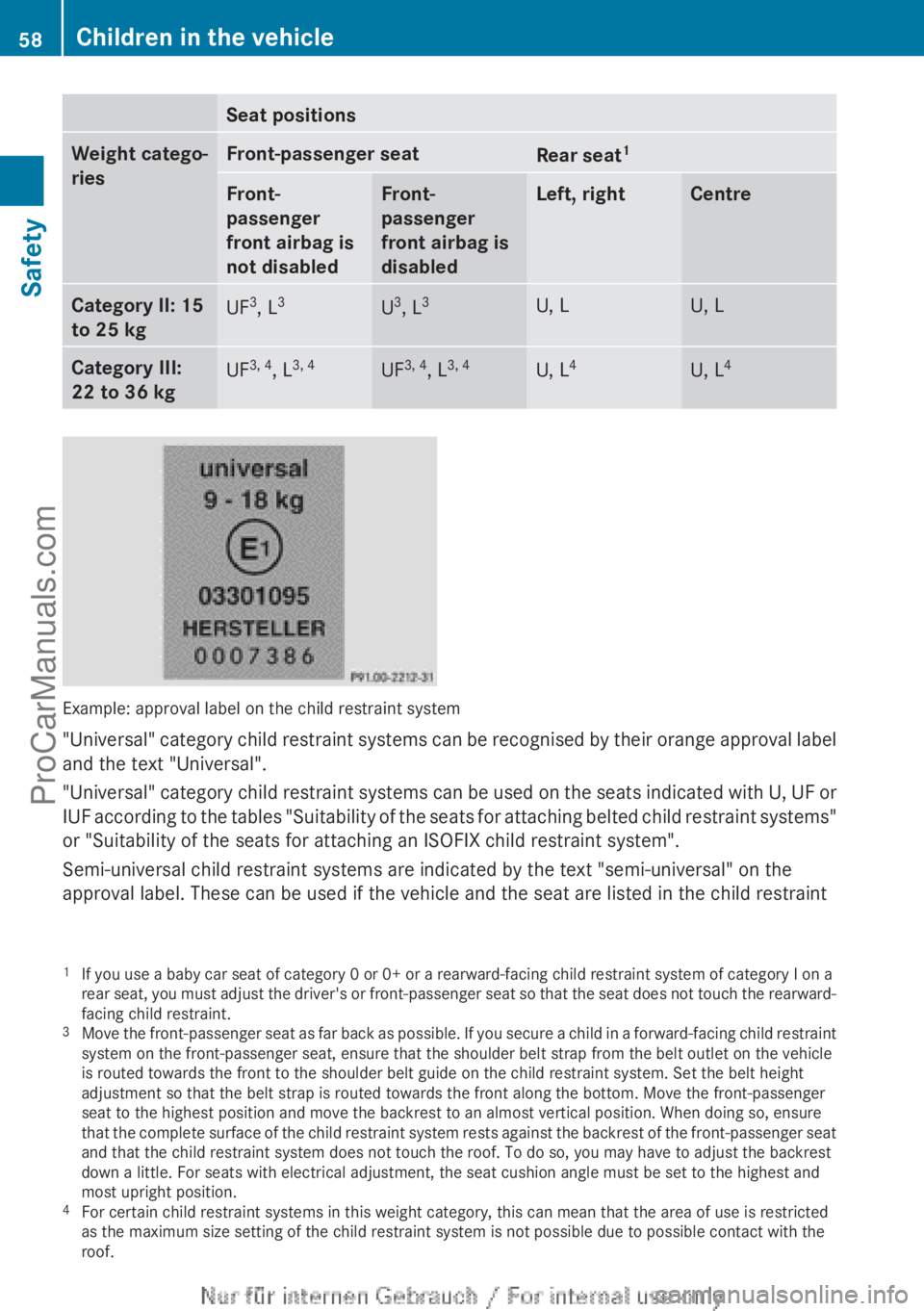
Seat positionsWeight catego-
riesFront-passenger seatRear seat 1Front-
passenger
front airbag is
not disabledFront-
passenger
front airbag is
disabledLeft, rightCentreCategory II: 15
to 25 kgUF 3
, L 3U3
, L 3U, LU, LCategory III:
22 to 36 kgUF 3, 4
, L3, 4UF 3, 4
, L3, 4U, L 4U, L4
Example: approval label on the child restraint system
" Universal" category child restraint systems can be recognised by their orange approval label
and the text "Universal".
" Universal" category child restraint systems can be used on the seats indicated with U, UF or
IUF according to the tables "Suitability of the seats for attaching belted child restraint systems"
or "Suitability of the seats for attaching an ISOFIX child restraint system".
Semi-universal child restraint systems are indicated by the text "semi-universal" on the
approval label. These can be used if the vehicle and the seat are listed in the child restraint
1 If you use a baby car seat of category 0 or 0+ or a rearward-facing child restraint system of category I on a
rear seat, you must adjust the driver's or front-passenger seat so that the seat does not touch the rearward-
facing child restraint.
3 Move the front-passenger seat as far back as possible. If you secure a child in a forward-facing child restraint
system on the front-passenger seat, ensure that the shoulder belt strap from the belt outlet on the vehicle
is routed towards the front to the shoulder belt guide on the child restraint system. Set the belt height
adjustment so that the belt strap is routed towards the front along the bottom. Move the front-passenger
seat to the highest position and move the backrest to an almost vertical position. When doing so, ensure
that the complete surface of the child restraint system rests against the backrest of the front-passenger seat
and that the child restraint system does not touch the roof. To do so, you may have to adjust the backrest
down a little. For seats with electrical adjustment, the seat cushion angle must be set to the highest and
most upright position.
4 For certain child restraint systems in this weight category, this can mean that the area of use is restricted
as the maximum size setting of the child restraint system is not possible due to possible contact with the
roof.58Children in the vehicleSafety
ProCarManuals.com
Page 61 of 352
system manufacturer's vehicle model list. For more information, contact the child restraint
system manufacturer or visit their website.
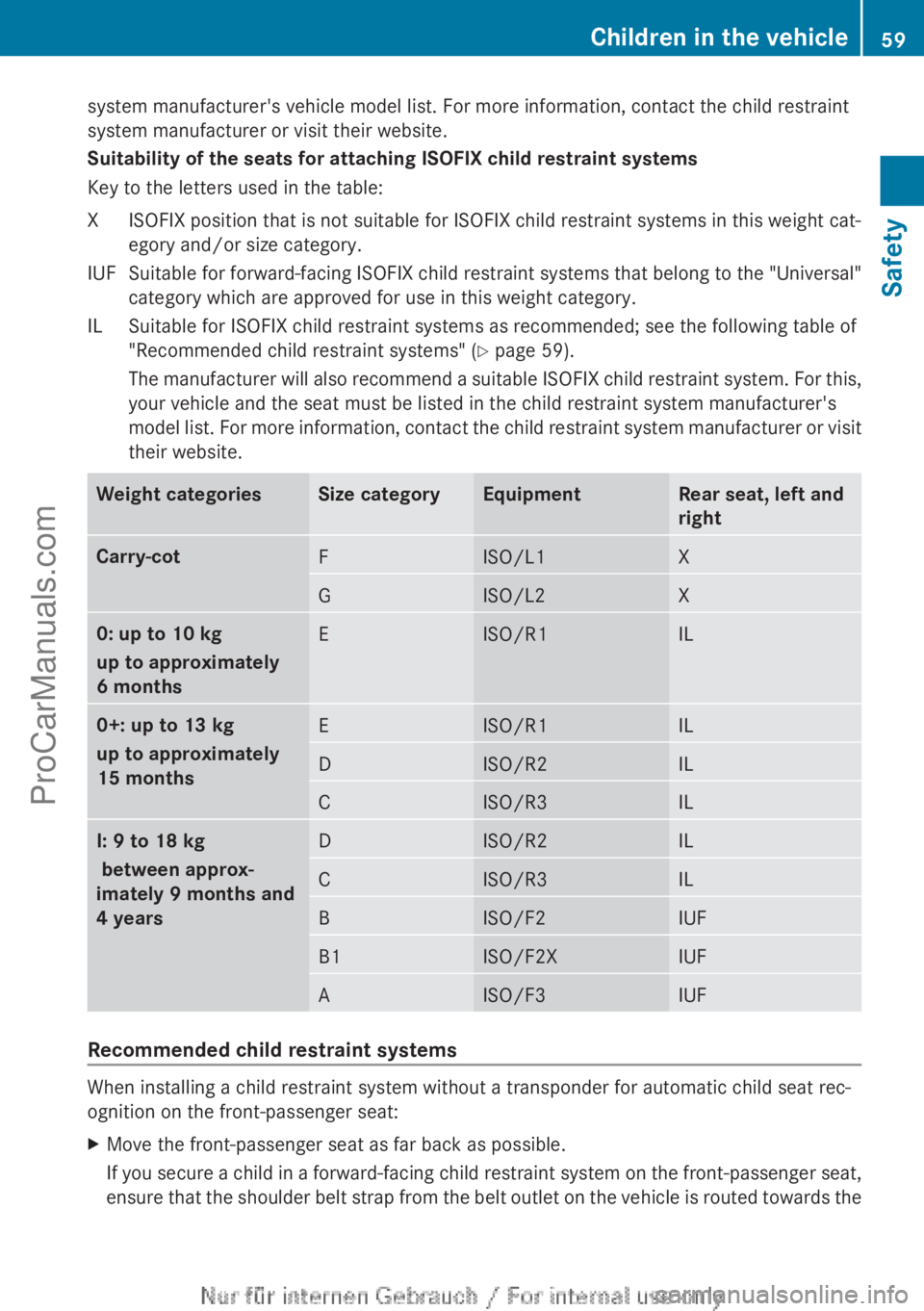
Suitability of the seats for attaching ISOFIX child restraint systems
Key to the letters used in the table:XISOFIX position that is not suitable for ISOFIX child restraint systems in this weight cat-
egory and/or size category.IUFSuitable for forward-facing ISOFIX child restraint systems that belong to the "Universal"
category which are approved for use in this weight category.ILSuitable for ISOFIX child restraint systems as recommended; see the following table of
"Recommended child restraint systems" ( Y page 59).
The manufacturer will also recommend a suitable ISOFIX child restraint system. For this,
your vehicle and the seat must be listed in the child restraint system manufacturer's
model list. For more information, contact the child restraint system manufacturer or visit
their website.Weight categoriesSize categoryEquipmentRear seat, left and
rightCarry-cotFISO/L1XGISO/L2X0: up to 10 kg
up to approximately
6 monthsEISO/R1IL0+: up to 13 kg
up to approximately
15 monthsEISO/R1ILDISO/R2ILCISO/R3ILI: 9 to 18 kg
between approx-
imately 9 months and
4 yearsDISO/R2ILCISO/R3ILBISO/F2IUFB1ISO/F2XIUFAISO/F3IUF
Recommended child restraint systems
When installing a child restraint system without a transponder for automatic child seat rec-
ognition on the front-passenger seat:
XMove the front-passenger seat as far back as possible.
If you secure a child in a forward-facing child restraint system on the front-passenger seat,
ensure that the shoulder belt strap from the belt outlet on the vehicle is routed towards theChildren in the vehicle59SafetyZProCarManuals.com
Page 62 of 352
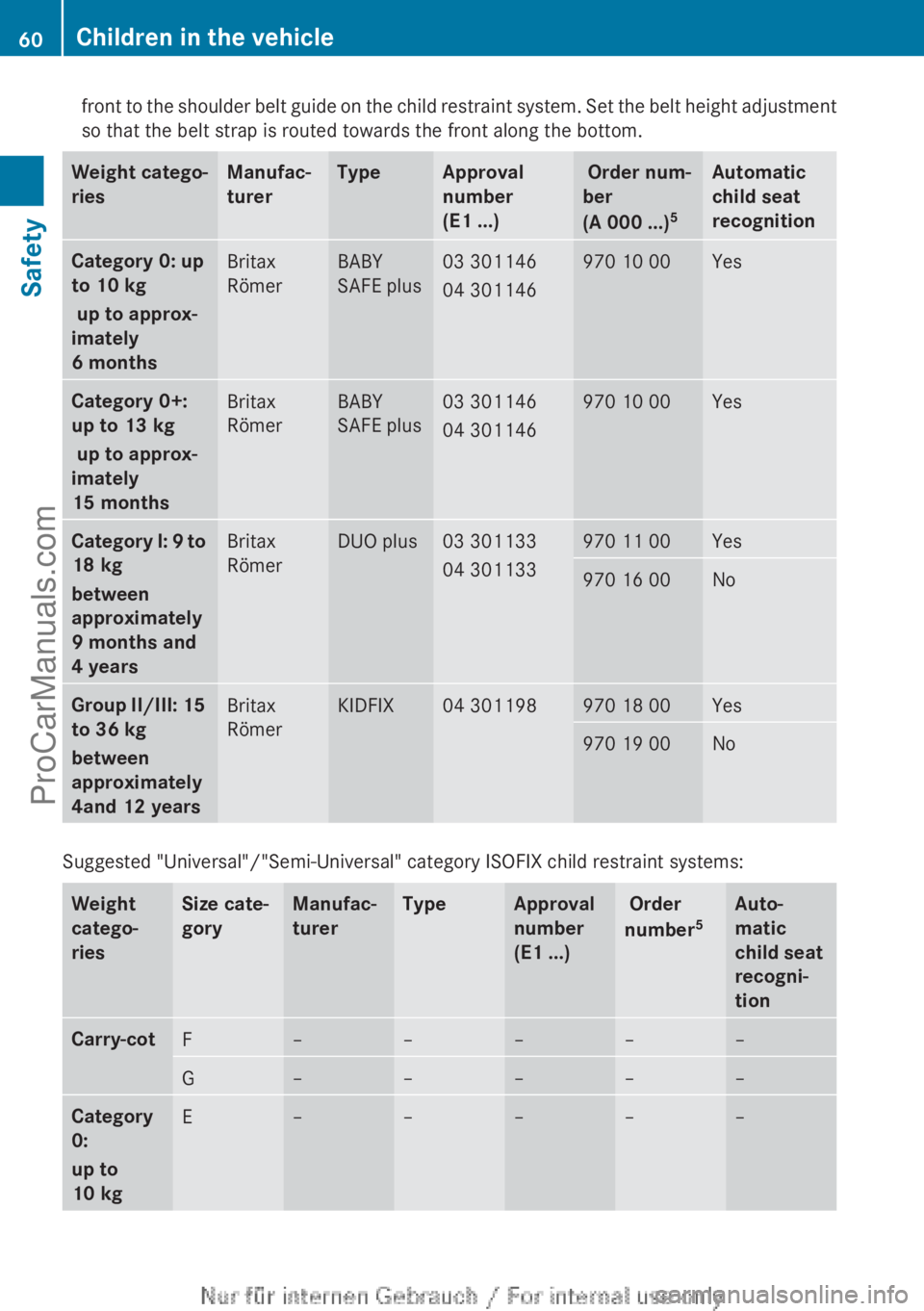
front to the shoulder belt guide on the child restraint system. Set the belt height adjustment
so that the belt strap is routed towards the front along the bottom.Weight catego-
riesManufac-
turerTypeApproval
number
(E1 ...) Order num-
ber
(A 000 ...) 5Automatic
child seat
recognitionCategory 0: up
to 10 kg
up to approx-
imately
6 monthsBritax
RömerBABY
SAFE plus03 301146
04 301146970 10 00YesCategory 0+:
up to 13 kg
up to approx-
imately
15 monthsBritax
RömerBABY
SAFE plus03 301146
04 301146970 10 00YesCategory I: 9 to
18 kg
between
approximately
9 months and
4 yearsBritax
RömerDUO plus03 301133
04 301133970 11 00Yes970 16 00NoGroup II/III: 15
to 36 kg
between
approximately
4and 12 yearsBritax
RömerKIDFIX04 301198970 18 00Yes970 19 00No
Suggested "Universal"/"Semi-Universal" category ISOFIX child restraint systems:
Weight
catego-
riesSize cate-
goryManufac-
turerTypeApproval
number
(E1 ...) Order
number 5Auto-
matic
child seat
recogni-
tionCarry-cotF–––––G–––––Category
0:
up to
10 kgE–––––60Children in the vehicleSafety
ProCarManuals.com
Page 70 of 352
Rstrong radar reflections, for example, in
multi-storey car parks
R a narrow vehicle travelling in front, e.g. a
motorcycle
R a vehicle travelling in front on a different
line
Following damage to the front end of the vehi-
cle, have the configuration and operation of
the radar sensor checked at a qualified spe-
cialist workshop. This also applies to colli-
sions at slow speeds where there is no visible
damage to the front of the vehicle.
Adaptive brake lamps
Adaptive Brake Assist warns following traffic
in an emergency braking situation:
R by means of flashing brake lamps
R the hazard warning lamps are activated
If you brake sharply from a speed of more
than 50 km/h or if braking is assisted by BAS
or BAS PLUS, the brake lamps flash rapidly.
In this way, traffic travelling behind you is
warned in an even more noticeable manner.
If you brake sharply from a speed of more
than 70 km/h to a standstill, the hazard warn-
ing lamps are activated automatically. If the
brakes are applied again, the brake lamps
light up continuously. The hazard warning
lamps switch off automatically if you travel
faster than 10 km/h . You can also switch off
the hazard warning lamps using the hazard
warning button ( Y page 110).
ESP ®
(Electronic Stability Program)
General notes
i Observe the "Important safety notes" sec-
tion ( Y page 64).
ESP ®
monitors driving stability and traction,
i.e. power transmission between the tyres
and the road surface.
If ESP ®
detects that the vehicle is deviating
from the direction desired by the driver, one
or more wheels are braked to stabilise the
vehicle. The engine output is also modified to
keep the vehicle on the desired course within
physical limits. ESP ®
assists the driver when
pulling away on wet or slippery roads. ESP ®
can also stabilise the vehicle during braking.
ETS (Electronic Traction System)
i Observe the "Important safety notes" sec-
tion ( Y page 64).
ETS traction control is part of ESP ®
.
ETS brakes the drive wheels individually if
they spin. This enables you to pull away and
accelerate on slippery surfaces, for example
if the road surface is slippery on one side. In
addition, more drive torque is transferred to
the wheel or wheels with traction.
ETS remains active when you deactivate
ESP ®
.
Important safety notes
GWARNING
If ESP ®
is malfunctioning, ESP ®
is unable to
stabilise the vehicle. In addition, other driving
safety systems are switched off. This increa-
ses the risk of skidding and an accident.
Drive on carefully. Have ESP ®
checked at a
qualified specialist workshop.
! When testing the electric parking brake
on a braking dynamometer, switch off the
ignition. Application of the brakes by
ESP ®
may otherwise destroy the brake sys-
tem.
When towing your vehicle with the front axle
raised, observe the notes on
ESP ®
(Y page 310).
ESP ®
is deactivated if the å ESP®
OFF
warning lamp in the instrument cluster lights
up continuously when the engine is running.
If the ÷ ESP®
warning lamp and the
å ESP®
OFF warning lamp are lit contin-
uously, ESP ®
is not available due to a mal-
function.
68Driving safety systemsSafety
ProCarManuals.com
Page 73 of 352

Anti-theft systems
Immobiliser
The immobiliser prevents your vehicle from
being started without the correct key.
XTo activate: remove the key from the igni-
tion lock.XTo deactivate: switch on the ignition.
When leaving the vehicle, always take the key
with you and lock the vehicle. The engine can
be started by anyone with a valid key that is
left inside the vehicle.
i The immobiliser is always deactivated
when you start the engine.
ATA (Anti-Theft Alarm system)
XTo prime: lock the vehicle with the key.
Indicator lamp : flashes. The alarm sys-
tem is primed after approximately
15 seconds.XTo deactivate: unlock the vehicle with the
key.
or
XInsert the key into the ignition lock.
A visual and audible alarm is triggered if the
alarm system is primed and you open:
R the vehicle with the emergency key ele-
ment
R a door
R the boot lid
R the bonnet
XTo stop the alarm: insert the key into the
ignition lock.
The alarm is switched off.
or
XPress the % or & button on the key.
The alarm is switched off.
The alarm is not switched off, even if you
close the open door that has triggered it, for
example.
Tow-away protection
Function
An audible and visual alarm is triggered if your
vehicle's angle of inclination is altered while
tow-away protection is primed. This can occur
if the vehicle is jacked up on one side, for
example.
Activating
XMake sure that:
R the doors are closed.
R the boot lid is closed.
Only then is the tow-away protection
primed.XLock the vehicle with the key.
Tow-away protection is primed after
approximately 60 seconds.
Deactivating
XUnlock the vehicle with the key.
or
XInsert the key into the ignition lock.
Tow-away protection is switched off auto-
matically.Anti-theft systems71SafetyZProCarManuals.com
Page 74 of 352
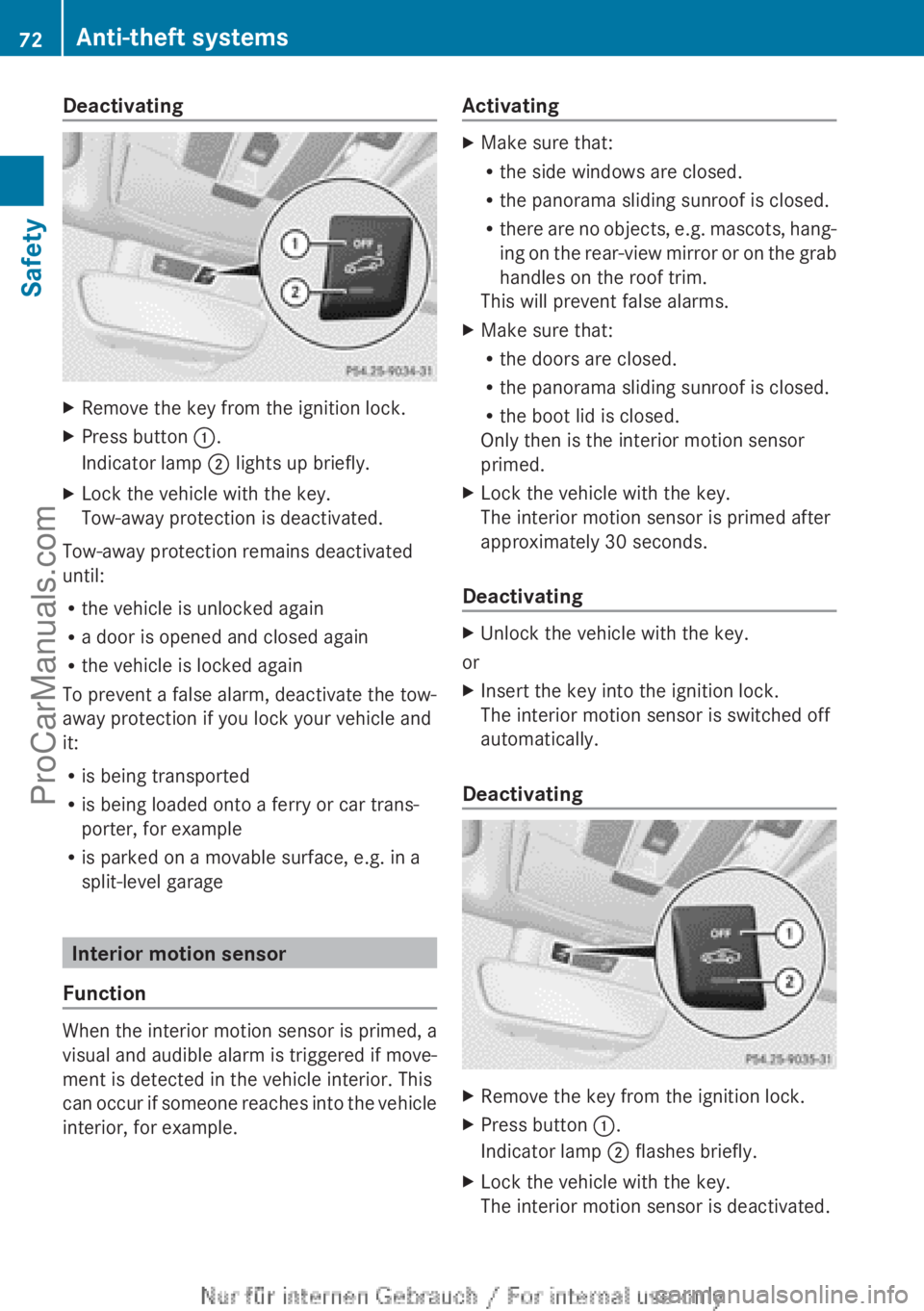
DeactivatingXRemove the key from the ignition lock.XPress button :.
Indicator lamp ; lights up briefly.XLock the vehicle with the key.
Tow-away protection is deactivated.
Tow-away protection remains deactivated
until:
R the vehicle is unlocked again
R a door is opened and closed again
R the vehicle is locked again
To prevent a false alarm, deactivate the tow-
away protection if you lock your vehicle and
it:
R is being transported
R is being loaded onto a ferry or car trans-
porter, for example
R is parked on a movable surface, e.g. in a
split-level garage
Interior motion sensor
Function
When the interior motion sensor is primed, a
visual and audible alarm is triggered if move-
ment is detected in the vehicle interior. This
can occur if someone reaches into the vehicle
interior, for example.
ActivatingXMake sure that:
R the side windows are closed.
R the panorama sliding sunroof is closed.
R there are no objects, e.g. mascots, hang-
ing on the rear-view mirror or on the grab
handles on the roof trim.
This will prevent false alarms.XMake sure that:
R the doors are closed.
R the panorama sliding sunroof is closed.
R the boot lid is closed.
Only then is the interior motion sensor
primed.XLock the vehicle with the key.
The interior motion sensor is primed after
approximately 30 seconds.
Deactivating
XUnlock the vehicle with the key.
or
XInsert the key into the ignition lock.
The interior motion sensor is switched off
automatically.
Deactivating
XRemove the key from the ignition lock.XPress button :.
Indicator lamp ; flashes briefly.XLock the vehicle with the key.
The interior motion sensor is deactivated.72Anti-theft systemsSafety
ProCarManuals.com
Page 83 of 352
ProblemPossible causes/consequences and M SolutionsThe engine cannot be
started using the key.The on-board voltage is too low.XSwitch off non-essential consumers, e.g. seat heating or interior
lighting, and try to start the engine again.
If this does not work:
XCheck the starter battery and charge it if necessary
( Y page 302).
or
XJump-start the vehicle ( Y page 306).
or
XConsult a qualified specialist workshop.The engine cannot be
started using the key.The steering lock is mechanically blocked.XRemove the key and reinsert it into the ignition lock. While doing
this, turn the steering wheel in both directions.Doors
Important safety notes
GWARNING
If children are left unsupervised in the vehicle,
they could:
R open the doors, thus endangering other
people or road users.
R get out and disrupt traffic.
R operate the vehicle's equipment.
Additionally, children could set the vehicle in
motion if, for example, they:
R release the parking brake.
R shift the automatic transmission out of
parking position P.
R shift the manual transmission into neutral.
R start the engine.
There is a risk of an accident and injury.
When leaving the vehicle, always take the key
with you and lock the vehicle. Never leave
children or animals unattended in the vehicle.
Always keep the key out of reach of children.
GWARNING
If persons (particularly children) are exposed
to heat or cold for a prolonged period, there
is a risk of serious or even fatal injuries. Never
leave persons (particularly children) unatten-
ded in the vehicle.
Stow luggage or loads preferably in the boot.
Observe the loading guidelines
( Y page 268).
United Kingdom only:
GWARNING
When the double locks are activated, the
doors can no longer be opened from the
inside. People in the vehicle can no longer get
out, e.g. in hazardous situations. There is a
risk of injury.
Therefore, do not leave any people unsuper-
vised in the vehicle, particularly children, eld-
erly people or people in need of special assis-
tance. Do not activate the double lock when
people are in the vehicle.
If the vehicle has been locked with the key,
then the double lock function is activated as
standard. It is then not possible to open the
doors from inside the vehicle. You can deac-
Doors81Opening and closingZProCarManuals.com
Page 85 of 352
For all countries except the United King-
dom:
You can open a door from inside the vehicle
even if it has been locked.
If the vehicle has previously been locked with
the key, opening a door from the inside will
trigger the anti-theft alarm system. Switch off
the alarm ( Y page 71).
You can only open the rear doors from inside
the vehicle if they are not secured by the
child-proof locks ( Y page 63).
If the vehicle has been locked using the lock-
ing button for the central locking, or has been
locked automatically, and a door is opened
from the inside:
R the vehicle will be fully unlocked if it had
previously been fully unlocked
R only the door which has been opened form
the inside is unlocked if only the driver's
door had been previously unlocked
Only for the United Kingdom: if the vehicle
has been locked with the key, the double lock
function is activated as standard. It is then
not possible to open the doors from inside the
vehicle. You can deactivate the double lock
function by deactivating the interior motion
sensor ( Y page 72). The doors can then be
opened from the inside after the vehicle has
been locked from the outside. You can open
the rear doors from inside the vehicle if they
are not secured by the child-proof locks
( Y page 63). The anti-theft alarm system is
triggered if the door is opened from the
inside. Switch off the alarm ( Y page 71).
If the vehicle has been locked using the lock-
ing button for the central locking, or has been
locked automatically, and a door is opened
from the inside:
R the vehicle will be fully unlocked if it had
previously been fully unlocked
R only the door which has been opened form
the inside is unlocked if only the driver's
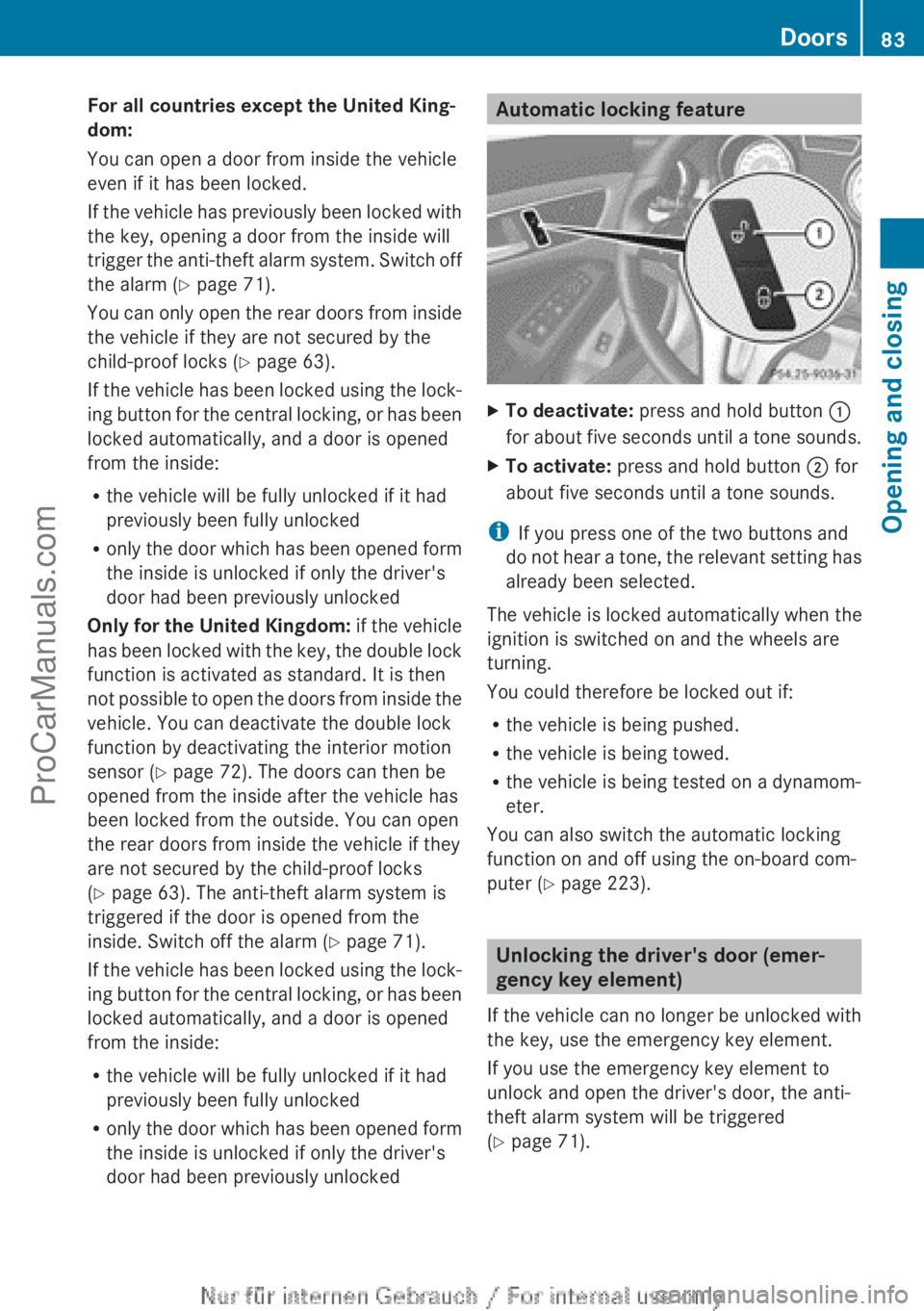
door had been previously unlockedAutomatic locking featureXTo deactivate: press and hold button :
for about five seconds until a tone sounds.XTo activate: press and hold button ; for
about five seconds until a tone sounds.
i If you press one of the two buttons and
do not hear a tone, the relevant setting has
already been selected.
The vehicle is locked automatically when the
ignition is switched on and the wheels are
turning.
You could therefore be locked out if:
R the vehicle is being pushed.
R the vehicle is being towed.
R the vehicle is being tested on a dynamom-
eter.
You can also switch the automatic locking
function on and off using the on-board com-
puter ( Y page 223).
Unlocking the driver's door (emer-
gency key element)
If the vehicle can no longer be unlocked with
the key, use the emergency key element.
If you use the emergency key element to
unlock and open the driver's door, the anti-
theft alarm system will be triggered
( Y page 71).
Doors83Opening and closingZProCarManuals.com
Page 87 of 352
leave persons (particularly children) unatten-
ded in the vehicle.
! The boot lid swings upwards when
opened. Therefore, make sure that there is
sufficient clearance above the boot lid.
i The opening dimensions of the boot lid
can be found in the "Vehicle data" section
( Y page 343).
Stow luggage or loads preferably in the boot.
Observe the loading guidelines
( Y page 268).
Do not leave the key in the boot. You could
otherwise lock yourself out.
The boot lid can be:
R opened and closed manually from outside
R unlocked from the inside with the emer-
gency key element
Opening and closing manually from
outside
Opening
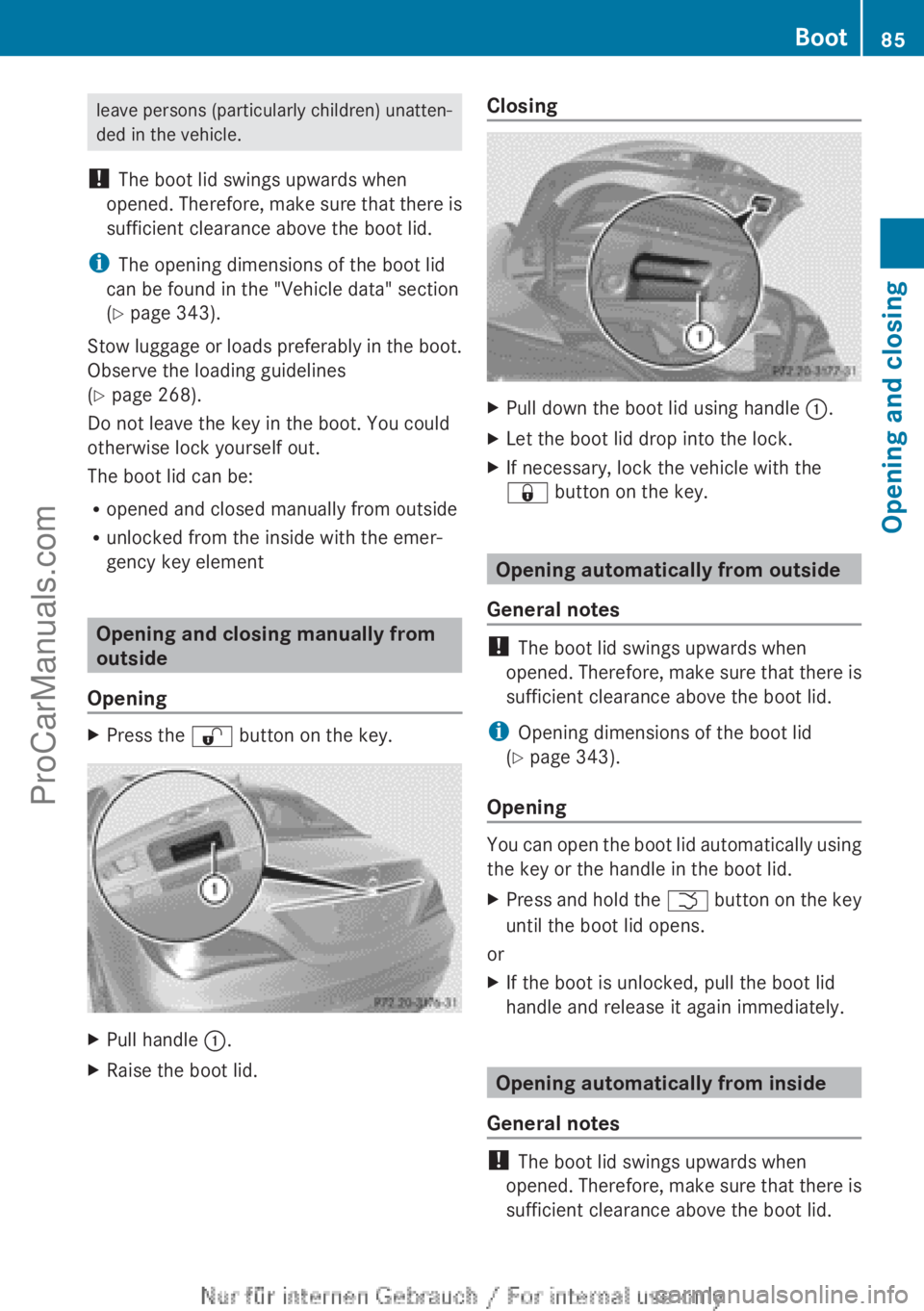
XPress the % button on the key.XPull handle :.XRaise the boot lid.ClosingXPull down the boot lid using handle :.XLet the boot lid drop into the lock.XIf necessary, lock the vehicle with the
& button on the key.
Opening automatically from outside
General notes
! The boot lid swings upwards when
opened. Therefore, make sure that there is
sufficient clearance above the boot lid.
i Opening dimensions of the boot lid
( Y page 343).
Opening
You can open the boot lid automatically using
the key or the handle in the boot lid.
XPress and hold the F button on the key
until the boot lid opens.
or
XIf the boot is unlocked, pull the boot lid
handle and release it again immediately.
Opening automatically from inside
General notes
! The boot lid swings upwards when
opened. Therefore, make sure that there is
sufficient clearance above the boot lid.
Boot85Opening and closingZProCarManuals.com