light MERCEDES-BENZ CLA-Class 2014 C117 User Guide
[x] Cancel search | Manufacturer: MERCEDES-BENZ, Model Year: 2014, Model line: CLA-Class, Model: MERCEDES-BENZ CLA-Class 2014 C117Pages: 358, PDF Size: 6.6 MB
Page 16 of 358
Operator's Manual
Vehicle equipment ........................... 22
Outside temperature display ........... 197
Overhead control panel ......................36
Override feature Rear side windows ........................... 63 P
Paint code number ............................346
Paintwork (cleaning instructions) ... 289
Panic alarm .......................................... 40
Panorama roof with power tilt/
sliding panel
Important safety notes .................... 90
Opening/closing the roller sun-
blind ................................................. 93
Problem (malfunction) ..................... 94
Rain closing feature ......................... 92
Resetting ......................................... 93
Parcel net .......................................... .259
Parking ............................................... 157
Important safety notes .................. 157
Parking brake ................................ 158
Position of exterior mirror, front-
passenger side ............................... 104
Rear view camera .......................... 186
see Active Parking Assist
see PARKTRONIC
Parking aid
Active Parking Assist ..................... 181
see Exterior mirrors
see PARKTRONIC
Parking assistance
see PARKTRONIC
Parking brake
Display message ............................ 217
Electric parking brake .................... 158
Warning lamp ................................. 250
Parking lamps
Switching on/off ........................... 110
PARKTRONIC
Deactivating/activating ................. 180
Driving system ............................... 178
Function/notes ............................ .178
Important safety notes .................. 178
Problem (malfunction) ................... 181 Range of the sensors ..................... 179
Warning displa y............................. 180
PASSENGER AIR BAG OFF
Problems (malfunction) .................. 225
PASSENGER AIR BAG OFF indicator
lamp ...................................................... 47
Plastic trim (cleaning instruc-
tions) .................................................. 292
Power washers .................................. 289
Power windows see Side windows
Program selector button .................. 150
Protection of the environment General notes .................................. 21
Pulling away
Automatic transmission ................. 142 Q
Qualified specialist workshop ........... 26 R
RACE START (AMG vehicles) ............. 177
RACETIMER (on-board computer) .... 211
Radar sensor system Activating/deactivating ................. 209
Display message ............................ 233
Radio
Selecting a station ......................... 202
see separate operating instructions
Radio-wave reception/transmis-
sion in the vehicle
Declaration of conformity ................ 25
Rain closing feature (panorama
roof with power tilt/sliding panel) .... 92
Reading lamp ..................................... 113
Rear compartment Setting the air vents ...................... 137
Rear fog lamp
Changing bulb s.............................. 117
Display message ............................ 228
Switching on/of f........................... 109
Rear lamps
see Lights
Rear seats
Folding the backrest forwards/
back ............................................... 260 14
Index
Page 19 of 358
Steering (display message)
.............. 242
Steering wheel Adjusting (manually) ......................1 02
Button overview ............................... 33
Buttons (on-board computer) ......... 197
Cleaning ......................................... 293
Important safety notes .................. 102
Paddle shifters ............................... 151
Steering wheel paddle shifters ........151
Stopwatch (RACETIMER) ................... 211
Stowage areas ................................... 256
Stowage compartments Armrest (front) ............................... 258
Armrest (under) ............................ .258
Center console .............................. 257
Center console (rear) ..................... 259
Cup holders ................................... 262
Eyeglasses compartment .............. .257
Glove box ....................................... 257
Important safety information ......... 256
Parcel net ...................................... 259
Under driver's seat/front-
passenger sea t.............................. 258
Stowage well beneath the trunk
floor .................................................... 261
Summer tires ..................................... 316
Sun visor ............................................ 263
Supplemental restraint system see SRS (Supplemental Restraint
System)
Surround lighting (on-board com-
puter) .................................................. 208
Switching air-recirculation mode
on/off ................................................. 135 T
Tachometer ........................................ 197
Tail lamps Display message ............................ 227
see Lights
Tank
see Fuel tank
Tank content
Fuel gauge ....................................... 31 Technical data
Information .................................... 346
Tires/wheels ................................. 340
Vehicle data ................................... 353
TELEAID
Call priority .................................... 270
Downloading destinations
(COMAND) ..................................... 270
Downloading routes ....................... 273
Emergency call .............................. 267
General notes ................................ 266
Geo fencing ................................... 274
Locating a stolen vehicle ............... 272
MB info call button ........................ 269
Remote vehicle locking .................. 272
Roadside Assistance button .......... 268
Search & Send ............................... 271
Self-test ......................................... 267
Speed alert .................................... 274
System .......................................... 267
Triggering the vehicle alarm ........... 274
Vehicle remote malfunction diag-
nosis .............................................. 273
Vehicle remote unlocking .............. 272
Telephone
Accepting a cal l............................. 203
Display message ............................ 242
Menu (on-board computer) ............ 203
Number from the phone book ........ 204
Redialing ........................................ 204
Rejecting/ending a call ................. 203
Temperature
Coolant .......................................... 196
Coolant (on-board computer) ......... 210
Engine oil (on-board computer) ...... 210
Outside temperature ...................... 197
Setting (climate control )................ 131
Theft deterrent systems
ATA (Anti-Theft Alarm system )......... 72
Immobilizer ...................................... 72
Through-loading ................................ 259
Through-loading feature ................... 259
Time see separate operating instructions
Timing (RACETIMER) ......................... 211
TIREFIT kit .......................................... 298 Index
17
Page 32 of 358
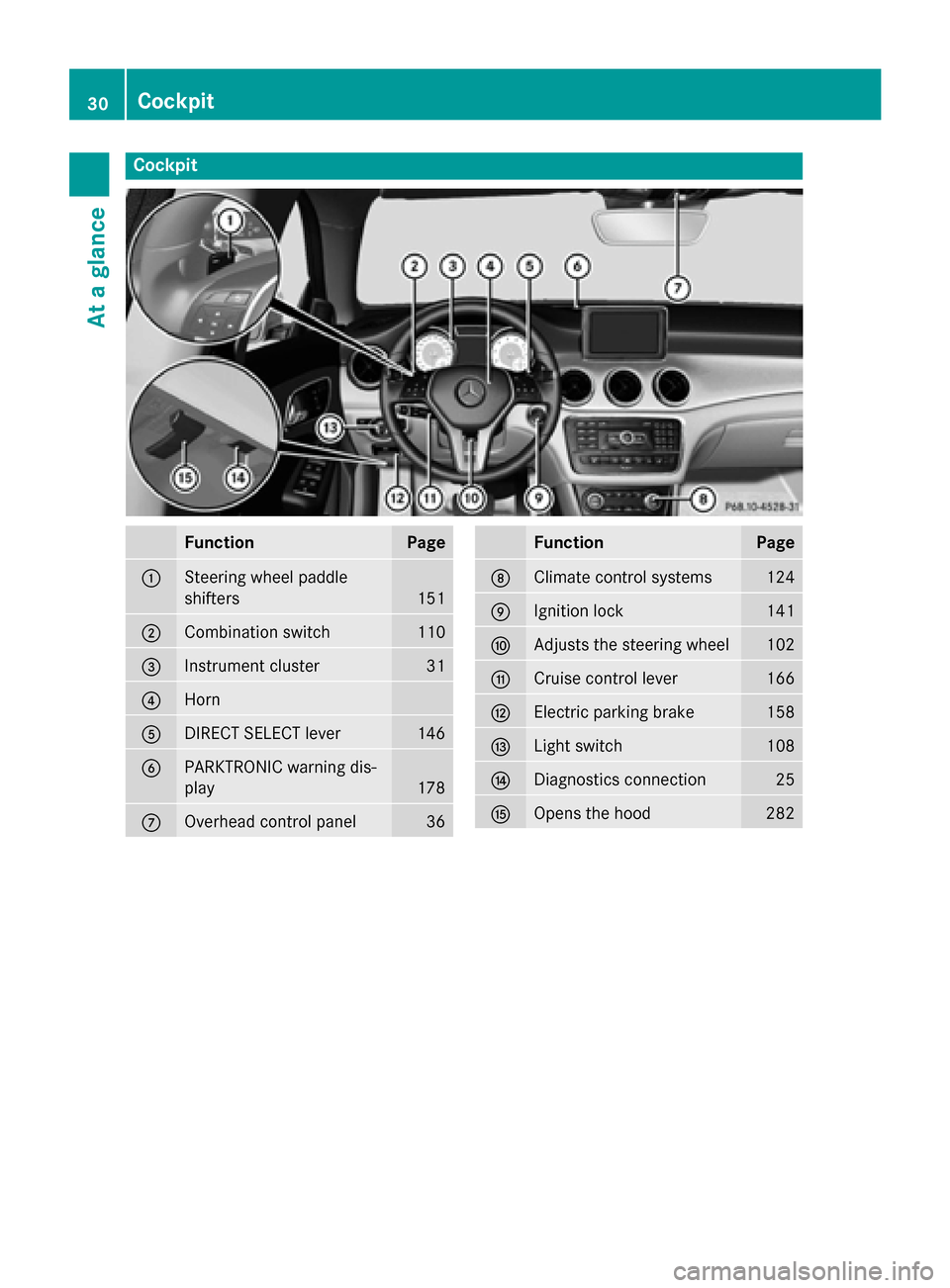
Cockpit
Function Page
0043
Steering wheel paddle
shifters
151
0044
Combination switch 110
0087
Instrument cluster 31
0085
Horn
0083
DIRECT SELECT lever 146
0084
PARKTRONIC warning dis-
play
178
006B
Overhead control panel 36 Function Page
006C
Climate control systems 124
006D
Ignition lock 141
006E
Adjusts the steering wheel 102
006F
Cruise control lever 166
0070
Electric parking brake 158
0071
Light switch 108
0072
Diagnostics connection 25
0073
Opens the hood 28230
CockpitAt a glance
Page 33 of 358
Instrument cluster
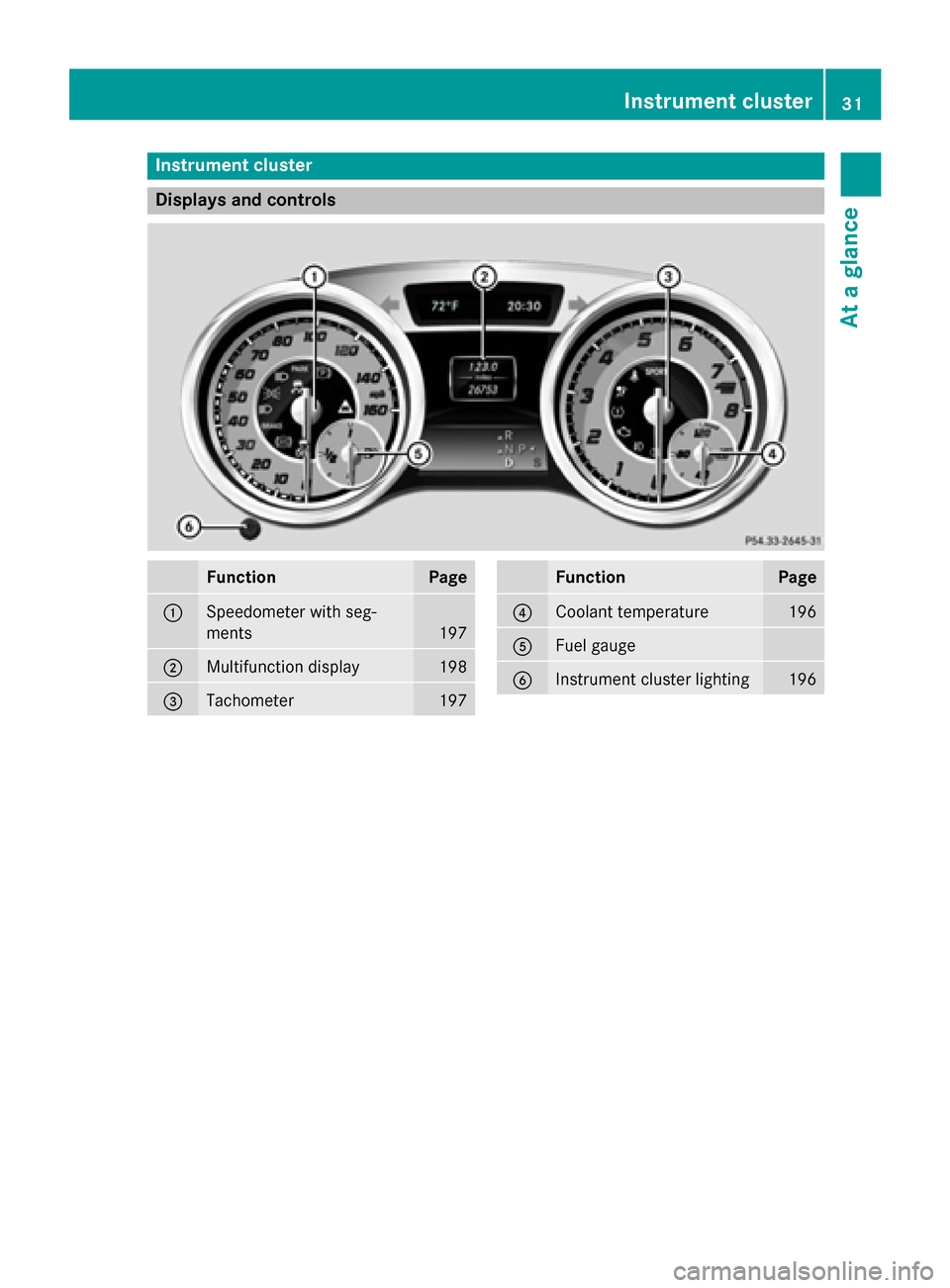
Displays and controls
Function Page
0043
Speedometer with seg-
ments
197
0044
Multifunction display 198
0087
Tachometer 197 Function Page
0085
Coolant temperature 196
0083
Fuel gauge
0084
Instrument cluster lighting 196Instrument cluster
31At a glance
Page 37 of 358
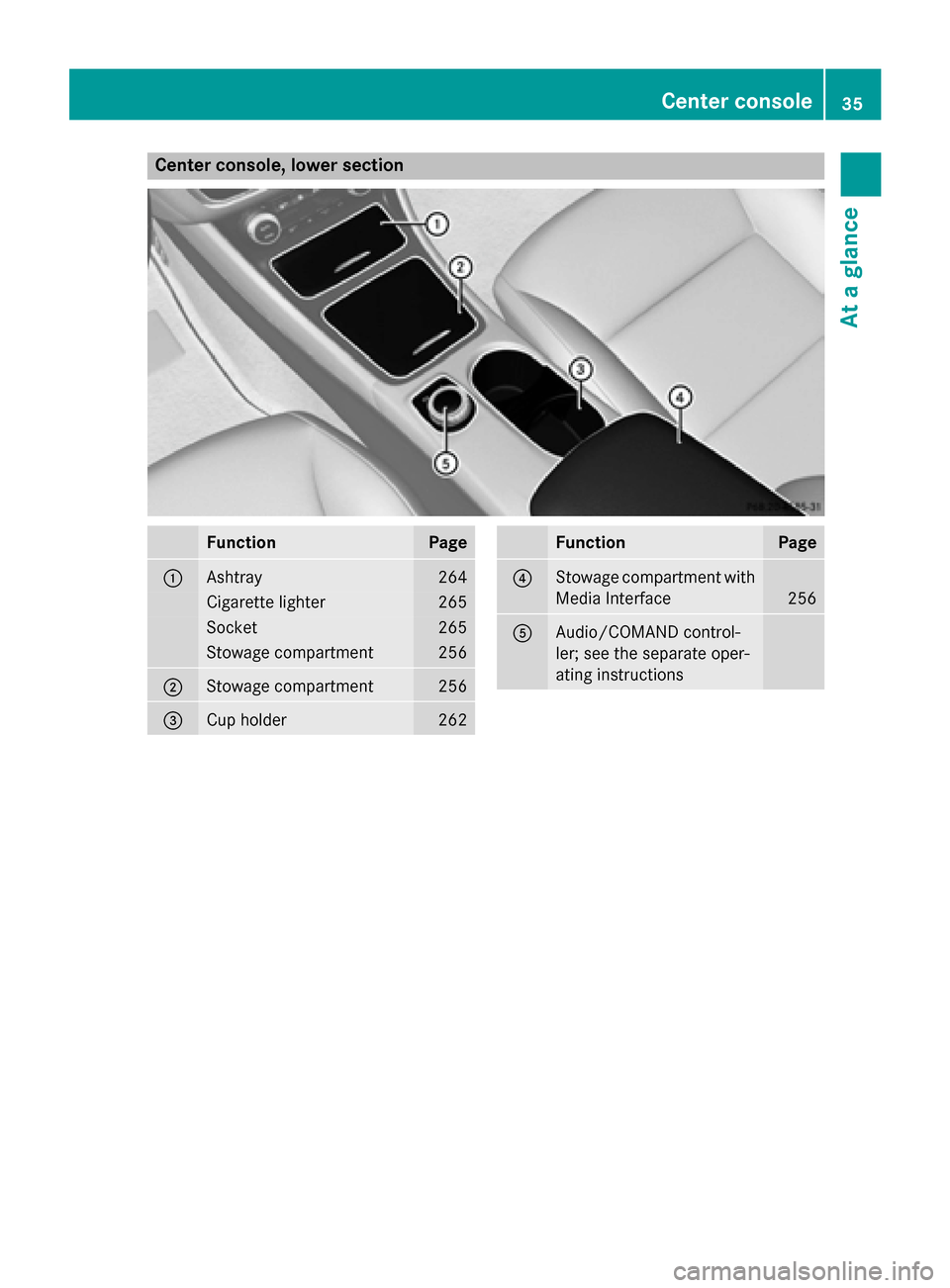
Center console, lower section
Function Page
0043
Ashtray 264
Cigarette lighter 265
Socket 265
Stowage compartment 256
0044
Stowage compartment 256
0087
Cup holder 262 Function Page
0085
Stowage compartment with
Media Interface 256
0083
Audio/COMAND control-
ler; see the separate oper-
ating instructions Center console
35At a glance
Page 38 of 358
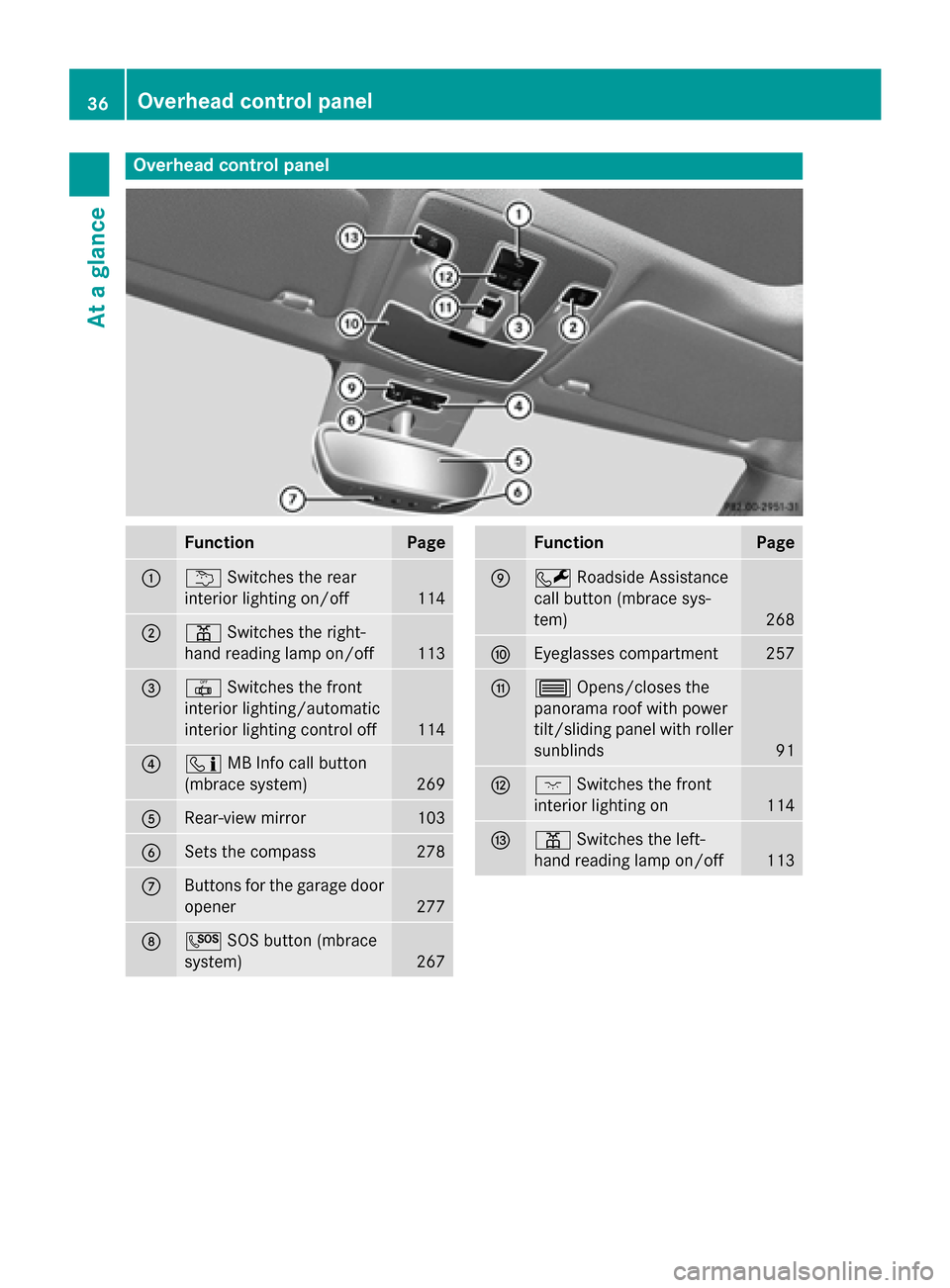
Overhead control panel
Function Page
0043
0042
Switches the rear
interior lighting on/off 114
0044
003D
Switches the right-
hand reading lamp on/off 113
0087
0033
Switches the front
interior lighting/automatic
interior lighting control off 114
0085
00D9
MB Info call button
(mbrace system) 269
0083
Rear-view mirror 103
0084
Sets the compass 278
006B
Buttons for the garage door
opener 277
006C
0053
SOS button (mbrace
system) 267 Function Page
006D
0052
Roadside Assistance
call button (mbrace sys-
tem) 268
006E
Eyeglasses compartment 257
006F
0057
Opens/closes the
panorama roof with power
tilt/sliding panel with roller sunblinds 91
0070
004A
Switches the front
interior lighting on 114
0071
003D
Switches the left-
hand reading lamp on/off 11336
Overhead control panelAt a glance
Page 42 of 358
Useful information
i This Operator's manual describes all
models and all standard and optional equip- ment of your vehicle available at the time of
publication of the Operator's manual.
Country-specific differences are possible.
Please note that your vehicle may not be
equipped with all features described. This
also applies to safety-related systems and
functions.
i Read the information on qualified special-
ist workshops (Y page 26). Panic alarm
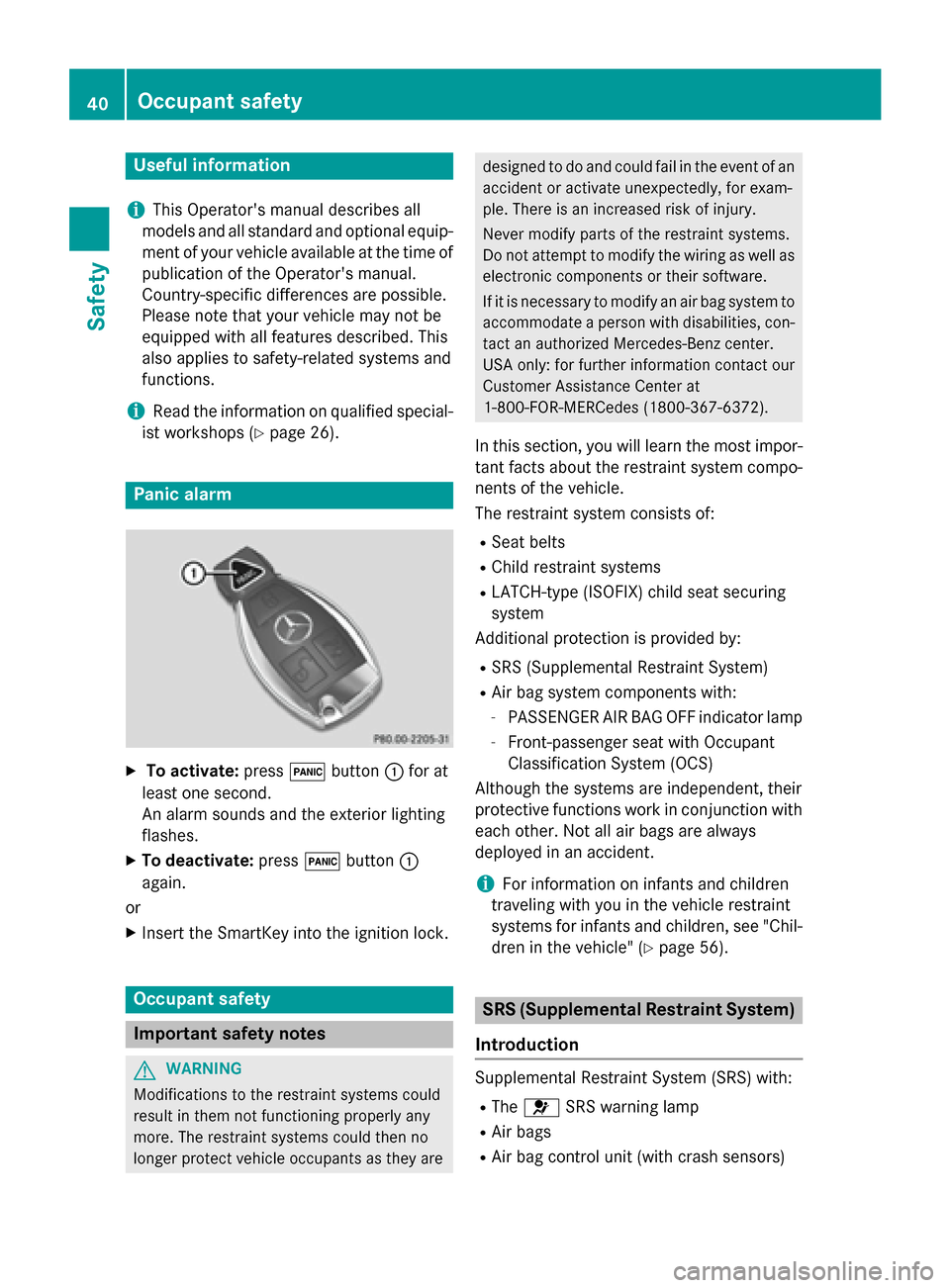
X
To activate: press0033button 0043for at
least one second.
An alarm sounds and the exterior lighting
flashes.
X To deactivate: press0033button 0043
again.
or
X Insert the SmartKey into the ignition lock. Occupant safety
Important safety notes
G
WARNING
Modifications to the restraint systems could
result in them not functioning properly any
more. The restraint systems could then no
longer protect vehicle occupants as they are designed to do and could fail in the event of an
accident or activate unexpectedly, for exam-
ple. There is an increased risk of injury.
Never modify parts of the restraint systems.
Do not attempt to modify the wiring as well as
electronic components or their software.
If it is necessary to modify an air bag system to accommodate a person with disabilities, con-tact an authorized Mercedes-Benz center.
USA only: for further information contact our
Customer Assistance Center at
1-800-FOR-MERCedes (1800-367-6372).
In this section, you will learn the most impor- tant facts about the restraint system compo-
nents of the vehicle.
The restraint system consists of:
R Seat belts
R Child restraint systems
R LATCH-type (ISOFIX) child seat securing
system
Additional protection is provided by:
R SRS (Supplemental Restraint System)
R Air bag system components with:
- PASSENGER AIR BAG OFF indicator lamp
- Front-passenger seat with Occupant
Classification System (OCS)
Although the systems are independent, their
protective functions work in conjunction with each other. Not all air bags are always
deployed in an accident.
i For information on infants and children
traveling with you in the vehicle restraint
systems for infants and children, see "Chil-
dren in the vehicle" (Y page 56). SRS (Supplemental Restraint System)
Introduction Supplemental Restraint System (SRS) with:
R The 0075 SRS warning lamp
R Air bags
R Air bag control unit (with crash sensors) 40
Occupant safetySafety
Page 43 of 358
R
Emergency Tensioning Devices for the
front seat belts and the outer seat belts in
the rear
R Seat belt force limiter for the front seat
belts and the outer seat belts in the rear
SRS reduces the risk of vehicle occupants
coming into contact with parts of the vehi-
cle's interior in the event of an accident. It can
also reduce the forces to which vehicle occu-
pants are subjected during an accident.
SRS warning lamp G
WARNING
If SRS is malfunctioning, restraint system
components may be triggered unintentionally
or might not be triggered at all in the event of
an accident with a high rate of vehicle decel-
eration. There is an increased risk of injury,
possibly even fatal.
Have SRS checked and repaired immediately
at a qualified specialist workshop.
SRS functions are checked regularly when
you switch on the ignition and when the
engine is running. Therefore, malfunctions
can be detected in good time.
The 0075 SRS warning lamp in the instrument
cluster lights up when the ignition is switched on. It goes out no later than a few seconds
after the engine is started.
The SRS components are in operational read-
iness when the 0075SRS indicator lamp goes
out while the engine is running.
There is a malfunction if:
R the 0075 SRS warning lamp does not light
up when the ignition is switched on
R the engine is running and the 0075SRS
warning lamp does not go out after a few
seconds
R the engine is running and the 0075SRS
warning lamp lights up again Triggering of Emergency Tensioning
Devices and air bags During the first stage of a collision, the air bag
control unit evaluates important physical
data relating to vehicle deceleration or accel-
eration, such as:
R duration
R direction
R magnitude
Based on the evaluation of this data, the air
bag control unit pre-emptively triggers the
Emergency Tensioning Device in the first
stage.
If there is an even higher rate of vehicle decel- eration or acceleration in a longitudinal direc-tion, the front air bags are also deployed.
Your vehicle has adaptive, two-stage front air bags. The air bag control unit evaluates vehi-cle deceleration or acceleration in the event
of a collision. In the first deployment stage,
the front air bag is filled with enough propel-
lant gas to reduce the risk of injuries. The
front air bag is fully deployed if a second
deployment threshold is reached within a few
milliseconds.
The Emergency Tensioning Device and air bag triggering thresholds are variable and are
adapted to the detected rate of deceleration
or acceleration of the vehicle. This process is
pre-emptive in nature. The triggering process must take place in good time at the start of
the collision.
The rate of vehicle deceleration or accelera-
tion and the direction of the force are essen-
tially determined by:
R the distribution of forces during the colli-
sion
R the collision angle
R the deformation characteristics of the vehi-
cle
R the characteristics of the object with which
the vehicle has collided
Factors that can only be seen and measured
after a collision has occurred do not play a Occupant safety
41Safety Z
Page 46 of 358
R
do not lean your head or chest close to the
steering wheel or dashboard.
R only hold the steering wheel on the outside.
Placing hands and arms inside the rim can
increase the risk and potential severity of
hand/arm injury if the driver front air bag
inflates.
R adjust the front-passenger seat as far back
as possible from the dashboard when the
seat is occupied.
R occupants, especially children, should
never place their bodies or lean their heads
in the area of the door where the side
impact air bag inflates. This could result in
serious or fatal injuries should the side
impact air bag be deployed. Always sit as
upright as possible, wear the seat belt prop-
erly and use an appropriately sized infant
restraint, toddler restraint or booster seat
recommended for the size and weight of the
child.
Failure to follow these instructions can result in severe injuries to you or other occupants.
If you sell your vehicle, it is important that you
make the buyer aware of this safety informa-
tion. Be sure to give the buyer this Operator's
Manual.
If the air bags are deployed, you will hear a
bang, and a small amount of powder may also
be released. Only in rare cases will the bang
affect your hearing. The powder that is
released generally does not constitute a
health hazard and does not indicate that there is a fire in the vehicle. The dust might cause
some temporary breathing difficulty for peo-
ple with asthma or other breathing trouble. To avoid this, you may wish to get out of the
vehicle as soon as it is safe to do so. You can
also open the window to allow fresh air to
enter the vehicle interior. The 0075SRS warn-
ing lamp lights up.
The air bag installation locations are identi-
fied by the AIR BAG symbol.
The air bags are deployed if the air bag control
unit detects the need for deployment. Only in the event of such a situation will the air bags
provide their supplemental protection.
If the driver and front passenger do not wear their seat belts, it is not possible for the air
bags to provide their supplemental protec-
tion.
In the event of other types of impacts and
impacts below air bag deployment thresh-
olds, the air bags will not deploy. The driver
and passenger will then be protected to the
extent possible by a properly fastened seat
belt. A properly fastened seat belt is also nee- ded to provide the best possible protection in
a rollover.
Air bags provide additional protection; they
are not, however, a substitute for seat belts.
All vehicle occupants must fasten their seat
belts regardless of whether your vehicle is
equipped with air bags or not.
It is important for your safety and that of your
passenger to have deployed air bags replaced and to have any malfunctioning air bags
repaired. This will help to make sure the air
bags continue to perform their protective
function for the vehicle occupants in the
event of a crash.
i After an air bag has been deployed, have
the vehicle towed to the nearest qualified
specialist workshop, even if your vehicle is
ready to drive.
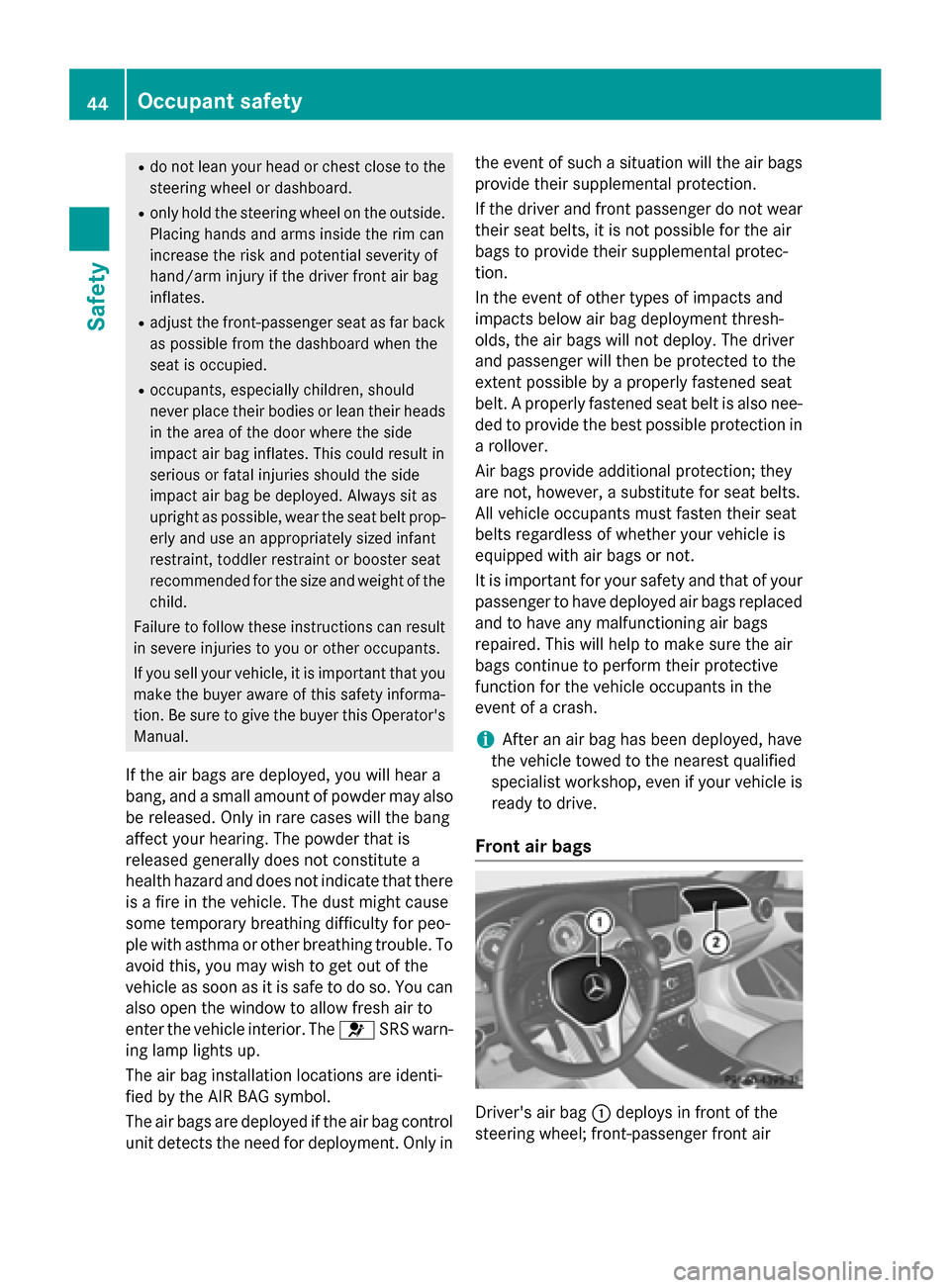
Front air bags Driver's air bag
0043deploys in front of the
steering wheel; front-passenger front air 44
Occupant safetySafety
Page 47 of 358
bag
0044deploys in front of and above the glove
box.
The front air bags increase protection for the driver's and front passenger's head and
chest.
They are deployed:
R at the start of an accident with a high rate of
vehicle acceleration or deceleration in a
longitudinal direction
R if the system determines that air bag
deployment can offer additional protection
to that provided by the seat belt
R independently of other air bags in the vehi-
cle
The release time of the front air bags is
dependent upon the use of the seat belt.
If the vehicle rolls over, the front air bags are
generally not deployed.
Your vehicle has adaptive, two-stage front air bags. The air bag control unit evaluates vehi-cle deceleration or acceleration in the event
of a collision. In the first deployment stage,
the front air bag is filled with part of the total
available propellant gas, thereby reducing the
risk of injury. If the air bag control unit rec-
ognizes within a few milliseconds that the
vehicle is being braked or accelerated faster
than originally predicted, the front air bag is
filled with the maximum amount of propellant gas available.
The deployment of the front-passenger front
air bag is also influenced by the weight cate-
gory of the front passenger, which is deter-
mined by the Occupant Classification System
(OCS) (Y page 47).
The lighter the passenger-side occupant, the
higher the vehicle deceleration rate required
(predicted at the start of the impact) for sec- ond stage inflation of the front-passenger
front air bag. In the second stage, the front air
bags are inflated with the maximum amount
of propellant gas available. The front-passenger front air bag will only
deploy if:
R the system, based on the OCS weight sen-
sor readings, detects that the front-
passenger seat is occupied
R the PASSENGER air bag OFF indicator lamp
on the center console is not lit
(Y page 47)
R the air bag control unit predicts a high
impact severity
The front air bags are not deployed in situa-
tions where a low impact severity is predic-
ted. You will then be protected by the fas-
tened seat belt.
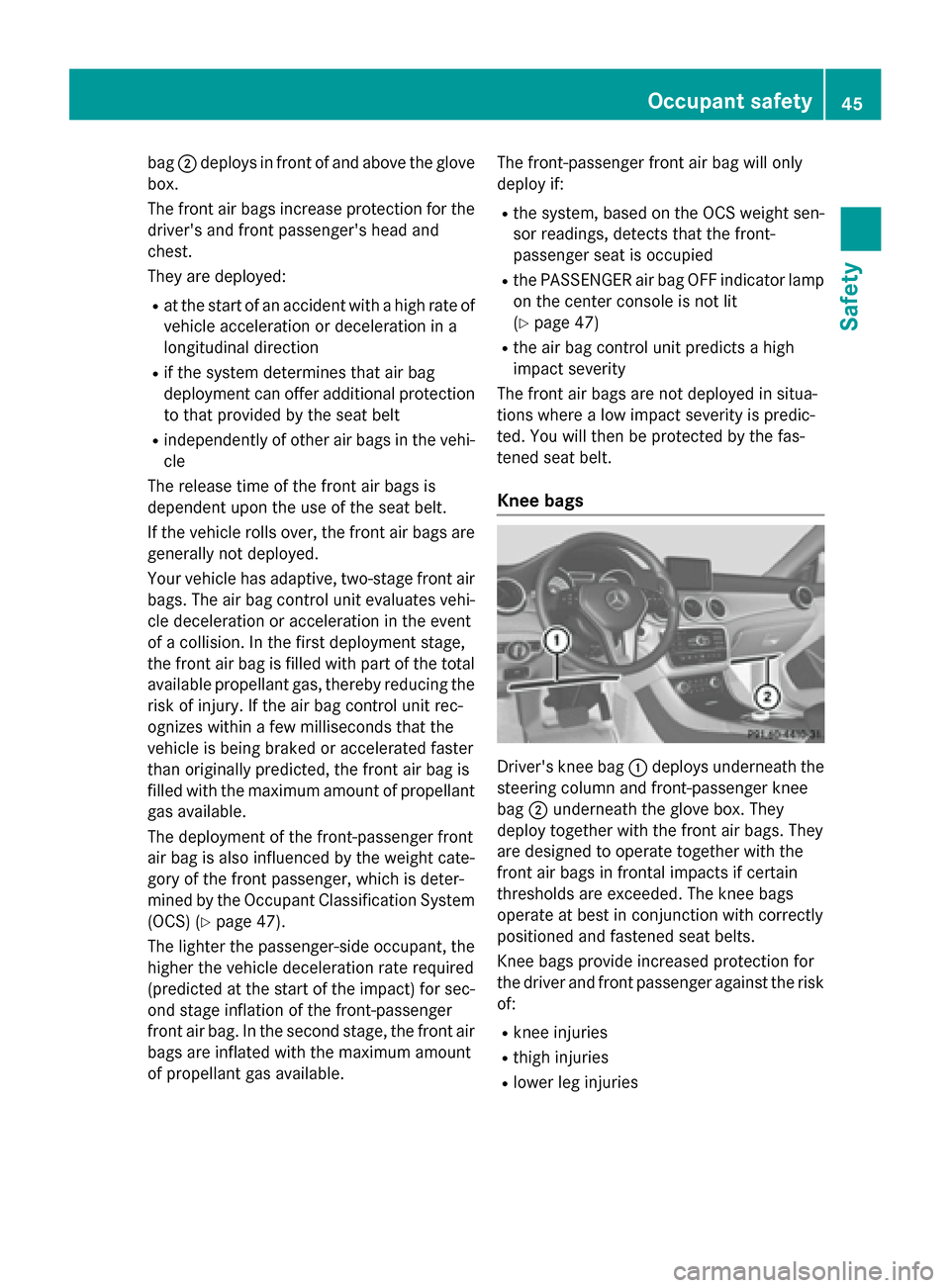
Knee bags Driver's knee bag
0043deploys underneath the
steering column and front-passenger knee
bag 0044underneath the glove box. They
deploy together with the front air bags. They
are designed to operate together with the
front air bags in frontal impacts if certain
thresholds are exceeded. The knee bags
operate at best in conjunction with correctly
positioned and fastened seat belts.
Knee bags provide increased protection for
the driver and front passenger against the risk
of:
R knee injuries
R thigh injuries
R lower leg injuries Occupant safety
45Safety Z