oil capacity MERCEDES-BENZ CLA-Class 2015 C117 Owner's Manual
[x] Cancel search | Manufacturer: MERCEDES-BENZ, Model Year: 2015, Model line: CLA-Class, Model: MERCEDES-BENZ CLA-Class 2015 C117Pages: 362, PDF Size: 6.93 MB
Page 11 of 362
On-board computer ....................... 204
ECO start/stop function
Automatic engine start .................. 146
Automatic engine switch-off ..........1 45
Deactivating/activating ................. 146
General information ....................... 145
Important safety notes .................. 145
Introduction ................................... 145
Emergency
Automatic measures after an acci-
dent ................................................. 56
Emergency release
Driver's door ................................... .83
Trunk ............................................... 85
Vehicle ............................................. 83
Emergency Tensioning Devices
Activation ......................................... 54
Emissions control
Service and warranty information ....21
Engine
Check Engine warning lamp .......... .256
Display message ............................ 233
ECO start/stop function ................ 145
Engine number ............................... 353
Irregular running ............................ 147
Jump-starting ................................. 309
Starting problems .......................... 147
Starting the engine with the
SmartKey ....................................... 144
Starting with the Start/Stop but-
ton ................................................. 144
Switching off .................................. 161
Tow-starting (vehicle) ..................... 314
Engine electronics
Problem (malfunction) ................... 147
Engine oil
Adding .......................................... .288
Additives ........................................ 356
Checking the oil level ..................... 287
Checking the oil level using the
dipstick .......................................... 288
Display message ............................ 234
Filling capacity ............................... 356
Notes about oil grades ................... 356
Notes on oil level/consumption .... 287
Temperature (on-board computer, AMG vehicles) ................................ 214
Viscosity ........................................ 356 ESP
®
(Electronic Stability Pro-
gram)
Activating/deactivating (except
AMG vehicles) .................................. 68
Activating/deactivating (on-
board computer, except AMG
vehicles) ........................................ 210
AMG menu (on-board computer) ... 214
Characteristics ................................. 67
Deactivating/activating (button
in AMG vehicles) .............................. 68
Display message ............................ 218
ETS/4ETS ........................................ 67
Function/notes ................................ 67
General notes .................................. 67
Important safety information ........... 67
Trailer stabilization ........................... 70
Warning lamp ................................. 252
ETS/4ETS (Electronic Traction Sys-
tem) ...................................................... 67
Exhaust
see Exhaust pipe
Exhaust check ................................... 164
Exhaust pipe
Cleaning ......................................... 296
Exterior lighting
Cleaning ......................................... 295
see Lights
Exterior mirrors
Adjusting ....................................... 103
Dipping (automatic) ....................... 104
Folding in when locking (on-boardcomputer) ...................................... 213
Folding in/out (automatically) ....... 104
Folding in/out (electrically) ........... 103
Out of position (troubleshooting) ... 104
Setting ........................................... 104
Storing settings (memory func-
tion) ............................................... 106
Storing the parking position .......... 105
Eyeglasses compartment ................. 263 F
Filler cap see Fuel filler flap
Flat tire
MOExtended tire s.......................... 301 Index
9
Page 19 of 362
Transmission oil (on-board com-
puter, AMG vehicles) ..................... 214
Through-loading feature ...................265
Timing (RACETIMER) ......................... 214
Tire pressure
Calling up (on-board computer) ..... 326
Checking manually ........................ 325
Display message ............................ 239
Important safety notes .................. 326
Maximum ....................................... 324
Not reached (TIREFIT) .................... 304
Notes ............................................. 323
Reached (TIREFIT) .......................... 304
Recommended ............................... 322
Tire pressure loss warning system
General notes ................................ 325
Important safety notes .................. 325
Restarting ...................................... 326
Tire pressure monitor
Checking the tire pressure elec-
tronically ........................................ 328
Function/notes ............................ .326
General notes ................................ 326
Important safety notes .................. 326
Radio type approval for the tire
pressure monitor ........................... 329
Restarting ...................................... 328
Warning lamp ................................. 259
Warning message .......................... 328
TIREFIT kit .......................................... 302
Tires
Aspect ratio (definition) ................. 340
Average weight of the vehicle
occupants (definition) .................... 339
Bar (definition) ............................... 338
Changing a wheel .......................... 341
Characteristics .............................. 338
Checking ........................................ 319
Curb weight (definition) ................. 340
Definition of terms ......................... 338
Direction of rotatio n...................... 341
Display message ............................ 239
Distribution of the vehicle occu-
pants (definition) ............................ 341
DOT (Department of Transporta-
tion) (definition) ............................. 339
DOT, Tire Identification Number
(TIN) ............................................... 338 GAWR (Gross Axle Weight Rating)
(definition) ..................................... 339
General notes ................................ 345
GVW (Gross Vehicle Weight) (def-
inition) ........................................... 339
GVWR (Gross Vehicle Weight Rat- ing) (definition) .............................. 339
Important safety notes .................. 318
Increased vehicle weight due to
optional equipment (definition) ...... 339
Information on driving .................... 318
Kilopascal (kPa) (definition) ........... 339
Labeling (overview) ........................ 335
Load bearing index (definition) ...... 340
Load index ..................................... 337
Load index (definition) ................... 339
M+S tires ....................................... 320
Maximum load on a tire (defini-
tion) ............................................... 340
Maximum loaded vehicle weight
(definition) ..................................... 339
Maximum permissible tire pres-
sure (definition) ............................. 340
Maximum tire load ......................... 337
Maximum tire load (definition) ....... 340
MOExtended tire s.......................... 320
Optional equipment weight (defi-
nition) ............................................ 340
PSI (pounds per square inch) (def-
inition) ........................................... 340
Replacing ....................................... 341
Service life ..................................... 320
Sidewall (definition) ....................... 340
Speed rating (definition) ................ 339
Storing ........................................... 341
Structure and characteristics
(definition) ..................................... 338
Summer tires ................................. 320
Temperature .................................. 334
TIN (Tire Identification Number)
(definition) ..................................... 340
Tire bead (definition) ...................... 340
Tire pressure (definition) ................ 340
Tire pressures (recommended )...... 339
Tire size (data )............................... 345
Tire size designation, load-bearing
capacity, speed rating .................... 335
Tire tread ....................................... 319 Index
17
Page 342 of 362
Curb weight
The weight of a vehicle with standard equip-
ment including the maximum capacity of fuel, oil and coolant. It also includes the air-condi-
tioning system and optional equipment if
these are installed in the vehicle, but does not include passengers or luggage.
Maximum load rating
The maximum load rating is the maximum
permissible weight in kilograms or lbs for
which a tire is approved.
Maximum permissible tire pressure
Maximum permissible tire pressure for one
tire.
Maximum load on one tire
Maximum load on one tire. This is calculated
by dividing the maximum axle load of one axle by two.
PSI (pounds per square inch)
A standard unit of measure for tire pressure.
Aspect ratio
Relationship between tire height and tire
width in percent.
Tire pressure
This is pressure inside the tire applying an
outward force to each square inch of the tire's
surface. The tire pressure is specified in
pounds per square inch (psi), in kilopascal
(kPa) or in bar. The tire pressure should only
be corrected when the tires are cold.
Cold tire pressure
The tires are cold:
R if the vehicle has been parked without
direct sunlight on the tires for at least three
hours and
R if the vehicle has not been driven further
than 1 mile (1.6 km) Tread
The part of the tire that comes into contact
with the road.
Bead
The tire bead ensures that the tire sits
securely on the wheel. There are several steel
wires in the bead to prevent the tire from
coming loose from the wheel rim.
Sidewall
The part of the tire between the tread and the bead.
Weight of optional extras
The combined weight of those optional extras
that weigh more than the replaced standard
parts and more than 2.3 kg (5 lbs). These
optional extras, such as high-performance
brakes, level control, a roof rack or a high-
performance battery, are not included in the
curb weight and the weight of the accesso-
ries.
TIN (Tire Identification Number)
This is a unique identifier which can be used
by a tire manufacturer to identify tires, for
example for a product recall, and thus identify the purchasers. The TIN is made up of the
manufacturer's identity code, tire size, tire
type code and the manufacturing date.
Load bearing index
The load bearing index (also load index) is a
code that contains the maximum load bearing
capacity of a tire.
Traction
Traction is the result of friction between the
tires and the road surface.
Treadwear indicators
Narrow bars (tread wear bars) that are dis-
tributed over the tire tread. If the tire tread is level with the bars, the wear limit of áin
(1.6 mm) has been reached. 340
All about wheels and tiresWheels and tires
Page 358 of 362
R
efficient use of the fuel by the engine
R driving style
R other non-technical factors, such as envi-
ronmental influences, road conditions or
traffic flow
You can minimize your vehicle's CO 2emis-
sions by driving carefully and having it serv-
iced regularly.
The vehicle will use more fuel than usual in the following situations:
R at very low outside temperatures
R in city traffic
R on short journeys
R in mountainous terrain Engine oil
General notes !
Never use engine oil or an oil filter of a
specification other than is necessary to ful- fill the prescribed service intervals. Do not
change the engine oil or oil filter in order to
achieve longer replacement intervals than
those prescribed. You could otherwise
cause engine damage or damage to the
exhaust gas aftertreatment.
Follow the instructions in the service inter-
val display regarding the oil change. Other-
wise, you may damage the engine and the
exhaust gas aftertreatment.
When handling engine oil, observe the impor- tant safety notes on service products
(Y page 353).
The engine oils are matched to the perform-
ance of Mercedes-Benz engines and service
intervals. You should therefore only use
engine oils and oil filters that are approved for
vehicles with maintenance systems.
For a list of approved engine oils and oil filters, consult an authorized Mercedes-Benz Cen-
ter. Or visit the website
http://bevo.mercedes-benz.com. The table shows which engine oils have been
approved for your vehicle. Model MB Approval
All models
229.5
Use only SAE 0W-40o
r SAE 5W-40 engine oils
for AMG vehicles.
i MB approval is indicated on the oil con-
tainers.
Filling capacities The following values refer to an oil change
including the oil filter. Model Capacity
AMG vehicles
5.8 US qt (5.5
l) All other models
5.9 US qt (5.6
l) Additives
!
Do not use any additives in the engine oil.
This could damage the engine.
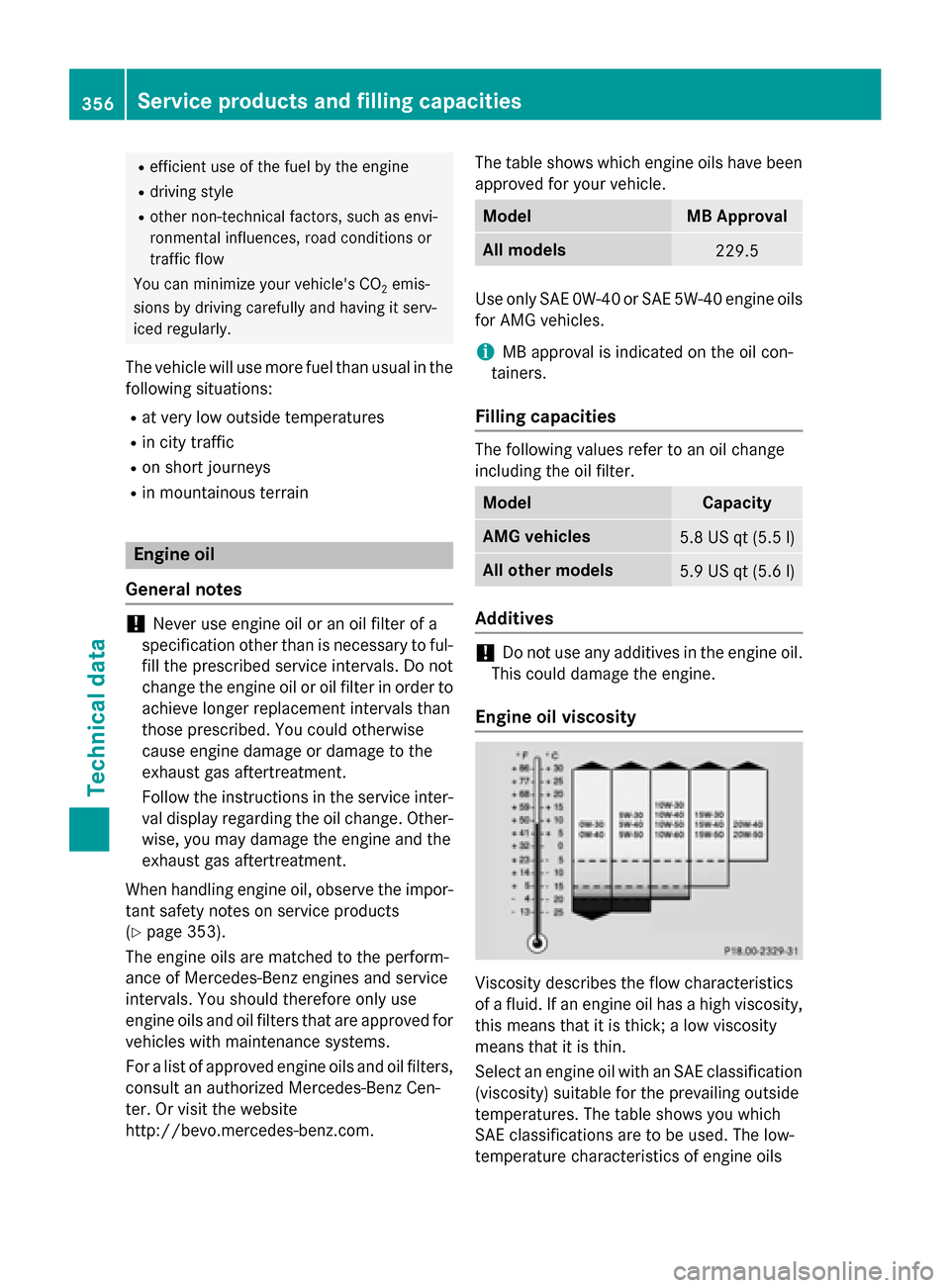
Engine oil viscosity Viscosity describes the flow characteristics
of a fluid. If an engine oil has a high viscosity,
this means that it is thick; a low viscosity
means that it is thin.
Select an engine oil with an SAE classification (viscosity) suitable for the prevailing outside
temperatures. The table shows you which
SAE classifications are to be used. The low-
temperature characteristics of engine oils 356
Service products and filling capacitiesTechnical data
Page 360 of 362
Mercedes-Benz recommends coolant or anti-
freeze/corrosion inhibitor concentrate in
accordance with
MB Specifications for Service Products 310.1
.
i When the vehicle is first delivered, it is fil-
led with a coolant mixture that ensures
adequate antifreeze and corrosion protec-
tion.
i The coolant is checked with every main-
tenance interval at a qualified specialist
workshop.
Filling capacities Model Capacity
AMG vehicles
Approx. 12.6 US qt
(11.9l) All ot
her models Approx. 8.2 US qt
(7.8l) Windshield washer system
Important safety notes G
WARNING
Windshield washer concentrate could ignite if it comes into contact with hot engine compo-
nents or the exhaust system. There is a risk of
fire and injury.
Make sure that no windshield washer con-
centrate is spilled next to the filler neck.
! Do not add distilled or de-ionized water to
the washer fluid container. Otherwise, the
level sensor may be damaged.
! Only MB SummerFit and MB WinterFit
washer fluid should be mixed together. The
spray nozzles may otherwise become
blocked.
When handling washer fluid, observe the
important safety notes on service products
(Y page 353). At temperatures above freezing:
X Fill the washer fluid reservoir with a mixture
of water and windshield washer fluid, e.g.
MB SummerFit.
Add 1 part MB SummerFit to 100 parts water.
At temperatures below freezing:
X Fill the washer fluid reservoir with a mixture
of water and washer fluid, e.g. MB Winter-
Fit.
For the correct mixing ratio refer to the
information on the antifreeze reservoir.
i Add windshield washer fluid, e.g. MB
SummerFit or MB WinterFit, to the washer
fluid all year round. Climate control system refrigerant
Important safety notes The climate control system of your vehicle is
filled with refrigerant R‑134a.
The instruction label regarding the refrigerant
type used can be found on the left, on the
underside of the hood.
! Only the refrigerant R‑134a and the PAG
oil approved by Mercedes-Benz may be
used. The approved PAG oil may not be
mixed with any other PAG oil that is not
approved for R-134a refrigerant. Other-
wise, the climate control system may be
damaged.
Service work, such as topping up refrigerant
or replacing components, may only be carried
out by a qualified specialist workshop. All
applicable regulations must be adhered to,
SAE standard J639 included.
Always have work on the climate control sys- tem carried out at a qualified specialist work-
shop. 358
Service products and filling capacitiesTechnical data
Page 361 of 362
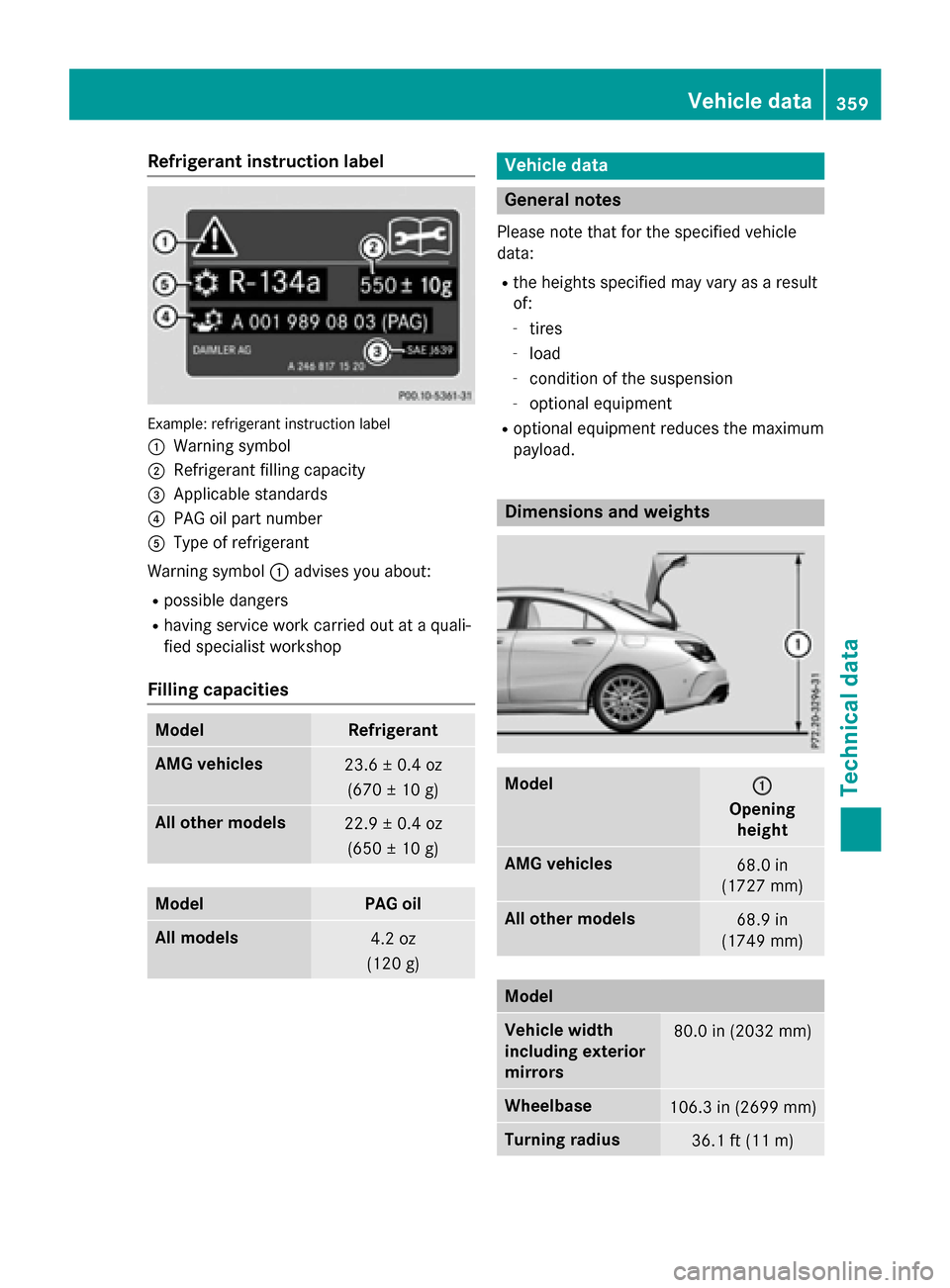
Refrigerant instruction label
Example: refrigerant instruction label
: Warning symbol
; Refrigerant filling capacity
= Applicable standards
? PAG oil part number
A Type of refrigerant
Warning symbol :advises you about:
R possible dangers
R having service work carried out at a quali-
fied specialist workshop
Filling capacities Model Refrigerant
AMG vehicles
23.6 ± 0.4 oz
(670 ± 10 g) All ot
her models 22.9 ± 0.4 oz
(650 ± 10 g) Model PAG oil
All models
4.2 oz
(120 g) Vehicle data
General notes
Please note that for the specified vehicle
data: R the heights specified may vary as a result
of:
- tires
- load
- condition of the suspension
- optional equipment
R optional equipment reduces the maximum
payload. Dimensions and weights
Model
: :
Opening height AMG vehicles
68.0 in
(1727 mm) All other models
68.9 in
(1749 mm) Model
Vehicle width
including exterior
mirrors
80.0 in (2032 mm)
Wheelbase
106.3 in (2699 mm)
Turning radius
36.1 ft (11
m) Vehicle data
359Technical data Z