lock MERCEDES-BENZ CLA COUPE 2013 User Guide
[x] Cancel search | Manufacturer: MERCEDES-BENZ, Model Year: 2013, Model line: CLA COUPE, Model: MERCEDES-BENZ CLA COUPE 2013Pages: 373, PDF Size: 11.47 MB
Page 31 of 373
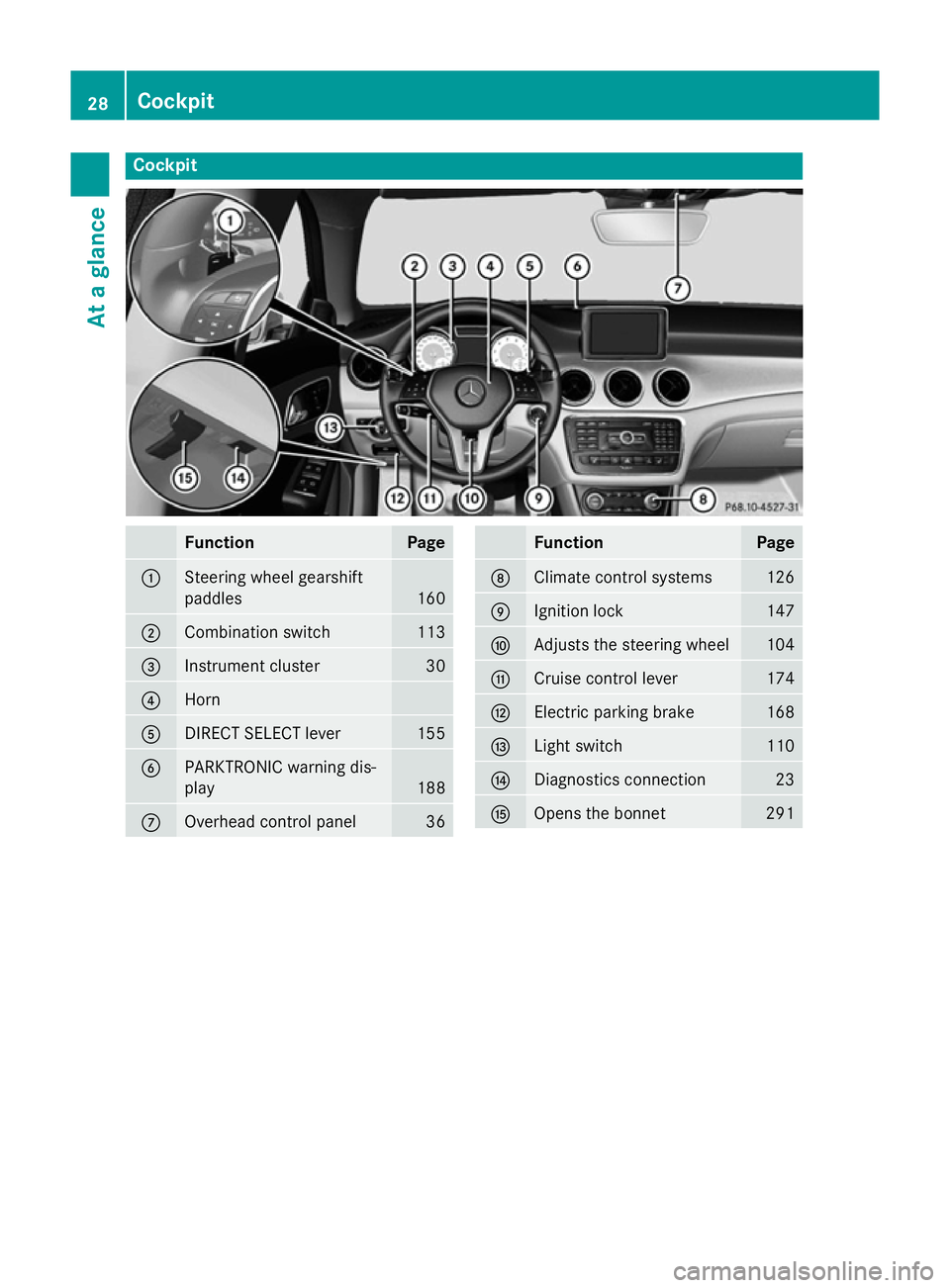
Cockpit
Function Page
:
Steering wheel gearshift
paddles
160
;
Combination switch 113
=
Instrument cluster 30
?
Horn
A
DIRECT SELECT lever 155
B
PARKTRONIC warning dis-
play
188
C
Overhead control panel 36 Function Page
D
Climate control systems 126
E
Ignition lock 147
F
Adjusts the steering wheel 104
G
Cruise control lever 174
H
Electric parking brake 168
I
Light switch 110
J
Diagnostics connection 23
K
Opens the bonnet 29128
CockpitAt a glance
Page 32 of 373
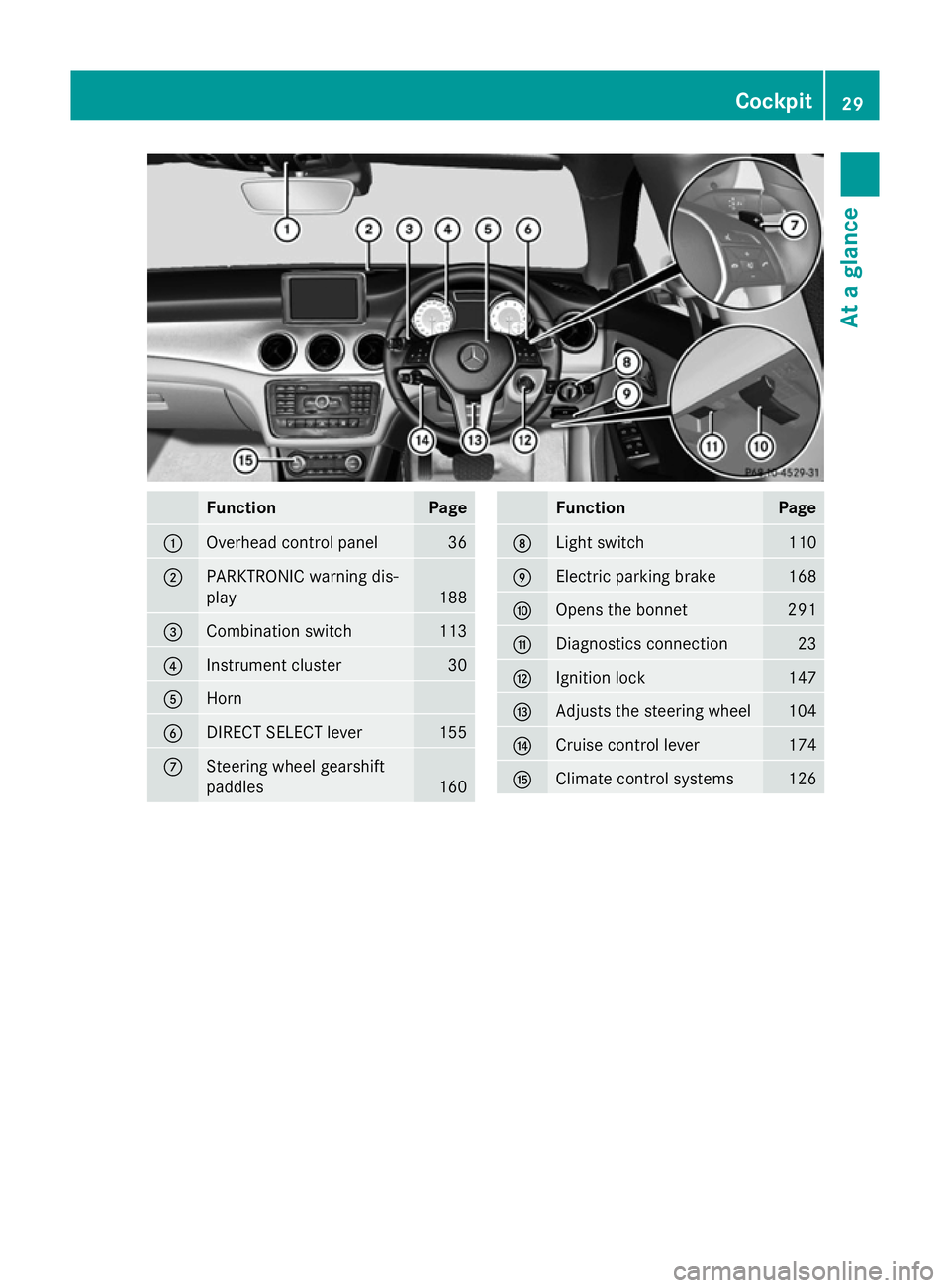
Function Page
:
Overhead control panel 36
;
PARKTRONIC warning dis-
play 188
=
Combination switch 113
?
Instrument cluster 30
A
Horn
B
DIRECT SELECT lever 155
C
Steering wheel gearshift
paddles
160 Function Page
D
Light switch 110
E
Electric parking brake 168
F
Opens the bonnet 291
G
Diagnostics connection 23
H
Ignition lock 147
I
Adjusts the steering wheel 104
J
Cruise control lever 174
K
Climate control systems 126Cockpit
29At a glance
Page 40 of 373

Door control panel
Function Page
:
Opens the door 84
;
%&Unlocks/locks
the vehicle
84
=
r45=
Saves
the seat and exterior mirror settings 107
?
Adjusts the seats electri-
cally
100
A
7
Zö\
Adjusts and folds the exte-
rior mirrors in/out electri-
cally 105 Function Page
B
W
Opens/closes the
side windows 89
C
n
Activates/deacti-
vates the override feature
for the side windows in the
rear compartment 63
D
o
Opens the boot 87Door control panel
37At a glance
Page 43 of 373
Useful information
i This Owner's Manual describes all mod-
els, series and optional equipment for your
vehicle that were available at the time of
going to press. National variations are pos- sible. Note that your vehicle may not be
equipped with all of the functions descri-
bed. This is also the case for systems and
functions relevant to safety.
i Read the information on qualified special-
ist workshops: (Y page 24). Panic alarm
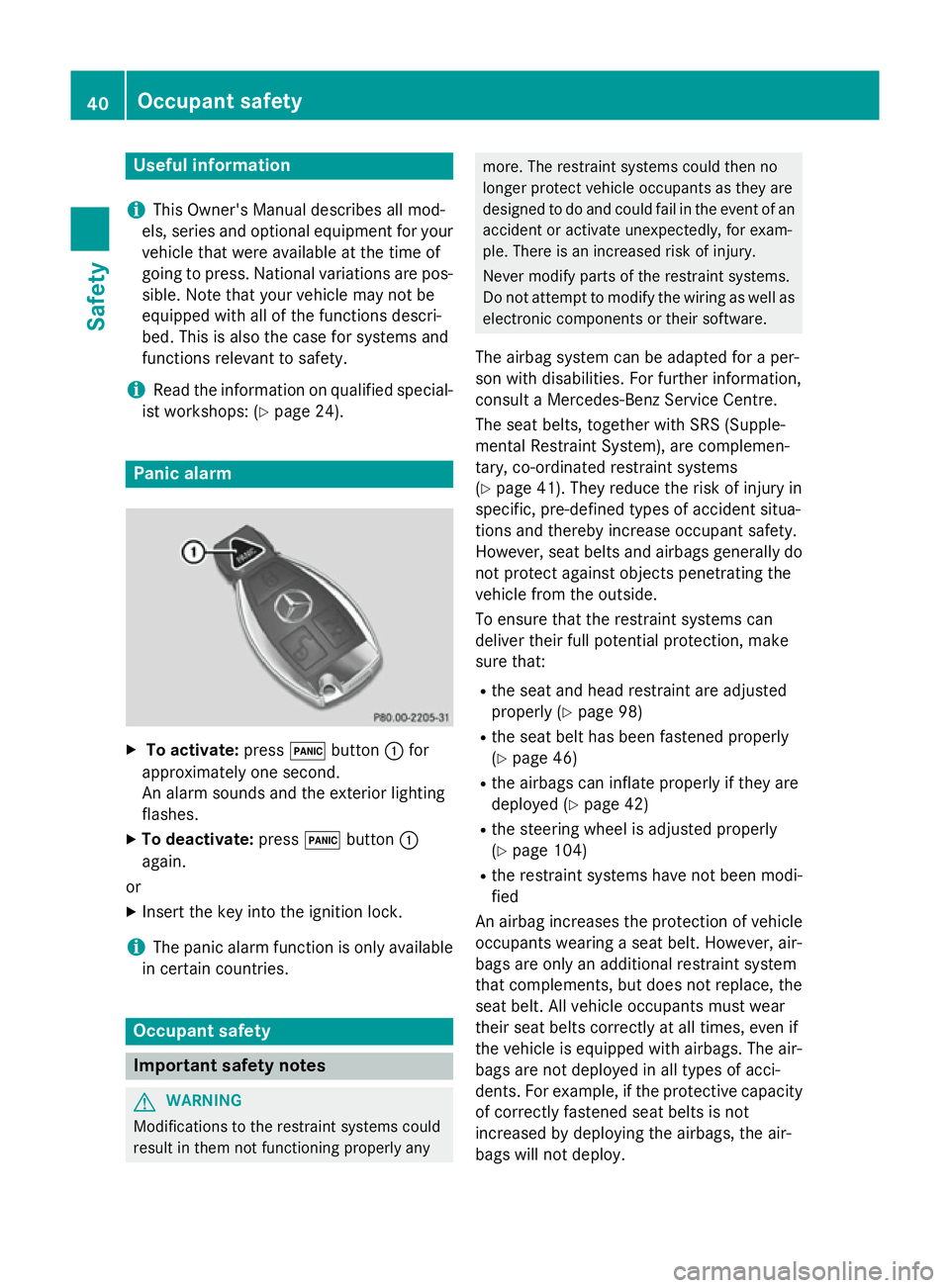
X
To activate: press!button :for
approximately one second.
An alarm sounds and the exterior lighting
flashes.
X To deactivate: press!button :
again.
or
X Insert the key into the ignition lock.
i The panic alarm function is only available
in certain countries. Occupant safety
Important safety notes
G
WARNING
Modifications to the restraint systems could
result in them not functioning properly any more. The restraint systems could then no
longer protect vehicle occupants as they are
designed to do and could fail in the event of an accident or activate unexpectedly, for exam-
ple. There is an increased risk of injury.
Never modify parts of the restraint systems.
Do not attempt to modify the wiring as well as
electronic components or their software.
The airbag system can be adapted for a per-
son with disabilities. For further information,
consult a Mercedes-Benz Service Centre.
The seat belts, together with SRS (Supple-
mental Restraint System), are complemen-
tary, co-ordinated restraint systems
(Y page 41). They reduce the risk of injury in
specific, pre-defined types of accident situa-
tions and thereby increase occupant safety.
However, seat belts and airbags generally do
not protect against objects penetrating the
vehicle from the outside.
To ensure that the restraint systems can
deliver their full potential protection, make
sure that:
R the seat and head restraint are adjusted
properly (Y page 98)
R the seat belt has been fastened properly
(Y page 46)
R the airbags can inflate properly if they are
deployed (Y page 42)
R the steering wheel is adjusted properly
(Y page 104)
R the restraint systems have not been modi-
fied
An airbag increases the protection of vehicle
occupants wearing a seat belt. However, air-
bags are only an additional restraint system
that complements, but does not replace, the
seat belt. All vehicle occupants must wear
their seat belts correctly at all times, even if
the vehicle is equipped with airbags. The air-
bags are not deployed in all types of acci-
dents. For example, if the protective capacity of correctly fastened seat belts is not
increased by deploying the airbags, the air-
bags will not deploy. 40
Occupant safetySafety
Page 49 of 373
Windowbags are deployed:
R at the start of an accident with a high rate of
lateral vehicle deceleration or acceleration,
e.g. in a side impact
R on the side on which an impact occurs
R on the driver's and the front-passenger's
side if the vehicle overturns and the system
determines that deployment can offer addi-
tional protection to that provided by the
seat belt
R independently of the use of the seat belt
R regardless of whether the front-passenger
seat is occupied
R independently of the front airbags PRE-SAFE
®
(anticipatory occupant
protection)
Introduction PRE-SAFE
®
takes pre-emptive measures to
protect occupants in certain hazardous sit-
uations.
Important safety notes !
Make sure that there are no objects in the
footwell or behind the seats when moving
the seat back. There is a risk that the seats and/or the objects could be damaged.
Although your vehicle is equipped with a PRE-
SAFE ®
system, the possibility of injury in the
event of an accident cannot be ruled out.
Always adapt your driving style to suit the
prevailing road and weather conditions and
maintain a safe distance from the vehicle in
front. Drive carefully. Function PRE-SAFE
®
intervenes:
R in emergency braking situations, e.g. when
BAS is activated.
R in critical driving situations, e.g. when phys-
ical limits are exceeded and the vehicle
understeers or oversteers severely.
R on vehicles with DISTRONIC PLUS: when
adaptive Brake Assist intervenes power-
fully.
PRE-SAFE ®
takes the following measures
depending on the hazardous situation detec-
ted:
R the front seat belts are pre-tensioned.
R if the vehicle skids, the panorama sliding
sunroof and the side windows are closed so
that only a small gap remains.
R vehicles with the memory function: the
front-passenger seat is adjusted if it is in an
unfavourable position.
If the hazardous situation passes without
resulting in an accident, PRE-SAFE ®
slackens
the belt pre-tensioning. All settings made by
PRE-SAFE ®
can then be reversed.
If the seat belts are not released:
X Move the backrest or seat back slightly, but
only when the vehicle is stationary.
Seat belt pre-tensioning is reduced and the locking mechanism is released.
The seat-belt adjustment is an integral part of
the PRE-SAFE ®
convenience function. More
information about seat-belt adjustment can
be found under "Seat-belt adjustment"
(Y page 48). Seat belts
Important safety notes G
WARNING
A seat belt which is not worn correctly, or
which has not been engaged in the seat belt
buckle correctly, cannot provide the intended 46
Occupant safetySafety
Page 51 of 373
pants in the event of an accident. This
reduces the risk of vehicle occupants coming
into contact with parts of the vehicle interior.
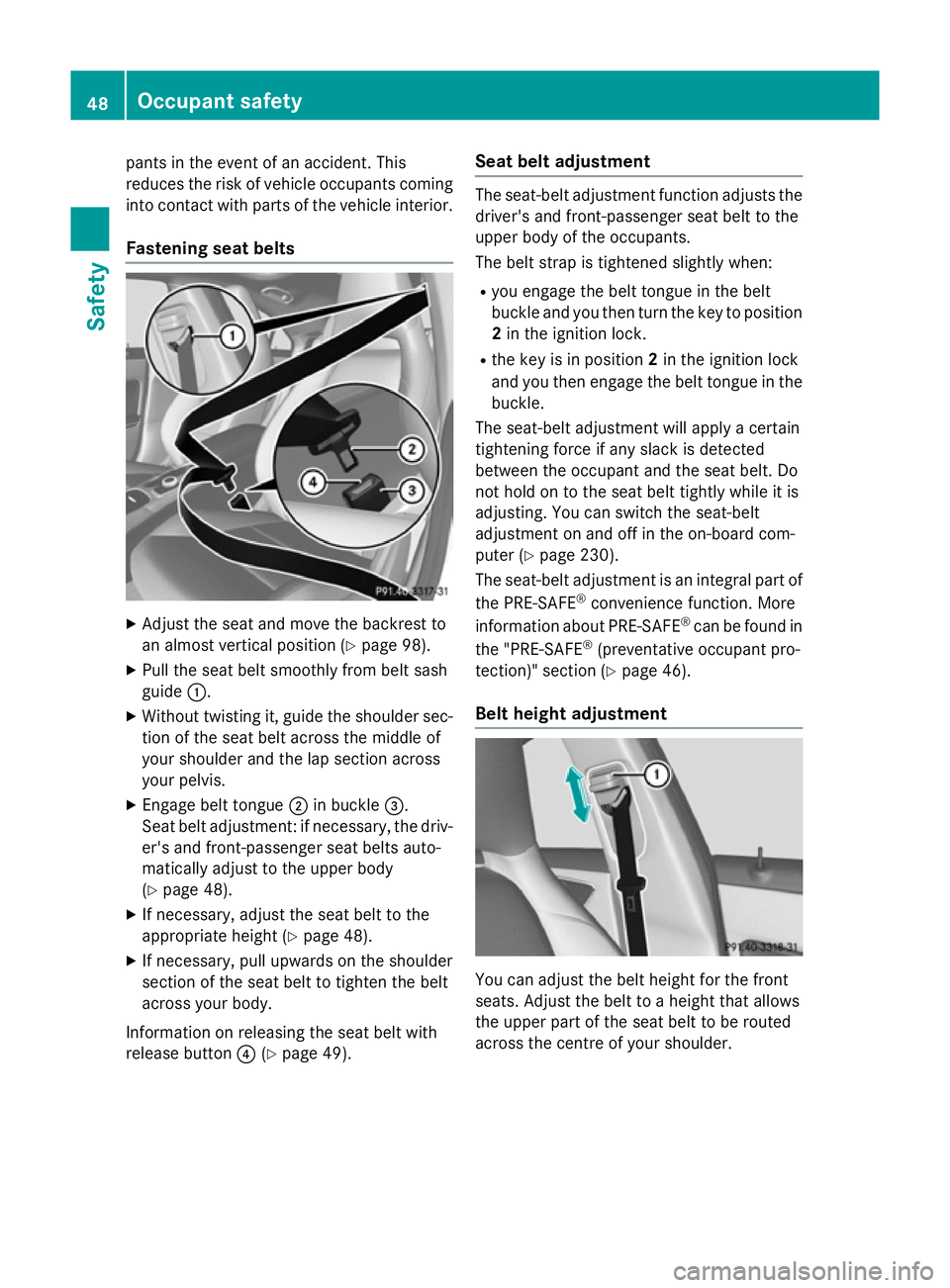
Fastening seat belts X
Adjust the seat and move the backrest to
an almost vertical position (Y page 98).
X Pull the seat belt smoothly from belt sash
guide :.
X Without twisting it, guide the shoulder sec-
tion of the seat belt across the middle of
your shoulder and the lap section across
your pelvis.
X Engage belt tongue ;in buckle =.
Seat belt adjustment: if necessary, the driv-
er's and front-passenger seat belts auto-
matically adjust to the upper body
(Y page 48).
X If necessary, adjust the seat belt to the
appropriate height (Y page 48).
X If necessary, pull upwards on the shoulder
section of the seat belt to tighten the belt
across your body.
Information on releasing the seat belt with
release button ?(Ypage 49). Seat belt adjustment The seat-belt adjustment function adjusts the
driver's and front-passenger seat belt to the
upper body of the occupants.
The belt strap is tightened slightly when:
R you engage the belt tongue in the belt
buckle and you then turn the key to position
2 in the ignition lock.
R the key is in position 2in the ignition lock
and you then engage the belt tongue in the buckle.
The seat-belt adjustment will apply a certain
tightening force if any slack is detected
between the occupant and the seat belt. Do
not hold on to the seat belt tightly while it is
adjusting. You can switch the seat-belt
adjustment on and off in the on-board com-
puter (Y page 230).
The seat-belt adjustment is an integral part of
the PRE-SAFE ®
convenience function. More
information about PRE-SAFE ®
can be found in
the "PRE-SAFE ®
(preventative occupant pro-
tection)" section (Y page 46).
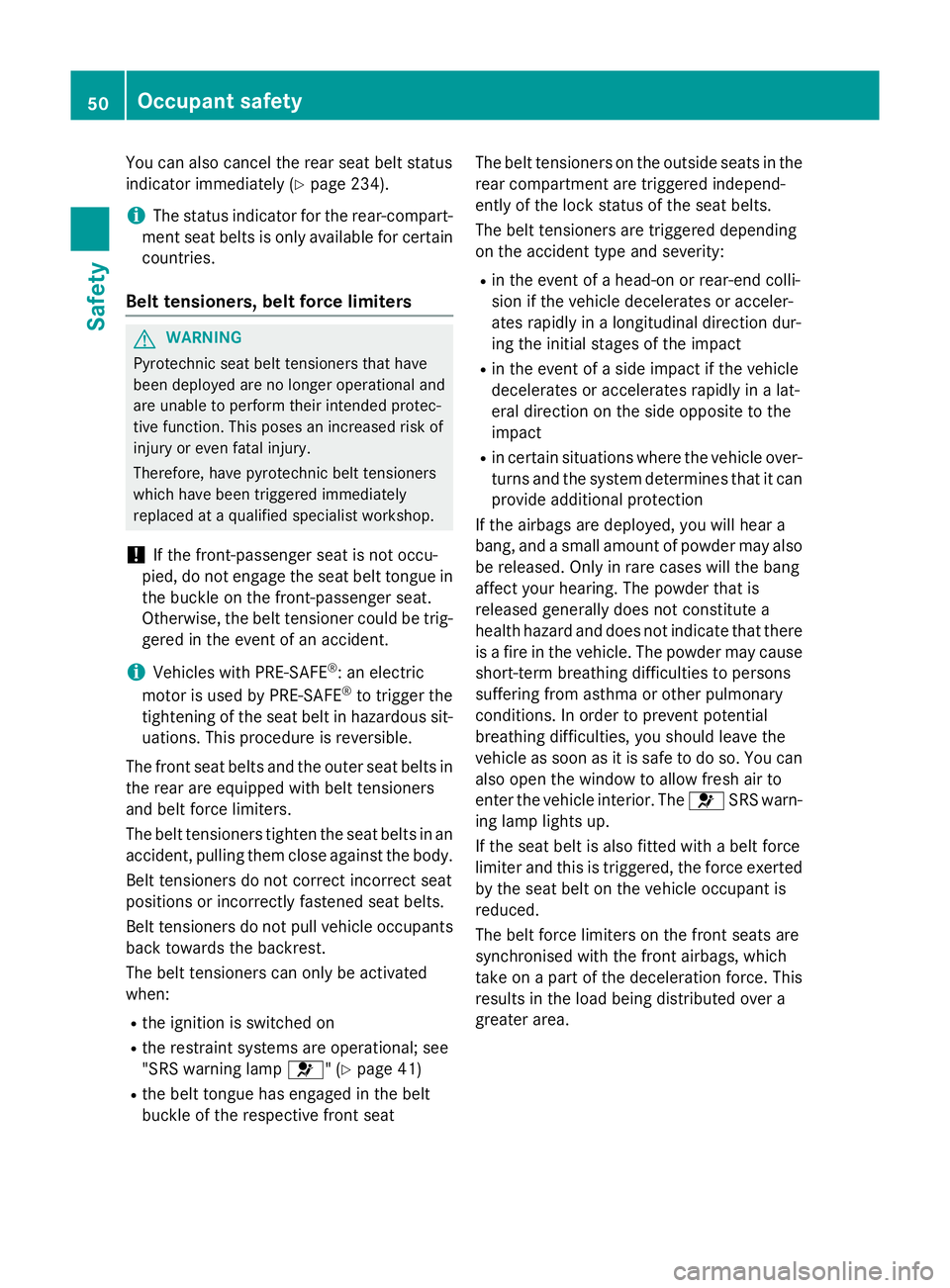
Belt height adjustment You can adjust the belt height for the front
seats. Adjust the belt to a height that allows
the upper part of the seat belt to be routed
across the centre of your shoulder. 48
Occupant safetySafety
Page 53 of 373
You can also cancel the rear seat belt status
indicator immediately (Y page 234).
i The status indicator for the rear-compart-
ment seat belts is only available for certain
countries.
Belt tensioners, belt force limiters G
WARNING
Pyrotechnic seat belt tensioners that have
been deployed are no longer operational and
are unable to perform their intended protec-
tive function. This poses an increased risk of
injury or even fatal injury.
Therefore, have pyrotechnic belt tensioners
which have been triggered immediately
replaced at a qualified specialist workshop.
! If the front-passenger seat is not occu-
pied, do not engage the seat belt tongue in
the buckle on the front-passenger seat.
Otherwise, the belt tensioner could be trig- gered in the event of an accident.
i Vehicles with PRE-SAFE ®
: an electric
motor is used by PRE-SAFE ®
to trigger the
tightening of the seat belt in hazardous sit- uations. This procedure is reversible.
The front seat belts and the outer seat belts in
the rear are equipped with belt tensioners
and belt force limiters.
The belt tensioners tighten the seat belts in an
accident, pulling them close against the body.
Belt tensioners do not correct incorrect seat
positions or incorrectly fastened seat belts.
Belt tensioners do not pull vehicle occupants
back towards the backrest.
The belt tensioners can only be activated
when:
R the ignition is switched on
R the restraint systems are operational; see
"SRS warning lamp 6" (Ypage 41)
R the belt tongue has engaged in the belt
buckle of the respective front seat The belt tensioners on the outside seats in the
rear compartment are triggered independ-
ently of the lock status of the seat belts.
The belt tensioners are triggered depending
on the accident type and severity:
R in the event of a head-on or rear-end colli-
sion if the vehicle decelerates or acceler-
ates rapidly in a longitudinal direction dur-
ing the initial stages of the impact
R in the event of a side impact if the vehicle
decelerates or accelerates rapidly in a lat-
eral direction on the side opposite to the
impact
R in certain situations where the vehicle over-
turns and the system determines that it canprovide additional protection
If the airbags are deployed, you will hear a
bang, and a small amount of powder may also be released. Only in rare cases will the bang
affect your hearing. The powder that is
released generally does not constitute a
health hazard and does not indicate that thereis a fire in the vehicle. The powder may causeshort-term breathing difficulties to persons
suffering from asthma or other pulmonary
conditions. In order to prevent potential
breathing difficulties, you should leave the
vehicle as soon as it is safe to do so. You can
also open the window to allow fresh air to
enter the vehicle interior. The 6SRS warn-
ing lamp lights up.
If the seat belt is also fitted with a belt force
limiter and this is triggered, the force exerted by the seat belt on the vehicle occupant is
reduced.
The belt force limiters on the front seats are
synchronised with the front airbags, which
take on a part of the deceleration force. This
results in the load being distributed over a
greater area. 50
Occupant safetySafety
Page 55 of 373
G
WARNING
If children are left unsupervised in the vehicle, they could:
R open the doors, thus endangering other
people or road users.
R get out and disrupt traffic.
R operate the vehicle's equipment.
Additionally, children could set the vehicle in
motion if, for example, they:
R release the parking brake.
R shift the automatic transmission out of
parking position P.
R shift the manual transmission into neutral.
R start the engine.
There is a risk of an accident and injury.
When leaving the vehicle, always take the key with you and lock the vehicle. Never leave
children or animals unattended in the vehicle.Always keep the key out of reach of children. G
WARNING
If persons (particularly children) are exposed
to heat or cold for a prolonged period, there is a risk of serious or even fatal injuries. Never
leave persons (particularly children) unatten-
ded in the vehicle. G
WARNING
If the child restraint system is placed in direct sunlight, the parts could become very hot.
Children could be suffer burns by touching
these parts, in particular on the metallic parts
of the child restraint system. There is a risk of injury.
If you and your child leave the vehicle, always
make sure that the child restraint system is
not in direct sunlight. Cover it with a blanket, for example. If the child restraint system has
been exposed to direct sunlight, leave it to
cool down before securing the child in it.
Never leave children unattended in the vehi-
cle.
If a child is travelling in your vehicle, secure
the child using a child restraint system which is appropriate to the size, age and weight of
the child. In order to correctly secure the child
in the child restraint system, always comply
with the child restraint system manufactur-
er's installation instructions. You should pref- erably fit the restraint system to a suitable
rear seat. Make sure that the child is securedfor the trip.
Mercedes-Benz recommends that you use
the listed child restraint systems
(Y page 59). You can obtain further infor-
mation about the correct child restraint sys-
tem from any Mercedes-Benz Service Centre.
i It is advisable to use Mercedes-Benz care
products to clean child restraint systems.
You can obtain information about this at
any Mercedes-Benz Service Centre.
Child restraint system on the front-
passenger seat G
WARNING
If the front-passenger front airbag is not dis-
abled:
R a child secured in a child restraint system
on the front-passenger seat could be seri-
ously or even fatally injured by the front-
passenger airbag deploying. This is espe-
cially a risk if the child is in the immediate
vicinity of the front-passenger front airbag
when it deploys.
R never secure a child on the front-passenger
seat in a rearward-facing child restraint sys- tem. Only secure a rearward-facing child
restraint system on a suitable rear seat.
R and you secure a forward-facing child
restraint system to the front-passenger
seat, you must move the front-passenger
seat as far back as possible. When doing so,
ensure that the shoulder belt strap from the
belt outlet on the vehicle is routed towards
the front to the shoulder belt guide on the
child restraint system. Set the belt height
adjustment so that the belt strap is routed
towards the front along the bottom. 52
Children in the vehicleSafety
Page 57 of 373
G
WARNING
Electronic devices on the front-passenger
seat can affect the function of the automatic
child seat recognition, for example:
R laptop
R mobile phone
R transponder cards such as ski passes or
access passes
The front-passenger front airbag could deploy unintentionally or not function as intended
during an accident. This poses an increased
risk of injury or even fatal injury.
Do not place any of the devices mentioned
above or similar devices on the front-
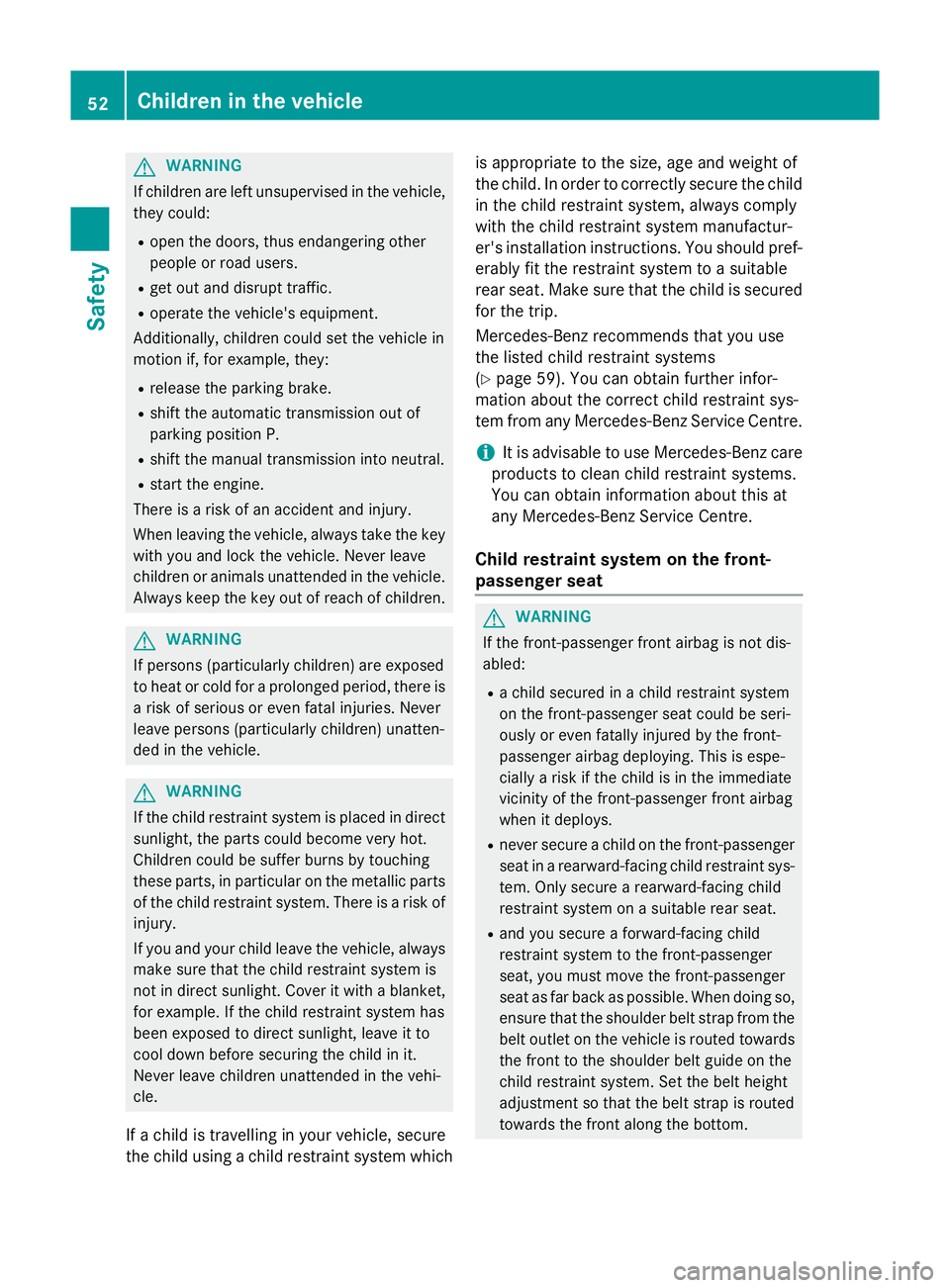
passenger seat. If the front-passenger seat of your vehicle is
not equipped with automatic child seat rec-
ognition, this is indicated by a special sticker. The sticker is affixed to the side of the dash-
board on the front-passenger side. The
sticker is visible when you open the front-
passenger door.
Vehicles without automatic child seat recog-
nition on the front-passenger seat: if you turn
the key to position 2in the ignition lock, the
PASSENGER AIRBAG OFF indicator lamp
lights up briefly. However, the indicator lamp
has no function. It does not indicate that there is automatic child seat recognition on the
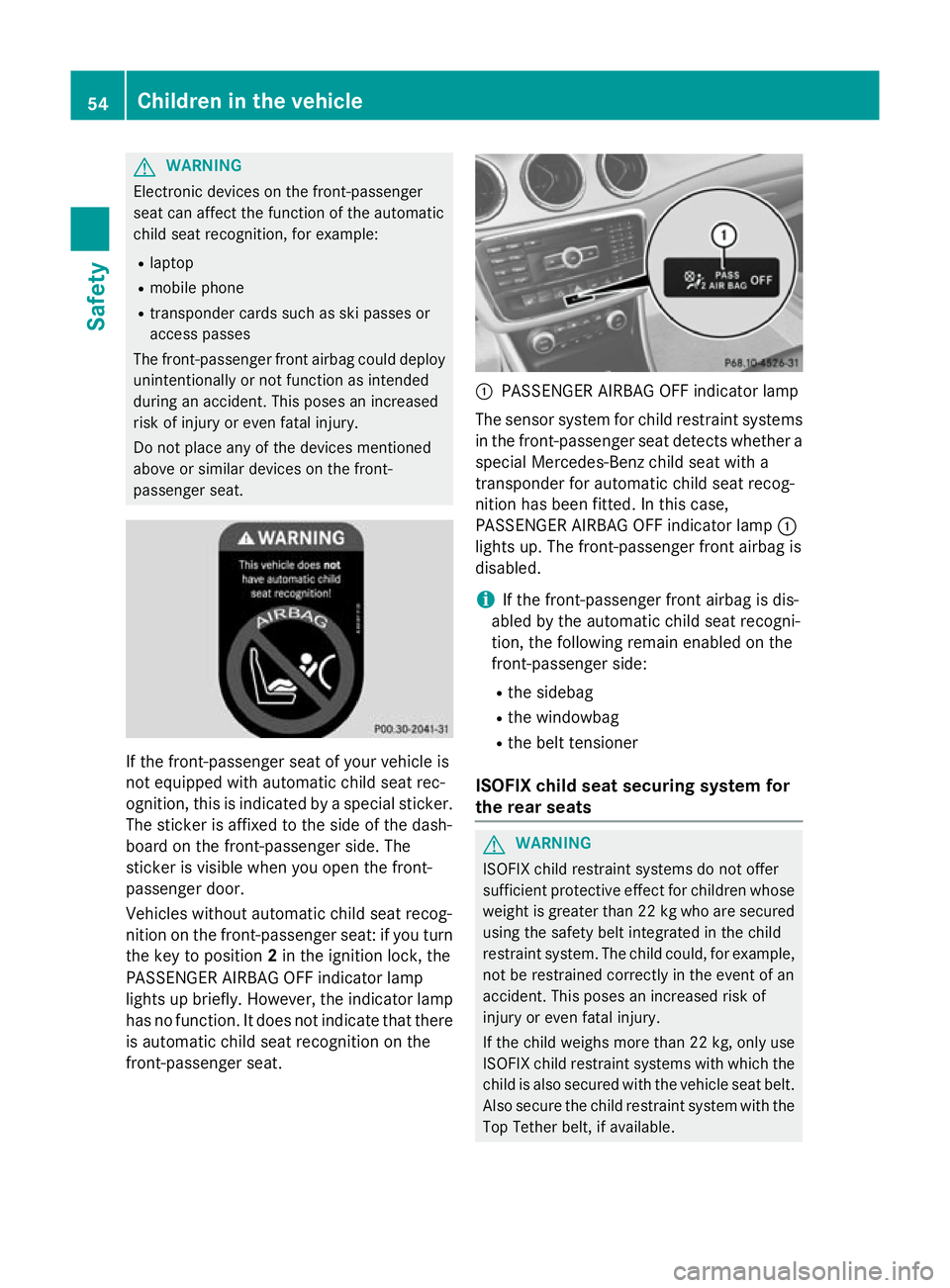
front-passenger seat. :
PASSENGER AIRBAG OFF indicator lamp
The sensor system for child restraint systems
in the front-passenger seat detects whether a special Mercedes-Benz child seat with a
transponder for automatic child seat recog-
nition has been fitted. In this case,
PASSENGER AIRBAG OFF indicator lamp :
lights up. The front-passenger front airbag is
disabled.
i If the front-passenger front airbag is dis-
abled by the automatic child seat recogni-
tion, the following remain enabled on the
front-passenger side:
R the sidebag
R the windowbag
R the belt tensioner
ISOFIX child seat securing system for
the rear seats G
WARNING
ISOFIX child restraint systems do not offer
sufficient protective effect for children whose weight is greater than 22 kg who are securedusing the safety belt integrated in the child
restraint system. The child could, for example,not be restrained correctly in the event of an
accident. This poses an increased risk of
injury or even fatal injury.
If the child weighs more than 22 kg, only use
ISOFIX child restraint systems with which the child is also secured with the vehicle seat belt. Also secure the child restraint system with the
Top Tether belt, if available. 54
Children in the vehicleSafety
Page 65 of 373
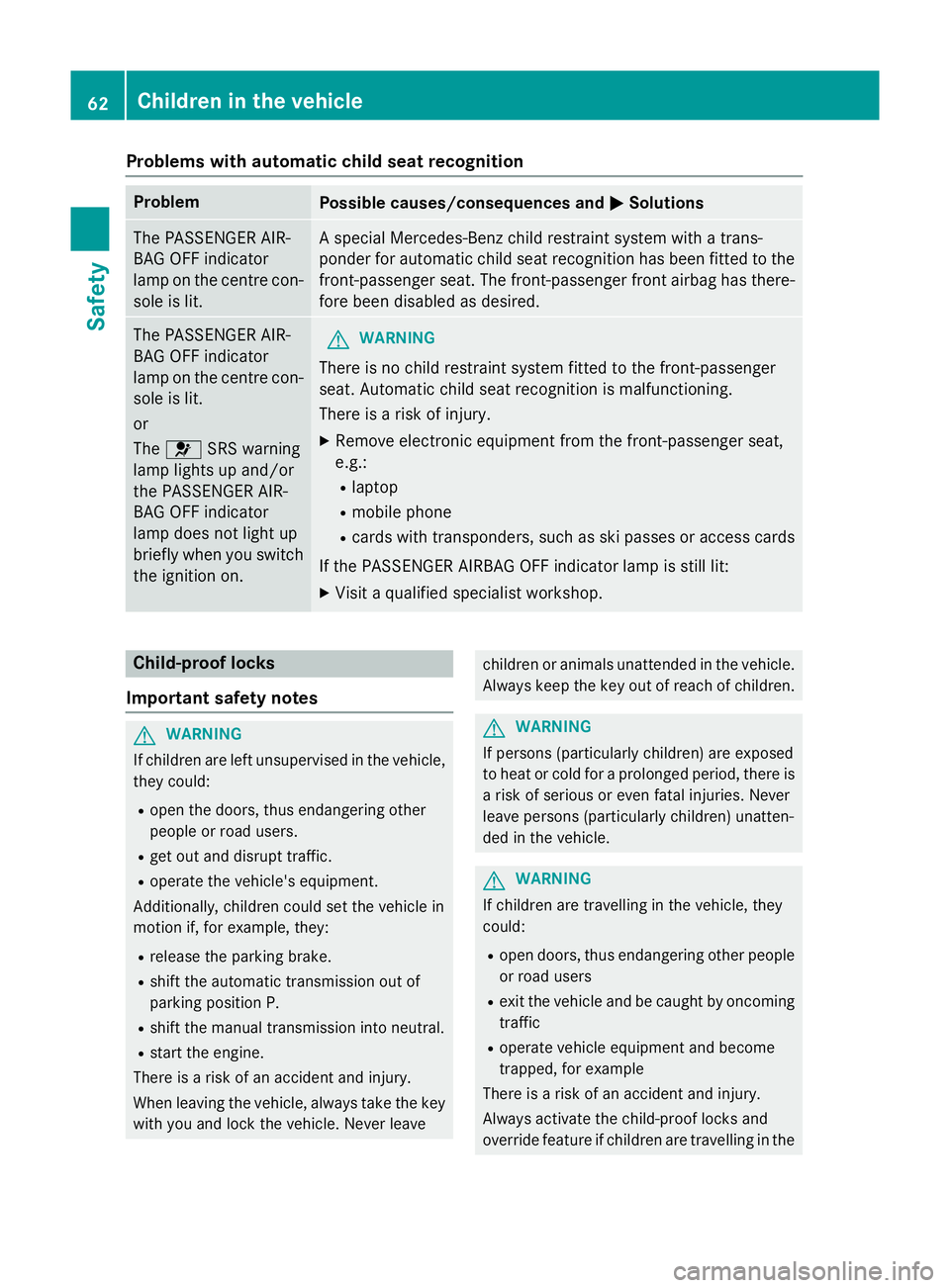
Problems with automatic child seat recognition
Problem
Possible causes/consequences and
M
MSolutions The PASSENGER AIR-
BAG OFF indicator
lamp on the centre con-
sole is lit. A special Mercedes-Benz child restraint system with a trans-
ponder for automatic child seat recognition has been fitted to the
front-passenger seat. The front-passenger front airbag has there- fore been disabled as desired. The PASSENGER AIR-
BAG OFF indicator
lamp on the centre con-
sole is lit.
or
The 6 SRS warning
lamp lights up and/or
the PASSENGER AIR-
BAG OFF indicator
lamp does not light up
briefly when you switch the ignition on. G
WARNING
There is no child restraint system fitted to the front-passenger
seat. Automatic child seat recognition is malfunctioning.
There is a risk of injury. X Remove electronic equipment from the front-passenger seat,
e.g.:
R laptop
R mobile phone
R cards with transponders, such as ski passes or access cards
If the PASSENGER AIRBAG OFF indicator lamp is still lit:
X Visit a qualified specialist workshop. Child-proof locks
Important safety notes G
WARNING
If children are left unsupervised in the vehicle, they could:
R open the doors, thus endangering other
people or road users.
R get out and disrupt traffic.
R operate the vehicle's equipment.
Additionally, children could set the vehicle in
motion if, for example, they:
R release the parking brake.
R shift the automatic transmission out of
parking position P.
R shift the manual transmission into neutral.
R start the engine.
There is a risk of an accident and injury.
When leaving the vehicle, always take the key with you and lock the vehicle. Never leave children or animals unattended in the vehicle.
Always keep the key out of reach of children. G
WARNING
If persons (particularly children) are exposed
to heat or cold for a prolonged period, there is a risk of serious or even fatal injuries. Never
leave persons (particularly children) unatten-
ded in the vehicle. G
WARNING
If children are travelling in the vehicle, they
could:
R open doors, thus endangering other people
or road users
R exit the vehicle and be caught by oncoming
traffic
R operate vehicle equipment and become
trapped, for example
There is a risk of an accident and injury.
Always activate the child-proof locks and
override feature if children are travelling in the 62
Children in the vehicleSafety