engine MERCEDES-BENZ CLA COUPE 2018 Owner's Guide
[x] Cancel search | Manufacturer: MERCEDES-BENZ, Model Year: 2018, Model line: CLA COUPE, Model: MERCEDES-BENZ CLA COUPE 2018Pages: 326, PDF Size: 5.59 MB
Page 63 of 326
Drivingsafet ys ystems
Overview of drivin gsafet ys ystems
In this section ,you will fin dinformati on about
th ef ollowin gdrivin gsafet ysystems :
RABS(Anti-lock Brakin gSystem)
(Ypage 61)
RBA S(Brak eAssist System) (Ypage 61)
RActive Brak eAssist(Ypage 62 )
RESP®(Electronic Stability Program)
(Ypage 64)
REB D( Electroni cBrak eforce Distribution )
(Ypage 67 )
RADAPTIV EBRAKE (Ypage 68 )
RSTEERCONTROL (Ypage 68)
Important safet ynotes
If you fail to adapt your drivin gstyle or if you are
inattentive ,the drivin gsafet ysystems can nei-
ther reduce th eriskofana ccidentnor override
th el aws of physics. Driving safet ysystems are
merely aids designed to assist driving. You are
responsible fo rmaintainin gthe distanc etothe
vehicle in front, fo rvehicle speed, fo rbraking in
goo dtime, and fo rstayin ginl ane. Always adapt
your drivin gstyle to suit th eprevailin groada nd
weather condition sand maintain asafed istanc e
from th evehicle in front. Drive carefully.
The drivin gsafet ysystems described only wor k
as effectively as possible when there is ade-
quat econtac tbetween th etires and th eroad
surface. Please pay special attention to th e
note sont ires ,recommended minimum tire
tread depths, etc. (
Ypage 288).
In wintr ydrivin gconditi ons, always use winte r
tires (M+ Stires )a nd if necessary,s now chains.
Onlyint hiswaywill the driving safety systems
describe dinthissection work as effectively as
possible.
ABS (Anti-lock Brakin gSystem)
General information
ABS regulate sbrake pressure in such awaythat
the wheels do not lock when yo ubrake. This
allows yo utocontinue steering the vehicl ewhen
braking. The
! ABS warning lamp in the instrument
cluster lights up when the ignition is switched
on. It goe soutwhen the engine is running.
ABS works from aspeed of about5m ph
(8 km/h), regardless of road-surface conditions.
ABS works on slippery surfaces, eve nwheny ou
onlyb rake gently.
Important safety notes
iObserve the "Important safety notes "sec-
tio n(Ypage 61).
GWARNING
If ABS is faulty ,the wheels could lock when
braking .The steerability and braking charac-
teristic smaybe severely impaired.A ddition-
ally ,further driving safety systemsa re deac-
tivated.T here is an increased danger of skid-
ding and accidents.
Driv eonc arefully. Hav eABS checked imme-
diately at aquali fied specialist workshop.
Whe nABS is malfunctioning ,othe rsystems,
including driving safety systems, will also
become inoperative. Observe the information
on the ABS warning lamp (
Ypage 220 )and dis-
play messages which maybes hown in the
instrument cluster (
Ypage 192).
Braking
XIf ABS intervenes: continue to depress the
brake peda lvigorously unti lthe braking sit-
uatio niso ver.
XTo make afullb rake application: depress
the brake peda lwithf ullf orce.
If ABS intervene swhenb raking ,you will fee la
pulsing in the brake pedal.
The pulsating brake peda lcan be an indication
of hazardousr oadconditions, and functions as a
reminder to take extra car ewhile driving.
BAS (Brak eAssis tSystem)
General information
BAS operates in emergency braking situations.
If yo udepress the brake peda lquickly, BAS
automaticall yboosts the braking force,t hus
shortening the stopping distance.
Driving safety systems61
Safety
Z
Page 66 of 326

sensor technology to assess the traffic situa-
tion.
Situation-dependent braking assistance is capa-
ble of reacting to moving objects that have
alreadybeen detected as such at least once
over the period of observation, up to vehicle
speeds of around 155 mph (250 km/h).
Situation-dependent braking assistance can
also detect stationary objects, up to vehicle
speeds of around 44 mph (70 km/h).
XKeep the brake pedal depressed until the
emergency braking situation is over.
ABS prevents the wheels from locking.
The brakes will work normally againi f:
Ryou release the brake pedal.
Rthere is no longer any danger ofacollision.
Rno obstacle is detected in front of your vehi-
cle.
Situation-dependent braking assistance is then
deactivated.
Important safety notes
iObserve the "Important safety notes" sec-
tion for driving safety systems (Ypage 61).
GWARNING
Adaptive Brake Assist does not react:
Rto people or animals
Rto oncoming vehicles
Rto crossing traffic
Rwhen cornering
As aresult, Adaptive Brake Assist may not
intervene in all critical conditions. There is a
risk of an accident.
Always pay careful attention to the traffic sit- uation and be ready to brake.
GWARNING
Adaptive Brake Assist cannot always clearly
identify objects and complex traffic situa-
tions.
In such cases, Adaptive Brake Assist might:
Rintervene unnecessarily
Rnot intervene
There is arisk of an accident.
Always pay careful attention to the traffic sit-
uation and be ready to brake. Terminate the
intervention in anon-critical driving situation.
Due to the nature of the system, complex but
non-critical driving conditions may also cause
Active Brake Assist to intervene.
Even if Active Brake Assist is not available due to
am alfunction in the radar sensor system, the
brake system is still available with full brake
boosting effect and BAS.
ESP®(Electronic Stability Program)
General notes
iObserve the "Important safety notes" sec-
tion (Ypage 61).
ESP
®monitors driving stability and traction,i .e.
power transmission between the tires and the
road surface.
If ESP
®detects that the vehicle is deviating from
the direction desired by the driver, one or more
wheels are braked to stabilize the vehicle. The
engine output is also modified to keep the vehi-
cle on the desired course within physical limits.
ESP
®assists the driver when pulling awayo n
wet or slippery roads. ESP®can also stabilize
the vehicle during braking.
ETS/4ETS (Electronic Traction System)
iObserve the "Important safety notes" sec-
tion (Ypage 61).
ETS traction control is part of ESP
®.Onv ehicles
with 4MATIC, 4ETS is part of ESP®.
Traction control brakes the drive wheels indi-
vidually if they spin. This enables you to pull
awaya nd accelerate on slippery surfaces, for
example if the road surface is slippery on one
side. In addition, more drive torque is transfer-
red to the wheel or wheels with traction.
Traction control remains active, even if you
deactivate ESP
®.
Important safety notes
iObserve the "Important safety notes" sec-
tion (Ypage 61).
64Driving safety systems
Safety
Page 67 of 326
GWARNING
If ESP
®is malfunctioning, ESP®is unable to
stabilize the vehicle. Additionally, further driv-
ing safety systems are deactivated. This
increases the risk of skidding and an accident.
Drive on carefully.H ave ESP
®checked at a
qualified specialist workshop.
Vehicles without 4MATIC: when towing your
vehiclew ith the front axle raised, it is important
that you observe the notes on ESP
®
(Ypage2 82).
If the å ESP®OFF warning lamp lights up
continuously,E SP®is deactivated.
If the ÷ ESP®warning lamp and the å
warning lamp are lit continuously,E SP®is not
available due to amalfunction.
Observe the information on warning lamps
(
Ypage2 21) and display messages which may
be shownint he instrument cluster
(
Ypage1 92).
Only use wheels with the recommendedt ire
sizes. Only then wil lESP
®function properly.
Characteristics of ESP®
General information
If the ÷ ESP®warning lamp goes out before
beginning the journey ,ESP®is automatically
active.
If ESP
®intervenes, the ÷ESP®warning lamp
flashes in the instrument cluster.
If ESP
®intervenes:
XDo not deactivate ESP®under any circum-
stances.
XOnly depress the accelerator pedalasf ar as
necessary when pulling away.
XAdapt you rdriving style to sui tthe prevailing
road and weather conditions.
ECOs tart/stop function
The ECO start/stop function switches the
engine off automatically when the vehicles tops
moving. The engine starts automatically when
the driverw ants to pullawa ya gain. ESP
®
remains in its previousl yselected status. Exam-
ple: if ESP®was deactivated before the engine
was switched off, ESP®remains deactivated
when the engine is switched on again.
Deactivating/activating ESP®(except
Mercedes‑AMG vehicles)
Important safety notes
iObserve the "Important safety notes" sec-
tion (Ypage6 1).
You can select between the following states of
ESP
®:
RESP®is activated.
RESP®is deactivated.
GWARNING
If you deactivate ESP
®,E SP®no longer sta-
bilizes the vehicle. There is an increased risk
of skidding and an accident.
Only deactivate ESP
®in the situations descri-
bed in the following.
The spinning of the wheels results in acutting
action for better traction on looses urfaces.
It may be best to deactivate ESP
®in the follow-
ing situations:
Rwhen using snow chains
Rin deep snow
Ron sand or gravel
iActivate ESP®as soon as the situations
described above no longer apply.E SP®will
otherwise not be abl etostabilize the vehiclei f
the vehicles tarts to skid or awhee lstarts to
spin.
!Avoid spinning the drivenw heels for an
extended period with ESP®deactivated. You
coul dotherwise damage the drivetrain.
Deactivating/activating ESP®
You can deactivate or activate ESP®via the on-
board computer (Ypag e185).
ESP®deactivated:
The å ESP®OFF warning lamp in the instru-
ment cluster lights up.
ESP
®activated:
The å ESP®OFF warning lamp in the instru-
ment cluster goes out.
Driving safety systems65
Safety
Z
Page 68 of 326
Characteristics when ESP®is deactivated
If ESP®is deactivatedand oneorm orew heels
start to spin,t he÷ ESP®warning lamp in the
instrumentc lusterflashes. In suchs ituations,
ESP
®will no tstabilizet hevehicle.
If you deactivate ESP®:
RESP®no longer improve sdriving stability.
REnginet orque is no longer limited and the
driv ewheels are able to spin.
RTractio ncontrol is still activated.
RActiv eBrake Assist is no longer available; nor
is it activated if you brak efirmly with assis-
tance from ESP
®.
RSTEER CONTROL is no longer active.
RESP®still provides support when you brake
firmly.
Deactivating/activatin gESP®
(Mercedes ‑AM Gvehicles)
Important safety notes
iObserv ethe "Important safety notes" sec-
tio n(Ypage 61).
You can selectb etween thefollowings tate so f
ESP
®:
RESP®is activated.
RSPORT handlingm ode is activated.
RESP®is deactivated.
GWARNING
When SPORT handlingm ode is activated,
there is agreate rrisk of skiddinga nd acci-
dents.
Only activat eSPORT handlingm ode in thesit-
uations describe dinthefollowing.
GWARNING
If you deactivate ESP
®,E SP®no longer sta-
bilizes th evehicle .Thereisani ncreased risk
of skiddinga nd an accident.
Only deactivate ESP
®in th esituations descri-
bed in th efollowing. In th
efollowings ituations,itmay be bette rto
activat eSPORT handlingm ode or deactivate
ESP
®:
Rwhen usings nowc hains
Rind eep snow
Ron sandorg ravel
Ron specially designated roads when th evehi-
cle's own oversteering and understeering
characteristics are desired
Drivin ginSPORT handlingm ode or without
ESP
®requires an extremely qualified and expe-
rienced driver.
iActivate ESP®as soon as th esituations
describe dabovenol onger apply. ESP®will
otherwise no tbeable to stabilizet hevehicle if
th ev ehicle start stoskidoraw heel start sto
spin.
!Avoid spinnin gthe driven wheels for an
extended period with ESP®deactivated. You
coul dotherwise damage th edrivetrain.
Deactivating/activatin gESP®
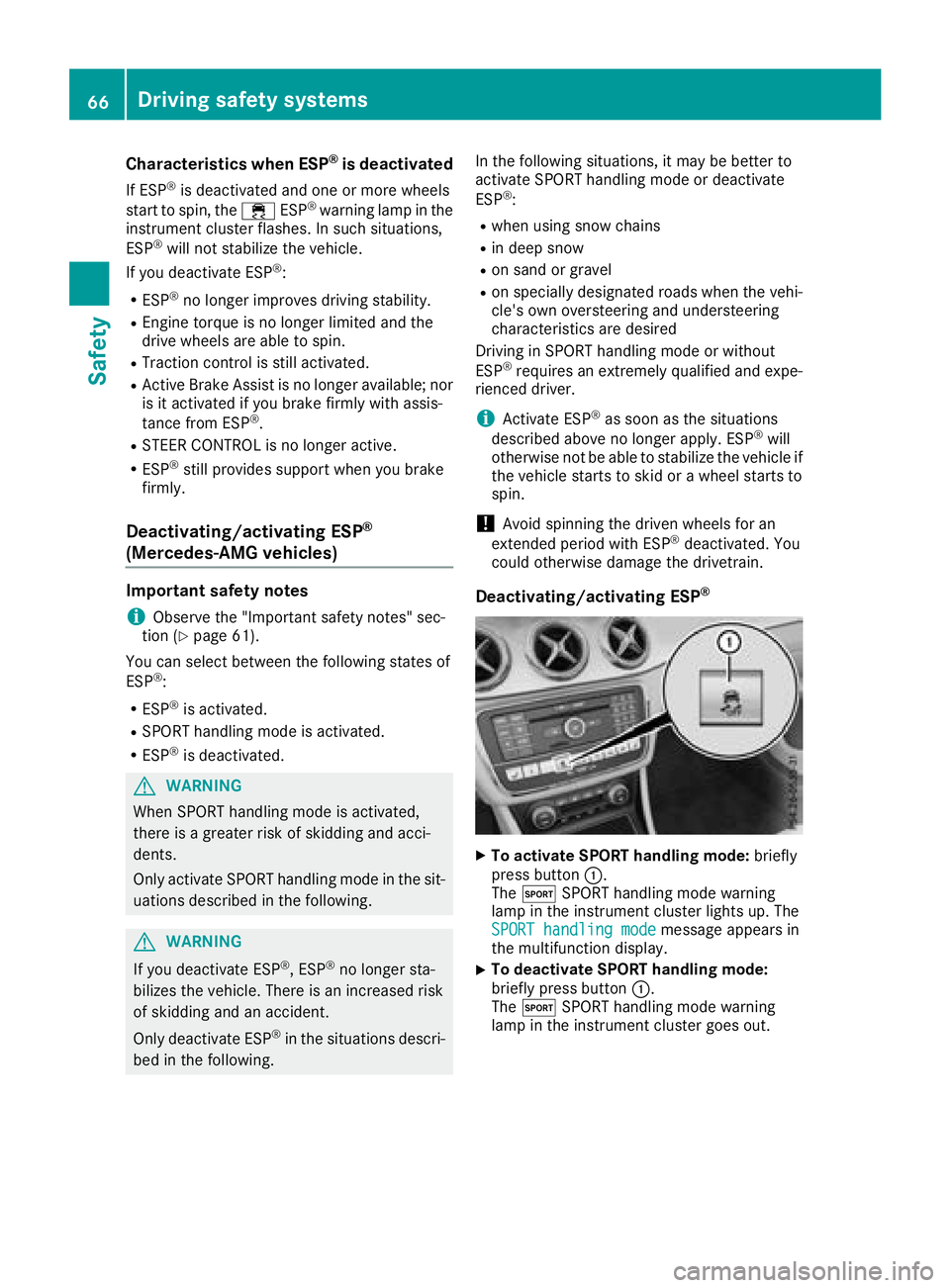
XTo activate SPORTh andling mode: briefly
pres sbutton :.
The M SPORT handlingm ode warning
lamp in th einstrumentc lusterlightsu p. The
SPORT handling mode
message appearsi n
th em ultifunction display.
XTo deactivat eSPORTh andling mode:
briefly pres sbutton :.
The M SPORT handlingm ode warning
lamp in th einstrumentc lustergoes out.
66Driving safety systems
Safety
Page 69 of 326
XTo deactivate ESP®:press button :until
the å ESP®OFF warning lamp lights up in
the instrument cluster.
The ÷ OFF
message appears in the multi-
functio ndisplay.
XTo activate ESP®:briefl ypress button :.
The å ESP®OFF warning lamp in the
instrument cluster goe sout.T he ÷ ESP®
ONmessage appears in the multifunctio ndis-
play.
Characteristic sofactivatedS PORT han-
dling mode
If SPOR Thandling modeisa ctivatedand one or
more wheels start to spin, the ÷ESP®warn-
ing lamp in the instrument cluster flashes. ESP®
onlys tabilizes the vehicl etoalimite dd egree.
Whe nSPOR Thandling modeisa ctivated:
RESP®onlyimprovesd riving stability to alim i-
ted degree.
RTractio ncontroliss tilla ctivated.
RThe engine's torque is onlyr estrictedtoa
limite ddegreea nd the drive wheels may start
to spin.
The spinning of the wheels results in acutting
action for better tractio nonloose surfaces.
RESP®stil lprovides support when yo ubrake
firmly.
Characteristic swhenE SP®is deactivated
If ESP®is deactivate dand one or more wheels
start to spin, the ÷ESP®warning lamp in the
instrument cluster does not flash. In such situa-
tions, ESP
®will not stabilize the vehicle.
If yo udeactivate ESP®:
RESP®no longer improvesd riving stability.
REngine torque is no longer limite dand the
drive wheels are able to spin.
The spinning of the wheels results in acutting
action for better tractio nonloose surfaces.
RTractio ncontroliss tilla ctivated.
RActive Brake Assist is no longer available ;nor
is it activate difyoubrake firmly with assis-
tance from ESP
®.
RESP®stil lprovides support when yo ubrake
firmly.
ESP®trailer stabilization
General information
If your vehicle/trailer combinatio nbegin sto
swerve ,ESP®assists yo uinthissituation. ESP®
slowst he vehicl edownbyb raking and limiting
the engine outputu ntilthe vehicle/trailer com-
bination hass tabilized.
Important safety notes
GWARNING
If roada nd weather conditions are poor,
traile rstabilization will not be able to prevent
the vehicle/trailer combinatio nfrom swerv-
ing .Trailers with ahighc ente rofg ravity can
tip overb efore ESP
®can detect this. There is
ar iskofana ccident.
Alway sadapt your driving style to the prevail-
ing roada nd weather conditions.
If your vehicl ewitht raile r(vehicle/trailer com-
bination) begins to lurch, yo ucan onlys tabilize
the vehicle/trailer combinatio nbydepressing
the brake firmly.
ESP
®traile rstabilization is active above speeds
of about65k m/h.
ESP
®traile rstabilization does not work if ESP®
is deactivate dordisable dbecause of amalfunc-
tion.
EBD (electronicb rake forcedistribu-
tion)
General information
EBD monitors and controls the brake pressure
on the rearw heelstoi mprove driving stability
whil ebraking.
Important safety notes
iObserve the "Important safety notes "sec-
tio n(Ypage 61).
GWARNING
If EBD is malfunctioning ,the rearw heelscan
lock, e.g .under ful lbraking .Thisi ncreases the
ris kofs kidding and an accident.
Driving safety systems67
Safety
Z
Page 70 of 326

You should therefore adapt your drivingstyle
to the differenth andlingcharacteristics. Have
the brakes ystemchecked at aqualified spe-
cialist workshop.
Please observet he information on warnin gand
indicator lamps (
Ypage 220)
(
Ypage 220) as well as on display messages
(Ypage 194).
ADAPTIVE BRAKE
ADAPTIVE BRAKE enhances braking safetya nd
offers increased braking comfort.Ina ddition to
the braking function ,ADA PTIVE BRAKE also has
the HOLDf unction (
Ypage 157) and hill start
assist (Ypage 125).
STEER CONTROL
Genera linformation
STEER CONTROL helps you by transmitting a
noticeable steeringf orcetothe steeringw heel
in the direction required for vehicle stabilization.
This steeringa ssistanceisprovided in particular
if:
Rboth right wheels or both left wheels are on a
wet or slippery road surfacew hen you brake
Rthe vehicle begins to skid
Important safetynotes
iObserve the "Importan tsafetyn otes" sec-
tion (Ypage 61).
No steeringa ssistanceisprovided from STEER
CONTROL, if:
RESP®is malfunctioning
Rthe steeringism alfunctioning
If ESP®is malfunctioning, you will be assisted
further by the electrical power steering.
Protection against theft
Immobilizer
The immobilizer prevent syour vehicle from
being started without the correctS martKey.
XTo activatewith theSmartKey: remove the
SmartKey from the ignition lock.
XTo activatew ith KEYLESS-GO start-func-
tion or KEYLESS-GO: switchthe ignition off
and open the driver's door.
XTo deactivate: switchont he ignition.
When leaving the vehicle, always tak ethe
SmartKey with you and lock the vehicle. Anyone
can star tthe engin eifavalid SmartKey has been
left inside the vehicle.
iThe immobilizer is always deactivate dwhen
you star tthe engine.
In the eventt hat the engin ecannot be started
(yet the vehicle's battery is charged), the sys-
tem is not operational. Contact an authorized
Mercedes-Ben zCenter or call
1-800-FOR-MERCedes (in the USA )or
1-800-387-0100( in Canada).
ATA (anti-theft alarms ystem)
XTo arm:lock the vehicle with the SmartKe yor
KEYLESS-GO.
Indicator lamp :flashes. The alarm system
is armed after approximately 15 seconds.
XTo disarm: unlock the vehicle with the Smart-
Key or KEYLESS-GO.
or
XInsert the SmartKe yintot he ignition lock.
Av isual and audible alarm is triggered if the
alarm system is armed and you open:
Rad oor
Rthe vehicle with the mechanical key
Rthe trun klid
Rthe hood
68Protection against theft
Safety
Page 72 of 326
SmartKey
Important safety notes
GWARNING
If children are left unsupervised in the vehicle,
they could:
Ropen the doors, thus endangering other
people or road users.
Rget out and disrupt traffic.
Roperate the vehicle's equipment.
Additionally, children could set the vehicle in
motion if, for example, they:
Rrelease the parking brake.
Rshifting the automatic transmission out of
park position P
RStart the engine.
There is arisk of an accident and injury.
When leaving the vehicle, always take the
SmartKey with you and lock the vehicle. Never
leave children or animals unattended in the
vehicle. Always keep the SmartKey out of
reach of children.
GWARNING
If you attach heavy or large object stothe
SmartKey, the SmartKey could be uninten-
tionally turned in the ignition lock. This could
cause the engine to be switched off. There is a risk of an accident.
Do not attach any heavy or large object stothe
SmartKey. Remove any bulky key rings before
insertingt he SmartKey into the ignition lock.
!Keep the SmartKey away from stron gmag-
netic fields. Otherwise, the remote control
function could be affected.
Strong magnetic fields can occur in the vicin-
ity of powerful electrical installations.
Do not keep the SmartKey:
Rwith electronic devices, e.g. amobile phone
or another SmartKey.
Rwith metallic objects, e.g. coins or metal foil.
Rinside metallic objects, e.g. ametal case
Vehicles with KEYLESS-GO startf unction:do
not keep the SmartKey in the trunk.O therwise,the SmartKey may not be detected, e.g. when
startin
gthe engine using the Start/Stop button.
SmartKey functions
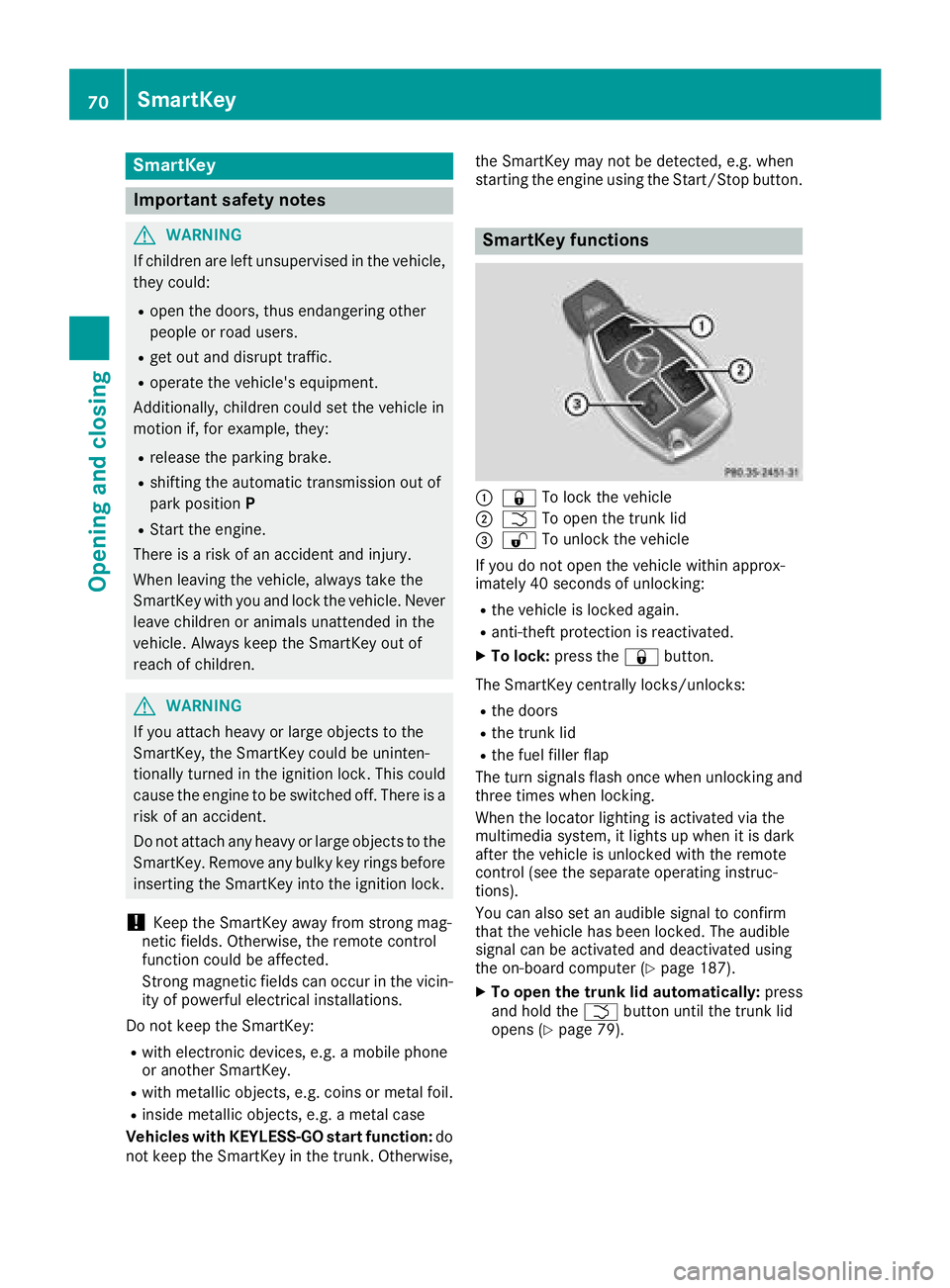
:& To lock the vehicle
;FTo open the trunk lid
=%To unlock the vehicle
If you do not open the vehicle within approx-
imately 40 seconds of unlocking:
Rthe vehicle is locked again.
Ranti-theft protection is reactivated.
XTo lock: press the &button.
The SmartKey centrally locks/unlocks:
Rthe doors
Rthe trunk lid
Rthe fuel filler flap
The turn signals flash once when unlocking and
three times when locking.
When the locator lighting is activated via the
multimedia system, it lights up when it is dark
after the vehicle is unlocked with the remote
control (see the separate operating instruc-
tions).
You can also set an audible signal to confirm
that the vehicle has been locked. The audible
signal can be activated and deactivated using
the on-board computer (
Ypage 187).
XTo open the trunk lid automatically: press
and hold the Fbutton until the trunk lid
opens (
Ypage 79).
70SmartKey
Opening and closing
Page 73 of 326
KEYLESS-GO
Gene raln otes
Bear in min dthatthe engin ecan be started by
any of th evehicl eoccupant sifthere is aSmart-
Key in th evehicle.
Lockin gand unlocking
You can start ,loc koru nlockthe vehicl eusing
KEYLESS-GO .Todothis, you only need carry th e
SmartKey wit hyou. You can combine th efunc-
tion sofK EYLESS-GO wit hthose of aconven-
tional SmartKey. Unloc kthe vehicl ebyu sing
KEYLESS-GO ,for instance ,and loc kitusingthe
& buttonont heSmartKey.
The driver's door and th edoor at whic hthe han -
dle is used ,mustb othbec losed. The SmartKey
mus tbeo utside th evehicle. Whe nlocking or
unlocking wit hKEYLESS-GO ,the distanc e
between th eSmartKey and th ecorre sponding
door handle mus tnotbe greate rtha nt hree fee t
(on em eter).
Ac heck whichperiodically establishes aradi o
connection between th evehicl eand th eSmart-
Key determine swhether avalid SmartKey is in
th ev ehicle. This occurs, for example:
Rwhen starting th eengine
Rwhile drivin g
Rwhen usingHANDS-F REEA CCESS
Rwhen th eexternal door handles are touched
Rduring convenience closin g
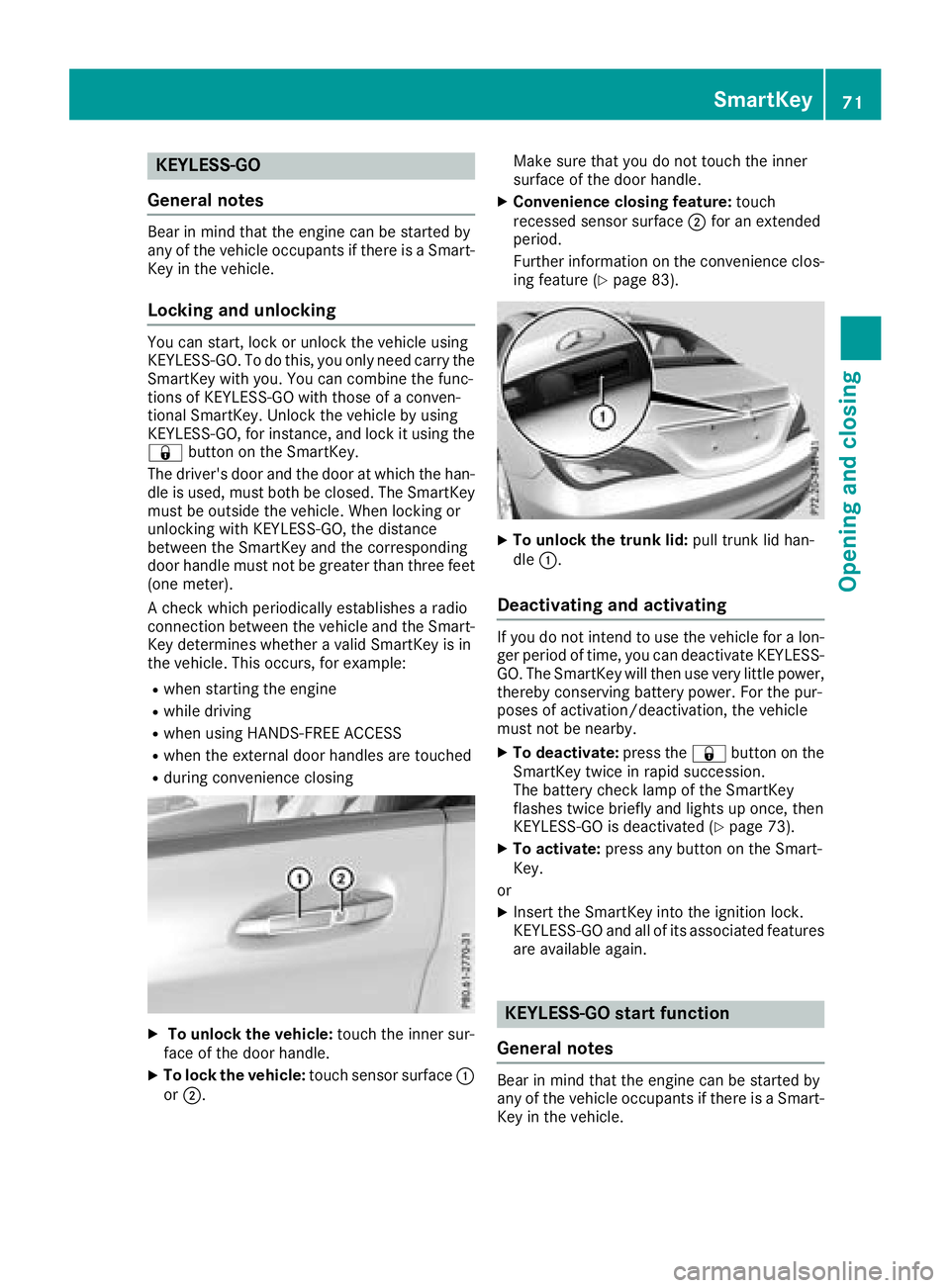
XTo unlock thevehicle: touch th einner sur -
fac eoft hedoor handle.
XTo lock th evehicle: touch sensor surfac e:
or ;. Mak
esuret haty ou do no ttou ch th einner
surfac eofthedoor handle.
XConvenienc eclosin gfeature: touch
recessed sensor surfac e; for an extended
period.
Further information on th econveni ence clos-
ing feature (
Ypage 83).
XTo unlock th etrunk lid :pull trunk lid han -
dle :.
Deactivating and activating
If you do no tinten dtou se thevehicl efor alon -
ger period of time, you can deactivat eKEYLESS -
GO. The SmartKey will then use ver ylittl ep ower,
thereby conserving battery power. Fo rthe pur-
poses of activation/deactivation ,the vehicl e
mus tnotbe nearby.
XTo deactivate: press the& buttonont he
SmartKey twice in rapi dsuccession .
The battery chec klamp of th eSmartKey
flashes twice briefl yand lights up once ,the n
KEYLESS-GO is deactivated (
Ypage 73).
XTo activate:press any butto nontheSmart -
Key.
or
XInser tthe SmartKey int othe ignition lock.
KEYLESS-GO and all of it sassociated features
are available again .
KEYLESS-GOstartfun ction
Gene raln otes
Bear in min dthatthe engin ecan be started by
any of th evehicl eoccupant sifthere is aSmart-
Key in th evehicle.
SmartKey71
Opening and closing
Z
Page 77 of 326
ProblemPossible causes/consequences andMSolutions
KEYLESS-GO is malfunctioning.
XLock/unlock the vehicle using the remote control function of the
SmartKey.
XHave the vehicle and SmartKey checked at aqualified specialist
workshop.
If the vehicle can also not be locked/unlocked using the remote con-
trol function:
XUnlock (Ypage 77) or lock (Ypage 77) the vehicle using the
mechanical key.
XHave the vehicle and SmartKey checked at aqualified specialist
workshop.
The engine cannot be
started using the Smart-
Key.The on-board voltage is too low.
XSwitch off non-essential consumers, e.g. seat heating or interior
lighting, and try to start the engine again.
If this does not work:
XCheck the starter battery and charge it if necessary (Ypage 278).
or
XJump-start the vehicle (Ypage 278).
or
XConsult aqualified specialist workshop.
The engine cannot be
started using the Start/
Stop button. The Smart-
Key is in the vehicle.The vehicle is locked.
XUnlock the vehicle and try to start the vehicle again.
The SmartKey battery is discharged or nearly discharged.
XCheck the SmartKey battery (Ypage 73) and replace it if necessary
(Ypage 73).
If this does not work:
XStart your vehicle with the SmartKey in the ignition lock.
There is interference from apowerful source of radio waves.
XStart your vehicle with the SmartKey in the ignition lock.
You have lost aSmart-
Key.XHave the SmartKey deactivated at aqualified specialist workshop.
XReport the loss immediately to the vehicle insurers.
XIf necessary, have the locks changed as well.
You have lost the
mechanical key.XReport the loss immediately to the vehicle insurers.
XIf necessary, have the locks changed as well.
SmartKey75
Opening and closing
Z
Page 78 of 326

Doors
Important safet ynotes
GWARNING
If children are lef tunsupervised in th evehicle,
they could:
Rope nthe doors ,thu se ndangerin gother
people or road users.
Rget out and disrup ttraffic .
Roperat ethe vehicle' sequipment.
Additionally, children could set th evehicle in
motion if, fo rexample, they:
Rrelease th eparking brake .
Rshiftingthe automatic transmissio nout of
par kposition P
RStart th eengine.
There is ariskofana ccidentand injury.
Whe nleavin gthe vehicle, always take th e
SmartKey wit hyou and loc kthe vehicle. Never
leav echildren or animals unattended in th e
vehicle. Always keep th eSmartKey out of
reach of children .
You should preferably plac eluggage or load sin
th ec argo compartment. Observ ethe loadin g
guidelines (
Ypage 237).
Unlockingand opening doors from
th ei nside
!
The sid ewindows will no topen/close if th e
battery is discharged or if th esidew indows
hav eicedu p. It will then no tbepossible to
close th edoor. Do no tattemp ttoforce the
doo rclosed. You could otherwise damage th e
doo rort hesidew indow.
Whe nad ooriso pened, th esidew indow on that
sid eo pens slightly. Whe nthe doo risc losed, th e
sid ew indow close sagain .
XTo unlock an dopenaf ront door: pull door
handle ;.
If th edoorisl ocked, locking knob :pop sup.
The doo risunlocke dand opens .
XTo unlock areard oor: pull up locking
knob :.
The doo risunlocke dand can be opened.
XTo ope nareard oor: pull doo rhandle ;.
You can ope nadoorfromi nsidet he vehicle
eve nifith as bee nlocked. You can only ope nthe
rea rdoors from insid ethe vehicle if they are no t
secure dbythechild-proof locks (
Ypage 60).
If th evehicle has previously bee nlocke dwith
th eS martKey from th eoutside, opening adoor
from th einsidew ill trigger th eanti-thef talarm
system. Switc hoffthea larm(
Ypage 68).
Centrally locking an dunlocking th e
vehicle from th einside
You can centrall yloc koru nlockthe vehicle from
th ei ns ide. Thi scan be useful if you wish to loc k
th ev ehicle befor epulling away, fo rexample.
XTo unlock :press butto n:.
XTo lock :press butto n;.
If all th edoors and th etrunk lid are closed, th e
vehicle locks .
76Doors
Opening andclosing