belt MERCEDES-BENZ CLK-CLASS 2000 Owner's Manual
[x] Cancel search | Manufacturer: MERCEDES-BENZ, Model Year: 2000, Model line: CLK-CLASS, Model: MERCEDES-BENZ CLK-CLASS 2000Pages: 299, PDF Size: 7.58 MB
Page 71 of 299
Restraint systems
Te ch n ica l
data Instruments
and controlsOperationDrivingInstrument
cluster displayPractical hints Car care Index
Important!
The use of infant or child restraints is required by law in
all 50 states and all Canadian provinces.
Infants and small children should be seated in an
appropriate infant or child restraint system properly
secured by a lap-shoulder belt, and that complies with
U.S. Federal Motor Vehicle Safety Standard 213 and
Canadian Motor Vehicle Safety Standard 213.
A statement by the child restraint manufacturer of
compliance with this standard can be found on the
instruction label on the restraint and in the instruction
manual provided with the restraint.
When using any infant or child restraint system, be sure
to carefully read and follow all manufacturer’s
instructions for installation and use.
Please read and observe warning labels affixed to inside
of vehicle and to infant or child restraints.
Warning!
Children 12 years old and under must never ride in
the front seat, except in a Mercedes-Benz
authorized BabySmart
TM compatible child seat,
which operates with the BabySmart
TM system
installed in the vehicle to deactivate the passenger
front airbag when it is properly installed.
Otherwise they will be struck by the airbag when it
inflates in a crash. If this happens, serious or fatal
injury can result.
According to accident statistics, children are safer
when properly restrained in the rear seating
positions than in the front seating positions.
Infants and small children must ride in back seats
and be seated in an appropriate infant or child
restraint system, which is properly secured with
the vehicle’s seat belt, fully in accordance with the
child seat manufacturer’s instructions.Infants and small children should never share a
seat belt with another occupant. During an
accident, they could be crushed between the
occupant and seat belt.
71
ProCarManuals.com
Page 72 of 299
Restraint systems
Te ch n ica l
data Instruments
and controlsOperationDrivingInstrument
cluster displayPractical hints Car care Index
Installation of infant and child restraint systems
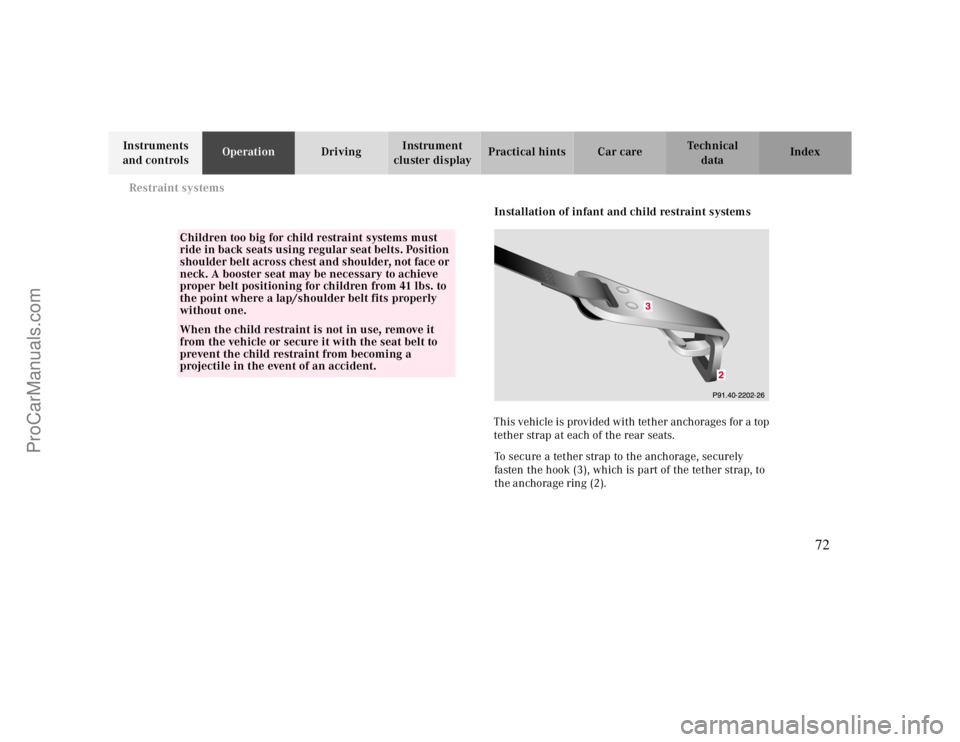
This vehicle is provided with tether anchorages for a top
tether strap at each of the rear seats.
To secure a tether strap to the anchorage, securely
fasten the hook (3), which is part of the tether strap, to
the anchorage ring (2).
Children too big for child restraint systems must
ride in back seats using regular seat belts. Position
shoulder belt across chest and shoulder, not face or
neck. A booster seat may be necessary to achieve
proper belt positioning for children from 41 lbs. to
the point where a lap/shoulder belt fits properly
without one.When the child restraint is not in use, remove it
from the vehicle or secure it with the seat belt to
prevent the child restraint from becoming a
projectile in the event of an accident.
72
ProCarManuals.com
Page 80 of 299
Instrument cluster
Te ch n ica l
data Instruments
and controlsOperationDrivingInstrument
cluster displayPractical hints Car care Index
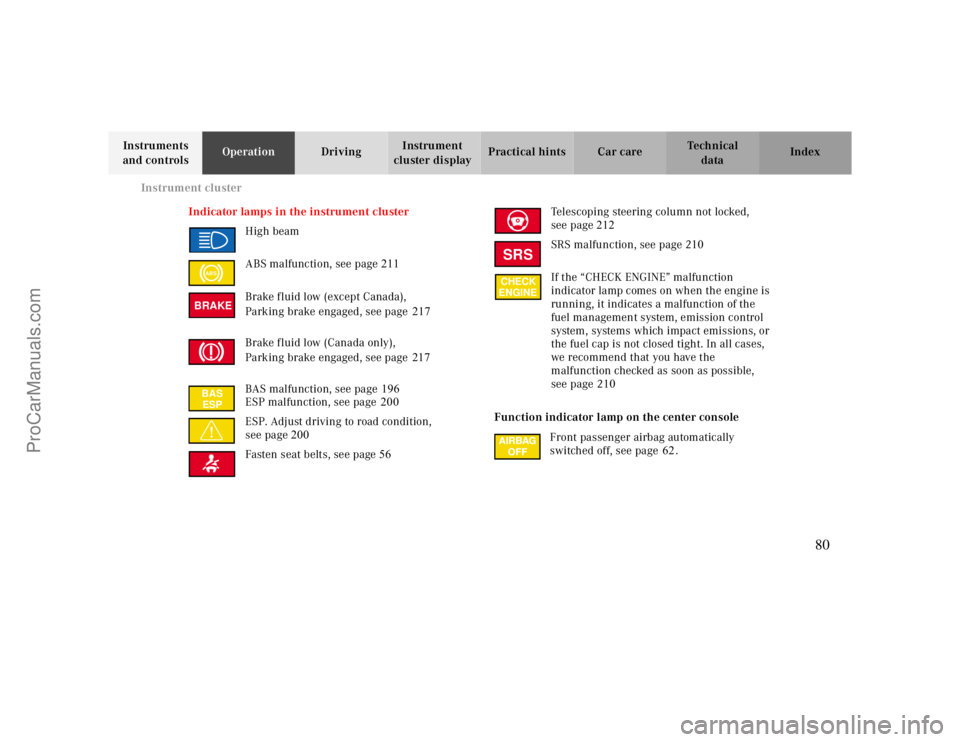
Indicator lamps in the instrument cluster
High beam
ABS malfunction, see page 211
Brake fluid low (except Canada),
Parking brake engaged, see page 217
Brake fluid low (Canada only),
Parking brake engaged, see page 217
BAS malfunction, see page 196
ESP malfunction, see page200
ESP. Adjust driving to road condition,
see page200
Fasten seat belts, see page56Telescoping steering column not locked,
see page212
SRS malfunction, see page 210
If the “CHECK ENGINE” malfunction
indicator lamp comes on when the engine is
running, it indicates a malfunction of the
fuel management system, emission control
system, systems which impact emissions, or
the fuel cap is not closed tight. In all cases,
we recommend that you have the
malfunction checked as soon as possible,
see page 210
Function indicator lamp on the center console
Front passenger airbag automatically
switched off, see page 62.
ABSBRAKEBAS
ESP
SRSCHECK
ENGINE
80
ProCarManuals.com
Page 207 of 299

Instrument cluster display
BRAKE FLUID 217
PARKING BRAKE 218
Malfunction and indicator lamps in the
instrument cluster 208ENGINE FAN 218
On-board diagnostic system
Check engine malfunction indicator lamp
208COOLANT (coolant level) 219
Brake warning lamp 209 COOLANT (coolant temp.) 220
Supplemental restraint system STEER. WHEEL ADJUST. 221
(SRS) indicator lamp 210 LIGHT SENSOR 221
Fuel reserve and fuel cap LIGHTING SYSTEM 222
placement warning 210 WASHER FLUID 223
Electronic stability program(ESP) OIL TEMP. (engine oil temperature) 224
warning lamp 211 ENGINE OIL LEVEL 224
BAS/ESP malfunction indicator lamp 211 ELEC. STABIL. PROG. (Electronic
ABS malfunction indicator lamp 211 stability program) 226
Telescoping steering column –
indicator lamp 212
Seat belt warning lamp 212
Malfunction and indicator lamps in the
center console 212
AIRBAG OFF indicator lamp 212
Roll bar warning lamp 221
Malfunction and warning messages in
the multifunction display 213
DISPLAY DEFECTIVE 214
BATTERY/ALTERNATOR 215
ABS-SYSTEM 216
BRAKE ASSIST 216
BRAKE LINING WEAR 217
207
ProCarManuals.com
Page 210 of 299
Malfunction and indicator lamps
Te ch n ica l
data Instruments
and controlsOperation DrivingInstrument
cluster displayPractical hints Car care Index
Supplemental restraint system (SRS) indicator lamp
The operational readiness of the airbag
system is verified by the indicator lamp
“SRS” in the instrument cluster when
turning the electronic key in steering lock to position 1
or 2. If no malfunction is detected, the lamp will go out
after approximately 4 seconds; after the lamp goes out,
the system continues to monitor the components and
circuitry of the airbag system and will indicate a
malfunction by coming on again.
See page for notes on airbags, see page63 64 for belt
tensioners and page 70 for infant and child seat
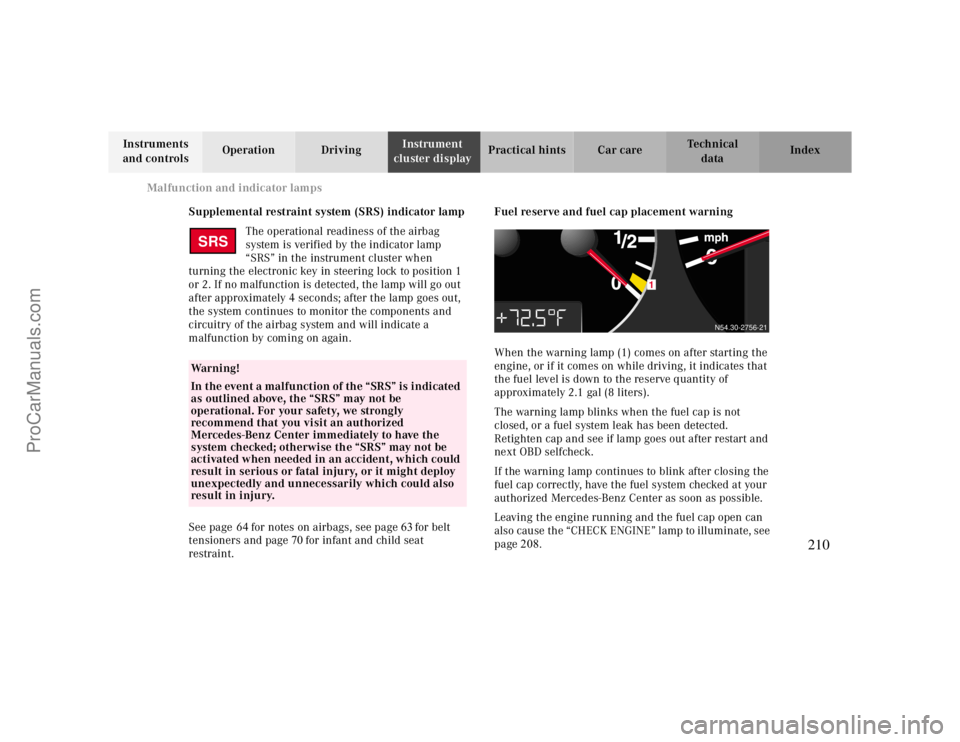
restraint.Fuel reserve and fuel cap placement warning
When the warning lamp (1) comes on after starting the
engine, or if it comes on while driving, it indicates that
the fuel level is down to the reserve quantity of
approximately 2.1 gal (8 liters).
The warning lamp blinks when the fuel cap is not
closed, or a fuel system leak has been detected.
Retighten cap and see if lamp goes out after restart and
next OBD selfcheck.
If the warning lamp continues to blink after closing the
fuel cap correctly, have the fuel system checked at your
authorized Mercedes-Benz Center as soon as possible.
Leaving the engine running and the fuel cap open can
also cause the “CHECK ENGINE” lamp to illuminate, see
page208.
Warning!
In the event a malfunction of the “SRS” is indicated
as outlined above, the “SRS” may not be
operational. For your safety, we strongly
recommend that you visit an authorized
Mercedes-Benz Center immediately to have the
system checked; otherwise the “SRS” may not be
activated when needed in an accident, which could
result in serious or fatal injury, or it might deploy
unexpectedly and unnecessarily which could also
result in injury.SRS
1
N54.30-2756-21
210
ProCarManuals.com
Page 212 of 299
Malfunction and indicator lamps
Te ch n ica l
data Instruments
and controlsOperation DrivingInstrument
cluster displayPractical hints Car care Index
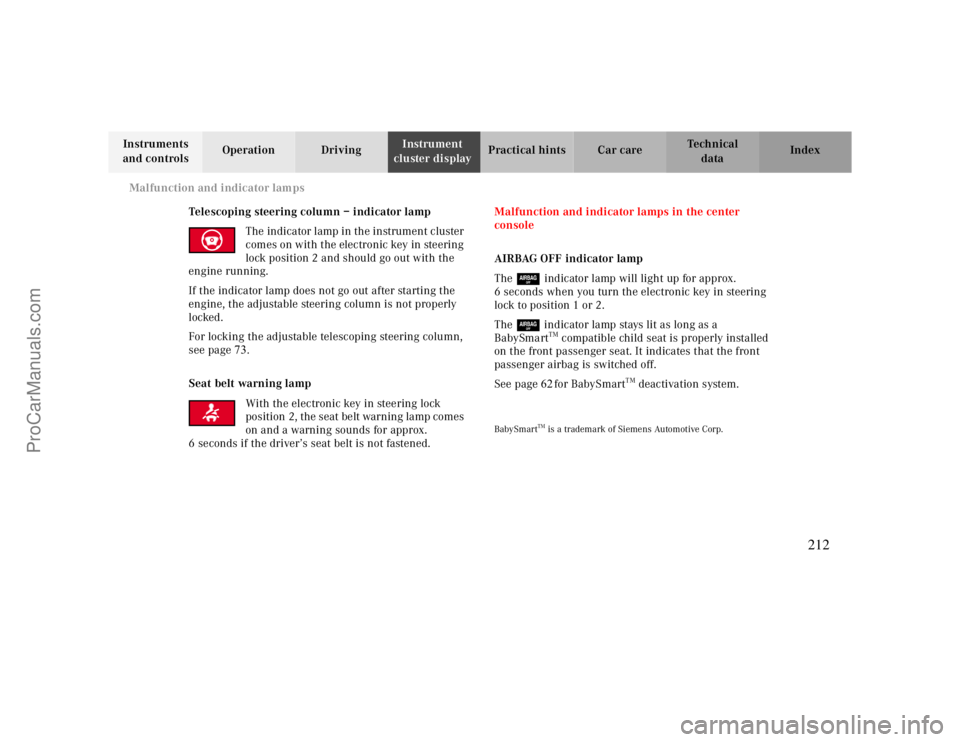
Telescoping steering column – indicator lamp
The indicator lamp in the instrument cluster
comes on with the electronic key in steering
lock position 2 and should go out with the
engine running.
If the indicator lamp does not go out after starting the
engine, the adjustable steering column is not properly
locked.
For locking the adjustable telescoping steering column,
see page
73.
Seat belt warning lamp
With the electronic key in steering lock
position 2, the seat belt warning lamp comes
on and a warning sounds for approx.
6 seconds if the driver’s seat belt is not fastened.Malfunction and indicator lamps in the center
console
AIRBAG OFF indicator lamp
The 7 indicator lamp will light up for approx.
6 seconds when you turn the electronic key in steering
lock to position 1 or 2.
The 7 indicator lamp stays lit as long as a
BabySmart
TM compatible child seat is properly installed
on the front passenger seat. It indicates that the front
passenger airbag is switched off.
See page62for BabySmart
TM deac tiva tio n system.
BabySmart
TM is a trademark of Siemens Automotive Corp.
212
ProCarManuals.com
Page 215 of 299
Malfunction and warning messages
Te ch n ica l
data Instruments
and controlsOperation DrivingInstrument
cluster displayPractical hints Car care Index
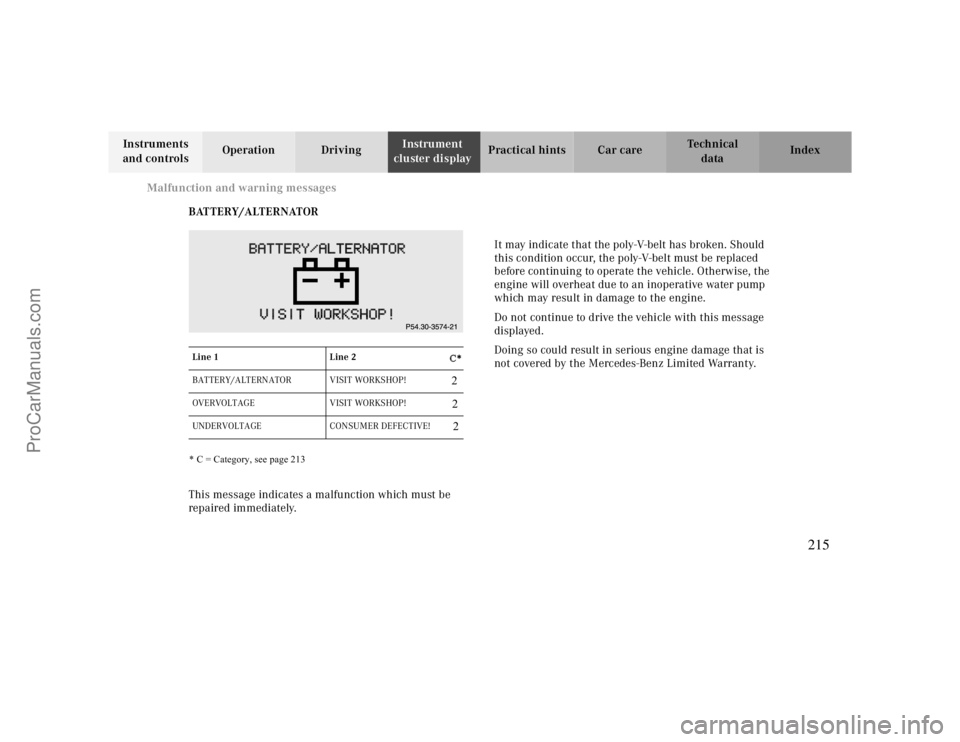
BATTERY/ALTERNATOR
This message indicates a malfunction which must be
repaired immediately.It may indicate that the poly-V-belt has broken. Should
this condition occur, the poly-V-belt must be replaced
before continuing to operate the vehicle. Otherwise, the
engine will overheat due to an inoperative water pump
which may result in damage to the engine.
Do not continue to drive the vehicle with this message
displayed.
Doing so could result in serious engine damage that is
not covered by the Mercedes-Benz Limited Warranty.
Line 1 Line 2
BATTERY/ALTERNATOR VISIT WORKSHOP!
OVERVOLTAGE V ISIT WORKS HOP !
UNDERVOLTAGE CONSUMER DEFECTIVE!
2 C*
* C = Category, see page 2132 2
215
ProCarManuals.com
Page 220 of 299
Malfunction and warning messages
Te ch n ica l
data Instruments
and controlsOperation DrivingInstrument
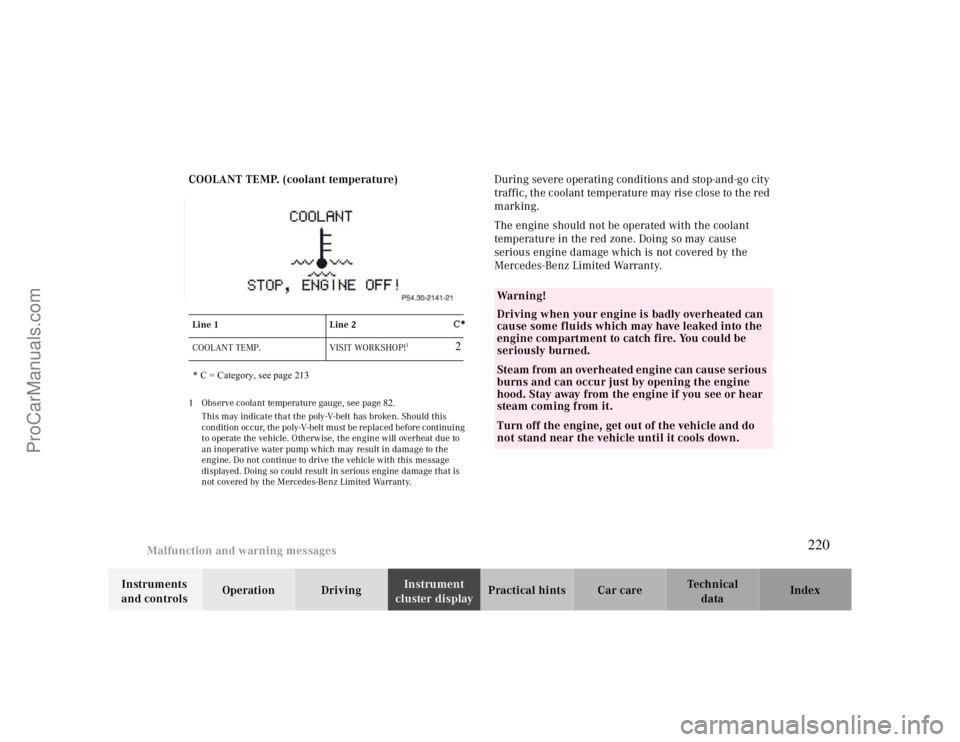
cluster displayPractical hints Car care Index COOLANT TEMP. (coolant temperature)
1 Observe coolant temperature gauge, see page 82.
This may indicate that the poly-V-belt has broken. Should this
condition occur, the poly-V-belt must be replaced before continuing
to operate the vehicle. Otherwise, the engine will overheat due to
an inoperative water pump which may result in damage to the
engine. Do not continue to drive the vehicle with this message
displayed. Doing so could result in serious engine damage that is
not covered by the Mercedes-Benz Limited Warranty.
During severe operating conditions and stop-and-go city
traffic, the coolant temperature may rise close to the red
marking.
The engine should not be operated with the coolant
temperature in the red zone. Doing so may cause
serious engine damage which is not covered by the
Mercedes-Benz Limited Warranty.
Line 1 Line 2
COOLANT TEMP. VISIT WORKSHOP!
1
Wa r n i n g !
Driving when your engine is badly overheated can
cause some fluids which may have leaked into the
engine compartment to catch fire. You could be
seriously burned.Steam from an overheated engine can cause serious
burns and can occur just by opening the engine
hood. Stay away from the engine if you see or hear
steam coming from it.Turn off the engine, get out of the vehicle and do
not stand near the vehicle until it cools down. 2
C*
* C = Category, see page 213
220
ProCarManuals.com
Page 271 of 299

Vehicle careCleaning and care of the vehicle 272
Engine cleaning 273
Vehicle washing 273
Plastic and rubber parts 273
Tar stains 274
Window cleaning 274
Headlamps, taillamps, turn signal lenses 274
Wiper blade 274
Seat belts 274
Headliner and shelf below rear window 275
Instrument cluster 275
Steering wheel and gear selector lever 275
Hard plastic trim items 275
Upholstery 275
Paintwork, painted body components 276
Light alloy wheels 276
Ornamental Moldings 276
271
ProCarManuals.com
Page 273 of 299
Cleaning and care of the vehicle
Te ch n ica l
data Instruments
and controlsOperation DrivingInstrument
cluster displayPractical hintsCar careIndex Scratches, corrosive deposits, corrosion or damage due
to negligent or incorrect care cannot always be removed
or repaired with the car-care products recommended
here. In such cases it is best to seek aid at your
authorized Mercedes-Benz Center.
The following topics deal with the cleaning and care of
your vehicle and give important “how-to” information as
well as references to Mercedes-Benz approved car-care
products.
Additional information can be found in the booklet titled
“Vehicle Care Guide”.
Engine cleaning
Prior to cleaning the engine compartment make sure to
protect electrical components and connectors from the
intrusion of water and cleaning agents.
Corrosion protection, such as MB Anticorrosion Wax
should be applied to the engine compartment after
every engine cleaning. Before applying, all control
linkage bushings and joints should be lubricated. The
poly-V-belt and all pulleys should be protected from any
wax.Vehicle washing
Do not use hot water or wash your vehicle in direct
sunlight. Use only a mild car wash detergent, such as
Mercedes-Benz approved Car Shampoo.
Thoroughly spray the vehicle with a diffused jet of
water. Direct only a very weak spray towards the
ventilation intake. Use plenty of water and rinse the
sponge and chamois frequently.
Rinse with clear water and thoroughly wipe dry with a
chamois. Do not allow cleaning agents to dry on the
finish.
In the winter, thoroughly remove all traces of road salt
as soon as possible.
When washing the underbody, do not forget to clean the
inner sides of the wheels.
Plastic and rubber parts
Do not use oil or wax on these parts.
273
ProCarManuals.com