key MERCEDES-BENZ CLK-CLASS 2001 Owners Manual
[x] Cancel search | Manufacturer: MERCEDES-BENZ, Model Year: 2001, Model line: CLK-CLASS, Model: MERCEDES-BENZ CLK-CLASS 2001Pages: 325, PDF Size: 8.4 MB
Page 228 of 325
225 Contents – Instrument cluster display
Te ch n ica l
data Instruments
and controlsOperation DrivingInstrument
cluster displayPractical hints Car care Index
Instrument cluster displayMalfunction and
indicator lamps in the
instrument cluster ....................226
On-board diagnostic system
Check engine malfunction
indicator lamp .............................226
Brake warning lamp ..................227
Supplemental restraint system
(SRS) indicator lamp ..................228
Fuel reserve and fuel cap
placement warning ....................228
Electronic stability program
(ESP) — warning lamp ...............229
BAS/ESP malfunction
indicator lamp .............................229
ABS malfunction
indicator lamp .............................229Telescoping steering column –
indicator lamp ............................ 230
Seat belt warning lamp ............. 230
Malfunction and indicator lamps in
the center console .................... 230
AIRBAG OFF
indicator lamp ............................ 230
Malfunction and warning
messages in the
multifunction display .............. 231
DISPLAY DEFECTIVE
(engine control unit) ................. 232
DISPLAY DEFECTIVE
(several systems) ....................... 232
BATTERY/ALTERNATOR .......... 233
ABS-SYSTEM .............................. 234
BRAKE ASSIST ........................... 234
BRAKE LINING WEAR .............. 235
BRAKE FLUID ............................ 235PARKING BRAKE .......................236
ENGINE FAN ...............................236
COOLANT
(coolant level) .............................237
COOLANT TEMP.
(coolant temperature) ................238
LIGHTING SYSTEM ....................239
LIGHT SENSOR ...........................240
STEER. WHEEL ADJUST. ...........240
ENGINE OIL LEVEL ................... 241
ELEC. STABIL. PROG.
(Electronic stability
program) ......................................242
REMOVE KEY .............................242
WASHER FLUID .........................243
TELE AID .....................................244
ProCarManuals.com
Page 229 of 325
226 Malfunction and indicator lamps
Te ch n ica l
data Instruments
and controlsOperation DrivingInstrument
cluster displayPractical hints Car care Index
Malfunction and indicator lamps
in the instrument cluster
General information:
If a bulb in the instrument cluster fails to light up
during the bulb self-check when turning the electronic
key in steering lock to position 2, have it checked and
replaced if necessary.
On-board diagnostic system
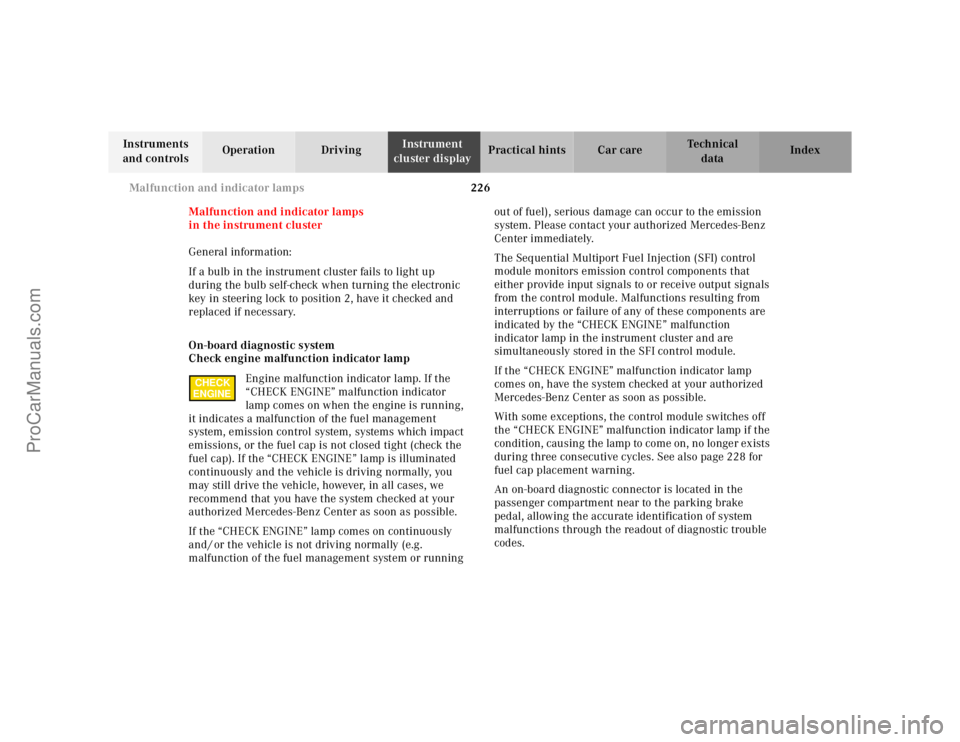
Check engine malfunction indicator lamp
Engine malfunction indicator lamp. If the
“CHECK ENGINE” malfunction indicator
lamp comes on when the engine is running,
it indicates a malfunction of the fuel management
system, emission control system, systems which impact
emissions, or the fuel cap is not closed tight (check the
fuel cap). If the “CHECK ENGINE” lamp is illuminated
continuously and the vehicle is driving normally, you
may still drive the vehicle, however, in all cases, we
recommend that you have the system checked at your
authorized Mercedes-Benz Center as soon as possible.
If the “CHECK ENGINE” lamp comes on continuously
and / or the vehicle is not driving normally (e.g.
malfunction of the fuel management system or running out of fuel), serious damage can occur to the emission
system. Please contact your authorized Mercedes-Benz
Center immediately.
The Sequential Multiport Fuel Injection (SFI) control
module monitors emission control components that
either provide input signals to or receive output signals
from the control module. Malfunctions resulting from
interruptions or failure of any of these components are
indicated by the “CHECK ENGINE” malfunction
indicator lamp in the instrument cluster and are
simultaneously stored in the SFI control module.
If the “CHECK ENGINE” malfunction indicator lamp
comes on, have the system checked at your authorized
Mercedes-Benz Center as soon as possible.
With some exceptions, the control module switches off
the “CHECK ENGINE” malfunction indicator lamp if the
condition, causing the lamp to come on, no longer exists
during three consecutive cycles. See also page 228 for
fuel cap placement warning.
An on-board diagnostic connector is located in the
passenger compartment near to the parking brake
pedal, allowing the accurate identification of system
malfunctions through the readout of diagnostic trouble
codes.
CHECK
ENGINE
ProCarManuals.com
Page 231 of 325
228 Malfunction and indicator lamps
Te ch n ica l
data Instruments
and controlsOperation DrivingInstrument
cluster displayPractical hints Car care Index
Supplemental restraint system (SRS) indicator lamp
The operational readiness of the airbag
system is verified by the indicator lamp
“SRS” in the instrument cluster when
turning the electronic key in steering lock to position 1
or 2. If no malfunction is detected, the lamp will go out
after approximately 4 seconds; after the lamp goes out,
the system continues to monitor the components and
circuitry of the airbag system and will indicate a
malfunction by coming on again.
See page 66 for notes on airbags, see page 65 for belt
tensioners and page 74 for infant and child seat
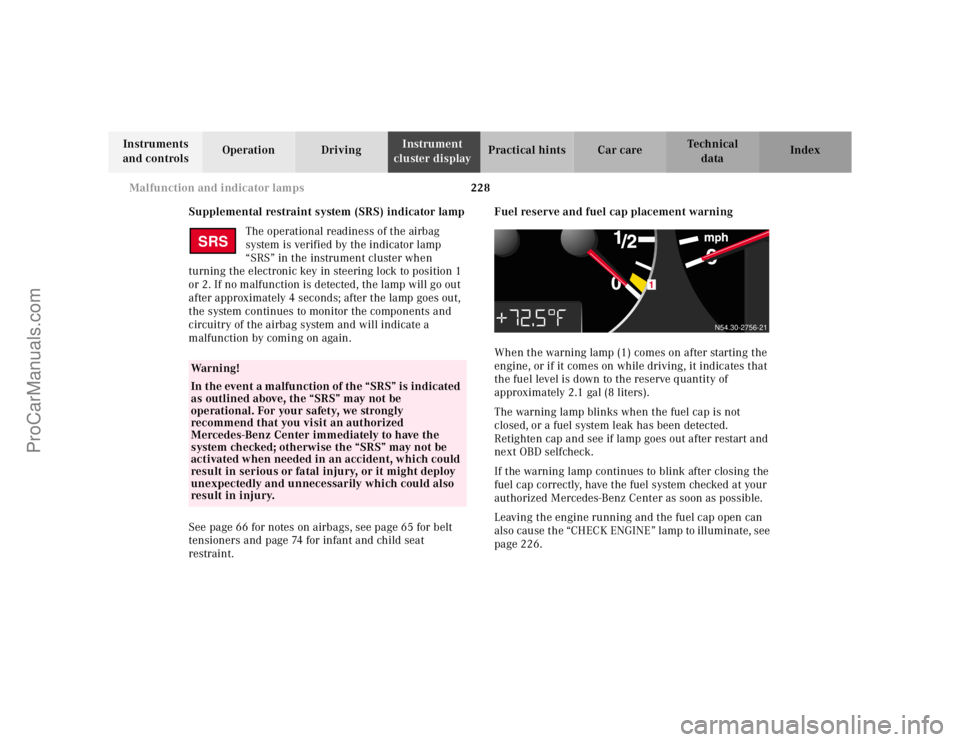
restraint.Fuel reserve and fuel cap placement warning
When the warning lamp (1) comes on after starting the
engine, or if it comes on while driving, it indicates that
the fuel level is down to the reserve quantity of
approximately 2.1 gal (8 liters).
The warning lamp blinks when the fuel cap is not
closed, or a fuel system leak has been detected.
Retighten cap and see if lamp goes out after restart and
next OBD selfcheck.
If the warning lamp continues to blink after closing the
fuel cap correctly, have the fuel system checked at your
authorized Mercedes-Benz Center as soon as possible.
Leaving the engine running and the fuel cap open can
also cause the “CHECK ENGINE” lamp to illuminate, see
page 226.
Wa r n i n g !
In the event a malfunction of the “SRS” is indicated
as outlined above, the “SRS” may not be
operational. For your safety, we strongly
recommend that you visit an authorized
Mercedes-Benz Center immediately to have the
system checked; otherwise the “SRS” may not be
activated when needed in an accident, which could
result in serious or fatal injury, or it might deploy
unexpectedly and unnecessarily which could also
result in injury.SRS
1
N54.30-2756-21
ProCarManuals.com
Page 232 of 325
229 Malfunction and indicator lamps
Te ch n ica l
data Instruments
and controlsOperation DrivingInstrument
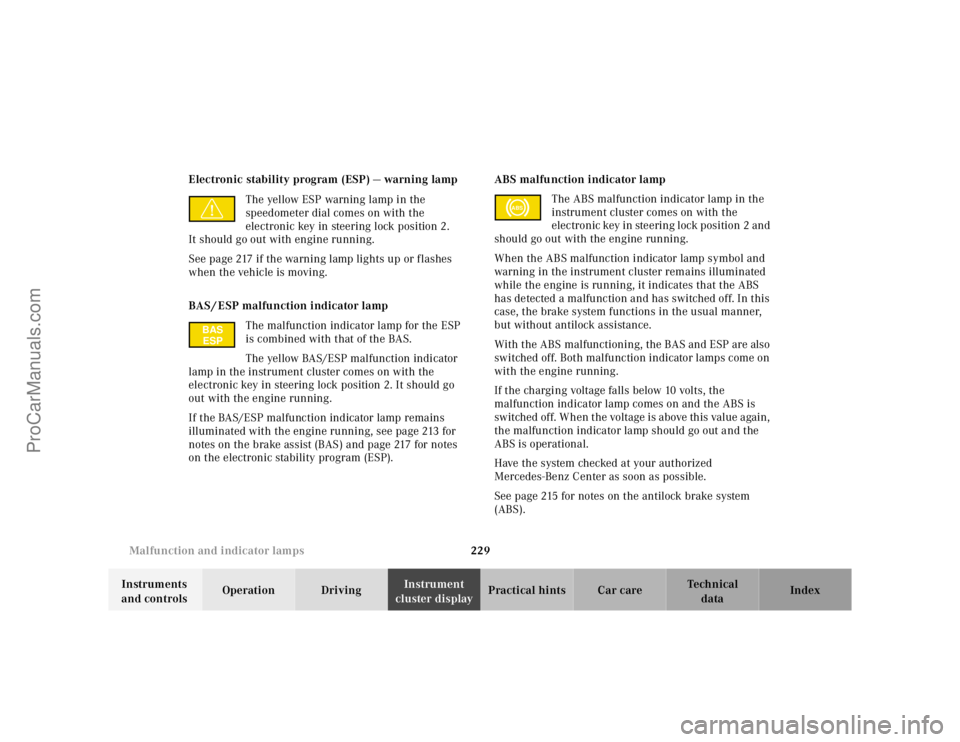
cluster displayPractical hints Car care Index Electronic stability program (ESP) — warning lamp
The yellow ESP warning lamp in the
speedometer dial comes on with the
electronic key in steering lock position 2.
It should go out with engine running.
See page 217 if the warning lamp lights up or f lashes
when the vehicle is moving.
BAS / ESP malfunction indicator lamp
The malfunction indicator lamp for the ESP
is combined with that of the BAS.
The yellow BAS/ESP malfunction indicator
lamp in the instrument cluster comes on with the
electronic key in steering lock position 2. It should go
out with the engine running.
If the BAS/ESP malfunction indicator lamp remains
illuminated with the engine running, see page 213 for
notes on the brake assist (BAS) and page 217 for notes
on the electronic stability program (ESP).ABS malfunction indicator lamp
The ABS malfunction indicator lamp in the
instrument cluster comes on with the
electronic key in steering lock position 2 and
should go out with the engine running.
When the ABS malfunction indicator lamp symbol and
warning in the instrument cluster remains illuminated
while the engine is running, it indicates that the ABS
has detected a malfunction and has switched off. In this
case, the brake system functions in the usual manner,
but without antilock assistance.
With the ABS malfunctioning, the BAS and ESP are also
switched off. Both malfunction indicator lamps come on
with the engine running.
If the charging voltage falls below 10 volts, the
malfunction indicator lamp comes on and the ABS is
switched off. When the voltage is above this value again,
the malfunction indicator lamp should go out and the
ABS is operational.
Have the system checked at your authorized
Mercedes-Benz Center as soon as possible.
See page 215 for notes on the antilock brake system
(ABS).
BAS
ESP
ABS
ProCarManuals.com
Page 233 of 325
230 Malfunction and indicator lamps
Te ch n ica l
data Instruments
and controlsOperation DrivingInstrument
cluster displayPractical hints Car care Index
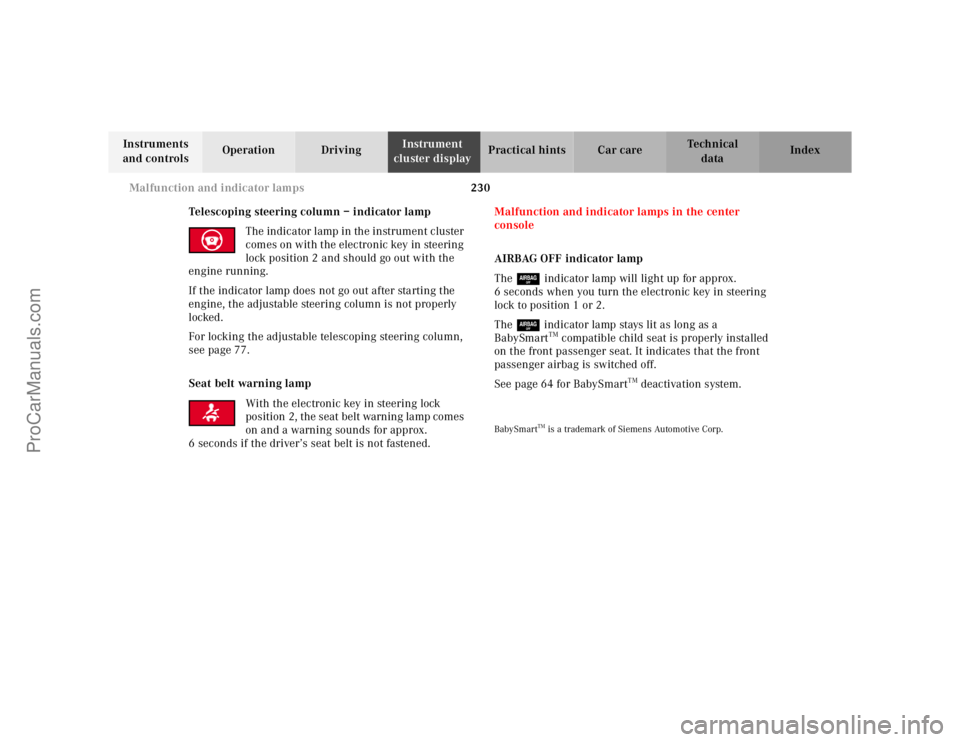
Telescoping steering column – indicator lamp
The indicator lamp in the instrument cluster
comes on with the electronic key in steering
lock position 2 and should go out with the
engine running.
If the indicator lamp does not go out after starting the
engine, the adjustable steering column is not properly
locked.
For locking the adjustable telescoping steering column,
see page 77.
Seat belt warning lamp
With the electronic key in steering lock
position 2, the seat belt warning lamp comes
on and a warning sounds for approx.
6 seconds if the driver’s seat belt is not fastened.Malfunction and indicator lamps in the center
console
AIRBAG OFF indicator lamp
The 7 indicator lamp will light up for approx.
6 seconds when you turn the electronic key in steering
lock to position 1 or 2.
The 7 indicator lamp stays lit as long as a
BabySmart
TM compatible child seat is properly installed
on the front passenger seat. It indicates that the front
passenger airbag is switched off.
See page 64 for BabySmart
TM deactivation system.
BabySmart
TM is a trademark of Siemens Automotive Corp.
ProCarManuals.com
Page 243 of 325
240 Malfunction and warning messages
Te ch n ica l
data Instruments
and controlsOperation DrivingInstrument
cluster displayPractical hints Car care Index
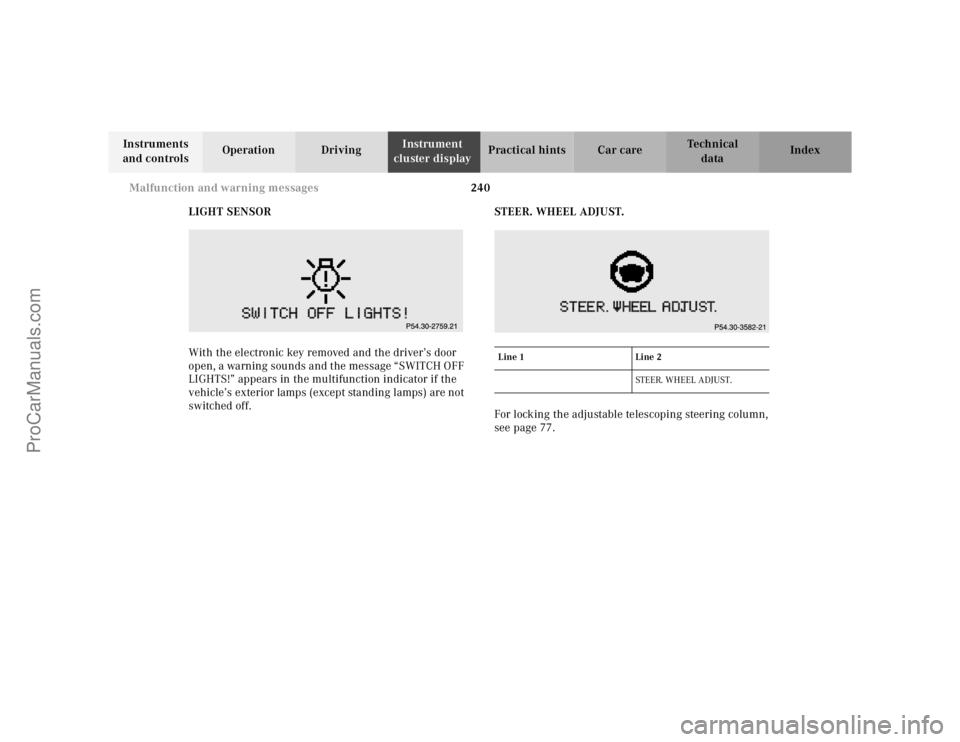
LIGHT SENSOR
With the electronic key removed and the driver’s door
open, a warning sounds and the message “SWITCH OFF
LIGHTS!” appears in the multifunction indicator if the
vehicle’s exterior lamps (except standing lamps) are not
switched off.STEER. WHEEL ADJUST.
For locking the adjustable telescoping steering column,
see page 77.
Line 1 Line 2
STEER. WHEEL ADJUST.
ProCarManuals.com
Page 245 of 325
242 Malfunction and warning messages
Te ch n ica l
data Instruments
and controlsOperation DrivingInstrument
cluster displayPractical hints Car care Index
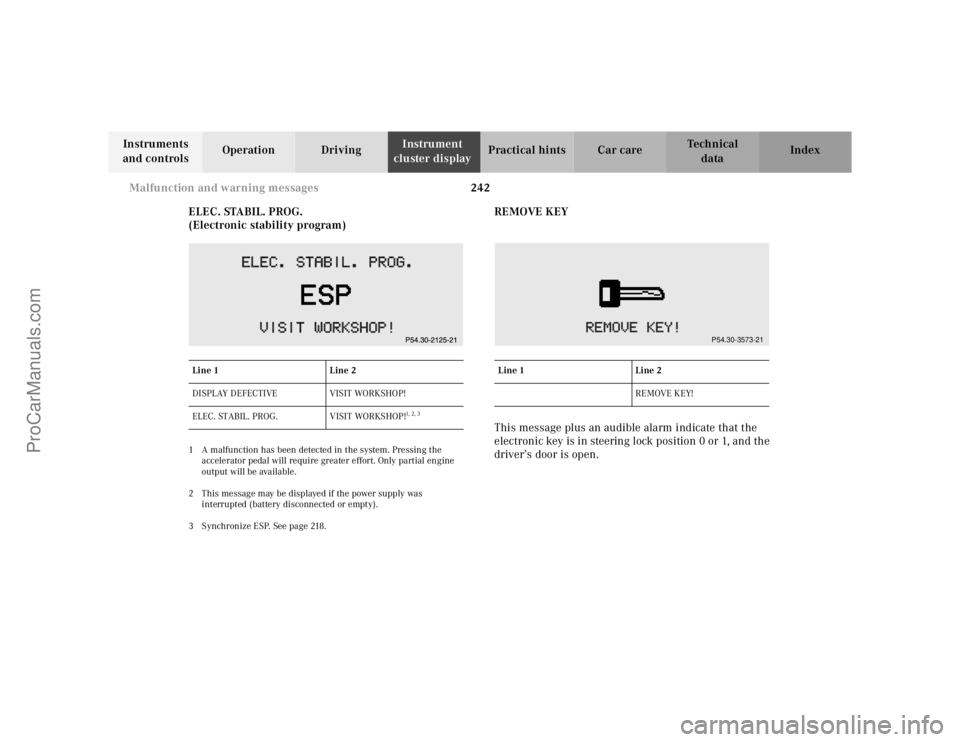
ELEC. STABIL. PROG.
(Electronic stability program)
1 A malfunction has been detected in the system. Pressing the
accelerator pedal will require greater effort. Only partial engine
output will be available.
2 This message may be displayed if the power supply was
interrupted (battery disconnected or empty).
3 Synchronize ESP. See page 218.
REMOVE KEY
This message plus an audible alarm indicate that the
electronic key is in steering lock position 0 or 1, and the
driver’s door is open.
Line 1 Line 2
DISPLAY DEFECTIVE VISIT WORKSHOP!
ELEC. STABIL. PROG. VISIT WORKSHOP!
1, 2, 3
Line 1 Line 2
RE MOVE KEY!
P54.30-3573-21
ProCarManuals.com
Page 248 of 325
245 Contents – Practical hints
Te ch n ica l
data Instruments
and controlsOperation DrivingInstrument
cluster displayPractical hintsCar care Index
Practical hintsFirst aid kit .....................................246
Shelf below rear window ..............246
Stowing things in the vehicle ......246
Fuses ................................................247
Hood .................................................249
Checking engine
oil level ....................................... 251
Automatic transmission
fluid level ...................................252
Coolant level ...................................252
Adding coolant ...........................253
Windshield washer/headlamp
cleaning system .........................254
Windshield and
headlamp washer
fluid mixing ratio .......................254Spare wheel, vehicle tools,
storage compartment ............... 255
Vehicle jack .................................... 256
Wheels ............................................ 257
Tire replacement ....................... 257
Rotating wheels ......................... 258
Spare wheel .................................... 259
Changing wheels ........................... 260
Tire inflation pressure ................. 265
Battery ............................................. 266
Jump starting ................................. 268
Towing the vehicle ........................ 270
Transmission selector lever,
manually unlocking .................. 272
Exterior lamps ............................... 273
Headlamp assembly ...................274
Taillamp assemblies ...................276Changing batteries in the
electronic main key .................. 281
Synchronizing
remote control ............................283
Emergency operation of
sliding/pop-up roof ...................284
Manual release for
fuel filler flap .............................285
Replacing wiper
blade insert ................................285
Trunk lamp .....................................287
Roof rack .........................................287
ProCarManuals.com
Page 270 of 325
267 Battery
Te ch n ica l
data Instruments
and controlsOperation DrivingInstrument
cluster displayPractical hintsCar care Index Therefore, we strongly recommend that you have the
battery charge checked frequently, and corrected if
necessary, especially if you use the vehicle less than
approximately 200 miles (300 km) per month,
mostly for short distance trips, or if it is not used for
long periods of time.
Only charge a battery with a battery charger after the
battery has been disconnected from the vehicle’s
electrical circuit.
Always disconnect the battery negative lead first and
connect last.
When removing and connecting the battery, always
make sure that all electrical consumers are off and the
electronic key is in steering lock position 0. The battery
and its filler caps must always be securely installed
when the vehicle is in operation. During removal and
installation always protect the disconnected battery
positive (+) terminal with the cover attached to the
battery.
While the engine is running the battery terminal clamps
must not be loosened or detached, otherwise the
generator and other electronic components would be
damaged.Note:
After reconnecting the battery also set the clock (see
page 106), resynchronize the front seats (see page 49),
front seat head restraints (see page 49), the express
feature of the power windows (see page 147), the
sliding/pop-up roof (see page 149)and the electronic
stability program (ESP) (see page 218).
Battery recycling
Batteries contain material that can harm the
environment with improper disposal.
Large 12 Volt storage batteries contain lead.
Recycling of batteries is the preferred method of
disposal.
Many states require sellers of batteries to accept old
batteries for recycling.
ProCarManuals.com
Page 273 of 325
270 Towing
Te ch n ica l
data Instruments
and controlsOperation DrivingInstrument
cluster displayPractical hintsCar care Index
Towing the vehicle
Important!
When towing the vehicle, please, note the following:
With the automatic central locking activated and the
electronic key in steering lock position 2, the vehicle
d oors l ock if th e l ef t front w heel as well as t he righ t rear
wheel are turning at vehicle speeds of approx. 9 mph
(15 km/h) or more.
To prevent the vehicle door locks from locking,
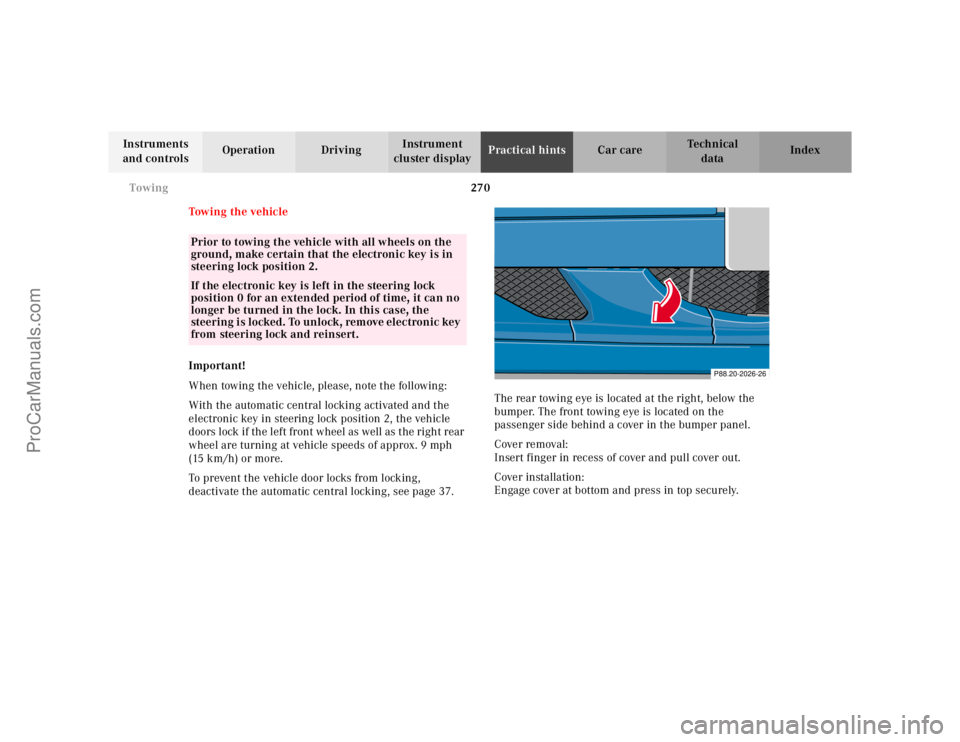
deactivate the automatic central locking, see page 37.The rear towing eye is located at the right, below the
bumper. The front towing eye is located on the
passenger side behind a cover in the bumper panel.
Cover removal:
Insert finger in recess of cover and pull cover out.
Cover installation:
Engage cover at bottom and press in top securely.
Prior to towing the vehicle with all wheels on the
ground, make certain that the electronic key is in
steering lock position 2.If the electronic key is left in the steering lock
position 0 for an extended period of time, it can no
longer be turned in the lock. In this case, the
steering is locked. To unlock, remove electronic key
from steering lock and reinsert.
P88.20-2026-26
ProCarManuals.com