fuel MERCEDES-BENZ CLK-CLASS 2002 Owner's Guide
[x] Cancel search | Manufacturer: MERCEDES-BENZ, Model Year: 2002, Model line: CLK-CLASS, Model: MERCEDES-BENZ CLK-CLASS 2002Pages: 341, PDF Size: 10.67 MB
Page 271 of 341
268 Tires, Wheels
Te ch n i c a l
data Instruments
and controlsOperation DrivingInstrument
cluster displayPractical hintsCar care Index
Notes:
Before storing the jack, the jack arm must be lowered
almost to the base of the jack.
For proper storage of vehicle jack see page 257.Tire inflation pressure
A table (see fuel filler flap) lists the tire inflation
pressures specified for Mercedes-Benz recommended
tires as well as for the varying operating conditions.
Important!
Tire pressure changes by approx. 1.5 psi (0.1 bar) per
18
°F (10
°C) of air temperature change. Keep this in
mind when checking tire pressure inside a garage –
especially in the winter.
Example:
If garage temperature = approx. +68
°F (+20
°C) and
ambient temperature = approx. +32
°F (0
°C) then the
adjusted air pressure = specified air pressure +3 psi
(+0.2 bar).
Wa r n i n g !
CLK 320 with Sport Package:
The dimensions of the spare wheel are different
from those of the road wheels. As a result, the
vehicle handling characteristics change when
driving with a spare wheel mounted.
CLK 430:
The dimensions of the spare wheel are different
from those of the road wheels for the rear axle. As a
result, the vehicle handling characteristics change
when driving with a spare wheel mounted on the
rear axle.The spare wheel should only be used temporarily,
and replaced with a regular road wheel as quick as
possible.When using the spare wheel, do not exceed vehicle
speed of 50 mph (80 km/h).
ProCarManuals.com
Page 272 of 341
269 Tires, Wheels
Te ch n i c a l
data Instruments
and controlsOperation DrivingInstrument
cluster displayPractical hintsCar care Index The pressures listed for light loads are minimum values
offering high driving comfort.
Increased inflation pressures listed for heavier loads
may also be used for light loads. These higher pressures
produce favorable handling characteristics. The ride of
the vehicle, however, will be somewhat harder. Never
exceed the max. values or inflate tires below the min.
values listed in the fuel filler flap.
Tire temperature and pressure increase with the vehicle
speed. Tire pressure should therefore only be checked
and corrected on cold tires. Correct tire pressure in
warm tires only if pressure has dropped below the
pressure listed in the table and the respective operating
conditions are taken into consideration.
An underinflated tire due to a slow leak (e.g. due to a
nail in the tire) may cause damage such as tread
separation, bulging etc.. Regular tire pressure checks
(including the spare tire) at intervals of no more than
14 days are therefore essential.If a tire constantly loses air, it should be inspected for
damage.
The spare tire should be checked periodically for
condition and inflation. Spare tire will age and become
worn over time even if never used, and thus should be
inspected and replaced when necessary.
Wa r n i n g !Do not overload the tires by exceeding the specified
vehicle capacity weight (as indicated by the label
on the driver’s door latch post). Overloading the
tires can overheat them, possibly causing a
blowout.
Follow recommended inflation pressures.
Do not overinflate tires. Overinflated tires can
result in sudden deflation (blowout) because they
are more likely to become punctured or damaged
by road debris, potholes etc.
Do not underinflate tires. Underinflated tires wear
unevenly, adversely affect handling and fuel
economy, and are more likely to fail from being
overheated.
ProCarManuals.com
Page 276 of 341
273 Towing
Te ch n i c a l
data Instruments
and controlsOperation DrivingInstrument
cluster displayPractical hintsCar care Index Important!
5. Start engine of the vehicle with the charged battery
and run at high idle. Make sure the cables are not
on or near pulleys, fans, or other parts that move
when the engine is started. Allow the discharged
battery to charge for a few minutes. Start engine of
the disabled vehicle in the usual manner.
6. After the engine has started, remove jumper cables
by exactly reversing the above installation
sequence, starting with the last connection made
first. When removing each clamp, make sure that it
does not touch any other metal while the other end
is still attached to a battery.
Notes:
If engine does not run after several unsuccessful
starting attempts, have it checked at the nearest
authorized Mercedes-Benz Center.
Excessive unburned fuel generated by repeated failed
starting attempts may damage the catalytic converter.Tow i n g t h e v e h i c l e
Mercedes-Benz recommends that the vehicle be
transported with all wheels off the ground using flatbed
or appropriate wheel lift/ dolly equipment. This method
is preferable to other types of towing.
Caution!
Use flatbed or wheel lift/ dolly equipment with key in
steering lock turned to position 0.
Do not tow with sling- type equipment. Towing with
sling- type equipment over bumpy roads will damage
radiator and supports.
To prevent damage during transport, do not tie down
vehicle by its chassis or suspension parts.
Switch off the tow-away alarm (see page 40) as well as
the ESP (see page 218).
When circumstances do not permit the recommended
towing methods, the vehicle may be towed with all
wheels on the ground or front wheels raised only so far
as necessary to have the vehicle moved to a safe location
where the recommended towing methods can be
employed.
ProCarManuals.com
Page 299 of 341
296 Manual release for fuel filler flap
Te ch n i c a l
data Instruments
and controlsOperation DrivingInstrument
cluster displayPractical hintsCar care Index
Manual release for fuel filler flap
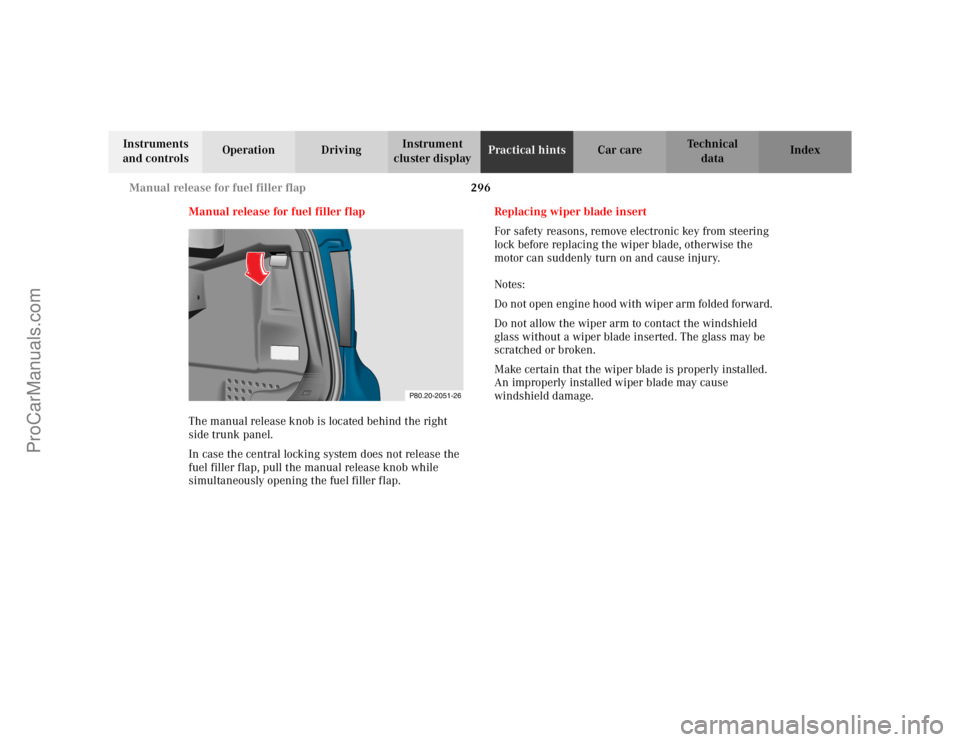
The manual release knob is located behind the right
side trunk panel.
In case the central locking system does not release the
fuel filler flap, pull the manual release knob while
simultaneously opening the fuel filler flap.Replacing wiper blade insert
For safety reasons, remove electronic key from steering
lock before replacing the wiper blade, otherwise the
motor can suddenly turn on and cause injury.
Notes:
Do not open engine hood with wiper arm folded forward.
Do not allow the wiper arm to contact the windshield
glass without a wiper blade inserted. The glass may be
scratched or broken.
Make certain that the wiper blade is properly installed.
An improperly installed wiper blade may cause
windshield damage.
P80.20-2051-26
ProCarManuals.com
Page 303 of 341
300 Cleaning and care of the vehicle
Instruments
and controlsOperation DrivingInstrument
cluster displayPractical hints IndexTe ch n i c a l
data Car care
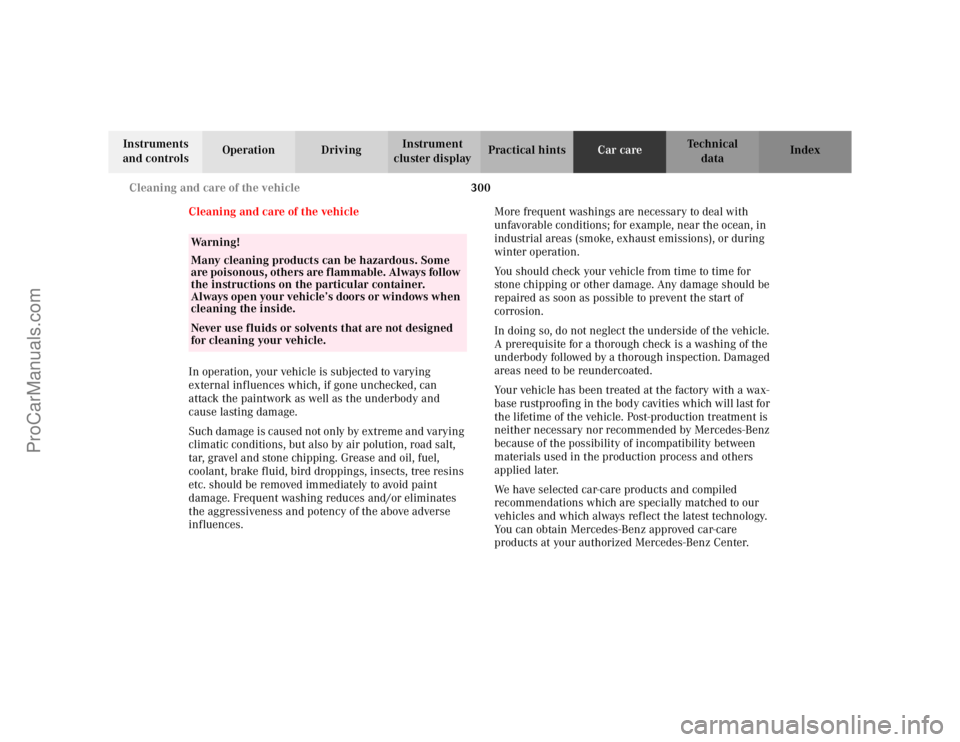
Cleaning and care of the vehicle
In operation, your vehicle is subjected to varying
external influences which, if gone unchecked, can
attack the paintwork as well as the underbody and
cause lasting damage.
Such damage is caused not only by extreme and varying
climatic conditions, but also by air polution, road salt,
tar, gravel and stone chipping. Grease and oil, fuel,
coolant, brake fluid, bird droppings, insects, tree resins
etc. should be removed immediately to avoid paint
damage. Frequent washing reduces and/or eliminates
the aggressiveness and potency of the above adverse
influences.More frequent washings are necessary to deal with
unfavorable conditions; for example, near the ocean, in
industrial areas (smoke, exhaust emissions), or during
winter operation.
You should check your vehicle from time to time for
stone chipping or other damage. Any damage should be
repaired as soon as possible to prevent the start of
corrosion.
In doing so, do not neglect the underside of the vehicle.
A prerequisite for a thorough check is a washing of the
underbody followed by a thorough inspection. Damaged
areas need to be reundercoated.
Your vehicle has been treated at the factory with a wax-
base rustproofing in the body cavities which will last for
the lifetime of the vehicle. Post-production treatment is
neither necessary nor recommended by Mercedes-Benz
because of the possibility of incompatibility between
materials used in the production process and others
applied later.
We have selected car-care products and compiled
recommendations which are specially matched to our
vehicles and which always reflect the latest technology.
You can obtain Mercedes-Benz approved car-care
products at your authorized Mercedes-Benz Center.
Wa r n i n g !
Many cleaning products can be hazardous. Some
are poisonous, others are flammable. Always follow
the instructions on the particular container.
Always open your vehicle’s doors or windows when
cleaning the inside.Never use fluids or solvents that are not designed
for cleaning your vehicle.
ProCarManuals.com
Page 310 of 341
307
Te ch n i c a l
data Instruments
and controlsOperation DrivingInstrument
cluster displayPractical hints Car care Index
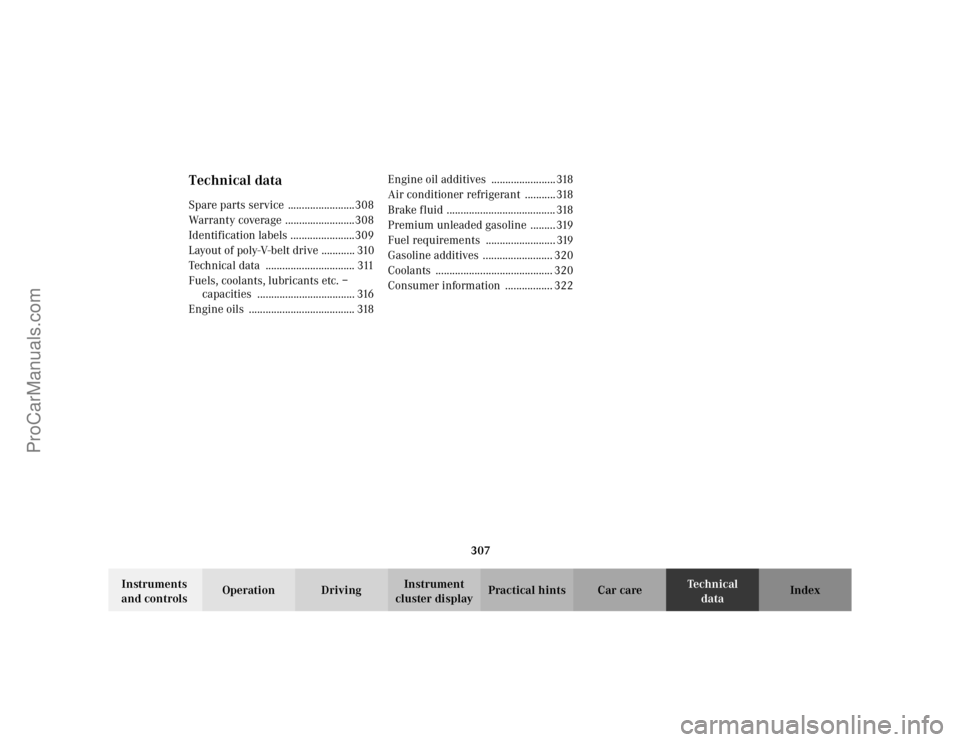
Technical dataSpare parts service ........................308
Warranty coverage .........................308
Identification labels .......................309
Layout of poly-V-belt drive ............ 310
Technical data ................................ 311
Fuels, coolants, lubricants etc. –
capacities ................................... 316
Engine oils ...................................... 318Engine oil additives ....................... 318
Air conditioner refrigerant ........... 318
Brake fluid ....................................... 318
Premium unleaded gasoline ......... 319
Fuel requirements ......................... 319
Gasoline additives ......................... 320
Coolants .......................................... 320
Consumer information ................. 322
ProCarManuals.com
Page 319 of 341
316 Fuels, coolants, lubricants etc. - capacities
Te ch n i c a l
data Instruments
and controlsOperation DrivingInstrument
cluster displayPractical hints Car care Index
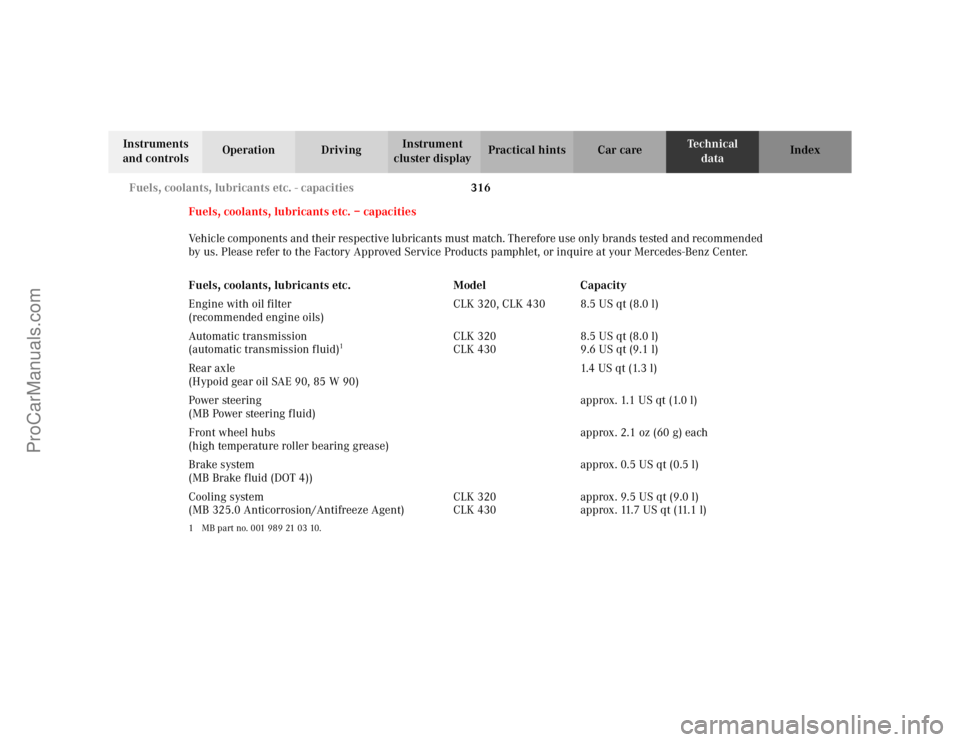
Fuels, coolants, lubricants etc. – capacities
Vehicle components and their respective lubricants must match. Therefore use only brands tested and recommended
by us. Please refer to the Factory Approved Service Products pamphlet, or inquire at your Mercedes-Benz Center.
Fuels, coolants, lubricants etc. Model Capacity
Engine with oil filter
(recommended engine oils)CLK 320, CLK 430 8.5 US qt (8.0 l)
Automatic transmission
(automatic transmission fluid)
1
CLK 320
CLK 4308.5 US qt (8.0 l)
9.6 US qt (9.1 l)
Rear axle
(Hypoid gear oil SAE 90, 85 W 90)1.4 US qt (1.3 l)
Power steering
(MB Power steering fluid)approx. 1.1 US qt (1.0 l)
Front wheel hubs
(high temperature roller bearing grease)approx. 2.1 oz (60 g) each
Brake system
(MB Brake fluid (DOT 4))approx. 0.5 US qt (0.5 l)
Cooling system
(MB 325.0 Anticorrosion/Antifreeze Agent)CLK 320
CLK 430approx. 9.5 US qt (9.0 l)
approx. 11.7 US qt (11.1 l)
1 MB part no. 001 989 21 03 10.
ProCarManuals.com
Page 320 of 341
317 Fuels, coolants, lubricants etc. - capacities
Te ch n i c a l
data Instruments
and controlsOperation DrivingInstrument
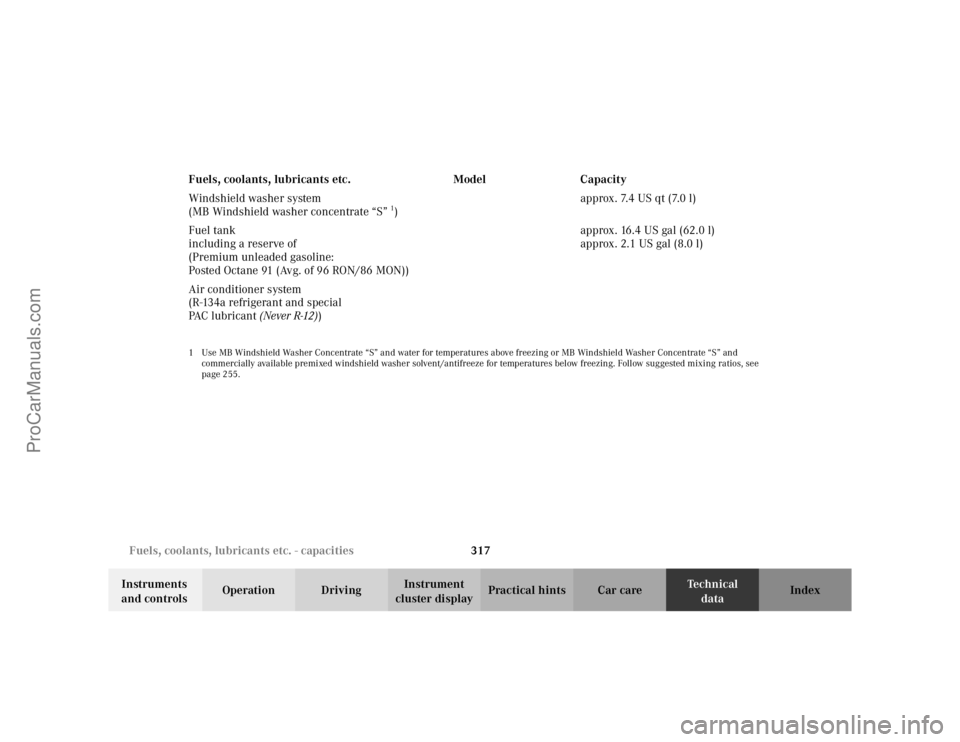
cluster displayPractical hints Car care Index Windshield washer system
(MB Windshield washer concentrate “S”
1)approx. 7.4 US qt (7.0 l)
Fuel tank
including a reserve of
(Premium unleaded gasoline:
Posted Octane 91 (Avg. of 96 RON/86 MON))approx. 16.4 US gal (62.0 l)
approx. 2.1 US gal (8.0 l)
Air conditioner system
(R-134a refrigerant and special
PA C l u b r i c a n t (Never R-12))
1 Use MB Windshield Washer Concentrate “S” and water for temperatures above freezing or MB Windshield Washer Concentrate “S” and
commercially available premixed windshield washer solvent/antifreeze for temperatures below freezing. Follow suggested mixing ratios, see
page 255.Fuels, coolants, lubricants etc. Model Capacity
ProCarManuals.com
Page 321 of 341
318 Fuels, coolants, lubricants etc.
Te ch n i c a l
data Instruments
and controlsOperation DrivingInstrument
cluster displayPractical hints Car care Index
Engine oils
Engine oils are specifically tested for their suitability in
our engines. Therefore, use only engine oils
recommended by Mercedes-Benz. Information on
recommended brands is available in the Factory
Approved Service Products pamphlet or at your
authorized Mercedes-Benz Center.
Please follow Service Booklet recommendations for
scheduled oil changes. Failure to do so could result in
engine damage not covered by the Mercedes-Benz
Limited Warranty.
Engine oil additives
Do not blend oil additives with engine oil. They may be
harmful to the engine operation.
Damage or malfunctions resulting from blending oil
additives are not covered by the Mercedes-Benz Limited
Warranty.Air conditioner refrigerant
R-134a (HFC) refrigerant and special PAG lubricating oil
is used in the air conditioner system.
Never use R-12 (CFC) or mineral-based lubricating oil,
otherwise damage to the system will occur.
Brake fluid
During vehicle operation, the boiling point of the brake
fluid is continuously reduced through the absorption of
moisture from the atmosphere. Under extremely hard
operating conditions, this moisture content can lead to
the formation of bubbles in the system thus reducing
the system’s efficiency.
The brake fluid must therefore be replaced every two
years, preferably in the spring.
It is recommended to use only brake fluid approved by
Mercedes-Benz. Your authorized Mercedes-Benz Center
will provide you with additional information.
ProCarManuals.com
Page 322 of 341
319 Fuels, coolants, lubricants etc.
Te ch n i c a l
data Instruments
and controlsOperation DrivingInstrument
cluster displayPractical hints Car care Index Premium unleaded gasoline
Caution!
To maintain the engine’s durability and performance,
premium unleaded gasoline must be used. If premium
unleaded is not available and low octane fuel is used,
follow these precautions:
•Have the fuel tank filled only partially with
unleaded regular and fill up with premium
unleaded as soon as possible.
•Avoid full throttle driving and abrupt acceleration.
•Do not exceed an engine speed of 3000 rpm, if the
vehicle is loaded with a light load such as two
persons and no luggage.
•Do not exceed 2/3 of maximum accelerator pedal
position, if the vehicle is fully loaded or operating in
mountainous terrain.Fuel requirements
Use only Premium unleaded meeting ASTM
standard D 439:
The octane number (posted at the pump) must be
91 min. It is an average of both the Research (R) octane
number and the Motor (M) octane number: [(R+M)/2].
This is also known as ANTI-KNOCK INDEX.
Unleaded gasoline containing oxygenates such as
Ethanol, IPA, IBA and TBA can be used provided the
ratio of any one of these oxygenates to gasoline does not
exceed 10%, MTBE not to exceed 15%.
The ratio of Methanol to gasoline must not exceed 3%
plus additional cosolvents.
Using mixtures of Ethanol and Methanol is not allowed.
Gasohol, which contains 10% Ethanol and 90% unleaded
gasoline, can be used.
These blends must also meet all other fuel requirements
such as resistance to spark knock, boiling range, vapor
pressure etc..
ProCarManuals.com