service MERCEDES-BENZ CLK-CLASS 2002 Owner's Guide
[x] Cancel search | Manufacturer: MERCEDES-BENZ, Model Year: 2002, Model line: CLK-CLASS, Model: MERCEDES-BENZ CLK-CLASS 2002Pages: 341, PDF Size: 10.67 MB
Page 199 of 341
196 Automatic transmission
Te ch n i c a l
data Instruments
and controlsOperationDrivingInstrument
cluster displayPractical hints Car care Index
Press and hold selector lever in the æ direction:
The transmission will shift from the current gear
directly to gear range “D”.
Important!
With transmission in gear range “D”, “4” or “3”,
upshifting from 1st to 2nd to 3rd gear is delayed
depending on vehicle speed and engine temperature.
This allows the catalytic converter to heat up more
quickly to operating temperatures.During the brief warm-up period this delayed upshift
and increased engine noise might be perceived as a
malfunction. However, neither the engine nor
transmission are negatively affected by this mode of
operation.
The delayed upshift is effective with vehicle speeds
below 31 mph (50 km/h) at partial throttle and engine
temperatures below 95
°F (35
°C).
To avoid overrevving the engine when the selector lever
is m ove d to a lower gear range , t he tran smi ss ion will n ot
shift to a lower gear, if the engine's max. speed would be
exceeded. In this case there will be no downshift, even
when the vehicle speed reaches the engine’s RPM limit
of that gear, e.g. by applying the service brakes.
To prevent the engine from laboring at low RPM when
driving uphill gradients or with your vehicle heavily
loaded, the automatic transmission will downshift when
necessary to maintain engine RPM within the best
torque range.
Wa r n i n g !
On slippery road surfaces, never downshift in order
to obtain braking action. This could result in drive
wheel slip and reduced vehicle control. Your
vehicle’s ABS will not prevent this type of loss of
control.
ProCarManuals.com
Page 206 of 341
203 Driving instructions
Te ch n i c a l
data Instruments
and controlsOperationDrivingInstrument
cluster displayPractical hints Car care Index All checks and service work on the brake system should
be carried out by an authorized Mercedes-Benz Center.
Install only brake pads and brake fluid recommended by
Mercedes-Benz.
Caution!
When driving down long and steep grades, relieve the
load on the brakes by shifting into a lower gear to use
the engine’s braking power. This helps prevent
overheating of the brakes and reduces brake pad wear.
After hard braking, it is advisable to drive on for some
time, rather than immediately parking, so the air stream
will cool down the brakes faster.Driving off
Apply the service brakes to test them briefly after
driving off. Perform this procedure only when the road
is clear of other traffic.
Warm up the engine smoothly. Do not place full load on
the engine until the operating temperature has been
reached.
When starting off on a slippery surface, do not allow one
drive wheel to spin for an extended period with the ESP
switched off. Doing so may cause serious damage to the
drive train which is not covered by the Mercedes-Benz
Limited Warranty.
Wa r n i n g !
If other than recommended brake pads are
installed, or other than recommended brake fluid
is used, the braking properties of the vehicle can be
degraded to an extent that safe braking is
substantially impaired. This could result in an
accident.
ProCarManuals.com
Page 207 of 341
204 Driving instructions
Te ch n i c a l
data Instruments
and controlsOperationDrivingInstrument
cluster displayPractical hints Car care Index
Parking
Important!
It is advisable to set the parking brake whenever
parking or leaving the vehicle. In addition, move
selector lever to position “P”.
When parking on hills, always set the parking brake.Tires
Tread wear indicators (TWI) are required by law. These
indicators are located in six places on the tread
circumference and become visible at a tread depth of
approximately
1/16in (1.5 mm), at which point the tire is
considered worn and should be replaced.
The tread wear indicator appears as a solid band across
the tread.
Wa r n i n g !
To reduce the risk of personal injury as a result of
vehicle movement, before
turning off the engine
and leaving the vehicle, always:
1. Keep right foot on the service brake pedal.
2. Firmly depress parking brake pedal.
3. Move the selector lever to position “P”.
4. Slowly release the service brake pedal.
5. Turn front wheels towards the road curb.
6. Turn the electronic key to steering lock
position 0 and remove.
7. Take the electronic key and lock vehicle when
leaving.
Wa r n i n g !
If you feel a sudden significant vibration or ride
disturbance, or you suspect that possible damage to
your vehicle has occurred, you should turn on the
hazard warning flashers, carefully slow down, and
drive with caution to an area which is a safe
distance from the roadway.Inspect the tires and under the vehicle for possible
damage. If the vehicle or tires appear unsafe, have
it towed to the nearest Mercedes-Benz Center or
tire dealer for repairs.
ProCarManuals.com
Page 212 of 341
209 Driving instructions
Te ch n i c a l
data Instruments
and controlsOperationDrivingInstrument
cluster displayPractical hints Car care Index For driving instructions with snow chains, see
page 207.
Standing water
Caution!
Do not drive through flooded areas or water of unknown
depth.
If you must dr ive t hrough stand in g water, dr ive slowly to
prevent water from entering the passenger
compartment or the engine compartment. Water in
these areas could cause damage to electrical
components or wiring of the engine or transmission, or
could result in water being ingested by the engine
through the air intake causing severe internal engine
damage. Any such damage is not covered by the
Mercedes-Benz Limited Warranty.
Block heater (Canada only)
The engine is equipped with a block heater.
The electrical cable may be installed at your authorized
Mercedes-Benz Center.Passenger compartment
Traveling abroad
Abroad, there is a widely-spread Mercedes-Benz service
network at your disposal. If you plan to travel into areas
which are not listed in the index of your Mercedes-Benz
Center directory, you should request pertinent
information from your authorized Mercedes-Benz
Center.
Wa r n i n g !
Always fasten items being carried as securely as
possible.In an accident, during hard braking or sudden
maneuvers, loose items will be thrown around
inside the vehicle, and cause injury to vehicle
occupants unless the items are securely fastened in
the vehicle.The trunk is the preferred place to carry objects.
ProCarManuals.com
Page 224 of 341
221 What you should know at the gas station
Te ch n i c a l
data Instruments
and controlsOperationDrivingInstrument
cluster displayPractical hints Car care Index •Engine oil
Engine oil level check, see page 108 and page 252.
Fill quantity between upper and lower dipstick
marking level: 2.1 US qt (2.0 l).
Recommended engine oils, see Approved Service
Products sheet.
• Coolant
For normal replenishing, use water (potable water
quality).
For further information (e.g. anticorrosion/
antifreeze), see page 316.
• Spark plugs
Approved spark plugs, see page 314.
• Tire pressure
For tire pressure, refer to tire pressure label inside
the fuel filler flap. See page 268 for further details.• Air conditioner
R-134a refrigerant and special PAG lubricant, see
page 316.
•Bulbs
High and low beams: H7 (55 W),
low beam: Xenon (optional)
fog lamps: H1 (55 W),
turn signal lamps,
front 1156 NA (26.9/5 W/32/4 cp),
parking and standing lamps, front: H 6W (6 W),
side marker lamps, front: 5 W/4 cp,
turn signal lamps, rear: 21 W/24 cp,
stop, tail, parking and side marker lamps: 21/4 W,
tail and parking lamp: 5 W/4 cp,
rear fog lamp, driver’s side: 21 W/32 cp,
backup lamps: 21 W/32 cp,
license plate lamps: 5 W/4 cp.
ProCarManuals.com
Page 237 of 341
234 Malfunction and warning messages
Te ch n i c a l
data Instruments
and controlsOperation DrivingInstrument
cluster displayPractical hints Car care Index
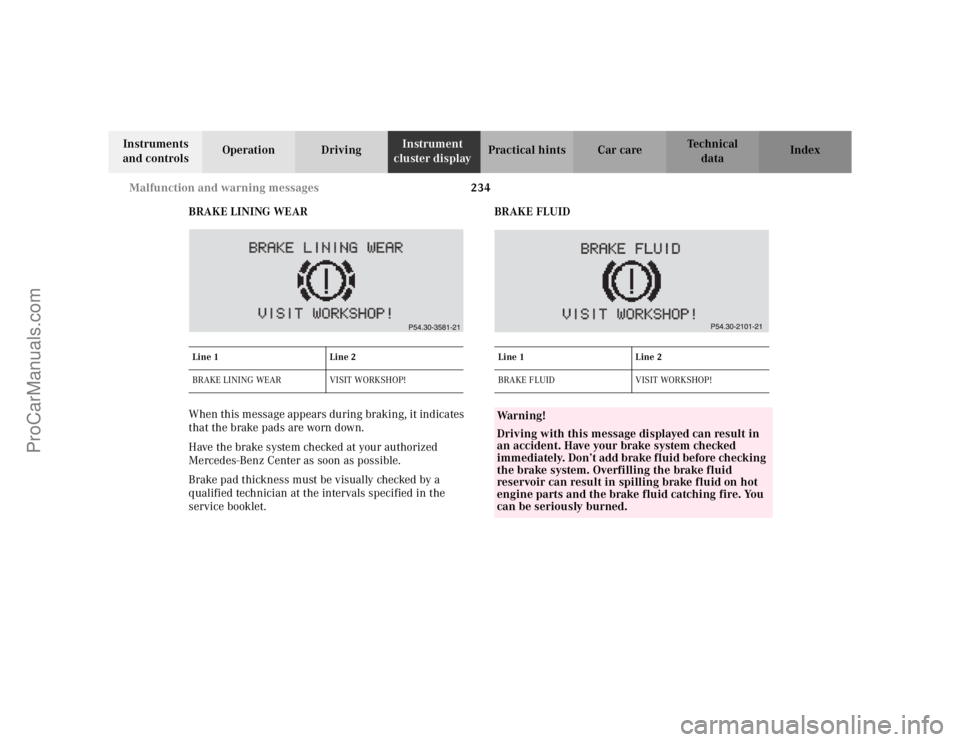
BRAKE LINING WEAR
When this message appears during braking, it indicates
that the brake pads are worn down.
Have the brake system checked at your authorized
Mercedes-Benz Center as soon as possible.
Brake pad thickness must be visually checked by a
qualified technician at the intervals specified in the
service booklet. BRAKE FLUID
Line 1 Line 2
BRAKE LINING WEAR VISIT WORKSHOP!
Line 1 Line 2
BRAKE FLUID VISIT WORKSHOP!Wa r n i n g !
Driving with this message displayed can result in
an accident. Have your brake system checked
immediately. Don’t add brake fluid before checking
the brake system. Overfilling the brake fluid
reservoir can result in spilling brake fluid on hot
engine parts and the brake fluid catching fire. You
can be seriously burned.
ProCarManuals.com
Page 239 of 341
236 Malfunction and warning messages
Te ch n i c a l
data Instruments
and controlsOperation DrivingInstrument
cluster displayPractical hints Car care Index
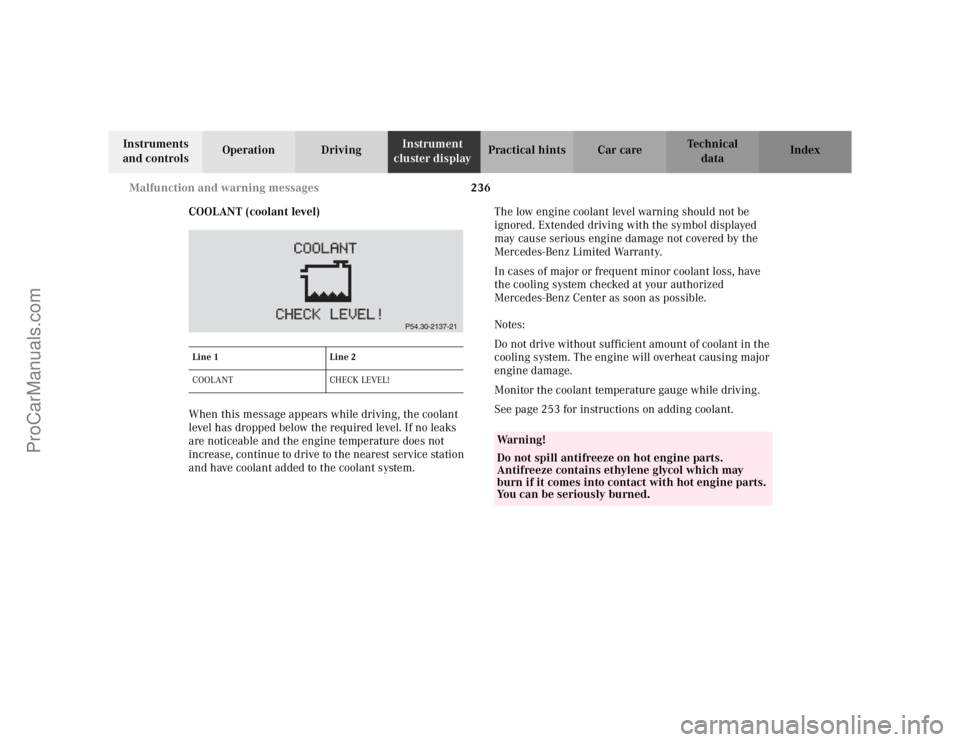
COOLANT (coolant level)
When this message appears while driving, the coolant
level has dropped below the required level. If no leaks
are noticeable and the engine temperature does not
increase, continue to drive to the nearest service station
and have coolant added to the coolant system.The low engine coolant level warning should not be
ignored. Extended driving with the symbol displayed
may cause serious engine damage not covered by the
Mercedes-Benz Limited Warranty.
In cases of major or frequent minor coolant loss, have
the cooling system checked at your authorized
Mercedes-Benz Center as soon as possible.
Notes:
Do not drive without sufficient amount of coolant in the
cooling system. The engine will overheat causing major
engine damage.
Monitor the coolant temperature gauge while driving.
See page 253 for instructions on adding coolant.
Line 1 Line 2
COOLANT CHECK LEVEL!
Wa r n i n g !
Do not spill antifreeze on hot engine parts.
Antifreeze contains ethylene glycol which may
burn if it comes into contact with hot engine parts.
You can be seriously burned.
ProCarManuals.com
Page 243 of 341
240 Malfunction and warning messages
Te ch n i c a l
data Instruments
and controlsOperation DrivingInstrument
cluster displayPractical hints Car care Index
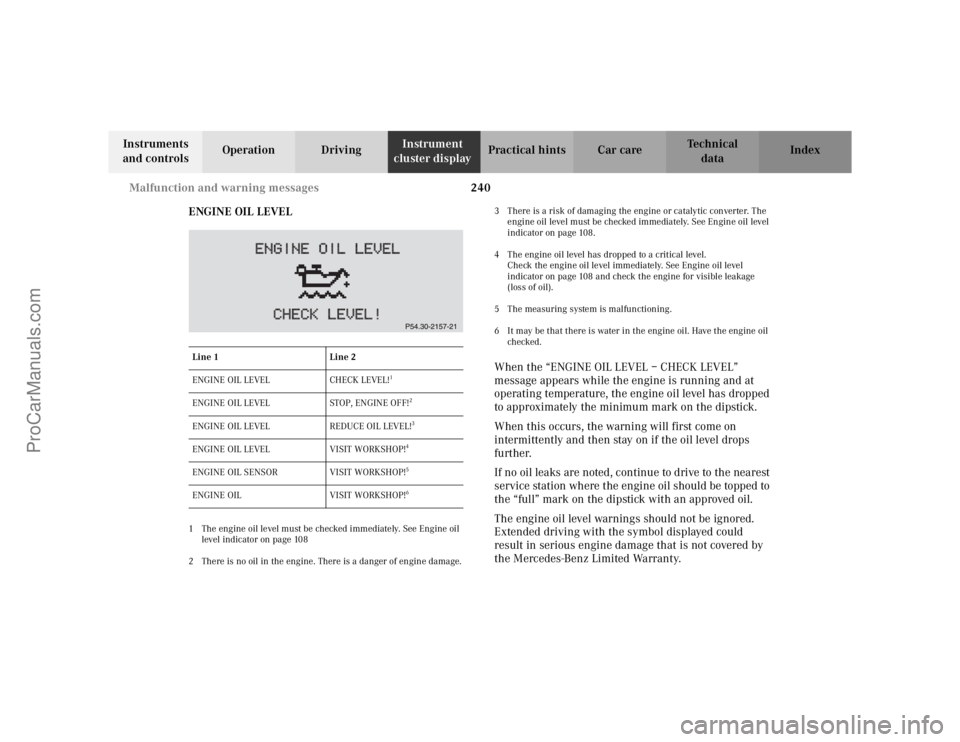
ENGINE OIL LEVEL
1 The engine oil level must be checked immediately. See Engine oil
level indicator on page 108
2 There is no oil in the engine. There is a danger of engine damage.3 There is a risk of damaging the engine or catalytic converter. The
engine oil level must be checked immediately. See Engine oil level
indicator on page 108.
4 The engine oil level has dropped to a critical level.
Check the engine oil level immediately. See Engine oil level
indicator on page 108 and check the engine for visible leakage
(loss of oil).
5 The measuring system is malfunctioning.
6 It may be that there is water in the engine oil. Have the engine oil
checked.
When the “ENGINE OIL LEVEL – CHECK LEVEL”
message appears while the engine is running and at
operating temperature, the engine oil level has dropped
to approximately the minimum mark on the dipstick.
When this occurs, the warning will first come on
intermittently and then stay on if the oil level drops
further.
If no oil leaks are noted, continue to drive to the nearest
service station where the engine oil should be topped to
the “full” mark on the dipstick with an approved oil.
The engine oil level warnings should not be ignored.
Extended driving with the symbol displayed could
result in serious engine damage that is not covered by
the Mercedes-Benz Limited Warranty.
Line 1 Line 2
ENGINE OIL LEVEL CHECK LEVEL!
1
ENGINE OIL LEVEL STOP, ENGINE OFF!
2
ENGINE OIL LEVEL REDUCE OIL LEVEL!
3
ENGINE OIL LEVEL VISIT WORKSHOP!
4
ENGINE OIL SENSOR VISIT WORKSHOP!
5
ENGINE OIL VISIT WORKSHOP!
6
ProCarManuals.com
Page 261 of 341
258 Tires, Wheels
Te ch n i c a l
data Instruments
and controlsOperation DrivingInstrument
cluster displayPractical hintsCar care Index
Wheels
Replace rims or tires with the same designation,
manufacturer and type as shown on the original part.
See your authorized Mercedes-Benz Center for further
information.
See your authorized Mercedes-Benz Center for
information on tested and recommended rims and tires
for summer and winter operation. They can also offer
advice concerning tire service and purchase.
Tire replacement
Front tires should be replaced in sets. Rims and tires
must be of the correct size and type. For dimensions,
see “Technical Data” (page 312).
We recommend that you break in new tires for approx.
60 miles (100 km) at moderate speed.It is imperative that the wheel mounting bolts be
fastened to a tightening torque of 80 ft.lb. (110 Nm)
whenever wheels are mounted.
For rim and tire specifications, refer to “Technical Data”
( p a g e 312 ) .
Wa r n i n g !
Worn, old tires can cause accidents. If the tire tread
is badly worn, or if the tires have sustained
damage, replace them.When replacing rims, use only genuine
Mercedes-Benz wheel bolts specified for the
particular rim type. Failure to do so can result in
the bolts loosening and possibly an accident.
ProCarManuals.com
Page 265 of 341
262 Tires, Wheels
Te ch n i c a l
data Instruments
and controlsOperation DrivingInstrument
cluster displayPractical hintsCar care Index
CLK 430
Important!
The spare wheel rim size is 7
1/2J x 17 H 2.
The spare wheel rim is for temporary use only. However,
that spare wheel rim is weight optimized and has a
limited service life of 12 000 miles (20 000 km) use
before a standard wheel rim must replace it.
If the arrow on tire side wall does not point in direction
of vehicle forward movement when using the spare
wheel, observe the following restriction:
•Drive to the nearest tire repair facility as soon as
possible.
•Do not exceed vehicle speed of 50 mph (80 km/h).
Unidirectional tires must always be mounted with arrow
on tire sidewall pointing in direction of vehicle forward
movement.For rim and tire specifications, refer to “Technical Data”
( p a g e 312 ) .
Wa r n i n g !
The spare wheel rim is for temporary use only. Use
for over a total of 12 000 miles (20 000 km)
(aggregate of all uses) may cause wheel rim failure
leading to an accident and possible injuries.The dimensions of the spare wheel are different
from those of the road wheels for the rear axle. As a
result, the vehicle handling characteristics change
when driving with a spare wheel mounted on the
rear axle.The spare wheel should only be used temporarily,
and replaced with a regular road wheel as quick as
possible.
Do not exceed vehicle speed of 50 mph (80 km/h).
ProCarManuals.com