Engine light MERCEDES-BENZ CLK320 2001 A208 Owner's Manual
[x] Cancel search | Manufacturer: MERCEDES-BENZ, Model Year: 2001, Model line: CLK320, Model: MERCEDES-BENZ CLK320 2001 A208Pages: 325, PDF Size: 8.12 MB
Page 5 of 325

2 Contents
Trip and main odometer, vehicle
speed, FSS and engine oil level
indicator ....................................... 92
Audio systems .................................. 93
Radio .............................................. 93
CD player ....................................... 94
Cassette player ............................. 95
Telephone .......................................... 96
Telephone book ............................ 96
Redialing ....................................... 98
Incoming call .............................. 100
Navigation system .......................... 101
Trip computer ................................. 102
Malfunction message
memory ...................................... 104
Individual settings ......................... 106
Setting the audio volume .............. 108
Flexible service system
(FSS) ............................................ 109
Engine oil level indicator .............. 112
Engine oil consumption .................113Exterior lamp switch ...................... 114
Night security illumination .......... 115
Headlamp cleaning system ........... 116
Combination switch ....................... 117
Hazard warning flasher
switch .......................................... 119
Automatic climate control ............ 120
Display and controls ................. 122
Basic setting ............................... 122
Economy ...................................... 123
Special settings .......................... 123
Rear window defroster .............. 124
Air recirculation ........................ 125
Residual engine
heat utilization ........................... 125
Dust filter .................................... 126
Audio and telephone,
operation .................................... 127
Power windows .............................. 146
Sliding/pop-up roof ....................... 148
Interior lighting ..............................150Rear window sunshade ................. 151
Sun visors ....................................... 151
Illuminated vanity mirrors ........... 152
Interior ............................................ 152
Storage compartments,
armrest and cup holder ........... 152
Glove box ..................................... 153
Storage compartments
in center console ........................ 153
Ashtrays .......................................... 156
Lighter ............................................. 158
Enlarged cargo area –
split folding rear
seat backrest .............................. 159
Loading instructions ..................... 160
Cargo tie down rings ..................... 162
Parcel net in front
passenger footwell .................... 162
Telephone, general ........................ 163
Cellular telephone ......................... 163
Garage door opener ....................... 164
Ski sack ........................................... 168
Page 7 of 325

4 Contents
Malfunction and indicator lamps in
the center console .....................230
AIRBAG OFF
indicator lamp .............................230
Malfunction and warning
messages in the
multifunction display ............... 231
DISPLAY DEFECTIVE
(engine control unit) ..................232
DISPLAY DEFECTIVE
(several systems) ........................232
BATTERY/ALTERNATOR ...........233
ABS-SYSTEM ...............................234
BRAKE ASSIST ...........................234
BRAKE LINING WEAR ..............235
BRAKE FLUID .............................235PARKING BRAKE ....................... 236
ENGINE FAN ............................... 236
COOLANT
(coolant level) ............................. 237
COOLANT TEMP.
(coolant temperature) ............... 238
LIGHTING SYSTEM ................... 239
LIGHT SENSOR .......................... 240
STEER. WHEEL ADJUST. .......... 240
ENGINE OIL LEVEL ................... 241
ELEC. STABIL. PROG.
(Electronic stability
program) ..................................... 242
REMOVE KEY ............................. 242
WASHER FLUID ......................... 243
TELE AID ..................................... 244
Practical hintsFirst aid kit .....................................246
Shelf below rear window ..............246
Stowing things in the vehicle ......246
Fuses ................................................247
Hood .................................................249
Checking engine
oil level ....................................... 251
Automatic transmission
fluid level ...................................252
Coolant level ...................................252
Adding coolant ...........................253
Windshield washer/headlamp
cleaning system ........................254
Windshield and
headlamp washer
fluid mixing ratio .......................254
Page 8 of 325

5 ContentsSpare wheel, vehicle tools,
storage compartment ................255
Vehicle jack .....................................256
Wheels .............................................257
Tire replacement ........................257
Rotating wheels ..........................258
Spare wheel ....................................259
Changing wheels ...........................260
Tire inflation pressure ..................265
Battery .............................................266
Jump starting ..................................268
Towing the vehicle .........................270
Transmission selector lever,
manually unlocking ...................272
Exterior lamps ................................273
Headlamp assembly ................... 274
Taillamp assemblies .................. 276Changing batteries in the
electronic main key .................. 281
Synchronizing
remote control ............................ 283
Emergency operation of
sliding/pop-up roof .................. 284
Manual release for
fuel filler flap ............................ 285
Replacing wiper
blade insert ............................... 285
Trunk lamp ..................................... 287
Roof rack ......................................... 287
Vehicle careCleaning and care
of the vehicle ............................. 290
Power washer ............................. 291
Paintwork, painted body
components ................................ 291Tar stains ..................................... 291
Engine cleaning ..........................292
Vehicle washing .........................292
Ornamental moldings ................292
Headlamps, taillamps,
turn signal lenses ......................292
Window cleaning .......................293
Wiper blade .................................293
Light alloy wheels ......................293
Instrument cluster .....................293
Steering wheel and
gear selector lever ......................293
Cup holder ...................................294
Seat belts .....................................294
Hard plastic trim items .............294
Headliner and shelf
below rear window .....................294
Upholstery ...................................294
Plastic and rubber parts ............294
Page 26 of 325
23 Contents – Operation
Te ch n ica l
data Instruments
and controlsOperationDrivingInstrument
cluster displayPractical hints Car care Index Telephone .......................................... 96
Telephone book ............................ 96
Redialing ....................................... 98
Incoming call .............................. 100
Navigation system .......................... 101
Trip computer ................................. 102
Malfunction message
memory ...................................... 104
Individual settings ......................... 106
Setting the audio volume .............. 108
Flexible service system
(FSS) ............................................ 109
Engine oil level indicator .............. 112
Engine oil consumption .................113
Exterior lamp switch ......................114
Night security illumination ..........115
Headlamp cleaning system ...........116
Combination switch .......................117
Hazard warning flasher
switch ...........................................119Automatic climate control ............ 120
Display and controls ................. 122
Basic setting ............................... 122
Economy ...................................... 123
Special settings .......................... 123
Rear window defroster .............. 124
Air recirculation ........................ 125
Residual engine
heat utilization ........................... 125
Dust filter .................................... 126
Audio and telephone,
operation .................................... 127
Power windows .............................. 146
Sliding/pop-up roof ....................... 148
Interior lighting ..............................150
Rear window sunshade .................151
Sun visors ........................................151
Illuminated vanity mirrors ...........152
Interior .............................................152Storage compartments,
armrest and cup holder ........... 152
Glove box ..................................... 153
Storage compartments
in center console ........................ 153
Ashtrays .......................................... 156
Lighter ............................................. 158
Enlarged cargo area –
split folding rear
seat backrest .............................. 159
Loading instructions ..................... 160
Cargo tie down rings ..................... 162
Parcel net in front
passenger footwell .................... 162
Telephone, general ........................ 163
Cellular telephone ......................... 163
Garage door opener ....................... 164
Ski sack ........................................... 168
Page 30 of 325

27 Central locking system
Te ch n ica l
data Instruments
and controlsOperationDrivingInstrument
cluster displayPractical hints Car care Index Start lock-out
Important!
Removing the electronic key from the steering lock
activates the start lock-out. The engine cannot be
started.
Inserting the electronic key in the steering lock
deactivates the start lock-out.
Note:
In case the engine cannot be started (vehicle’s battery is
in order), the system is not operational. Contact an
authorized Mercedes-Benz Center or call 1-800-FOR-
MERCedes (in the USA) or 1-800-387-0100 (in Canada).General notes on the central locking system
If the electronic key is inserted in the steering lock, the
vehicle cannot be locked or unlocked with the remote
control.
If the vehicle cannot be locked or unlocked:
•Aim transmitter eye at a receiver of either door
handle. Check the batteries of the electronic main
key, see page 281, or synchronize the remote
control, see page 283.
•Use the mechanical key to unlock the driver’s door.
To start the engine, insert the electronic main key in
the steering lock. There could be a slight delay until
the electronic main key can be turned in the
steering lock.
Important!
When unlocking the driver’s door with the mechanical
key, the exterior lamps will flash and the alarm will
sound.
To cancel the alarm, insert the electronic key in the
steering lock or press buttonŒ or‹ on the
electronic main key.
Page 118 of 325

115 Exterior lamp switch
Te ch n ica l
data Instruments
and controlsOperationDrivingInstrument
cluster displayPractical hints Car care Index Notes:
With the electronic key removed and the driver’s door
open, a warning sounds and the message “SWITCH OFF
LIGHTS” in the multifunction indicator appears if the
vehicle’s exterior lamps (except standing lamps) are not
switched off.
Fog lamps will operate with the parking lamps and / or
the low beam headlamps on. Fog lamps should only be
used in conjunction with low beam headlamps. Consult
your State or Province Motor Vehicle Regulations
regarding allowable lamp operation.
Fog lamps are automatically switched off when the
exterior lamp switch is turned to position D.Daytime running lamps (Canada only)
When the engine is running and the selector lever is in
a driving position, the low beam headlamps (includes
parking lamps, side marker lamps, taillamps and
license plate lamps) are automatically switched on.
When shifting from a driving position to position “N”
or “P”, the low beam switches off (2 seconds delay).
For nighttime driving the exterior lamp switch should
be turned to position B to permit activation of the
high beam headlamps.
Night security illumination
When exiting the vehicle after driving with the exterior
lamps on, they switch on again for added illumination
for approximately 30 seconds after closing the last door.
The lamp-on time period can be changed at your
Mercedes-Benz Center.
Page 159 of 325
156 Interior equipment
Te ch n ica l
data Instruments
and controlsOperationDrivingInstrument
cluster displayPractical hints Car care Index
Ashtrays
Center console, front
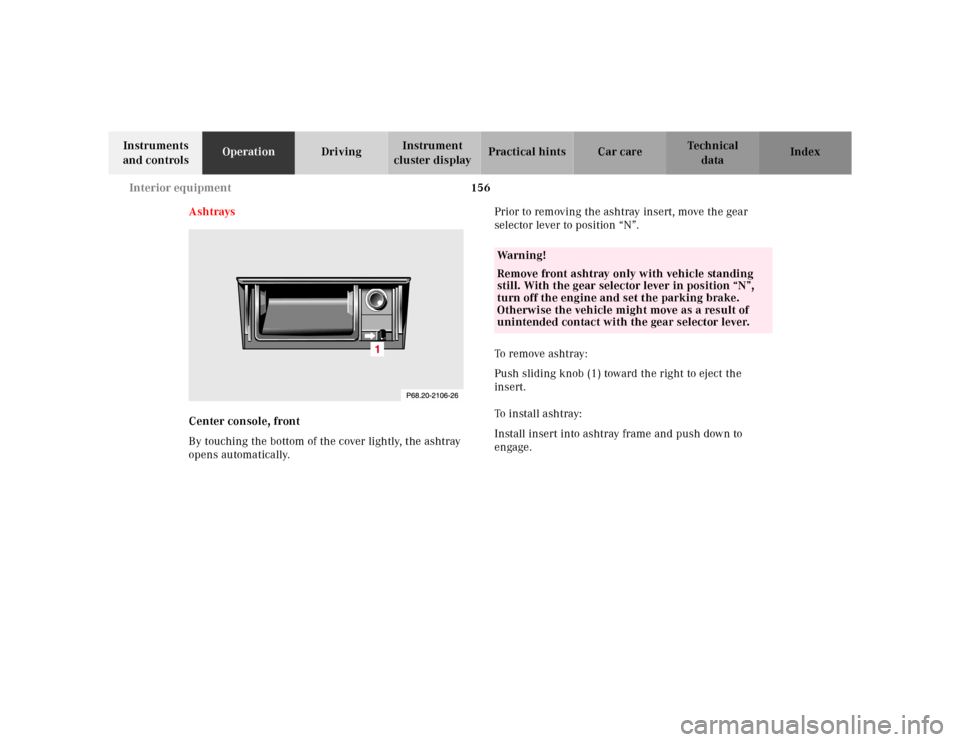
By touching the bottom of the cover lightly, the ashtray
opens automatically.Prior to removing the ashtray insert, move the gear
selector lever to position “N”.
To remove ashtray:
Push sliding knob (1) toward the right to eject the
insert.
To i n st a l l a s h t r ay :
Install insert into ashtray frame and push down to
engage.
Wa r n i n g !
Remove front ashtray only with vehicle standing
still. With the gear selector lever in position “N”,
turn off the engine and set the parking brake.
Otherwise the vehicle might move as a result of
unintended contact with the gear selector lever.
Page 191 of 325
188 Steering lock
Te ch n ica l
data Instruments
and controlsOperationDrivingInstrument
cluster displayPractical hints Car care Index
Steering lock
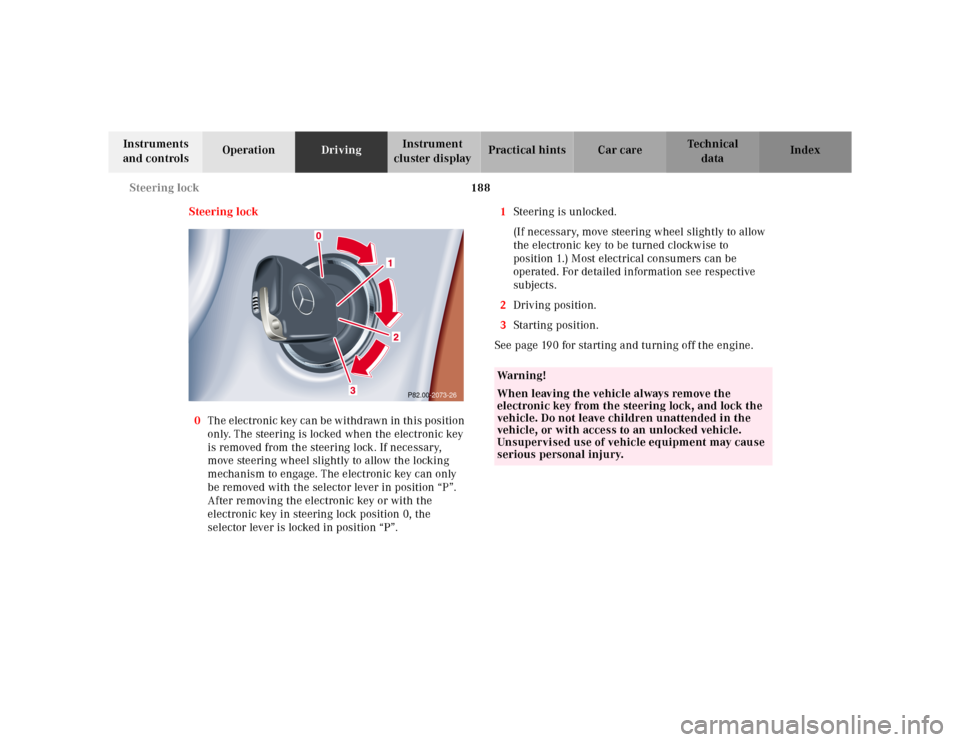
0The electronic key can be withdrawn in this position
only. The steering is locked when the electronic key
is removed from the steering lock. If necessary,
move steering wheel slightly to allow the locking
mechanism to engage. The electronic key can only
be removed with the selector lever in position “P”.
After removing the electronic key or with the
electronic key in steering lock position 0, the
selector lever is locked in position “P”.1Steering is unlocked.
(If necessary, move steering wheel slightly to allow
the electronic key to be turned clockwise to
position 1.) Most electrical consumers can be
operated. For detailed information see respective
subjects.
2Driving position.
3Starting position.
See page 190 for starting and turning off the engine.
P82.00-2073-26
Wa r n i n g !
When leaving the vehicle always remove the
electronic key from the steering lock, and lock the
vehicle. Do not leave children unattended in the
vehicle, or with access to an unlocked vehicle.
Unsupervised use of vehicle equipment may cause
serious personal injury.
Page 196 of 325
193 Automatic transmission
Te ch n ica l
data Instruments
and controlsOperationDrivingInstrument
cluster displayPractical hints Car care Index Stopping
For brief stops, e.g. at traffic lights, leave the
transmission in gear and hold vehicle with the service
brake.
For longer stops with the engine idling, shift into “N”
or “P” and hold the vehicle with the service brake.
When stopping the vehicle on an uphill gradient, do not
hold it with the accelerator, use the brake. This avoids
unnecessary transmission heat build up.
Maneuvering
To maneuver in tight areas, e.g. when pulling into a
parking space, control the vehicle speed by gradually
releasing the brakes. Accelerate gently and never
abruptly step on the accelerator.
To rock a vehicle out of soft ground (mud or snow),
alternately shift from forward to reverse, while applying
slight partial throttle.Rocking a vehicle free in this manner may cause the
ABS or traction system malfunction indicator lamp to
come on. Turn off and restart the engine to clear the
malfunction indication.
Wa r n i n g !
Getting out of your vehicle with the selector lever
not fully engaged in position “P” is dangerous.
Also, when parked on an incline, position “P” alone
may not prevent your vehicle from moving,
possibly hitting people or objects.Always set the parking brake in addition to shifting
to position “P”, see page 200 for parking brake. When parked on an incline, also turn front wheel
against curb.Wa r n i n g !
When leaving the vehicle, always remove the
electronic key from the steering lock, and lock the
vehicle. Do not leave children unattended in the
vehicle, or with access to an unlocked vehicle.
Children could move the gear selector lever from
position “P”, which could result in an accident or
serious personal injury.
Page 210 of 325
207 Driving instructions
Te ch n ica l
data Instruments
and controlsOperationDrivingInstrument
cluster displayPractical hints Car care Index Winter driving instructions
The most important rule for slippery or icy roads is to
drive sensibly and to avoid abrupt acceleration, braking
and steering maneuvers. Do not use the cruise control
system under such conditions.
When the vehicle is in danger of skidding, move
selector lever to position “N”. Try to keep the vehicle
under control by corrective steering action.
Road salts and chemicals can adversely affect braking
efficiency. Increased pedal force may become necessary
to produce the normal brake effect. We therefore
recommend depressing the brake pedal periodically
when traveling at length on salt-strewn roads. This can
bring road salt impaired braking efficiency back to
normal. A prerequisite is, however, that this be done
without endangering other drivers on the road.If the vehicle is parked after being driven on salt treated
roads, the braking efficiency should be tested as soon as
possible after driving is resumed while observing the
safety rules in the previous paragraph.
Wa r n i n g !
If the vehicle becomes stuck in snow, make sure
that snow is kept clear of the exhaust pipe and
from around the vehicle with engine running.
Otherwise, deadly carbon monoxide (CO) gases may
enter vehicle interior resulting in unconsciousness
and death.To assure sufficient fresh air ventilation, open a
window slightly on the side of the vehicle not
facing the wind.