light MERCEDES-BENZ CLS 2012 User Guide
[x] Cancel search | Manufacturer: MERCEDES-BENZ, Model Year: 2012, Model line: CLS, Model: MERCEDES-BENZ CLS 2012Pages: 356, PDF Size: 14.25 MB
Page 19 of 356
Supplement Restraint Systemsee SRS (Supplemental Restraint
System)
Surround lighting (on-board
computer) .......................................... 210
Suspension tuning AIRMATIC ...................................... 169
AMG adaptive sport suspension
system ........................................... 170
SETUP (on-board computer) ..........213
Switching air-recirculation mode
on/off ................................................. 126
Switching off the alarm (ATA) ............ 69
T
Tachometer ........................................ 197
Tail lamps Display message ............................ 225
see Lights
Tank
see Fuel tank
Tank content
Fuel gauge ....................................... 27
Technical data
CLS 550 4MATIC
BlueEFFICIENCY ............................ 351
CLS 550 BlueEFFICIENCY ..............351
CLS 63 AMG .................................. 352
Tires/wheels ................................. 339
TELEAID
Call priority .................................... 271
Display message ............................ 220
Downloading destinations
(COMAND) ..................................... 272
Emergency call .............................. 269
Important safety notes ..................267
Locating a stolen vehicle ...............273
MB info call button ........................271
Remote vehicle locking ..................273
Roadside Assistance button ..........270
Search & Send ............................... 272
Self-test ......................................... 268
System .......................................... 268
Vehicle remote unlocking ..............272
Telephone
Accepting a call ............................. 205
Menu (on-board computer) ............204
Number from the phone book ........ 205
Redialing ........................................ 205
Rejecting/ending a call .................205
Temperature
Coolant .......................................... 196
Coolant (on-board computer) ......... 213
Engine oil (on-board computer) ...... 213
Outside temperature ...................... 197
Setting (climate control) ................123
Theft deterrent locking system
Immobilizer ...................................... 69
Through-loading feature ................... 259
Tilt/sliding sunroof see Sliding sunroof
Timing (RACETIMER) ......................... 213
Tiredness assistant see ATTENTION ASSIST
Tire pressure
Calling up (on-board computer) .....322
Checking manually ........................321
Display message ............................ 234
Maximum ....................................... 320
Notes ............................................. 318
Pressure loss warning ....................321
Recommended ............................... 317
Tire pressure monitoring system
Function/notes ............................. 322
Restarting ...................................... 324
Warning lamp ................................. 252
Tires
Aspect ratio (definition) .................337
Average weight of the vehicle
occupants (definition) ....................335
Bar (definition) ............................... 335
Characteristics .............................. 335
Checking ........................................ 315
Definition of terms .........................335
Direction of rotation ......................338
Display message ............................ 234
Distribution of the vehicle
occupants (definition) ....................338
DOT, Tire Identification Number
(TIN) ............................................... 334
DOT (Department of
Transportation) (definition) ............335
GAWR (Gross Axle Weight Rating)
(definition) ..................................... 336Index17
Page 28 of 356
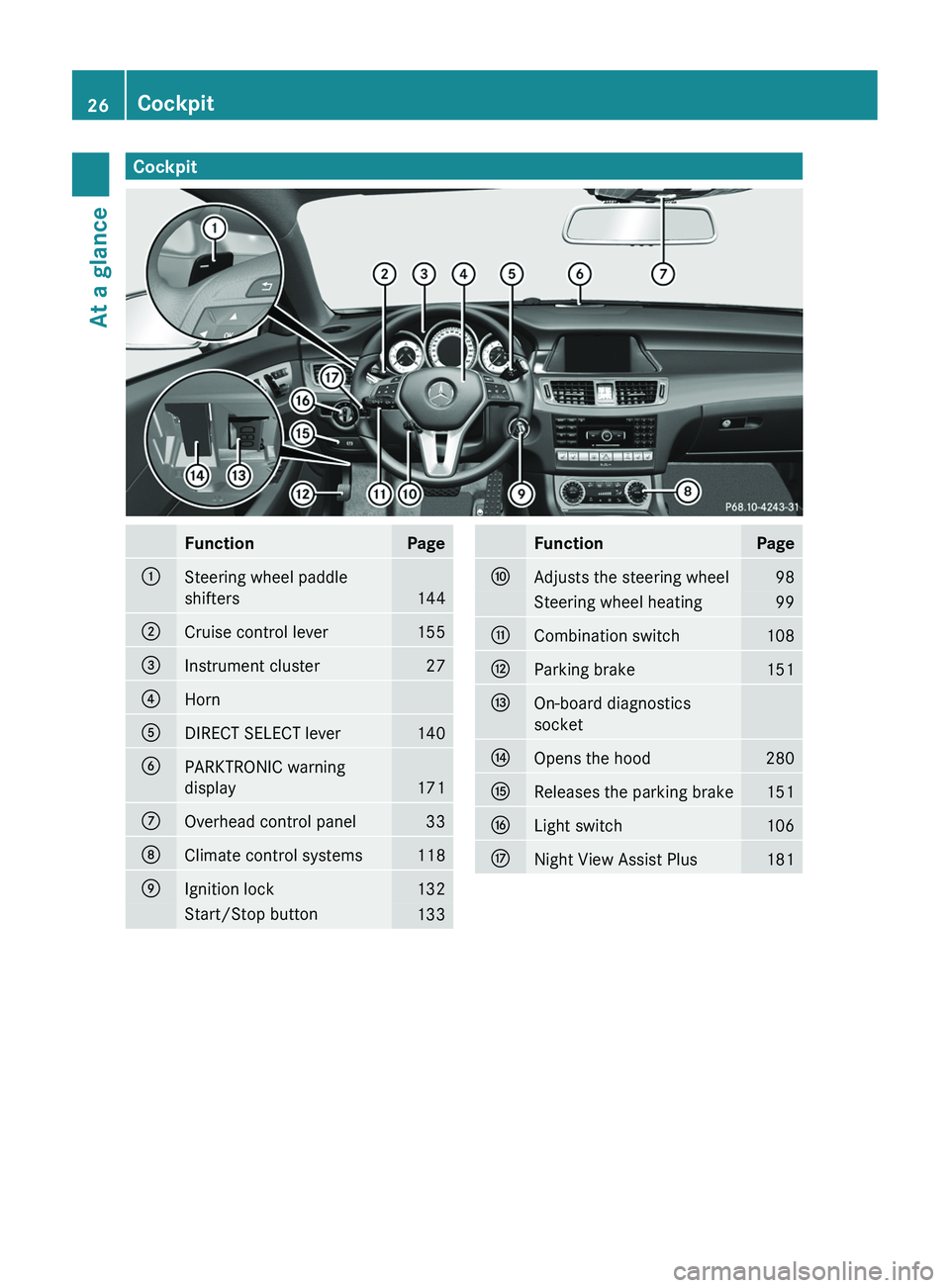
CockpitFunctionPage:Steering wheel paddle
shifters
144
;Cruise control lever155=Instrument cluster27?HornADIRECT SELECT lever140BPARKTRONIC warning
display
171
COverhead control panel33DClimate control systems118EIgnition lock132Start/Stop button133FunctionPageFAdjusts the steering wheel98Steering wheel heating99GCombination switch108HParking brake151IOn-board diagnostics
socketJOpens the hood280KReleases the parking brake151LLight switch106MNight View Assist Plus18126CockpitAt a glance
Page 29 of 356
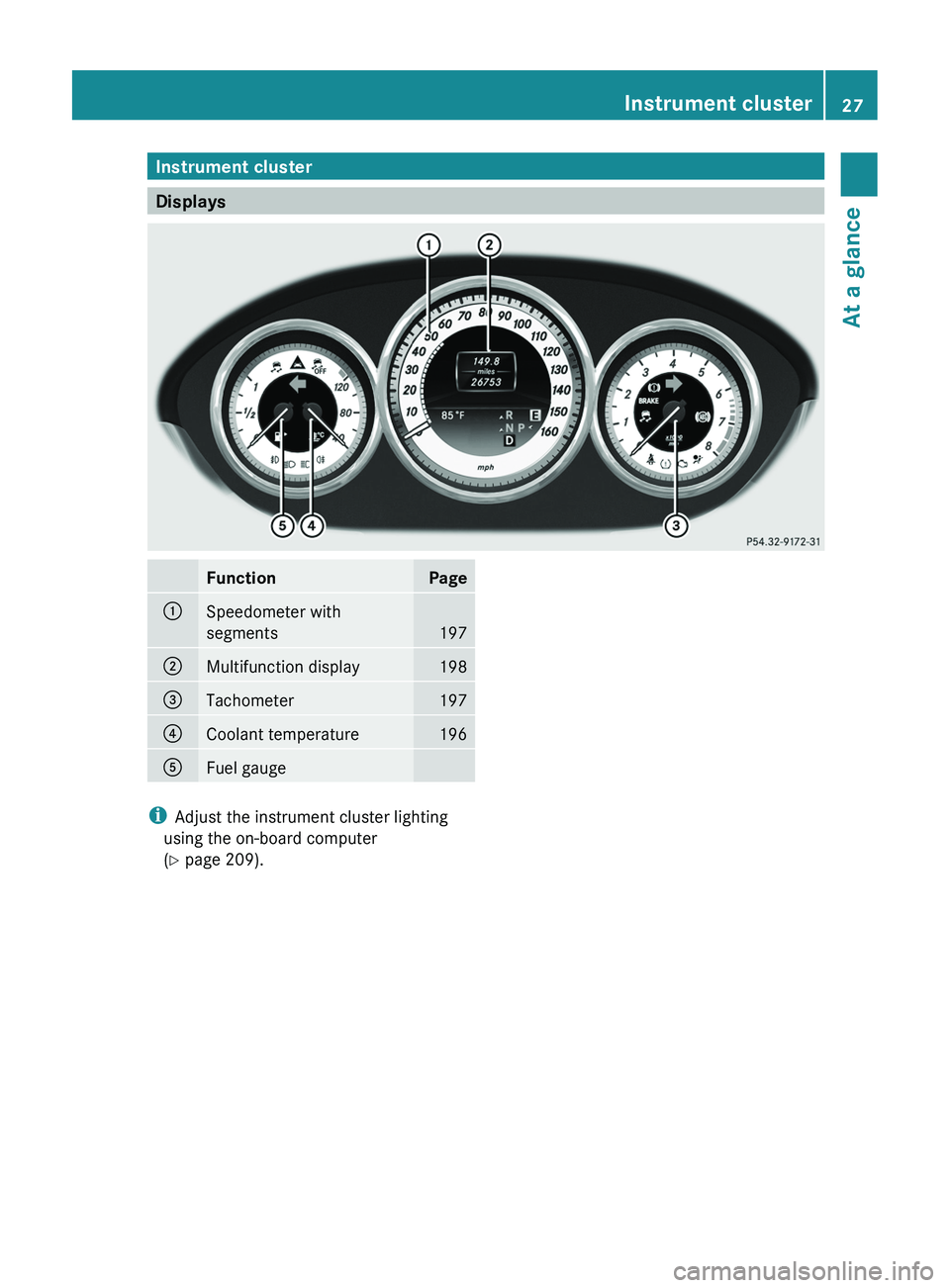
Instrument cluster
Displays
FunctionPage:Speedometer with
segments
197
;Multifunction display198=Tachometer197?Coolant temperature196AFuel gauge
i Adjust the instrument cluster lighting
using the on-board computer
( Y page 209).
Instrument cluster27At a glance
Page 33 of 356
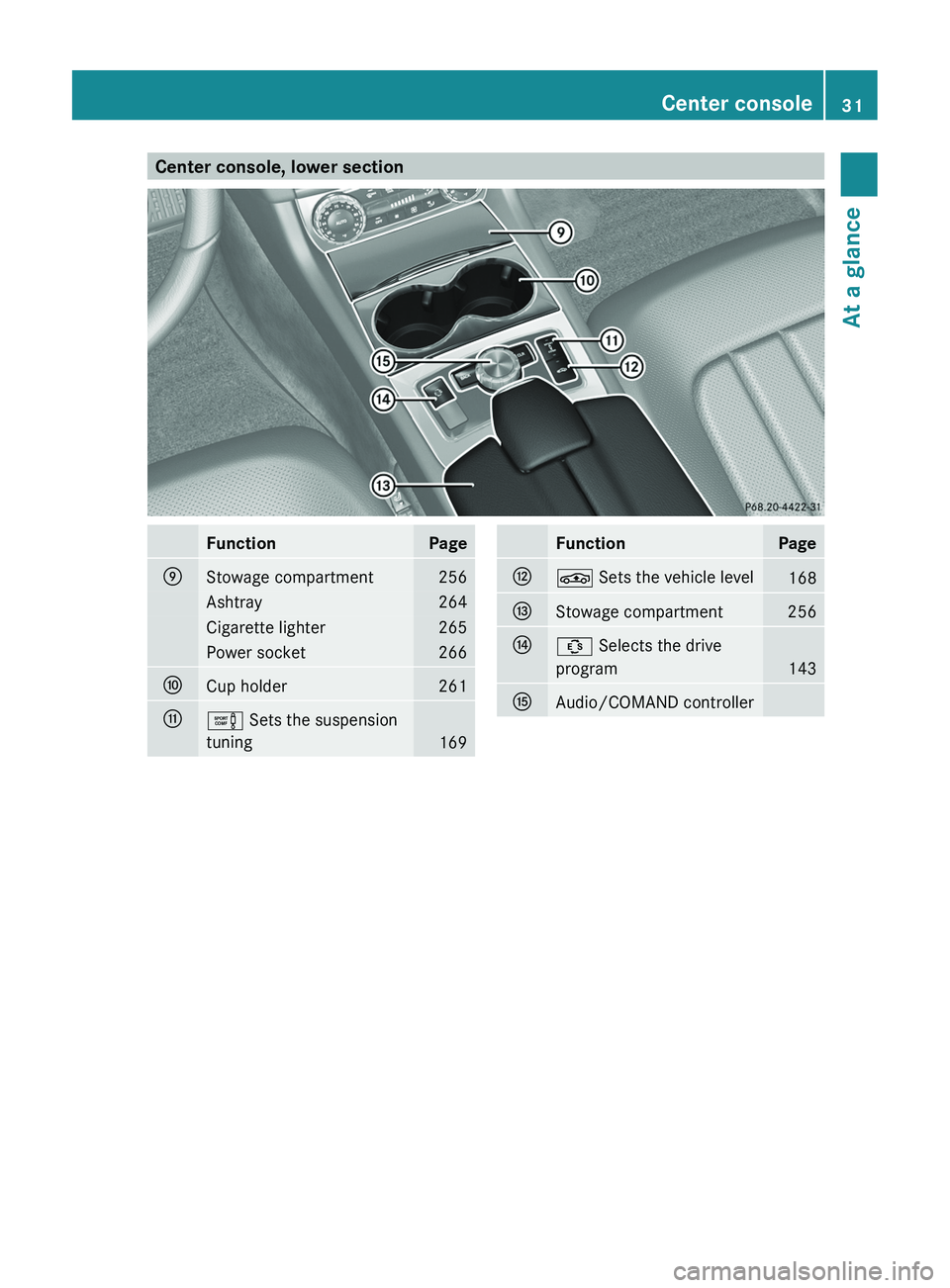
Center console, lower sectionFunctionPageEStowage compartment256Ashtray264Cigarette lighter265Power socket266FCup holder261Ge Sets the suspension
tuning
169
FunctionPageHÉ Sets the vehicle level168IStowage compartment256JÛ Selects the drive
program
143
KAudio/COMAND controllerCenter console31At a glance
Page 34 of 356
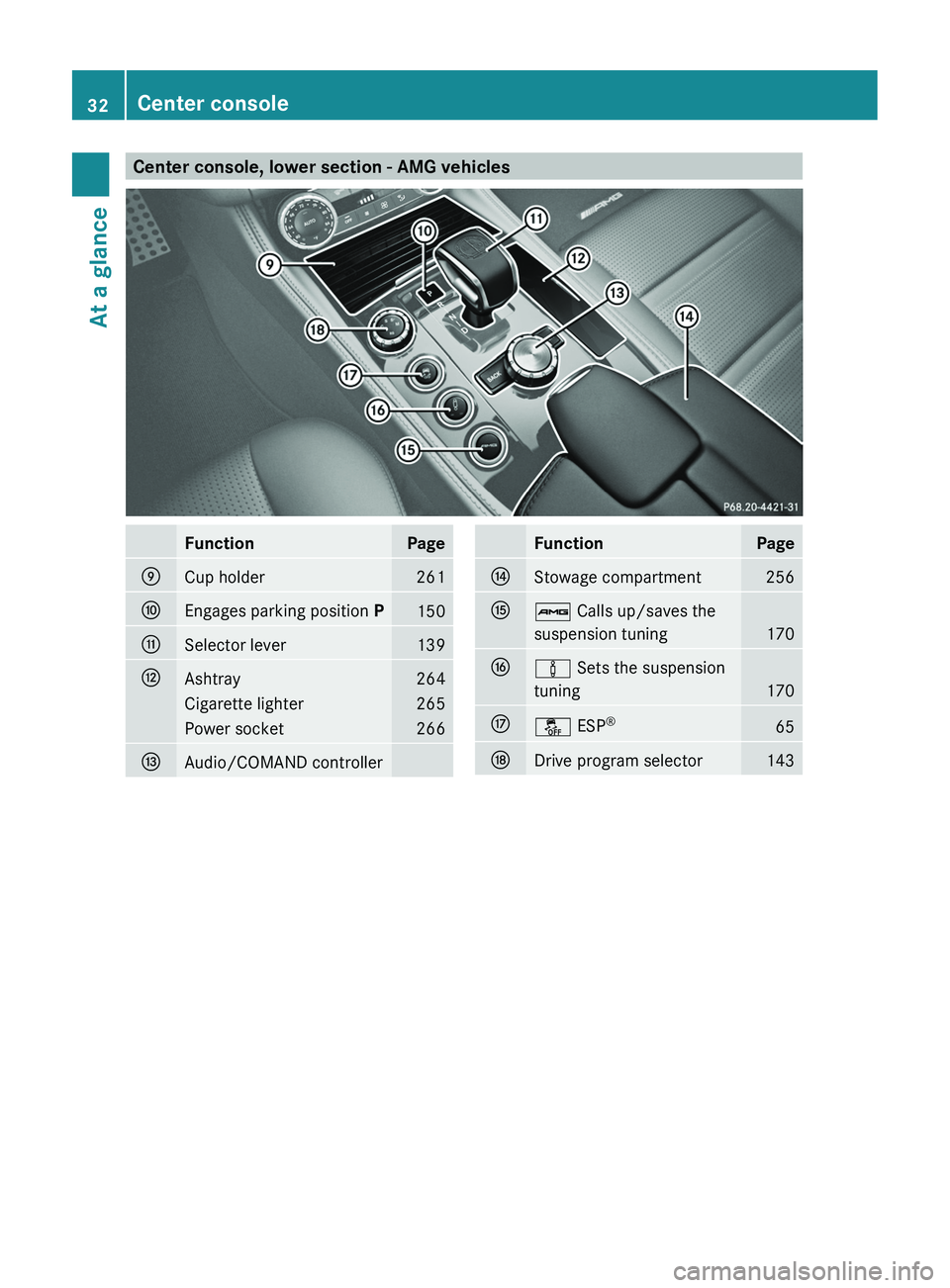
Center console, lower section - AMG vehiclesFunctionPageECup holder261FEngages parking position P150GSelector lever139HAshtray264Cigarette lighter265Power socket266IAudio/COMAND controllerFunctionPageJStowage compartment256Kß Calls up/saves the
suspension tuning
170
Là Sets the suspension
tuning
170
Må ESP®65NDrive program selector14332Center consoleAt a glance
Page 35 of 356
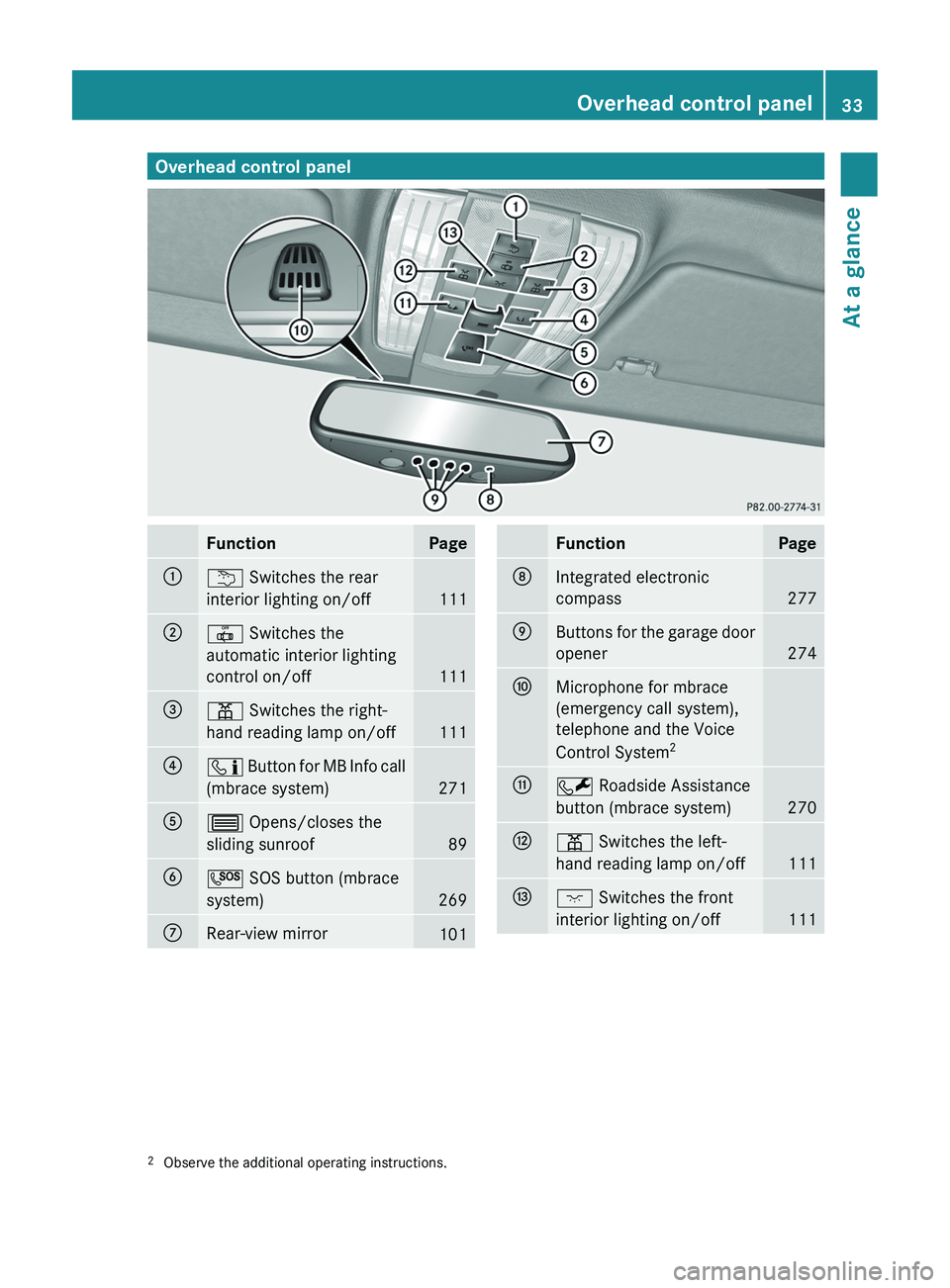
Overhead control panelFunctionPage:u Switches the rear
interior lighting on/off
111
;| Switches the
automatic interior lighting
control on/off
111
=p Switches the right-
hand reading lamp on/off
111
?ï Button for MB Info call
(mbrace system)
271
A3 Opens/closes the
sliding sunroof
89
BG SOS button (mbrace
system)
269
CRear-view mirror101FunctionPageDIntegrated electronic
compass
277
EButtons for the garage door
opener
274
FMicrophone for mbrace
(emergency call system),
telephone and the Voice
Control System 2GF
Roadside Assistance
button (mbrace system)
270
Hp Switches the left-
hand reading lamp on/off
111
Ic Switches the front
interior lighting on/off
1112 Observe the additional operating instructions.Overhead control panel33At a glance
Page 38 of 356
Useful information
i This Operator's Manual describes all
models and all standard and optional
equipment of your vehicle available at the
time of publication of the Operator's
Manual. Country-specific differences are
possible. Please note that your vehicle may
not be equipped with all features
described. This also applies to safety-
related systems and functions.
i Please read the information on qualified
specialist workshops ( Y page 22).
Occupant safety
Overview of occupant safety
In this section, you will learn the most
important facts about the restraint system
components of the vehicle.
The restraint system consists of:
R seat belts
R child restraint systems
R LATCH-type (ISOFIX) child seat anchors
Additional protection is provided by:
R SRS (Supplemental Restraint System)
R NECK-PRO head restraints/NECK-PRO
luxury head restraints
R PRE-SAFE ®
R Air bag system components with:
- PASSENGER AIR BAG OFF indicator lamp
- front-passenger seat with Occupant
Classification System (OCS)
The different air bag systems work
independently of each other. The protective
functions of the system work in conjunction
with each other. Not all air bags are deployed
in an accident.
GWARNING
Modifications to or work improperly
conducted on restraint system components
or their wiring, as well as tampering with
interconnected electronic systems, can lead
to the restraint systems no longer functioning
as intended.
Air bags or Emergency Tensioning Devices
(ETDs), for example, could deploy
inadvertently or fail to deploy in accidents
although the deceleration threshold for air
bag deployment is exceeded. Therefore,
never modify the restraint systems. Do not
tamper with electronic components or their
software.
i See "Children in the vehicle"
( Y page 55) for more information on
infants and children traveling with you in
the vehicle and restraints for infants and
children.
SRS (Supplemental Restraint System)
Introduction
SRS consists of:
R the 6 SRS warning lamp
R air bags
R air bag control unit (with crash sensors)
R Emergency Tensioning Devices
R belt force limiters
SRS reduces the risk of occupants coming
into contact with the vehicle's interior in the
event of an accident. It can also reduce the
effect of the forces to which occupants are
subjected during an accident.
SRS warning lamps
SRS functions are checked regularly when
you switch on the ignition and when the
engine is running. Therefore, malfunctions
can be detected in good time.
The 6 SRS warning lamp in the instrument
cluster lights up when the ignition is switched
on. It goes out no later than a few seconds
after the engine is started.
36Occupant safetySafety
Page 42 of 356
It is important for your safety and that of your
passenger to have deployed air bags replaced
and to have any malfunctioning air bags
repaired. This will help to make sure the air
bags continue to perform their protective
function for the vehicle occupants in the
event of a crash.
Front air bags
The front air bags increase protection for the
driver's and front-passenger's head and
chest.
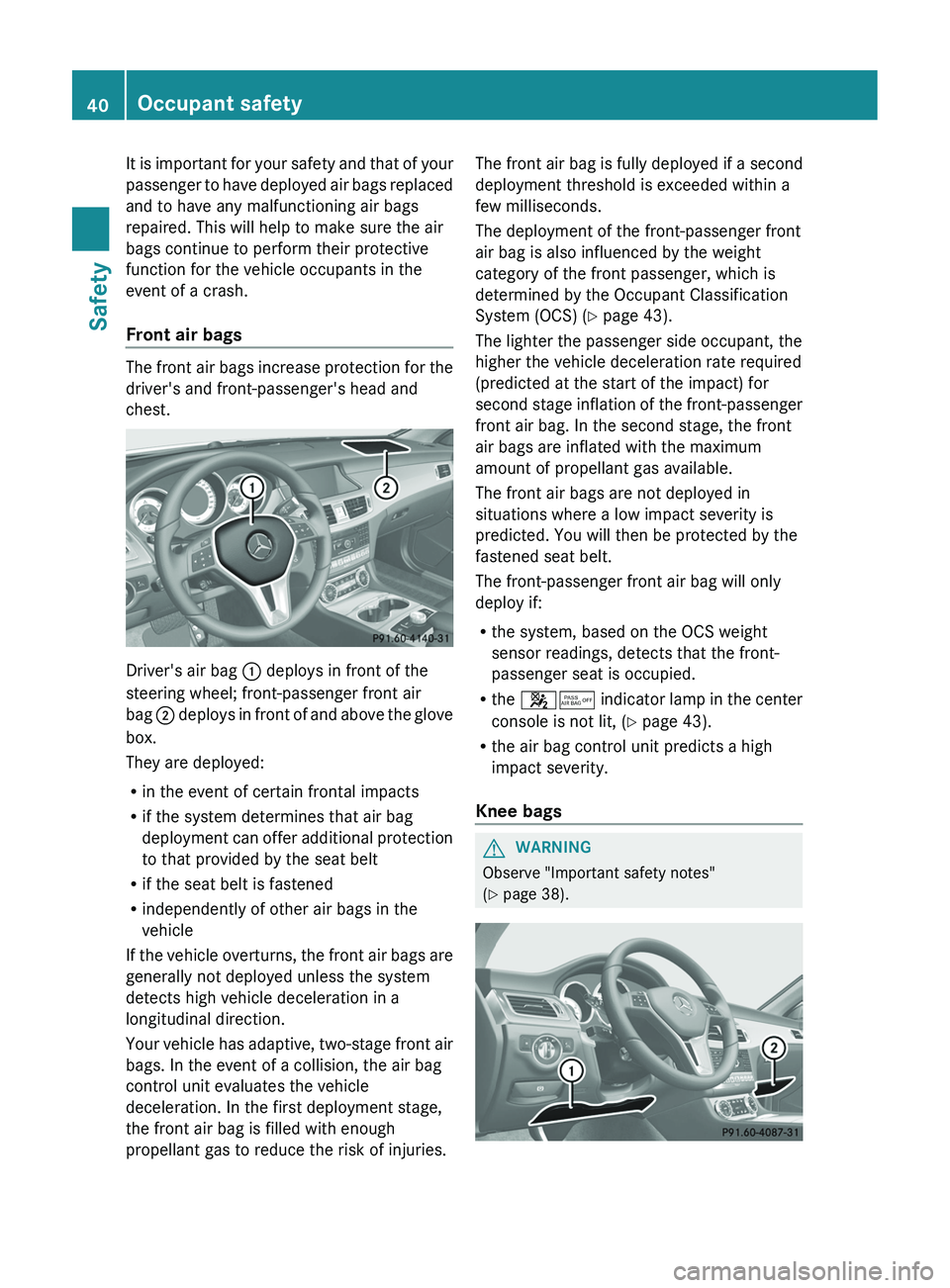
Driver's air bag : deploys in front of the
steering wheel; front-passenger front air
bag ; deploys in front of and above the glove
box.
They are deployed:
R in the event of certain frontal impacts
R if the system determines that air bag
deployment can offer additional protection
to that provided by the seat belt
R if the seat belt is fastened
R independently of other air bags in the
vehicle
If the vehicle overturns, the front air bags are
generally not deployed unless the system
detects high vehicle deceleration in a
longitudinal direction.
Your vehicle has adaptive, two-stage front air
bags. In the event of a collision, the air bag
control unit evaluates the vehicle
deceleration. In the first deployment stage,
the front air bag is filled with enough
propellant gas to reduce the risk of injuries.
The front air bag is fully deployed if a second
deployment threshold is exceeded within a
few milliseconds.
The deployment of the front-passenger front
air bag is also influenced by the weight
category of the front passenger, which is
determined by the Occupant Classification
System (OCS) ( Y page 43).
The lighter the passenger side occupant, the
higher the vehicle deceleration rate required
(predicted at the start of the impact) for
second stage inflation of the front-passenger
front air bag. In the second stage, the front
air bags are inflated with the maximum
amount of propellant gas available.
The front air bags are not deployed in
situations where a low impact severity is
predicted. You will then be protected by the
fastened seat belt.
The front-passenger front air bag will only
deploy if:
R the system, based on the OCS weight
sensor readings, detects that the front-
passenger seat is occupied.
R the 45 indicator lamp in the center
console is not lit, ( Y page 43).
R the air bag control unit predicts a high
impact severity.
Knee bagsGWARNING
Observe "Important safety notes"
( Y page 38).
40Occupant safetySafety
Page 47 of 356
passenger seat. We therefore strongly
recommend that you always place a child
in a rear-facing child restraint on the rear
seat.
R If you install a rear-facing child restraint on
the front-passenger seat, make sure the
45 indicator lamp is illuminated,
indicating that the front-passenger front air
bag and front-passenger knee bag are
deactivated. Should the 45
indicator lamp not illuminate or go out while
the restraint is installed, please check
installation. Periodically check the
45 indicator lamp while driving to
make sure that the 45 indicator
lamp is illuminated. If the 45
indicator lamp goes out or remains out, do
not transport a child on the front-passenger
seat until the system has been repaired.
A child in a rear-facing child restraint on the
front-passenger seat could be seriously
injured or even killed if the front-passenger
front air bag is deployed.
R If you place a child in a forward-facing child
restraint on the front-passenger seat:
- move the seat as far back as possible
- use the proper child restraint
recommended for the age, size and
weight of the child
- secure child restraint with the vehicle's
seat belt according to the child seat
manufacturer's instructions
R For children larger than the typical 12-
month-old child, the front-passenger front
air bag and the front-passenger knee bag
may or may not be activated.
If the driver's air bag deploys, this does not
mean that the front-passenger front air bag
also has to deploy.
The OCS may have detected that the seat:
R was empty or occupied by a person with a
weight of up to or less than that of a typical12-month-old child seated in a standard
child restraint
R was occupied by a small individual, such as
a young teenager or a small adult
R was occupied by a child in a child restraint
system, whose weight is greater than that
of a typical 12-month-old child.
These are examples of when the OCS
deactivates the front-passenger front air bag
and front-passenger knee bag. Deactivation
takes place although the collision fulfills the
criteria for deploying the driver's air bag.
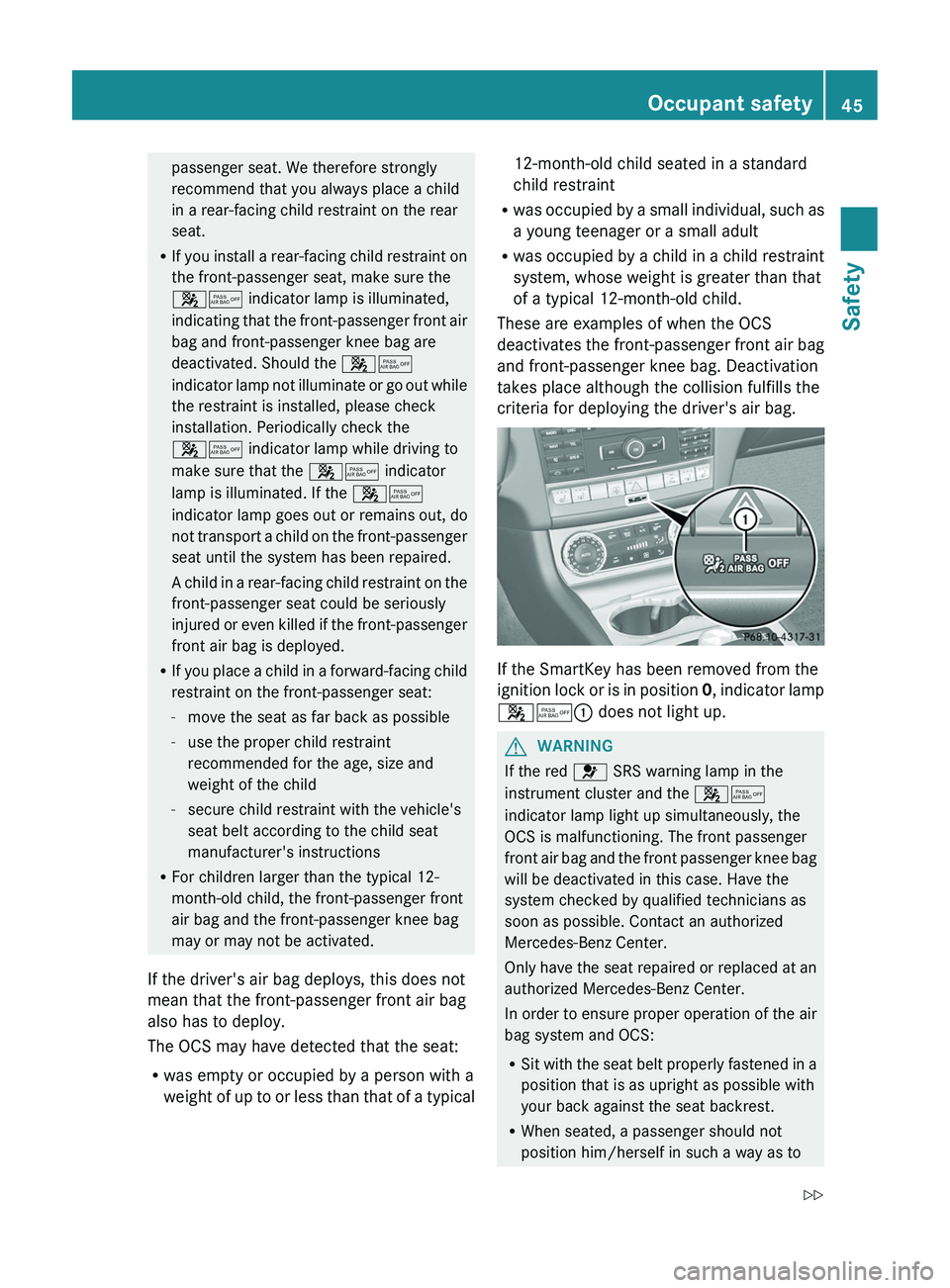
If the SmartKey has been removed from the
ignition lock or is in position 0, indicator lamp
45 : does not light up.
GWARNING
If the red 6 SRS warning lamp in the
instrument cluster and the 45
indicator lamp light up simultaneously, the
OCS is malfunctioning. The front passenger
front air bag and the front passenger knee bag
will be deactivated in this case. Have the
system checked by qualified technicians as
soon as possible. Contact an authorized
Mercedes-Benz Center.
Only have the seat repaired or replaced at an
authorized Mercedes-Benz Center.
In order to ensure proper operation of the air
bag system and OCS:
R Sit with the seat belt properly fastened in a
position that is as upright as possible with
your back against the seat backrest.
R When seated, a passenger should not
position him/herself in such a way as to
Occupant safety45SafetyZ
Page 50 of 356
PRE-SAFE®
(preventative occupant
protection)GWARNING
The PRE-SAFE ®
system reduces the impact of
an accident on vehicle occupants, as long as
their seat belts have been fastened correctly.
Although your vehicle is equipped with a PRE-
SAFE ®
system, the possibility of injury in the
event of an accident cannot be ruled out. You
should therefore always drive carefully and
adapt your driving style to the prevailing road,
weather and traffic conditions.
PRE-SAFE ®
takes preemptive measures to
protect occupants in certain hazardous
situations.
PRE-SAFE ®
intervenes:
R in emergency braking situations, e.g. if BAS
is activated or, in vehicles with DISTRONIC
PLUS, BAS PLUS intervenes powerfully
R if the radar sensor system detects an
imminent danger of collision in certain
situations (on vehicles with DISTRONIC
PLUS)
R in critical driving situations, e.g. when
physical limits are exceed and the vehicle
understeers or oversteers severely
PRE-SAFE ®
takes the following measures
depending on the hazardous situation
detected:
R the front seat belts are pre-tensioned.
R it adjusts the front-passenger seat if it is in
an unfavorable position.
R vehicles with a multicontour seat or an
active multicontour seat: the air pressure
in the side bolsters on the seat cushion and
the side bolsters on the backrest is
increased.
R if the vehicle skids, the sliding sunroof/
panorama roof with power tilt/sliding
panel and the side windows are closed so
that only a small gap remains.
If the hazardous situation passes without
resulting in an accident, PRE-SAFE ®
slackens
the belt pretensioning. The air pressure in the
side bolsters on the multicontour seat/active
multicontour seat is reduced again. All
settings made by PRE-SAFE ®
can then be
reversed.
If the seat belts are not released:XMove the backrest or seat back slightly, but
only when the vehicle is stationary.
The belt pretensioning is reduced and the
locking mechanism is released.GWARNING
Make sure that nobody can become trapped
as you adjust the seat.
! Make sure that there are no objects in the
footwell or behind the seats when resetting
the seats. There is a risk that the seats
and/or the objects could be damaged.
More information about seat-belt
adjustment, a convenience function
integrated into PRE-SAFE ®
, can be found in
the "Seat-belt adjustment" section
( Y page 53).
NECK-PRO head restraints/NECK-
PRO luxury head restraints
NECK-PRO head restraints/NECK-PRO luxury
head restraints increase protection of the
driver's and front-passenger's head and
neck. In the event of a rear collision of a
certain severity, the NECK-PRO head
restraints/NECK-PRO luxury head restraints
on the driver's and front-passenger seats are
moved forwards and upwards. This provides
better head support.
GWARNING
Do not attach any objects (e.g. a coat hanger)
to the NECK-PRO head restraints/NECK-PRO
luxury head restraints. Otherwise, the NECK-
PRO head restraints/NECK-PRO luxury head
restraints may not function properly and in
the event of a rear-end collision may not offer
the protection they are designed to provide.
48Occupant safetySafety