tow MERCEDES-BENZ CLS 2017 Workshop Manual
[x] Cancel search | Manufacturer: MERCEDES-BENZ, Model Year: 2017, Model line: CLS, Model: MERCEDES-BENZ CLS 2017Pages: 334, PDF Size: 10.18 MB
Page 283 of 334
have attained a pressure of at least 180 kPa
(1.8 bar/26 psi).
If a pressure of 180 kPa (1.8 bar/26 psi) has
been attained after five minutes, see "Tire pres-
sure reached" ( Y
page 281).
If a tire pressure of 180 kPa (1.8 bar/26 psi) has
not been attained after five minutes, see "Tire
pressure not reached" ( Y
page 281).
If tire sealant has escaped, clean it off affected
areas as quickly as possible. Use plain water if
possible.
If your clothes are soiled with tire sealant, have
them cleaned with perchloroethylene at a dry
cleaner as soon as possible.
Tire pressure not reached If a pressure of 180 kPa (1.8 bar/26 psi) has not
been attained after five minutes: X
Switch off the tire inflation compressor. X
Unscrew the filler hose from the valve of the
faulty tire.
Tire sealant may escape when the filler hose is
unscrewed. X
Very slowly drive forwards or reverse approx-
imately 30 ft (10 m). X
Pump up the tire again.
After a maximum of five minutes the tire pres-
sure must be at least 180 kPa (1.8 bar/
26 psi).
G WARNING
If the required tire pressure is not reached
after the specified time, the tire is too badly
damaged. The tire sealant cannot repair the
tire in this instance. Damaged tires and a tire
pressure that is too low can significantly
impair the vehicle's braking and driving char-
acteristics. There is a risk of accident.
Do not continue driving. Contact a qualified
specialist workshop.
Tire pressure reached
G WARNING
A tire temporarily sealed with tire sealant
impairs the driving characteristics and is not
suitable for higher speeds. There is a risk of
accident. You should therefore adapt your driving style
accordingly and drive carefully. Do not exceed
the specified maximum speed with a tire that
has been repaired using tire sealant.
The maximum permissible speed for a tire
sealed with tire sealant is 50 mph (80 km/h).
The upper part of the TIREFIT sticker must be
affixed to the instrument cluster in the driver's
field of vision.
If a tire pressure of 180 kPa (1.8 bar/26 psi) has
been attained after five minutes: X
Switch off the tire inflation compressor. X
Unscrew the filler hose from the valve of the
faulty tire.
Tire sealant may escape when the filler hose is
unscrewed. X
Stow the tire sealant bottle and the tire infla-
tion compressor. X
Pull away immediately .X
Stop after driving for approximately ten
minutes and check the tire pressure with the
tire inflation compressor.
The tire pressure must now be at least
130 kPa (1.3 bar/19 psi).
G WARNING
If the required tire pressure is not reached
after driving for a short period, the tire is too
badly damaged. The tire sealant cannot repair
the tire in this instance. Damaged tires and a
tire pressure that is too low can significantly
impair the vehicle's braking and driving char-
acteristics. There is a risk of accident.
Do not continue driving. Contact a qualified
specialist workshop.
In cases such as the one mentioned above, con-
tact an authorized Mercedes-Benz Center. Or
call 1-800-FOR-MERCedes (in the USA) or
1-800-387-0100 (in Canada). X
Correct the tire pressure if it is still at least
130 kPa (1.3 bar/19 psi). See the Tire and
Loading Information placard on the driver's
side B-pillar or the tire pressure table in the
fuel filler flap for values. X
To increase the tire pressure: switch on the
tire inflation compressor. Flat tire 281
Breakdown assistance Z
Page 290 of 334
! If you tow or tow-start another vehicle, its
weight must not exceed the maximum per-
missible gross vehicle weight of your vehicle.
It is better to have the vehicle transported than
to have it towed away.
If the vehicle has suffered transmission damage,
have it transported on a transporter or trailer.
The automatic transmission must be in position
N when the vehicle is being towed.
The battery must be connected and charged.
Otherwise, you: R
cannot turn the SmartKey to position 2 in the
ignition lock. R
cannot shift the automatic transmission to
position N .
In the event of damage to the electrical sys-
tem
If the battery is defective, the automatic trans-
mission will be locked in position P . To shift the
automatic transmission to position N , you must
provide power to the vehicle's electrical system
in the same way as when jump-starting
( Y
page 285).
Have the vehicle transported on a transporter or
trailer.
Disarm the automatic locking feature before the
vehicle is towed ( Y
page 82). You could other-
wise be locked out when pushing or towing the
vehicle.
Installing/removing the towing eye
Installing the towing eye
G WARNING
The exhaust tail pipe may be very hot. There is
a risk of burns when removing the rear cover.
Do not touch the exhaust pipe. Take particular
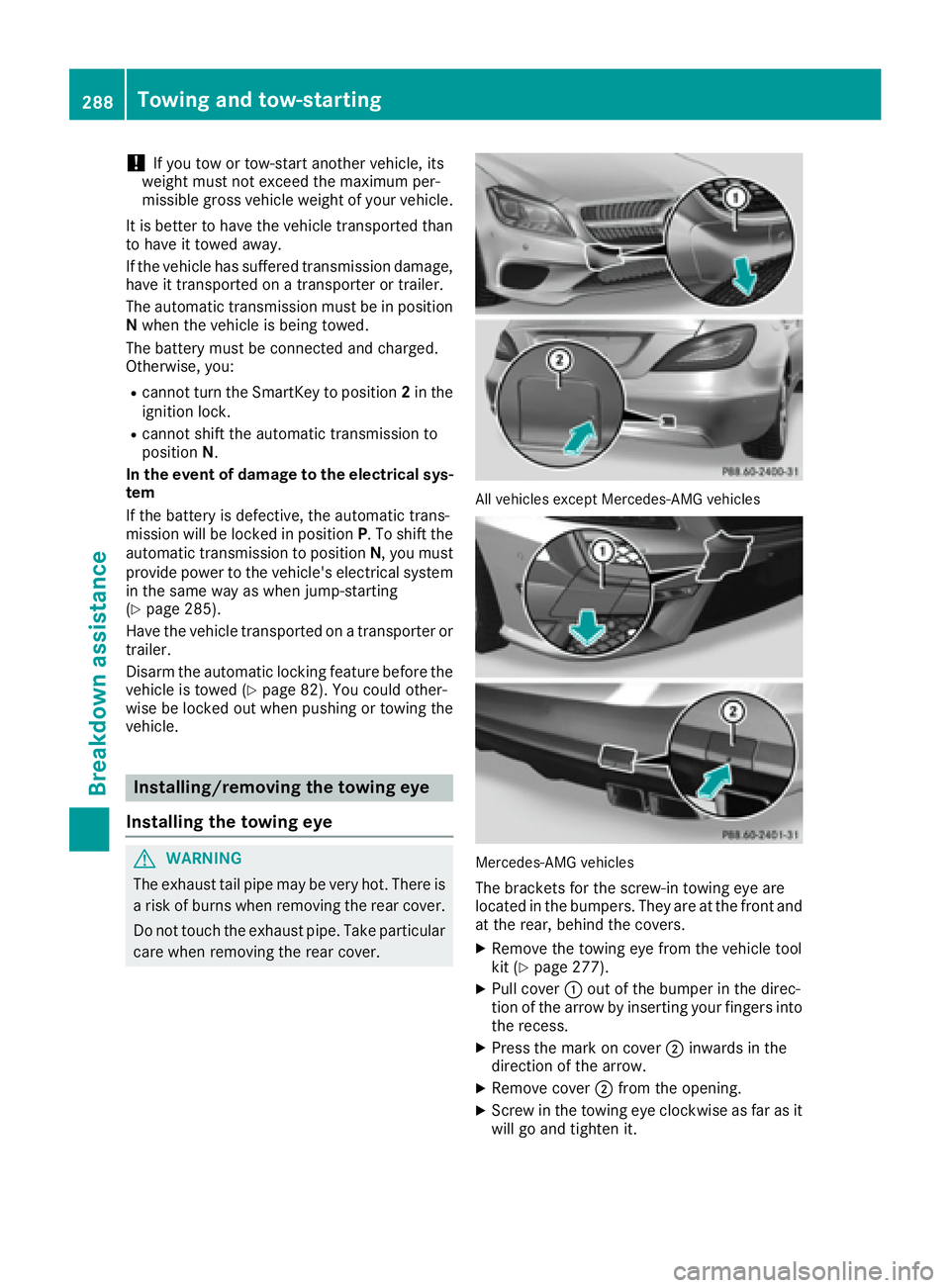
care when removing the rear cover. All vehicles except Mercedes-AMG vehicles
Mercedes-AMG vehicles
The brackets for the screw-in towing eye are
located in the bumpers. They are at the front and
at the rear, behind the covers. X
Remove the towing eye from the vehicle tool
kit ( Y
page 277). X
Pull cover C out of the bumper in the direc-
tion of the arrow by inserting your fingers into
the recess. X
Press the mark on cover D inwards in the
direction of the arrow. X
Remove cover D from the opening.X
Screw in the towing eye clockwise as far as it
will go and tighten it.288
Towing and tow-starting
Breakdown assistance
Page 291 of 334
Removing the towing eye X
Unscrew and remove the towing eye. X
Position cover C on top of the bumper and
press it in at the bottom until it engages. X
Attach cover D to the bumper and press until
it engages. X
Place the towing eye in the vehicle tool kit.
Towing a vehicle with both axles on
the ground It is important that you observe the safety
instructions when towing away your vehicle
( Y
page 287).
The automatic transmission automatically shifts
to position P when you open the driver's or front-
passenger door or when you remove the Smart-
Key from the ignition lock. In order to ensure
that the automatic transmission stays in posi-
tion N when towing the vehicle, you must
observe the following points: X
Make sure that the vehicle is stationary. X
Turn the SmartKey to position 2 in the ignition
lock.
On vehicles with KEYLESS-GO, use the Smart-
Key instead of the Start/Stop button
( Y
page 124). X
Depress and hold the brake pedal. X
Shift the automatic transmission to position
N . X
Release the brake pedal. X
Release the parking brake. X
Switch on the hazard warning lamps
( Y
page 107). X
Leave the SmartKey in position 2 in the igni-
tion lock.
In order to signal a change of direction when
towing the vehicle with the hazard warning
lamps switched on, use the combination switch
as usual. In this case, only the turn signals for
the desired direction flash. After resetting the
combination switch, the hazard warning lamp
starts flashing again. Towing the vehicle with the rear axle
raised
! Vehicles with 4MATIC must not be towed
with either the front or the rear axle raised, as
doing so will damage the transmission.
! Vehicles with automatic transmission must
not be towed with the rear axle raised. The
vehicle/trailer combination may otherwise
swerve or even roll over.
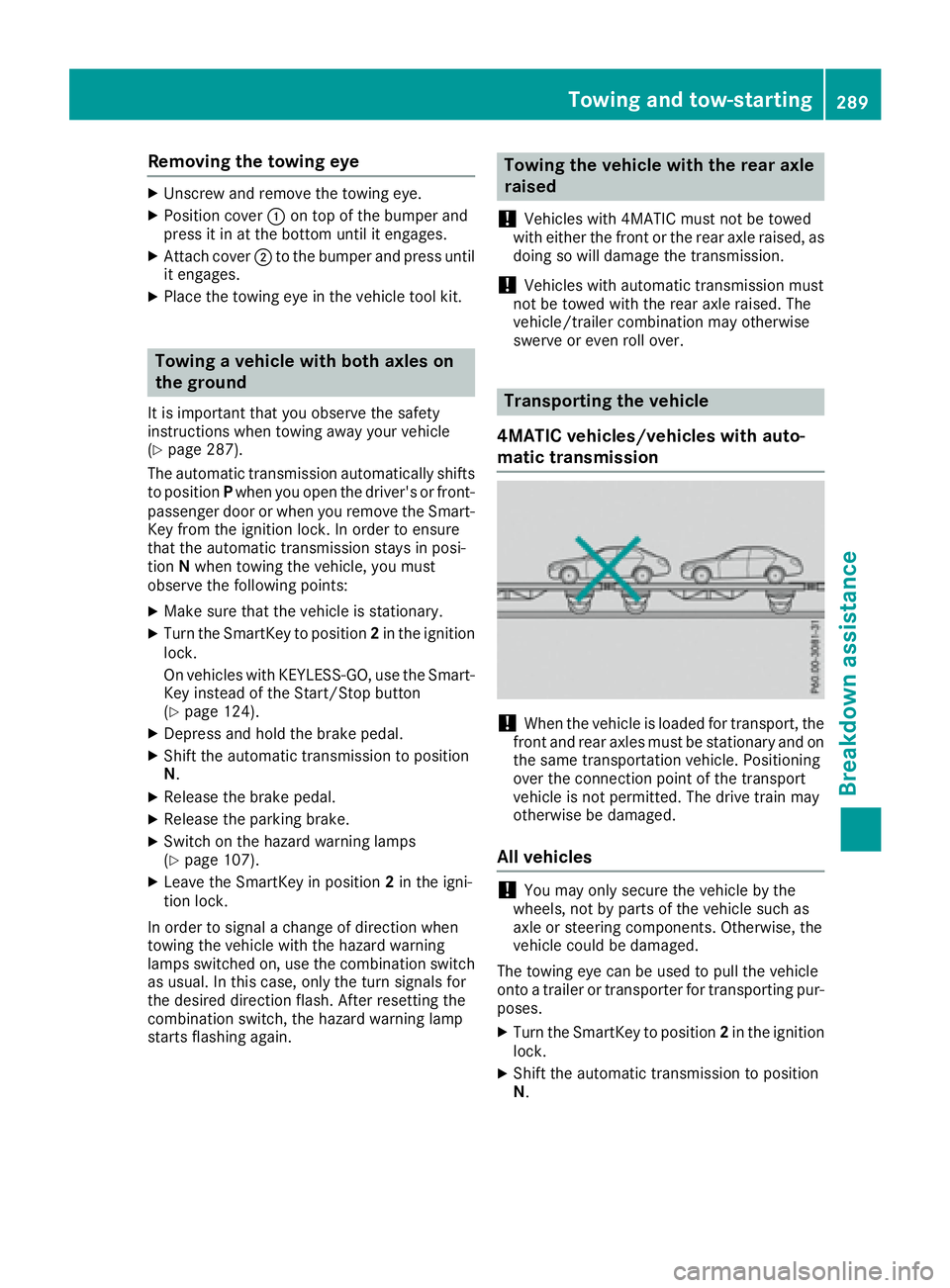
Transporting the vehicle
4MATIC vehicles/vehicles with auto-
matic transmission
! When the vehicle is loaded for transport, the
front and rear axles must be stationary and on
the same transportation vehicle. Positioning
over the connection point of the transport
vehicle is not permitted. The drive train may
otherwise be damaged.
All vehicles
! You may only secure the vehicle by the
wheels, not by parts of the vehicle such as
axle or steering components. Otherwise, the
vehicle could be damaged.
The towing eye can be used to pull the vehicle
onto a trailer or transporter for transporting pur-
poses. X
Turn the SmartKey to position 2 in the ignition
lock. X
Shift the automatic transmission to position
N .Towing and tow-starting 289
Breakdown assistance Z
Page 292 of 334
As soon as the vehicle has been loaded:X
Prevent the veh icle from rolling away by
applyin g the parking brake.X
Sh ift the automat ic transmission to posi-
tion P .X
Turn the Sm artKey to position 0 in the ignition
lock and remove it. X
Secure the veh icle .
Notes on 4MATIC vehicles
! Veh icle s wit h 4MATIC must not be towed
wit h either the front or the rear axle raised, as
doin g so will damage the transmission.
If the veh icle has transmission damage or dam-
age to the front or rear axle, have it transported
on a transporter or trailer.
In the event of da ma ge to the electrical sys-
tem
If the battery is defective, the automat ic trans-
mission will be locked in position P . To shift the
automat ic transmission to position N , you must
pro vide power to the veh icle 's electrical system
in the same way as when jump-starting
( Y
page 285).
Have the veh icle transported on a transporter or
trailer.
Tow-starting (emergency engine
starting)
! Veh icle s wit h automat ic transmission must
not be started by tow-starting. This could oth-
erwise damage the transmission.
i You can find information on "Jump-starting"
under ( Y
page 285).
Fuses
Important safety notes
G WAR NING
If you man ipulat e or brid ge a faulty fuse or if
you replace it wit h a fuse wit h a higher amper-
age, the electr ic cables could be overloaded.
This could result in a fire. There is a risk of an
acc iden t and injury. Alwa ys replace faulty fuses wit h the specified
new fuses having the correct amperage.
Blo wn fuses must be replaced wit h fuses of the
same rating, whic h you can recognize by the
color and value. The fuse ratings are listed in the
fuse allocation chart.
The fuse allocation chart is located in the vehicle
tool kit in the stowage compartment under the
trunk floor ( Y
page 277).
If a ne wly inserted fuse also blows, have the
cause traced and rectified at a qualified special-
ist worksho p, e.g. an authorized Mercedes-Benz
Center.
! Only use fuses that have been appr oved for
Mercedes-Benz vehicles and whic h have the
correct fuse rating for the system concerned.
Otherwise, components or systems could be
damaged.
! Make sure that no moisture can enter the
fuse box when the cover is open.
! When closing the cover, make sure that it is
lying correctly on the fuse box. Moisture seep-
ing in or dirt could otherwise impair the oper-
ation of the fuses.
The fuses in your vehicle ser ve to close down
faulty circuits. If a fuse blows, all the compo-
nents on the circuit and their functions stop
operating.
Before changing a fuse Pay attention to the important safety notes
( Y
page 290). X
Swit ch off the engine. X
Swit ch off all electrical consumers. X
Make sure that the ignition is swit ched off
( Y
page 123).
or X
When using the SmartKey, turn the SmartKey
to position 0 in the ignition lock and remove it
( Y
page 123). X
Secure the vehicle against rolling away
( Y
page 141).
All indicator lamps in the instrument cluster
must be off.290
Fuses
Breakdown assistance
Page 320 of 334
R
do not switch ESP ®
off.R
have a spare wheel or emergency spare
wheel of a different size replaced at the
nearest qualified specialist workshop.
Observe that the wheel and tire dimensions
as well as the tire type must be correct.
When using an emergency spare wheel or spare
wheel of a different size, you must not exceed
the maximum speed of 50 mph (80 km/h).
Snow chains must not be mounted on emer-
gency spare wheels.
General notes You can ask for information regarding permitted
emergency spare wheels at an authorized
Mercedes-Benz Center.
You should regularly check the pressure of the
emergency spare wheel, particularly prior to
long trips, and correct the pressure as neces-
sary ( Y
page 295). The value on the wheel is
valid.
An emergency spare wheel may also be moun-
ted against the direction of rotation. Observe
the time restriction on use as well as the speed
limitation specified on the emergency spare
wheel.
Replace the tires after six years at the latest,
regardless of wear. This also applies to the
emergency spare wheel.
i When you are driving with the collapsible
spare wheel mounted, the tire pressure loss
warning system or the tire pressure monitor
cannot function reliably. Only restart the tire
pressure loss warning system or tire pressure
monitor when the defective wheel has been
replaced with a new wheel.
Vehicles with tire pressure monitor: after
mounting an emergency spare wheel, the sys-
tem may still display the tire pressure of the
removed wheel for a few minutes. The value
displayed for the mounted emergency spare
wheel is not the same as the current tire pres-
sure of the emergency spare wheel. "Minispare" emergency spare wheel/
collapsible spare wheel
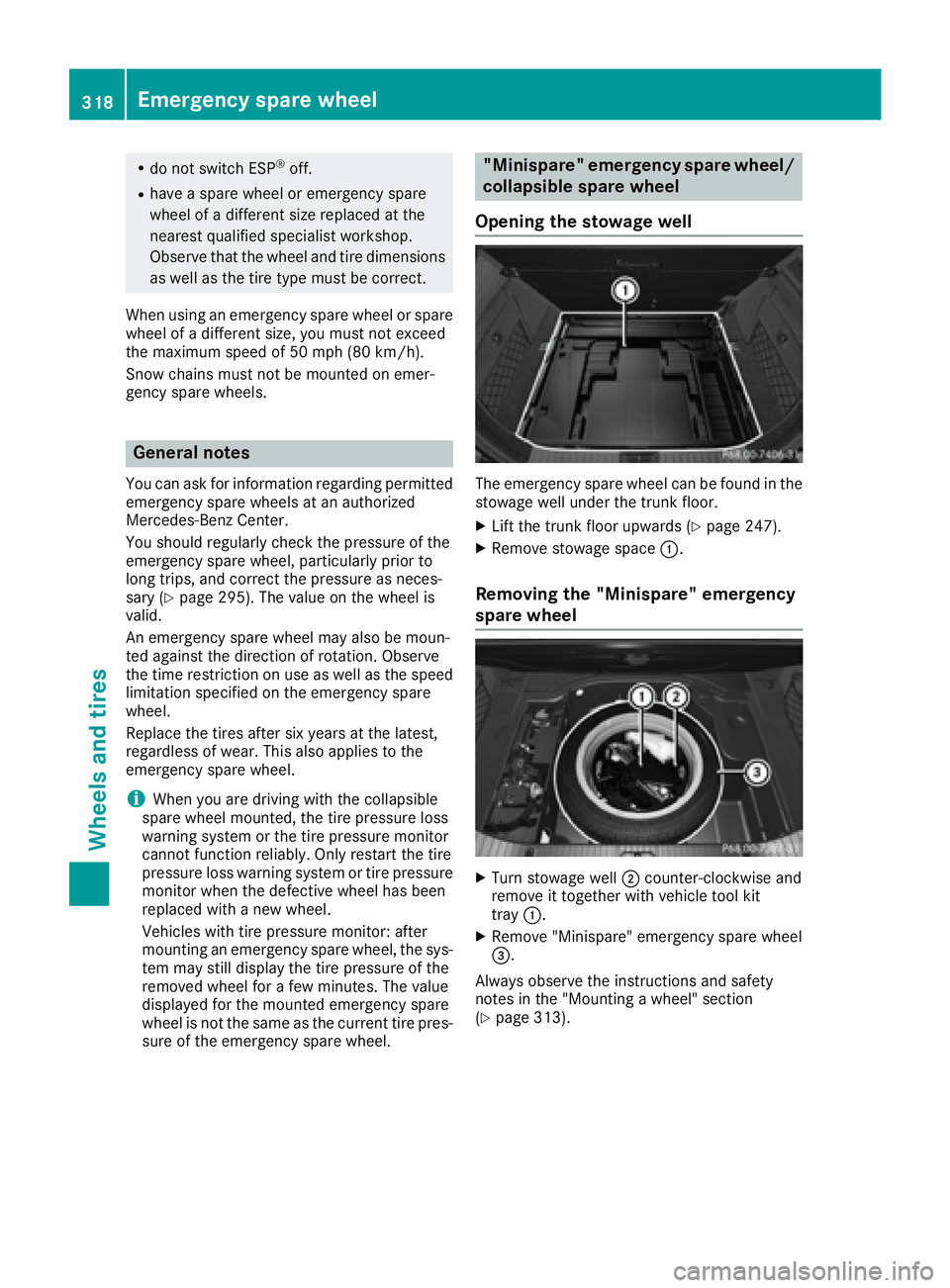
Opening the stowage well
The emergency spare wheel can be found in the
stowage well under the trunk floor. X
Lift the trunk floor upwards ( Y
page 247).X
Remove stowage space C .
Removing the "Minispare" emergency
spare wheel
X
Turn stowage well D counter-clockwise and
remove it together with vehicle tool kit
tray C . X
Remove "Minispare" emergency spare wheel
Page 321 of 334
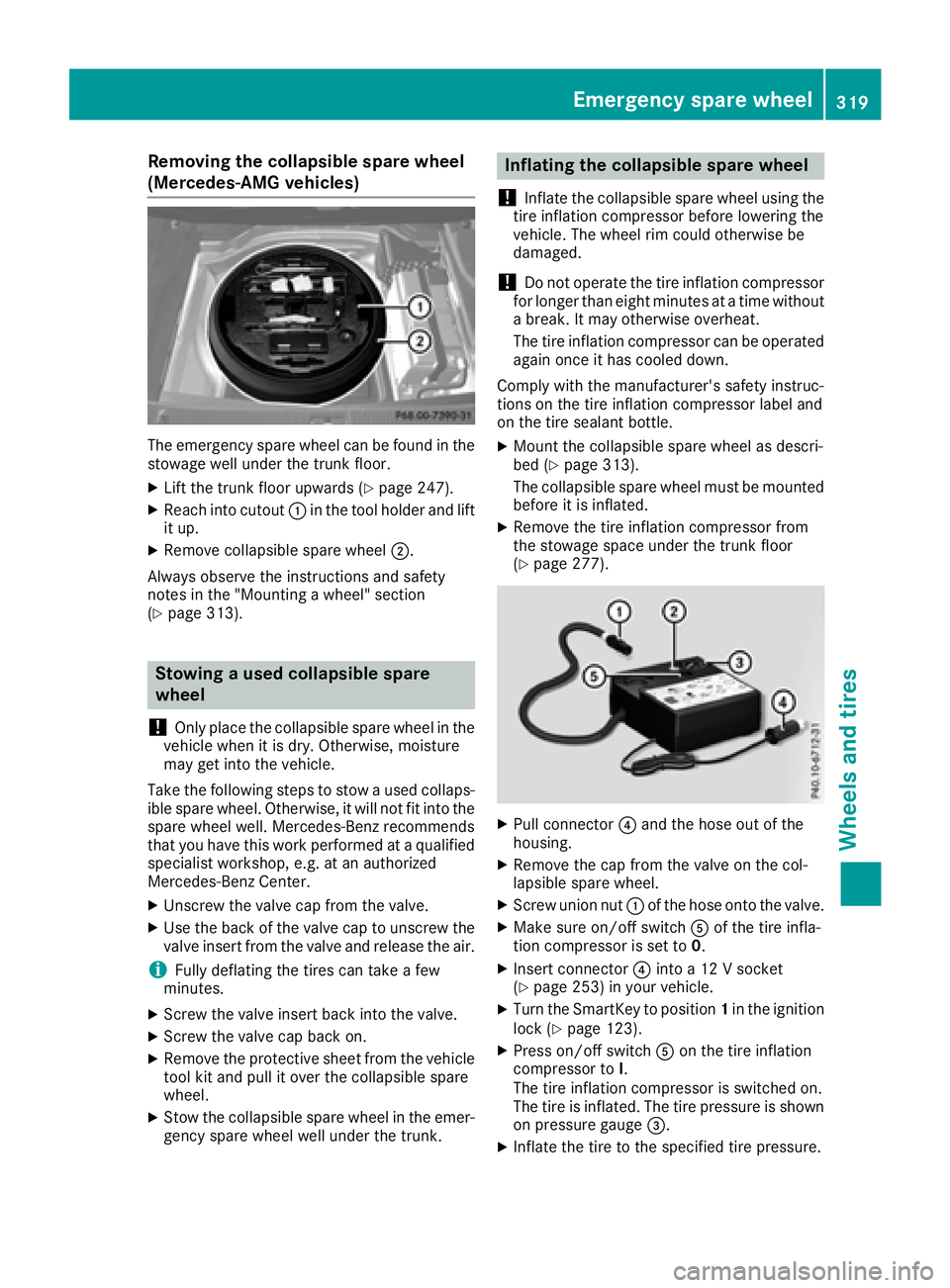
Removing the collapsible spare wheel
(Mercedes-AMG vehicles)
The emergency spare wheel can be found in the
stowage well under the trunk floor. X
Lift the trunk floor upwards ( Y
page 247).X
Reach into cutout C in the tool holder and lift
it up. X
Remove collapsible spare wheel D .
Always observe the instructions and safety
notes in the "Mounting a wheel" section
( Y
page 313).
Stowing a used collapsible spare
wheel
! Only place the collapsible spare wheel in the
vehicle when it is dry. Otherwise, moisture
may get into the vehicle.
Take the following steps to stow a used collaps-
ible spare wheel. Otherwise, it will not fit into the
spare wheel well. Mercedes-Benz recommends
that you have this work performed at a qualified
specialist workshop, e.g. at an authorized
Mercedes-Benz Center. X
Unscrew the valve cap from the valve. X
Use the back of the valve cap to unscrew the
valve insert from the valve and release the air.
i Fully deflating the tires can take a few
minutes. X
Screw the valve insert back into the valve. X
Screw the valve cap back on. X
Remove the protective sheet from the vehicle
tool kit and pull it over the collapsible spare
wheel. X
Stow the collapsible spare wheel in the emer-
gency spare wheel well under the trunk. Inflating the collapsible spare wheel
! Inflate the collapsible spare wheel using the
tire inflation compressor before lowering the
vehicle. The wheel rim could otherwise be
damaged.
! Do not operate the tire inflation compressor
for longer than eight minutes at a time without
a break. It may otherwise overheat.
The tire inflation compressor can be operated
again once it has cooled down.
Comply with the manufacturer's safety instruc-
tions on the tire inflation compressor label and
on the tire sealant bottle. X
Mount the collapsible spare wheel as descri-
bed ( Y
page 313).
The collapsible spare wheel must be mounted
before it is inflated. X
Remove the tire inflation compressor from
the stowage space under the trunk floor
( Y
page 277).
X
Pull connector