com MERCEDES-BENZ CLS-Class 2013 W218 Owner's Manual
[x] Cancel search | Manufacturer: MERCEDES-BENZ, Model Year: 2013, Model line: CLS-Class, Model: MERCEDES-BENZ CLS-Class 2013 W218Pages: 376, PDF Size: 13.45 MB
Page 354 of 376
G
WARNING
If you tighten the wheel bolts or wheel nuts
when the vehicle is raised, the jack could tip
over. There is a risk of injury.
Only tighten the wheel bolts or wheel nuts
when the vehicle is on the ground.
Always pay attention to the instructions and
safety notes in the "Changing a wheel"
section ( Y page 348).
Only
use wheel bolts that have been designed
for the wheel and the vehicle. For safety
reasons, Mercedes-Benz recommends that
you only use wheel bolts which have been
approved for Mercedes-Benz vehicles and the
respective wheel.
! AMG vehicle with ceramic brake
discs: during removal and repositioning of
the wheel, the wheel rim can strike the
ceramic-brake disc and damage it.
Therefore, take precautions and have a
second person assist you. Alternatively,
you can use a second alignment bolt.
! To prevent damage to the paintwork, hold
the wheel securely against the wheel hub
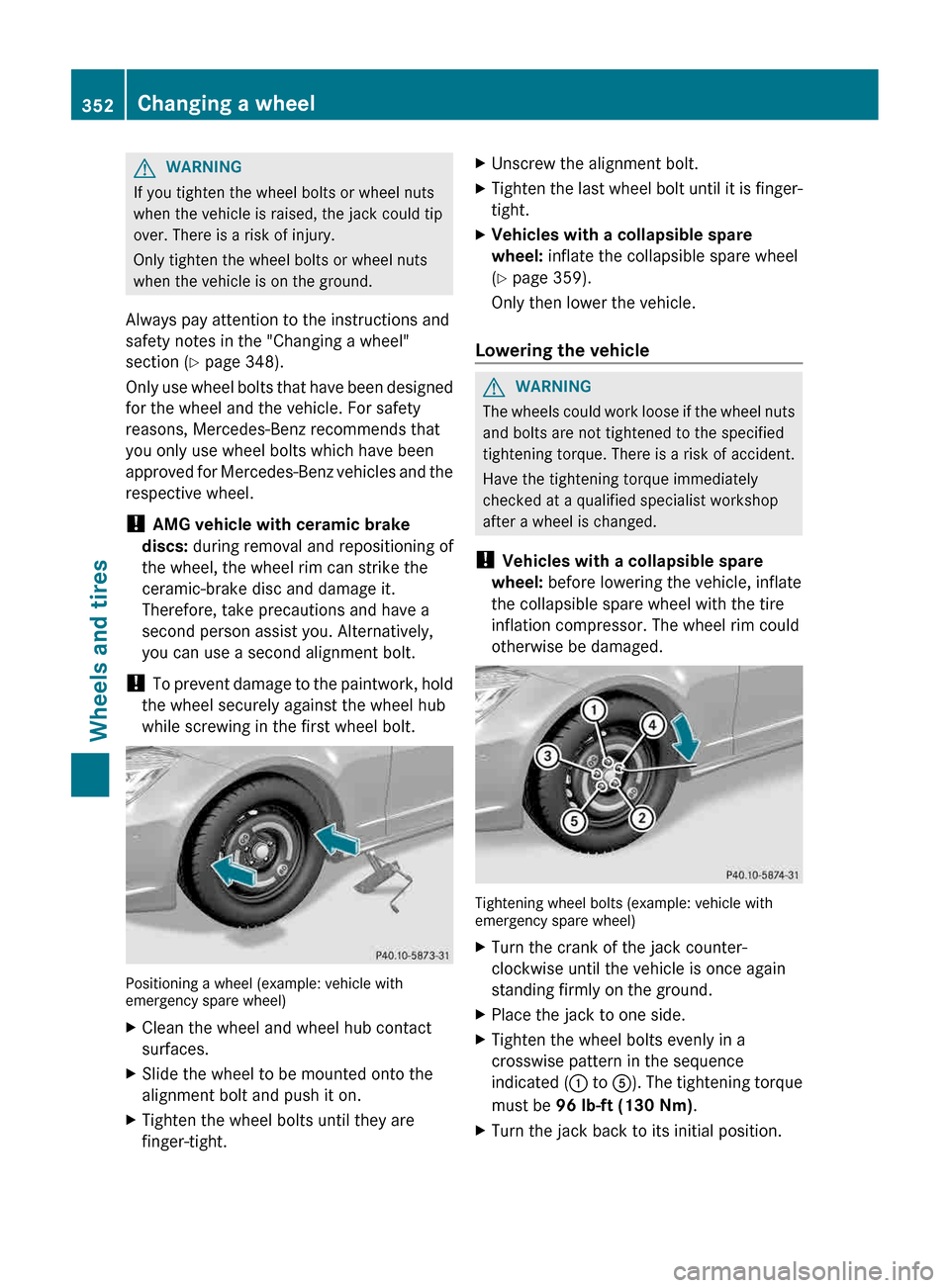
while screwing in the first wheel bolt. Positioning a wheel (example: vehicle with
emergency spare wheel)
X
Clean the wheel and wheel hub contact
surfaces.
X Slide the wheel to be mounted onto the
alignment bolt and push it on.
X Tighten the wheel bolts until they are
finger-tight. X
Unscrew the alignment bolt.
X Tighten the last wheel bolt until it is finger-
tight.
X Vehicles with a collapsible spare
wheel: inflate the collapsible spare wheel
(Y page 359).
Only then lower the vehicle.
Lowering the vehicle G
WARNING
The wheels could work loose if the wheel nuts
and bolts are not tightened to the specified
tightening torque. There is a risk of accident.
Have the tightening torque immediately
checked at a qualified specialist workshop
after a wheel is changed.
! Vehicles with a collapsible spare
wheel: before lowering the vehicle, inflate
the collapsible spare wheel with the tire
inflation compressor. The wheel rim could
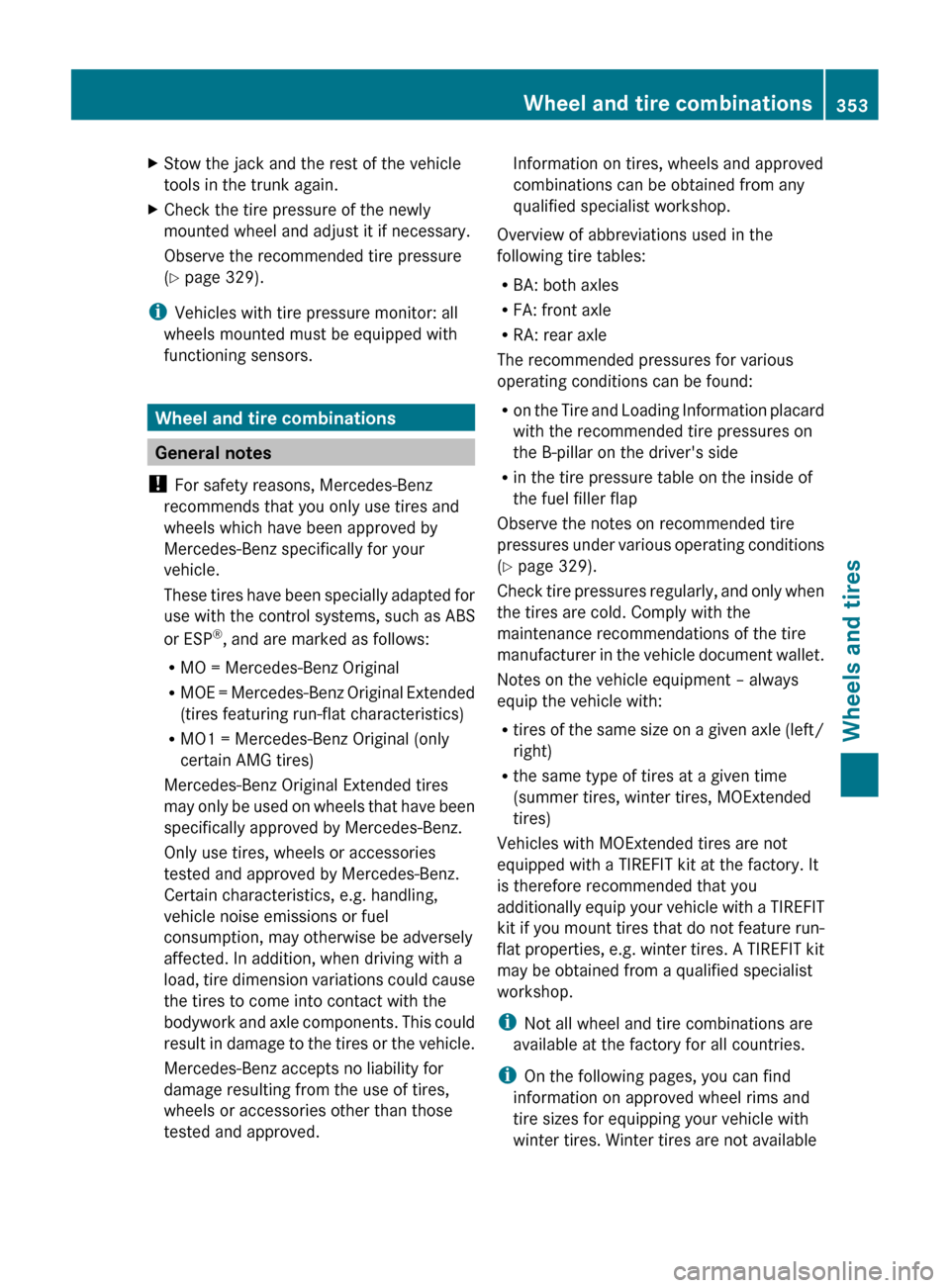
otherwise be damaged. Tightening wheel bolts (example: vehicle with
emergency spare wheel)
X
Turn the crank of the jack counter-
clockwise until the vehicle is once again
standing firmly on the ground.
X Place the jack to one side.
X Tighten the wheel bolts evenly in a
crosswise pattern in the sequence
indicated ( :
to A). The tightening torque
must be 96 lb-ft (130 Nm).
X Turn the jack back to its initial position.352
Changing a wheel
Wheels and tires
Page 355 of 376
X
Stow the jack and the rest of the vehicle
tools in the trunk again.
X Check the tire pressure of the newly
mounted wheel and adjust it if necessary.
Observe the recommended tire pressure
(Y page 329).
i Vehicles with tire pressure monitor: all
wheels mounted must be equipped with
functioning sensors. Wheel and tire combinations
General notes
! For safety reasons, Mercedes-Benz
recommends that you only use tires and
wheels which have been approved by
Mercedes-Benz specifically for your
vehicle.
These
tires have been specially adapted for
use with the control systems, such as ABS
or ESP ®
, and are marked as follows:
R MO = Mercedes-Benz Original
R MOE = Mercedes-Benz Original Extended
(tires featuring run-flat characteristics)
R MO1 = Mercedes-Benz Original (only
certain AMG tires)
Mercedes-Benz Original Extended tires
may only be used on wheels that have been
specifically approved by Mercedes-Benz.
Only use tires, wheels or accessories
tested and approved by Mercedes-Benz.
Certain characteristics, e.g. handling,
vehicle noise emissions or fuel
consumption, may otherwise be adversely
affected. In addition, when driving with a
load, tire dimension variations could cause
the tires to come into contact with the
bodywork and axle components. This could
result in damage to the tires or the vehicle.
Mercedes-Benz accepts no liability for
damage resulting from the use of tires,
wheels or accessories other than those
tested and approved. Information on tires, wheels and approved
combinations can be obtained from any
qualified specialist workshop.
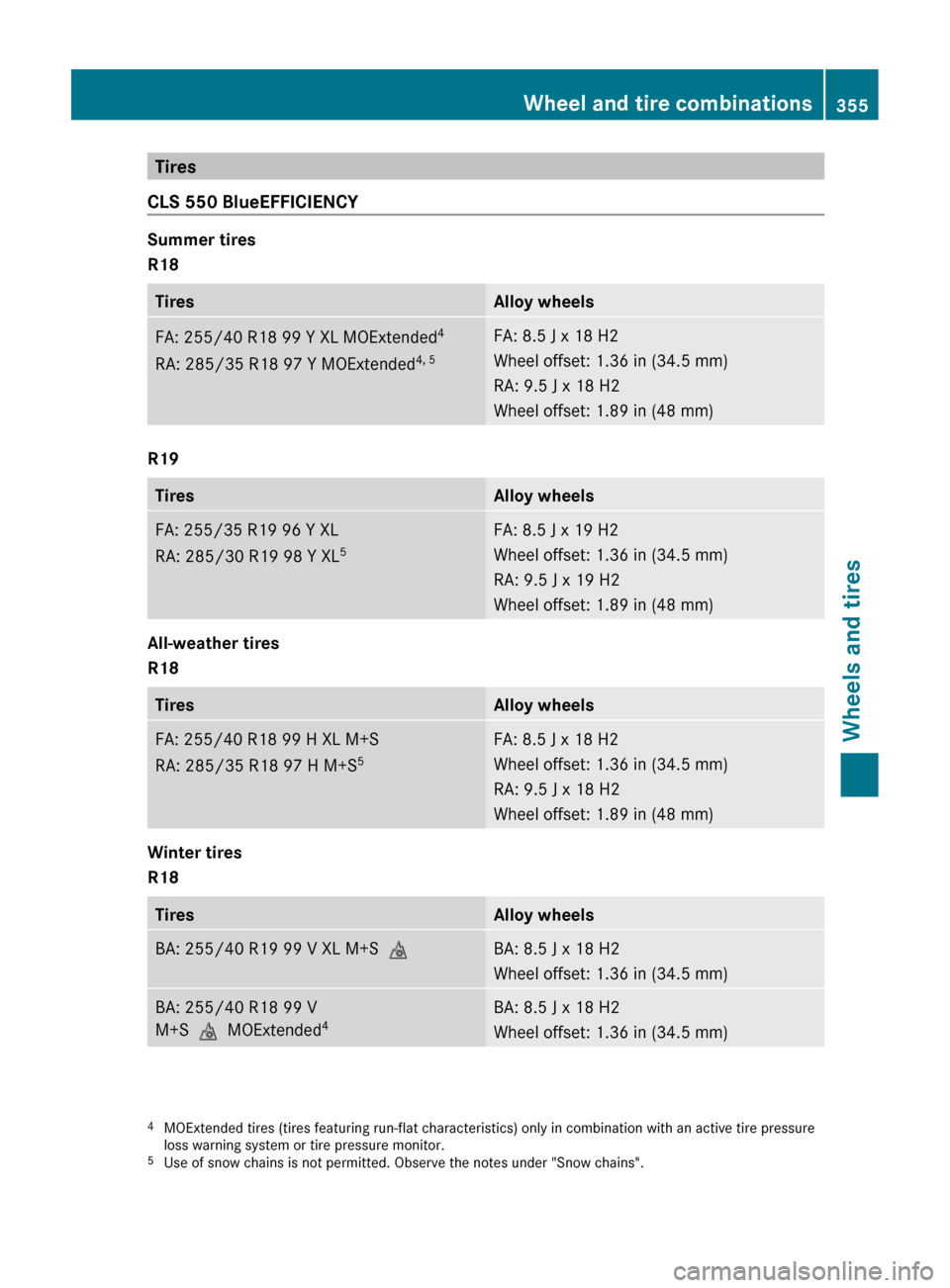
Overview of abbreviations used in the
following tire tables:
R BA: both axles
R FA: front axle
R RA: rear axle
The recommended pressures for various
operating conditions can be found:
R on
the Tire and Loading Information placard
with the recommended tire pressures on
the B-pillar on the driver's side
R in the tire pressure table on the inside of
the fuel filler flap
Observe the notes on recommended tire
pressures under various operating conditions
(Y page 329).
Check tire pressures regularly, and only when
the tires are cold. Comply with the
maintenance recommendations of the tire
manufacturer in the vehicle document wallet.
Notes on the vehicle equipment – always
equip the vehicle with:
R tires of the same size on a given axle (left/
right)
R the same type of tires at a given time
(summer tires, winter tires, MOExtended
tires)
Vehicles with MOExtended tires are not
equipped with a TIREFIT kit at the factory. It
is therefore recommended that you
additionally equip your vehicle with a TIREFIT
kit if you mount tires that do not feature run-
flat properties, e.g. winter tires. A TIREFIT kit
may be obtained from a qualified specialist
workshop.
i Not all wheel and tire combinations are
available at the factory for all countries.
i On the following pages, you can find
information on approved wheel rims and
tire sizes for equipping your vehicle with
winter tires. Winter tires are not available Wheel and tire combinations
353
Wheels and tires Z
Page 356 of 376
at the factory as standard equipment or
optional extras.
If
you would like to equip your vehicle with
approved winter tires, you may also, in
certain circumstances, require rims of the
appropriate size. The sizes of the approved
winter tires may deviate from that of the
standard tires. This is dependent on the
model and the equipment installed at the
factory.
The tires and wheel rims, as well as further
information, can be obtained at a qualified
specialist workshop. 354
Wheel and tire combinations
Wheels and tires
Page 357 of 376
Tires
CLS 550 BlueEFFICIENCY Summer tires
R18
Tires Alloy wheels
FA: 255/40 R18 99 Y XL MOExtended
4
RA: 285/35 R18 97 Y MOExtended 4, 5 FA: 8.5 J x 18 H2
Wheel offset: 1.36 in
(34.5 mm)
RA: 9.5 J x 18 H2
Wheel offset: 1.89 in (48 mm) R19
Tires Alloy wheels
FA: 255/35 R19 96 Y XL
RA: 285/30
R19 98 Y XL 5 FA: 8.5 J x 19 H2
Wheel offset: 1.36 in
(34.5 mm)
RA: 9.5 J x 19 H2
Wheel offset: 1.89 in (48 mm) All-weather tires
R18
Tires Alloy wheels
FA: 255/40 R18 99 H XL M+S
RA: 285/35
R18 97 H M+S 5 FA: 8.5 J x 18 H2
Wheel offset: 1.36 in
(34.5 mm)
RA: 9.5 J x 18 H2
Wheel offset: 1.89 in (48 mm) Winter tires
R18
Tires Alloy wheels
BA: 255/40 R19 99 V XL M+S
i BA: 8.5 J x 18 H2
Wheel offset: 1.36 in
(34.5 mm)BA: 255/40 R18 99 V
M+S
iMOExtended 4 BA: 8.5 J x 18 H2
Wheel offset: 1.36 in
(34.5 mm)4
MOExtended tires (tires featuring run-flat characteristics) only in combination with an active tire pressure
loss warning system or tire pressure monitor.
5 Use of snow chains is not permitted. Observe the notes under "Snow chains". Wheel and tire combinations
355
Wheels and tires Z
Page 358 of 376
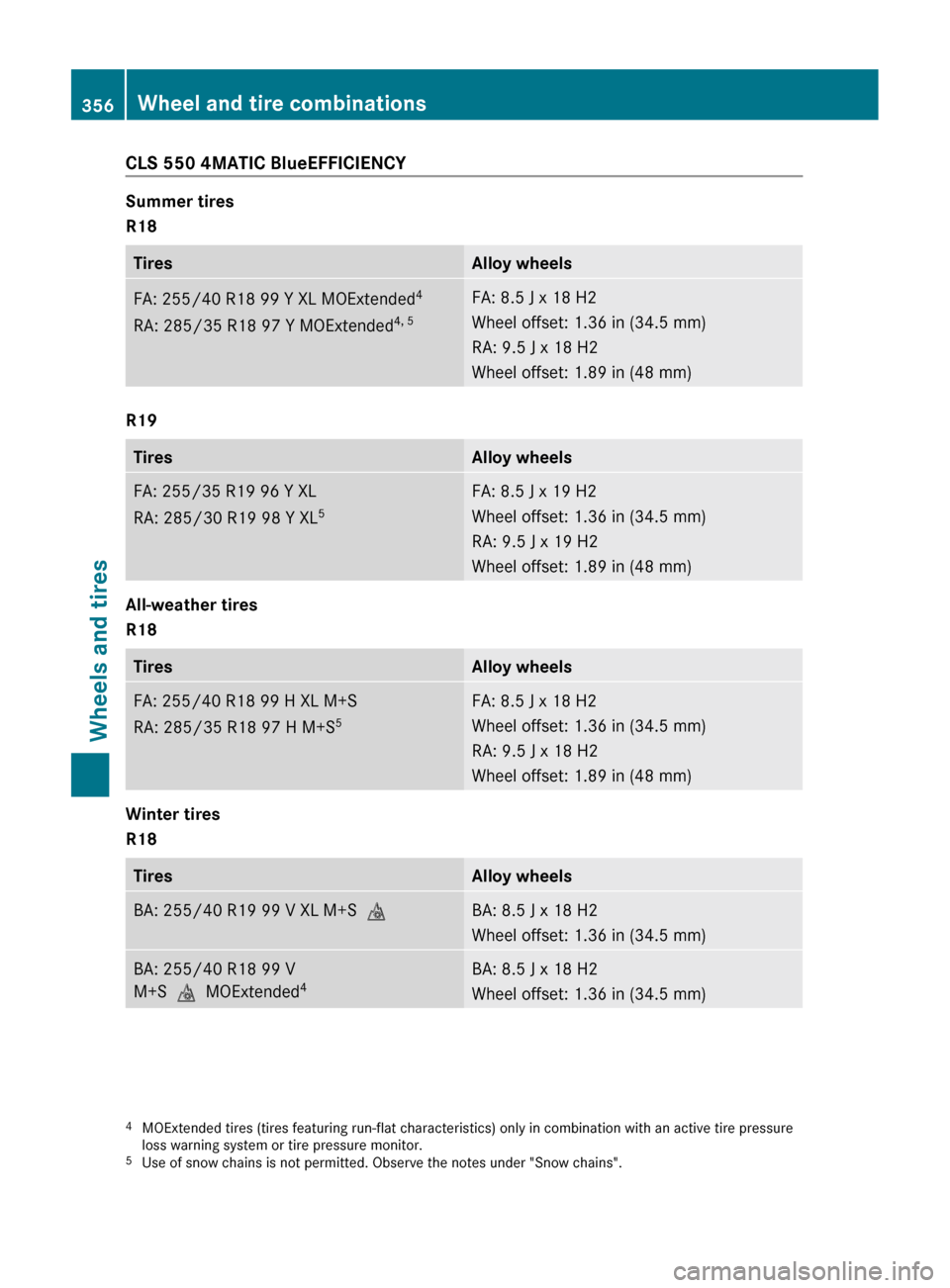
CLS 550 4MATIC BlueEFFICIENCY
Summer tires
R18
Tires Alloy wheels
FA: 255/40 R18 99 Y XL MOExtended
4
RA: 285/35 R18 97 Y MOExtended 4, 5 FA: 8.5 J x 18 H2
Wheel offset: 1.36 in
(34.5 mm)
RA: 9.5 J x 18 H2
Wheel offset: 1.89 in (48 mm) R19
Tires Alloy wheels
FA: 255/35 R19 96 Y XL
RA: 285/30
R19 98 Y XL 5 FA: 8.5 J x 19 H2
Wheel offset: 1.36 in
(34.5 mm)
RA: 9.5 J x 19 H2
Wheel offset: 1.89 in (48 mm) All-weather tires
R18
Tires Alloy wheels
FA: 255/40 R18 99 H XL M+S
RA: 285/35
R18 97 H M+S 5 FA: 8.5 J x 18 H2
Wheel offset: 1.36 in
(34.5 mm)
RA: 9.5 J x 18 H2
Wheel offset: 1.89 in (48 mm) Winter tires
R18
Tires Alloy wheels
BA: 255/40 R19 99 V XL M+S
i BA: 8.5 J x 18 H2
Wheel offset: 1.36 in
(34.5 mm)BA: 255/40 R18 99 V
M+S
iMOExtended 4 BA: 8.5 J x 18 H2
Wheel offset: 1.36 in
(34.5 mm)4
MOExtended tires (tires featuring run-flat characteristics) only in combination with an active tire pressure
loss warning system or tire pressure monitor.
5 Use of snow chains is not permitted. Observe the notes under "Snow chains".356
Wheel and tire combinations
Wheels and tires
Page 361 of 376
For further information on changing and
mounting a wheel, see
(Y page 349). Stowing a used collapsible spare
wheel
! Only place the collapsible spare wheel in
the vehicle when it is dry. Otherwise,
moisture may get into the vehicle.
Take the following steps to stow a used
collapsible spare wheel. It will not otherwise
install into the spare wheel well. Mercedes-
Benz recommends that you have this work
performed
at a qualified specialist workshop,
e.g. at an authorized Mercedes-Benz Center.
X Unscrew the valve cap from the valve.
X Use the back of the valve cap to unscrew
the valve insert from the valve and release
the air.
i Fully deflating the tires can take a few
minutes.
X Screw the valve insert back into the valve.
X Screw the valve cap back on.
X Remove the protective sheet from the
vehicle tool kit and pull it over the
collapsible spare wheel.
X Stow the collapsible spare wheel in the
emergency spare wheel well under the
trunk. Inflating the collapsible spare wheel
! Inflate the collapsible spare wheel using
the tire inflation compressor before
lowering the vehicle. The wheel rim could
otherwise be damaged.
! Do not operate the tire inflation
compressor for longer than eight minutes
at
a time without a break. It may otherwise
overheat.
The tire inflation compressor can be
operated again once it has cooled down. X
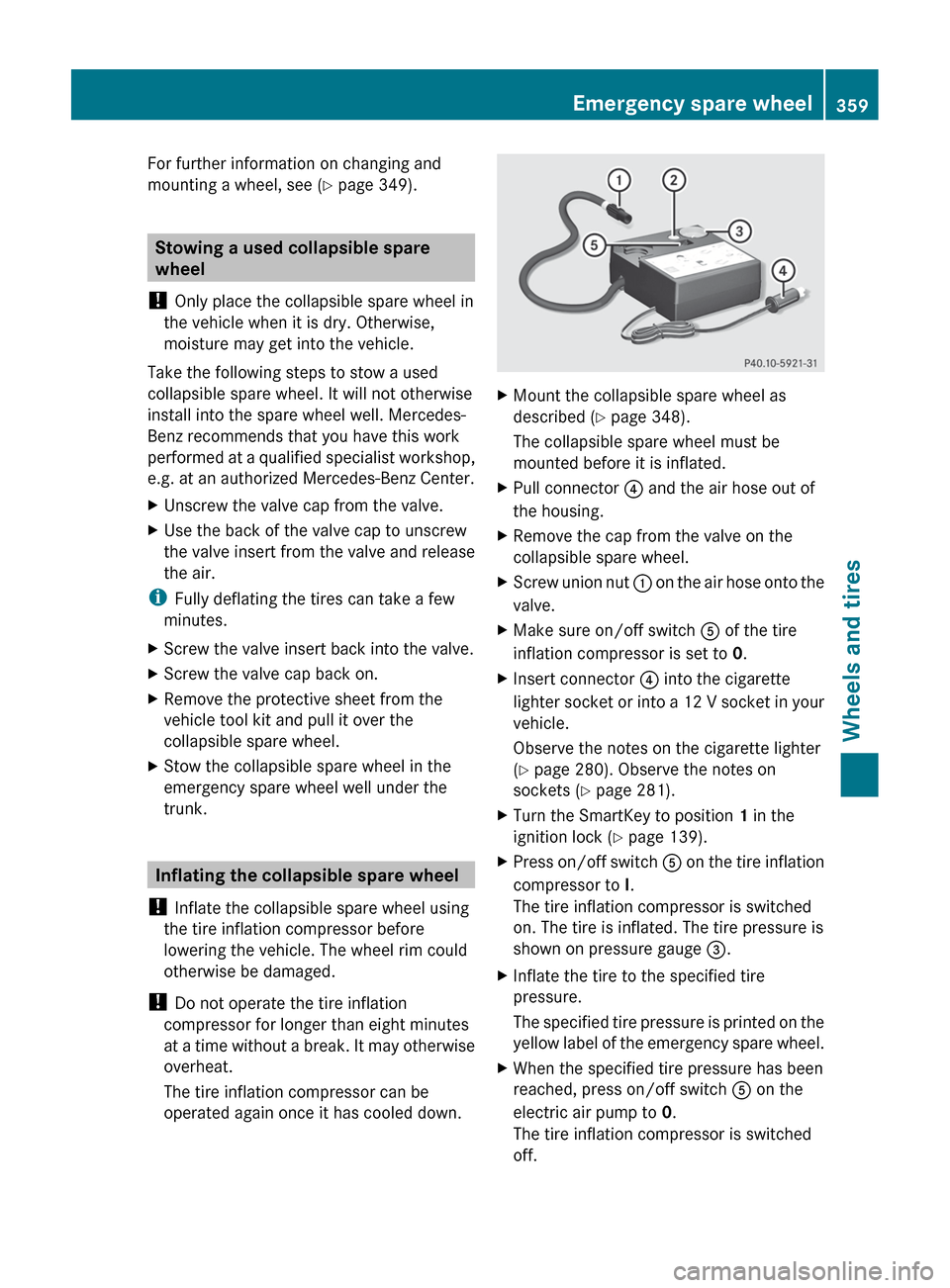
Mount the collapsible spare wheel as
described ( Y page 348).
The collapsible spare wheel must be
mounted before it is inflated.
X Pull connector ? and the air hose out of
the housing.
X Remove the cap from the valve on the
collapsible spare wheel.
X Screw union nut :
on the air hose onto the
valve.
X Make sure on/off switch A of the tire
inflation compressor is set to 0.
X Insert connector ? into the cigarette
lighter
socket or into a 12 V socket in your
vehicle.
Observe the notes on the cigarette lighter
(Y page 280). Observe the notes on
sockets ( Y page 281).
X Turn the SmartKey to position 1 in the
ignition lock ( Y page 139).
X Press on/off switch A
on the tire inflation
compressor to I.
The tire inflation compressor is switched
on. The tire is inflated. The tire pressure is
shown on pressure gauge =.
X Inflate the tire to the specified tire
pressure.
The
specified tire pressure is printed on the
yellow label of the emergency spare wheel.
X When the specified tire pressure has been
reached, press on/off switch A on the
electric air pump to 0.
The tire inflation compressor is switched
off. Emergency spare wheel
359
Wheels and tires Z
Page 362 of 376
X
Turn the SmartKey to position 0 in the
ignition lock.
X If the tire pressure is higher than the
specified pressure, press pressure release
button ;
until the correct tire pressure has
been reached.
X Unscrew union nut :
on the air hose from
the valve.
X Screw the valve cap onto the collapsible
spare wheel valve again.
X Stow plug ? and the air hose in the lower
section of the blower housing.
X Stow the tire inflation compressor in the
vehicle.360
Emergency spare wheel
Wheels and tires
Page 366 of 376
Useful information
i This Operator's Manual describes all
models and all standard and optional
equipment of your vehicle available at the
time of publication of the Operator's
Manual. Country-specific differences are
possible.
Please note that your vehicle may
not be equipped with all features
described. This also applies to safety-
related systems and functions.
i Read the information on qualified
specialist workshops: ( Y page 24).Information regarding technical data
i The
data stated here specifically refers to
a vehicle with standard equipment. Consult
an authorized Mercedes-Benz Center for
the data for all vehicle variants and trim
levels. Genuine Mercedes-Benz parts
G
WARNING
Driving safety may be impaired if non-
approved parts, tires and wheels or safety-
relevant accessories are used.
This could lead to malfunctions in safety-
relevant
systems, e.g. the brake system. This
could cause you to lose control of your vehicle
and cause an accident.
For this reason, Mercedes-Benz recommends
that you use genuine Mercedes-Benz parts or
parts of equal quality. Only use tires, wheels
and accessories that have been specifically
approved for your vehicle. H
Environmental note
Daimler AG also supplies reconditioned major
assemblies and parts which are of the same
quality
as new parts. They are covered by the
same Limited Warranty entitlements as new
parts. !
Air bags and Emergency Tensioning
Devices, as well as control units and
sensors
for these restraint systems, may be
installed in the following areas of your
vehicle:
R doors
R door pillars
R door sills
R seats
R cockpit
R instrument cluster
R center console
Do not install accessories such as audio
systems in these areas. Do not carry out
repairs or welding. You could impair the
operating efficiency of the restraint
systems.
Have aftermarket accessories installed at
a qualified specialist workshop.
Genuine Mercedes-Benz parts are subject to
strict quality control. Each part has been
specially developed, manufactured or
selected for Mercedes-Benz vehicles and
fine-tuned for them. Only genuine Mercedes-
Benz parts should therefore be used.
More than 300,000 different genuine
Mercedes-Benz parts are available for
Mercedes-Benz models.
All Mercedes-Benz Centers maintain a supply
of genuine Mercedes-Benz parts for
necessary service and repair work. In
addition, strategically located parts delivery
centers provide quick and reliable parts
service.
Always specify the vehicle identification
number (VIN) ( Y page 365) and the engine
number (Y page 366) when ordering genuine
Mercedes-Benz parts. Warranty
Your
vehicle is covered under the terms of the
warranties printed in the Service and
Warranty Information booklet. 364
Warranty
Technical data
Page 368 of 376
X
Slide the right-hand front seat to its
rearmost position.
X Fold floor covering : upwards.
You will see VIN ;.
The VIN can also be found in the following
locations:
R on the lower edge of windshield
(Y page 366)
R on the vehicle identification plate
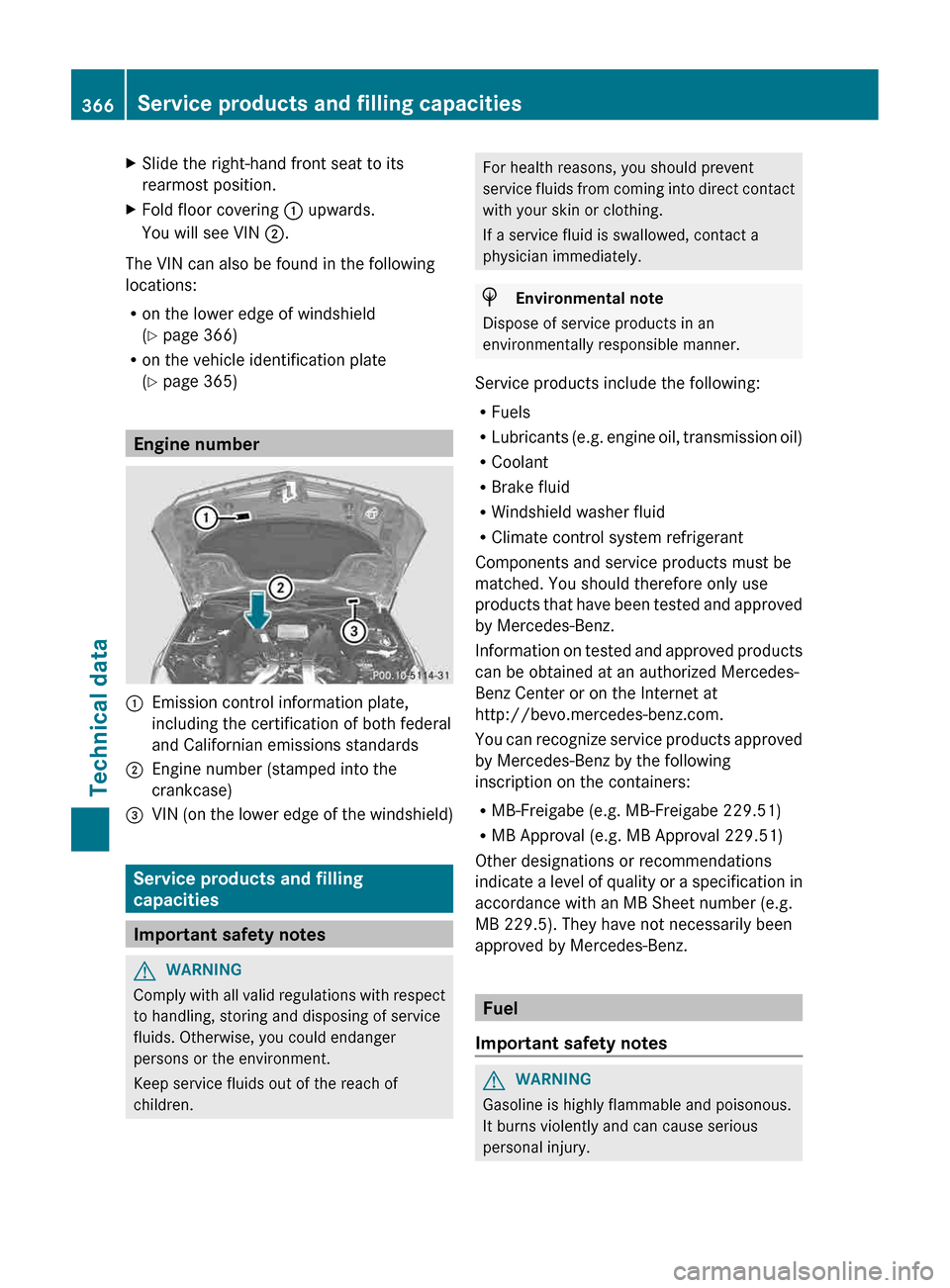
(Y page 365) Engine number
:
Emission control information plate,
including the certification of both federal
and Californian emissions standards
; Engine number (stamped into the
crankcase)
= VIN (on the lower edge of the windshield) Service products and filling
capacities
Important safety notes
G
WARNING
Comply with all valid regulations with respect
to handling, storing and disposing of service
fluids. Otherwise, you could endanger
persons or the environment.
Keep service fluids out of the reach of
children. For health reasons, you should prevent
service
fluids from coming into direct contact
with your skin or clothing.
If a service fluid is swallowed, contact a
physician immediately. H
Environmental note
Dispose of service products in an
environmentally responsible manner.
Service products include the following:
R Fuels
R Lubricants
(e.g. engine oil, transmission oil)
R Coolant
R Brake fluid
R Windshield washer fluid
R Climate control system refrigerant
Components and service products must be
matched. You should therefore only use
products that have been tested and approved
by Mercedes-Benz.
Information on tested and approved products
can be obtained at an authorized Mercedes-
Benz Center or on the Internet at
http://bevo.mercedes-benz.com.
You can recognize service products approved
by Mercedes-Benz by the following
inscription on the containers:
R MB-Freigabe (e.g. MB-Freigabe 229.51)
R MB Approval (e.g. MB Approval 229.51)
Other designations or recommendations
indicate a level of quality or a specification in
accordance with an MB Sheet number (e.g.
MB 229.5). They have not necessarily been
approved by Mercedes-Benz. Fuel
Important safety notes G
WARNING
Gasoline is highly flammable and poisonous.
It burns violently and can cause serious
personal injury. 366
Service products and filling capacities
Technical data
Page 370 of 376
All of these mix fuels must fulfill the fuel
requirements, e.g.:
R
knock resistance
R boiling point
R vapor pressure
You
will usually find information about the fuel
grade on the pump. If you cannot find the
label on the pump, ask the staff for
assistance.
i For further information, consult an
authorized Mercedes-Benz Center or on
the Internet at http://www.mbusa.com
(USA only).
Information on refueling (Y page 155).
Additives
! Do not refuel with low-grade fuel and do
not use fuel additives that are not tested
and approved for Mercedes-Benz vehicles.
Damage to or malfunctions of the fuel
system may otherwise occur.
One of the main problems of poor fuel quality
is the forming of deposits that are created
during the gasoline combustion process.
Mercedes-Benz recommends that you use
branded fuels that have additives.
If you use fuels without these additives over
a longer period of time, carbon deposits may
build up. These deposits form at the inlet
valves and in the combustion chamber in
particular.
This could lead to engine problems, e.g.:
R longer engine warm-up phase
R uneven idle
R engine noise
R misfiring
R loss of power
Carbon deposits may form if the availability
of gasoline with relevant additives is
insufficient (in certain regions). In this case,
Mercedes-Benz recommends additives
approved for use in Mercedes-Benz vehicles;
see http://bevo.mercedes-benz.com. For a list of approved products, consult an
authorized Mercedes-Benz Center. Comply
with the instructions for use on the product
label.
Do
not mix other fuel additives with fuel. This
causes unnecessary costs and could damage
the engine. Engine oil
General notes !
Never use engine oil or an oil filter of a
specification other than is necessary to
fulfill the prescribed service intervals. Do
not change the engine oil or oil filter in
order to achieve longer replacement
intervals than those prescribed. You could
otherwise
cause engine damage or damage
to the exhaust gas aftertreatment.
Follow the instructions in the service
interval display regarding the oil change.
Otherwise, you may damage the engine and
the exhaust gas aftertreatment.
The engine oils are matched to the
performance of Mercedes-Benz engines and
service intervals. You should therefore only
use engine oils and oil filters that are
approved for vehicles with maintenance
systems.
For a list of approved engine oils and oil filters,
consult an authorized Mercedes-Benz
Center. Or visit the website
http://bevo.mercedes-benz.com.
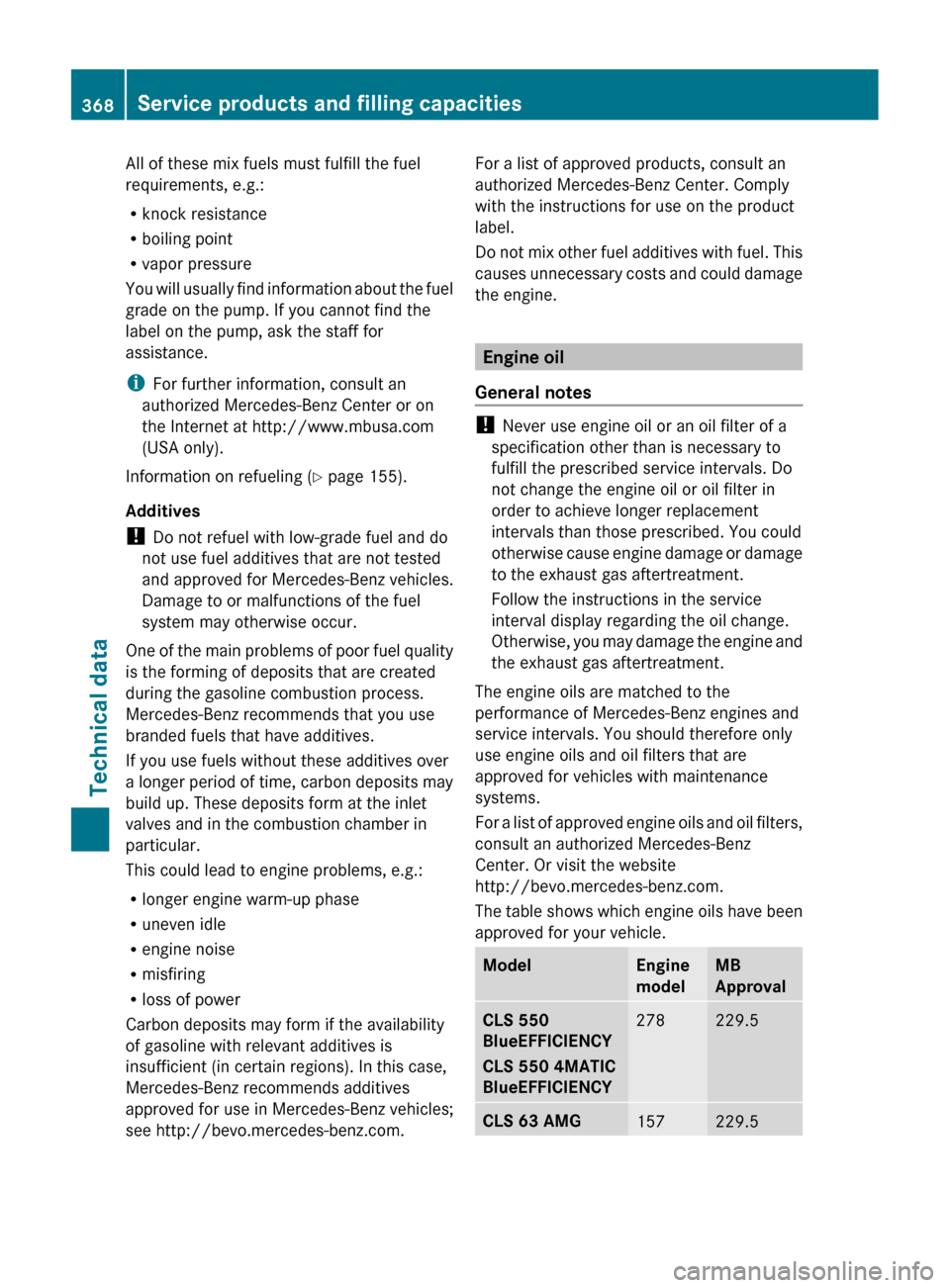
The table shows which engine oils have been
approved for your vehicle. Model Engine
model MB
Approval
CLS 550
BlueEFFICIENCY
CLS 550 4MATIC
BlueEFFICIENCY
278 229.5
CLS 63 AMG
157 229.5368
Service products and filling capacities
Technical data