check engine light MERCEDES-BENZ CLS-Class 2014 W218 User Guide
[x] Cancel search | Manufacturer: MERCEDES-BENZ, Model Year: 2014, Model line: CLS-Class, Model: MERCEDES-BENZ CLS-Class 2014 W218Pages: 382, PDF Size: 5.36 MB
Page 100 of 382
Useful information
i This Operator's Manual describes all
models and all standard and optional
equipment of your vehicle available at the
time of publication of the Operator's
Manual. Country-specific differences are
possible. Please not ethat your vehicle may
not be equipped with all features
described. This also applies to safety-
related system sand functions.
i Read the information on qualified
specialist workshops: (Y page 26).Correct driver's seat position
G
WARNING
You could lose contro lofyour vehicle if you
do the following while driving:
R adjust the driver' sseat, head restraint,
steering wheel or mirrors
R faste nthe seat belt
There is arisk of an accident.
Adjust the driver's seat, head restraint,
steering wheel and mirror and fasten your
seat belt before startingt he engine. X
Observe the safety guidelines on seat
adjustment (Y page 99).
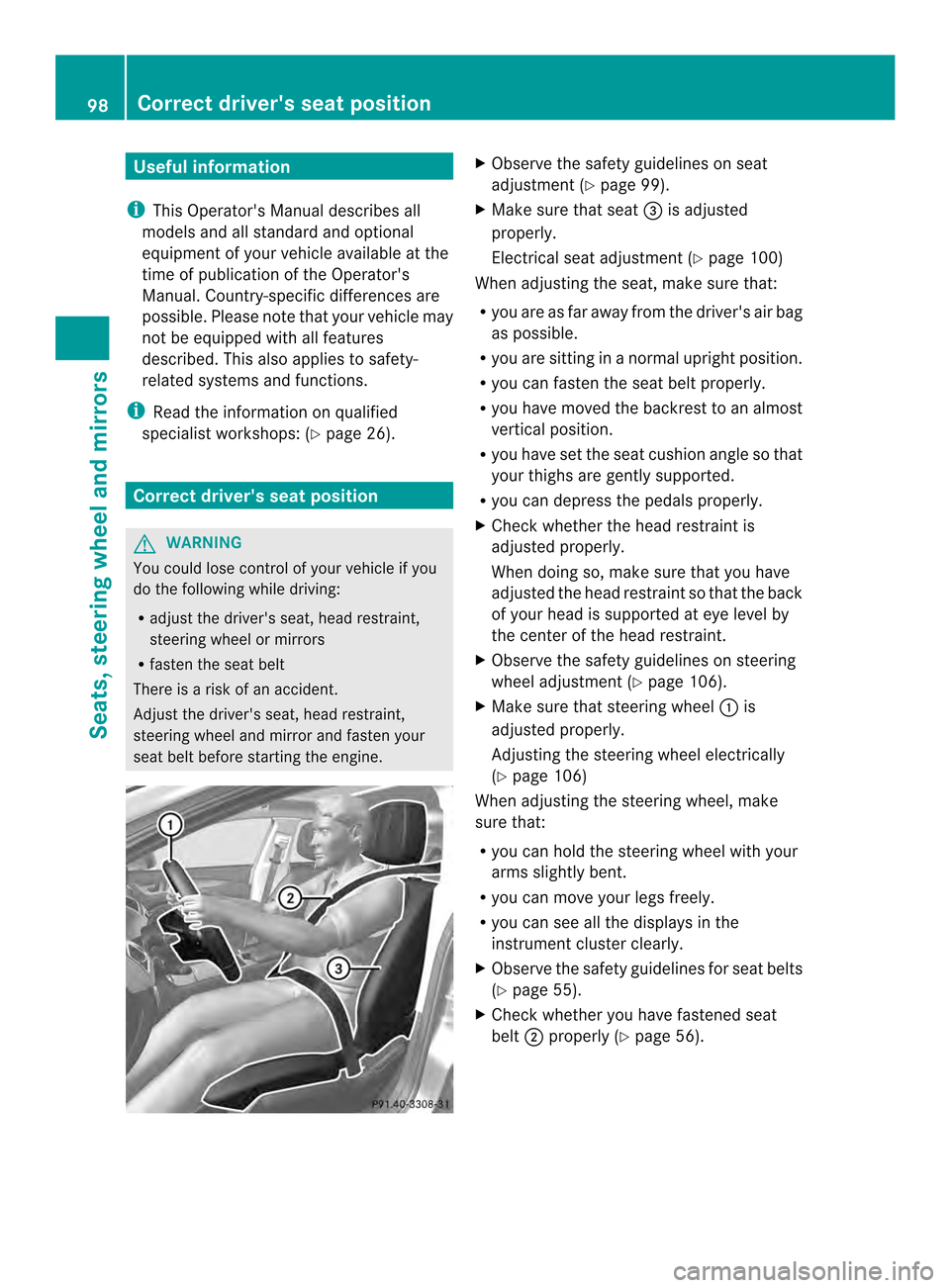
X Make sure that seat 0024is adjusted
properly.
Electrical seat adjustment (Y page 100)
When adjusting the seat, make sure that:
R you are as far away from the driver's air bag
as possible.
R you are sitting in anormal upright position.
R you can fasten the seat belt properly.
R you have moved the backrest to an almost
vertical position.
R you have set the seat cushion angle so that
your thighs are gently supported.
R you can depress the pedals properly.
X Check whether the head restraint is
adjusted properly.
When doing so, make sure that you have
adjusted the head restraint so that the back
of your head is supported at eye level by
the center of the head restraint.
X Observe the safety guidelines on steering
wheel adjustment (Y page 106).
X Make sure that steering wheel 001Ais
adjusted properly.
Adjustingt he steering wheel electrically
(Y page 106)
When adjusting the steering wheel, make
sure that:
R you can hold the steering wheel with your
arms slightly bent.
R you can move your legs freely.
R you can see all the displays in the
instrumentc luster clearly.
X Observe the safet yguideline sfor seat belts
(Y page 55).
X Check whether you have fastened seat
belt 0010properly (Y page 56). 98
Correct driver'
sseat positionSeats, steering wheel and mirrors
Page 130 of 382
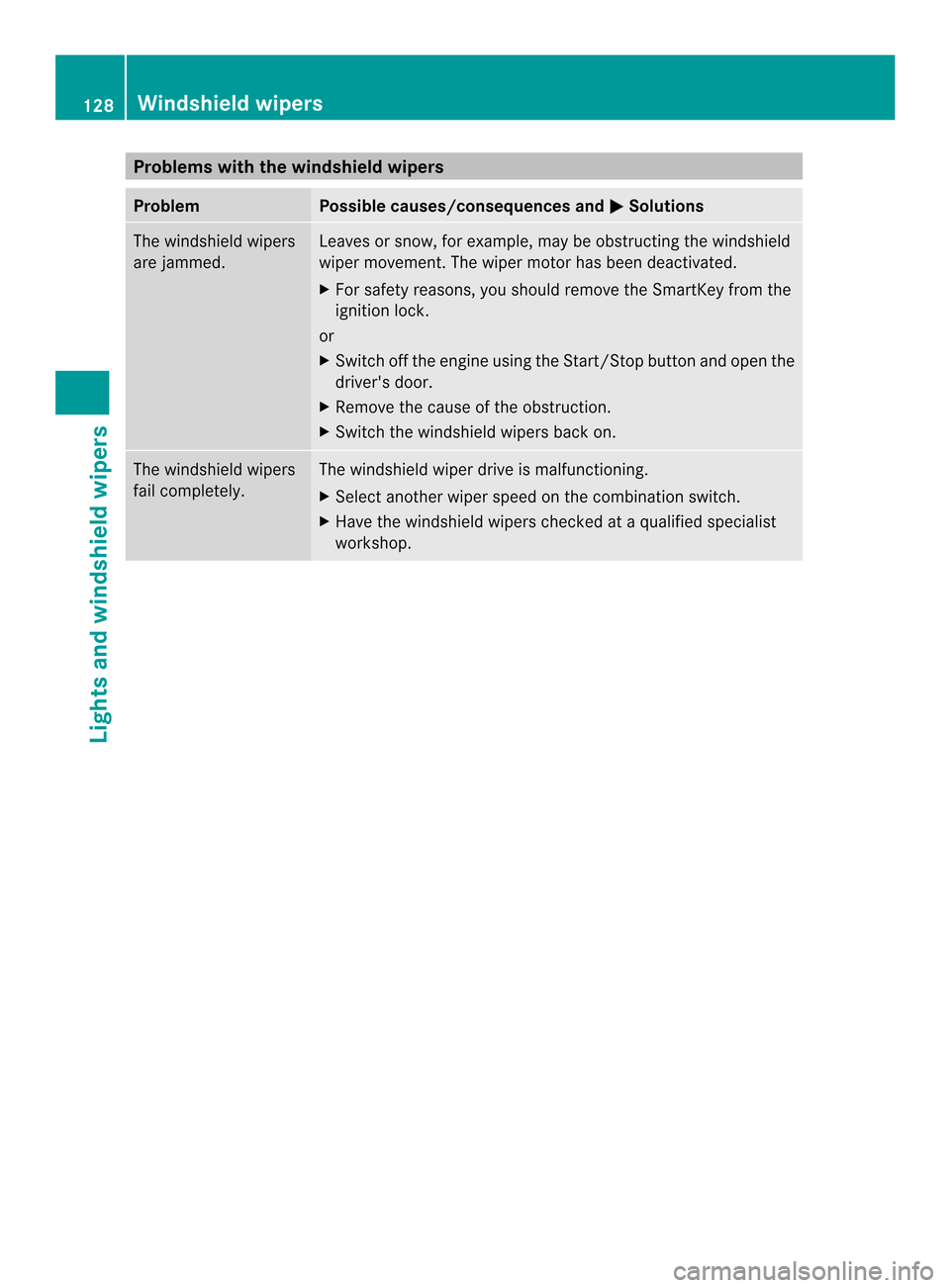
Problems with the windshield wipers
Problem Possible causes/consequences and
000B Solutions
The windshield wipers
are jammed. Leaves or snow, for example, may be obstructing the windshield
wiper movement.T
he wiper motor has been deactivated.
X For safety reasons, you should remove the SmartKey from the
ignition lock.
or
X Switch off the engine using the Start/Stop button and open the
driver's door.
X Remove the cause of the obstruction.
X Switch the windshield wipers back on. The windshield wipers
fail completely. The windshield wiper drive is malfunctioning.
X
Select another wiper speed on the combination switch.
X Have the windshield wipers checked at aqualified specialist
workshop. 128
Windshield wipersLights and windshield wipers
Page 156 of 382
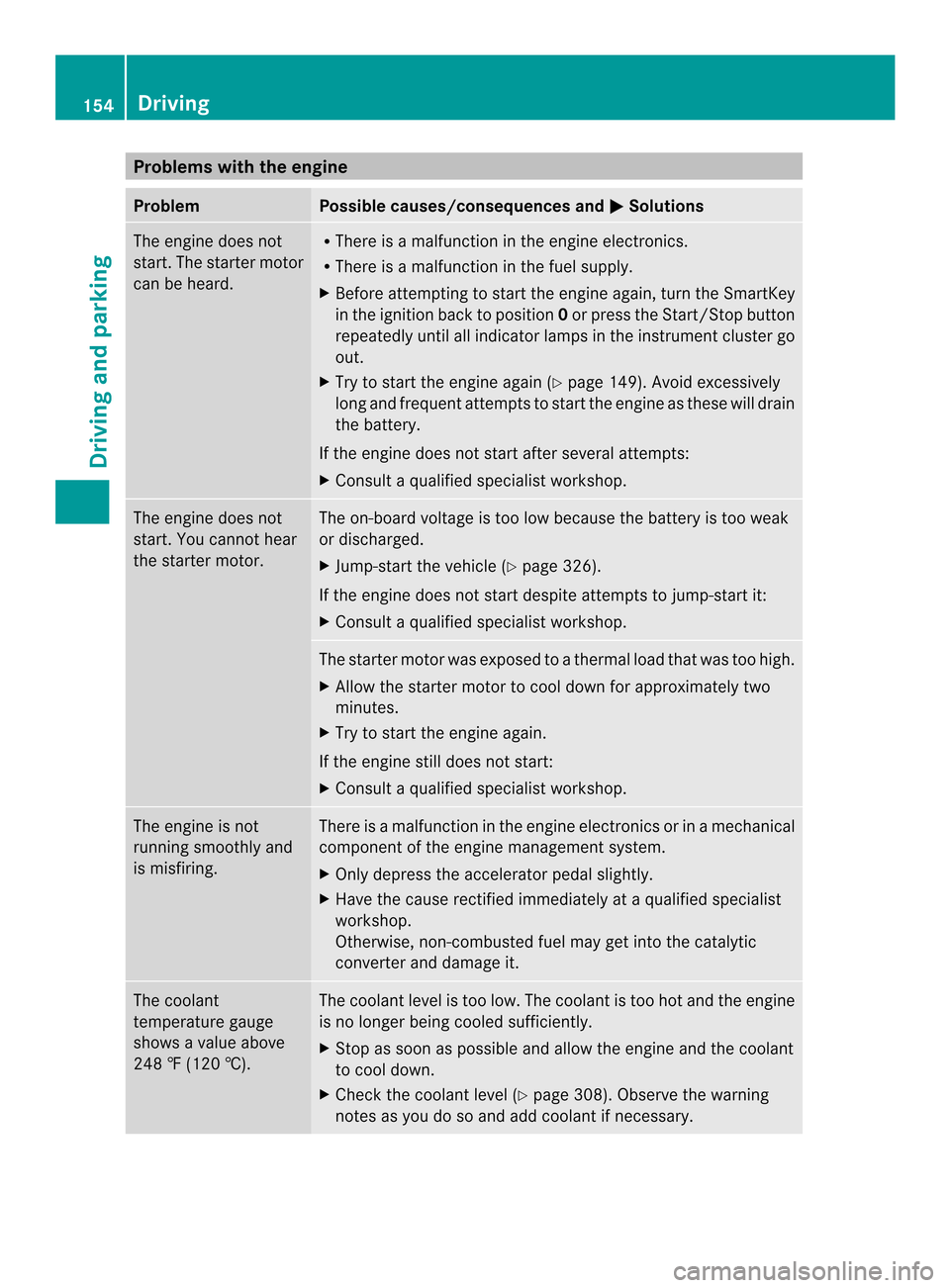
Problems with the engine
Problem Possible causes/consequences and
000B Solutions
The engine does not
start. The starter motor
can be heard. R
There is amalfunction in the engine electronics.
R There is amalfunction in the fuel supply.
X Before attempting to start the engine again, turn the SmartKey
in the ignition back to position 0or press the Start/Stop button
repeatedly until all indicator lamps in the instrumen tcluster go
out.
X Try to start the engine again (Y page 149). Avoid excessively
long and frequent attempt stostart the engine as these will drain
the battery.
If the engine does not start after several attempts:
X Consult aqualified specialist workshop. The engine does not
start
.You cannot hear
the starter motor. The on-board voltage is too low because the battery is too weak
or discharged.
X
Jump-star tthe vehicle (Y page 326).
If the engine does not start despite attemptstoj ump-start it:
X Consult aqualified specialist workshop. The starter motor was exposed to
athermal load that was too high.
X Allow the starter motor to cool down for approximately two
minutes.
X Try to start the engine again.
If the engine still does not start:
X Consult aqualified specialist workshop. The engine is not
running smoothly and
is misfiring. There is
amalfunction in the engine electronics or in amechanical
componentoft he engine management system.
X Only depress the accelerator pedal slightly.
X Have the cause rectified immediately at aqualified specialist
workshop.
Otherwise, non-combusted fuel may get into the catalytic
converter and damage it. The coolant
temperature gauge
shows
avalue above
248 ‡(120 †). The coolant level is too low. The coolant is too hot and the engine
is no longer being cooled sufficiently.
X
Stop as soon as possible and allow the engine and the coolant
to cool down.
X Check the coolant level (Y page 308). Observe the warning
notes as you do so and add coolant if necessary. 154
DrivingDriving and parking
Page 157 of 382

Automati
ctransmission Important safety notes
G
WARNING
If th eengines pee disa bovethe idlin gspeed
and you engage transmission position Dor
R,t hevehicl ecould pull away suddenly. There
is ar iskofana ccident.
When engagin gtransmission position Dor R,
always firmly depress th ebrak epedal and do
no tsimultaneously accelerate. G
WARNING
The automatic transmission switches to
neutral position Nwhen you switc hoff the
engine. The vehicle may roll away. There is a
risk of an accident.
After switching off the engine, always switch
to parking position P.Prevent the parked
vehicle fro mrolling away by applying the
parking brake. Selector lever
Overview of transmission positions Selector lever in AMG vehicles with
Pbutton
0008 Park position with parking lock
000A Reverse gear
0006 Neutral
0007 Drive Transmission position and drive
program display !
If the transmission position display in the
multifunction display is not working, you
should pull away carefully to check whether
the desired transmission position is
engaged. Ideally ,you should select
transmission position Dand drive program
C.Don ot restric tthe shift range. 001A
Transmission position display
0010 Drive program display
The current position of the selector lever is
shown by the indicators next to the selector
lever.
The indicators light up when the SmartKey is
inserted into the ignition lock. The indicators
go out when the SmartKey is removed from
the ignition lock. DIRECT SELECTl
ever
Overview of transmission positions 0008
Park position with parking lock
000A Reverse gear
0006 Neutral
0007 Drive Automatic transmission
155Driving and parking Z
Page 168 of 382

X
insert the fuel filler cap int othe holder on
the insid eoffuel filler flap 0010.
X Completely insert the filler nec kofthe fuel
pump nozzle into the tank,h ook in place
and refuel.
X Only fill the tank until the pump nozzle
switches off.
i Do not add any more fuel after the pump
stops filling for the first time. Otherwise,
fuel may leak out.
Closing the fuel filler flap X
Replace the cap on the filler neck and turn
clockwise until it engages audibly.
X Close the fuel filler flap.
i Close the fuel filler flap before locking the
vehicle. Otherwise, the locking pin of the
central locking prevents the fuel filler flap
from closing.
i If you are driving with the fuel filler cap
open, the 0007reserve fuel warning lamp
flashes. Amessage appears in the
multifunction display (Y page 251).
In addition, the 000ACheck Engine warning
lamp may light up (Y page 273).
For further information on warning and
indicator lamps in the instrument cluster,
see (Y page 273). Fuel filler flap emergency release
X
open the trun klid.
X Slide down the parcel net. X
Open the right-han dside trim panel.
X Remove the first-aid kit (Y page 320).
X Detach the emergenc yrelease from
retainer 001A.
X Pull the emergency release in the direction
of arrow 0010.
The fuel filler flap is unlocked.
X Open the fuel filler flap. 166
RefuelingDriving and parking
Page 175 of 382
Servicing the brakes
!
If the red brake warning lamp lights up in
the instrumen tcluster and you hear a
warnin gtonew hile the engine is running,
the brak efluid level may be too low.
Observe additional warnin gmessages in
the multifunction display.
The brak efluid level may be too low due to
brak epad wear or leakin gbrak elines.
Have the brak esystem checked
immediately. This work should be carried
out at aqualified specialist workshop.
! Vehicles with 4MATIC: function or
performanc etests may only be carried out
on a2 -axle dynamometer. If you are
planning to have the vehicle tested on such
ad ynamometer, contac tanauthorized
Mercedes-Ben zCenter to obtain further
information first. Otherwise, you could
damage the drive train or the brak esystem.
! Vehicles with 4MATIC: as the ESP®
system operates automatically, the engine
and the ignition must be switched off
(SmartKey in position 0or 1in the ignition
lock or Start/Stop button in position 0or
1)w hile the parking brak eisbeing tested
on abrak edynamometer.
Brakin gmaneuvers triggere dautomatically
by ESP ®
may seriousl ydamag ethe brake
system.
! Vehicles with 4MATIC: as theESP®
system operate sautomatically, th eengine
and th eignition system must be switched
off (SmartKey in position 0or 1in the
ignition loc korStart/Sto pbutto nin
position 0or 1)w hen:
R testing th eparking brak eonabrake
dynamometer.
R you inten dtohave th evehicl etow ed with
on eoft heaxle sraised.
Braking maneuvers triggered automatically
by ESP ®
may seriousl ydamag ethe brake
system. All check
sand maintenance work on the
brak esystem must be carried out at a
qualified specialist workshop. Consult a
qualified specialist worksho ptoarrangethis.
Hav ebrak epads installed and brak efluid
replace dataq ualified specialist workshop.
If th ebrak esystem has only been subject to
moderat eloads ,you should test the
functionalit yofyour brakes at regular
intervals. To do so, press firmly on th ebrake
pedal when driving at ahigh speed. This
improve sthe gripoft hebrak epads.
You can fin dadescription of Brake Assist
(BAS) on (Y page 67)orofBASPLU Son
( Ypage 67).
The braking characteristics of th evehicl ecan
be seriousl yimpaired if:
R brak epads other than those recommended
are installed
R ther ecommended brak efluid is no tused
Safe braking can no longer be guaranteed.
AMG high-performance and ceramic
brakes The high-performance brake system is
installed only on the CLS 63 AMG.
The AMG brake systems are designed for
heavy loads. This may lead to noise when
braking. This will depend on:
R
Speed
R Braking force
R Environmental conditions, such as
temperature and humidity
The wear of individualc omponentsofthe
brake system, such as the brake pads/linings
or brake discs, depends on the individual
driving style and operating conditions.
For this reason, it is impossibletos tate a
mileage that will be valid under all
circumstances. An aggressive driving style
will lead to high wear. You can obtain further
information aboutt his from your authorized
Mercedes-Ben zCenter. Driving tips
173Driving and parking Z
Page 275 of 382
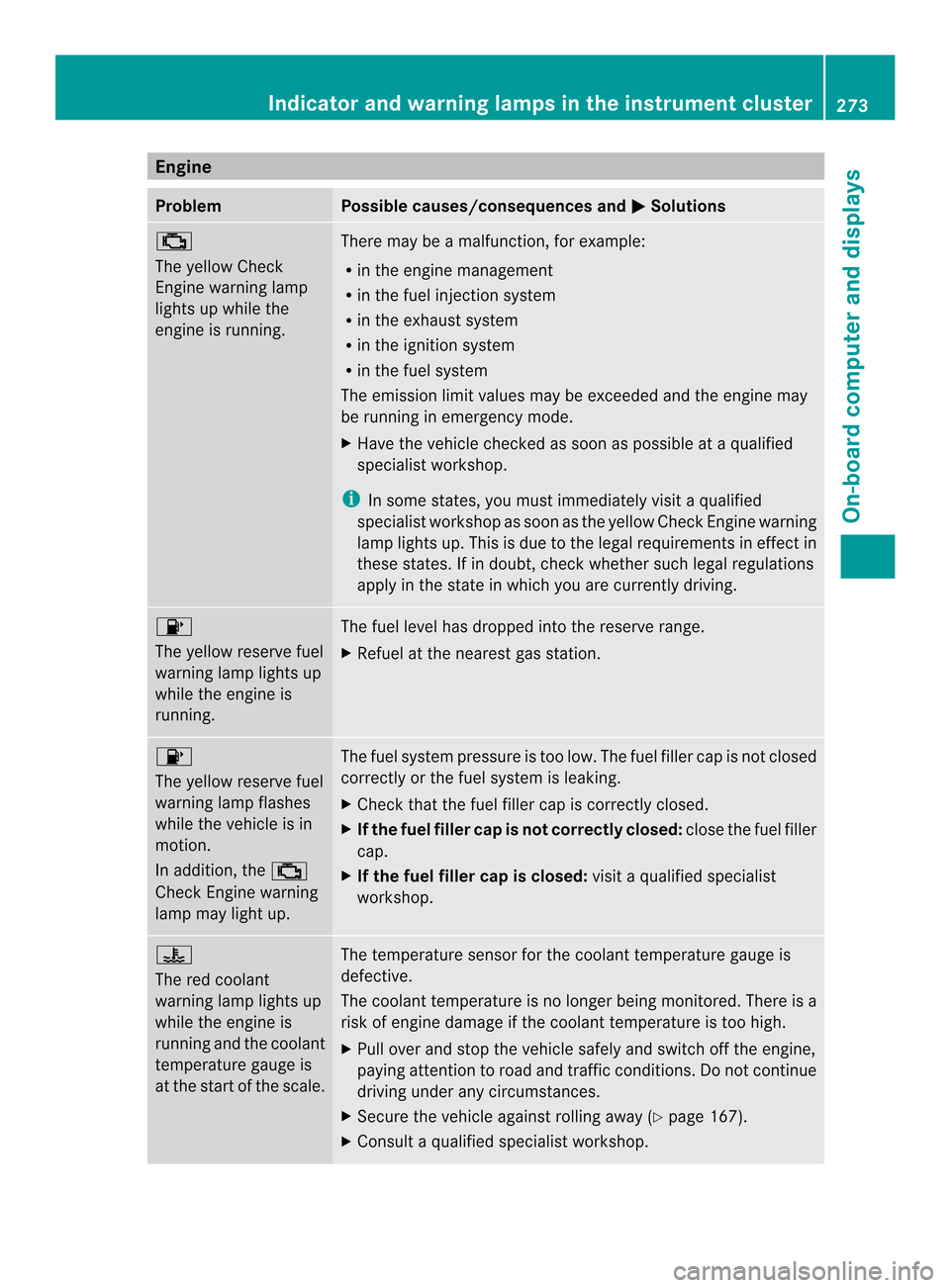
Engine
Problem Possible causes/consequences and
000B Solutions
000A
The yellow Check
Engin
ewarning lamp
light supw hile the
engin eisrunning. Ther
emay be amalfunction, for example:
R in th eenginem anagement
R in th efuel injection system
R in th eexhaust system
R in th eignition system
R in th efuel system
The emission limit values may be exceeded and th eenginem ay
be runnin ginemergenc ymode.
X Hav ethe vehicle checked as soon as possible at aqualified
specialist workshop.
i In som estates, you must immediately visit aqualified
specialist worksho passoon as th eyellow Chec kEngine warning
lamp lights up .This is due to the legal requirements in effect in
these states. If in doubt, check whether such legal regulations
apply in the state in which you are currently driving. 0007
The yellow reserve fuel
warning lamp lights up
while the engine is
running.
The fuel level has dropped into the reserve range.
X
Refuel at the nearest gas station. 0007
The yellow reserve fuel
warning lamp flashes
while the vehicle is in
motion.
In addition, the
000A
Check Enginew arning
lamp may light up. The fuel system pressure is too low. The fuel filler cap is not closed
correctly or the fuel system is leaking.
X
Check that the fuel filler cap is correctly closed.
X If the fuel filler cap is not correctly closed: close the fuel filler
cap.
X If the fuel filler cap is closed: visitaqualified specialist
workshop. 0017
The red coolant
warning lamp lights up
while the engine is
running and the coolant
temperature gauge is
at the start of the scale.
The temperature sensor for the coolant temperature gauge is
defective.
The coolant temperature is no longer being monitored. There is a
risk of engine damage if the coolant temperature is too high.
X Pull over and stop the vehicle safely and switch off the engine,
paying attention to road and traffic conditions. Do not continue
driving under any circumstances.
X Secure the vehicle against rolling away (Y page 167).
X Consult aqualified specialist workshop. Indicator and warning lampsint
he instrument cluster
273On-board computer and displays Z
Page 277 of 382
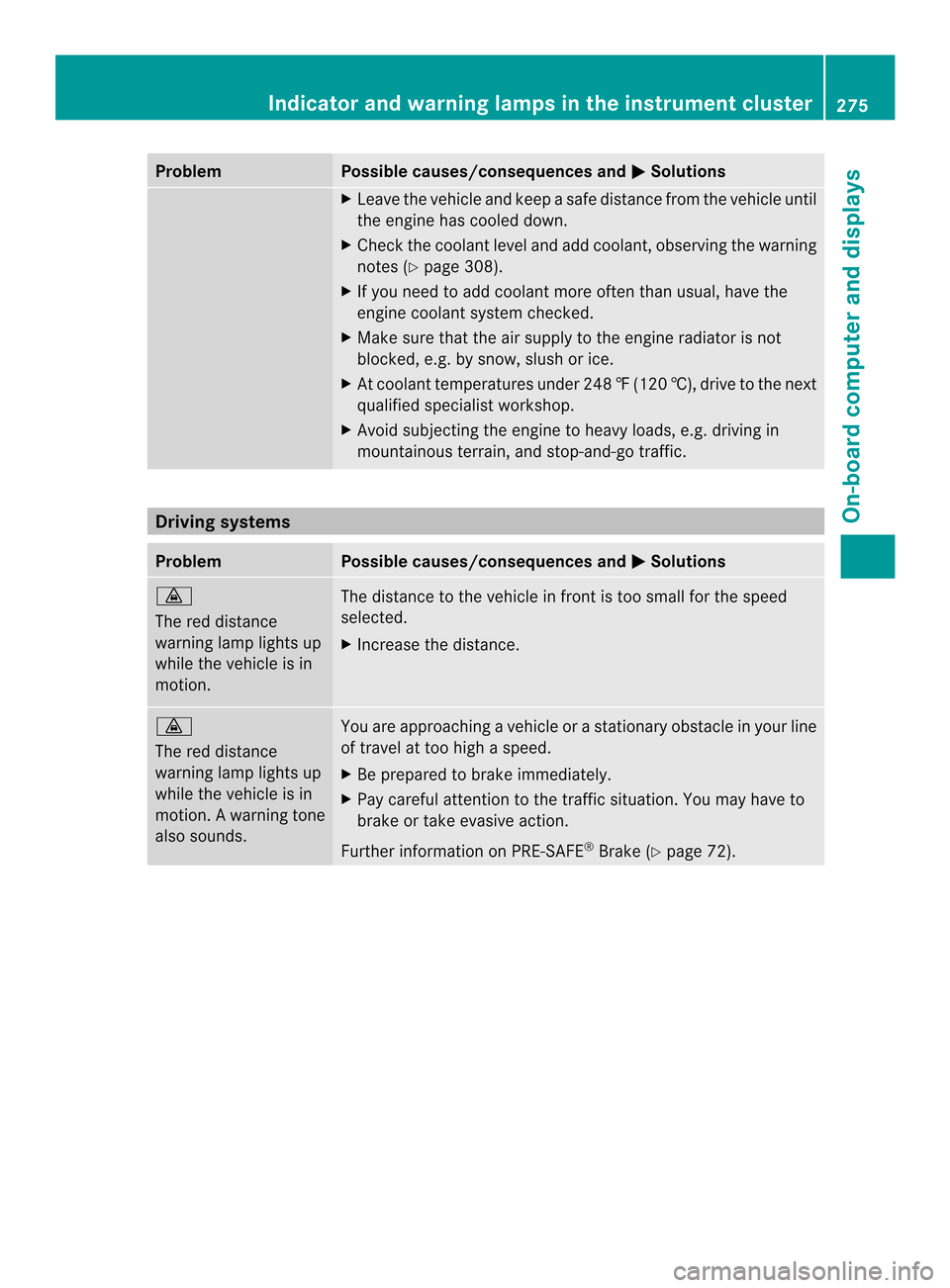
Problem Possible causes/consequences and
000B Solutions
X
Leave the vehicle and keep asafe distance from the vehicle until
the engine has cooled down.
X Check the coolant level and add coolant, observing the warning
notes (Y page 308).
X If you need to add coolant more often than usual, have the
engine coolant system checked.
X Make sure that the air supply to the engine radiator is not
blocked, e.g. by snow, slush or ice.
X At coolant temperatures under 248 ‡(120 †), drive to the next
qualified specialist workshop.
X Avoid subjecting the engine to heavy loads, e.g. driving in
mountainou sterrain, and stop-and-go traffic. Driving systems
Problem Possible causes/consequencesa
nd000B Solutions
0008
The red distance
warning lamp lights up
while the vehicle is in
motion.
The distance to the vehicle in front is too smal
lfor the speed
selected.
X Increase the distance. 0008
The red distance
warning lamp lights up
while the vehicle is in
motion
.Awarning tone
also sounds. You are approaching
avehicle or astationary obstacle in your line
of travel at too high aspeed.
X Be prepared to brake immediately.
X Pay careful attention to the traffic situation. You may have to
brake or take evasive action.
Further information on PRE-SAFE ®
Brake (Y page 72). Indicator and warning lampsint
he instrument cluster
275On-board computer and displays Z
Page 309 of 382

!
Make sure that the windshieldw ipers are
not folded away fro mthe windshield. You
could otherwise damage the windshield
wipers or the hood. X
Make sure that the windshield wipers are
turned off.
X Pull release lever 001Aon the hood.
The hood is released. X
Reach into the gap, pull hood catch
handle 0010up and lift the hood.
If you lift the hood by approximately
15 inches (40c m),the hood is opened and
held open automatically by the gas-filled
strut.
Closing theh ood X
Lower the hood and let it fall from aheight
of approximately 8inche s(20 cm).
X Check that the hood has engaged properly.
If the hood can be raised slightly ,itisnot
properly engaged. Open it again and close
it with alittle more force. Engine oil
General notes Depending on the driving style, the vehicle
consume
supto0.9 US qt (0.8 liters) of oil
over adistanc eof600 miles (1,000 km). The
oil consumption may be higher than this when
the vehicle is new or if you frequently drive at
high engin espeeds.
Depending on the engine, the oil dipstic kmay
be in adifferent location.
When checking th eoil level:
R park th evehicle on aleve lsurface.
R thee ngines hould be switched off for
approximately fiv eminute siftheengin eis
at normal operatin gtem perature.
R if th eengineisn otat normal operating
temperature, e.g .ifthe engine was only
started briefly, wait about 30 minutes
before carrying out the measurement.
Checking the oil level using the oil
dipstick X
Pull oil dipstick 001Aout of the dipstick guide
tube.
X Wipe off oil dipstick 001A.
X Slowly slide oil dipstick 001Ainto the guide
tube to the stop, and take it out again.
If the level is between MIN mark 0024and
MAX mark 0010,the oil level is correct.
X If the oil level has dropped to MIN mark
0024 or below, add 1.1 US qt (1.0 liter) of
engine oil. Engine compartment
307Maintenance and care Z
Page 327 of 382
over the battery. Keep children away from
batteries. Wash battery acid immediately with
water and seek medical attention. G
WARNING
Ad ischarged battery can freeze at
temperatures below freezin gpoint .When
jump-starting the vehicle or charging the
battery, gases can escape from the battery.
There is arisk of an explosion.
Allow the frozen battery to thaw out before
charging it or jump-starting.
! Only use battery chargers with a
maximum charging voltage of 14.8 V.
! Only charge the battery using the jump-
startingc onnection point.
The jump-starting connection point is in the
engine compartment( Ypage 326).
X Open the hood (Y page 306).
X Connect the battery charger to the positive
terminal and ground point in the same
order as when connecting the donor
battery in the jump-starting procedure
(Y page 326).
If, at low temperatures, the indicator lamps/
warning lamps in the instrumentc luster do
not light up, it is highly likely that the
discharged battery has frozen.Int his case,
you may neither charge the battery nor jump-
start the vehicle. The service life of athawed-
out battery may be shorter. The starting
characteristics may be impaired, especiallyat
low temperatures. Have the thawed-out
battery checked at aqualified specialist
workshop.
Never charge abattery still installed in the
vehicle unless abattery charger unit
approved by Mercedes-Ben zisbeing used. A
battery charger unit speciallya dapted for
Mercedes-Benz vehicles and tested and
approved by Mercedes-Benz is available as an
accessory. It permits the charging of the
battery in its installed position. Contact an
authorized Mercedes-Benz Center for further information and availability. Read the battery
charger's operating instructions before
charging the battery. Battery (vehicle)
325Breakdown assistance Z