seats MERCEDES-BENZ CLS-Class 2014 W218 User Guide
[x] Cancel search | Manufacturer: MERCEDES-BENZ, Model Year: 2014, Model line: CLS-Class, Model: MERCEDES-BENZ CLS-Class 2014 W218Pages: 382, PDF Size: 5.36 MB
Page 58 of 382
Correct use of th
eseat belts G
WARNING
US ES EATB ELTS PROPERLY
R Seat belt scan only work when used
properly. Never wear seat belt sinany other
way than as describe dinthiss ection, as
that coul dresult in serious injuries in the
event of an accident.
R Eac hoccupan tshould wear their seat belt
at all times, because seat belts help reduce
the likelihood of and potential severity of
injuries in accidents, including rollovers.
The integrated restraint system includes
SRS (driver front air bag, driver's side knee
bag, front-passenger front air bag, side
impact air bags, pelvis air bags, window
curtain air bags for the side windows),
EmergencyT ensioning Devices, seat belt
force limiters, and front seat knee bolsters.
The system is designed to enhance the
protection offered to properly belted
occupants in certain frontal (front air bags,
driver's side knee bag and ETDs) and side
(side impact air bags, window curtain air
bags, and ETDs) impacts which exceed
preset deployment thresholds and in
certain rollovers (window curtain air bags
and ETDs).
R Never wear the shoulder belt under your
arm, across your neck or off your shoulder.
In af rontal crash, your body would move
too far forward. That would increase the
chance of head and neck injuries. The seat
belt would also apply too much force to the
ribs or abdomen, which could severely
injure internal organs such as your liver or
spleen.
Adjust the seat belt so that the shoulder
section is located as close as possible to
the middle of the shoulder. It should not
touch the neck.N ever pass the shoulder
portion of the seat belt under your arm. For
this purpose, you can adjust the height of
the seat belt outlet. R
Position the lap belt as low as possible on
your hips and not across the abdomen. If
the lap belt is positioned across your
abdomen, it could cause serious injuries in
ac rash.
R Never wear seat belts over rigid or
breakable objects in or on your clothing,
such as eyeglasses, pens, keys etc., as
these might cause injuries.
R Make sure the seat belt is alway sfitted
snugly. Take special care of this when
wearing loose clothing.
R Never use aseat belt for more than one
person at atime. Do not fasten aseat belt
around aperson and another person or
other objects at the same time.
R Seat belts should not be worn twisted. In a
crash, you would not have the full width of
the seat belt to distribut eimpact forces.
The twisted seat belt against yourb ody
could cause injuries.
R Pregnant women should also alwaysu se a
lap-shoulder belt. The lap belt portion
should be positioned as low as possible on
the hips to avoid any possible pressure on
the abdomen.
R Place the seat backrest in aposition that is
as upright as possible.
R Check your seat belt during travel to make
sure it is properly positioned.
R Never place your feet on the instrument
panel, dashboard, or on the seat. Always
keep both feet on the floor in front of the
seat.
R When using aseat belt to secure infant
restraints, toddler restraints, or children in
booster seats, alwaysf ollow the child seat
manufacturer' sinstructions.
Fastening seat belts G
WARNING
According to accident statistics, children are
safer when properly restrained on the rear
seats than on the front-passenger seat. Thus,
we strongly recommen dthat children be 56
Occupant safetySafety
Page 60 of 382

Bel
theight adjustment Yo
uc an adjus tthe seat belt height on the
front seats. Adjust the belt to aheight that
allowst he upper part of the seat belt to be
routed across the center of your shoulder.
X To raise: slide the belt sash guide upwards.
The belt sash guide engages in various
positions.
X To lower: press and hold belt sash guide
release 001A.
X Slide the belt sash guide downwards.
X Release belt sash guide release 001Aand
make sure that the belt sash guide has
engaged.
Releasing seat belts !
Make sure that the seat belt is fully rolled
up. Otherwise, the seat belt or belt tongue
will be trapped in the door or in the seat
mechanism. This could damage the door,
the door trim panel and the seat belt.
Damaged seat belts can no longer fulfill
their protective function and must be
replaced. Visit aqualified specialist
workshop. X
Press release button 0021on belt buckle 0024.
X Guideb elt tongue 0010to belt sash
guide 001A.
Belt warning for the driver and front
passenger Regardless of whether the driver's and front-
passenger seat belts have already been
fastened, the
0013seat belt warning lamp
lights up for six seconds each time the engine
is started. It then goes out if the driver and
the front passenger have already fastened
their seat belts.
If the driver's seat belt is not fastened when
the engine is started, an additional warning
tone will sound. This warning tone stops after
am aximum of six seconds or once the
driver's seat belt is fastened.
If after six seconds, the driver or front
passenger have not fastened their seat belts
and the doors are closed:
R the 0013 seat belt warning lamp remains lit
as long as the driver's or front-passenger's
seat belt is not fastened
and
R ifav ehicle speed of 15 mph (25 km/h) is
exceeded, the 0013seat belt warning lamp
begins to flash. Awarning tone also sounds
wit hincreasing intensit yfor am aximum of 58
Occupant safetySafety
Page 61 of 382
60 seconds or until the drive
rorfront
passenger have fastene dtheir sea tbelts.
If the driver/fron tpassenger unfasten their
seat belt while the vehicle is in motion ,the
0013 seat belt warning lamp lights up and a
warning tones ounds again.
The warning tonec eases even if the driver or
front-passenger seat belt has still not been
fastened after 60 seconds. The 0013seat belt
warning lamp stops flashing but remains
illuminated.
After the vehicle comes to astandstill, the
warning toneisr eactivated and the seat belt
warning lamp 0013flashes again if the vehicle
speed again exceeds 15 mph (25 km/h).
The 0013 seat belt warning lamp only goes
out if:
R both the driver and the fron tpassenger
have fastened their seat belts.
or
R thev ehicle is stationar yand adoor is open.
i For mor einformatio nonthe0013 seat
belt warning lamp, see "Warning and
indicator lamps in th einstrumen tcluster,
seat belts" ( Ypage 265).
Emergency Tensionin gDevices, seat
belt force limiters G
WARNING
Pyrotechnic Emergency Tensioning Devices
that have been deployed are no longer
operational and are unable to perfor mtheir
intended protective function. This poses an
increased risk of injury or even fatal injury.
Therefore, have pyrotechnic Emergency
Tensioning Devices which have been
triggered immediately replaced at aqualified
specialist workshop.
! If the front-passenger seat is not
occupied, do not engage the seat belt
tongue in the buckle on the front-
passenger seat. Otherwise, the Emergency Tensioning Device could be triggered in the
event of an accident.
i Vehicles with PRE-SAFE ®
:E mergency
Tensioning Devices that are triggered by an
electric motor can be deployed as often as
desired and do not need to be replaced.
The front seat belts and the outer seat belts
in the rear are equipped with Emergency
Tensioning Devices and seat belt force
limiters.
The ETDs tighten the seat belts in an accident,
pulling them close against the body.
The ETDs do not correct incorrects eat
positions or incorrectly fastened seat belts.
The ETDs do not pull vehicle occupants back
towards the backrest.
The ETDs can only be activated when:
R the ignition is switched on
R the restraint systems are operational; see
"SRS warning lamp 0012"(Ypage 41)
R the belt tongue is engaged in the buckle on
each of the front seat belts.
The ETDs on the outside seats in the rear
compartmenta re triggeredindependently of
the lock status of the seat belts.
The ETDs are triggere ddepending on the type
and severity of an accident:
R if, in the event of ahead-on or rear-end
collision, the vehicl edecelerates or
accelerates rapidly in alongitudinal
direction during the initia lstages of the
impact
R if,int he event of asidei mpact ,onthe side
opposite the impact the vehicle
decelerates or accelerates rapidl yina
latera ldirection
R if,inc ertainsituations where the vehicle
rolls over ,the system determines that it
can provide additional protection
If the ETD sare deployed, you will hear abang,
and asmall amoun tofpowder may also be
released. Only in rare cases will the bang
affect your hearing. The powder that is
released generally does not constitute a Occupant safety
59Safety Z
Page 62 of 382
health hazard and does not indicate that there
is
af ire in the vehicle. The dust might cause
some temporary breathing difficulty for
people with asthma or other breathing
trouble. To avoid this, you may wish to get out
of the vehicle as soon as it is safe to do so.
You can also open the window to allow fresh
air to enter the vehicle interior. The 0012SRS
warning lamp lights up.
If the seat belt is also equipped with aseat
belt force limiter and this is triggered, the
force exerted by the seat belt on the vehicle
occupant is reduced.
The seat belt force limiters for the front seats
are synchronized with the front air bags,
which take on apart of the deceleration force.
This results in the force exerted on the
occupant being distributed over agreater
area. Children in the vehicle
Child restraint systems
Important safety notes G
WARNING
According to accident statistics, children are
safer when properly restrained in the rear
seating positions than in the front seating
position. Thus, we strongly recommendt hat
children be placed in the rear seats whenever
possible. Regardless of seating position,
children 12 years old and under must be
seated and properly secured in an appropriate
infant restraint,t oddler restraint,orb ooster
seat recommended for the size and weight of
the child.
The infant or child restraint must be properly
secured with the vehicle's seat belt, the seat
belt and top tether strap, or lower anchors and
top tether strap, fully in accordance with the
child seat manufacturer's instructions.
Occupants, especially children, should always
sit as upright as possible, wear the seat belt
properly and use an appropriately sized infant
restraint,t oddler restraint,orb ooster seat recommended for the size and weight of the
child.
Children can be killed or seriously injured by
an inflating air bag. Note the following
important information when circumstances
require you to place
achild in the front
passenger seat:
R Your vehicle is equipped with air bag
technology designed to deactivate the front
passenger front air bag in your vehicle
when the system senses the weight of a
typical 12-month-old child or less along
with the weight of astandard appropriate
child restraint on the front passenger seat.
R For children larger than the typical
12-month-old child, the front passenger
front air bag may or may not be activated.
Always make sure the 000F000Bindicator
lamp is illuminated, indicatin gthat the front
passenger front air bag is deactivated.
R Ac hild in arear-facing child restraint on the
front passenger seat will be seriously
injured or even killed if the front passenger
front air bag inflates in acollision which
could occur under some circumstances,
even with the air bag technology installed
in your vehicle. The only means to
completely eliminate this risk is to never
place achild in arear-facing child restraint
in the front seat. We therefore strongly
recommendt hat you always place achild
in ar ear-facing child restraint in abackseat.
R If you must install arear-facing child
restraint on the front passenger seat
because circumstances require you to do
so, make sure the 000F000Bindicator
lamp is illuminated, indicatin gthat the front
passenger front air bag is deactivated.
Should the 000F000Bindicator lamp not
illuminat eorgoo ut while the restraint is
installed, please chec kinstallation.
Periodically check the 000F000Bindicator
lamp while drivin gtomake sure the 000F
000B indicator lamp is illuminated. If the
000F000Bindicator lamp goes out or
remain sout, do not transport achild on the 60
Children in thev
ehicleSafety
Page 63 of 382
front passenger sea
tuntil the system has
been repaired.
Ac hild in arear-facing child restraint on the
front passenger seat will be seriously
injured or even killed if the front passenger
front air bag inflates.
R If you have to place achild in aforward-
facing child restraint on the front passenger
seat, move the seat as far back as possible,
use the proper child restraint
recommended for the age, size and weight
of the child, and secure child restraint with
the vehicle's seat belt according to the
child seat manufacturer's instructions. G
WARNING
If the child restraint system is installed
incorrectly on asuitable seat, it cannot
protect as intended. The child cannot then be
restrained in the event of an accident, heavy
braking or sudden changes of direction. There
is an increased risk of injury, possibly even
fatal.
Make sure that you observe the child restraint
system manufacturer's installation
instructions and the notes on use. Please
ensure, that the base of the child restraint
system is always resting completely on the
seat cushion. Never place objects, e.g.
cushions, under or behind the child restraint
system. Only use child restraint systems with
the original cover designed for them. Only
replace damaged covers with genuine covers. G
WARNING
If the child restraint system is installed
incorrectly or is not secured, it can come
loose in the event of an accident, heavy
braking or asudden change in direction. The
child restraint system could be thrown about,
strikingv ehicle occupants. There is an
increased risk of injury, possibly even fatal.
Always install child restraint systems
properly, even if they are not being used.
Make sure that you observe the child restraint system manufacturer's installation
instructions.
G
WARNING
Child restraint systems or their securing
systems which have been damaged or
subjected to aload in an accident can no
longer protect as intended. The child cannot
then be restrained in the event of an accident,
heavy braking or sudden changes of direction.
There is an increased risk of injury, possibly
even fatal.
Replace child restraint systems which have
been damaged or subjected to aload in an
accident as soon as possible. Have the
securing systems on the child restraint
system checked at aqualified specialist
workshop, before you install achild restraint
system again. G
WARNING
Infantsa nd small children should never share
as eat belt with another occupant. In the event
of an accident, they could be crushed
between the occupant and seat belt.
Ac hild's risk of serious or fatal injuries is
significantly increased if the child restraints
are not properly secured in the vehicle and/
or the child is not properly secured in the child
restraint.
Children that are too large for achild restraint
must travel in seats using normal seat belts.
Position the shoulder belt across the chest
and shoulder, not the face or neck.Ab ooster
seat may be necessary to achieve proper seat
belt positioning for children over 41 lbs
(18 kg )until they reach aheight where alap/
shoulder belt fit sproperly without abooster
seat.
When th echild restraint is no tinuse, remove
it from the vehicle or secure it with the seat
belt to prevent the child restraint from
becoming aprojectile in the event of an
accident. Children in the vehicle
61Safety Z
Page 65 of 382
Special seat belt retractor
G
WARNING
If the seat belt is released while driving, the
child restraint system will no longer be
secured properly. The special seat belt
retractor is disabled and the inertia real draws
in ap ortion of the seat belt. The seat belt
cannot be immediately refastened. There is
an increased risk of injury, possibly even fatal.
Stop the vehicle immediately, paying
attention to road and traffic conditions.
Reactivate the special seat belt retractor and
secure the child restraint system properly.
All seat belts except the driver's seat belt are
equipped with aspecial seat belt retractor.
When activated, the special seat belt
retractor ensures that the seat belt will not
slacken once the child restraint system has
been secured.
Installing achild restraint system:
X Always comply with the manufacturer's
installation instructions.
X Pull the seat belt smoothly from the seat
belt retractor.
X Engage the seat belt tongue in the belt
buckle.
Activating the special seat belt retractor:
X Pull the seat belt out fully and let the seat
belt retractor retract it again.
While the seat belt is retracting, you should
hear aratcheting sound. The special seat
belt retractor is activated.
X Push down on the child restraint system to
take up any slack.
Removing achild restraint system/
deactivating the special seat belt retractor:
X Always comply with the manufacturer's
installation instructions.
X Press the seat belt release button and
guide the belt tongue to the belt outlet.
The special seat belt retractor is
deactivated. LATCH-type (ISOFIX) child seat anchors
in the rear G
WARNING
LATCH-type (ISOFIX) child restraint systems
do not offer sufficient protective effect for
children whose weight is greater than 48 lbs
(22 kg). The child could, for example, not be
restrained correctly in the event of an
accident. This poses an increased risk of
injury or even fatal injury.
If the child weighs more than 48 lbs (22 kg),
also secure the LATCH-type (ISOFIX) child
restraint system with the vehicle seat belt.
Also secure the child restraint system with the
Top Tether belt, if available.
When installing achild restraint system, be
sure to observe the manufacturer's
installation instructions and the instructions
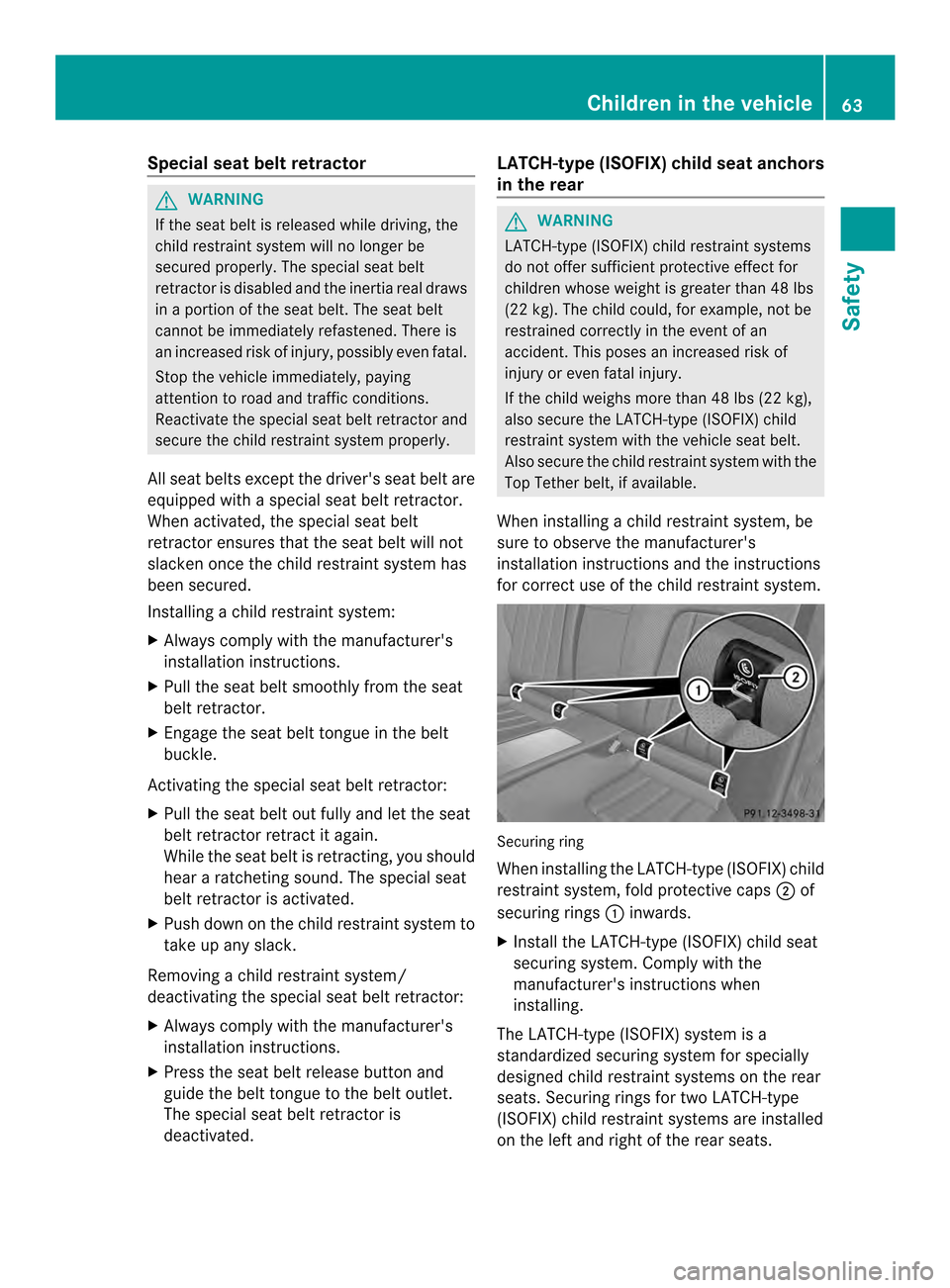
for correctu se of the child restraint system. Securing ring
When installing the LATCH-type (ISOFIX) child
restraint system, fold protective caps 0010of
securing rings 001Ainwards.
X Install the LATCH-type (ISOFIX) child seat
securing system. Comply with the
manufacturer's instructions when
installing.
The LATCH-type (ISOFIX) system is a
standardized securing system for specially
designed child restraint systems on the rear
seats. Securing rings for two LATCH-type
(ISOFIX) child restraint systems are installed
on the left and right of the rear seats. Children in the vehicle
63Safety Z
Page 66 of 382

Secure child restraint systems withou
ta
LATCH-type (ISOFIX) child seat securing
system using the seat belts in the vehicle.
When installing child restraint systems, you
must observe the manufacturer's installation
instructions.
Top Tether Top Tether anchorages
G
WARNING
Alway slock the rear seat backrests in their
upright positio nwhen the rear seats are
occupied by passengers. Lock the rear seat
backrests in their upright position before
installing the Top Tether straps or when the
cargo compartmentisn ot in use. Make sure
that rear seat backrests are secured properly
by pushing and pulling on the seat backrests.
If the seat backrest is not locked properly, the
seat backrest could fold forward. The child
restraint system is no longer supported
properly or held in position and can no longer
fulfill its function. This could cause serious or
even fatal injuries. Top Tether provides an additional connection
between
achild restraint system, secured
with aLATCH-type (ISOFIX) child seat mount,
and the rear seat. This helps reduce the risk
of injury even further.
The Top Tether anchorage points are located
in the rear compartmentb ehind the head
restraints.
X Move head restraint 001Aupwards.
X Fold up cover 0010of Top Tether anchorage
0024.
X Route Top Tether belt 001Eunder head
restraint 001Abetween the two head restraint
bars.
X Hook Top Tether hook 0021intoT op Tether
anchorage 0024.
X Make sure that Top Tether belt 001Eis not
twisted.
X Fold down cover 0010of Top Tether
anchorage 0024.
X Slide down head restraint 001Auntil it
engages (Y page 101).
Make sure that you do not interfere with the
correct routin gofTop Tether belt 001E.
X Install the LATCH-type (ISOFIX) child
restraint system with Top Tether .Comply
with the manufacturer's installation
instructions when doing so. Make sure that
Top Tether belt 001Eis tight. Child-proof locks
Important safety notes G
WARNING
If children are left unsupervised in the vehicle,
they could:
R open the doors, thus endangering other
people or road users.
R get out and disrupt traffic.
R operate the vehicle's equipment. 64
Children in the vehicleSafety
Page 67 of 382

Additionally, children could set the vehicl
ein
motion if, for example, they:
R release the parking brake.
R shifting the automatic transmission ou tof
park position P
R Start the engine.
There is arisk of an acciden tand injury.
When leaving the vehicle, always take the
SmartKey with you and lock the vehicle. Never
leave children or animals unattended in the
vehicle. Always keep the SmartKey out of
reach of children. G
WARNING
If persons, particularly children are subjected
to prolonged exposure to extreme heat or
cold, ther eisarisk of injury, possibly even
fatal. Never leave children unattended in the
vehicle. G
WARNING
If children are traveling in the vehicle, they
could:
R open doors, thus endangering other people
or road users
R exit the vehicle and be caught by oncoming
traffic
R operate vehicle equipment and become
trapped
There is arisk of an acciden tand injury.
Always activate the child-proof lock sand
override feature if children are traveling in the
vehicle. When leaving the vehicle, always take
the key with you and lock the vehicle. Never
leave children unattended in the vehicle.
You can activate the following child-proof
locks:
R rear doors (Y page 65)
R rear side windows (Y page 65) Child-proof locks for the rear doors G
WARNING
Children could open arear door from inside
the vehicle. This could result in serious
injuries or an accident. Therefore, when
children ride in the rear always secure the rear
doors with the child-proof locks. You secure each door individually with the
child-proof lock
sonthe rear doors. Adoor
secured with achild-proof lock cannot be
opened from inside the vehicle. When the
vehicle is unlocked, the door can be opened
from the outside.
X To activate: press the child-proof lock
lever up in the direction of arrow 001A.
X Make sure that the child-proof locks are
working properly.
X To deactivate: press the child-proof lock
lever down in the direction of arrow 0010.
Overrid efeature for the rear side
windows G
WARNING
When children ride on the vehicle's rear seats,
activate the override switch. Otherwise, the
children could be injured, e.g. by trapping
themselves in the rear side window. Children in the vehicle
65Safety Z
Page 99 of 382
Useful information
..............................98
Correct driver's seat position ............98
Seats .................................................... 99
Steering wheel .................................. 106
Mirrors ............................................... 109
Memor yfunction .............................. 112 97Seats, steering wheel and mirrors
Page 100 of 382
Useful information
i This Operator's Manual describes all
models and all standard and optional
equipment of your vehicle available at the
time of publication of the Operator's
Manual. Country-specific differences are
possible. Please not ethat your vehicle may
not be equipped with all features
described. This also applies to safety-
related system sand functions.
i Read the information on qualified
specialist workshops: (Y page 26).Correct driver's seat position
G
WARNING
You could lose contro lofyour vehicle if you
do the following while driving:
R adjust the driver' sseat, head restraint,
steering wheel or mirrors
R faste nthe seat belt
There is arisk of an accident.
Adjust the driver's seat, head restraint,
steering wheel and mirror and fasten your
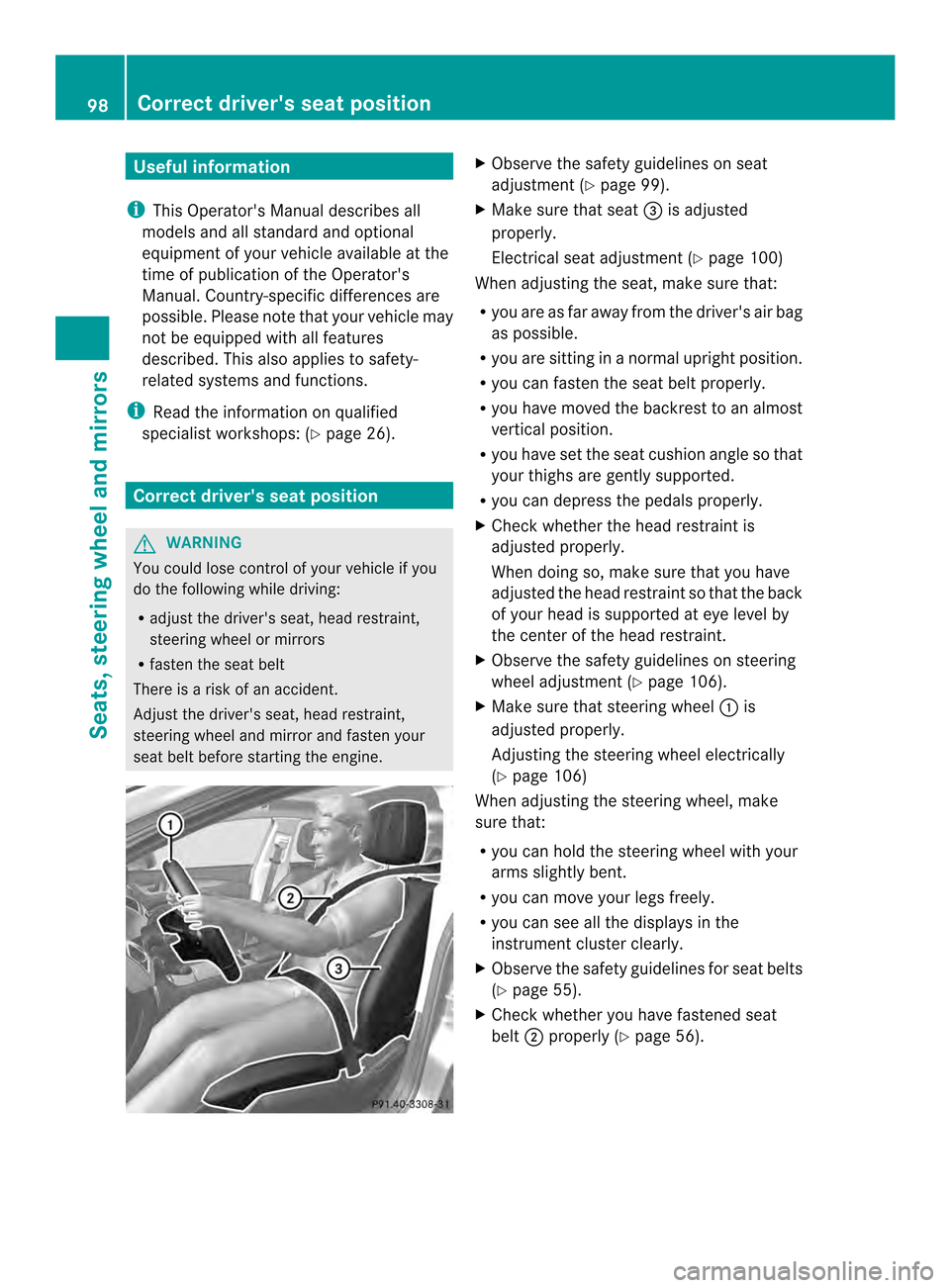
seat belt before startingt he engine. X
Observe the safety guidelines on seat
adjustment (Y page 99).
X Make sure that seat 0024is adjusted
properly.
Electrical seat adjustment (Y page 100)
When adjusting the seat, make sure that:
R you are as far away from the driver's air bag
as possible.
R you are sitting in anormal upright position.
R you can fasten the seat belt properly.
R you have moved the backrest to an almost
vertical position.
R you have set the seat cushion angle so that
your thighs are gently supported.
R you can depress the pedals properly.
X Check whether the head restraint is
adjusted properly.
When doing so, make sure that you have
adjusted the head restraint so that the back
of your head is supported at eye level by
the center of the head restraint.
X Observe the safety guidelines on steering
wheel adjustment (Y page 106).
X Make sure that steering wheel 001Ais
adjusted properly.
Adjustingt he steering wheel electrically
(Y page 106)
When adjusting the steering wheel, make
sure that:
R you can hold the steering wheel with your
arms slightly bent.
R you can move your legs freely.
R you can see all the displays in the
instrumentc luster clearly.
X Observe the safet yguideline sfor seat belts
(Y page 55).
X Check whether you have fastened seat
belt 0010properly (Y page 56). 98
Correct driver'
sseat positionSeats, steering wheel and mirrors