spare tire MERCEDES-BENZ CLS-Class 2014 W218 User Guide
[x] Cancel search | Manufacturer: MERCEDES-BENZ, Model Year: 2014, Model line: CLS-Class, Model: MERCEDES-BENZ CLS-Class 2014 W218Pages: 382, PDF Size: 5.36 MB
Page 346 of 382

The tire pressure monitor has
ayellow
warning lamp in the instrument cluster for
indicatin gapressure loss or malfunction.
Whether the warning lamp flashes or lights up
indicates whether atire pressure is too low or
the tire pressure monitor is malfunctioning:
R if the warning lamp is lit continuously, the
tire pressure on one or more tires is
significantly too low. The tire pressure
monitor is not malfunctioning.
R if the warning lamp flashes for around a
minute and then remains lit constantly, the
tire pressure monitor is malfunctioning.
If the tire pressure monitor is malfunctioning,
it may take more than ten minutes for the tire
pressure warning lamp to inform you of the
malfunction by flashing for approximately one
minute and then remaining lit. When the
malfunction has been rectified, the tire
pressure warning lamp goes out after afew
minutes of driving.
The tire pressure values indicated by the on-
board computer may differ from those
measured at agas station with apressure
gauge. The tire pressures shown by the on-
board computer refer to those measured at
sea level. At high altitudes, the tire pressure
values indicated by apressure gauge are
higher than those shown by the on-board
computer .Inthis case, do not reduce the tire
pressures.
The operation of the tire pressure monitor can
be affected by interference from radio
transmitting equipment (e.g. radio
headphones, two-way radios) that may be
being operated in or near the vehicle.
Checking the tire pressure
electronically X
Make sure that the SmartKey is in position
2(Y page 147) in the ignition lock .
X Press the 000Aor0004 button on the
steering wheel to select the Serv. menu.X
Press the 0006or0005 button to select
Tire Pressure .
X Press the 000Cbutton.
The current tire pressure of each tire is
shown in the multifunction display.
If the vehicle was parked for longer than
20 minutes ,the Tire pressures will be
displayed after driving
afew minutes message is shown.
After ateach-in process, the tire pressure
monitor automatically detects new wheels or
new sensors. As long as aclear allocation of
the tire pressure value to the individual
wheels is not possible, the Tire Pressure Monitor Active displaym
essage is shown
instead of the tire pressure display. The tire
pressures are already being monitored.
i If an emergency spare wheel is mounted,
the system may continue to show the tire
pressure of the wheel that has been
removed for afew minutes. If this occurs,
note that the value displayed for the
position where the spare wheel is mounted
is not the same as the current tire pressure
of the emergency spare wheel.
Tire pressurem onitor warning
messages If the tire pressure monitor detects
apressure
loss in one or more tires, awarning message
is shown in the multifunction displaya nd the
yellow tire pressure monitor warning lamp
comes on.
R If the Correct Tire Pressure message
appears in the multifunction display, the
tire pressure in at least one tire is too low
and must be corrected at the next
opportunity.
R If the Check Tire Pressure message
appears in the multifunction display, the
tire pressure in one or more tires has
dropped significantly and the tires must be
checked.
R If the Tire Malfunction appears in the
multifunction display, the tire pressure in 344
CheckWheels and tires
Page 353 of 382
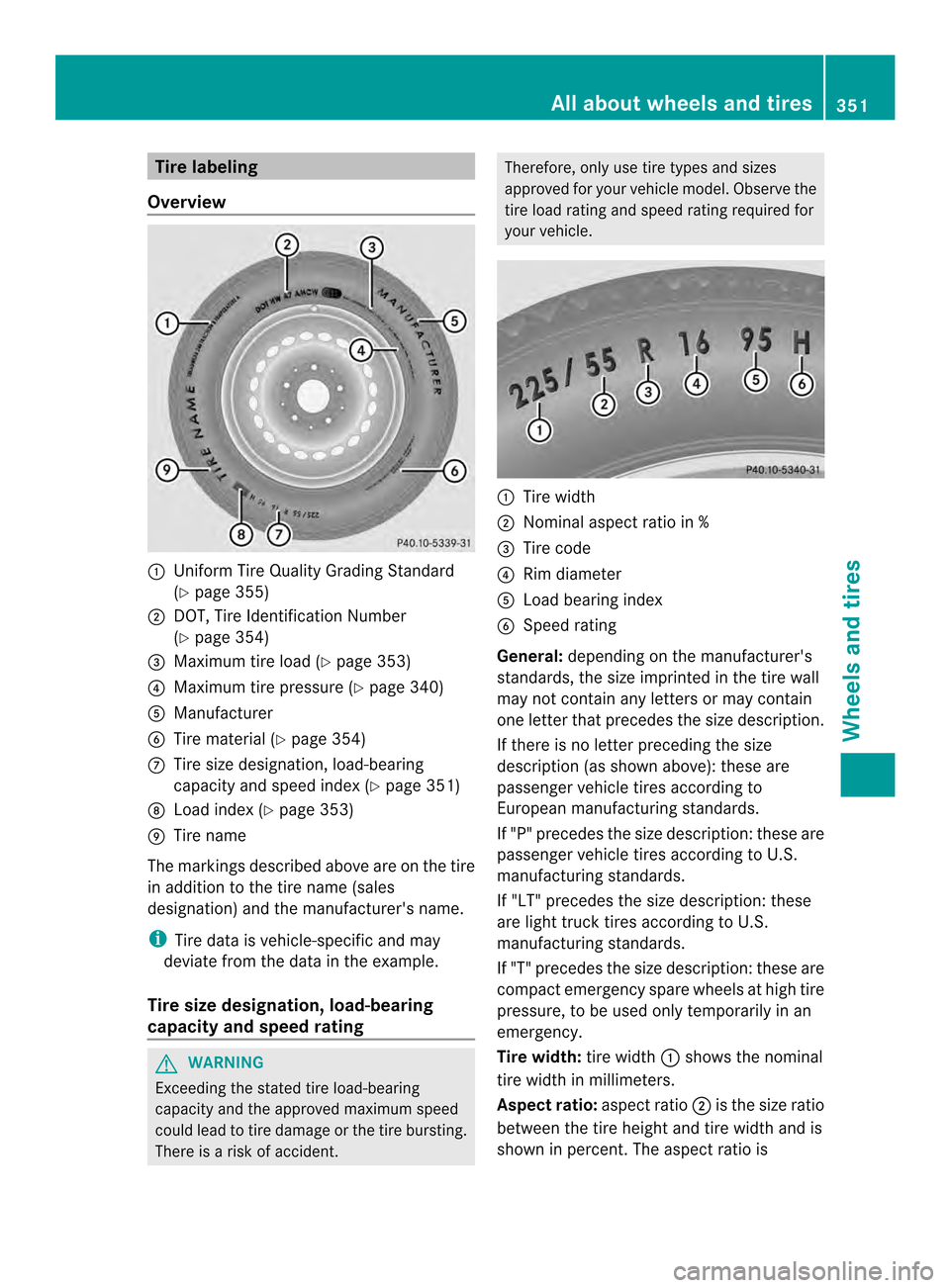
Tire labeling
Overview 001A
Unifor mTire Qualit yGrading Standard
(Y page 355)
0010 DOT, Tire Identification Number
(Ypage 354)
0024 Maximum tir eload (Y page 353)
0021 Maximum tir epressure (Y page 340)
001E Manufacturer
0025 Tire material (Y page 354)
0009 Tire size designation ,load-bearing
capacity and speed index (Y page 351)
0016 Load index (Y page 353)
001D Tire name
The markings described above are on the tire
in additio ntothe tire name (sales
designation) and the manufacturer's name.
i Tire data is vehicle-specific and may
deviate from the data in the example.
Tire size designation, load-bearing
capacity and speed rating G
WARNING
Exceeding the stated tire load-bearing
capacity and the approved maximum speed
could lead to tire damage or the tire bursting.
There is arisk of accident. Therefore, only use tire types and sizes
approved for your vehicle model. Observe the
tire load rating and speed rating required for
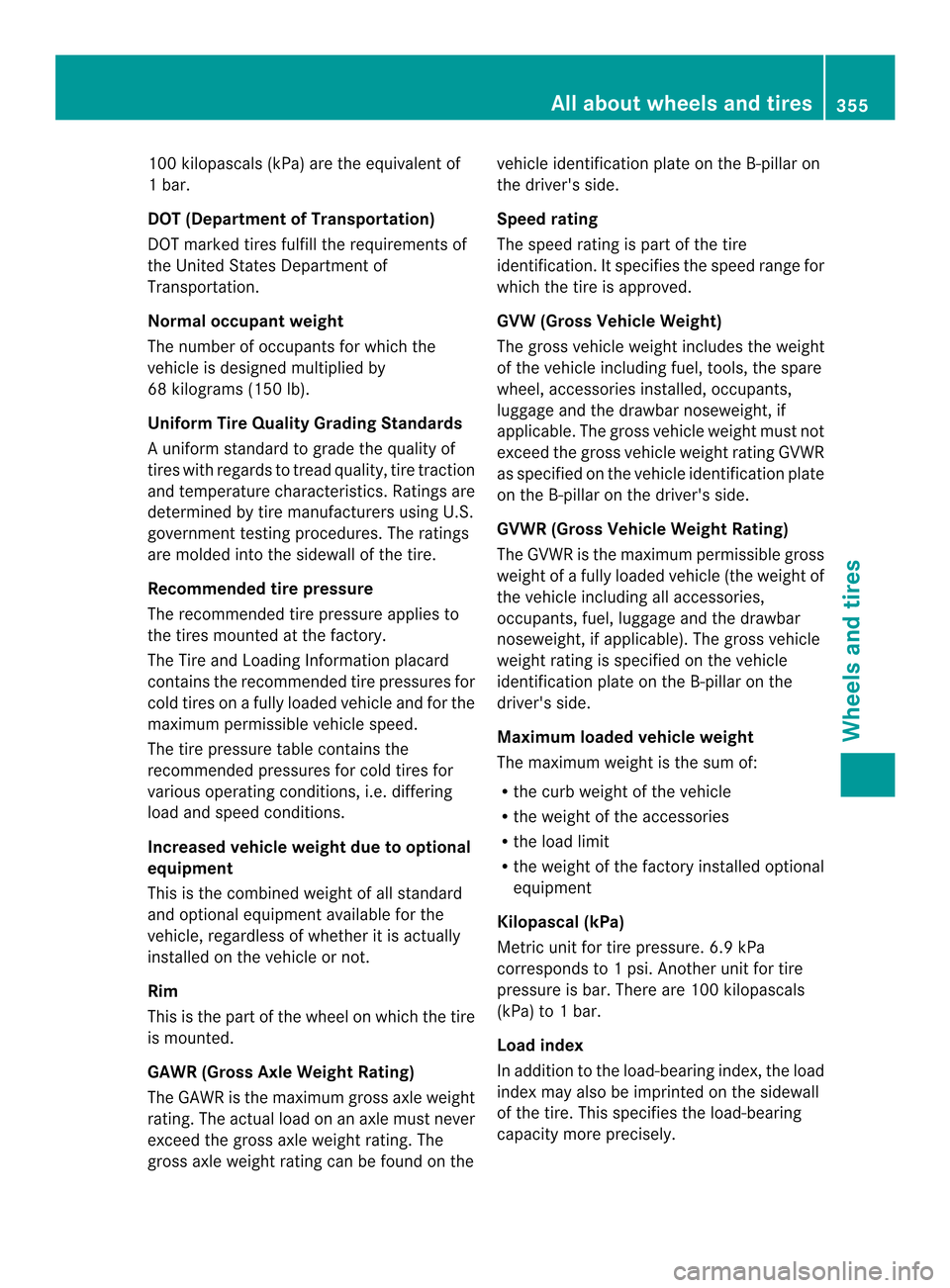
your vehicle. 001A
Tire width
0010 Nominal aspect ratio in %
0024 Tire code
0021 Rim diameter
001E Load bearing index
0025 Speed rating
General: depending on the manufacturer's
standards, the size imprinted in the tire wall
may not contain any letters or may contain
one letter that precedes the size description.
If there is no letter preceding the size
description (as shown above): these are
passenger vehicle tires according to
European manufacturin gstandards.
If "P" precedes the size description :these are
passenger vehicle tires according to U.S.
manufacturing standards.
If "LT" precedes the size description: these
are light truck tires according to U.S.
manufacturing standards.
If "T" precedes the size description: these are
compact emergency spare wheels at high tire
pressure, to be used only temporarily in an
emergency.
Tire width: tire width001Ashows the nominal
tire width in millimeters.
Aspect ratio: aspect ratio0010is the size ratio
between the tire height and tire width and is
shown in percent.T he aspect ratio is All about wheels and tires
351Wheels and tires Z
Page 357 of 382
100 kilopascals (kPa
)are the equivalent of
1b ar.
DOT (Department of Transportation)
DOT marked tires fulfill the requirements of
the United States Department of
Transportation.
Normal occupant weight
The numbe rofoccupants for which the
vehicl eisdesigned multiplie dby
68 kilograms (150 lb).
Uniform Tire Quality Gradin gStandards
Au niform standard to grade the quality of
tire swithr egards to trea dquali ty,tire traction
and temperatur echaracteristics. Rating sare
determine dbytire manufacturer susing U.S.
government testing procedures. The ratings
ar em olde dinto the sidewall of the tire.
Recommende dtire pressure
The recommende dtire pressure applie sto
the tire smounted at the factory.
The Tire and Loading Informatio nplacard
contain sthe recommende dtirep ressures for
cold tires on afully loaded vehicle and for the
maximum permissible vehicle speed.
The tir epressure table contain sthe
recommende dpressures for cold tires for
various operating conditions, i.e. differing
load and speed conditions.
Increased vehicle weight du etooptional
equipment
This is the combined weight of all standard
and optional equipmen tavailablef or the
vehicle, regardless of whethe ritisactually
installed on the vehicle or not.
Rim
This is the part of the wheel on which the tire
is mounted.
GAWR (Gross Axle Weight Rating)
The GAWR is the maximum gross axle weight
rating. The actual load on an axle must never
exceed the gross axle weight rating. The
gross axle weight rating can be found on the vehicle identification plate on the B-pillar on
the driver's side.
Speed rating
The speed rating is part of the tire
identification. It specifies the speed range for
which the tire is approved.
GVW (Gross Vehicle Weight)
The gross vehicle weight includes the weight
of the vehicle including fuel, tools, the spare
wheel, accessories installed, occupants,
luggage and the drawbarn
oseweight, if
applicable. The gross vehicle weight must not
exceed the gross vehicle weight rating GVWR
as specified on the vehicle identification plate
on the B-pillar on the driver's side.
GVWR (Gross Vehicle Weight Rating)
The GVWR is the maximum permissible gross
weight of afully loaded vehicle (the weight of
the vehicle including all accessories,
occupants, fuel, luggage and the drawbar
noseweight, if applicable). The gross vehicle
weight rating is specified on the vehicle
identification plate on the B-pillar on the
driver's side.
Maximu mloaded vehicle weight
The maximum weight is th esum of:
R thec urbw eight of th evehicle
R thew eight of th eaccessories
R thel oad limit
R thew eight of th efactory installe doptional
equipment
Kilopascal (kPa)
Metric unit for tir epressure. 6. 9kPa
correspond sto1psi. Another unit for tire
pressure is bar. Ther eare 10 0kilopascals
(kPa) to 1bar.
Load index
In addition to th eload-bearing index ,the load
index may also be imprinted on th esidewall
of th etire. This specifie sthe load-bearing
capacity more precisely. All about wheels and tires
355Wheels and tires Z
Page 359 of 382
Occupant distribution
The distribution of occupant
sinavehicleat
their designated seating positions.
Total load limit
Rated cargo and luggagel oadp lus
68 kilograms (150 lb) multiplied by the
number of seats in the vehicle. Changing
awheel Flat tire
You can find information on wha ttodointhe
event of aflat tire in the "Breakdown
assistance" section (Y page 321).
Information on driving with MOExtended tires
in the event of aflat tire can be found under
"MOExtended tires (tires with run-flat
characteristics" (Y page 321).
Vehicle with emergency sparew heel:in
the event of aflat tire, the emergenc yspare
wheel is mounted as described under
"Mounting awheel" ( Ypage 358). Rotating the wheels
G
WARNING
Interchangin gthe front and rear wheels may
severely impair the driving characteristics if
the wheels or tires have different dimensions.
The wheel brakes or suspension components
may also be damaged. There is arisk of
accident.
Rotate front and rear wheels only if the wheels
and tires are of the same dimensions.
! On vehicles equipped with atire pressure
monitor, electronic components are
located in the wheel.
Tire-mounting tools should not be used
near the valve. This could damage the
electronic components.
Only have tires changed at aqualified
specialist workshop. Always observe the instructions and safety
notes in the "Mounting
awheel" section
(Y page 358).
The wear patternsont he front and rear tires
differ, depending on the operating conditions.
Rotate the wheels before aclear wear pattern
has formed on the tires. Front tires typically
wear more on the shoulders and the rear tires
in the center.
If your vehicle's tire configuration allows, you
can rotate the wheels according to the
intervals in the tire manufacturer's warranty
book in your vehicle documents. If this is not
available, the tires should then be replaced
every 3,000 to 6,000 miles (5,000 to
10,000 km), or earlier if the tire wear requires
this. Do not change the direction of wheel
rotation.
Cleant he contact surfaces of the wheel and
the brake disc thoroughly every time awheel
is interchanged. Check the tire pressure and,
if necessary, restart the tire pressure loss
warning system or the tire pressure monitor. Direction of rotation
Tires with aspecified direction of rotation
have additional benefits, e.g. if there is arisk
of hydroplaning. You will only gain these
benefits if the correct direction of rotation is
maintained.
An arrow on the sidewall of the tire indicates
its correct direction of rotation. Storing wheels
Storew heels that are not being used in acool,
dry and preferably dark place. Protect the
tires from oil, grease, gasoline and diesel. Cleaningt
he wheels G
WARNING
The water jet from acircular jet nozzle (dirt
blasters) can cause invisible exterior damage Changing
awheel
357Wheels and tires
Z
Page 363 of 382

G
WARNING
If you tighten the whee lbolts or whee lnuts
when the vehicl eisraised, the jack coul dtip
over. There is arisk of injury.
Only tighten the whee lbolts or whee lnuts
when the vehicl eisonthe ground.
Always pay attention to the instructions and
safety notes in the "Changing awheel"
section (Y page357).
Only use whee lbolts that have been designed
for the whee land the vehicle. For safety
reasons, Mercedes-Benz recommends that
you only use whee lbolts which have been
approved for Mercedes-Benz vehicles and the
respective wheel.
! AMG vehicle with ceramic brake
discs: during remova land repositioning of
the wheel, the whee lrim can strike the
ceramic-brake disc and damage it.
Therefore, take precautions and have a
second perso nassist you. Alternatively,
you can use asecond alignment bolt.
! To prevent damage to the paintwork, hold
the wheel securely against the wheel hub
while screwing in the first wheel bolt. Positioning
awheel (example: vehicle with an
emergency spare wheel)
X Cleant he wheel and wheel hub contact
surfaces.
X Slide the wheel to be mounted onto the
alignment bolt and push it on.
X Tighten the wheel bolts until they are
finger-tight. X
Unscrew the alignment bolt.
X Tighten the last wheel bolt until it is finger-
tight.
X Vehicles with acollapsible spare
wheel: inflate th ecollapsible spare wheel
(Y page 368).
Only then lower th evehicle.
Lowering th evehicle G
WARNING
The wheels could work loose if th ewheel nuts
and bolt sare not tightene dtothe specified
tightening torque. There is arisk of accident.
Have the tightening torque immediately
checked at aqualified specialist workshop
after awheel is changed.
! Vehicles with acollapsible spare
wheel: before lowering th evehicle, inflate
th ec ollapsible spare wheel with th etire
inflatio ncompressor. The wheel rim could
otherwise be damaged. Tightenin
gthe wheel nuts (example: vehicle with
an emergenc yspare wheel)
X Turn the crank of the jack counter-
clockwise until the vehicle is once again
standin gfirmly on the ground.
X Place the jack to one side.
X Tighten the wheel bolts evenly in a
crosswise pattern in the sequence
indicated (001A to001E). The specified
tightening torque is 96 lb-ft(130 Nm).
X Turn the jack back to its initial position. Changing
awheel
361Wheels and tires Z
Page 369 of 382
Winter tires
R19
Tires Alloy wheels
FA: 255/35 R19 96
VXLM+S0012
RA: 255/35 R19 96 VXLM+S0012 FA: 9.0
Jx19H2
Whee loffset: 1.46 in (37 mm)
RA: 9.5 Jx19H2
Whee loffset: 2.05 in (52 mm) FA: 255/35 R19 96
VXLM+S0012
RA: 285/30 R19 98 VXLM+S0012 3 FA: 9.0
Jx19H2
Whee loffset: 1.46 in (37 mm)
RA: 10.0 Jx19H2
Whee loffset: 1.85 in (47 mm) Emergency spare wheel
Important safety notes
G
WARNING
The whee lortire size as wel lasthe tire type
of the spare whee loremergency spare wheel
and the whee ltobereplaced may differ.
Mounting an emergency spare whee lmay
severely impair the driving characteristics.
There is arisk of an accident.
To avoi dhazardou ssituations:
R adapt you rdriving style accordingly and
drive carefully.
R never mount more than one spare whee lor
emergency spare whee lthat differs in size.
R only use aspare whee loremergency spare
whee lofad ifferent size briefly.
R do not switch ESP ®
off.
R have aspare whee loremergency spare
whee lofad ifferent size replaced at the
nearest qualified specialist workshop.
Observe that the whee land tire dimensions
as wellast he tire type must be correct.
When using an emergency spare whee lor
spare whee lofadifferent size, you must not
exceed the maximu mspee dof50m ph
(80 km/h). Snow chains must not be mounted on
emergency spare wheels. General notes
You should regularl ycheck the pressure of
the emergency spare wheel, particularl yprior
to long trips, and correct the pressure as
necessary (Y page338). The applicable value
is found on the whee lorunder "Technical
data "(Ypage3 70).
An emergency spare whee lmay alsobe
mounted against the direction of rotation.
Observe the time restriction on use as wellas
the spee dlimitation specified on the
emergency spare wheel.
Replace the tires after six years at the latest,
regardless of wear. This alsoa ppliestothe
emergency spare wheel.
i When you are driving with the collapsible
spare whee lmounted, the tire pressure
loss warning system or the tire pressure
monitor cannot function reliably. Only
restart the tire pressure loss warning
system/the tire pressure monitor when the
damaged whee lhas been replaced with a
new wheel.
Vehicles with tire pressure monitor:
after mounting an emergency spare wheel,
3 Use of snow chains is not permitted .Observe the notes under "Snow chains". Emergency spar
ewheel
367Wheels and tires Z
Page 370 of 382
the syste
mmay still display th etire
pressure of th eremove dwheel for afew
minutes. The value displayed for the
mounte demergenc yspar ew heel is no tthe
same as the current tire pressure of the
emergency spare wheel. "Minispare" emergency sparew
heel/
collapsible sparew heel
Removing the "Minispare" emergency
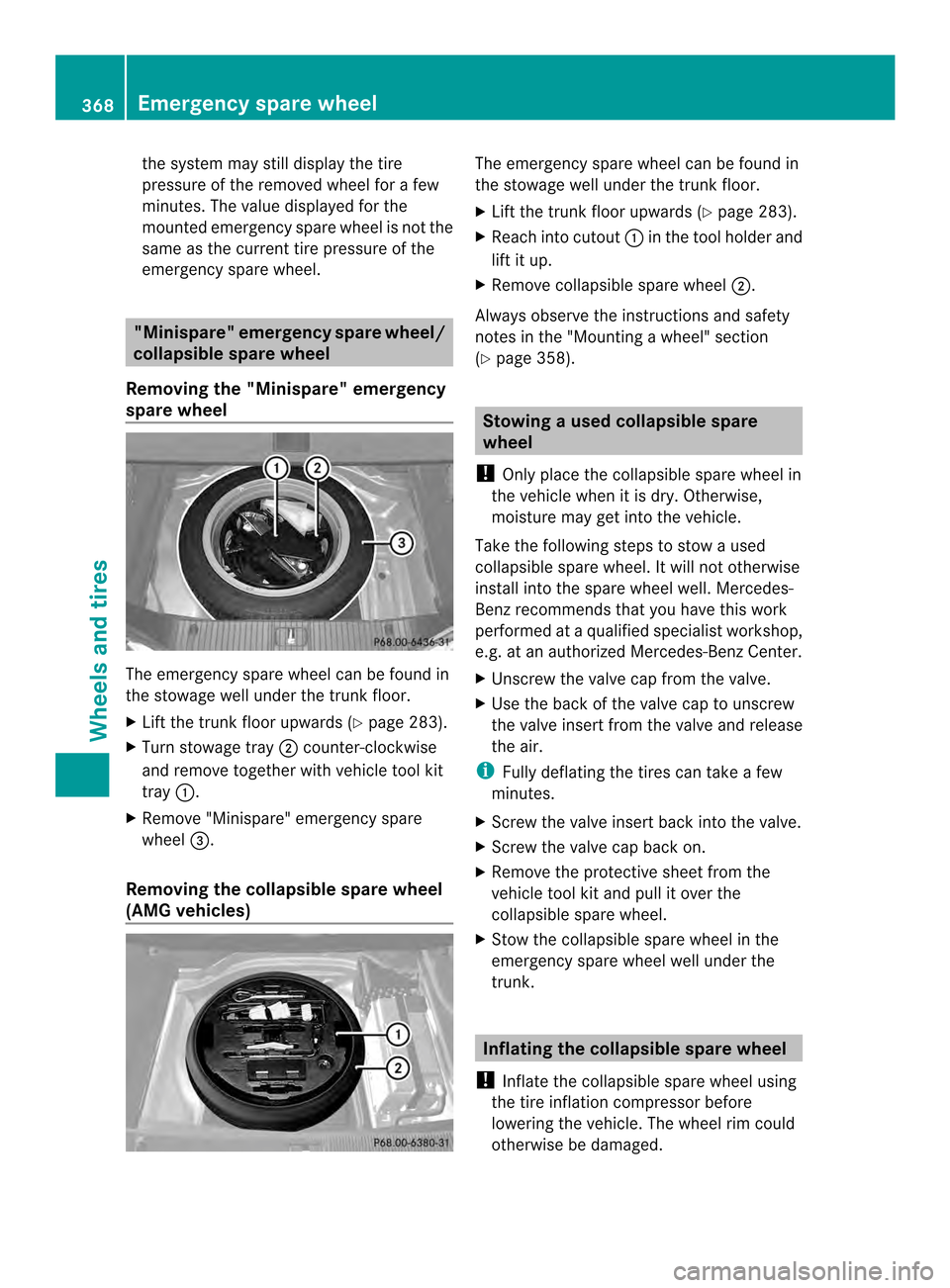
sparew heel The emergency spare wheel can be found in
the stowage well under the trunk floor.
X Lift the trunk floor upwards (Y page 283).
X Turn stowage tray 0010counter-clockwise
and remove together with vehicle tool kit
tray 001A.
X Remove "Minispare" emergency spare
wheel 0024.
Removing the collapsible sparew heel
(AMG vehicles) The emergency spare wheel can be found in
the stowage wel
lunde rthe trunk floor.
X Lift the trunk floor upwards (Y page 283).
X Reach into cutout 001Ain the tool holder and
lift it up.
X Remove collapsibles pare wheel0010.
Always observe the instructions and safety
notes in the "Mounting awheel" section
(Y page 358). Stowing
aused collapsible spare
wheel
! Only place the collapsible spare wheel in
the vehicle when it is dry. Otherwise,
moisture may get into the vehicle.
Take the following steps to stow aused
collapsible spare wheel. It will not otherwise
install into the spare wheel well. Mercedes-
Benz recommends that you have this work
performed at aqualified specialist workshop,
e.g. at an authorized Mercedes-Benz Center.
X Unscrew the valve cap from the valve.
X Use the back of the valve cap to unscrew
the valve insert from the valve and release
the air.
i Fully deflating the tires can take afew
minutes.
X Screw the valve insert back into the valve.
X Screw the valve cap back on.
X Remove the protective sheet from the
vehicle tool kit and pull it over the
collapsible spare wheel.
X Stow the collapsible spare wheel in the
emergency spare wheel well under the
trunk. Inflating the collapsible spar
ewheel
! Inflate the collapsible spare wheel using
the tire inflation compressor before
lowering the vehicle. The wheel rim could
otherwise be damaged. 368
Emergency sparew
heelWheels and tires
Page 371 of 382
!
Do not operate the tire inflation
compressor for longer than eight minutes
at at ime without abreak. It may otherwise
overheat.
The tire inflation compressor can be
operated againo nce it hascoole ddown. X
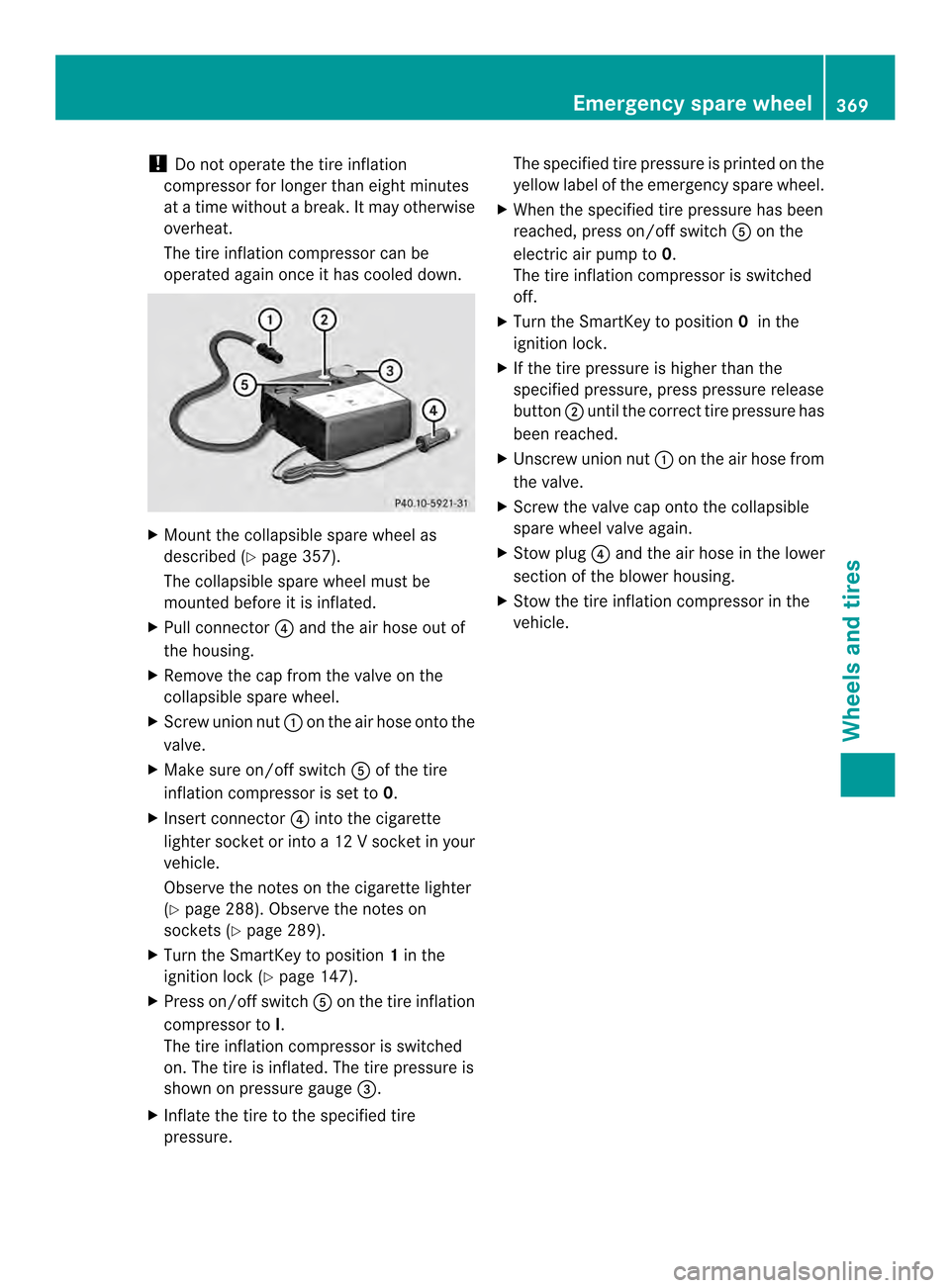
Mount the collapsibl espare whee las
described (Y page 357).
The collapsible spare wheel must be
mounted before it is inflated.
X Pull connector 0021and the air hose out of
the housing.
X Remove the cap from the valve on the
collapsible spare wheel.
X Screw union nut 001Aon the air hose ont othe
valve.
X Make sure on/off switch 001Eof the tire
inflation compressor is set to 0.
X Insert connector 0021intot he cigarette
lighter socket or int oa12Vsocket in your
vehicle.
Observe the notes on the cigarett elighter
(Y page 288). Observe the notes on
socket s(Ypage 289).
X Turn the SmartKey to position 1in the
ignition lock (Y page 147).
X Press on/offs witch001Eon th etirei nflation
compressor to I.
The tir einflatio ncompressor is switched
on. The tire is inflated. The tire pressure is
shown on pressure gauge 0024.
X Inflate the tire to the specified tire
pressure. The specified tire pressure is printed on the
yellow label of the emergenc
yspare wheel.
X When the specified tire pressure has been
reached, press on/offs witch001Eon the
electric air pump to 0.
The tir einflatio ncompressor is switched
off.
X Turn the SmartKey to position 0in the
ignition lock.
X If the tire pressure is higher than the
specified pressure, press pressure release
button 0010until the correc ttire pressure has
been reached.
X Unscrew union nut 001Aon the air hose from
the valve.
X Screw the valve cap ont othe collapsible
spare wheel valve again.
X Stow plug 0021and the air hose in the lower
section of the blower housing.
X Stow the tire inflation compressor in the
vehicle. Emergency sparew
heel
369Wheels and tires Z
Page 372 of 382
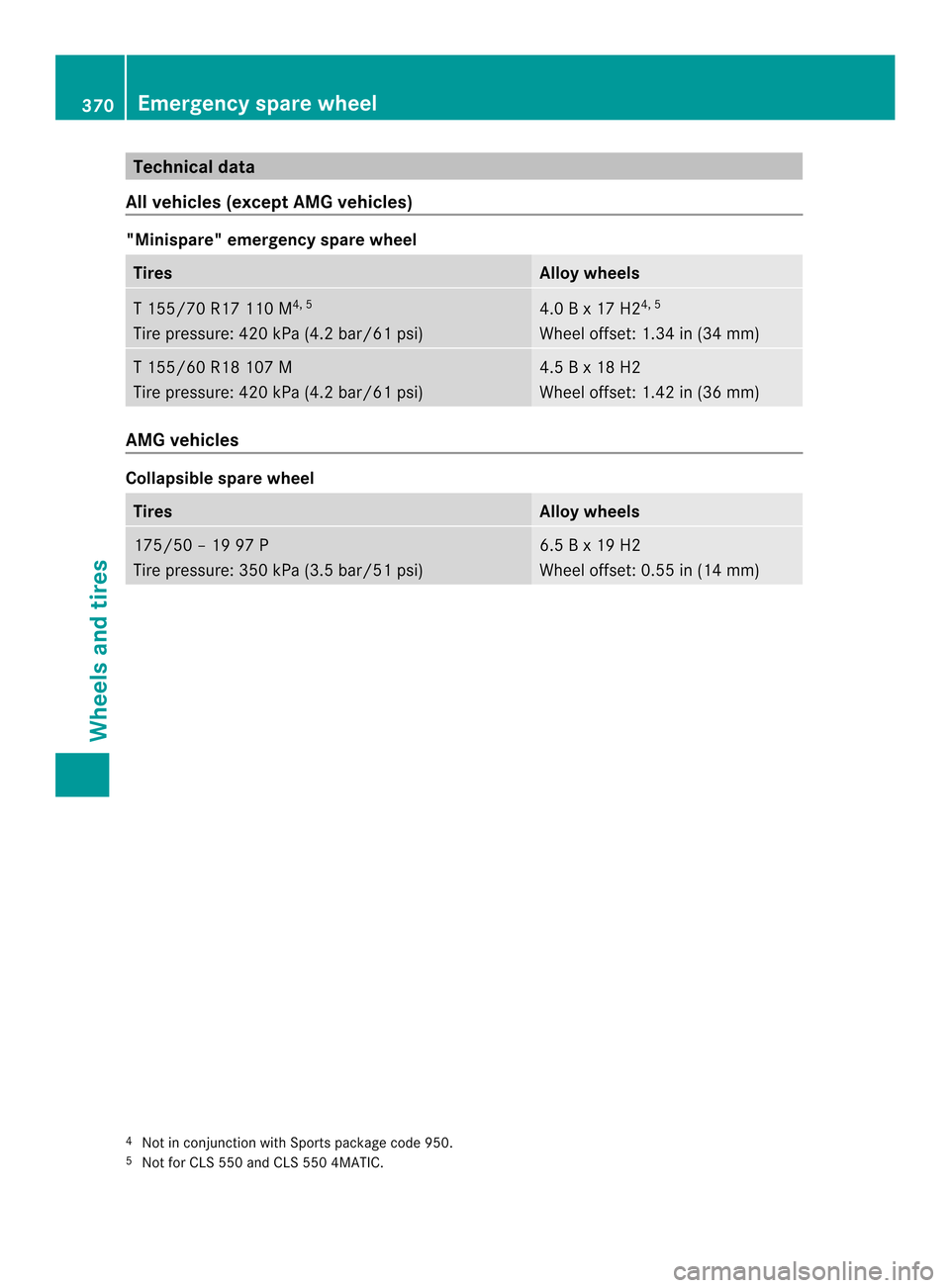
Technica
ldata
Al lv eh icle s(exce pt AM Gvehicles) "Minispare" emergency spare wheel
Tires Alloy wheels
T1
55/70 R17 110M4, 5
Tire pressure: 42 0kPa(4.2b ar/61 psi) 4.
0Bx17H2 4, 5
Wheel offset :1.34i n( 34 mm) T1
55/60 R18 107M
Tire pressure: 42 0kPa(4.2b ar/61 psi) 4.
5Bx18H2
Wheel offset :1.42i n( 36 mm) AMG vehicles
Collapsible spare wheel
Tires Alloy wheels
175/50
–1997P
Tire pressure: 35 0kPa(3.5b ar/51 psi) 6.
5Bx19H2
Wheel offset :0.55i n( 14 mm) 4
Not in conjunction with Sport spackage cod e950.
5 Not for CLS 55 0and CLS 55 04MATIC. 370
Emergency spare wheelWheels and tires