spare tire MERCEDES-BENZ CLS-Class 2014 W218 Owner's Manual
[x] Cancel search | Manufacturer: MERCEDES-BENZ, Model Year: 2014, Model line: CLS-Class, Model: MERCEDES-BENZ CLS-Class 2014 W218Pages: 382, PDF Size: 5.36 MB
Page 19 of 382
Stowag
enet ................................... 281
Unde rdriver' sseat/front-
passenger sea t.............................. 280
Stowage net ....................................... 281
Stowage space Center console (rear) .....................280
Stowage well beneath the trunk
floor .................................................... 283
Summer tires ..................................... 336
Sun visor ............................................ 286
Surround lighting (on-board
computer) .......................................... 231
Suspensio ntuning
AIRMATIC ...................................... 190
AMG adaptive sport suspension
system ........................................... 191
SETUP (on-board computer) ..........234
Switchin gair-recirculation mode
on/off ................................................. 141
Switchin goff the alarm (ATA) ............74 T
Tachometer ........................................ 219
Tail lamps Display message ............................ 246
Tank content
Fuel gauge ............................... 31, 219
Technical data
Capacities ...................................... 373
Emergency spare wheel .................370
Information .................................... 372
Tires/wheels ................................. 362
Vehicle data ................................... 379
TELEAID
Call priority .................................... 294
Downloading destinations
(COMAND) ..................................... 294
Downloading route s....................... 298
Emergency call .............................. 291
Geo fencing ................................... 298
Important safety notes ..................290
Locating astolen vehicl e............... 297
MB info call button ........................293
Remote vehicle locking ..................296
Roadside Assistance button ..........293
Search &Send ............................... 295
Self-test ......................................... 291Speed alert
.................................... 298
System .......................................... 291
Triggering the vehicle alarm ........... 299
Vehicle remote malfunction
diagnosi s....................................... 297
Vehicle remote unlocking ..............296
Telephone
Accepting acall............................. 226
Display message ............................ 262
Menu (on-board computer) ............226
Number from the phone book ....... .226
Redialing ........................................ 227
Rejecting/ending acall................. 226
Temperature
Coolant .......................................... 219
Coolant (on-board computer) ......... 234
Engine oil (on-board computer) ...... 234
Outside temperature ..................... .220
Setting (climate control) ................138
Theft deterren tsystems
ATA (Anti-Theft Alarm system) .........74
Immobilize r...................................... 73
Through-loading feature ...................281
Timing (RACETIMER) .........................235
Tire pressure Calling up (on-board computer) .....342
Checking manually ........................341
Display message ............................ 258
Maximum ....................................... 340
Notes ............................................. 339
Recommended ............................... 338
Tire pressure los swarning system
General notes ................................ 341
Important safety notes ..................341
Restarting ...................................... 342
Tire pressure monitoring system
Checking the tire pressure
electronically ................................. 344
Function/notes ............................. 342
Restarting ...................................... 345
Warning lamp ................................. 276
Warning message .......................... 344
Tires
Aspect ratio (definition) .................356
Averag eweight of the vehicle
occupants (definition) ....................355
Bar (definition) ............................... 354
Changing awheel .......................... 357 Index
17
Page 21 of 382
Opening/closing (automatically
from outside)
................................... 86
Opening/closing (manually from
outside) ............................................ 85
Trunk lid
Display message ............................ 261
Opening/closing .............................. 84
Opening dimensions ......................379
Trunk load (maximum) ......................379
Turn signals Display message ............................ 245
Switching on/off ........................... 119
Type identification plate
see Vehicle identification plate U
Unlocking Emergency unlocking .......................84
From insid ethe vehicle (central
unlocking button) ............................. 83 V
Vanity mirror (in the sun visor) ........286
Vehicle Data acquisition ............................... 27
Display message ............................ 260
Equipment ....................................... 22
Individua lsettings .......................... 229
Limited Warranty ............................. 26
Loading .......................................... 345
Locking (in an emergency) ...............84
Locking (SmartKey) .......................... 76
Lowering ........................................ 361
Maintenance .................................... 23
Parking for along period ................ 169
Pulling away ................................... 150
Raising ........................................... 359
Reporting problems .........................26
Securing from rolling away ............358
Towing away .................................. 328
Transporting .................................. 330
Unlocking (in an emergency) ...........84
Unlocking (SmartKey) ......................76
Vehicle data ................................... 379
Vehicle data ....................................... 379
Vehicle dimensions ...........................379Vehicle emergency locking
................84
Vehicle identification number see VIN
Vehicle identification plate ..............372
Vehicle level AIRMATIC ...................................... 189
Vehicle level (display message) .......252
Vehicle tool kit .................................. 320
Video Operating the DVD ......................... 226
VIN ...................................................... 372 W
Warning and indicator lamps ABS ................................................ 267
Brakes ........................................... 266
Check Engine ................................. 273
Coolant .......................................... 273
Distance warning ........................... 275
DISTRONI CPLUS ........................... 275
ESP ®
.............................................. 269
ESP ®
OFF ....................................... 270
Fuel tank ........................................ 273
Overview .................................. 32, 264
PASSENGER AIR BAG OFF ...............47
Reserve fuel ................................... 273
Seat bel t........................................ 265
SPORT handling mode ...................270
SRS ................................................ 272
Tire pressure monitor ....................276
Warranty ............................................ 372
Washer fluid Display message ............................ 262
Whee lboltt ightening torque ...........361
Whee lchock ...................................... 358
Wheels Changing awheel .......................... 357
Checking ........................................ 335
Cleaning ......................................... 314
Cleaning (warning) .........................357
Emergency spare wheel .................367
Important safety notes ..................334
Interchanging/changing ................357
Mounting anew wheel ................... 360
Mounting awheel .......................... 358
Removing awheel .......................... 360
Storing ........................................... 357 Index
19
Page 323 of 382
001E
Alignment bolt
0025 Sheet for faulty wheel
0009 Tire inflation compressor
0016 Lugw rench
001D Fusealloc ation chart
X Ope nthe trunk lid.
X Lift the trunk floor upwards (Y page 283).Flat tire
Preparing the vehicle
Your vehicle may be equipped with:
R MOExtended tires (tires with run-flat
properties) (Y page 321)
Vehicle preparation is not necessary on
vehicles with MOExtended tires.
R an emergency spare wheel(Y page 367)
Information on changing/mounting awheel
(Y page 357).
X Stop the vehicle on solid, non-slippery and
level ground, as far away as possible from
traffic.
X Switch on the hazard warning lamps.
X Secure the vehicle against rolling away
(Y page 167).
X If possible, bring the front wheels into the
straight-ahead position.
X Vehicles with AIRMATIC: make sure that
"normal" level is selected (Y page 189).
X Switch off the engine.
X Vehicles without KEYLESS-GO: remove
the SmartKey from the ignition lock.
X Vehicles with KEYLESS-GO: open the
driver's door.
The on-board electronicsn ow have status
0.T his is the same as the SmartKey having
been removed.
X Vehicles with KEYLESS-GO: remove the
Start/Stop button from the ignition lock
(Y page 147). X
All occupants must get out of the vehicle.
Make sure that they are not endangered as
they do so.
X Make sure that no one is near the danger
area while awheel is being changed.
Anyone who is not directly assisting in the
wheel change should, for example, stand
behind the barrier.
X Get out of the vehicle. Pay attention to
traffic conditionsw hen doing so.
X Close the driver's door. MOExtended tires (tires with run-flat
properties)
General notes With MOExtended tires (tires with run flat
characteristics), you can continue to drive
your vehicle even if there is
atotal loss of
pressure in one or more tires. The affected
tire must not show any clearly visible damage.
You can recognizeM OExtended tires by the
MOExtended marking which appears on the
sidewall of the tire. You will find this marking
next to the tire size designation, the load-
bearing capacity and the speed index
(Y page 351).
MOExtended tires may only be used in
conjunction with an active tire pressure loss
warning system or with an active tire pressure
monitor.
If the pressurel oss warning message
appearsint he multifunction display:
R Observe the instructions in the display
messages (Y page 258).
R Check the tire for damage.
R If driving on, observe the following notes.
The maximum driving distance is
approximately 50 miles (80 km) when the
vehicle is partially laden and approximately
18 miles (30 km) when the vehicle is fully
laden. Flat tire
321Breakdown assistance
Page 336 of 382
Useful information
i This Operator's Manual describes all
models and all standard and optional
equipment of your vehicle available at the
time of publication of the Operator's
Manual. Country-specific differences are
possible. Please not ethat your vehicle may
not be equipped with all features
described. This also applies to safety-
related system sand functions.
i Read the information on qualified
specialist workshops: (Y page 26).Important safet
ynotes G
WARNING
If wheels and tires of the wrong size are used,
the wheel brakes or suspension components
may be damaged. There is arisk of an
accident.
Always replac ewheels and tires with those
that fulfill the specifications of the original
part.
When replacing wheels, make sure to use the
correct:
R designation
R model
When replacing tires, make sure to use the
correct:
R designation
R manufacturer
R model G
WARNING
Af lat tir eseverely impairs the driving,
steerin gand braking characteristics of the
vehicle. There is arisk of accident.
Tires without run-flat characteristics:
R do not drive with aflat tire.
R immediately replac ethe flat tir ewith your
emergenc yspare wheel or spare wheel, or
consult aqualified specialist workshop. Tires with run-flat characteristics:
R
pay attention to the information and
warnin gnotices on MOExtended tires (tires
with run-flat characteristics).
Accessories that are not approved for your
vehicle by Mercedes-Ben zorthat are not
being used correctly can impair the operating
safety.
Before purchasing and using non-approved
accessories, visit aqualified specialist
workshop and inquire about:
R suitability
R legal stipulations
R factory recommendations
Information on the dimensions and types of
wheels and tires for your vehicle can be found
in the "Wheel/tire combinations" section
(Y page 362).
Information on air pressure for the tires on
your vehicle can be found:
R on the vehicle's Tire and Loading
Information placard on the B-pillar
(Y page 345)
R on the tire pressure label on the fuel filler
flap (Y page 165)
R under "Tire pressure" (Y page 338) Operation
Information on driving
If the vehicle is heavily loaded, check the tire
pressures and correct them if necessary.
While driving, pay attention to vibrations,
noises and unusual handling characteristics,
e.g. pulling to one side. This may indicate that
the wheels or tires are damaged. If you
suspect that atire is defective, reduce your
speed immediately. Stop the vehicle as soon
as possible to check the wheels and tires for
damage. Hidden tire damage could also be
causing the unusual handling characteristics.
If you find no signs of damage, have the tires 334
OperationWheels and tires
Page 337 of 382

and wheels checked at
aqualified specialist
workshop.
When parking your vehicle ,makes ure that
th et ires do no tget deformed by the curb or
other obstacles. If it is necessary to drive over
curbs, speed humps or similar elevations, try
to do so slowly and at an obtuse angle.
Otherwise, the tires, particularly the
sidewalls, may be damaged. Regular checking of wheels and tires
G
WARNING
Damaged tires can cause tire inflation
pressure loss. As aresult, you could lose
control of your vehicle. There is arisk of
accident.
Check the tires regularly for signs of damage
and replace any damaged tires immediately.
Regularly chec kthe wheels and tires of your
vehicle for damage at least once amonth, as
well as after driving off-road or on rough
roads. Damaged wheels can cause aloss of
tire pressure. Pay particular attention to
damage such as:
R cuts in the tires
R punctures
R tears in the tires
R bulges on tires
R deformation or severe corrosion on wheels
Regularly check the tire tread depth and the
condition of the tread across the whole width
of the tire (Y page 335). If necessary, turn
the front wheels to full lock in order to inspect
the inner side of the tire surface.
All wheels must have avalve cap to protect
the valve against dirt and moisture. Do not
mount anything onto the valve other than the
standard valve cap or other valve caps
approved by Mercedes-Ben zfor your vehicle.
Do not use any other valve caps or systems,
e.g. tire pressure monitoring systems. Regularly check the pressure of all the tires
particularly prior to long trips. Adjust the tire
pressure as necessary (Y
page 338).
Observe the notes on the emergenc yspare
wheel (Y page 367).
The service life of tires depends, among other
things, on the following factors:
R Drivin gstyle
R Tire pressure
R Distance covered Important safety notes on the tire
tread
G
WARNING
Insufficient tire tread will reduce tire traction.
The tire is no longer able to dissipate water.
This means that on wet road surfaces, the risk
of hydroplaning increases, in particular where
speed is not adapted to suit the driving
conditions. There is arisk of accident.
If the tire pressure is too high or too low, tires
may exhibit different levels of wear at
different locations on the tire tread. Thus, you
should regularly check the tread depth and
the condition of the tread across the entire
width of all tires.
Minimum tire tread depth for:
R Summer tires: 0015in (3 mm)
R M+S tires: 001Fin (4 mm)
For safety reasons, replace the tires before
the legally prescribed limit for the minimum
tire tread depth is reached. Operation
335Wheels and tires Z
Page 338 of 382
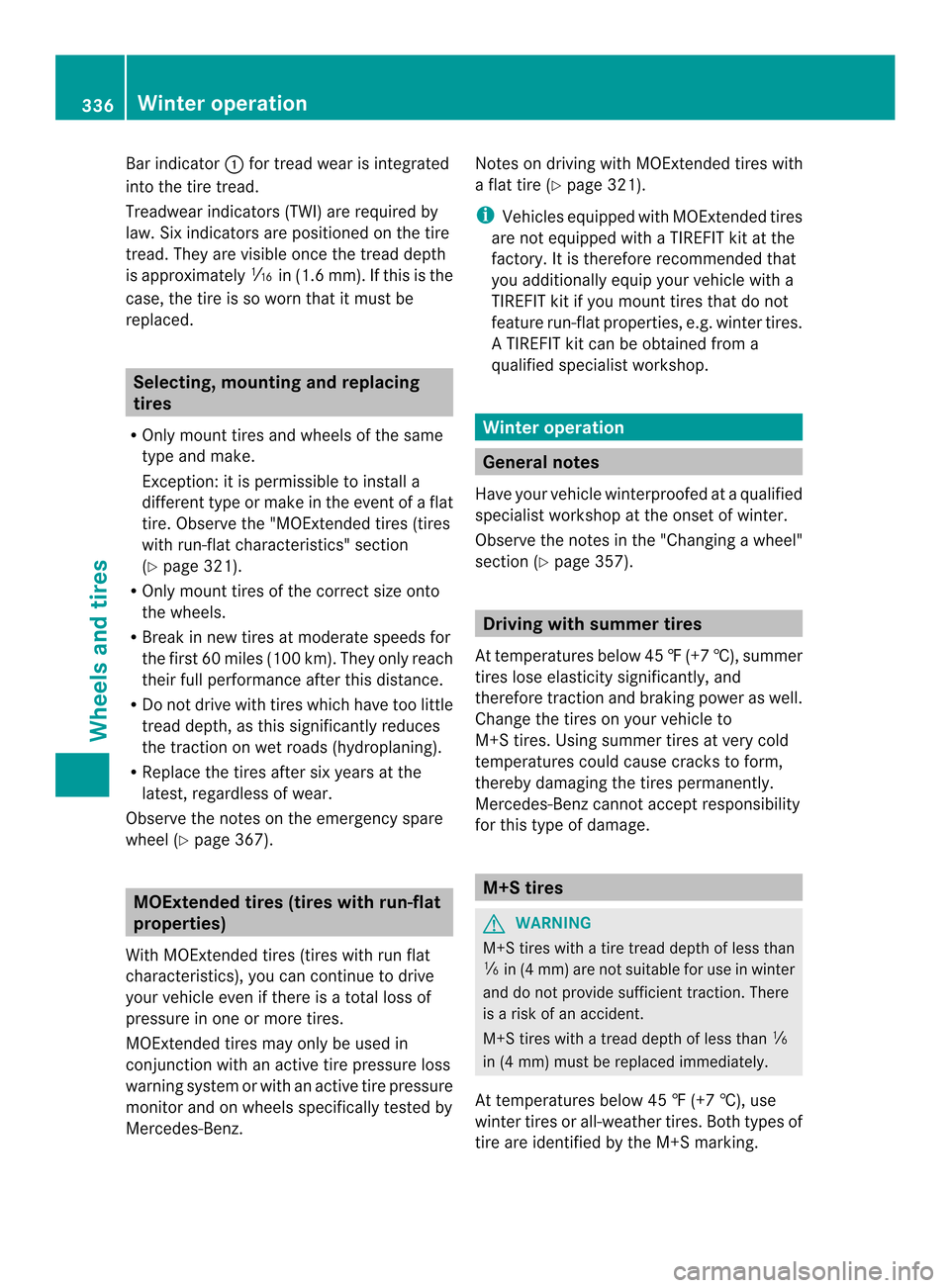
Bar indicator
001Afor trea dwearisi ntegrated
into the tire tread.
Treadwear indicator s(TWI) are required by
law. Six indicator sare positioned on the tire
tread. The yare visible once the trea ddepth
is approximately 0014in (1.6 mm). If this is the
case ,the tire is so worn that it mus tbe
replaced. Selecting, mounting and replacing
tires
R Only mount tires and wheels of the same
type and make.
Exception: it is permissible to install a
different type or make in the event of aflat
tire. Observe the "MOExtended tires (tires
with run-flat characteristics" section
(Y page3 21).
R Only mount tires of the correct size onto
the wheels.
R Break in new tires at moderate speeds for
the first 60 mile s(100 km) .They only reach
their full performance after this distance.
R Do not drive with tires which have too little
tread depth, as this significantly reduces
the traction on wet roads (hydroplaning).
R Replace the tires after six years at the
latest, regardless of wear.
Observe the notes on the emergency spare
wheel (Y page 367). MOExtended tires (tires with run-flat
properties)
With MOExtended tires (tires with run flat
characteristics), you can continue to drive
your vehicle even if there is atotal loss of
pressure in one or more tires.
MOExtended tires may only be used in
conjunction with an active tire pressure loss
warning system or with an active tire pressure
monitor and on wheels specifically tested by
Mercedes-Benz. Notes on driving with MOExtended tires with
af
lat tire (Y page 321).
i Vehicles equipped with MOExtended tires
are not equipped with aTIREFIT kit at the
factory. It is therefore recommended that
you additionall yequip your vehicle with a
TIREFIT kit if you mount tires that do not
feature run-flat properties, e.g. winter tires.
AT IREFIT kit can be obtained from a
qualified specialist workshop. Winter operation
General notes
Have your vehicle winterproofed at aqualified
specialist workshop at the onset of winter.
Observe the notes in the "Changing awheel"
section (Y page 357). Driving with summer tires
At temperatures below 45 ‡(+7 †), summer
tires lose elasticity significantly ,and
therefore traction and braking power as well.
Change the tires on you rvehicle to
M+S tires. Using summer tires at very cold
temperatures could cause crack stoform,
thereby damaging the tires permanently.
Mercedes-Benz cannot accept responsibility
for this type of damage. M+S tires
G
WARNING
M+S tires with atiret read dept hofless than
001F in (4 mm )are no tsuitable for use in winter
and do no tprovide sufficient traction .There
is ar iskofana ccident.
M+S tires wit hatread dept hofless than 001F
in (4 mm )must be replace dimmediately.
At temperatures below 45 ‡(+7 †), use
winter tires or all-weather tires. Both type sof
tir ea re identified by th eM+S marking. 336
Winte
roperationWheels and tires
Page 339 of 382
Only winter tires bearing the
0012snowflake
symbol in addition to the M+S marking
provide the best possibleg rip in wintry road
conditions.
Only these tires will allowd riving safety
systems such as ABS and ESP ®
to function
optimally in winter. These tires have been
developeds pecificallyfor driving in snow.
Use M+S tires of the same make and tread on
all wheels to maintain safe handling
characteristics.
Alwayso bserve the maximum permissible
speed specified for the M+S tires you have
mounted.
Once the winter tires are mounted:
X Check the tire pressures (Y page 341).
X Vehiclesf or Canada: restart the tire
pressure loss warning system
(Y page 342).
X Restart the tire pressure monitor
(Y page 342).
For more information on driving with the
emergency spare wheel, see (Y page 367).Snow chains
G
WARNING
If snow chains are installed to the front
wheels, they may drag against the vehicle
body or chassis components. This could
cause damage to the vehicle or the tires.
There is arisk of an accident.
To avoid hazardous situations:
R never install snow chains to the front
wheels
R always install snow chains in pairs to the
rear wheels.
! On vehicles with AIRMATIC, you must
drive at raised vehicle level if snow chains
have been mounted. The vehicle may
otherwise be damaged.
! On some tire sizes there is not enough
space for snow chains. To avoid damage to the vehicle or tires, observe the "Wheel and
tire combinations" section under "Tires and
wheels".
For safety reasons, Mercedes-Benz
recommends that you only use snow chains
that have been speciallya pproved for your
vehicle by Mercedes-Benz,ora re of a
corresponding standard of quality.
If you intend to mount snow chains, please
bear the following points in mind:
R Snow chains may not be mounted on all
wheel/tire combinations. Permissible
wheel-tire combinations (Y page 362).
R Only use snow chains when driving on
roads completely covered by snow.
Remove the snow chains as soon as
possiblew hen you come to aroad that is
not snow-covered.
R Local regulations may restrict the use of
snow chains. Observe the appropriate
regulations if you wish to mount snow
chains.
R Do not exceed the maximum permissible
speed of 30 mph (50 km/h).
i You may wish to deactivate ESP ®
when
pulling away with snow chains installed
(Y page 69). This way you can allow the
wheels to spin in acontrolled manner,
achieving an increased driving force
(cutting action).
For more information on driving with the
emergenc yspare wheel, see (Y page 367). Winter operation
337Wheels and tires Z
Page 340 of 382
Check
Tir
ep ressure specifications
Important safety notes G
WARNING
Tire switht irep ressure sthata re to olow or
to oh igh are associated wit hthe following
hazards:
R they can burst, in particular if th evehicle is
heavily laden or when driven at high
speeds.
R thet ires can wear excessively and/or
unevenly, whic hcan severely impai rtire
traction.
R the driving, steerin gand braking
characteristics may be severely impaired.
There is arisk of accident.
Follow recommended tir einflation pressures
and chec kthe pressure of all the tires
including the spare wheel:
R monthly, at least
R if the load changes
R before beginning along journey
R under different operating conditions,e .g.
off-road driving
If necessary, correct the tire pressure.
i The specifications on the sample Tire and
Loading Information placard and tire
pressure tables are examples. Tire
pressure specifications are vehicle-specific
and may deviate from the data shown here.
The tire pressure specifications that are
valid for your vehicle can be found on the
Tire and Loading Information placard and
tire pressure table on the vehicle.
General notes The recommended tire pressures for the tires
mounted at the factory can be found on the
labelsd escribed here.
Operation with the emergency spare
wheel (Ypage 367). Further information on tire pressures can be
obtained at aqualified specialist workshop.
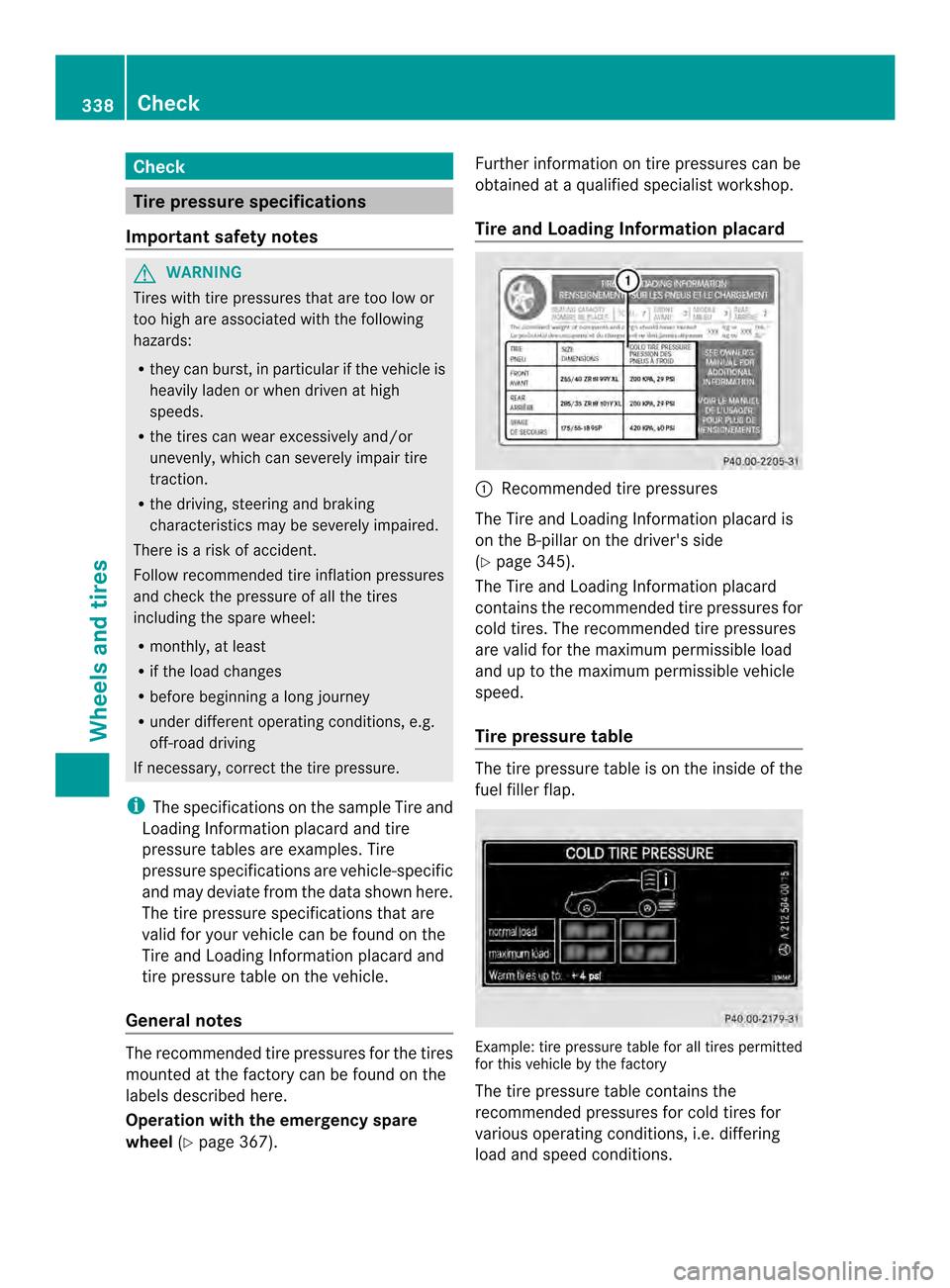
Tire and Loading Information placard 001A
Recommended tire pressures
The Tire and Loading Information placard is
on the B-pillar on the driver's side
(Y page 345).
The Tire and Loading Information placard
contains the recommended tire pressures for
cold tires. The recommended tire pressures
are valid for the maximum permissible load
and up to the maximum permissible vehicle
speed.
Tire pressuret able The tire pressure table is on the inside of the
fuel filler flap.
Example: tire pressure table for all tires permitted
for this vehicle by the factory
The tire pressure table contains the
recommended pressures for cold tires for
various operating conditions, i.e. differing
load and speed conditions.338
CheckWheels and tires
Page 342 of 382
The tires are cold:
R
if the vehicle has been parked without
direct sunlight on the tires for at least three
hours and
R if the vehicle has been driven for less than
1m ile (1.6 km).
The tire temperature changes depending on
the outside temperature, the vehicle speed
and the tire load. If the tire temperature
changes by 18 ‡(10 †), the tire pressure
changes by approximately 10 kPa (0.1 bar/
1.5 psi). Take this into account when
checking the pressure of warm tires. Only
correc tthe tire pressure if it is too low for the
current operating conditions. If you check the
tire pressure when the tires are warm, the
resulting value will be higher than if the tires
were cold. This is normal. Do not reduce the
tire pressure to the value specified for cold
tires. The tire pressure would otherwise be
too low.
Observe the recommended tire pressures for
cold tires:
R on the Tire and Loading Information placard
on the B-pillar on the driver's side
R in the tire pressure table on the inside of
the fuel filler flap
R on the yellow label on the emergency spare
wheel (depending on the vehicle
equipment) Underinflated or overinflated tires
Underinflation G
WARNING
Tires with pressure that is too low can
overheat and burst as aconsequence. In
addition, they also suffer from excessive and/
or irregular wear, which can severely impair
the braking properties and the driving
characteristics. There is arisk of an accident.
Avoid tire pressures that are too low in all the
tires, including the spare wheel. Underinflated tires may:
R
overheat, leading to tire defects
R have an adverse effect on handling
characteristics
R wear quickly and unevenly
R have an adverse effect on fuel consumption
Overinflation G
WARNING
Tires with excessively high pressure can burst
because they are damaged more easily by
road debris, potholes etc. In addition, they
also suffer from irregular wear, which can
severely impair the braking properties and the
driving characteristics. There is arisk of an
accident.
Avoid tire pressures that are too high in all the
tires, including the spare wheel.
Overinflated tires may:
R increase the braking distance
R have an adverse effect on handling
characteristics
R wear quickly and unevenly
R have an adverse effect on ride comfort
R be more susceptible to damage
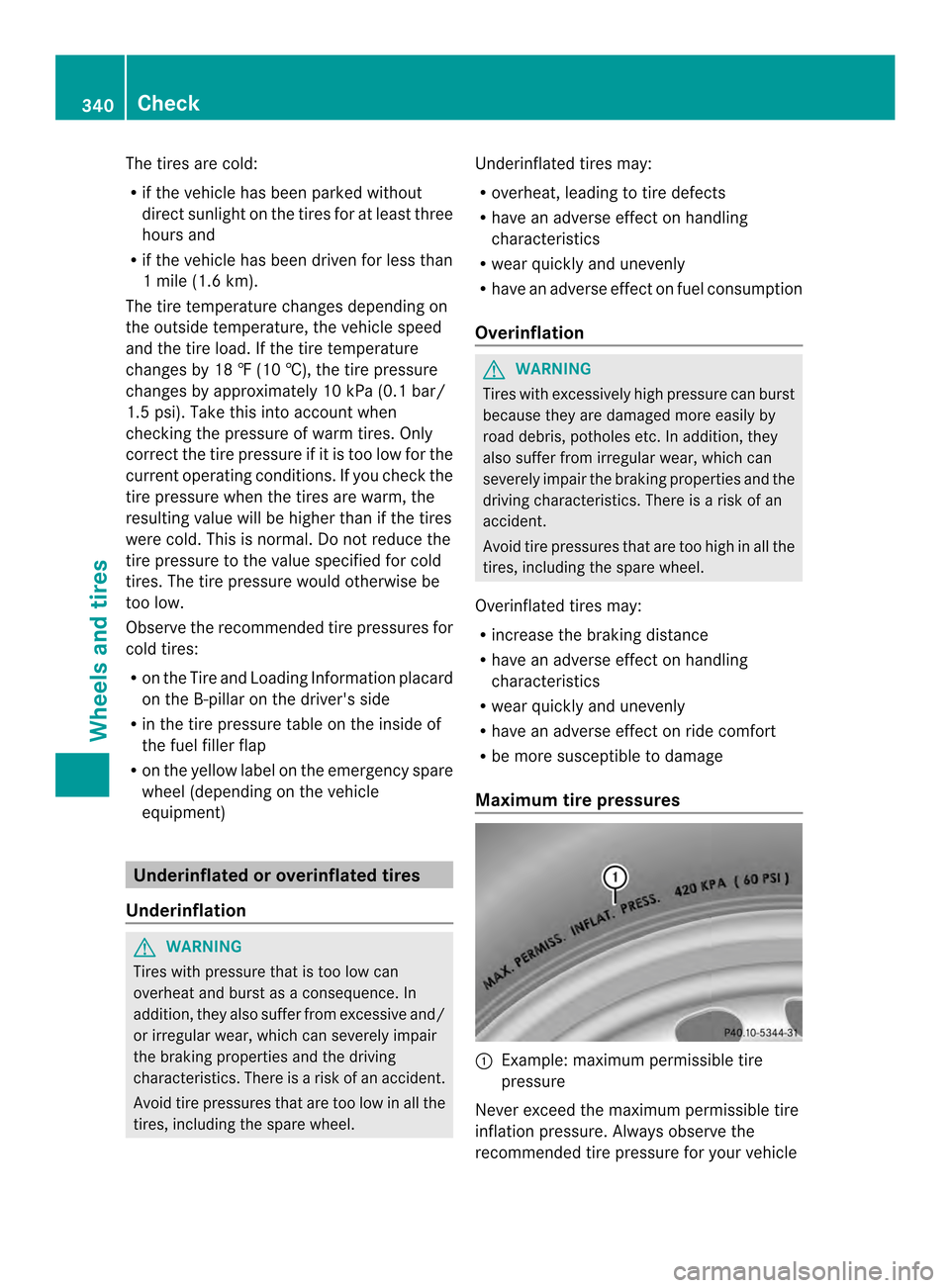
Maximum tire pressures 001A
Example: maximum permissible tire
pressure
Never exceed the maximum permissible tire
inflation pressure. Always observe the
recommended tire pressure for your vehicle 340
CheckWheels and tires
Page 345 of 382
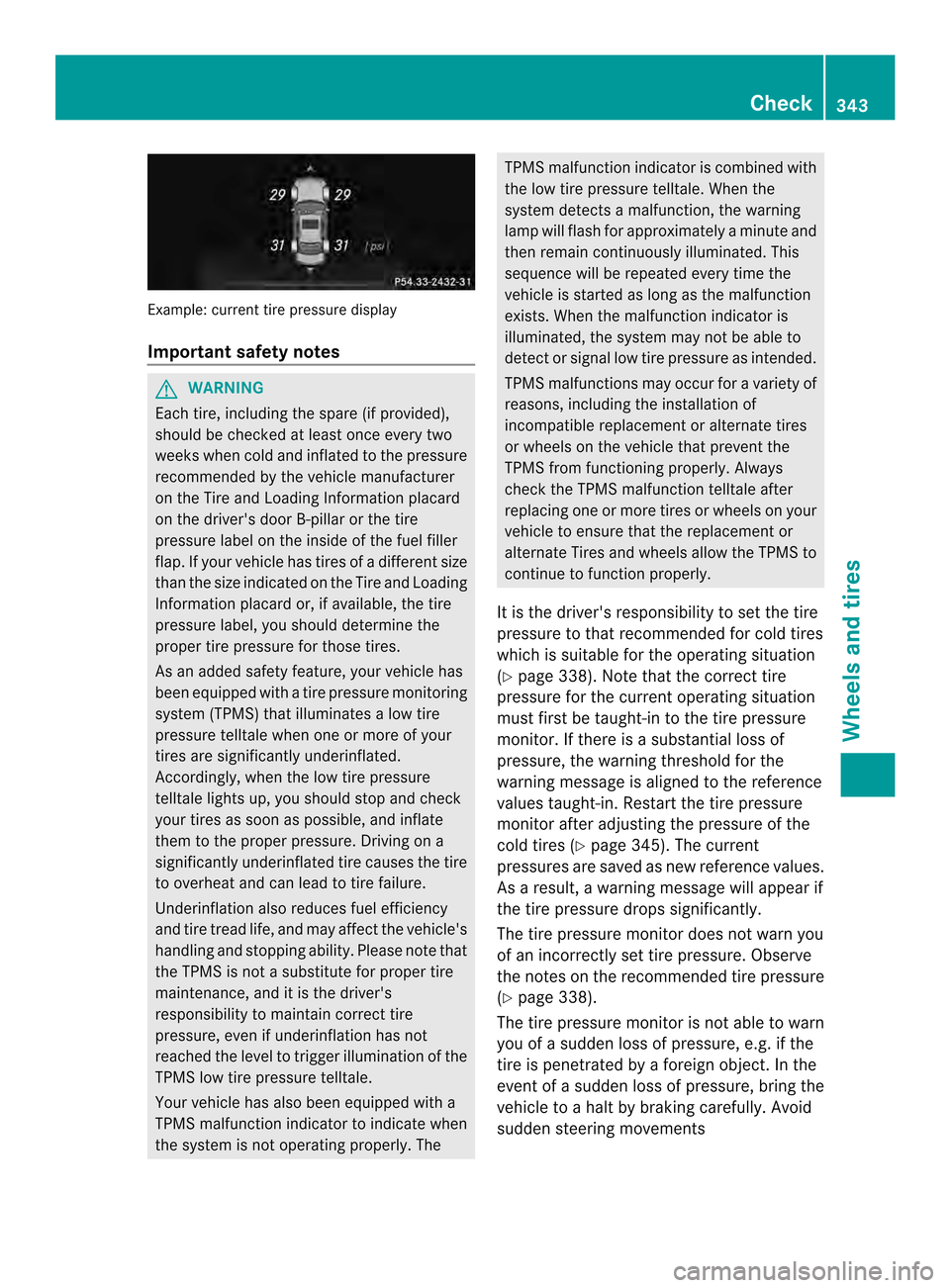
Example: current tire pressure display
Important safety notes
G
WARNING
Each tire ,including the spare (i fprovided),
should be checked at least once every two
weeks when cold and inflated to the pressure
recommended by the vehicl emanufacturer
on the Tire and Loading Information placard
on the driver' sdoor B-pillar or the tire
pressure label on the inside of the fuel filler
flap .Ify our vehicle has tires of adifferent size
than the size indicated on the Tire and Loading
Information placard or, if available, the tire
pressure label, you should determin ethe
proper tire pressure for those tires.
As an added safety feature, your vehicle has
been equipped with atire pressure monitoring
system (TPMS) that illuminates alow tire
pressure telltale when one or more of your
tires are significantly underinflated.
Accordingly, when the low tire pressure
telltale lights up, you should stop and check
your tires as soon as possible, and inflate
them to the proper pressure. Drivin gona
significantly underinflated tire causes the tire
to overheat and can lead to tire failure.
Underinflation also reduces fuel efficiency
and tire tread life, and may affect the vehicle's
handling and stopping ability. Please note that
the TPMS is not asubstitute for proper tire
maintenance, and it is the driver's
responsibility to maintain correc ttire
pressure, even if underinflation has not
reached the level to trigger illumination of the
TPMS low tire pressure telltale.
Your vehicle has also been equipped with a
TPMS malfunction indicator to indicate when
the system is not operating properly. The TPMS malfunction indicator is combined with
the low tire pressure telltale. When the
system detect
samalfunction, the warning
lamp will flash for approximately aminute and
then remain continuously illuminated. This
sequence will be repeated every time the
vehicle is started as long as the malfunction
exists. When the malfunction indicator is
illuminated, the system may not be able to
detect or signal low tire pressure as intended.
TPMS malfunctions may occur for avariety of
reasons, including the installation of
incompatible replacement or alternate tires
or wheels on the vehicle that prevent the
TPMS from functioning properly. Always
check the TPMS malfunction telltale after
replacing one or more tires or wheels on your
vehicle to ensure that the replacement or
alternate Tires and wheels allow the TPMS to
continue to function properly.
It is the driver's responsibility to set the tire
pressure to that recommended for cold tires
which is suitable for the operating situation
(Y page 338). Note that the correc ttire
pressure for the current operating situation
must first be taught-in to the tire pressure
monitor. If there is asubstantial loss of
pressure, the warning threshold for the
warning message is aligned to the reference
values taught-in .Restart the tire pressure
monitor after adjustin gthe pressure of the
cold tires (Y page 345). The current
pressures are saved as new reference values.
As aresult, awarning message will appear if
the tire pressure drops significantly.
The tire pressure monitor does not warn you
of an incorrectly set tire pressure. Observe
the notes on the recommended tire pressure
(Y page 338).
The tire pressure monitor is not able to warn
you of asudden loss of pressure, e.g. if the
tire is penetrated by aforeign object. In the
event of asudden loss of pressure, bring the
vehicle to ahalt by brakin gcarefully. Avoid
sudden steering movements Check
343Wheels and tires Z