wheel MERCEDES-BENZ CLS-Class 2014 W218 User Guide
[x] Cancel search | Manufacturer: MERCEDES-BENZ, Model Year: 2014, Model line: CLS-Class, Model: MERCEDES-BENZ CLS-Class 2014 W218Pages: 382, PDF Size: 5.36 MB
Page 22 of 382
Tightenin
gtorque ........................... 361
Wheel size/tire size .......................362
Windo wcurtain air bag
Operation ........................................ .47
Windows
see Side windows
Windshield
Defrosting ...................................... 139
Windshiel dwasher fluid
see Windshield washer system
Windshield washer system
Adding washer fluid .......................309
Notes ............................................. 378
Windshiel dwipers
Problem (malfunction) ...................128
Replacing the wiper blades ............126
Switching on/off ........................... 125
Winte rdriving
Important safety note s.................. 336
Slippery road surfaces ...................174
Snow chains .................................. 337
Winte rtires
M+S tires ....................................... 336
Wiper blades
Cleaning ......................................... 314
Important safety notes ..................126
Replacing ....................................... 126
Wooden trim (cleaning
instructions) ...................................... 316Z
ZONE function Switching on/off ........................... 13920
Index
Page 24 of 382
Genuine Mercedes-Benz parts
H
Environmental note
Daimle rAGalso supplie sreconditioned major
assemblies and part swhicha re of th esame
qualit yasn ew parts. They are covered by the
same Limite dWarrant yentitlements as new
parts.
! Air bags and Emergenc yTensioning
Devices, as well as control unit sand
sensor sfor these restraint systems ,may be
installe dinthefollowin gareas of your
vehicle:
R doors
R door pillars
R door sills
R seats
R cockpit
R instrumen tcluster
R cente rconsole
Do no tinstall accessorie ssuchasa udio
system sintheseareas. Do not carry out
repairs or welding .You could impair the
operating efficienc yofthe restraint
systems.
Have aftermarket accessories installed at
aq ualified specialist workshop.
You could jeopardize the operating safety of
your vehicle if you use parts, tires and wheels
as well as accessories relevant to safety
which have not been approved by Mercedes.
This could lead to malfunctions in safety-
relevant systems, e.g. the brake system. Use
only genuine Mercedes-Benz parts or parts of
equal quality. Only use tires, wheels and
accessories that have been specifically
approved for your vehicle.
Genuine Mercedes-Benz parts are subject to
strictq ualitycontrol. Every part ha sbeen
specifically developed ,manufactured or
selected for and adapted to Mercedes-Benz
vehicles. Only genuine Mercedes-Benz parts
should therefore be used. More than 300,000 different genuine
Mercedes-Benz parts are available for
Mercedes-Benz models.
All authorized Mercedes-Benz Centers
maintai
nasupply of genuine Mercedes-Benz
parts for necessary service and repair work.
In addition, strategically located parts
delivery centers provide quick and reliable
parts service.
Alwayss pecify the vehicle identification
number (VIN) (Y page 372) and the engine
number (Y page 373) when ordering genuine
Mercedes-Benz parts. Operator's Manual
Vehicle equipment
This Operator's Manual describes all models
and all standard and optional equipment of
your vehicle available at the time of going to
print. Country-specific differences are
possible.B ear in mind that your vehicle may
not feature all function sdescribed here. This
also applies to safety-relevant systems and
functions. The equipment in your vehicle may
therefore differ from that shown in the
descriptions and illustrations.
The original purchase agreement lists all
systems installed in your vehicle.
Should you have any questions concerning
equipment and operation ,please consult an
authorized Mercedes-BenzC enter.
The Operator's Manual and Maintenance
Booklet are important documents and should
be kept in the vehicle. 22
Introduction
Page 27 of 382
Never tamper with the wiring as well as
electronic components or their software. You
shouldh ave all work to electrical and
electronic equipment carried out at aqualified
specialist workshop.
! There is arisk of damage to the vehicle if:
R the vehicle becomes stuck, e.g. on ahigh
curb or an unpaved road
R you drive too fast over an obstacle, e.g.
ac urb or ahole in the road
R ah eavy object strikes the undercarriage
or parts of the chassis.
In situations like this, the body,t he
undercarriage, chassis parts, wheelsor
tires could be damaged withoutt he
damage being visible. Components
damaged in this way can unexpectedly fail
or, in the case of an accident, no longer
withstand the strain they are designed to.
If the underbody paneling is damaged,
combustible materials such as leaves,
grass or twigs can gather between the
underbody and the underbody paneling. If
these materials come in contact with hot
parts of the exhaust system for an
extended period, they can catch fire.
Have the vehicle checked and repaired
immediately at aqualified specialist
workshop. If on continuing your journey
you noticet hat driving safety is impaired,
pull over and stop the vehicle immediately,
paying attention to road and traffic
conditions. In such cases, visit aqualified
specialist workshop. Declarations of conformity
Vehicle components which receive
and/or transmit radio waves USA:
"The wireless devices of this vehicle
comply with Part 15 of the FCC Rules.
Operation is subject to the two following two
conditions: 1) These devices may not cause
harmful interference, and 2) These devices must accept any interference received,
including interference that may cause
undesired operation. Changes or
modifications not expressly approved by the
party responsible for compliance could void
the user’s authority to operate the
equipment."
Canada: "The wireless devices of this vehicle
comply with Industry Canada license-exempt
RSS standard(s). Operation is subject to the
following two conditions: (1) These devices
may not cause interference, and (2) These
devices must accept any interference,
including interference that may cause
undesired operation of the device." Diagnostics connection
The diagnostics connection is only intended
for the connection of diagnostic equipment at
aq ualified specialist workshop. G
WARNING
If you connect equipment to the diagnostics
connection in the vehicle, it may affect the
operation of the vehicle systems. As aresult,
the operating safety of the vehicle could be
affected. There is arisk of an accident.
Do not connect any equipment to a
diagnostics connection in the vehicle. G
WARNING
Objectsint he driver's footwell can restrict the
pedal travel or obstruct adepressed pedal.
The operatin gand road safety of the vehicle
is jeopardized. There is arisk of an accident.
Make sure that all objects in the vehicle are
stowed correctly, and that they cannot enter
the driver's footwell. Install the floormats
securely and as specified in order to ensure
sufficien tclearanc efor the pedals. Do not use
loose floormats.
! If the engin eisswitched off and
equipmen tonthe diagnostics connection
is used, the starter battery may discharge. Introduction
25 Z
Page 31 of 382
Dashboard
........................................... 30
Instrument cluster ..............................31
Multifunction steering wheel .............33
Center console .................................... 34
Overhea dcontrol panel ...................... 37
Door control panel .............................. 38 29At
ag lance
Page 32 of 382
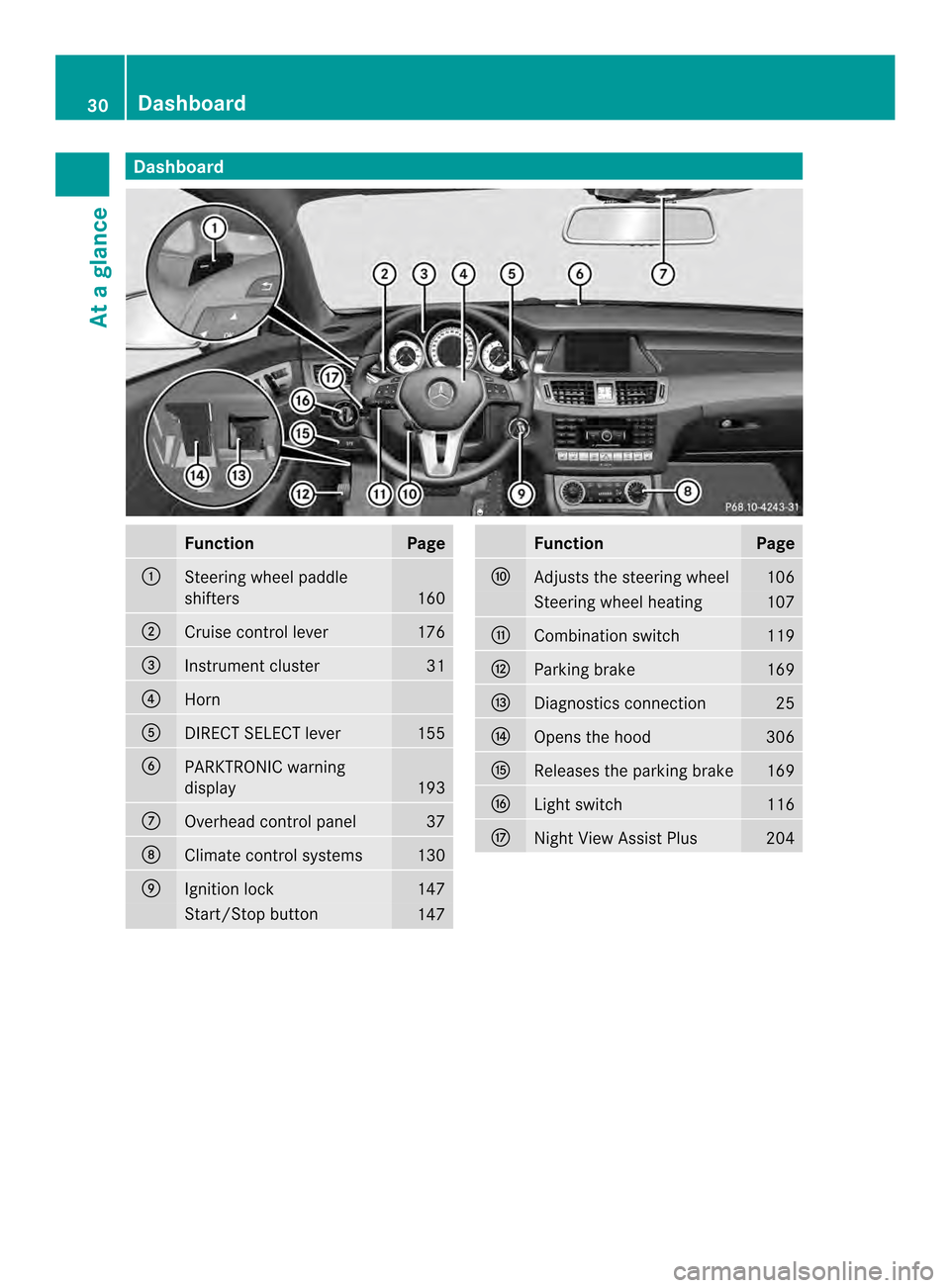
Dashboard
Function Page
001A
Steerin
gwhee lpaddle
shifters 160
0010
Cruis
econtrol lever 176
0024
Instrumen
tcluster 31
0021
Horn
001E
DIREC
TSELEC Tlever 155
0025
PARKTRONIC warning
display
193
0009
Overhead contro
lpanel 37
0016
Climat
econtrol systems 130
001D
Ignition lock 147
Start/Sto
pbutton 147 Function Page
000F
Adjust
sthe steerin gwheel 106
Steerin
gwhee lheating 107
0004
Combination switch 119
000B
Parking brake 169
001C
Diagnostic
sconnection 25
000E
Opens th
ehood 306
0012
Releases th
eparking brake 169
0013
Light switch 116
0017
Night Vie
wAssistP lus 20430
DashboardAt
ag lance
Page 35 of 382
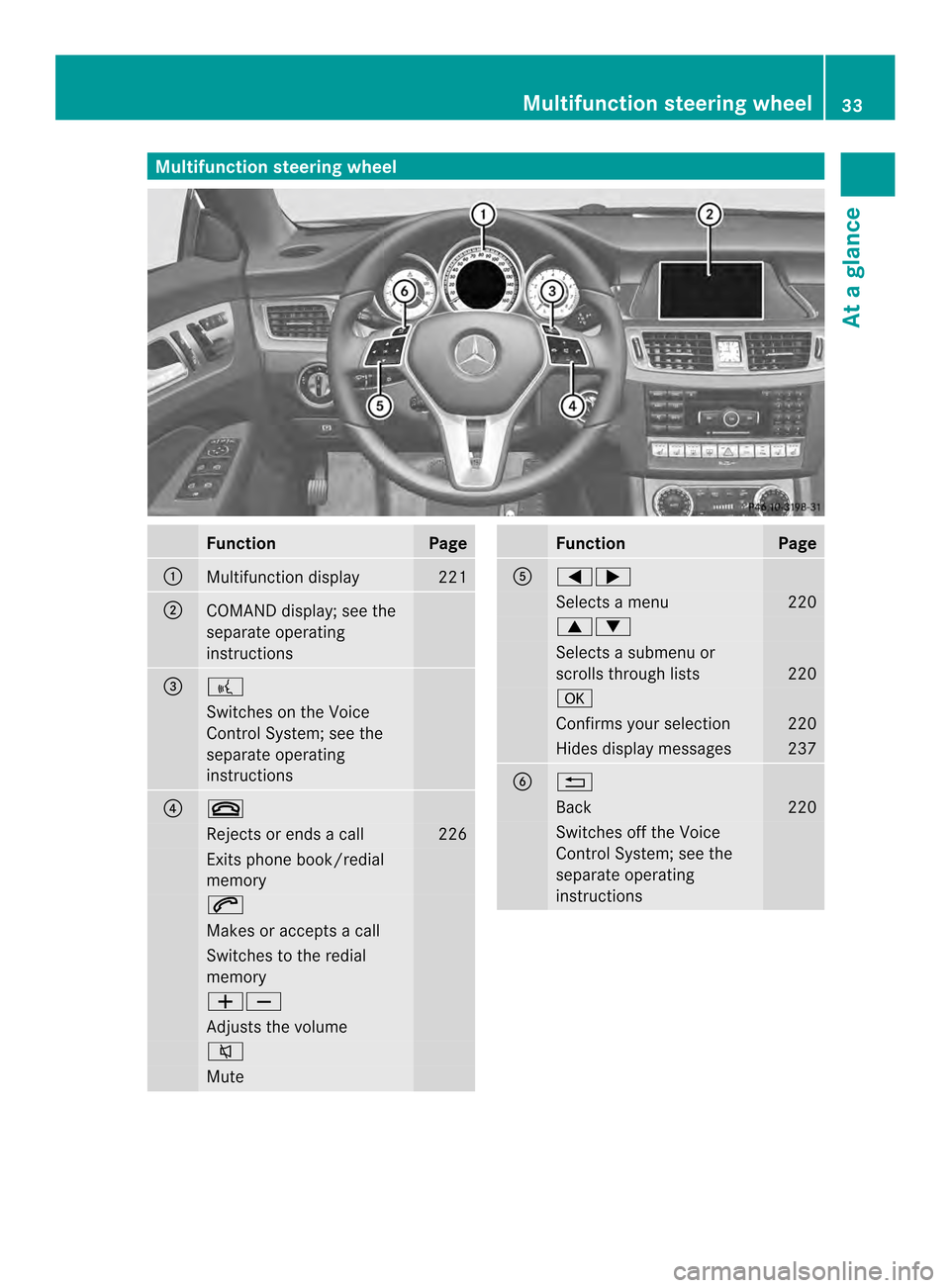
Multifunction steering wheel
Function Page
001A
Multifunction display 221
0010
COMAND display;s
ee the
separate operating
instructions 0024
0007
Switches on the Voice
Control System; see the
separate operating
instructions
0021
0008
Rejects or ends
acall 226
Exits phone book/redial
memory
0006
Makes or accepts
acall Switches to the redial
memory
00080009
Adjusts the volume
0001
Mute Function Page
001E
000A0004
Selects
amenu 220
00060005
Selects
asubmenu or
scroll sthrough lists 220
000C
Confirm
syours election 220
Hides display messages 237
0025
0002
Back 220
Switches off the Voice
Control System
;see the
separate operating
instructions Multifunction steering wheel
33Atag lance
Page 40 of 382
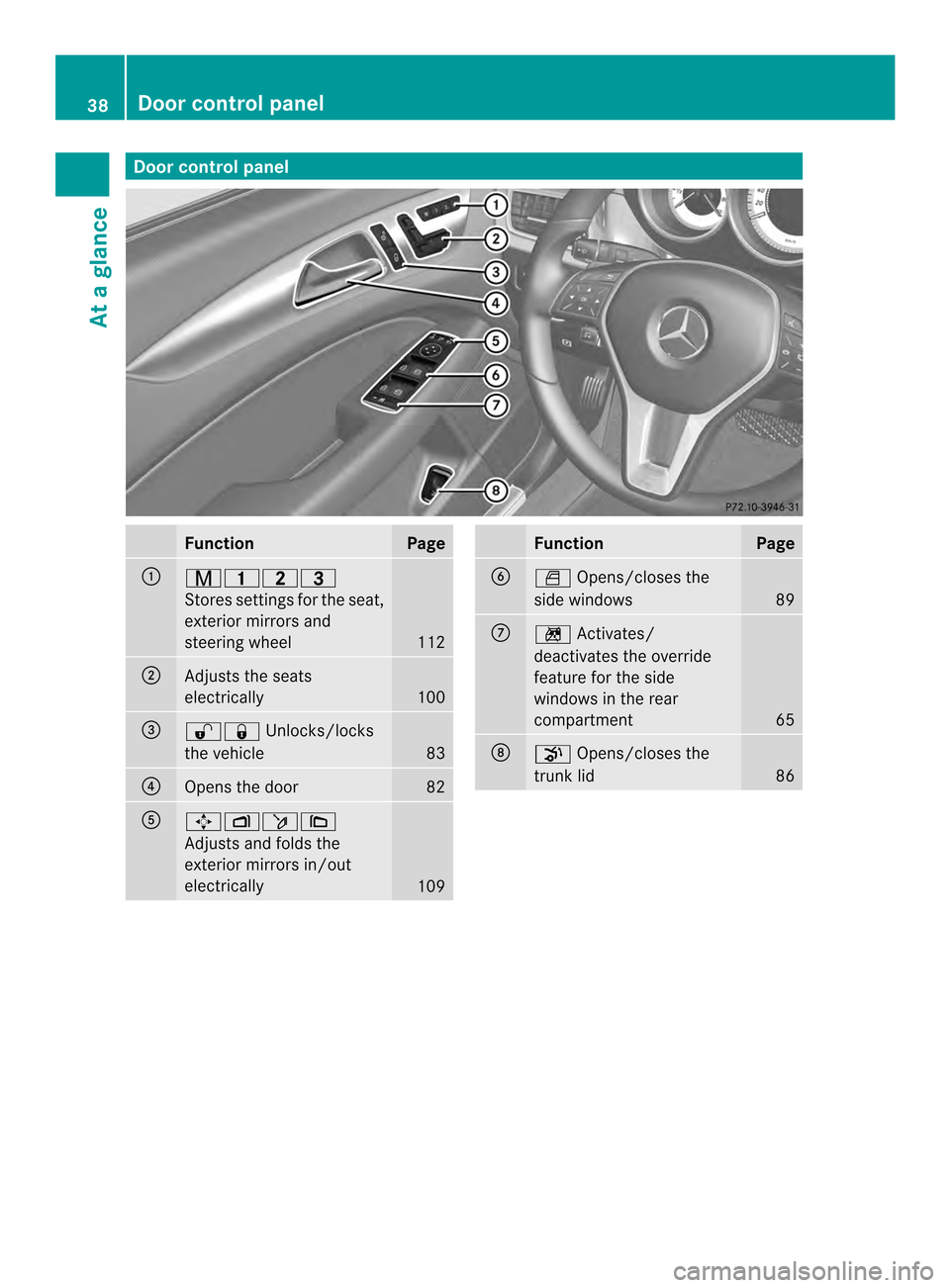
Door contro
lpanel Function Page
001A
0005000B000A
Stores setting
sfor the seat,
exterior mirror sand
steering wheel 112
0010
Adjusts the seats
electrically
100
0024
0014000F
Unlocks/locks
the vehicle 83
0021
Opens the door 82
001E
0005000200060003
Adjusts and folds the
exterior mirrors in/out
electrically
109 Function Page
0025
000A
Opens/closes the
side windows 89
0009
0010
Activates/
deactivates the override
feature for the side
windows in the rear
compartment 65
0016
0009
Opens/closes the
trunk lid 8638
Doorc
ontrol panelAtag lance
Page 44 of 382
R
No modifications of any kind may be made
to any components or wiring of the SRS.
R Do not change or remove any component
or part of the SRS.
R Do not install additional trim material ,seat
covers, badges, etc. to the:
- padded steering wheel boss
- knee bag covers
- front-passenger air bag cover
- outer side of front seat bolsters
- side trim next to the rear seat backrest
- roof lining trim
R Do not install additional electrical/
electronic equipment on or near SRS
components and wiring.
R Keep area between air bags and occupants
free of objects (e.g. packages, purses,
umbrellas, etc.).
R Do not hang items such as coat hangers
from the coat hooks or handles over the
door. These items may be thrown around in
the vehicle and cause head and other
injuries when the window curtain air bag is
deployed.
R Air bag system components willbeh ot after
an air bag has inflated. Do not touch them.
R Never place yourf eet on the instrument
panel, dashboard, or on the seat. Always
keep both feet on the floor in front of the
seat.
R Improper repairw ork on the SRS creates a
risk of rendering the SRS inoperative or
causing unintended air bag deployment.
Work on the SRS must therefor eonly be
performed by qualified technicians.
Contact an authorized Mercedes-Benz
Center.
R For your protection and the protection of
others, when scrapping the air bag unit or
ETD, our safety instructions must be
followed. These instructions are available from any authorized Mercedes-Benz
Center.
R Given the considerable deployment speed,
required inflation volume, and the material
of the air bags, there is the possibility of
abrasions or other, potentially more serious
injuries resulting from air bag deployment.
If you sell your vehicle, Mercedes-Benz
strongly recommends that you inform the
subsequent owner that the vehicle is
equipped with SRS. Also, refer them to the
applicabl esection in the Operator's Manual. Air bags
Important safety notes G
WARNING
If you modify the air bag covers or affix objects
such as stickers to them, the air bags may not
function correctly. There is an increased risk
of injury.
Never modify the air bag covers or affix
object stothem. G
WARNING
Using unsuitable seat covers could restric tor
even preven tdeployment of the air bags
integrated into the seats. Consequently, the
air bags cannot protec tvehicle occupant sas
they are designed to do. In addition, the
function of the air bag deactivation system
could be restricted. This poses an increased
risk of injury or even fatal injury.
You should only use seat cover sthat have
been approved for the respective seat by
Mercedes-Benz. G
WARNING
The air bag parts are hot after the airbag has
been deployed. There is arisk of injury.
Do not touch the air bag parts. Have the
deployed air bags replaced at aqualified
specialist workshop as soon as possible. 42
Occupant safetySafety
Page 45 of 382
G
WARNING
Air bagsa re designed to reduce the incidence
of injurie sand fatalities in certain situations:
R frontal impacts (driver's and front-
passenger front air bagsa nd knee bags)
R side impacts (sid eimpact air bags, window
curtai nair bags and pelvis air bags)
R rollover (window curtain air bags)
However, no system available today can
completely eliminate injuries and fatalities.
When the air bags are deployed, asmall
amount of powder is released .The powder
generally does not constitute ahealth hazard
and does not indicate that there is afire in the
vehicle. In order to prevent potential
breathing difficulties, you should leave the
vehicle as soon as it is safe to do so. If you
have any breathing difficulty but cannot get
out of the vehicle after the air bag inflates,
then get fresh air by opening awindow or
door. G
WARNING
In order to reduce the potential danger of
injuries caused during the deployment of the
front air bags, the driver and front passenger
must always be correctly seated and wear
their seat belts.
For maximum protection in the event of a
collision, you must always be in the normal
seat position with your back against the
backrest. Fasten your seat belt and make sure
that it is correctly positioned on your body. As the air bag inflates with considerable
speed and force,
aproper seating position
and correct positioning of the hands on the
steering wheel will help to keep you at asafe
distance from the air bag. Occupants who are
not wearing their seat belt, are not seated
properly or are too close to the air bag can be
seriously injured or killed by an air bag, as it
inflates with great force instantaneously:
R sit with the seat belt fastened correctly and
in ap osition that is as upright as possible
with your back against the backrest.
R move the driver's seat as far back as
possible, still permittingp roper operation
of vehicle controls. The distance from the
center of the driver's chest to the center of
the air bag cover on the steering wheel
must be at least 10 inches (25 cm). You
should be able to accomplish this by
adjusting the seat and steering wheel. If
you have any difficulties, please contact an
authorized Mercedes-Ben zCenter.
R do not lean your head or chest close to the
steerin gwheel or dashboard.
R only hold the steerin gwheel on the outside.
Placing hands and arms inside the rim can
increase the risk and potential severit yof
hand/arm injury if the driver fron tair bag
inflates.
R adjust the front-passenger seat as far back
as possible from the dashboard when the
seat is occupied.
R occupants, especially children ,should
never place their bodies or lean their heads
in the area of the door where the side
impact air bag inflates .This could result in
serious or fatal injuries should the side
impact air bag be deployed. Always sit as
upright as possible, wear the seat belt
properly and use an appropriately sized
infant restraint,t oddler restraint or booster
seat recommended for the size and weight
of the child.
Failure to follow these instructions can result
in severe injuries to you or other occupants. Occupant safety
43Safety
Z
Page 46 of 382
If you sell yourv
ehicle, it is important that you
make the buyer aware of this safety
information .Besure to give the buyer this
Operator's Manual.
If the air bags are deployed, you will hear a
bang, and asmall amount of powder may also
be released. Only in rare cases will the bang
affect your hearing. The powder that is
released generally does not constitute a
health hazard and does not indicat ethat there
is af ire in the vehicle. The dust might cause
some temporary breathin gdifficulty for
people with asthma or other breathing
trouble. To avoid this, you may wish to get out
of the vehicle as soon as it is safe to do so.
You can also open the window to allow fresh
air to enter the vehicle interior. The 0012SRS
warning lamp lights up.
The air bag installation location sare
identified by the AIR BAG symbol.
The air bags are deployed if the air bag control
unit detects the need for deployment. Only in
the event of such asituation will the air bags
provide their supplemental protection.
If the driver and fron tpassenger do no twear
their seat belts, it is not possible for the air
bags to provide their supplemental
protection.
In the event of other types of impacts and
impacts below air bag deployment
thresholds, the air bags will not deploy. The
driver and passenger will then be protected
to the extent possible by aproperly fastened
seat belt. Aproperl yfastened seat beltisa lso
needed to provide the best possible
protection in arollover.
Air bags provide additional protection; they
are not, however, asubstitute for seat belts.
All vehicle occupants must fasten their seat
belts regardless of whether your vehicle is
equipped with air bags or not.
It is important for your safety and that of your
passenger to have deployed air bags replaced
and to have any malfunctioning air bags
repaired. This will help to make sure the air
bags continue to perform their protective function for the vehicle occupants in the
event of
acrash.
i After an air bag has been deployed, have
the vehicle towed to the nearest qualified
specialist workshop, even if your vehicle is
ready to drive.
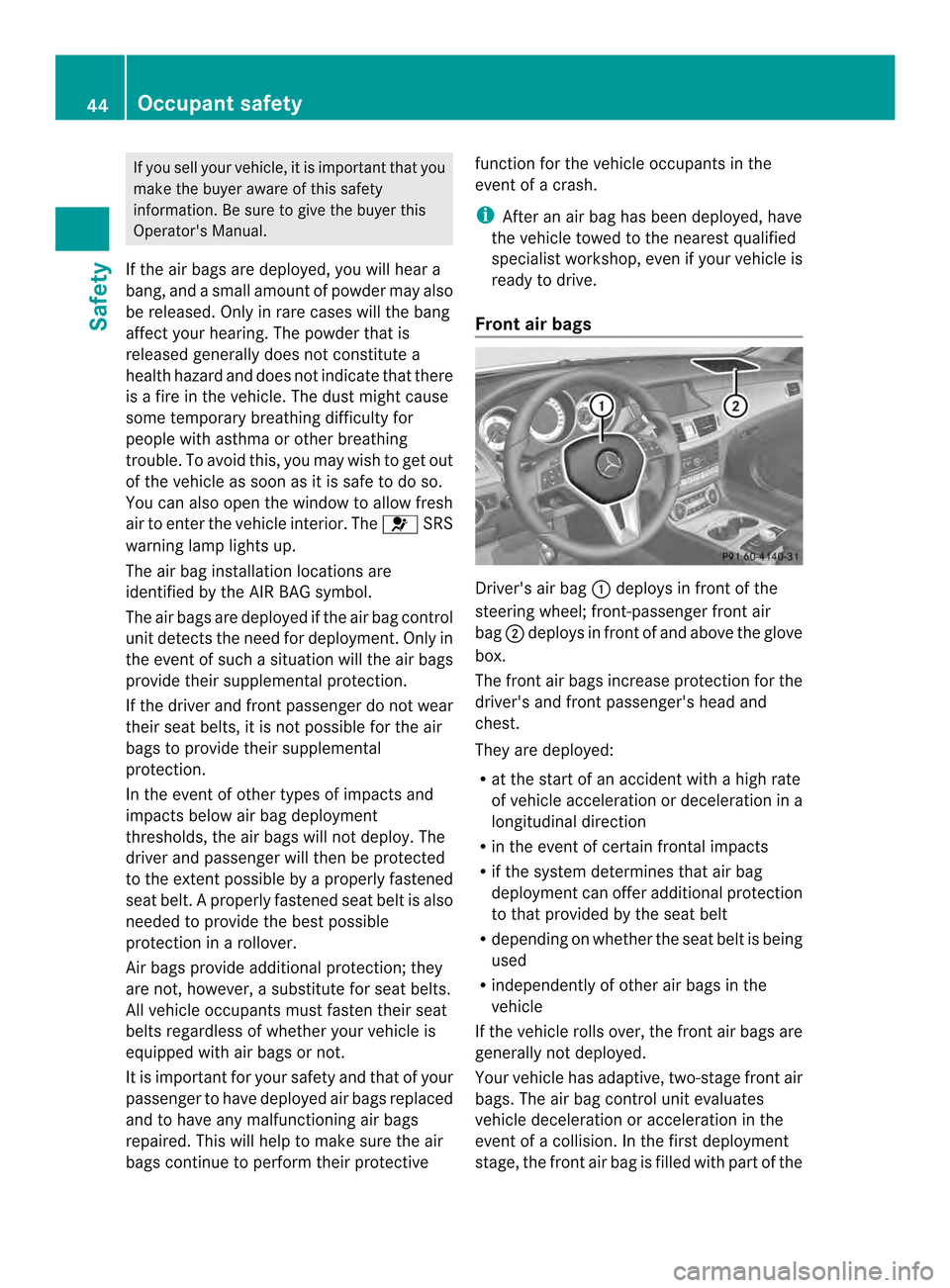
Front air bags Driver's air bag
001Adeploysinf ront of the
steering wheel; front-passenger front air
bag 0010deploysinf ront of and above the glove
box.
The front air bags increase protection for the
driver's and front passenger's head and
chest.
They are deployed:
R at the start of an accident with ahigh rate
of vehicle acceleration or deceleration in a
longitudinal direction
R in the event of certain frontal impacts
R if the system determines that air bag
deployment can offer additional protection
to that provided by the seat belt
R depending on whether the seat belt is being
used
R independently of other air bags in the
vehicle
If the vehicle rolls over, the front air bags are
generally not deployed.
Your vehicle has adaptive, two-stage front air
bags. The air bag control unit evaluates
vehicle deceleration or acceleration in the
event of acollision. In the first deployment
stage, the front air bag is filled with part of the 44
Occupant safetySafety