child lock MERCEDES-BENZ CLS-Class 2014 W218 Owner's Guide
[x] Cancel search | Manufacturer: MERCEDES-BENZ, Model Year: 2014, Model line: CLS-Class, Model: MERCEDES-BENZ CLS-Class 2014 W218Pages: 382, PDF Size: 5.36 MB
Page 290 of 382

X
To open: brieflypress the trim on
cover 001A.
The stowag ecompartment opens.
X To remove the insert: slideinsert 0010
forwards in the direction of the arrow.
X Remov einsert 0010.
X To re-install the insert: place the insert
into the holde rand press it in the opposite
direction of the arrow unti litengages.
X To close: foldd ownc over 001A.
i Youc an remove the ashtra yinsert and
us et he resulting compartment for
stowage.
Rear-compartmen tashtray X
To open: slidecover 0010forwards.
X To remove the insert: pull insert001Aup
and out.
X To instal lthe insert: installinsert 001Afrom
above into the holde rand press down into
the holde runtil it engages. Cigarette lighter
G
WARNING
Yo uc an burn yoursel fifyou touch the hot
heating element or the socket of the cigarette
lighter. In addition, flammable materials can ignite if:
R
the hot cigarett elighter falls
R ac hild holds the hot cigarett elighter to
objects, for example
There is arisk of fire and injury.
Always hold the cigarett elighter by the knob.
Always make sure that the cigarett elighter is
out of reach of children. Never leave children
unsupervised in the vehicle. All vehicles (except AMG)
Your attention must always be focused on the
traffic conditions. Only use the cigarette
lighter when road and traffic conditions
permit.
X
Turn the SmartKey to position 2in the
ignition lock (Y page 147).
X To open: slide cover 001Aforwards until it
engages.
X Press in cigarett elighter 0010.
Cigarette lighter 0010will pop out
automatically when the heating element is
red-hot.
X To close: briefly press cover 001Aat the
front.
The cover moves back. 288
FeaturesStowage and features
Page 325 of 382
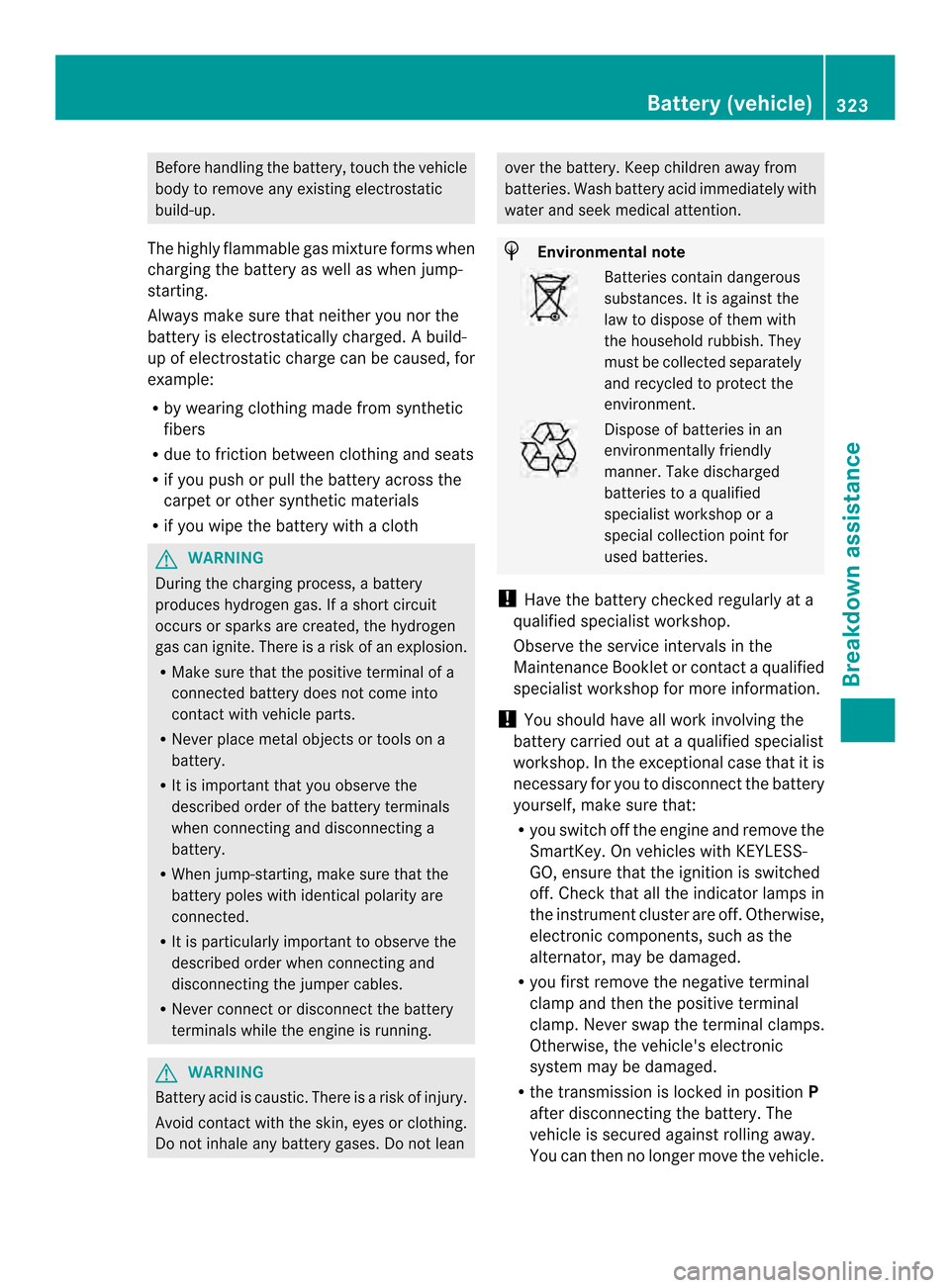
Befor
ehandling the battery ,touch the vehicle
bod ytor emove any existing electrostatic
build-up.
The highly flammable ga smixture forms when
charging the battery as well as whe njump-
starting.
Always mak esure that neither you no rthe
battery is electrostatically charged. Abuild-
up of electrostati ccharge can be caused, for
example:
R by wearing clothing made from synthetic
fibers
R due to friction between clothing and seats
R if you push or pull the battery across the
carpet or other synthetic materials
R if you wipe the battery with acloth G
WARNING
During the charging process, abattery
produces hydrogen gas. If ashort circuit
occurs or sparks are created, the hydrogen
gas can ignite. There is arisk of an explosion.
R Make sure that the positive terminal of a
connected battery does not come into
contact with vehicle parts.
R Never place metal objectsort ools on a
battery.
R It is important that you observe the
described order of the battery terminals
when connecting and disconnecting a
battery.
R When jump-starting, make sure that the
battery poles with identical polarity are
connected.
R It is particularly important to observe the
described order when connecting and
disconnecting the jumper cables.
R Never connect or disconnectt he battery
terminals while the engine is running. G
WARNING
Batterya cid is caustic. There is arisk of injury.
Avoid contact with the skin, eyes or clothing.
Do not inhale any battery gases. Do not lean over the battery. Keep children away from
batteries. Wash battery acid immediately with
water and seek medical attention.
H
Environmental note Batteries contain dangerous
substances. It is against the
law to dispose of them with
the household rubbish. They
must be collected separately
and recycled to protect the
environment. Dispose of batteries in an
environmentally friendly
manner. Take discharged
batteries to aqualified
specialist workshop or a
special collection point for
used batteries.
! Have the battery checked regularly at a
qualified specialist workshop.
Observe the service intervals in the
MaintenanceB ooklet or contact aqualified
specialist workshop for more information.
! You should have all work involving the
battery carried out at aqualified specialist
workshop. In th eexcepti onal cas ethatitis
necessar yfor you to disconnect th ebattery
yourself, mak esure that:
R you switch off th eenginea nd remove the
SmartKey. On vehicles wit hKEYLESS-
GO, ensure that th eignition is switched
off .C heck that all the indicator lamps in
the instrumentc luster are off.Otherwise,
electroni ccomponents, such as the
alternator ,may be damaged.
R you first remove the negative terminal
clamp and then the positive terminal
clamp. Never swap the terminal clamps.
Otherwise, the vehicle's electronic
system may be damaged.
R the transmission is locked in position P
after disconnectingt he battery. The
vehicle is secured against rolling away.
You can then no longer move the vehicle. Battery (vehicle)
323Breakdown assistance Z
Page 326 of 382
The battery and the cover of the positive
terminal clamp must be installed securely
during operation.
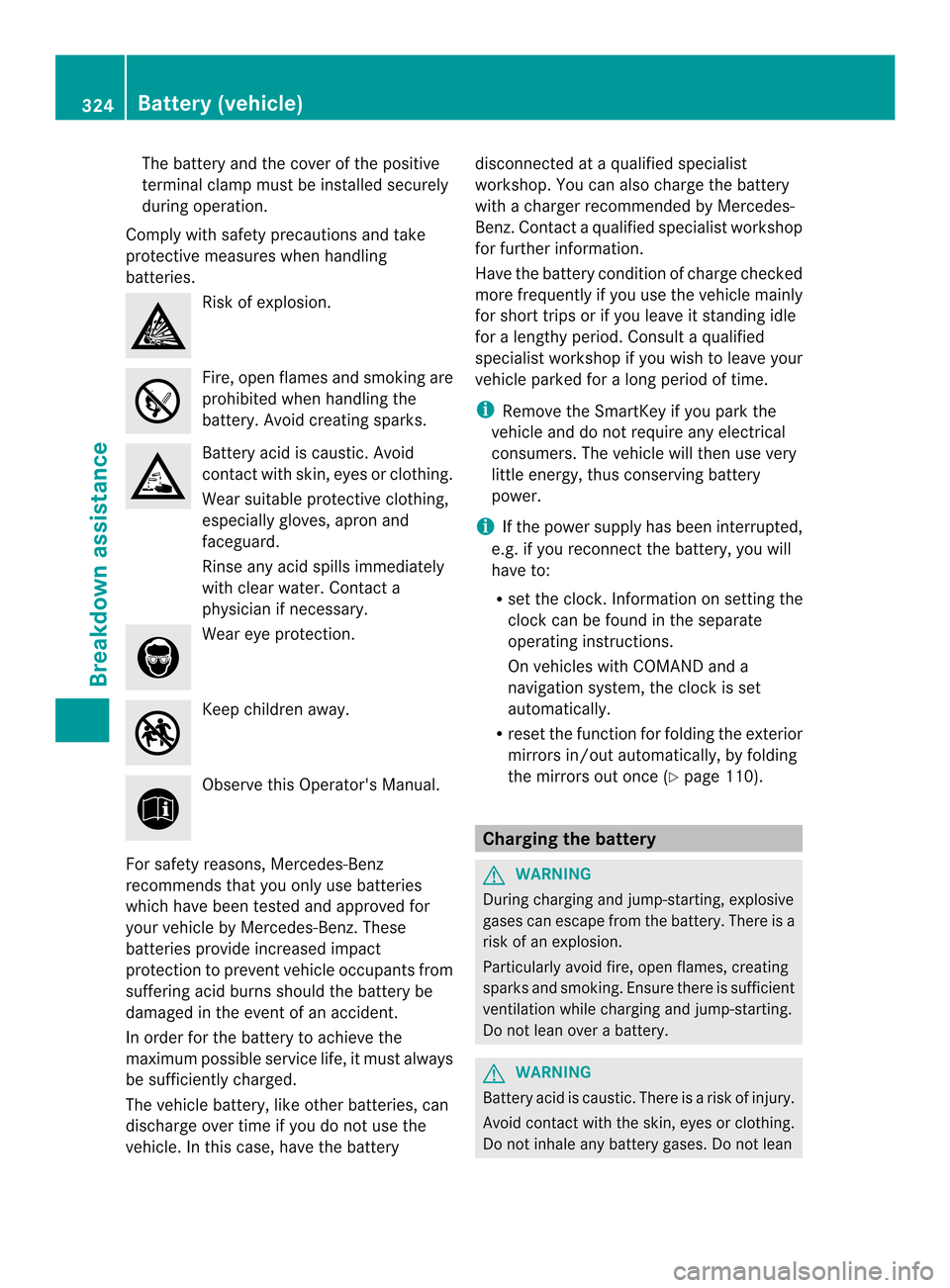
Comply with safety precautions and take
protective measures when handling
batteries. Risk of explosion.
Fire, open flames and smokin
gare
prohibited when handling the
battery. Avoid creatin gsparks. Battery acid is caustic. Avoid
contact with skin, eyes or clothing.
Wear suitable protective clothing,
especially gloves, apron and
faceguard.
Rinse any acid spills immediately
with clear water. Contact a
physician if necessary.
Wear eye protection.
Keep children away.
Observe this Operator's Manual.
For safety reasons, Mercedes-Benz
recommends that you only use batteries
which have been tested and approved for
your vehicle by Mercedes-Benz.T hese
batteries provide increased impact
protection to prevent vehicle occupants from
suffering acid burns should the battery be
damaged in the event of an accident.
In order for the battery to achieve the
maximum possible service life, it must always
be sufficiently charged.
The vehicle battery, like other batteries, can
discharge over time if you do not use the
vehicle. In this case, have the battery disconnected at
aqualified specialist
workshop. You can also charge the battery
with acharger recommended by Mercedes-
Benz.C ontactaqualified specialist workshop
for further information.
Have the battery condition of charge checked
more frequently if you use the vehicle mainly
for short trips or if you leave it standin gidle
for alengthy period. Consult aqualified
specialist workshop if you wish to leave your
vehicle parked for along period of time.
i Remove the SmartKey if you park the
vehicle and do not require any electrical
consumers. The vehicle will then use very
little energy, thus conserving battery
power.
i If the power supply has been interrupted,
e.g. if you reconnect the battery, you will
have to:
R set the clock.I nformation on setting the
clock can be found in the separate
operating instructions.
On vehicles with COMAND and a
navigation system, the clock is set
automatically.
R reset the function for folding the exterior
mirrors in/out automatically, by folding
the mirrors out once (Y page 110). Charging the battery
G
WARNING
During charging and jump-starting, explosive
gases can escape from the battery. There is a
risk of an explosion.
Particularly avoid fire, open flames, creating
sparks and smoking. Ensure there is sufficient
ventilation while charging and jump-starting.
Do not lean over abattery. G
WARNING
Battery acid is caustic. There is arisk of injury.
Avoid contact with the skin, eyes or clothing.
Do not inhale any battery gases. Do not lean 324
Battery (vehicle)Breakdown assistance