engine overheat MERCEDES-BENZ CLS-Class 2014 W218 Owner's Manual
[x] Cancel search | Manufacturer: MERCEDES-BENZ, Model Year: 2014, Model line: CLS-Class, Model: MERCEDES-BENZ CLS-Class 2014 W218Pages: 382, PDF Size: 5.36 MB
Page 149 of 382

G
WARNING
Unsuitable footwea rcan hinder correc tusage
of the pedals, e.g.:
R shoes with thick soles
R shoes with high heels
R slippers
There is arisk of an accident.
Wear suitable footwear to ensure correct
usage of the pedals. G
WARNING
If you switch off the ignition while driving,
safety-relevant functions are only available
with limitations, or not at all. This could affect,
for example, the power steering and the brake
boosting effect. You will require considerably
more effort to steer and brake. There is arisk
of an accident.
Do not switch off the ignition while driving. G
WARNING
If the parking brake has not been fully
released when driving, the parking brake can:
R overheat and cause afire
R lose its hold function.
There is arisk of fire and an accident. Release
the parking brake fully before driving off.
! Warm up the engine quickly. Do not use
the engine's full performance until it has
reached operating temperature.
Only shift the automatic transmission to
the desired drive position when the vehicle
is stationary.
Where possible,a void spinning the drive
wheels when pulling awayons lippery
roads. You could otherwise damage the
drive train.
! AMG vehicles: at low engine oil
temperatures below 68 ‡(+20 †), the
maximu mengine speed is restricte din
order to protect the engine .Toprotectt he
engine and maintain smooth engine operation, avoid driving at full throttle when
the engine is cold. Key positions
SmartKey 0018
To remove the SmartKey
(shift the transmission to position P)
0001 Power supply for some consumers, such
as the windshield wipers
0002 Ignition (power supply for all consumers)
and drive position
0003 To start the engine
i The SmartKey can be turned in the
ignition lock even if it is not the correct
SmartKey for the vehicle. The ignition is not
switched on. The engine cannot be started.
KEYLESS-GO General notes
R
Do not store the KEYLESS-GO key together
with:
-electronic devices, e.g. amobile phone
or another SmartKey
- metallic objects, e.g. coins or metal film
R Do not keep the KEYLESS-GO key in metal
objects, e.g. metal cases.
This can affect the functionality of
KEYLESS-GO.
Vehicles with KEYLESS-GO are equipped with
keys featuring the integrated KEYLESS-GO
function and adetachable Start/Stop button. Driving
147Driving and parking Z
Page 174 of 382
Braking
Important safety notes G
WARNING
If yo ushift down on aslipper yroads urface in
an attempt to increas ethe engine's braking
effect,t he drive wheels could lose their grip.
There is an increased danger of skidding and
accidents.
Do not shift down for additional engine
braking on aslippery road surface.
Downhill gradients !
On long and steep gradients, you must
reduce the load on the brakes by shifting
early to alower gear. This allowsy ou to take
advantage of the engine braking effect and
helps avoid overheating and excessive
wear of the brakes.
When you take advantage of the engine
braking effect,ad rive wheel may not turn
for some time, e.g. on aslippery road
surface. This could cause damage to the
drive train. This type of damage is not
covered by the Mercedes-Ben zwarranty.
Do no tdepress the brake pedal continuously
while the vehicle is in motion ,e.g. causing the
brakes to rub by constantly applying light
pressure to the pedal. This results in
excessive and premature wear to the brake
pads.
On long and steep downhill gradients, you
must select shift range 1,2or 3in good time.
This is especially important if the vehicle is
laden.
Heavy and light loads G
WARNING
If you rest your foot on the brake pedal while
driving, the brakin gsystem can overheat .This
increases the stopping distance and can even
cause the braking system to fail. There is a
risk of an accident. Never use the brake pedal as
afootrest .Never
depress the brake pedal and the accelerator
pedal at the same time.
! Depressing the brake pedal constantly
results in excessive and premature wear to
the brake pads.
If the brakes have been subjected to aheavy
load, do not stop the vehicle immediately, but
drive on for ashort while. This allows the
airflow to cool the brakes more quickly.
Wet roads If you have driven for
along time in heavy rain
without braking ,there may be adelayed
reaction from the brakes when braking for the
first time. This may also occur after the
vehicle has been washed or driven through
deep water.
You have to depress the brake pedal more
firmly. Maintain agreater distanc efrom the
vehicle in front.
After driving on awet road or having the
vehicle washed, brake firmly while paying
attention to the traffic conditions. This will
warm up the brake discs, thereby drying them
more quickly and protecting them against
corrosion.
Limited braking performance on salt-
treated roads If you drive on salted roads,
alayer of salt
residue may form on the brake discs and
brake pads. This can result in asignificantly
longer braking distance.
R Brak eoccasionally to remove any possible
salt residue. Make sure that you do not
endanger other road users when doing so.
R Carefully depress the brake pedal and the
beginnin gand end of ajourney.
R Maintain agreater distanc etothe vehicle
ahead. 172
Driving tipsDriving and parking
Page 177 of 382
If the vehicle threatens to skid or cannot be
stopped when moving at low speed:
X Shift the transmission to position N.
Drive particularly carefully on slippery road
surfaces .Avoid sudden acceleration, steering
and braking maneuvers. Do not use the cruise
control or DISTRONIC PLUS.
i For more information on driving with
snow chains, see (Y page337).
The outside temperature indicator is not
designed to serve as an ice-warning device
and is therefore unsuitabl efor that purpose.
Changes in the outside temperature are
displayed after ashort delay.
Indicated temperatures just above the
freezing point do not guarantee that the road
surface is free of ice. The road may still be icy,
especially in wooded area soronbridges. The
vehicl ecoulds kid if you fail to adapt your
driving style .Always adapt your drivin gstyle
and drive at aspeed to suit the prevailing
weathe rconditions.
You should pay special attention to road
conditions when temperatures are around
freezin gpoint. Driving systems
Cruise control
Important safety notes Cruise control maintains
aconstant road
speed for you. It brakes automatically in order
to avoid exceeding the set speed. On long and
steep downhill gradients, especially if the
vehicle is laden, you must select shift range
1, 2or 3in good time. By doing so, you will
make use of the braking effect of the engine.
This relieves the load on the brake system and
prevent sthe brakes from overheating and
wearing too quickly.
Use cruise control only if road and traffic
conditions make it appropriate to maintain a
steady speed for aprolonged period. You can store any road speed above 20 mph
(30 km/h).
If you fail to adapt your driving style, cruise
control can neither reduce the risk of an
accident nor override the laws of physics.
Cruise control cannot take into account the
road, traffic and weather conditions. Cruise
control is only an aid. You are responsible for
the distance to the vehicle in front,f
or vehicle
speed, for braking in good time and for
staying in your lane.
Do not use cruise control:
R in road and traffic conditions which do not
allow you to maintain aconstant speed e.g.
in heavy traffic or on winding roads
R on slippery road surfaces. Brakin gor
accelerating could cause the drive wheels
to lose traction and the vehicle could then
skid
R when there is poor visibility, e.g. due to fog,
heavy rain or snow
If there is achange of drivers, advise the new
driver of the speed stored.
General notes Cruise control maintains
aconstant road
speed for you. It brakes automatically in order
to avoid exceeding the set speed. On long and
steep downhill gradients, especially if the
vehicle is laden, you must select shift range
1, 2or 3in good time. By doing so, you will
make use of the braking effect of the engine,
which relieves the load on the brake system
and prevent sthe brakes from overheating
and wearing too quickly.
Use cruise control only if road and traffic
conditions make it appropriate to maintain a
steady speed for aprolonged period. You can
store any road speed above 20 mph
(30 km/h). Driving systems
175Driving and parking Z
Page 181 of 382

sensor system. DISTRONIC PLUS brakes
automaticallysot hat the set speed is not
exceeded.
Change into alower gear in good time on long
and steep downhill gradients. This is
especially important if the vehicle is laden. By
doing so, you will make use of the braking
effect of the engine. This relieves the load on
the brake system and prevents the brakes
from overheating and wearing too quickly.
If DISTRONIC PLUS detects that there is arisk
of ac ollision, you will be warned visually and
acoustically.D ISTRONIC PLUS cannot
prevent acollision without your intervention.
An intermittent warning tone will then sound
and the distance warning lamp will light up in
the instrument cluster. Brake immediately in
order to increase the distance to the vehicle
in front or take evasive action provided it is
safe to do so.
For DISTRONIC PLUS to assist you, the radar
sensor system must be operational.
If there is no vehicle in front,D ISTRONIC
PLUS operates in the same way as cruise
control in the speed range between 20 mph
(Canada: 30 km/h) and 120 mph (Canada:
200 km/h). If avehicle is driving in front of
you, it operates in the speed range between
0m ph (0 km/h) and 120 mph (Canada:
200 km/h).
Do not use DISTRONIC PLUS while driving on
roads with steep gradients.
As DISTRONIC PLUS transmits radar waves,
it can resemble the radar detectors of the
responsible authorities. You can refer to the
relevant chapter in the Operator's Manual if
questions are asked aboutt his.
i USA only: This device has been approved
by the FCC as a"VehicularR adar System".
The radar sensor is intended for use in an
automotive radar system only. Removal,
tampering ,oralterin gofthedevice will void
any warranties, and is no tpermitted by the
FCC. Do not tamper with, alter, or use in
any non-approved way. Anyu
nauthorized modification to this
device could void the user's authorit yto
operate the equipment.
i Canada only: This device complies with
RSS-210 of Industry Canada. Operation is
subject to the following two conditions:
1. This device may not cause harmful
interference, and
2. this device must accept any interference
received, including interference that may
cause undesired operation of the device.
Removal, tampering, or altering of the
device will void any warranties, and is not
permitted. Do not tamper with, alter, or use
in any non-approved way.
Anyu nauthorized modification to this
device could void the user's authorit yto
operate the equipment.
Cruise control lever 001A
To stor ethe curren tspeed or ahigher
speed
0010 To stor ethe curren tspeed or alower
speed
0024 To deactivate DISTRONIC PLUS
0021 To stor ethe curren tspeed or call up the
last stored speed
001E To set the specified minimum distance Driving systems
179Driving and parking Z
Page 221 of 382
Display
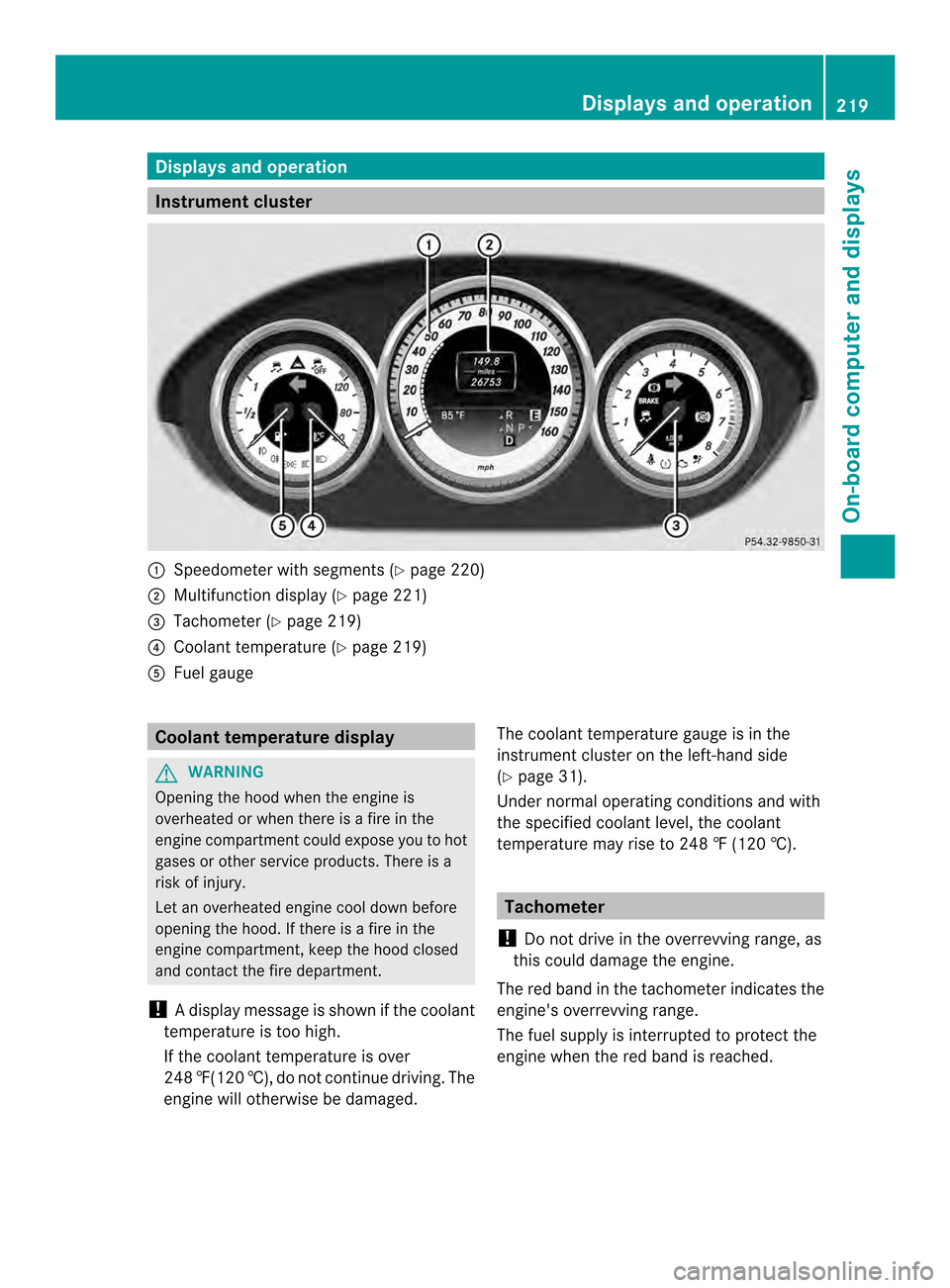
sand operation Instrument cluster
001A
Speedometer wit hsegments (Y page 220)
0010 Multifunction display (Y page 221)
0024 Tachometer (Y page 219)
0021 Coolant temperature ( Ypage 219)
001E Fue lgauge Coolant temperatur
edisplay G
WARNING
Opening th ehoodw hen th eengineis
overheated or when there is afireint he
engin ecom partmen tcould expose you to hot
gases or other service products. There is a
risk of injury.
Let an overheated engine cool down before
opening the hood. If there is afire in the
engine compartment, keep the hood closed
and contact the fire department.
! Adisplay message is shown if the coolant
temperature is too high.
If the coolan ttemperature is over
248 ‡(120 †), do not continue driving. The
engine will otherwise be damaged. The coolan
ttemperature gauge is in the
instrument cluster on the left-hand side
(Y page 31).
Under normal operatin gconditions and with
the specified coolant level, the coolant
temperature may rise to 248 ‡(120 †). Tachometer
! Do not drive in the overrevving range, as
this could damage the engine.
The red band in the tachometer indicates the
engine's overrevving range.
The fuel supply is interrupted to protec tthe
engine when the red band is reached. Displays and operation
219On-board computer and displays Z
Page 251 of 382
Display messages Possible causes/consequences and
000B Solutions
0017
Coolan
tToo Hot Sto
pV ehicl eTurn Engine Off The coolan
tistoo hot.
Aw arning tone also sounds.
G WARNING
Do no tdrive when youre ngine is overheated. Thi scan caus esome
fluids whic hmay have leaked int othe engin ecom partmen tto
catch fire.
Stea mfrom the overheated engine can alsoc auseserious burns
which can occur just by opening the hood.
There is arisk of injury.
X Pullo ver and stop the vehicl esafel yand switch off the engine,
paying attention to road and traffic conditions.
X Secure the vehicl eagainst rolling away (Y page167).
X Waitu ntil the engine ha scoole ddown.
X Make sure tha tthe air supply to the engine radiator is not
blocked, e.g. by snow, slush or ice.
X Do not start the engine again until the displaym essage goes out
and the coolant temperature is below 248 ‡(120 †).
Otherwise, the engine could be damaged.
X Pay attention to the coolant temperature display.
X If the temperature increases again, visit aqualified specialist
workshop immediately.
Under normal operating conditionsa nd with the specified coolant
level, the coolant temperature may rise to 248 ‡(120 †). Display messages
249On-board computer and displays Z
Page 252 of 382
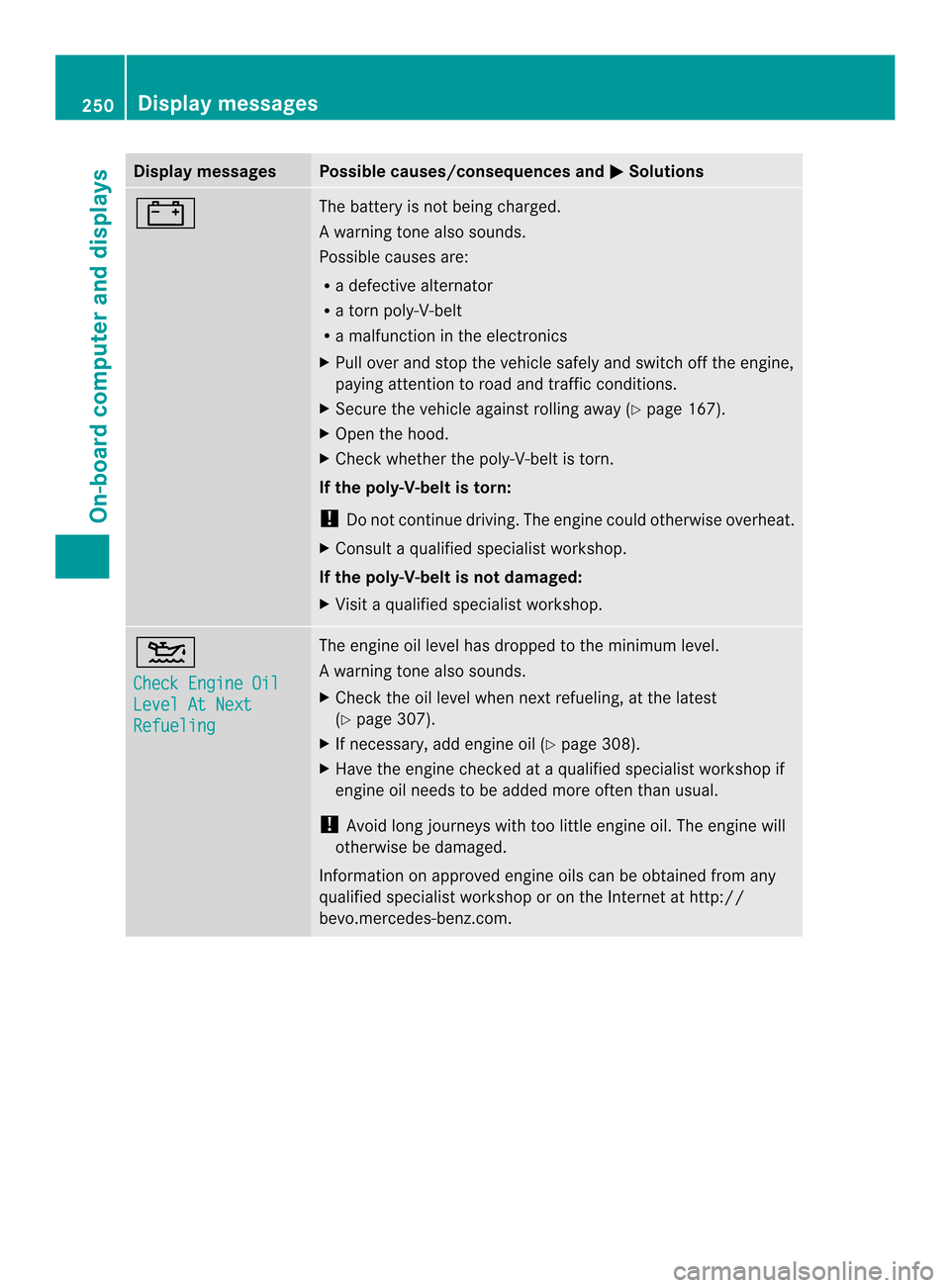
Display messages Possible causes/consequences and
000B Solutions
001C The battery is no
tbeing charged.
Aw arning tone also sounds.
Possible causes are:
R ad efective alternator
R at ornp oly-V-belt
R am alfunctio nintheelectronics
X Pull ove rand stop the vehicl esafelya nd switch off the engine,
paying attentio ntoroada nd traffic conditions.
X Secure the vehicl eagain st rolling away (Y page 167).
X Ope nthe hood.
X Check whether the poly-V-belt is torn.
If the poly-V-belt is torn:
! Do not continue driving. The engine could otherwise overheat.
X Consult aqualified specialist workshop.
If the poly-V-belt is not damaged:
X Visit aqualified specialist workshop. 0009
Check Engine Oil
Level At Next
Refueling The engine oil level has dropped to the minimum level.
Aw
arning tone also sounds.
X Chec kthe oil level when next refueling, at the latest
(Y page 307).
X If necessary, add engine oil (Y page 308).
X Have the engine checked at aqualified specialist workshop if
engine oil needs to be added more often than usual.
! Avoid long journeys with too little engine oil. The engine will
otherwise be damaged.
Information on approved engine oils can be obtained from any
qualified specialist workshop or on the Internet at http://
bevo.mercedes-benz.com. 250
Display messagesOn-board computer and displays
Page 276 of 382
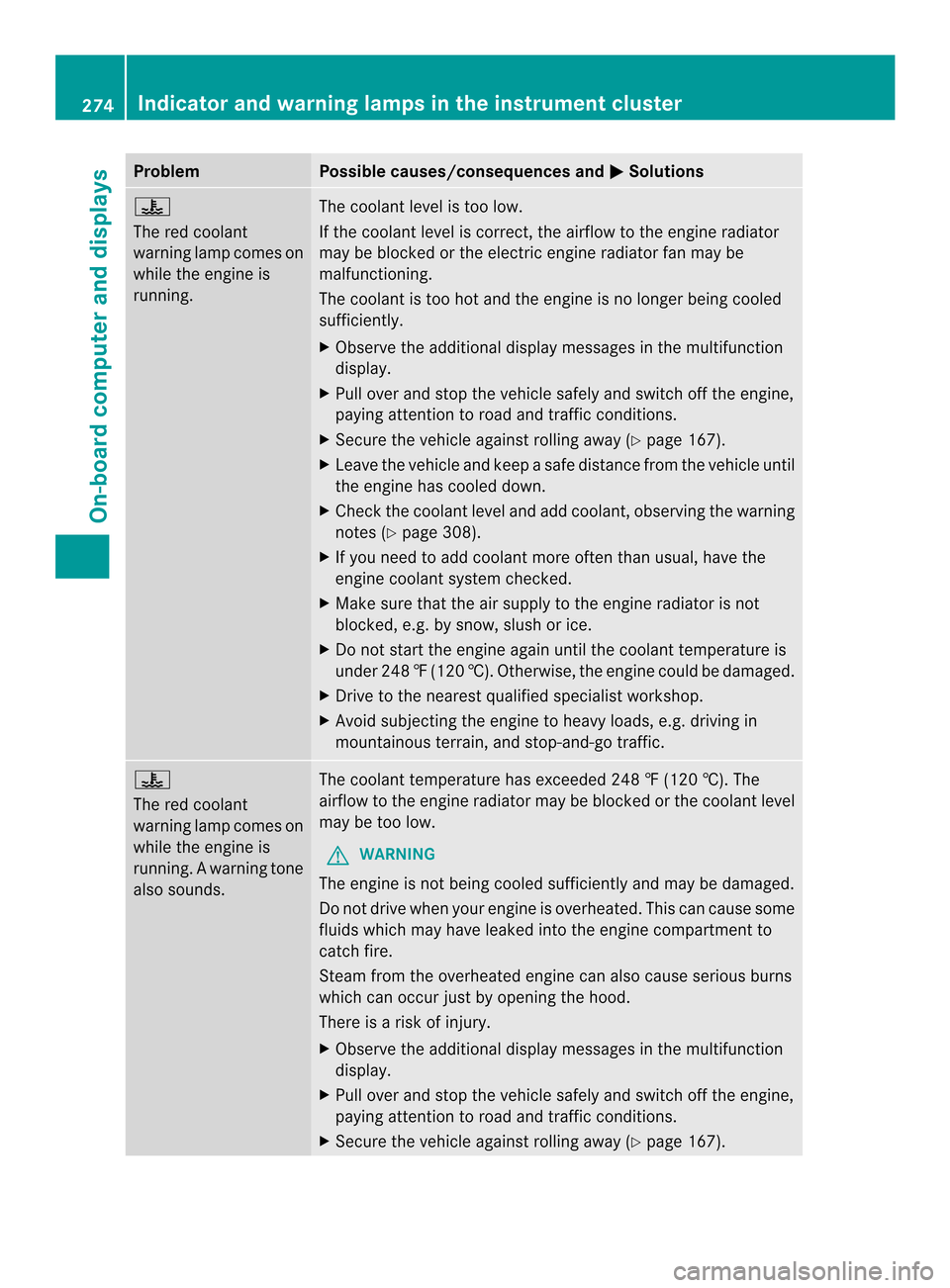
Problem Possible causes/consequences and
000B Solutions
0017
The red coolant
warning lamp comes on
while the engine is
running.
The coolant level is too low.
If the coolant level is correct, the airflow to the engine radiator
may be blocked or the electric engine radiator fan may be
malfunctioning.
The coolant is too hot and the engine is no longer being cooled
sufficiently.
X
Observe the additional display messages in the multifunction
display.
X Pull over and stop the vehicle safely and switch off the engine,
paying attention to road and traffic conditions.
X Secure the vehicle against rolling away (Y page 167).
X Leave the vehicle and keep asafe distance from the vehicle until
the engine has cooled down.
X Check the coolant level and add coolant, observing the warning
notes (Y page 308).
X If you need to add coolant more often than usual, have the
engine coolant system checked.
X Make sure that the air supply to the engine radiator is not
blocked, e.g. by snow, slush or ice.
X Do not start the engine again until the coolant temperature is
under 248 ‡(120 †). Otherwise ,the engine coul dbedamaged.
X Drive to the nearest qualified specialist workshop.
X Avoid subjecting the engine to heavy loads, e.g. driving in
mountainou sterrain, and stop-and-go traffic. 0017
The red coolant
warning lamp comes on
while the engine is
running.
Awarning tone
also sounds. The coolant temperature has exceeded 248
‡(120 †). The
airflow to the engine radiator may be blocked or the coolant level
may be too low.
G WARNING
The engine is not being coole dsufficiently and may be damaged.
Do not drive whe nyour engine is overheated. This can cause some
fluids which may have leaked into the engine compartment to
catchf ire.
Steam from the overheated engine can also cause serious burns
which can occur just by opening the hood.
There is arisk of injury.
X Observe the additional display messages in the multifunction
display.
X Pull over and stop the vehicle safely and switch off the engine,
paying attention to road and traffic conditions.
X Secure the vehicle against rolling away (Y page 167).274
Indicator and warning lampsint
he instrument clusterOn-board computer and displays
Page 308 of 382
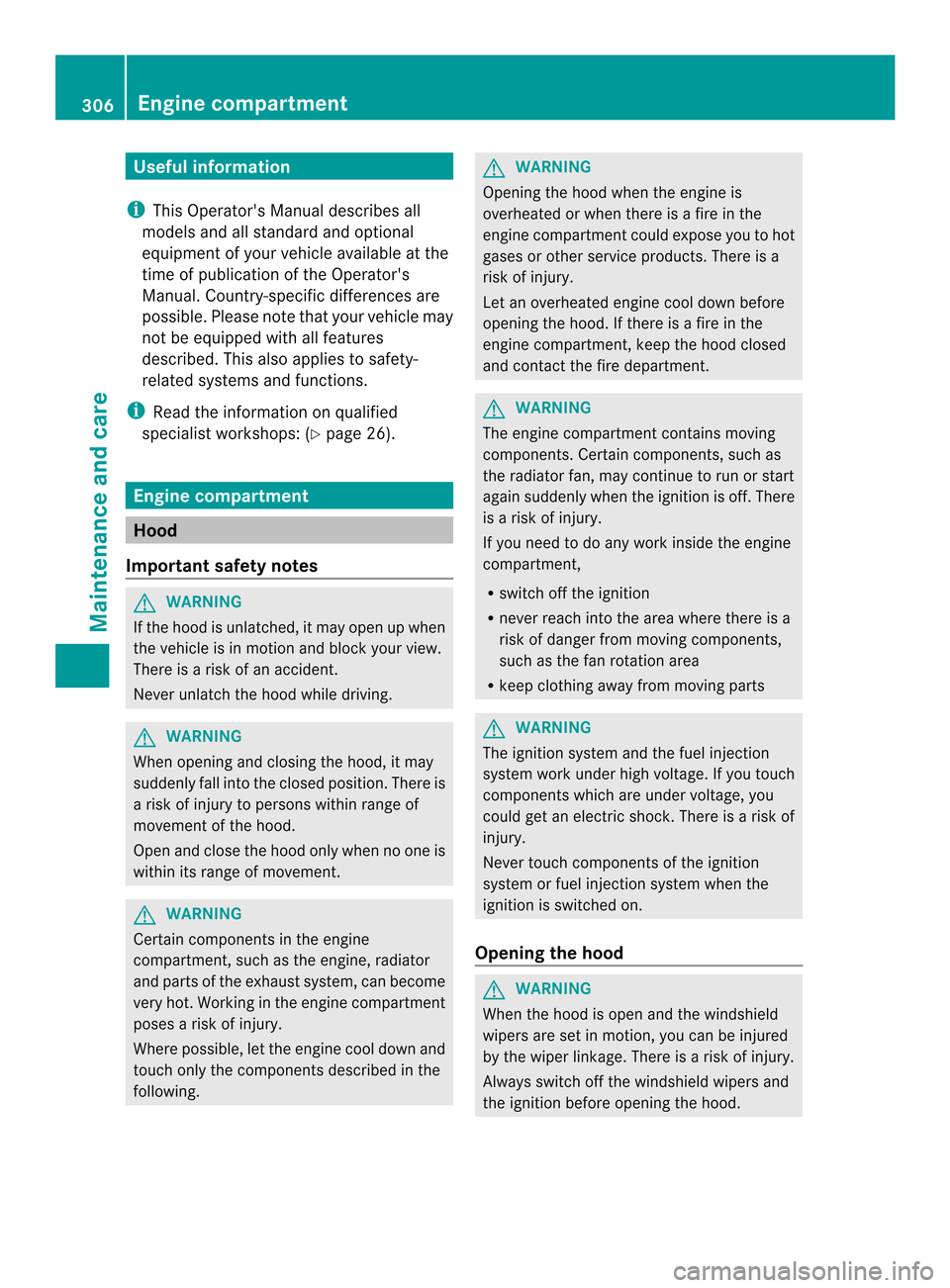
Useful information
i This Operator's Manual describes all
models and all standard and optional
equipment of your vehicle available at the
time of publication of the Operator's
Manual. Country-specific differences are
possible. Please not ethat your vehicle may
not be equipped with all features
described. This also applies to safety-
related system sand functions.
i Read the information on qualified
specialist workshops: (Y page 26).Engine compartment
Hood
Important safet ynotes G
WARNING
If the hood is unlatched, it may open up when
the vehicle is in motion and block your view.
There is arisk of an accident.
Never unlatc hthe hood while driving. G
WARNING
When openin gand closin gthe hood, it may
suddenly fall int othe closed position .There is
ar isk of injury to persons within range of
movement of the hood.
Open and close the hood only when no one is
within its range of movement. G
WARNING
Certain components in the engine
compartment, such as the engine, radiator
and parts of the exhaust system, can become
very hot. Working in the engine compartment
poses arisk of injury.
Where possible, let the engine cool down and
touch only the components described in the
following. G
WARNING
Opening the hood when the engine is
overheated or when there is afire in the
engine compartmentc ould expose you to hot
gases or other service products. There is a
risk of injury.
Let an overheated engine cool down before
opening the hood. If there is afire in the
engine compartment, keep the hood closed
and contact the fire department. G
WARNING
The engine compartment contains moving
components. Certain components, such as
the radiator fan, may continue to run or start
again suddenly when the ignition is off. There
is ar isk of injury.
If you need to do any work inside the engine
compartment,
R switch off the ignition
R never reach into the area where there is a
risk of danger from moving components,
such as the fan rotation area
R keep clothin gaway from moving parts G
WARNING
The ignition system and the fuel injection
system work under high voltage. If you touch
components which are under voltage, you
could get an electric shock. There is arisk of
injury.
Never touch components of the ignition
system or fuel injection system when the
ignition is switched on.
Opening the hood G
WARNING
When the hood is open and the windshield
wipers are set in motion ,you can be injured
by the wiper linkage. There is arisk of injury.
Always switch off the windshield wipers and
the ignition before opening the hood. 306
Engine compartmentMaintenance and care
Page 379 of 382
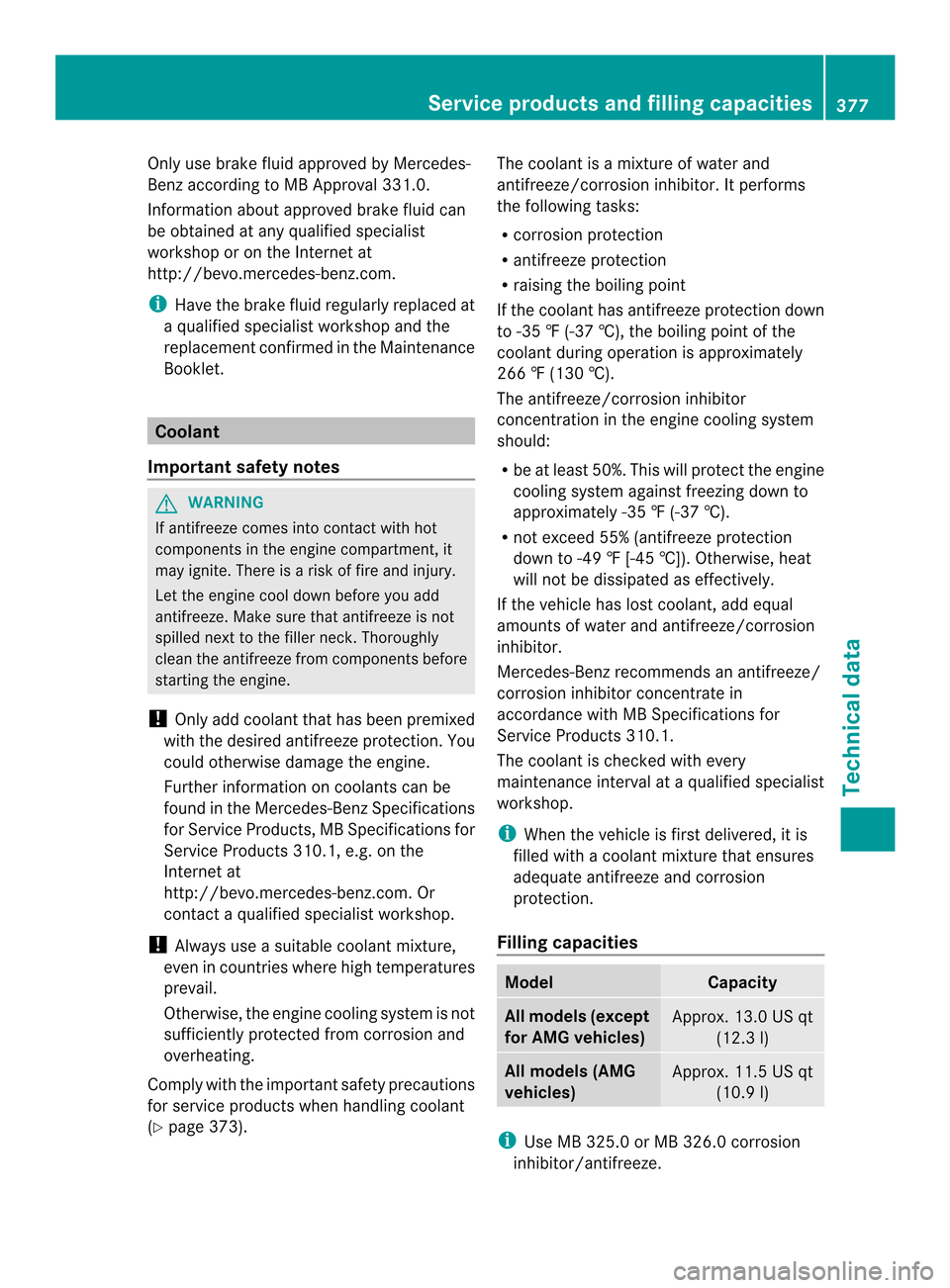
Only use brake fluid approved by Mercedes-
Benz according to MB Approval 331.0.
Information abouta
pproved brake fluid can
be obtaine datany qualified specialist
workshop or on the Internet at
http://bevo.mercedes-benz.com.
i Have the brake fluid regularly replaced at
aq ualified specialist workshop and the
replacemen tconfirmed in the Maintenance
Booklet. Coolant
Important safety notes G
WARNING
If antifreez ecomes into contact with hot
components in the engine compartment, it
may ignite. There is arisk of fire and injury.
Let the engine cool down before you add
antifreeze. Make sure that antifreez eisnot
spilled next to the filler neck.T horoughly
clean the antifreeze from components before
startingt he engine.
! Only add coolant that has been premixed
with the desired antifreezep rotection. You
coul dotherwise damage the engine.
Further information on coolants can be
found in the Mercedes-Benz Specifications
for Service Products, MB Specifications for
Service Products 310.1, e.g. on the
Internet at
http://bevo.mercedes-benz.com .Or
contact aqualified specialist workshop.
! Always use asuitable coolant mixture,
even in countries where high temperatures
prevail.
Otherwise, the engine cooling system is not
sufficiently protected from corrosio nand
overheating.
Comply with the important safety precautions
for service products when handling coolant
(Y page3 73). The coolant is
amixture of water and
antifreeze/corrosion inhibitor. It performs
the following tasks:
R corrosio nprotection
R antifreeze protection
R raising the boiling point
If the coolant has antifreeze protection down
to -35 ‡(-37 †), the boiling point of the
coolant during operatio nisapproximately
266 ‡(130 †).
The antifreeze/corrosion inhibitor
concentration in the engine cooling system
should:
R be at least 50%. This will protect the engine
cooling system against freezing down to
approximately -35 ‡(-37 †).
R not exceed 55% (antifreeze protection
down to -49 ‡[-45 †]). Otherwise, heat
will not be dissipated as effectively.
If the vehicle has lost coolant, add equal
amounts of water and antifreeze/corrosion
inhibitor.
Mercedes-Benz recommends an antifreeze/
corrosion inhibitor concentrate in
accordance with MB Specifications for
Service Products 310.1.
The coolant is checked with every
maintenance interval at aqualified specialist
workshop.
i When the vehicle is first delivered, it is
filled with acoolant mixture that ensures
adequate antifreeze and corrosion
protection.
Filling capacities Model Capacity
All models (except
for AMG vehicles)
Approx. 13.0 US qt
(12.3 l) All models (AMG
vehicles) Approx. 11.5 US qt
(10.9 l) i
Use MB 325.0 or MB 326.0 corrosion
inhibitor/antifreeze. Service products and filling capacities
377Technical data Z