ignition MERCEDES-BENZ CLS-Class 2014 W218 Owner's Manual
[x] Cancel search | Manufacturer: MERCEDES-BENZ, Model Year: 2014, Model line: CLS-Class, Model: MERCEDES-BENZ CLS-Class 2014 W218Pages: 382, PDF Size: 5.36 MB
Page 18 of 382
Setting the air distribution
...............138
Settin gthe airflow ............................ 139
SETUP (on-board computer) .............234
Side impact air bag .............................45
Side marker lamp (display
message) ............................................ 247
Side windows Cleaning ......................................... 314
Convenience closing feature ............90
Convenience opening feature ..........89
Important safety information ...........88
Opening/closing .............................. 89
Problem (malfunction) .....................92
Resetting ......................................... 91
Sliding sunroof
Important safety notes ....................92
Opening/closing .............................. 93
Problem (malfunction) .....................95
Resetting ......................................... 94
SmartKey
Changing the battery .......................79
Changing the programming .............77
Checking the battery .......................79
Convenience closing feature ............90
Convenience opening feature ..........89
Display message ............................ 262
Door central locking/unlocking .......76
Important safety notes ....................76
Loss ................................................. 81
Mechanical key ................................ 78
Positions (ignition lock) .................147
Problem (malfunction) .....................81
Starting the engine ........................149
Sno wchains ...................................... 337
Sockets Center console .............................. 289
General notes ................................ 289
Rea rcompartmen t......................... 290
Trunk ............................................. 290
Under the armrest .........................289
Spare wheel
Stowing .......................................... 368
Specialist workshop ............................ 26
Special seat bel tretractor .................. 63
Speed ,controlling
see Cruise control Speedometer
Digital ............................................ 223
In the Instrument cluster .........31, 219
Segments ...................................... 220
Selecting the unit of
measurement ................................ 229
see Instrument cluster
SPORT handling mode
Activating/deactivating (AMG
vehicles) .......................................... 70
Warning lamp ................................. 270
SRS (Supplemental Restraint
System)
Display message ............................ 242
Introduction ..................................... 41
Warning lamp ................................. 272
Warning lamp (function) ................... 41
Standin glamps
Display message ............................ 246
Switching on/off ........................... 119
Start/stop function
see ECO start/stop function
Starting (engine) ................................ 149
Steering (display message) ..............262
Steering wheel Adjusting (electrically). ..................106
Button overview ............................... 33
Buttons (on-board computer) ......... 220
Cleaning ......................................... 316
Important safety notes ..................106
Paddle shifters ............................... 160
Steering wheel heating ..................107
Storing settings (memory
function) ........................................ 112
Steering wheel heating
Problem (malfunction) ...................108
Switching on/off ........................... 107
Steering wheel paddle shifters ........160
Stopwatch (RACETIMER) ................... 235
Stowage areas ................................... 278
Stowage compartments Armrest (under) ............................. 280
Center console .............................. 279
Cuph olders ................................... 284
Eyeglasses compartment ...............279
Glove box ...................................... .279
Important safety information .........278
Rea r............................................... 28116
Index
Page 26 of 382
Change of address or change of
ownership
In th eevent of achang eofa ddress, please
sen dust he"Notificatio nofAddress Change"
in the Service and Guarantee booklet or
simply call the Mercedes-Benz Customer
Assistance Cente r(USA )att he hotline
number
1-800-FOR-MERCedes(1-800-367-6372 )or
Customer Servic eCenter (Canada) at
1-800-387-0100 .This will assist us in
contacting you in atimely manner should the
need arise.
If you sell your Mercedes, please leave the
entirel iterature in the vehicle so that it is
available to the next owner.
If you have purchased aused car, please send
us the "Notification of Used Car Purchase" in
the Servic eand Guarantee booklet or simply
call the Mercedes-Benz Customer Assistance
Center (USA) at the hotline number
1-800-FOR-MERCedes(1-800-367-6372)or
Customer Servic e(Canada) at
1-800-387-0100. Vehicle operation outside the USA
and Canada
If you plan to operate your vehicle in foreign
countries, please be aware that:
R service facilities or replacement parts may
not be readily available.
R unleaded fuel for vehicles with acatalytic
converter may not be available. Leaded fuel
may cause damage to the catalytic
converter.
R the fuel may have aconsiderably lower
octaner ating. Unsuitable fuel can cause
engine damage.
Some Mercedes-Benz models are available
for delivery in Europe through our European
Delivery Program. For details, consult an
authorized Mercedes-Benz Center or write to
one of the following addresses.
In the USA Mercedes-Benz USA,L
LC
European Delivery Department
One Mercedes Drive
Montvale, NJ 07645-0350
In Canada
Mercedes-Benz Canada, Inc.
European Delivery Department
98 Vanderhoof Avenue
Toronto, Ontario M4G 4C9 Operating safety
Important safety notes
G
WARNING
If you do not have the prescribed service/
maintenance work or any required repairs
carried out, this can result in malfunctions or
system failures. There is arisk of an accident.
Always have the prescribed service/
maintenance work as well as any required
repairs carried out at aqualified specialist
workshop. G
WARNING
If you switch off the ignition while driving,
safety-relevant functions are only available
with limitations, or not at all. This could affect,
for example, the power steering and the brake
boosting effect .You will require considerably
more effort to steer and brake. There is arisk
of an accident.
Do not switch off the ignition while driving. G
WARNING
Modifications to electronic components, their
software as well as wiring can impair their
function and/or the function of other
networked components. In particular,
systems relevant to safety could also be
affected. As aresult, these may no longer
function as intended and/or jeopardize the
operating safety of the vehicle. There is an
increased risk of an accident and injury. 24
Introduction
Page 32 of 382
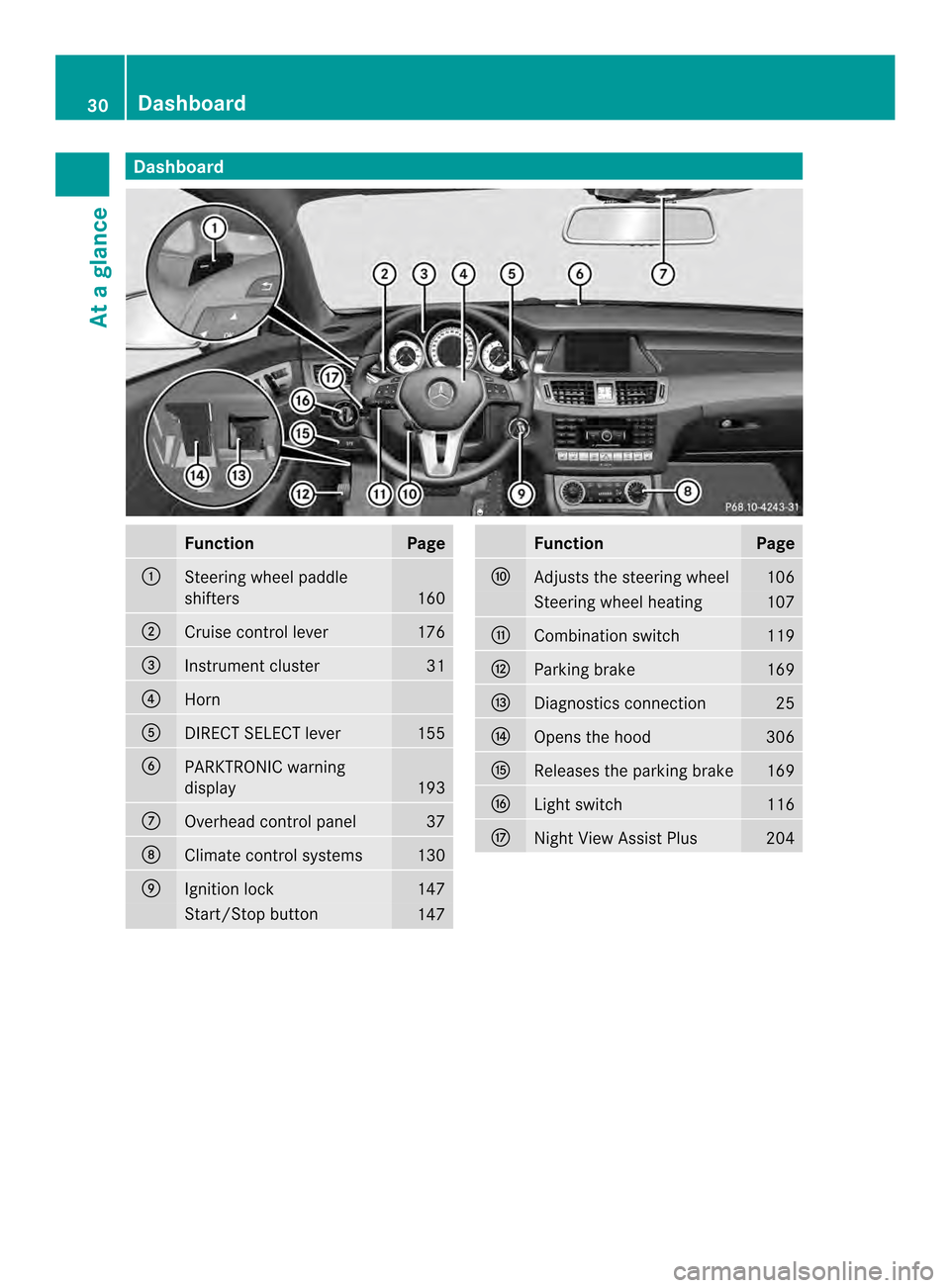
Dashboard
Function Page
001A
Steerin
gwhee lpaddle
shifters 160
0010
Cruis
econtrol lever 176
0024
Instrumen
tcluster 31
0021
Horn
001E
DIREC
TSELEC Tlever 155
0025
PARKTRONIC warning
display
193
0009
Overhead contro
lpanel 37
0016
Climat
econtrol systems 130
001D
Ignition lock 147
Start/Sto
pbutton 147 Function Page
000F
Adjust
sthe steerin gwheel 106
Steerin
gwhee lheating 107
0004
Combination switch 119
000B
Parking brake 169
001C
Diagnostic
sconnection 25
000E
Opens th
ehood 306
0012
Releases th
eparking brake 169
0013
Light switch 116
0017
Night Vie
wAssistP lus 20430
DashboardAt
ag lance
Page 42 of 382
Useful information
i This Operator's Manual describes all
models and all standard and optional
equipment of your vehicle available at the
time of publication of the Operator's
Manual. Country-specific differences are
possible. Please not ethat your vehicle may
not be equipped with all features
described. This also applies to safety-
related system sand functions.
i Read the information on qualified
specialist workshops: (Y page 26).Panic alarm
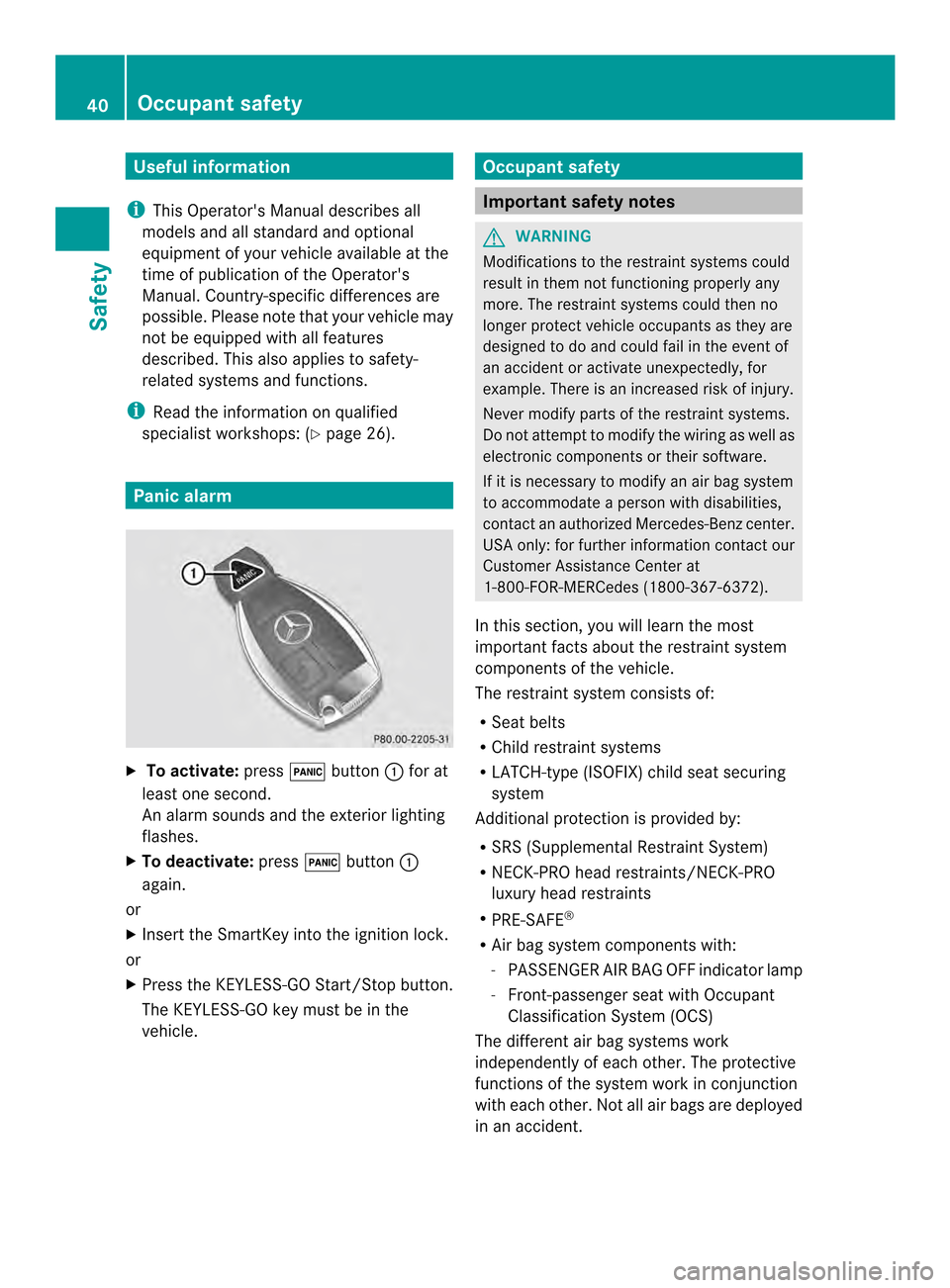
X
To activate: press000Dbutton 001Afor at
least one second.
An alarm sounds and the exterior lighting
flashes.
X To deactivate: press000Dbutton 001A
again.
or
X Insert the SmartKey int othe ignition lock.
or
X Press the KEYLESS-GO Start/Stop button.
The KEYLESS-GO key must be in the
vehicle. Occupant safety
Important safet
ynotes G
WARNING
Modifications to the restraint system scould
result in them not functioning properly any
more. The restraint system scould then no
longer protect vehicle occupants as they are
designed to do and could fail in the even tof
an acciden toractivat eunexpectedly, for
example. Ther eisanincreased risk of injury.
Never modify part softherestraint systems.
Do no tattemp ttomodify the wiring as well as
electronic components or their software.
If it is necessary to modify an air bag system
to accommodat eaperson with disabilities,
contact an authorized Mercedes-Benz center.
USA only: for further information contact our
Customer Assistance Center at
1-800-FOR-MERCedes (1800-367-6372).
In this section ,you will learn the most
important facts about the restraint system
components of the vehicle.
The restraint system consist sof:
R Seat belts
R Child restraint systems
R LATCH-type (ISOFIX) child seat securing
system
Additional protection is provided by:
R SRS (Supplemental Restraint System)
R NECK-PRO head restraints/NECK-PRO
luxury head restraints
R PRE-SAFE ®
R Air bag system components with:
-PASSENGER AIR BAG OFF indicator lamp
- Front-passenger seat with Occupant
Classification System (OCS)
The different air bag systems work
independently of each other. The protective
functions of the system work in conjunction
with each other. Not all air bags are deployed
in an accident. 40
Occupant safetySafety
Page 43 of 382
i
For information on infants and children
traveling with yo uinthe vehicle as well as
restraint systems for infants and children,
see "Childre ninthe vehicle"
(Y page 60). SRS (Supplemental Restraint System)
Introduction RS consistso
f:
R The 0012 RS warning lamp
R Air bags
R The air bag control unit with crash sensors
R Emergency Tensioning Device for the front
seat belts and the outer seat belts in the
rear
R Seat belt force limiters for the front seat
belts and the outer seat belts in the rear
RS reduces the risk of occupants coming into
contact with the vehicle's interior in the event
of an accident. It can also reduce the effect
of the forces to which occupants are
subjected during an accident.
SRS warning lamp G
WARNING
If SRS is malfunctioning, child restraint
system components may be triggered
unintentionally or might not be triggered at all
in the event of an accident with ahigh rate of
vehicle deceleration. There is an increased
risk of injury, possibly even fatal.
Have SRS checked and repaired immediately
at aq ualified specialist workshop.
SRS functions are checked regularly when
you switch on the ignition and when the
engine is running. Therefore, malfunctions
can be detected in good time.
The 0012 SRS warning lamp in the instrument
cluster lights up when the ignition is switched
on. It goes out no later than afew seconds
after the engine is started. The SRS components are in operational
readiness when the
0012SRS indicator lamp
goes out while the engine is running.
There is amalfunction if:
R the 0012 SRS warning lamp does not light
up when the ignition is switched on
R the engine is running and the 0012SRS
warning lamp does not go out after afew
seconds
R the engine is running and the 0012SRS
warning lamp lights up again.
Safety guidelines for seat belts,
Emergency Tensioning Devices (ETDs)
and air bags G
WARNING
R Damaged seat belts or seat belts that have
been subjected to stress in an accident
must be replaced. Their anchoring points
must also be checked. Only use seat belts
installed or supplied by an authorized
Mercedes-Ben zCenter.
R Air bags and pyrotechnic Emergency
Tensioning Devices (ETDs) contain
perchlorate material, which may require
special handling and regard for the
environment. Check your national disposal
guidelines. California residents, see
www.dtsc.ca.gov/HazardousWaste/
Perchlorate/index.cfm.
R Air bags and ETDs are designed to function
on aone-time-only basis. An air bag or ETD
that has deployed must be replaced. PRE-
SAFE ®
has electrically operated reversible
belt tensionersina ddition to the
pyrotechnic ETDs.
R Do not pass seat belts over sharp edges.
They could tear.
R Do not make any modification that could
change the effectiveness of the seat belts.
R Do not bleach or dye seat belts as this may
severely weaken them. In acrash they may
not be able to provide adequate protection. Occupant safety
41Safety
Z
Page 52 of 382
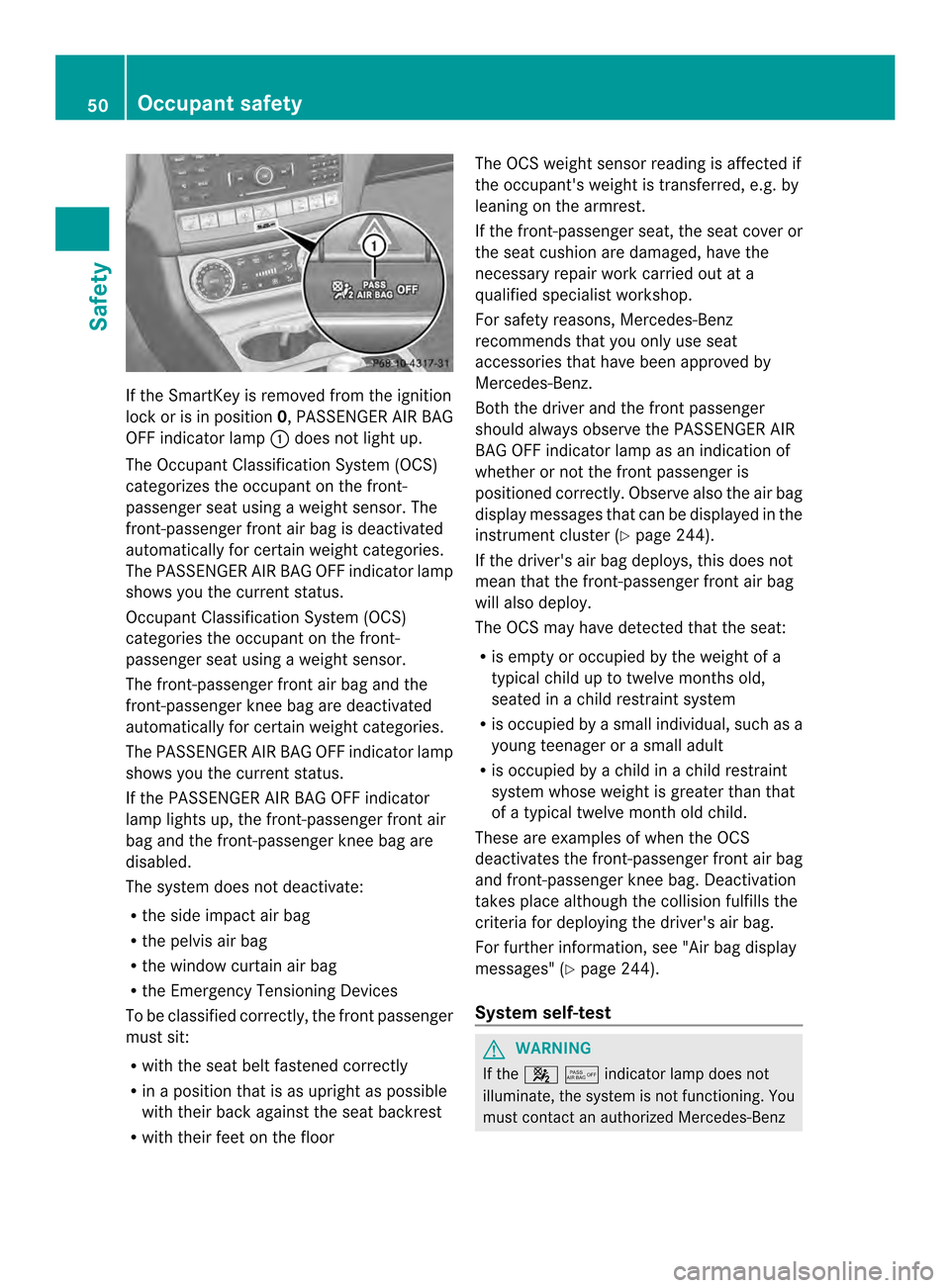
If the SmartKey is removed from the ignition
lock or is in position 0,PASSENGER AIR BAG
OFF indicator lamp 001Adoes not light up.
The Occupant Classification System (OCS)
categorize sthe occupant on the front-
passenge rseat using aweight sensor .The
front-passenger front air bag is deactivated
automatically for certain weight categories.
The PASSENGER AIR BAG OFF indicator lamp
shows you the current status.
Occupant Classification System (OCS)
categories the occupant on the front-
passenger seat using aweight sensor.
The front-passenger front air bag and the
front-passenger knee bag are deactivated
automatically for certain weight categories.
The PASSENGER AIR BAG OFF indicator lamp
shows you the current status.
If the PASSENGER AIR BAG OFF indicator
lamp lights up, the front-passenger front air
bag and the front-passenger knee bag are
disabled.
The system does not deactivate:
R the side impact air bag
R the pelvis air bag
R the window curtain air bag
R the Emergency Tensioning Devices
To be classified correctly, the front passenger
must sit:
R with the seat belt fastened correctly
R in ap osition that is as upright as possible
with their back against the seat backrest
R with their feet on the floor The OCS weight sensor reading is affected if
the occupant's weight is transferred, e.g. by
leaning on the armrest.
If the front-passenger seat, the seat cover or
the seat cushion are damaged, have the
necessary repair work carried out at a
qualified specialist workshop.
For safety reasons, Mercedes-Benz
recommends that you only use seat
accessories that have been approved by
Mercedes-Benz.
Both the driver and the front passenger
should always observe the PASSENGER AIR
BAG OFF indicator lamp as an indication of
whether or not the front passenger is
positioned correctly. Observe also the air bag
displaym essages that can be displayed in the
instrumentc luster (Ypage 244).
If the driver's air bag deploys, this does not
mean that the front-passenger front air bag
will also deploy.
The OCS may have detected that the seat:
R is empty or occupied by the weight of a
typical child up to twelve months old,
seated in achild restraint system
R is occupied by asmall individual, such as a
young teenager or asmall adult
R is occupied by achild in achild restraint
system whose weight is greater than that
of at ypical twelve montho ld child.
These are examples of when the OCS
deactivates the front-passenger front air bag
and front-passenger knee bag. Deactivation
takes place although the collision fulfills the
criteria for deploying the driver's air bag.
For further information ,see "Air bag display
messages" (Y page 244).
System self-test G
WARNING
If the 000F000Bindicator lamp does not
illuminate, the system is not functioning. You
must contac tanauthorized Mercedes-Benz 50
Occupant safetySafety
Page 53 of 382
Cente
rbefore seating any child on the front
passenger seat. G
WARNING
Objects between the seat surface and the
child restraint system could affect the
function of the OCS. This could result in the
front-passenger fron tair bag not functioning
as intended during an accident. This poses an
increased risk of injury or even fatal injury.
Do not place any objects between the seat
surface and the child restraint system. Make
sure that the bottom and back of the child
restraint system make full contact with the
front-passenger seat cushion and backrest.
Always comply with the child restraint system
manufacturer's installation instructions.
The PASSENGER AIR BAG OFF indicator lamp
lights up:
R if you turn the SmartKey in the ignition lock
to position 1or 2
R if you press the KEYLESS-GO Start/Stop
button onceort wice on vehicles with
KEYLESS-GO
R if an adult is seated properly on the front-
passenger seat and the OCS classifies the
occupant as an adult
The PASSENGER AIR BAG OFF indicator
lamp goes out again after approximately six
seconds.
If the seat is not occupied and the OCS
system detects that the front-passenger
seat is empty, the PASSENGER AIR BAG
OFF indicator lamp will continue to light up.
The PASSENGER AIR BAG OFF indicator
lamp will not go out.
For more information about the OCS, see
"Problems with the Occupant Classification
System "(Ypage 52). Occupant safety
51Safety Z
Page 59 of 382
placed in the rear seat whenever possible.
Regardless of seatin
gposition ,children 12
years old and under must be seated and
properly secured in an appropriately sized
child restraint system or booster seat
recommended for the size and weight of the
child. For additional information ,see the
"Children in the vehicle" section.
Ac hild's risk of serious or fatal injuries is
significantly increased if the child restraints
are not properly secured in the vehicle and/
or the child is not properly secured in the child
restraint. X
Adjust the seat and move the backrest to
an almost vertical position (Y page 98).
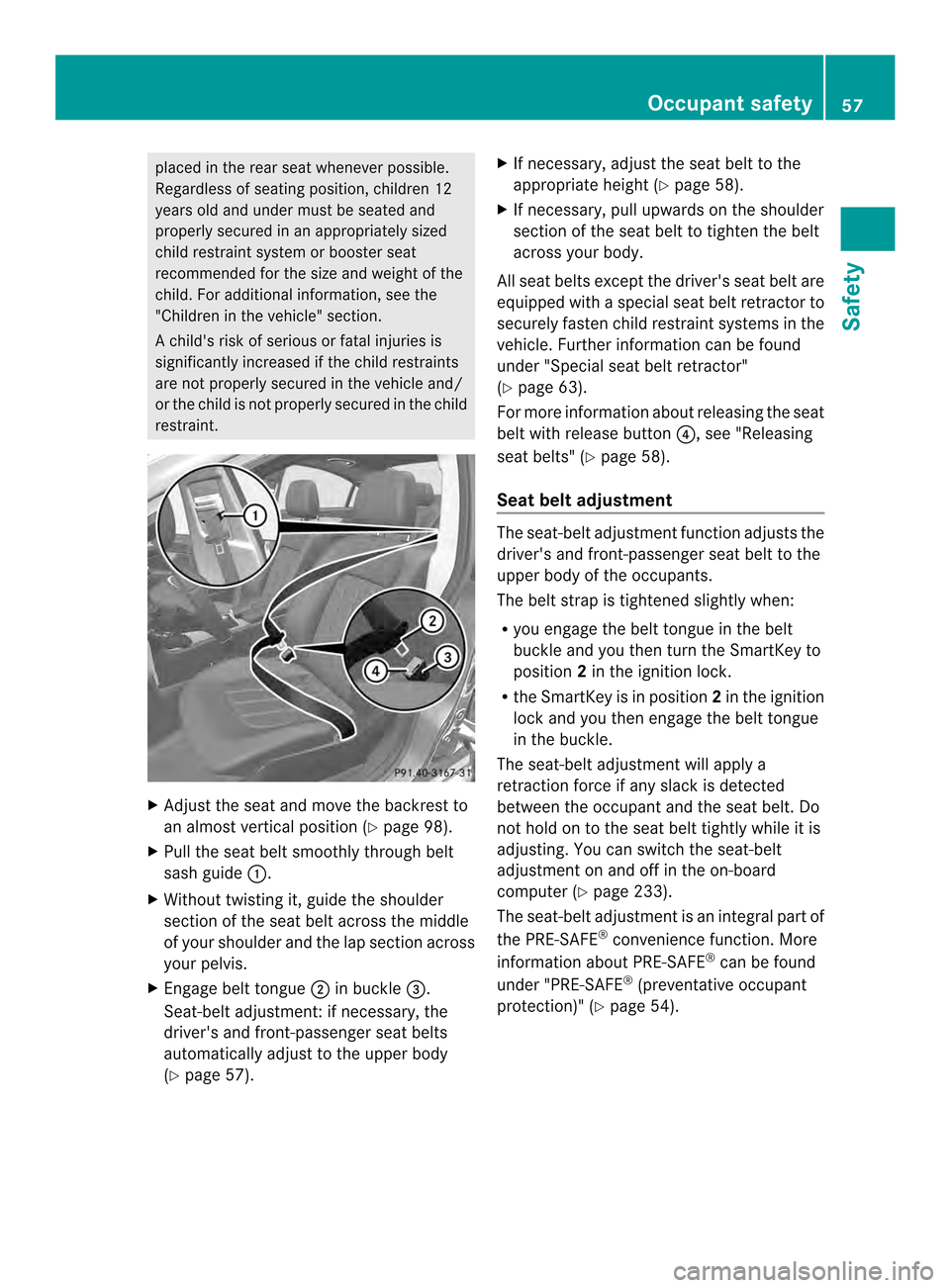
X Pull the seat belt smoothly through belt
sash guide 001A.
X Without twisting it, guide the shoulder
section of the seat belt across the middle
of your shoulder and the lap section across
your pelvis.
X Engage belt tongue 0010in buckle 0024.
Seat-belt adjustment:ifn ecessary, the
driver's and front-passenger seat belts
automatically adjust to the upper body
(Y page 57). X
If necessary, adjust the seat belt to the
appropriate height (Y page 58).
X If necessary, pull upwards on the shoulder
section of the seat belt to tighten the belt
across your body.
All seat belts except the driver's seat belt are
equipped with aspecial seat belt retractor to
securely fasten child restraint systems in the
vehicle. Further information can be found
under "Special seat belt retractor"
(Y page 63).
For more information about releasing the seat
belt with release button 0021,see "Releasing
seat belts" (Y page 58).
Seat belt adjustment The seat-belt adjustment function adjusts the
driver's and front-passenger seat belt to the
upper body of the occupants.
The belt strap is tightened slightly when:
R you engage the belt tongue in the belt
buckle and you then turn the SmartKey to
position 2in the ignition lock.
R the SmartKey is in position 2in the ignition
lock and you then engage the belt tongue
in the buckle.
The seat-belt adjustment will apply a
retraction forc eifany slack is detected
between the occupant and the seat belt. Do
not hold on to the seat belt tightly while it is
adjusting. You can switch the seat-belt
adjustment on and off in the on-board
computer (Y page 233).
The seat-belt adjustment is an integral part of
the PRE-SAFE ®
convenience function .More
information about PRE-SAFE ®
can be found
under "PRE-SAFE ®
(preventativ eoccupant
protection)" (Y page 54). Occupant safety
57Safety Z
Page 61 of 382
60 seconds or until the drive
rorfront
passenger have fastene dtheir sea tbelts.
If the driver/fron tpassenger unfasten their
seat belt while the vehicle is in motion ,the
0013 seat belt warning lamp lights up and a
warning tones ounds again.
The warning tonec eases even if the driver or
front-passenger seat belt has still not been
fastened after 60 seconds. The 0013seat belt
warning lamp stops flashing but remains
illuminated.
After the vehicle comes to astandstill, the
warning toneisr eactivated and the seat belt
warning lamp 0013flashes again if the vehicle
speed again exceeds 15 mph (25 km/h).
The 0013 seat belt warning lamp only goes
out if:
R both the driver and the fron tpassenger
have fastened their seat belts.
or
R thev ehicle is stationar yand adoor is open.
i For mor einformatio nonthe0013 seat
belt warning lamp, see "Warning and
indicator lamps in th einstrumen tcluster,
seat belts" ( Ypage 265).
Emergency Tensionin gDevices, seat
belt force limiters G
WARNING
Pyrotechnic Emergency Tensioning Devices
that have been deployed are no longer
operational and are unable to perfor mtheir
intended protective function. This poses an
increased risk of injury or even fatal injury.
Therefore, have pyrotechnic Emergency
Tensioning Devices which have been
triggered immediately replaced at aqualified
specialist workshop.
! If the front-passenger seat is not
occupied, do not engage the seat belt
tongue in the buckle on the front-
passenger seat. Otherwise, the Emergency Tensioning Device could be triggered in the
event of an accident.
i Vehicles with PRE-SAFE ®
:E mergency
Tensioning Devices that are triggered by an
electric motor can be deployed as often as
desired and do not need to be replaced.
The front seat belts and the outer seat belts
in the rear are equipped with Emergency
Tensioning Devices and seat belt force
limiters.
The ETDs tighten the seat belts in an accident,
pulling them close against the body.
The ETDs do not correct incorrects eat
positions or incorrectly fastened seat belts.
The ETDs do not pull vehicle occupants back
towards the backrest.
The ETDs can only be activated when:
R the ignition is switched on
R the restraint systems are operational; see
"SRS warning lamp 0012"(Ypage 41)
R the belt tongue is engaged in the buckle on
each of the front seat belts.
The ETDs on the outside seats in the rear
compartmenta re triggeredindependently of
the lock status of the seat belts.
The ETDs are triggere ddepending on the type
and severity of an accident:
R if, in the event of ahead-on or rear-end
collision, the vehicl edecelerates or
accelerates rapidly in alongitudinal
direction during the initia lstages of the
impact
R if,int he event of asidei mpact ,onthe side
opposite the impact the vehicle
decelerates or accelerates rapidl yina
latera ldirection
R if,inc ertainsituations where the vehicle
rolls over ,the system determines that it
can provide additional protection
If the ETD sare deployed, you will hear abang,
and asmall amoun tofpowder may also be
released. Only in rare cases will the bang
affect your hearing. The powder that is
released generally does not constitute a Occupant safety
59Safety Z
Page 69 of 382
ABS works fro
maspeed of abou t5mph
(8 km/h )upwar ds,regardless of road-surface
conditions .ABS works on slippery surfaces,
eve nify ou only brake gently.
The yellow 001CABS warning lamp in the
instrument cluster lights up when the ignition
is switched on. It goes out when the engine is
running.
Braking X
If ABS intervenes: continue to depress the
brake pedal vigorously until the braking
situation is over.
X To makeaf ull brake application:
depress the brake pedal with full force.
If ABS intervenes when braking, you will feel
ap ulsing in the brake pedal.
The pulsating brake pedal can be an
indication of hazardous road conditions, and
functions as areminder to take extrac are
while driving. BAS (Brake Assist System)
i Observe the "Important safety notes"
section (Y page 66). G
WARNING
If BAS is malfunctioning, the braking distance
in an emergenc ybraking situation is
increased. There is arisk of an accident.
In an emergenc ybraking situation, depress
the brake pedal with full force. ABS prevents
the wheels from locking.
BAS operates in emergenc ybraking
situations. If you depress the brake pedal
quickly, BAS automatically boosts the braking
force, thus shortening the stopping distance.
The brakes will function as usual once you
release the brake pedal. BAS is deactivated. BAS PLUS (Brake Assist System
PLUS)
General information i
Observe the "Important safety notes"
section (Y page 66).
BAS PLUS is only available in vehicles
equipped with DISTRONIC PLUS.
For BAS PLUS to assist you when driving, the
radar sensor system must be:
R activated (Y page 232)
R operational
With the help of the radar sensor system, BAS
PLUS can detect obstacles that are in the
path of your vehicle for an extended period of
time.
If the radar sensor system is malfunctioning,
BAS PLUS will not be available. The brake
system is still available with complete brake
boosting effect and BAS.
BAS PLUS provides braking assistance in
hazardous situations at speeds greater than
4m ph (7 km/h).
At speeds of up to approximately 40 mph
(70 km/h) ,BAS PLUS can also react to
stationary objects. Examples of stationary
object sare stopped or parked vehicles.
Important safety notes G
WARNING
BAS PLUS cannot alwaysc learly identify
object sand complex traffic situations. BAS
PLUS cannot intervene in these cases. There
is ar isk of an accident.
Always pay careful attention to the traffic
situation and be ready to brake. G
WARNING
BAS PLUS does not react:
R to people or animals
R to oncoming vehicles
R to crossin gtraffic
R when cornering Driving safety systems
67Safety
Z