check engine MERCEDES-BENZ CLS COUPE 2008 User Guide
[x] Cancel search | Manufacturer: MERCEDES-BENZ, Model Year: 2008, Model line: CLS COUPE, Model: MERCEDES-BENZ CLS COUPE 2008Pages: 329, PDF Size: 29.26 MB
Page 220 of 329
Where will I find...?
217Fire extinguisher*
i Have the fire extinguisher refilled after
each use and checked every one or two
years. Otherwise, it may fail in an emer-
gency.
Observe the legal requirements in all coun-
tries concerned.
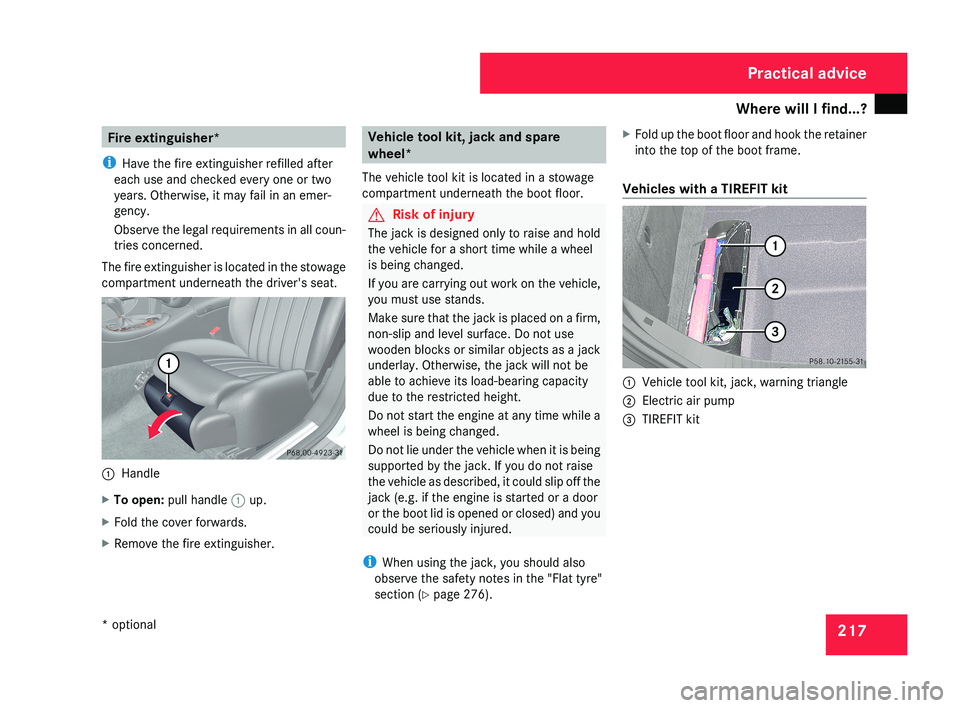
The fire extinguisher is located in the stowage
compartment underneath the driver's seat.1 Handle
X To open: pull handle 1 up.
X Fold the cover forwards.
X Remove the fire extinguisher.
Vehicle tool kit, jack and spare
wheel*
The vehicle tool kit is located in a stowage
compartment underneath the boot floor.
G Risk of injury
The jack is designed only to raise and hold
the vehicle for a short time while a wheel
is being changed.
If you are carrying out work on the vehicle,
you must use stands.
Make sure that the jack is placed on a firm,
non-slip and level surface. Do not use
wooden blocks or similar objects as a jack
underlay. Otherwise, the jack will not be
able to achieve its load-bearing capacity
due to the restricted height.
Do not start the engine at any time while a
wheel is being changed.
Do not lie under the vehicle when it is being
supported by the jack. If you do not raise
the vehicle as described, it could slip off the
jack (e.g. if the engine is started or a door
or the boot lid is opened or closed) and you
could be seriously injured.
i When using the jack, you should also
observe the safety notes in the "Flat tyre"
section ( Y page 276). X
Fold up the boot floor and hook the retainer
into the top of the boot frame.
Vehicles with a TIREFIT kit
1 Vehicle tool kit, jack, warning triangle
2 Electric air pump
3 TIREFIT kit
Practical advice
* optional
219_AKB; 2; 4, en-GB
mkalafa,
2007-11-13T09:28:36+01:00 - Seite 217
Page 230 of 329
Display messages
227Display messages Possible cause/consequence Possible solution
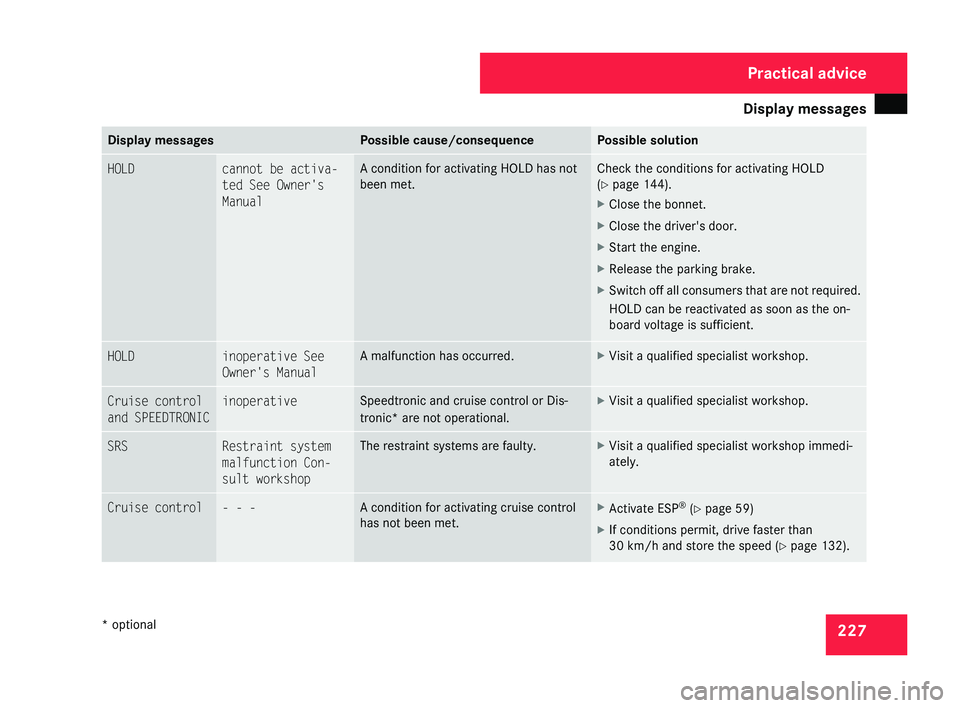
HOLD cannot be activa-
ted See Owner's
Manual A condition for activating HOLD has not
been met. Check the conditions for activating HOLD
(Y page 144).
X
Close the bonnet.
X Close the driver's door.
X Start the engine.
X Release the parking brake.
X Switch off all consumers that are not required.
HOLD can be reactivated as soon as the on-
board voltage is sufficient. HOLD inoperative See
Owner's Manual A malfunction has occurred. X
Visit a qualified specialist workshop. Cruise control
and SPEEDTRONIC inoperative Speedtronic and cruise control or Dis-
tronic* are not operational. X
Visit a qualified specialist workshop. SRS Restraint system
malfunction Con-
sult workshop The restraint systems are faulty. X
Visit a qualified specialist workshop immedi-
ately. Cruise control - - - A condition for activating cruise control
has not been met. X
Activate ESP ®
(Y page 59)
X If conditions permit, drive faster than
30 km/h
and store the speed (Y page 132). Practical advice
* optional
219_AKB; 2; 4, en-GB
mkalafa,
2007-11-13T09:28:36+01:00 - Seite 227
Page 235 of 329
Display messages
232 Display messages Possible cause/consequence Possible solution
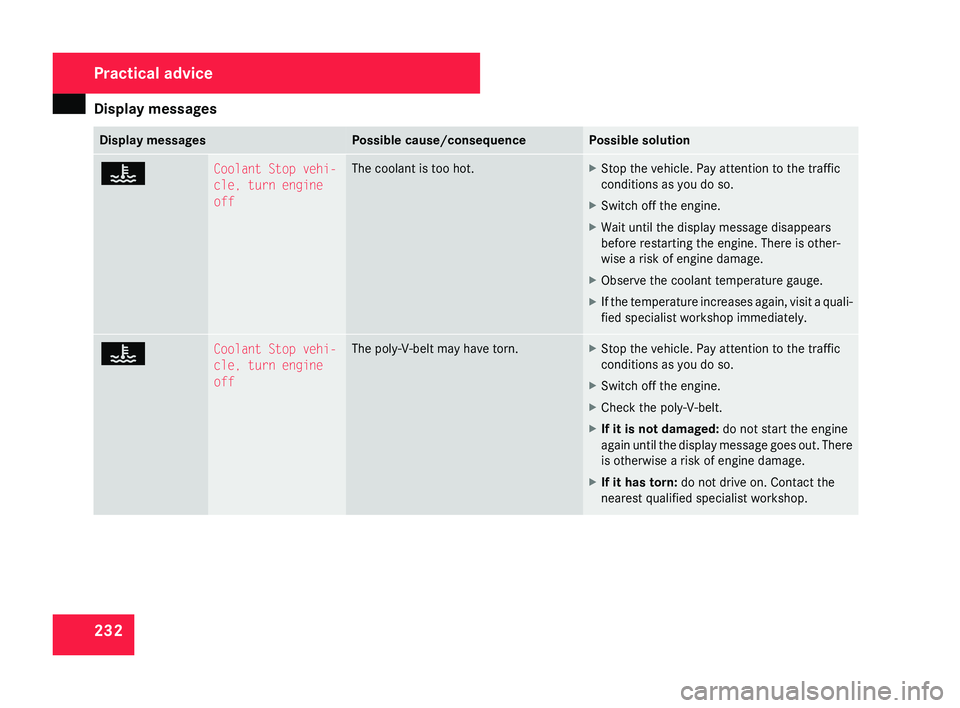
D Coolant Stop vehi-
cle, turn engine
off The coolant is too hot. X
Stop the vehicle. Pay attention to the traffic
conditions as you do so.
X Switch off the engine.
X Wait until the display message disappears
before restarting the engine. There is other-
wise a risk of engine damage.
X Observe the coolant temperature gauge.
X If the temperature increases again, visit a quali-
fied specialist workshop immediately. D Coolant Stop vehi-
cle, turn engine
off The poly-V-belt may have torn. X
Stop the vehicle. Pay attention to the traffic
conditions as you do so.
X Switch off the engine.
X Check the poly-V-belt.
X If it is not damaged: do not start the engine
again until the display message goes out. There
is otherwise a risk of engine damage.
X If it has torn: do not drive on. Contact the
nearest qualified specialist workshop. Practical advice
219_AKB; 2; 4, en-GB
mkalafa,
2007-11-13T09:28:36+01:00 - Seite 232
Page 240 of 329
Display messages
237Display messages Possible cause/consequence Possible solution
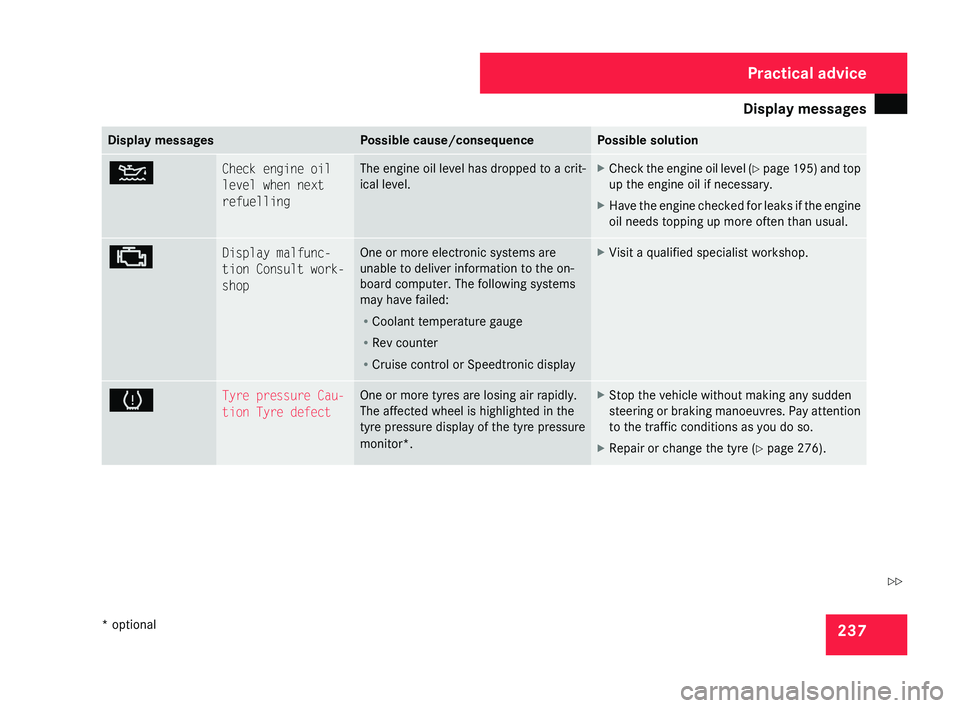
N Check engine oil
level when next
refuelling The engine oil level has dropped to a crit-
ical level. X
Check the engine oil level (Y page 195) and top
up the engine oil if necessary.
X Have the engine checked for leaks if the engine
oil needs topping up more often than usual. ± Display malfunc-
tion Consult work-
shop One or more electronic systems are
unable to deliver information to the on-
board computer. The following systems
may have failed:
R
Coolant temperature gauge
R Rev counter
R Cruise control or Speedtronic display X
Visit a qualified specialist workshop. H Tyre pressure Cau-
tion Tyre defect One or more tyres are losing air rapidly.
The affected wheel is highlighted in the
tyre pressure display of the tyre pressure
monitor*. X
Stop the vehicle without making any sudden
steering
or braking manoeuvres. Pay attention
to the traffic conditions as you do so.
X Repair or change the tyre (Y page 276). Practical advice
* optional
219_AKB; 2; 4, en-GB
mkalafa,
2007-11-13T09:28:36+01:00 - Seite 237 Z
Page 241 of 329
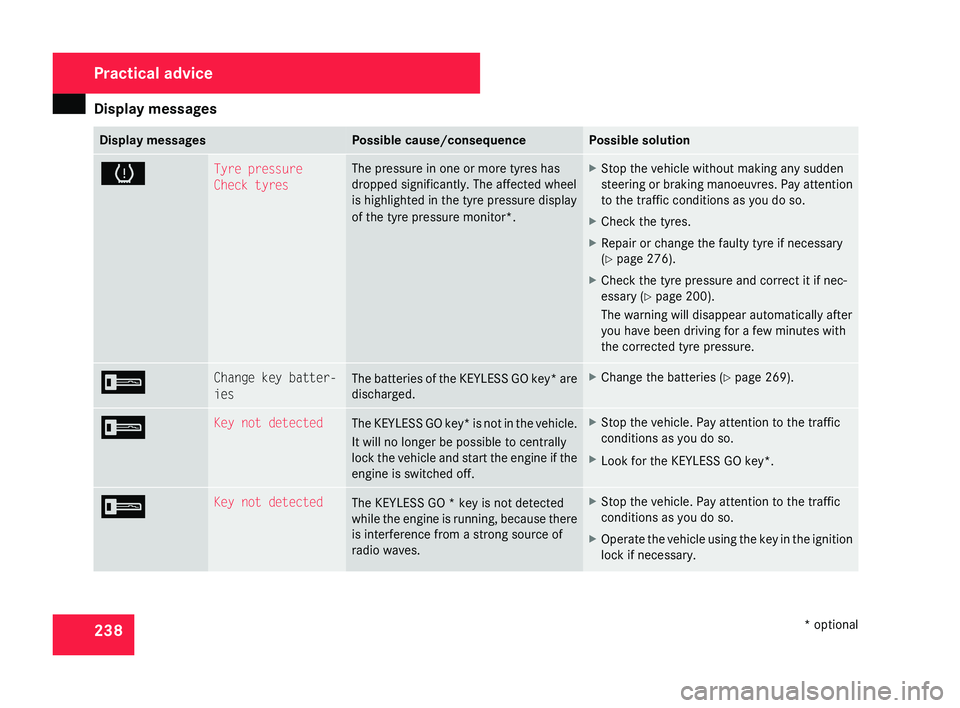
Display messages
238 Display messages Possible cause/consequence Possible solution
H Tyre pressure
Check tyres The pressure in one or more tyres has
dropped significantly. The affected wheel
is highlighted in the tyre pressure display
of the tyre pressure monitor*. X
Stop the vehicle without making any sudden
steering
or braking manoeuvres. Pay attention
to the traffic conditions as you do so.
X Check the tyres.
X Repair or change the faulty tyre if necessary
(Y page 276).
X Check the tyre pressure and correct it if nec-
essary ( Y page 200).
The warning will disappear automatically after
you have been driving for a few minutes with
the corrected tyre pressure. I Change key batter-
ies
The batteries of the KEYLESS GO key* are
discharged. X
Change the batteries ( Y page 269).I Key not detected
The KEYLESS GO key* is not in the vehicle.
It will no longer be possible to centrally
lock
the vehicle and start the engine if the
engine is switched off. X
Stop the vehicle. Pay attention to the traffic
conditions as you do so.
X Look for the KEYLESS GO key*. I Key not detected
The KEYLESS GO * key is not detected
while
the engine is running, because there
is interference from a strong source of
radio waves. X
Stop the vehicle. Pay attention to the traffic
conditions as you do so.
X Operate the vehicle using the key in the ignition
lock if necessary. Practical advice
* optional
219_AKB; 2; 4, en-GB
mkalafa,
2007-11-13T09:28:36+01:00 - Seite 238
Page 249 of 329
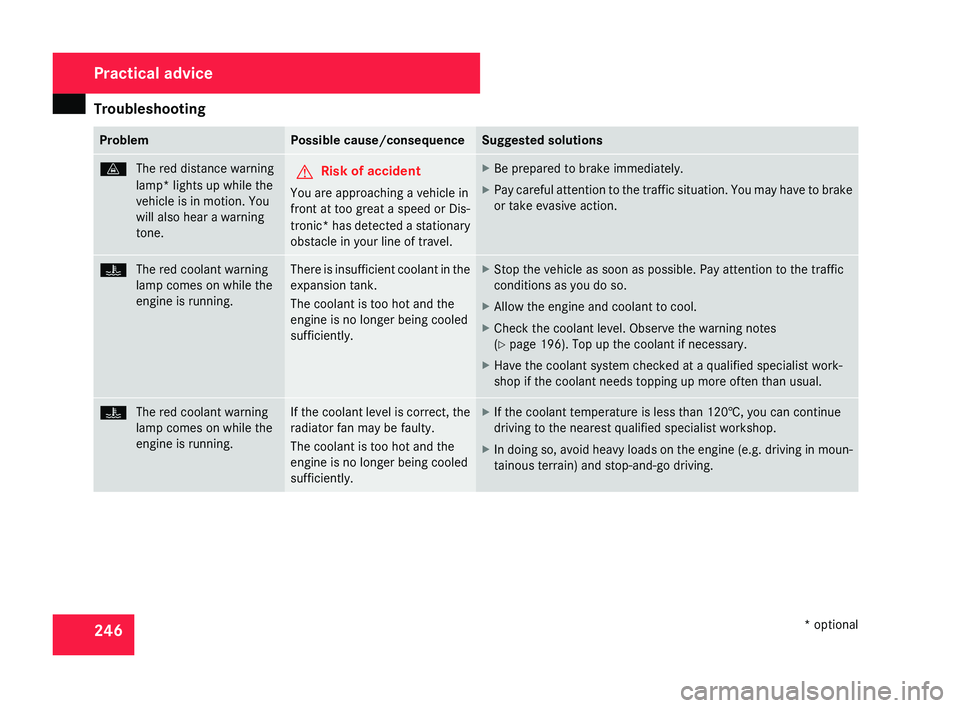
Troubleshooting
246 Problem Possible cause/consequence Suggested solutions
l
The red distance warning
lamp* lights up while the
vehicle is in motion. You
will also hear a warning
tone. G
Risk of accident
You are approaching a vehicle in
front at too great a speed or Dis-
tronic*
has detected a stationary
obstacle in your line of travel. X
Be prepared to brake immediately.
X Pay careful attention to the traffic situation. You may have to brake
or take evasive action. D
The red coolant warning
lamp comes on while the
engine is running. There is insufficient coolant in the
expansion tank.
The coolant is too hot and the
engine is no longer being cooled
sufficiently. X
Stop the vehicle as soon as possible. Pay attention to the traffic
conditions as you do so.
X Allow the engine and coolant to cool.
X Check the coolant level. Observe the warning notes
(Y page 196). Top up the coolant if necessary.
X Have the coolant system checked at a qualified specialist work-
shop if the coolant needs topping up more often than usual. D
The red coolant warning
lamp comes on while the
engine is running. If the coolant level is correct, the
radiator fan may be faulty.
The coolant is too hot and the
engine is no longer being cooled
sufficiently. X
If the coolant temperature is less than 120†, you can continue
driving to the nearest qualified specialist workshop.
X In doing so, avoid heavy loads on the engine (e.g. driving in moun-
tainous terrain) and stop-and-go driving. Practical advice
* optional
219_AKB; 2; 4, en-GB
mkalafa,
2007-11-13T09:28:36+01:00 - Seite 246
Page 250 of 329
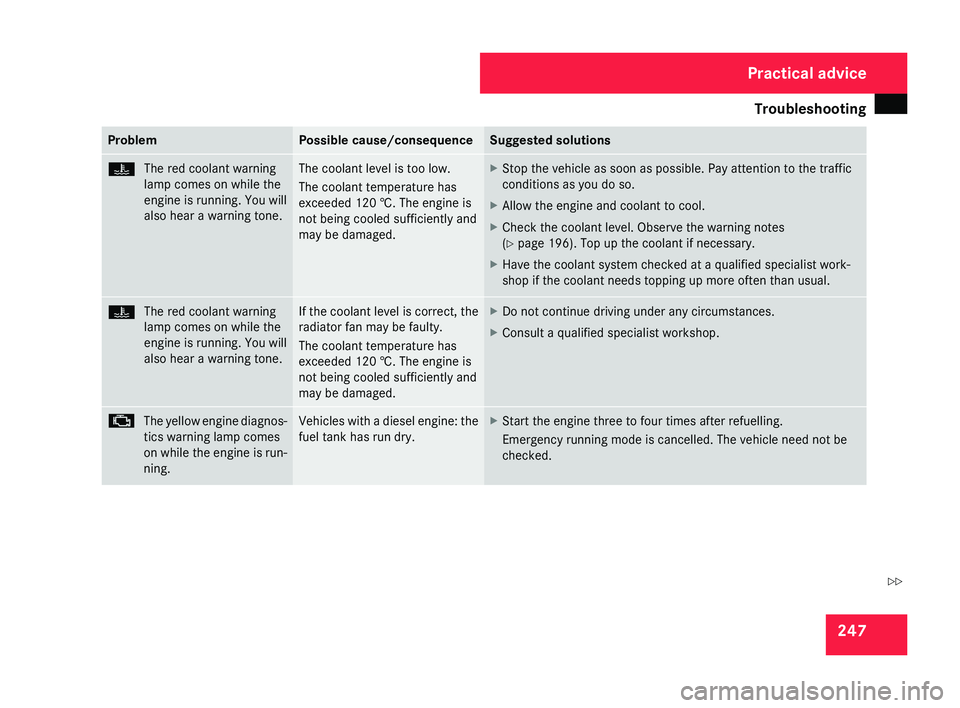
Troubleshooting
247Problem Possible cause/consequence Suggested solutions
D
The red coolant warning
lamp comes on while the
engine is running. You will
also hear a warning tone. The coolant level is too low.
The coolant temperature has
exceeded 120 †. The engine is
not being cooled sufficiently and
may be damaged. X
Stop the vehicle as soon as possible. Pay attention to the traffic
conditions as you do so.
X Allow the engine and coolant to cool.
X Check the coolant level. Observe the warning notes
(Y page 196). Top up the coolant if necessary.
X Have the coolant system checked at a qualified specialist work-
shop if the coolant needs topping up more often than usual. D
The red coolant warning
lamp comes on while the
engine is running. You will
also hear a warning tone. If the coolant level is correct, the
radiator fan may be faulty.
The coolant temperature has
exceeded 120 †. The engine is
not being cooled sufficiently and
may be damaged. X
Do not continue driving under any circumstances.
X Consult a qualified specialist workshop. ±
The yellow engine diagnos-
tics warning lamp comes
on
while the engine is run-
ning. Vehicles with a diesel engine: the
fuel tank has run dry. X
Start the engine three to four times after refuelling.
Emergency running mode is cancelled. The vehicle need not be
checked. Practical advice
219_AKB; 2; 4, en-GB
mkalafa,
2007-11-13T09:28:36+01:00 - Seite 247 Z
Page 251 of 329
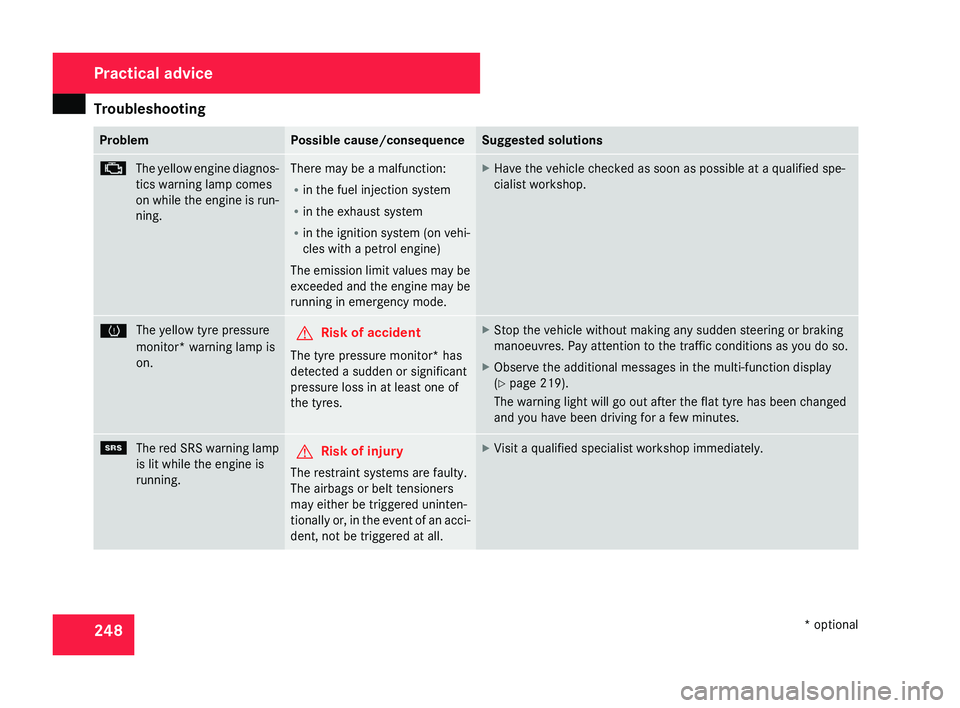
Troubleshooting
248 Problem Possible cause/consequence Suggested solutions
±
The yellow engine diagnos-
tics warning lamp comes
on
while the engine is run-
ning. There may be a malfunction:
R
in the fuel injection system
R in the exhaust system
R in
the ignition system (on vehi-
cles with a petrol engine)
The emission limit values may be
exceeded and the engine may be
running in emergency mode. X
Have the vehicle checked as soon as possible at a qualified spe-
cialist workshop. H
The yellow tyre pressure
monitor* warning lamp is
on. G
Risk of accident
The tyre pressure monitor* has
detected a sudden or significant
pressure loss in at least one of
the tyres. X
Stop the vehicle without making any sudden steering or braking
manoeuvres. Pay attention to the traffic conditions as you do so.
X Observe the additional messages in the multi-function display
(Y page 219).
The warning light will go out after the flat tyre has been changed
and you have been driving for a few minutes. 1
The red SRS warning lamp
is lit while the engine is
running. G
Risk of injury
The restraint systems are faulty.
The airbags or belt tensioners
may either be triggered uninten-
tionally
or, in the event of an acci-
dent, not be triggered at all. X
Visit a qualified specialist workshop immediately. Practical advice
* optional
219_AKB; 2; 4, en-GB
mkalafa,
2007-11-13T09:28:36+01:00 - Seite 248
Page 259 of 329
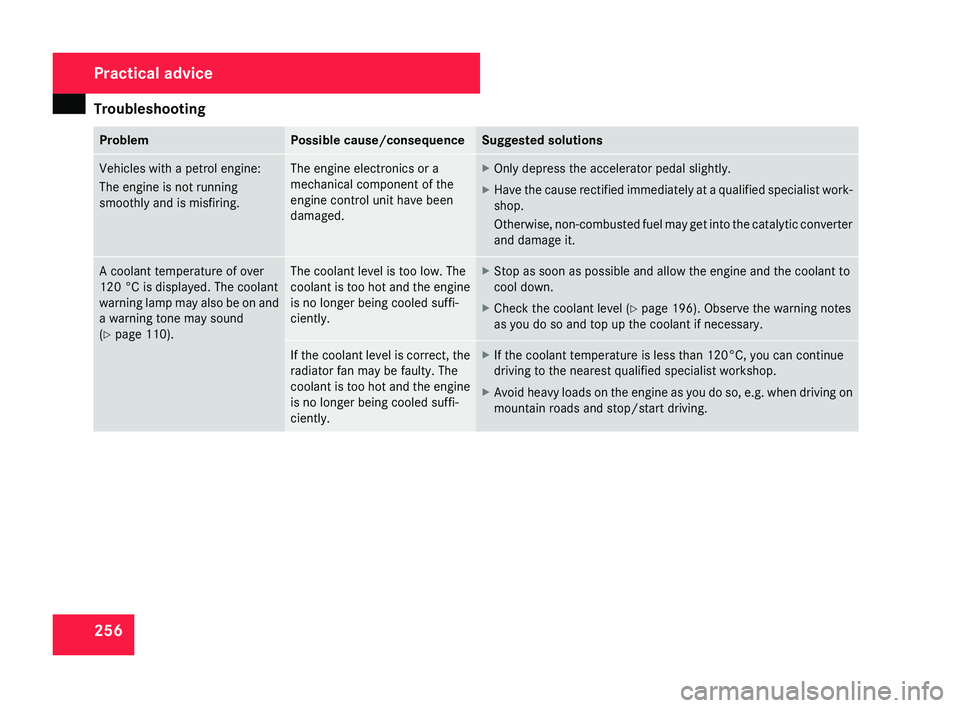
Troubleshooting
256 Problem Possible cause/consequence Suggested solutions
Vehicles with a petrol engine:
The engine is not running
smoothly and is misfiring. The engine electronics or a
mechanical component of the
engine control unit have been
damaged. X
Only depress the accelerator pedal slightly.
X Have the cause rectified immediately at a qualified specialist work-
shop.
Otherwise,
non-combusted fuel may get into the catalytic converter
and damage it. A coolant temperature of over
120 °C is displayed. The coolant
warning
lamp may also be on and
a warning tone may sound
(Y page 110). The coolant level is too low. The
coolant
is too hot and the engine
is no longer being cooled suffi-
ciently. X
Stop as soon as possible and allow the engine and the coolant to
cool down.
X Check the coolant level (Y page 196). Observe the warning notes
as you do so and top up the coolant if necessary. If the coolant level is correct, the
radiator fan may be faulty. The
coolant
is too hot and the engine
is no longer being cooled suffi-
ciently. X
If the coolant temperature is less than 120°C, you can continue
driving to the nearest qualified specialist workshop.
X Avoid heavy loads on the engine as you do so, e.g. when driving on
mountain roads and stop/start driving. Practical advice
219_AKB; 2; 4, en-GB
mkalafa,
2007-11-13T09:28:36+01:00 - Seite 256
Page 260 of 329
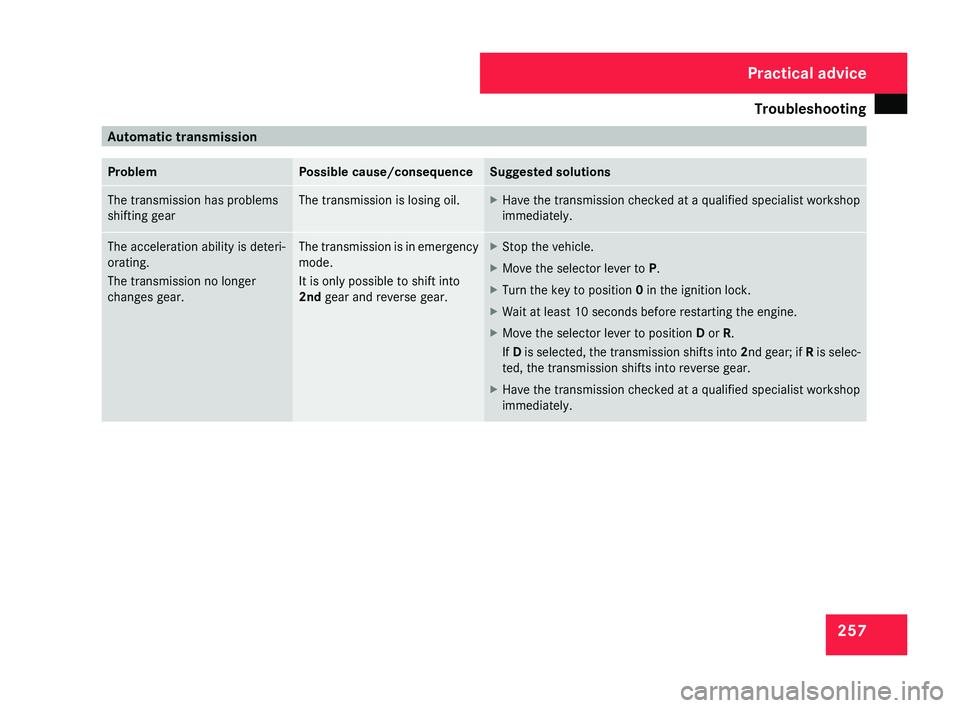
Troubleshooting
257Automatic transmission
Problem Possible cause/consequence Suggested solutions
The transmission has problems
shifting gear The transmission is losing oil. X
Have the transmission checked at a qualified specialist workshop
immediately. The acceleration ability is deteri-
orating.
The transmission no longer
changes gear. The transmission is in emergency
mode.
It is only possible to shift into
2nd gear and reverse gear. X
Stop the vehicle.
X Move the selector lever to P.
X Turn the key to position 0 in the ignition lock.
X Wait at least 10 seconds before restarting the engine.
X Move the selector lever to position D or R.
If D
is selected, the transmission shifts into 2nd gear; if R is selec-
ted, the transmission shifts into reverse gear.
X Have the transmission checked at a qualified specialist workshop
immediately. Practical advice
219_AKB; 2; 4, en-GB
mkalafa,
2007-11-13T09:28:36+01:00 - Seite 257