ESP MERCEDES-BENZ CLS COUPE 2008 Repair Manual
[x] Cancel search | Manufacturer: MERCEDES-BENZ, Model Year: 2008, Model line: CLS COUPE, Model: MERCEDES-BENZ CLS COUPE 2008Pages: 329, PDF Size: 29.26 MB
Page 290 of 329
Flat tyre
287MOExtended run-flat system*
The MOExtended run-flat system must only
be
used in conjunction with the tyre pressure
loss warning system or the tyre pressure
monitor*.
! The maximum permissible distance which
can be driven in run-flat mode depends on
the load in the vehicle. It is 50 km if the
vehicle is partially laden and 30 km if fully
laden.
The maximum range that can be driven in
emergency operation is measured from the
point at which the pressure loss warning
message appears in the multi-function dis-
play.
You must not exceed a maximum speed of
80 km/h.
i Vehicles featuring the MOExtended run-
flat system are not equipped with the
TIREFIT kit*.
It is therefore recommended to additionally
equip your vehicle with the TIREFIT kit*
when fitting tyres that do not feature run-
flat properties, e.g. winter tyres. i
A TIREFIT kit* is available from any quali-
fied specialist workshop, e.g. a Mercedes-
Benz Service Centre. G
Risk of accident
The handling characteristics of your vehicle
deteriorate in run-flat mode, for example:
R when cornering
R when braking
R when accelerating rapidly
Adapt your driving style accordingly and
avoid
sudden changes in direction and sud-
den acceleration, as well as driving over
obstacles (i.e. kerbs, potholes), and driving
off-road. This is particularly the case when
the vehicle is heavily laden.
The maximum permissible distance that
can be driven in run-flat mode depends to
a large extent on the loads placed on the
vehicle. It can be shorter due to high
speeds, a heavy load, sudden acceleration
and/or manoeuvring, the road surface con-
dition, outside temperature, etc., or further
if you drive carefully and conservatively.
Do not continue to drive in run-flat mode if:
R you hear banging noises
R the vehicle starts to shake R
you see smoke and smell rubber
R ESP ®
is intervening constantly
R there
are tears in the sidewalls of the tyre
After driving in run-flat mode, you must
have the rims checked for damage at a
qualified specialist workshop which has the
necessary specialist knowledge and tools
to carry out the work required. The faulty
tyre must be replaced in every case.
Mercedes-Benz recommends that you use
a Mercedes-Benz Service Centre for this
purpose. In particular, work relevant to
safety or on safety-related systems must be
carried out at a qualified specialist work-
shop.
i On a vehicle with MOExtended tyres, only
MOExtended spare tyres should be used.
These must be of the size specified for the
vehicle. Practical advice
* optional
219_AKB; 2; 4, en-GB
mkalafa,
2007-11-13T09:28:36+01:00 - Seite 287
Page 291 of 329
Battery
288 Battery
Notes on the battery
In order for the battery to achieve the maxi-
mum possible service life, it must always be
sufficiently charged.
Have the battery charge checked more fre-
quently if you use the vehicle mainly for short
trips or if you leave it standing idle for a
lengthy period.
To prevent damage from corrosion, only
replace the battery with one that has a central
ventilation cover.
Consult a Mercedes-Benz Service Centre if
you wish to leave your vehicle parked up for
a long period of time. G
Risk of injury
Comply with safety precautions and take
protective measures when handling batter-
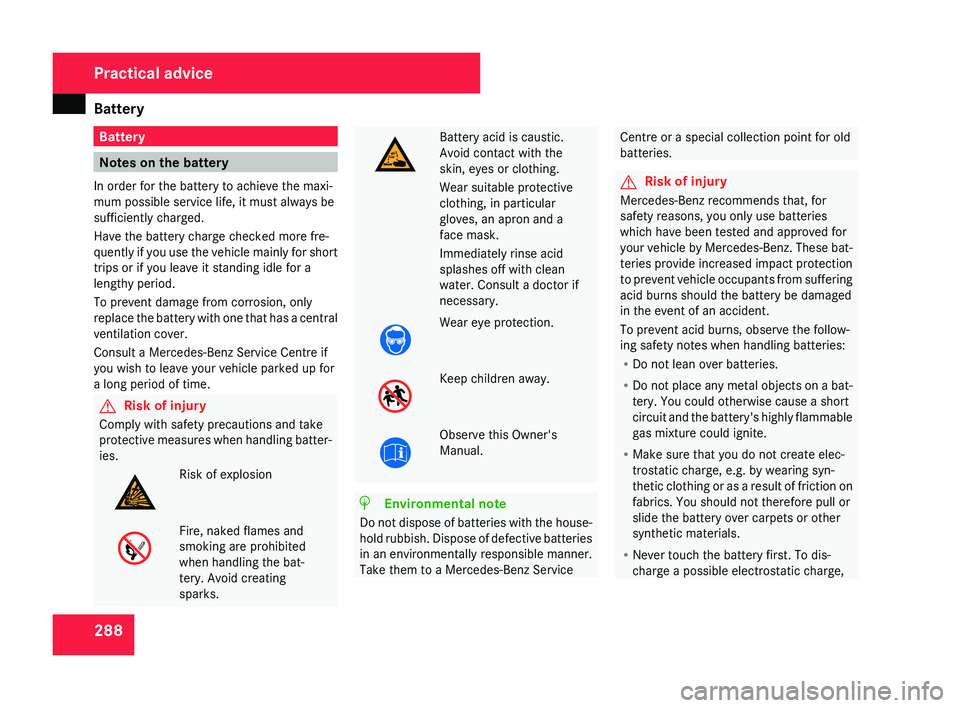
ies.Risk of explosion
Fire, naked flames and
smoking are prohibited
when handling the bat-
tery. Avoid creating
sparks.
Battery acid is caustic.
Avoid contact with the
skin, eyes or clothing.
Wear suitable protective
clothing, in particular
gloves, an apron and a
face mask.
Immediately rinse acid
splashes off with clean
water. Consult a doctor if
necessary.
Wear eye protection.
Keep children away.
Observe this Owner's
Manual.
H Environmental note
Do not dispose of batteries with the house-
hold rubbish. Dispose of defective batteries
in an environmentally responsible manner.
Take them to a Mercedes-Benz Service
Centre or a special collection point for old
batteries.
G Risk of injury
Mercedes-Benz recommends that, for
safety reasons, you only use batteries
which have been tested and approved for
your vehicle by Mercedes-Benz. These bat-
teries provide increased impact protection
to prevent vehicle occupants from suffering
acid burns should the battery be damaged
in the event of an accident.
To prevent acid burns, observe the follow-
ing safety notes when handling batteries:
R Do not lean over batteries.
R Do not place any metal objects on a bat-
tery. You could otherwise cause a short
circuit and the battery's highly flammable
gas mixture could ignite.
R Make sure that you do not create elec-
trostatic charge, e.g. by wearing syn-
thetic clothing or as a result of friction on
fabrics. You should not therefore pull or
slide the battery over carpets or other
synthetic materials.
R Never touch the battery first. To dis-
charge a possible electrostatic charge,
Practical advice
219_AKB; 2; 4, en-GB
mkalafa,
2007-11-13T09:28:36+01:00 - Seite 288
Page 296 of 329
Towing and tow-starting
293Towing and tow-starting
Points to remember
G
Risk of accident
If you tow the vehicle, you must use a rigid
towing bar if:
R the engine is not running
R there is a brake system malfunction
R the voltage supply or the vehicle's elec-
trical system is damaged
There
is no power assistance for the steer-
ing when the engine is not running. G
Risk of accident
The vehicle is braked when HOLD is activa-
ted.
Therefore, deactivate HOLD if the vehi-
cle is to be towed.
If you tow or tow-start another vehicle, its
weight must not exceed the maximum per-
missible gross vehicle weight of your vehi-
cle.
It is better to have the vehicle transported
than to have it towed.
When towing, observe the legal requirements
in all countries concerned. !
When towing, pull away slowly and with-
out
jerking. If the tractive power is too high,
the vehicles could be damaged. Do not use
the towing eye for recovery.
! You may tow the vehicle for a maximum
of 50 km. A towing speed of 50 km/h must
not be exceeded.
With towing distances over 50 km, the
entire vehicle needs to be lifted up and
transported.
! Only secure the tow cable or towing bar
to the towing eyes. You may otherwise
damage the vehicle.
R Vehicles with an automatic transmission
must not be tow-started.
R If the engine does not start, try jump-start-
ing it (Y page 291).
R If it is not possible to jump-start the vehicle,
have it towed to the nearest qualified spe-
cialist workshop, e.g. a Mercedes-Benz
Service Centre.
R If the vehicle has suffered transmission
damage, only tow it with the propeller shaft
disconnected.
R The selector lever must be in position N on
vehicles with automatic transmission. R
If you are towing the vehicle over a consid-
erable distance, this may only be done with
the rear axle raised.
R The ignition must be switched off if you are
towing the vehicle with the front/rear axle
raised. Intervention by ESP ®
could other-
wise damage the brake system.
R Before towing the vehicle, make sure that
the battery is connected and charged. Oth-
erwise:
-You cannot switch on the ignition
- You cannot move the selector lever to N
- You have no support when braking
i Switch off the automatic locking feature
before the vehicle is towed (Y page 127).
You could otherwise be locked out when
pushing or towing the vehicle. Practical advice
219_AKB; 2; 4, en-GB
mkalafa,
2007-11-13T09:28:36+01:00 - Seite 293
Page 297 of 329
Towing and tow-starting
294 Fitting the towing eye
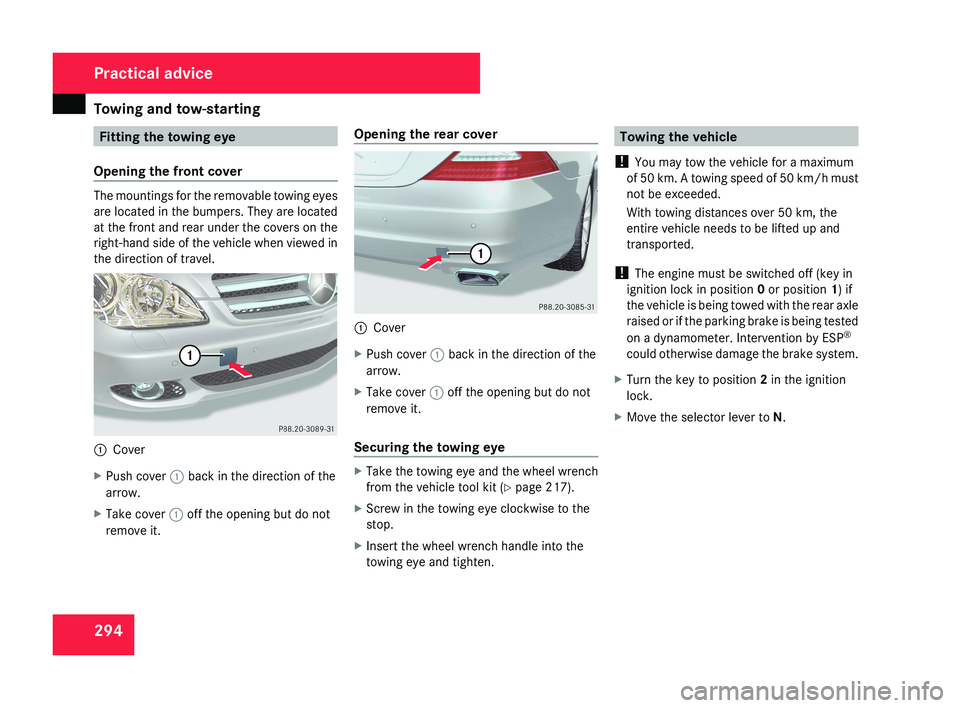
Opening the front cover The mountings for the removable towing eyes
are located in the bumpers. They are located
at the front and rear under the covers on the
right-hand side of the vehicle when viewed in
the direction of travel.
1
Cover
X Push cover 1 back in the direction of the
arrow.
X Take cover 1 off the opening but do not
remove it. Opening the rear cover
1
Cover
X Push cover 1 back in the direction of the
arrow.
X Take cover 1 off the opening but do not
remove it.
Securing the towing eye X
Take the towing eye and the wheel wrench
from the vehicle tool kit ( Y page 217).
X Screw in the towing eye clockwise to the
stop.
X Insert the wheel wrench handle into the
towing eye and tighten. Towing the vehicle
! You may tow the vehicle for a maximum
of 50 km. A towing speed of 50 km/h must
not be exceeded.
With towing distances over 50 km, the
entire vehicle needs to be lifted up and
transported.
! The engine must be switched off (key in
ignition lock in position 0 or position 1) if
the vehicle is being towed with the rear axle
raised or if the parking brake is being tested
on a dynamometer. Intervention by ESP ®
could otherwise damage the brake system.
X Turn the key to position 2 in the ignition
lock.
X Move the selector lever to N. Practical advice
219_AKB; 2; 4, en-GB
mkalafa,
2007-11-13T09:28:36+01:00 - Seite 294
Page 301 of 329
Genuine Mercedes-Benz parts
298 Introduction to technical data
i The technical data was determined in
accordance with EU directives. All data
applies to the vehicle's standard equip-
ment. The data may therefore differ for
vehicles with optional equipment. You can
obtain further information from a
Mercedes-Benz Service Centre. Genuine Mercedes-Benz parts
Mercedes-Benz tests genuine parts and con-
version parts and accessories which have
been
specifically approved for your vehicle for
their reliability, safety and suitability. Despite
ongoing market research, Mercedes-Benz is
unable to evaluate other parts. Mercedes-
Benz therefore accepts no responsibility for
the use of such parts in Mercedes-Benz vehi-
cles, even if they have been independently or
officially approved.
In Germany and some other countries, certain
parts are only officially approved for installa-
tion or modification if they comply with legal
requirements. All genuine Mercedes-Benz
parts meet this requirement. The use of non-
approved parts may invalidate the vehicle's
general operating permit. This is the case if:
R they cause a change of the vehicle type
from that for which the vehicle's general
operating permit was granted
R other road users could be endangered
R the emission or noise levels are adversely
affected
The use of non-approved parts could affect
your vehicle's operating safety. Mercedes-
Benz therefore recommends genuine Mercedes-Benz parts and conversion parts
and
accessories that have been approved for
your vehicle. H
Environmental note
Daimler also supplies reconditioned
assemblies
and parts which are of the same
quality as new parts and to which the same
warranty applies.
Genuine Mercedes-Benz parts and approved
conversion parts and accessories are availa-
ble from Mercedes-Benz Service Centres.
There, you can also receive advice about tech-
nical modifications and have the parts pro-
fessionally fitted.
Always quote the vehicle identification num-
ber and the engine number when ordering
genuine parts. You will find these numbers on
the vehicle data card in the Service Booklet
or on your vehicle's identification plates
(Y page 300). Technical data
219_AKB; 2; 4, en-GB
mkalafa,
2007-11-13T09:28:36+01:00 - Seite 298
Page 307 of 329
Tyres and wheels
304 Tyres and wheels
! For safety reasons, Mercedes-Benz rec-
ommends that you only use tyres which
have been approved by Mercedes-Benz
specifically
for your vehicle. These tyres are
specially adapted for use with the control
systems, such as ABS or ESP ®
, and are
marked as follows:
R MO = Mercedes-Benz Original
R MOE = Mercedes-Benz Original Exten-
ded* (with run-flat characteristics)
If you use other tyres, Mercedes-Benz can-
not accept any responsibility for damage
which may occur. Information about tyres
can be obtained from any Mercedes-Benz
Service Centre.
! If you fit tyres other than those tested and
recommended by Mercedes-Benz, charac-
teristics such as handling, noise levels and
fuel consumption, etc. may be adversely
affected. In addition, when driving with a
load, dimensional variations and different
tyre deformation characteristics could
cause the tyres to make contact with the
bodywork and axle components. This could
result in damage to the tyres or the vehicle. i
Further information about tyres and
wheels can be obtained from any
Mercedes-Benz Service Centre.
You
will find a table of tyre pressures on the
inside of your vehicle's fuel filler flap . You
will find further information about tyre pres-
sures in the "Operation" section
(Y page 200). Technical data
* optional
219_AKB; 2; 4, en-GB
mkalafa,
2007-11-13T09:28:36+01:00 - Seite 304
Page 314 of 329
Service products and capacities
311Service products and capacities
Notes on service products and capaci-
ties
Service products are:
R fuels (e.g. petrol, diesel)
R lubricants
(e.g. engine oil, transmission oil)
R coolant
R brake fluid
R windscreen washer fluid
Mercedes-Benz recommends that you only
use those products which have been tested
and specially approved by Mercedes-Benz for
your vehicle and are listed in the Mercedes-
Benz Owner's Manual in the relevant chapter
since:
R parts and service products are matched
R damage caused by the use of non-approved
service products is not covered by the war-
ranty
You can recognise service products approved
by Mercedes-Benz by the following inscrip-
tion on the containers:
R MB-Freigabe (e.g. MB-Freigabe 229.51)
R MB Approval (e.g. MB Approval 229.51) Other designations or recommendations that
relate
to a level of quality or a specification in
accordance with an MB Approval have not
necessarily been approved by Mercedes-
Benz.
You can obtain further information from any
Mercedes-Benz Service Centre. G
Risk of injury
When handling, storing and disposing of
any service products, please observe the
relevant regulations, as you could other-
wise endanger yourself and others.
Keep
service products away from children.
To protect your health, do not allow service
products to come into contact with your
eyes or open wounds. See a doctor imme-
diately if any service product is swallowed. H
Environmental note
Dispose of service products in an environ-
mentally-responsible manner. Fuels
G
Risk of explosion
Fuel is highly flammable. Fire, naked flames
and
smoking are therefore prohibited when
handling fuels.
Before refuelling, turn off the engine and
the auxiliary heating*. G
Risk of injury
Do not allow fuel to come into contact with
skin or clothing.
Allowing fuels to come into direct contact
with your skin or inhaling fuel vapours is
damaging to your health.
Tank capacity Total capacity 80 l
Of which reserve
fuel
On AMG vehicles Approx. 8 – 9 l
Approx. 14 l !
Do
not use petrol to refuel vehicles with a
diesel engine. Do not use diesel to refuel
vehicles with a petrol engine. Never mix
diesel with petrol. Even small amounts of Technical data
* optional
219_AKB; 2; 4, en-GB
mkalafa,
2007-11-13T09:28:36+01:00 - Seite 311 Z
Page 315 of 329
Service products and capacities
312the wrong fuel result in damage to the
injection system. Damage resulting from
adding
the wrong fuel is not covered by the
warranty.
More information about refuelling and fuels
can be found in the "Operation" section. Introduction to fuel consumption
The vehicle will use more fuel than usual in
the following situations: R
at very low temperatures
R in urban traffic
R on short trips
R in mountainous terrain
! Do not use any special additives, as they
can cause malfunctions and engine dam-
age.
Damage resulting from the use of such
additives is not covered by the Mercedes-
Benz warranty. H
Environmental note
CO 2 (carbon dioxide) is the gas which sci-
entists
believe to be principally responsible
for global warming (the greenhouse effect).
Your vehicle's CO 2 emissions are directly
related to fuel consumption and therefore
depend on: R
efficient use of the fuel by the engine
R driving style
R other
non-technical factors, such as envi-
ronmental influences or road conditions
You can minimise your vehicle's CO 2 emis-
sions by driving carefully and having it serv-
iced regularly. Technical data
219_AKB; 2; 4, en-GB
mkalafa,
2007-11-13T09:28:36+01:00 - Seite 312