ECU MERCEDES-BENZ CLS COUPE 2008 Owners Manual
[x] Cancel search | Manufacturer: MERCEDES-BENZ, Model Year: 2008, Model line: CLS COUPE, Model: MERCEDES-BENZ CLS COUPE 2008Pages: 329, PDF Size: 29.26 MB
Page 11 of 329
8
Head restraint
Adjusting (front) . . . . . . . . . . . . . 76, 77
Adjusting (rear) . . . . . . . . . . . . . . . . 78
Luxury . . . . . . . . . . . . . . . . . . . . 76, 77
NECK-PRO . . . . . . . . . . . . . . . . . . . . 49
Resetting triggered head
restraints . . . . . . . . . . . . . . . . . . . . 269
Heating
see Air conditioning
High-pressure cleaners . . . . . . . . . . . 211
HOLD . . . . . . . . . . . . . . . . . . . . . . . . . . 144
Display message . . . . . . . . . . . . . . 226 I
Immobiliser
. . . . . . . . . . . . . . . . . . . . . 61
Indicator and warning lamp Brakes (red) . . . . . . . . . . . . . . . . . . 245
Coolant . . . . . . . . . . . . . . . . . . . . . 246
Distronic (red) . . . . . . . . . . . . 138, 245
Engine diagnostic . . . . . . . . . . . . . . 247
ESP ®
. . . . . . . . . . . . . . . . . . . . 59, 244
LIM . . . . . . . . . . . . . . . . . . . . . . . . . 133
PASSENGER AIRBAG OFF . . . . 51, 242
Reserve fuel . . . . . . . . . . . . . . . . . . 250
Seat belt . . . . . . . . . . . . . . . . . . . . . 249
SRS . . . . . . . . . . . . . . . . . . . . . 43, 248
Tyre pressure monitor . . . . . . . . . . 248
Indicator and warning lamps . . . . . . 244 Indicator lamp
see Indicator and warning lamp
Instrument cluster . . . . . . . . . . . . . . 109
Overview . . . . . . . . . . . . . . . . . . . . . 26
Selecting the language (on-board
computer) . . . . . . . . . . . . . . . . . . . 123
Instrument lighting . . . . . . . . . . . . . . 110
Interior lighting . . . . . . . . . . . . . . . . . . 96
Ambient (on-board computer) . . . . 126
Automatic control . . . . . . . . . . . . . . 96
Delayed switch-off (on-board
computer) . . . . . . . . . . . . . . . . . . . 126
Manual control . . . . . . . . . . . . . . . . . 96
Reading lamp . . . . . . . . . . . . . . . . . . 96
Interior motion sensor . . . . . . . . . . . . 62
ISOFIX child seat securing system . . 55 J
Jack Operation
. . . . . . . . . . . . . . . . . . . . 283
Storage location . . . . . . . . . . . . . . . 217
Jump-starting . . . . . . . . . . . . . . . . . . . 291
Jump leads . . . . . . . . . . . . . . . . . . . 291 K
Key
. . . . . . . . . . . . . . . . . . . . . . . . . . . . 66
Changing the battery . . . . . . . . . . . 270
Checking the battery . . . . . . . . . . . 270
Convenience closing . . . . . . . . . . . 101 Display message
. . . . . . . . . . . . . . 238
Factory setting . . . . . . . . . . . . . . 66, 67
Loss . . . . . . . . . . . . . . . . . . . . . . . . 261
Malfunction . . . . . . . . . . . . . . . . . . 261
Modifying the programming . . . . . . . 66
KEYLESS GO . . . . . . . . . . . . . . . . . . . . . 67
Button . . . . . . . . . . . . . . . . . . . . . . . 74
Changing the battery . . . . . . . . . . . 270
Checking the battery . . . . . . . . . . . 270
Closing the boot lid automatically . . 73
Convenience closing . . . . . . . . . . . 101
Factory settings . . . . . . . . . . . . . . . . 68
Losing the key . . . . . . . . . . . . . . . . 264
Malfunction . . . . . . . . . . . . . . . . . . 263
Modifying the programming . . . . . . . 68
Starting the engine . . . . . . . . . . . . 102
Key positions
Key . . . . . . . . . . . . . . . . . . . . . . . . . . 74
KEYLESS GO . . . . . . . . . . . . . . . . . . 74
Kickdown . . . . . . . . . . . . . . . . . . 107, 109 L
Lamps see Indicator and warning lamp
Language
Selecting (on-board computer) . . . 123
Licence plate lighting
Display message . . . . . . . . . . . . . . 235
Lighting
see Lights Index
219_AKB; 2; 4, en-GB
mkalafa,
2007-11-13T09:28:36+01:00 - Seite 8
Page 48 of 329
Occupant safety
45
ates rapidly in a longitudinal direction
during the initial stages of the collision
R In certain situations if the vehicle over-
turns, if the system determines that it can
provide additional protection
When the belt tensioners are triggered, you
will hear a bang, which will not cause any
harm to your hearing, and a small amount of
powder
may also be released. The 1 warn-
ing lamp lights up. G
Risk of injury
If the seat belt tensioners have been trig-
gered, they provide no additional protec-
tion in the event of another accident.
Therefore,
have belt tensioners which have
been triggered replaced at a qualified spe-
cialist workshop.
Comply with safety regulations when dis-
posing of belt tensioners. Any Mercedes-
Benz Service Centre can provide details of
these regulations.
Airbags Airbag deployment slows down and restricts
the movement of the vehicle occupant.
When
the airbags are deployed, you will hear
a bang, which will not cause any harm to your hearing, and a small amount of powder may
also be released. The
1 warning lamp
lights up.
The SRS/AIRBAG symbol indicates the loca-
tion of the airbags. G
Risk of injury
Airbags provide additional protection; they
are not, however, a substitute for the seat
belts.
Observe the following notes to reduce the
risk of serious or even fatal injury if an air-
bag is deployed:
R Vehicle occupants — in particular preg-
nant woman — must wear their seat belt
correctly at all times and lean back
against their backrest, which should be
positioned
as close to the vertical as pos-
sible. The head restraint must support
the back of the seat occupant's head at
about eye level.
R Always secure children less than
1.50 m tall or under 12 years of age in
suitable child restraint systems.
R All vehicle occupants must select a seat
position that is as far away from the air-
bag as possible. The driver's seat posi-
tion must allow the vehicle to be driven safely. The driver's chest should be as far
away
from the middle of the driver's front
airbag cover as possible.
R Move the front-passenger seat as far
back as possible, in particular, if a child
is secured in a child restraint system on
the seat.
R Vehicle occupants – in particular, chil-
dren – must not lean their head into the
area of the window in which the sidebag/
windowbag is deployed.
R Rearward-facing child restraint systems
must not be fitted to the front-passenger
seat unless the front-passenger front air-
bag has been disabled. On the front-
passenger seat, the front-passenger
front airbag is only deactivated if a child
restraint system with automatic child
seat recognition is fitted to the front-
passenger seat*. The 5 PASSENGER
AIRBAG OFF warning lamp must be lit
constantly.
If either the rearward-facing child
restraint system or the front-passenger
seat* of your vehicle does not have auto-
matic child seat recognition, children
must be secured in a child restraint sys- Safety
* optional
219_AKB; 2; 4, en-GB
mkalafa,
2007-11-13T09:28:36+01:00 - Seite 45 Z
Page 49 of 329
Occupant safety
46 tem on a suitable seat in the rear. If you
secure a forward-facing child restraint
system to the front-passenger seat, you
must move the front-passenger seat as
far back as possible.
R Make sure there are no heavy or sharp-
edged objects in pockets of clothing.
R Do
not lean forwards, e.g. over the cover
of the driver's front airbag, particularly
when the vehicle is in motion.
R Do not put your feet on the dashboard.
R Only hold the steering wheel by the rim.
This allows the airbag to inflate fully. You
could be injured if the airbag is deployed
and you are holding the inside of the
steering wheel.
R Do not lean on the doors from inside the
vehicle.
R Make sure that there are no people, ani-
mals or objects between the vehicle
occupants and the area of deployment of
the airbag.
R Do not place any objects between the
seat backrest and the door. R
Do not hang any hard objects, for exam-
ple
coat hangers, on the grab handles or
coat hooks.
R Do not attach accessories, e.g. cup hold-
ers, to the doors.
It is not possible to rule out the risk of inju-
ries caused by an airbag due to the high
speed at which the airbag is required to
deploy. G
Risk of injury
The airbag's functionality can only be guar-
anteed if the following parts are not cov-
ered and no badges or stickers are
attached to them:
R Padded steering wheel boss
R Front-passenger front airbag cover
R Outer side of front seats
R Rear door trims G
Risk of injury
When an airbag deploys, a small amount of
powder
is released. The powder may cause
short-term breathing difficulties to persons
suffering from asthma or other pulmonary
conditions. In order to prevent possible breathing dif-
ficulties you should leave the vehicle as
soon
as it is safe to do so. You can also open
the window to allow fresh air to enter the
interior. The powder does not constitute a
health hazard and does not indicate that
there is a fire in the vehicle. G
Risk of injury
The airbag parts are hot after the airbag has
been deployed. Do not touch them, other-
wise you may burn yourself.
Occupants
are not protected by the airbags
in the event of another accident. Have the
airbags checked at a qualified specialist
workshop.
Front airbags
The front airbags are designed to increase
protection for the driver's and front-
passenger head and chest. Safety
219_AKB; 2; 4, en-GB
mkalafa,
2007-11-13T09:28:36+01:00 - Seite 46
Page 52 of 329
Occupant safety
49NECK-PRO head restraint
NECK-PRO head restraints are designed to
increase protection to the driver's and front-
passenger's head and neck. To this end, the
head restraints on the driver's and front-
passenger seats are moved forwards and
upwards
in the event of a rear-end collision in
the direction of travel. This provides better
head support. G
Risk of injury
Head restraint covers prevent the NECK-
PRO head restraints from triggering cor-
rectly. Consequently, the NECK-PRO head
restraints
cannot provide the intended level
of protection. Do not use head restraint
covers.
If the NECK-PRO head restraints are triggered
in an accident, you must reset the head
restraints on the driver's and front-passenger
seats (Y page 269). Head restraints that have
been triggered are tilted forwards. Children in the vehicle
If a child is riding in your vehicle, secure the
child using a child restraint system appropri-
ate to the size and age of the child and
approved for Mercedes-Benz vehicles. Pref-
erably,
you should fit the restraint system on
a suitable rear seat. Preferably, you should fit
it to a suitable rear seat. Make sure that the
child is strapped in throughout the trip.
You can obtain information about the correct
child restraint system from any Mercedes-
Benz Service Centre.
i It is advisable to use Mercedes-Benz care
products to clean child restraint systems.
You can obtain information about this from
any Mercedes-Benz Service Centre. G
Risk of injury
Do not leave children unsupervised in the
vehicle, even if they are secured in a child
restraint system. The children could injure
themselves on parts of the vehicle. They
could also be seriously or even fatally
injured by prolonged exposure to extreme
heat or cold.
Do
not expose the child restraint system to
direct sunlight. The metallic parts of the child restraint system could heat up and the
child could be burned by them.
If
the children open the door other persons
could be injured. They could get out and
injure themselves or be injured by a passing
vehicle.
You should also observe the information on
HOLD; see the index. G
Risk of injury
An unsecured or incorrectly positioned load
increases the risk of injury to the child in
the event of:
R an accident
R a braking manoeuvre
R a sudden change of direction
Do not carry heavy or hard objects inside
the vehicle unless they are secured. You
will
find further information under "Loading
guidelines" in the index.
Child restraint systems Mercedes-Benz recommends that you only
use the child restraint systems listed on
(Y page 54). Safety
219_AKB; 2; 4, en-GB
mkalafa,
2007-11-13T09:28:36+01:00 - Seite 49 Z
Page 53 of 329
Occupant safety
50 G
Risk of injury
To reduce the risk of serious or even fatal
injury to the child in the event of a sudden
change in direction, braking or an accident:
R Children less than 1.50 m tall and under
twelve years of age must always be
secured in special child restraint systems
on a suitable vehicle seat. This is neces-
sary because the seat belts are not
designed for children of this size.
R Do not secure children under twelve
years of age on the front-passenger seat.
Exception: the child is secured in a vehi-
cle with automatic child seat recognition
on the front-passenger seat* and is
secured in a child restraint system with
automatic child seat recognition.
R If you fit a child restraint system to the
front-passenger seat, you must move the
front-passenger seat as far back as pos-
sible.
R Never allow children to travel sitting on
the lap of another occupant. Due to the
forces occurring in the event of an acci-
dent, heavy braking or during a sudden
change in direction, it would not be pos-
sible to restrain the child. The child would be thrown against parts of the vehicle
interior and be seriously or even fatally
injured.
G
Risk of injury
If the child restraint system is not fitted
correctly to a suitable vehicle seat, it can-
not perform its protective function. The
child cannot be restrained in the event of
an accident, heavy braking or sudden
changes of direction. This may lead to seri-
ous or even fatal injuries. For this reason,
when fitting a child restraint system
observe the manufacturer's installation
instructions and correct use of the child
restraint system.
Child restraint systems should preferably
be fitted to the rear seats. The child is gen-
erally better protected there.
The entire base of the child restraint system
must always be resting on the seat cushion.
Never place objects, e.g. a cushion, under
the child restraint system.
Only use child restraint systems with their
original covers. Only replace damaged cov-
ers with genuine Mercedes-Benz covers.
For safety reasons, you should only use
child restraint systems which have been approved for use in Mercedes-Benz vehi-
cles.
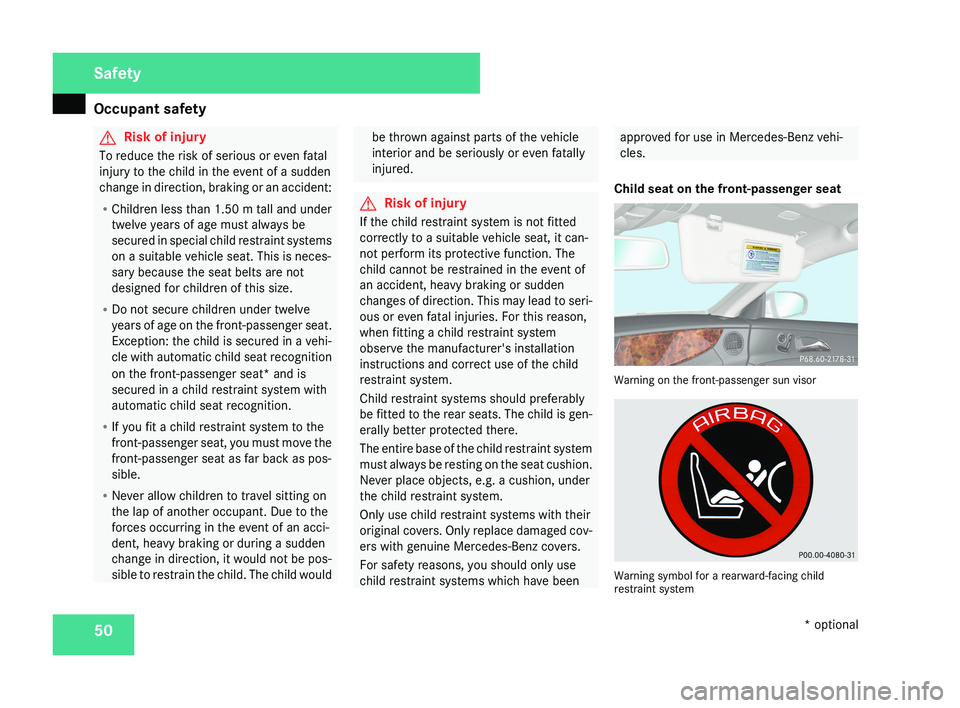
Child seat on the front-passenger seatWarning on the front-passenger sun visor
Warning symbol for a rearward-facing child
restraint system
Safety
* optional
219_AKB; 2; 4, en-GB
mkalafa,
2007-11-13T09:28:36+01:00 - Seite 50
Page 54 of 329
Occupant safety
51G
Risk of injury
If the front-passenger front airbag is not
disabled:
R a child secured in a child restraint system
on the front-passenger seat can be seri-
ously and even fatally injured by the
front-passenger airbag deploying. This is
especially likely if the child is in the imme-
diate vicinity of the front-passenger front
airbag when it is deployed.
R a child must never be secured on the
front-passenger seat in a rearward-facing
child restraint system. Only secure a
rearward-facing child restraint system on
a suitable rear seat.
R always move the front-passenger seat to
the rearmost position if you secure a
child in a forward-facing child restraint
system on the front-passenger seat.
The front-passenger front airbag is not dis-
abled:
R on vehicles without automatic child seat
recognition in the front-passenger seat*
R on vehicles with automatic child seat rec-
ognition on the front-passenger seat* if there is no child restraint system with
automatic child seat recognition fitted to
the front-passenger seat.
R on vehicles with automatic child seat rec-
ognition on the front-passenger seat*, if
the 5 PASSENGER AIRBAG OFF warn-
ing lamp is not lit.
To draw attention to this danger, there is an
appropriate warning sticker on the dash-
board as well as on both sides of the sun
visor on the front-passenger side.
Information about recommended child
restraint systems is available at any
Mercedes-Benz Service Centre.
Automatic child seat recognition on the
front-passenger seat*
If your vehicle does not have automatic child
seat recognition on the front-passenger seat,
this is indicated by a special sticker.
The sticker is affixed to the side of the dash-
board on the front-passenger side. It is visible
when you open the front-passenger door.
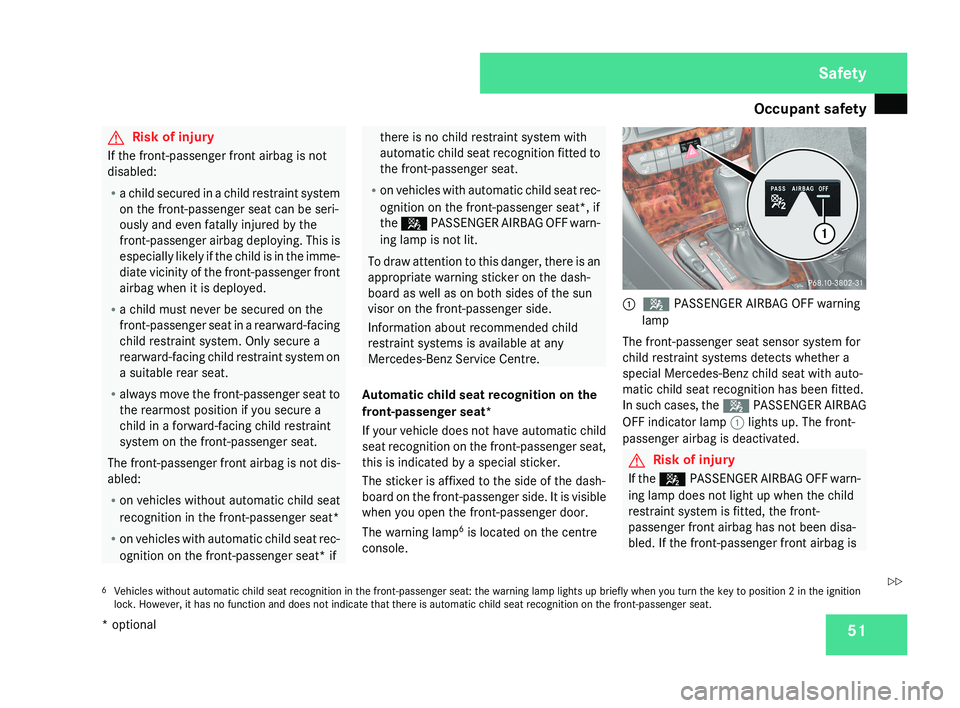
The warning lamp 6
is located on the centre
console.1 5 PASSENGER AIRBAG OFF warning
lamp
The front-passenger seat sensor system for
child restraint systems detects whether a
special Mercedes-Benz child seat with auto-
matic child seat recognition has been fitted.
In such cases, the 5 PASSENGER AIRBAG
OFF indicator lamp 1 lights up. The front-
passenger airbag is deactivated.
G Risk of injury
If the 5 PASSENGER AIRBAG OFF warn-
ing lamp does not light up when the child
restraint system is fitted, the front-
passenger front airbag has not been disa-
bled. If the front-passenger front airbag is
6 Vehicles without automatic child seat recognition in the front-passenger seat: the warning lamp lights up briefly when you turn the key to position 2 in the ignition
lock. However, it has no function and does not indicate that there is automatic child seat recognition on the front-passenger seat.
Safety
* optional
219_AKB; 2; 4, en-GB
mkalafa,
2007-11-13T09:28:36+01:00 - Seite 51
Z
Page 58 of 329
Occupant safety
55Weight categories and
ages Manufacturer Type Approval number Daimler order num-
ber Automatic child seat
recognition
Group I: 9 to 18 kg;
Between approximately 8
months and 4 years Britax-Römer DUO PLUS E1 03 301133 A 000 970 11 00 Yes
A 000 970 16 00
No
8 Group II/III: 15 to 36 kg;
Between approximately
3½ and 12 years Britax-Römer KID E1 03 301148 A 000 970 12 00 Yes
A 000 970 17 00
No
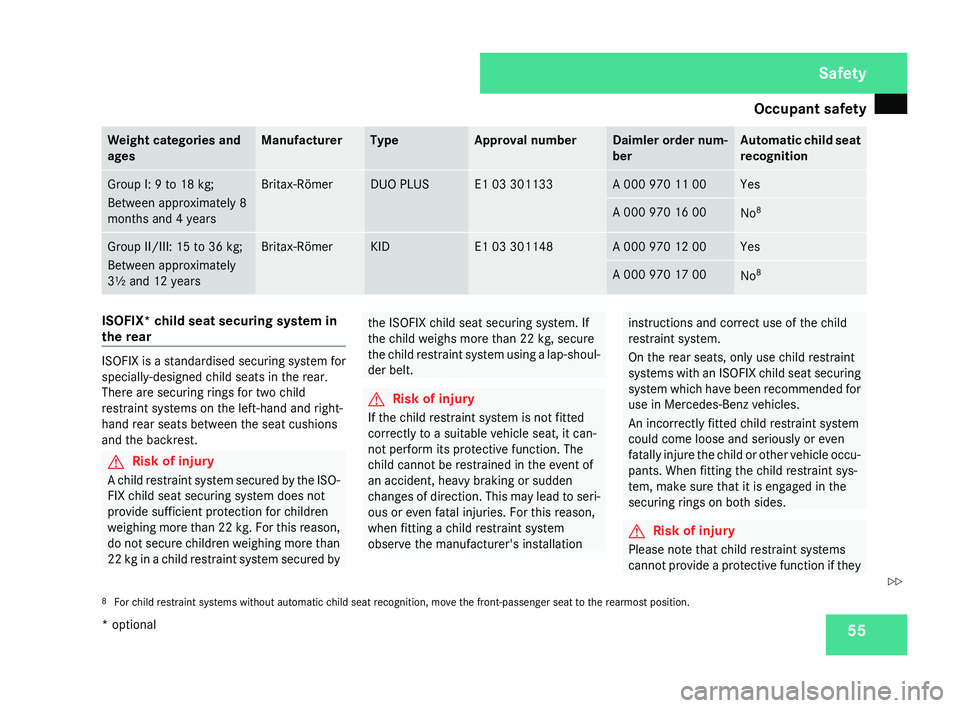
8 ISOFIX* child seat securing system in
the rear
ISOFIX is a standardised securing system for
specially-designed child seats in the rear.
There are securing rings for two child
restraint systems on the left-hand and right-
hand rear seats between the seat cushions
and the backrest.
G
Risk of injury
A child restraint system secured by the ISO-
FIX child seat securing system does not
provide sufficient protection for children
weighing
more than 22 kg. For this reason,
do not secure children weighing more than
22 kg in a child restraint system secured by the ISOFIX child seat securing system. If
the child weighs more than 22 kg, secure
the
child restraint system using a lap-shoul-
der belt. G
Risk of injury
If the child restraint system is not fitted
correctly to a suitable vehicle seat, it can-
not perform its protective function. The
child cannot be restrained in the event of
an accident, heavy braking or sudden
changes
of direction. This may lead to seri-
ous or even fatal injuries. For this reason,
when fitting a child restraint system
observe the manufacturer's installation instructions and correct use of the child
restraint system.
On the rear seats, only use child restraint
systems
with an ISOFIX child seat securing
system which have been recommended for
use in Mercedes-Benz vehicles.
An incorrectly fitted child restraint system
could come loose and seriously or even
fatally injure the child or other vehicle occu-
pants. When fitting the child restraint sys-
tem, make sure that it is engaged in the
securing rings on both sides. G
Risk of injury
Please note that child restraint systems
cannot
provide a protective function if they
8 For child restraint systems without automatic child seat recognition, move the front-passenger seat to the rearmost position. Safety
* optional
219_AKB; 2; 4, en-GB
mkalafa,
2007-11-13T09:28:36+01:00 - Seite 55 Z
Page 59 of 329
Occupant safety
56 or their retaining systems are damaged or
have been subjected to a load in an acci-
dent. This can result in serious or even fatal
injury to the secured child in the event of
an accident, heavy braking or a sudden
change in direction.
For this reason, have child restraint sys-
tems and their anchorages that are dam-
aged or which have been subjected to a
load in an accident checked immediately at
a qualified specialist workshop.1
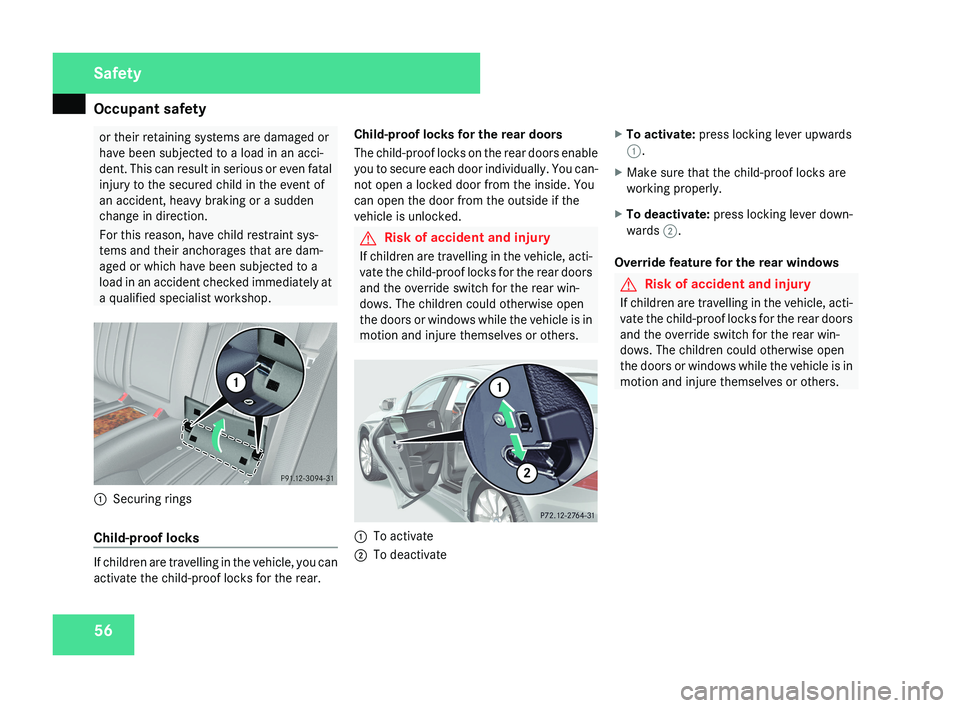
Securing rings
Child-proof locks
If children are travelling in the vehicle, you can
activate the child-proof locks for the rear. Child-proof locks for the rear doors
The child-proof locks on the rear doors enable
you to secure each door individually. You can-
not open a locked door from the inside. You
can open the door from the outside if the
vehicle is unlocked.
G
Risk of accident and injury
If children are travelling in the vehicle, acti-
vate the child-proof locks for the rear doors
and the override switch for the rear win-
dows. The children could otherwise open
the doors or windows while the vehicle is in
motion and injure themselves or others.
1 To activate
2 To deactivate X
To activate: press locking lever upwards
1.
X Make sure that the child-proof locks are
working properly.
X To deactivate: press locking lever down-
wards 2.
Override feature for the rear windows
G Risk of accident and injury
If children are travelling in the vehicle, acti-
vate the child-proof locks for the rear doors
and the override switch for the rear win-
dows. The children could otherwise open
the doors or windows while the vehicle is in
motion and injure themselves or others.
Safety
219_AKB; 2; 4, en-GB
mkalafa,
2007-11-13T09:28:36+01:00 - Seite 56
Page 78 of 329
Seats
75Seats
Depending on the vehicle's equipment, seat
adjustments can be made either manually/
electrically or electrically*. G
Risk of injury
The seats can still be adjusted when there
is no key in the ignition lock. For this rea-
son, children should never be left unsuper-
vised in the vehicle. They could become
trapped by a seat adjustment movement. G
Risk of accident
Only adjust the driver's seat when the vehi-
cle is stationary. You will otherwise be dis-
tracted from the road and traffic conditions
and you could lose control of the vehicle as
a result of the seat moving. This could
cause an accident. G
Risk of injury
Make sure that nobody can become trap-
ped as you adjust the seat.
Observe the notes concerning the airbag
system.
Secure children as recommended; see the
"Children in the vehicle" section. !
When you move the seats, make sure that
there are no objects in the footwell or
behind the seats. Otherwise, you could
damage the seats and the objects.
i The head restraints in the front seats are
fitted with the NECK-PRO system
(Y page 49). For this reason, it is not pos-
sible to remove the head restraints from
the front seats.
For design reasons, the rear-compartment
head restraints cannot be removed.
Please contact a Mercedes-Benz Service
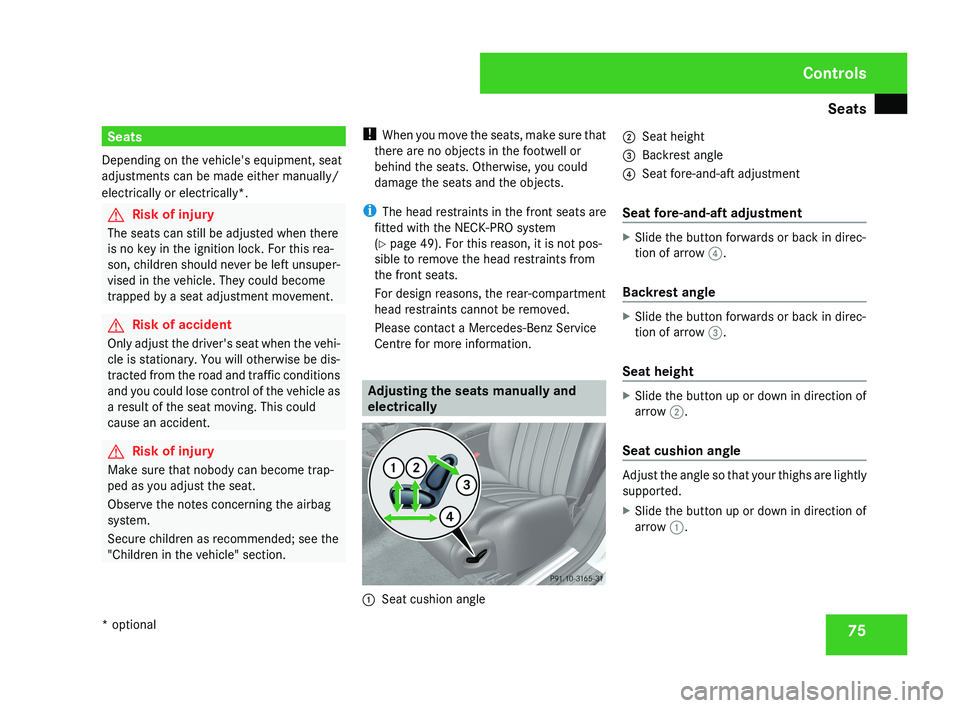
Centre for more information. Adjusting the seats manually and
electrically1
Seat cushion angle 2
Seat height
3 Backrest angle
4 Seat fore-and-aft adjustment
Seat fore-and-aft adjustment
X Slide the button forwards or back in direc-
tion of arrow 4.
Backrest angle
X Slide the button forwards or back in direc-
tion of arrow 3.
Seat height
X Slide the button up or down in direction of
arrow 2.
Seat cushion angle
Adjust the angle so that your thighs are lightly
supported.
X Slide the button up or down in direction of
arrow 1.
Controls
* optional
219_AKB; 2; 4, en-GB
mkalafa,
2007-11-13T09:28:36+01:00 - Seite 75
Page 91 of 329
Seat belts
88 Seat belts
Seat belts are the most effective means of
restraining the movement of vehicle occu-
pants in the event of an accident. This
reduces
the risk of vehicle occupants coming
into contact with the vehicle interior. Wearing seat belts
G
Risk of injury
A seat belt which is not worn correctly, or
which
has not been engaged in the seat belt
buckle correctly, cannot perform its inten-
ded protective function. Under certain cir-
cumstances this could cause severe or
even fatal injuries.
Make sure that all occupants – in particular,
pregnant women – wear their seat belt cor-
rectly at all times.
R The seat belt must pass closely over your
body and must not be twisted. You
should therefore avoid wearing bulky
clothing (e.g. a winter coat). The shoulder
belt section must be routed across the
middle of your shoulder – on no account
across your neck or under your arm – and
pulled tight against your upper body. The
lap belt must always pass across your lap as low down as possible, i.e. over your
hip joints – not across your abdomen. If
necessary, push down the belt strap
slightly
and then retighten it in the roll-up
direction.
R Do not route the belt strap across sharp
or fragile objects, especially if these are
located on or in your clothing, e.g. spec-
tacles, pencils, keys, etc. The seat belt
strap could be damaged and tear in an
accident and you or other vehicle occu-
pants could be injured.
R Only one person should use each seat
belt at any one time. Children must never
travel sitting on the lap of other occu-
pants. It would not be possible to restrain
the child in the event of a sudden change
in direction, braking or an accident. This
could result in severe or even fatal inju-
ries to the child and other occupants.
R Persons less than 1.50 m tall cannot
wear the seat belts correctly. For this
reason, secure persons less than 1.50 m
tall in specially designed, suitable
restraint systems.
R Children less than 1.50 m tall or under
12 years of age cannot wear the seat
belts properly. Therefore, always secure these children in suitable child restraint
systems on suitable vehicle seats. You
can find more information under "Chil-
dren in the vehicle" in the "Safety" sec-
tion of the Owner's Manual. Follow the
manufacturer's installation instructions
when fitting the child restraint system.
R Do
not secure any objects with a seat belt
if the seat belt is also being used by one
of the vehicle's occupants. G
Risk of injury
The seat belt does not offer the intended
level of protection unless the backrest is
almost vertical. Under certain circumstan-
ces this could cause severe or even fatal
injuries.
Before starting a journey, make sure that
the seat is properly adjusted and that the
backrest is almost vertical. G
Risk of injury
A dirty or damaged seat belt or a seat belt
that has been subjected to a load in an
accident or modified no longer offers the
intended level of protection. Under certain
circumstances this could cause severe or
even fatal injuries. Controls
219_AKB; 2; 4, en-GB
mkalafa,
2007-11-13T09:28:36+01:00 - Seite 88