belt MERCEDES-BENZ CLS COUPE 2012 User Guide
[x] Cancel search | Manufacturer: MERCEDES-BENZ, Model Year: 2012, Model line: CLS COUPE, Model: MERCEDES-BENZ CLS COUPE 2012Pages: 373, PDF Size: 9.12 MB
Page 52 of 373
during an acciden
tand yo uoro thervehicle
occupant scould be injured.
R Only one person should use each seat belt
at any one time. Children must never travel
sitting on the lap of another occupant .The
child will not be secured in the event of an
accident, heavy braking or sudden change
of direction. This may result in the child or
other occupant sbeing seriously or fatally
injured.
R Person sunder 1.50m tallcanno twear the
seat belt scorrectly. For this reason secure
person sless than 1.50 mtall in specially
designed ,suitable restraint systems.
R Children unde r1.50 mtall and younger
than twelve years of age canno twear the
seat belts correctly. For this reason secure
them in special suitable child restraint sys-
tems installed on asuitable seat. Additional
information can be found in the Operating
Instructions in the chapter "Safety", "Chil-
dren in the Vehicle". Observe the installa-
tion instructions of the child restraint sys-
tem manufacturer.
R Do not secure an objec twith aseat belt if
the seat belt is also being used by one of
the vehicle's occupants. G
WARNING
The seat belt does not offer the intended level
of protection unless the backrest is almost
vertical. Under certain circumstances, this
could cause severe or even fatal injuries in the
event of an accident.
Befor estarting ajourney, make sure that the
seat is properly adjusted and that the back-
rest is almost vertical. G
WARNING
Ad irtyord amaged seat belt or one that has
been modified or subjected to aload in an
accident no longer offers the intended level of
protection. Under certain circumstances, this
could cause sever eoreven fatal injuries in the
even tofana ccident. For this reason
,chec kregularly that the seat
belts are not damaged or dirty.
Always have damaged seat belts or seat belts
that have been subjected to aload in an acci-
dent replaced at aqualified specialist work-
shop.
For safety reasons, Mercedes-Benz recom-
mends that you only use seat belts which have
been approved by Mercedes-Benz for your
vehicle.
Seat belts are the most effective means of
restraining the movemen tofvehicle occu-
pants in the event of an accident. This
reduces the risk of vehicle occupant scoming
into contact with parts of the vehicle interior.
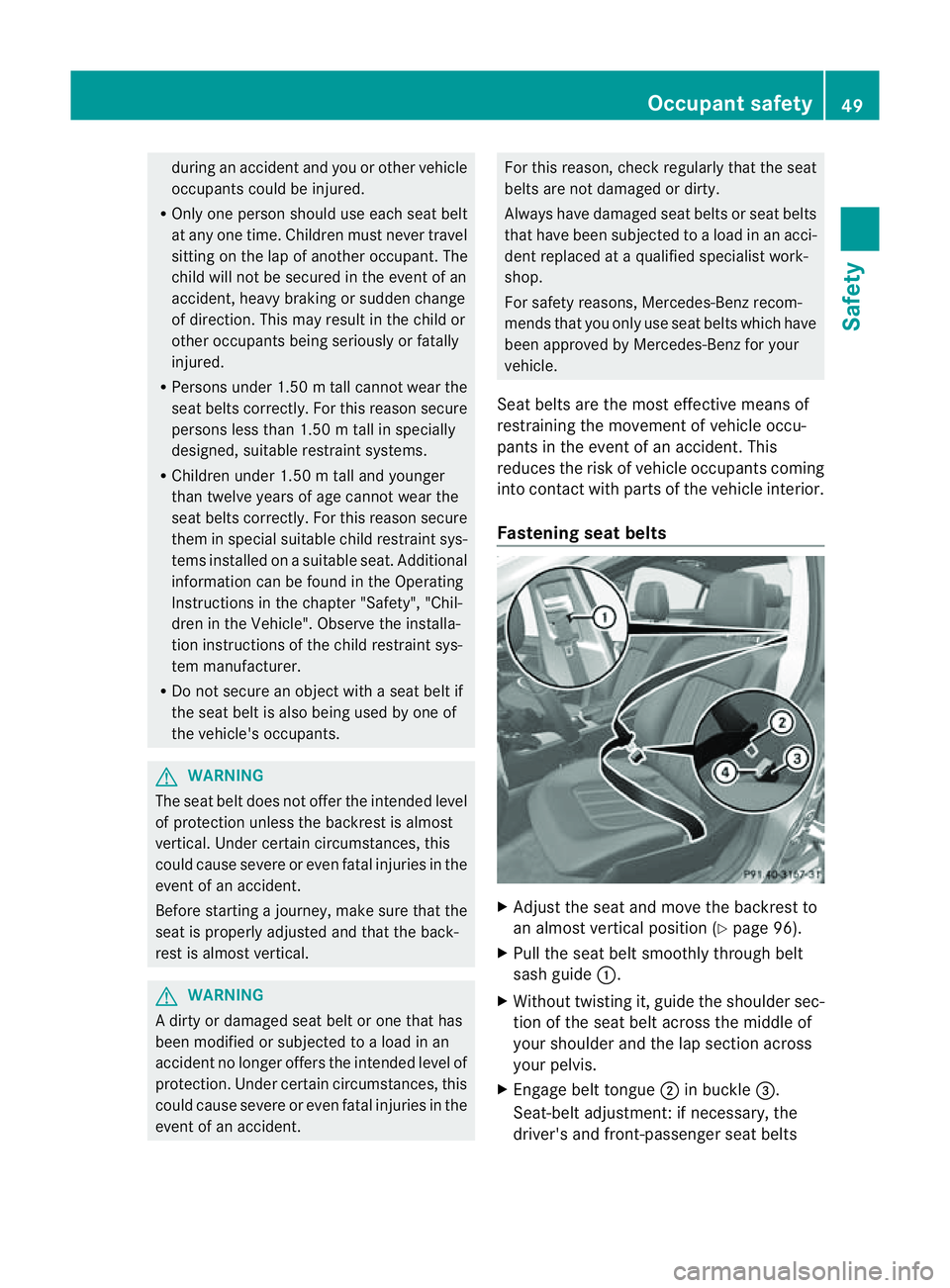
Fastening seat belts X
Adjust the seat and move the backrest to
an almost vertical position (Y page 96).
X Pull the seat belt smoothly through belt
sash guide :.
X Without twistin git, guide the shoulder sec-
tion of the seat belt across the middle of
your shoulder and the lap section across
your pelvis.
X Engage belt tongue ;in buckle =.
Seat-belt adjustment:ifn ecessary, the
driver's and front-passenger seat belts Occupant safety
49Safety Z
Page 53 of 373
automaticall
yadjust to th eupper body
(Y page 50).
X If necessary, adjust the seat belt to the
appropriate height (Y page 50).
X If necessary, pull upwards on the shoulder
section of the seat belt to tighten the belt
across your body.
For more information about releasing the seat
belt with release button ?,see "Releasing
seat belts" (Y page 50).
Seat belt adjustment The seat-belt adjustment function adjusts the
driver' sand front-passenger seat belt to the
upper body of the occupants.
The belt strap is tightened slightly when:
R you engage the belt tongue in the belt
buckle and you then turn the key to position
2in the ignition lock.
R the key is in position 2in the ignition lock
and you then engage the belt tongue in the
buckle.
The seat-belt adjustment will apply acertain
tightenin gforc eifa ny slack is detected
between the occupant and the seat belt. Do
not hold on to the seat belt tightly while it is
adjusting. You can switc hthe belt adjustment
on and off in the on-board computer
(Y page 227).
The seat-belt adjustment is an integral part of
the PRE-SAFE ®
convenience function. More
information about PRE-SAFE ®
can be found
under "PRE-SAFE ®
(preventative occupant
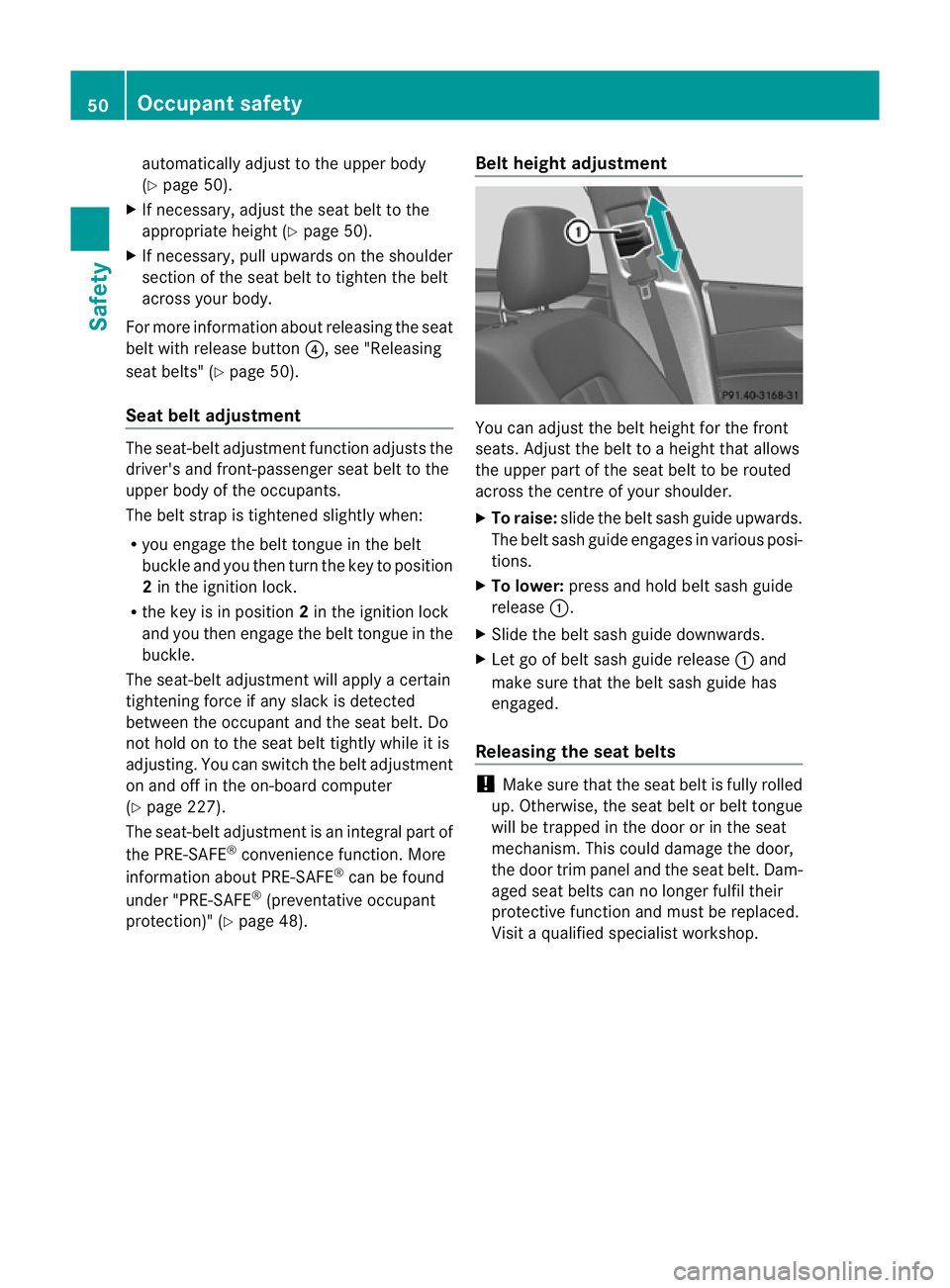
protection)" (Y page 48). Belt height adjustment You can adjust the belt height for the front
seats. Adjust the belt to
aheight that allows
the upper part of the seat belt to be routed
across the centre of your shoulder.
X To raise: slide the belt sash guide upwards.
The belt sash guide engages in various posi-
tions.
X To lower: press and hold belt sash guide
release :.
X Slide the belt sash guide downwards.
X Let go of belt sash guide release :and
make sure that the belt sash guide has
engaged.
Releasing the seat belts !
Make sure that the seat belt is fully rolled
up. Otherwise, the seat belt or belt tongue
will be trapped in the door or in the seat
mechanism. This could damage the door,
the door trim panel and the seat belt. Dam-
aged seat belts can no longer fulfil their
protective function and must be replaced.
Visit aqualified specialist workshop. 50
Occupant safetySafety
Page 54 of 373
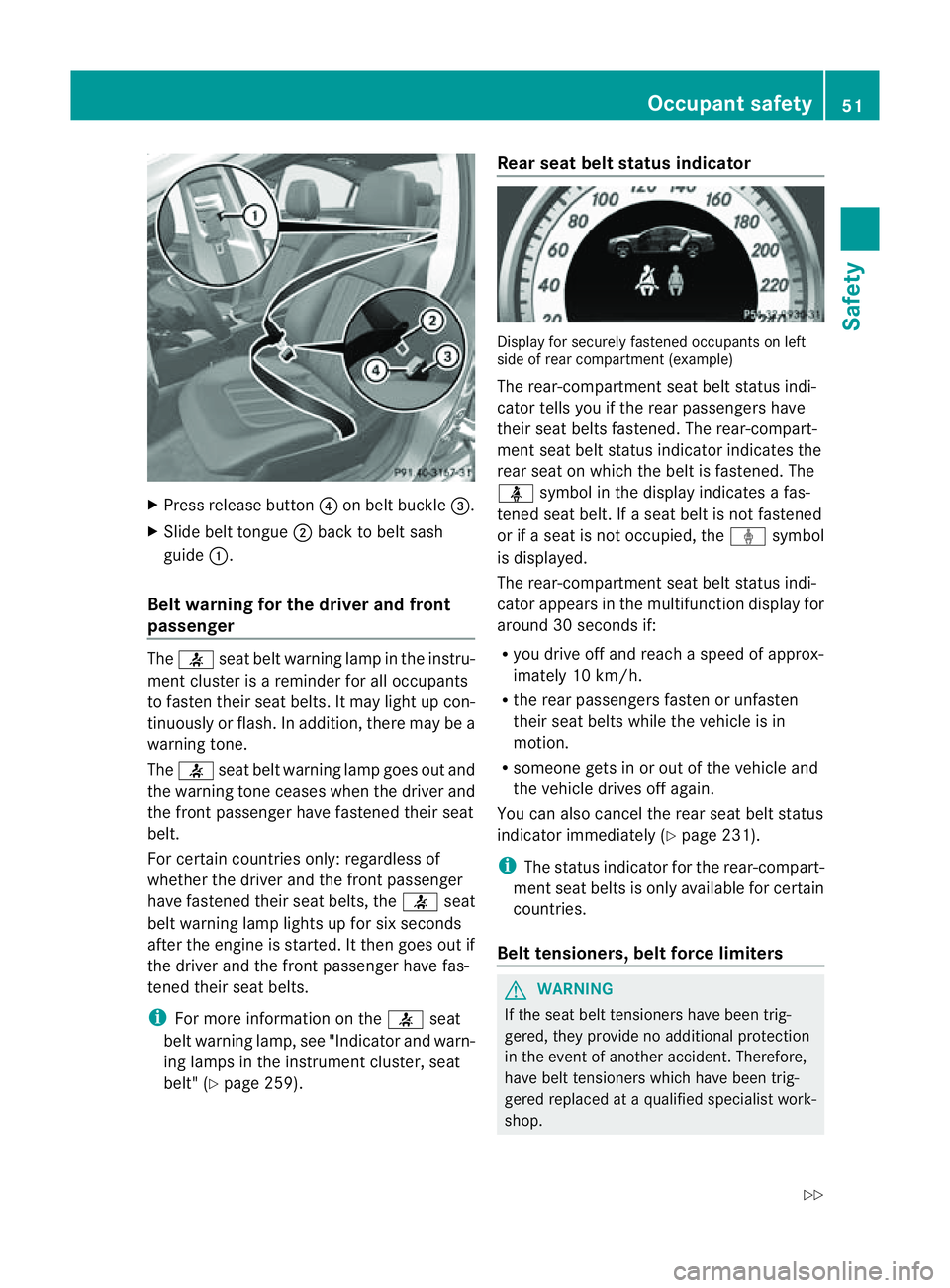
X
Press release button ?on belt buckle =.
X Slide belt tongue ;back to belt sash
guide :.
Belt warning for the driver and front
passenger The
7 seat belt warning lamp in the instru-
ment cluster is areminder for all occupants
to fasten their seat belts. It may light up con-
tinuously or flash. In addition, there may be a
warning tone.
The 7 seat belt warning lamp goes out and
the warning tonec eases when the driver and
the frontp assenger have fastened their seat
belt.
For certain countries only: regardless of
whether th edriver and th efront passenger
have fastened their seat belts, the 7seat
beltw arning lamp light supfor six seconds
after th eengineiss tarted. It then goes out if
th ed river and th efront pa ssenger have fas-
tene dtheir seat belts.
i For mor einformatio nonthe7 seat
belt warning lamp, see "Indicato rand warn-
ing lamps in the instrument cluster ,seat
belt" (Y page 259). Rea
rseatb elts tatus indicator Display for securel
yfastene doccupants on left
side of rea rcompartmen t(example)
The rear-compartment seat belt status indi-
cator tells you if the rear passengers have
their seat belts fastened. The rear-compart-
ment seat belt status indicato rindicate sthe
rea rseat on which the belt is fastened. The
ü symbol in the display indicates afas-
tened seat belt. If aseat belt is not fastened
or if aseat is not occupied, the ýsymbol
is displayed.
The rear-compartment seat belt status indi-
cator appears in the multifunction display for
around 30 seconds if:
R you drive off and reach aspeed of approx-
imately 10 km/h.
R the rear passengers fasten or unfasten
their seat belts while the vehicle is in
motion.
R someon egets in or out of the vehicle and
the vehicle drives off again.
You can also cancel the rear seat belt status
indicator immediately (Y page 231).
i The status indicator for the rear-compart-
ment seat belts is only available for certain
countries.
Belt tensioners, belt force limiters G
WARNING
If the seat belt tensioners have been trig-
gered, they provide no additional protection
in the event of another accident. Therefore,
have belt tensioners which have been trig-
gered replaced at aqualified specialist work-
shop. Occupant safety
51Safety
Z
Page 55 of 373
Comply wit
hsafety regulation swhen dispos-
ing of belt tensioners. Any Mercedes-Benz
Service Centre can provide details of these
regulations.
! If the front-passenger seat is not occu-
pied, do not engage the seat belt tongue in
the buckle on the front-passenger seat.
Otherwise, the belt tensioner could be trig-
gered in the event of an accident.
The seat belts are fitted with belt tensioners.
The belt tensioners tighten the seat belts in
an accident, pulling them close against the
body.
Belt tensioners do not correct incorrects eat
positions or incorrectly fastened seat belts.
Belt tensioners do not pull vehicle occupants
back towards the backrest.
If the seat belt is also fitted with abelt force
limiter and this is triggered, the force exerted
by the seat belt on the vehicle occupant is
reduced.
The belt force limiters for the front seats are
synchronised with the front airbags, which
take on apart of the deceleration force. This
results in the force exerted on the occupant
being distributed over agreater area.
The belt tensioners can only be activated
when:
R the ignition is switched on.
R the restraint systems are operational; see
"SRS warning lamp" (Y page 41).
R the belt tongue is engaged in the buckle on
each of the three-point seat belts in front.
R
The belt tensioners on the seats in the rear
compartmenta re triggeredindependently of
the lock status of the seat belts.
The beltt ensioners are triggered depending
on the type and severit yofanaccident:
R if, in the event of ahead-on or rear-en dcol-
lision the vehicle decelerates or acceler- ates rapidly in
alongitudinal direction dur-
ing the initial stages of the impact
R if, in the event of aside impact, on the side
opposite the impact the vehicle deceler-
ates or accelerates rapidly in alateral direc-
tion
R in certain situation swhere the vehicle over-
turn sand the system determines that it can
provide additional protection
If the airbags are deployed, you will hear a
bang, and asmall amount of powder may also
be released. Only in rare cases will the bang
affect your hearing. The powder that is
released generally does not constitute a
health hazard. The 6SRS warning lamp
lights up. Children in the vehicle
Child restraint systems
Important safet ynotes G
WARNING
To reduce the risk of serious or even fatal
injur ytot he child in the event of asudden
change in direction, brakin goranaccident:
R children less than 1.5 0mtall and under
twelve years of age must alway sbesecured
in special child restraint systems on asuit-
able vehicle seat. This is necessary
because the seat belts are not designed for
children.
R Do not drive with achild secured in arear-
ward-facin gchild restraint system on the
front-passenger seat. Exception: if the vehi-
cle is equipped with automatic child seat
recognition on the front-passenger seat
and the child is secured in achild restraint
system with transponder sfor automatic
child seat recognition
R if you secure aforward-facing child
restraint system to the front-passenger 52
Children in thev
ehicleSafety
Page 59 of 373
i
If the front-passenger front airbag is dis-
abled by the automatic child seat recogni-
tion, the following remaine nabledont he
front-passenger side:
R the sidebag
R the pelvisbag
R the windowbag
R the belt tensioner
ISOFIX chil dseat securing system for
th er ears eats G
WARNING
Ac hild restraint system secured by the ISOFIX
child seat securing system does not provide
sufficient protection for children weighing
more than 22 kg. For this reason, do not
secure children weighing more than 22 kg in
ac hild restraint system secured by the ISOFIX
child seat securing system. If the child weighs
more than 22 kg, secure the child restraint
system with the vehicle seat belt as well. In
addition, when fittingac hild restraint system,
be sure to observe the manufacturer's instal-
lation instructions and the instructions for
correct use of the child restraint system. G
WARNING
Please note that if child restraint systems, or
their retaining systems, are damaged or sub-
jected to aload in an accident, they may not
be able to provide their protective function.
This could result in serious or even fatal inju-
ries to the secured child in the event of an
accident, heavy braking or asudden change
in direction.
For this reason, have child restraint systems
and their anchorages which have been dam-
aged or subjected to aload in an accident
checked immediately at aqualified specialist
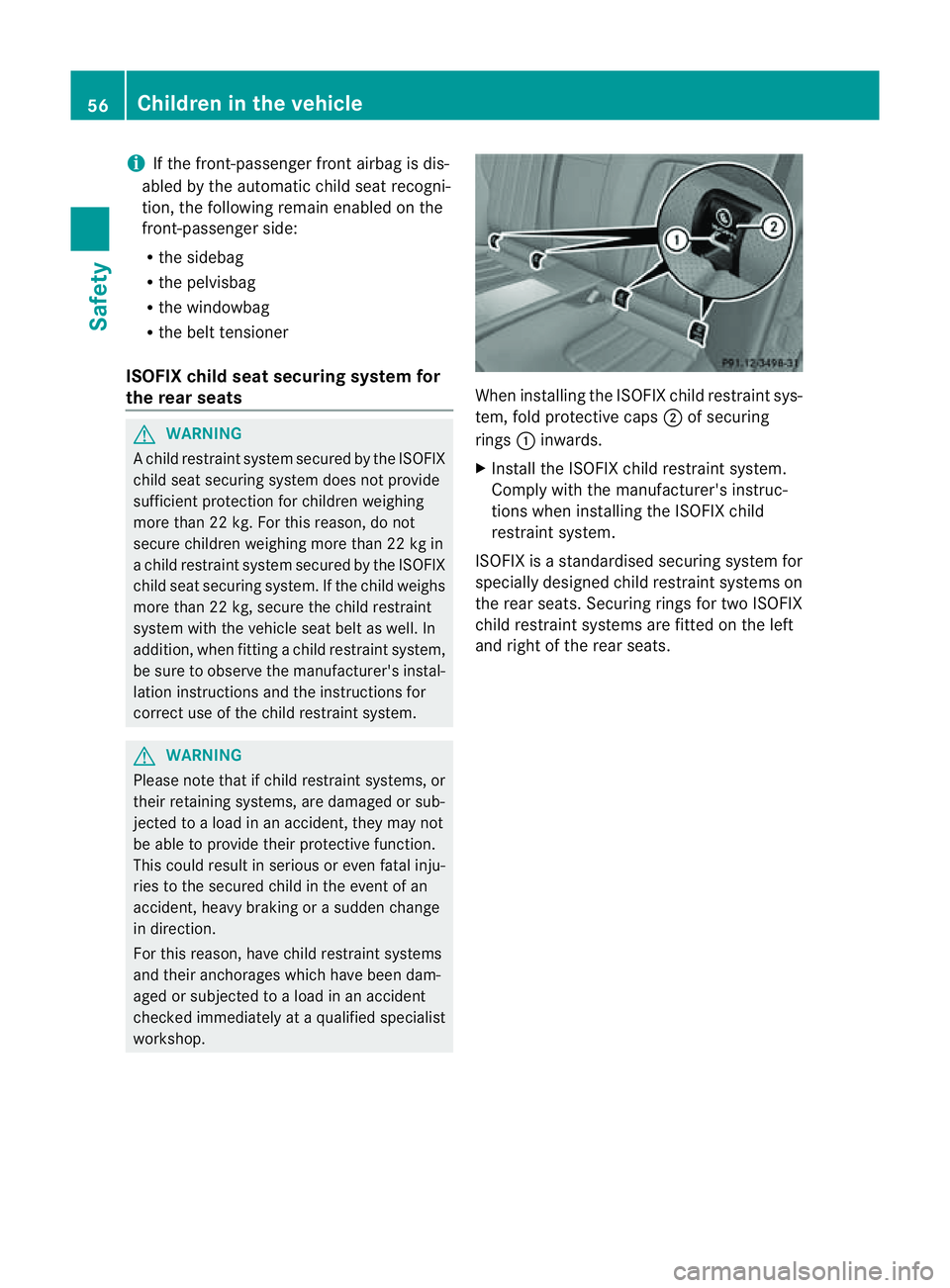
workshop. When installing the ISOFIXc
hild restraint sys-
tem, fold protective caps ;of securing
rings :inwards.
X Install the ISOFIXc hild restraint system.
Comply with the manufacturer's instruc-
tions when installing the ISOFIXc hild
restraint system.
ISOFIXisas tandardised securing system for
specially designed child restraint systems on
the rear seats. Securing rings for two ISOFIX
child restraint systems are fitted on the left
and right of the rear seats. 56
Children in the vehicleSafety
Page 60 of 373
Top Tether
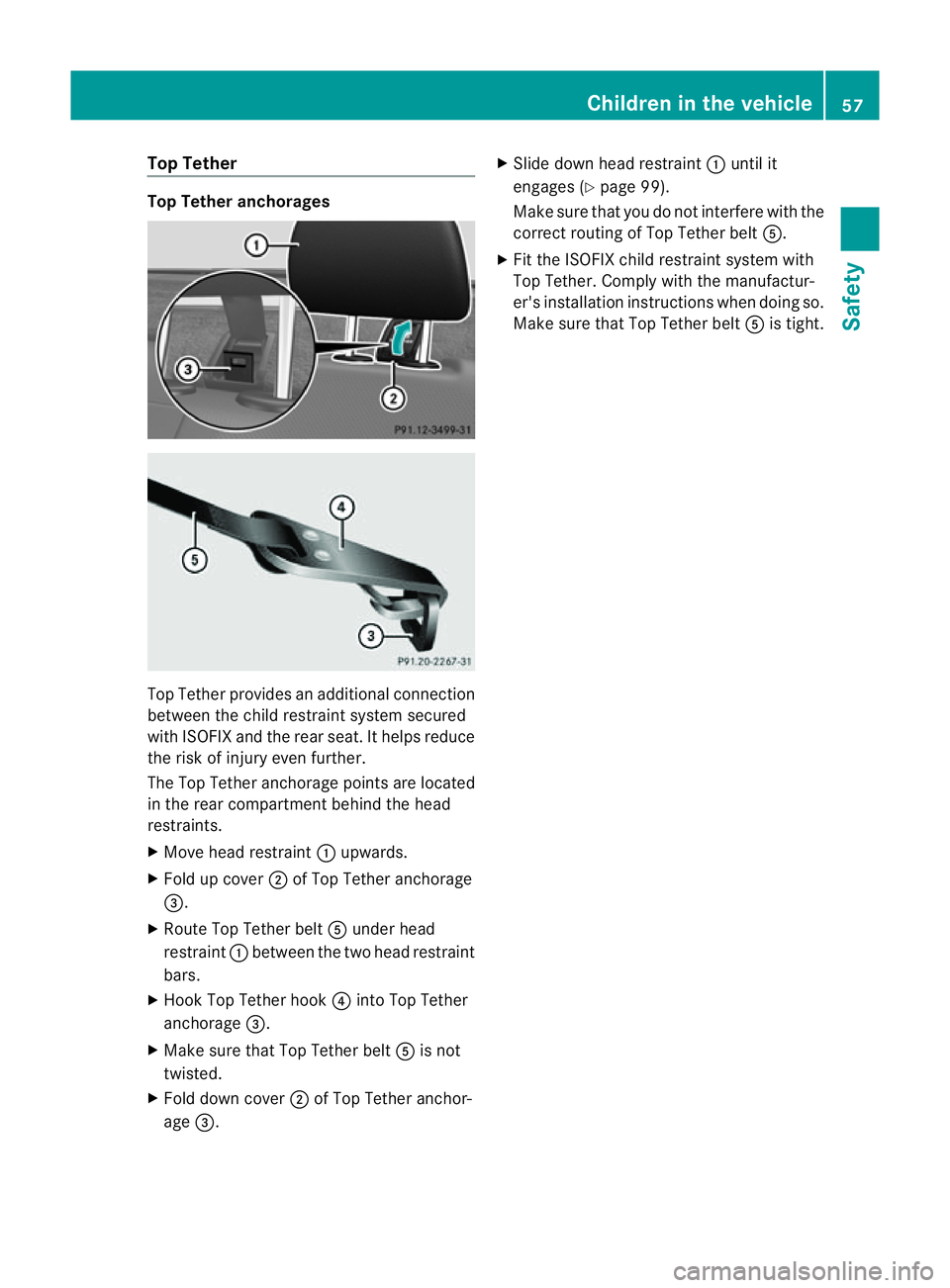
Top Tether anchorages
To
pT ether provides an additional connection
between the child restraint system secured
with ISOFI Xand the rea rseat. It helps reduce
the risk of injury even further.
The Top Tether anchorage point sare located
in the rear compartment behind the head
restraints.
X Move head restraint :upwards.
X Fold up cover ;of Top Tether anchorage
=.
X Route Top Tether belt Aunder head
restraint :between the two head restraint
bars.
X Hook Top Tether hook ?intoT op Tether
anchorage =.
X Make sure that Top Tether belt Ais not
twisted.
X Fold down cover ;of Top Tether anchor-
age =. X
Slide down head restraint :until it
engages (Y page 99).
Make sure that you do not interfere with the
correct routin gofTop Tether belt A.
X Fit the ISOFIX child restraint system with
Top Tether .Comply with the manufactur-
er's installation instructions when doing so.
Make sure that Top Tether belt Ais tight. Children in the vehicle
57Safety Z
Page 61 of 373
Problems with child seat recognition
Problem Possible causes/consequences and
M Solutions
The
4 PASSENGER
AIRBAGO FF indicator
lamp on the centre con-
sole is lit. As
pecial Mercedes-Benz child seat with atransponder for auto-
matic child seat recognition has been fitted to the front-passenger
seat. The front-passenger fron tairbag has therefore been disabled
as desired. The
4 PASSENGER
AIRBA GOFF indicator
lamp on the centr econ-
sole is lit.
or
The 6 warnin glamp
light supa nd/or the
4 PASSENGER AIR-
BA GO FF indicator
lamp does not light up
briefly when you switch
the ignition on. G
Risk of injury
There is no child seat fitted to the front-passenger seat .Automatic
child seat recognition is malfunctioning.
X Remove electronic equipmen tfrom the front-passenge rseat,
e.g.:
R laptop
R mobile phone
R cards with transponders ,such as ski passes or access cards
If the 4 PASSENGER AIRBA GOFF indicator lamp is still lit:
X Visit aqualified specialist workshop. Suitable positioning of the child
restraint systems
X
To install achild restraint system on
the front-passenger seat: move the front-
passenger seat to the rearmost position
and the belt outlet height to the lowest
position.
Key to the letters used in the following table:
XS eat which is unsuitable for children in
this weight category.
US uitable for child restraint systems in the
"Universal" categor ythata re approved
for use in this weigh tcategory.
UF Suitable for forward-facing child restraint systems that belon gtothe"Universal"
category and are approved for use in this
weight category.
LS uitable for child restraint systems as
recommended, see th efollowin gtable of
"Recommended child restraint systems"
(Y page 60). Front-passenger seat Weight cat-
egories Front-
passenger
airbag is
not disa-
bled: Front-
passenger
front air-
bag is disa-
bled. Categor
y0:
up to 10 kg X U, L
Category
0+: up to
13 kg
X U, L
Category I:
9to18kg
UF, L U, L
Group II:15
to 25 kg
UF, L U, L
Grou
pIII:
22 to 36 kg UF, L U, L
Vehicles with automatic child seat recog-
nition in the front-passenger seat:
a"Uni-
versal" category child restraint system with a 58
Children in thev
ehicleSafety
Page 72 of 373
This function will issue
awarning if:
R at speeds of around 30 km/ho rmore, over
several seconds, the distance maintained
to the vehicle travelling in front is insuffi-
cient.
The · distance warning lamp then lights
up in the instrument cluster.
R at as peed of approximately 7km/h or
higher, you very quickly approach avehicle
in front.
An intermittent warning tone willt hen
sound and the ·distance warning lamp
willl ight up in the instrument cluster.
X Brake immediately in order to increase the
distance from the vehicl einfront.
or
X Take evasive action provided it is safe to do
so.
From aspee dofa pproximatel y7km/h,ifthe
driver and passengers have fastened their
seat belts, PRE-SAFE ®
Brake can brake the
vehicl eautomatically at speeds up to approx-
imatel y200 km/h.
Due to the nature of the system, particularly
complicate ddriving conditions may cause
unnecessary warnings or the unnecessary
interventio nofPRE-SAFE ®
Brake.
You can prevent the interventio nofthe PRE-
SAFE ®
Brake at any time by:
R depressing the accelerato rpedal further
R activating kickdown
R releasing the brake pedal.
The brakin gaction of PRE-SAFE ®
Brak eis
ended automatically if:
R you manoeuvre to avoid the obstacle.
R ther eisnol onger any danger of arear-end
collision.
R ther eisnol onger an obstacle detected in
fron tofy our vehicle.
With the help of the radar sensor system,
PRE-SAFE ®
Brak ecan detec tobstacles that
are in fron tofyour vehicle for an extended
period of time. At speeds up to approximately 70 km/h, PRE-
SAFE
®
Brak ecan also detec tstationary
obstacles such as stopped or parked vehi-
cles.
If you approach an obstacle and PRE-SAFE ®
Brak edetects arisk of acollision, the system
will alert you both visually and acoustically. If
you do not brake or take evasive action ,the
system will warn you by automatically braking
the vehicle gently. If ther eisanincreased risk
of collision, preventativ epassenger protec-
tion measures (PRE-SAFE ®
)a re activated
(Y page 48). If, at speeds over 30 km/h, arisk
of collision remains and you do not brake,
take evasive action or significantly acceler-
ate, automatic brakin gmay be performed up
to alevel of automatic emergency braking.
Automatic emergency brakin gisnot per-
formed until immediately prior to an accident
that can no longer be avoided. G
WARNING
PRE-SAFE ®
Brak ewill initially brake your vehi-
cle by apartial application of the brakes if a
danger of collision is detected. There may be
ac ollision unless you also brake. Automatic
emergency braking cannot preven tacolli-
sion. There is arisk of an accident.
Always apply the brakes yourself and try to
take evasive action. G
WARNING
PRE-SAFE ®
Brak ecannot alway sclearly iden-
tify objects and complex traffic conditions.
In these cases, PRE-SAFE ®
Brak emay:
R give an unnecessary warning and then
brake the vehicle
R neither give awarning nor intervene
There is arisk of an accident.
Always pay particular attention to the traffic
situation and be ready to brake, especially if
PRE-SAFE ®
Brak ewarns you. Terminate the
intervention in anon-critical driving situation. Driving safet
ysystems
69Safety Z
Page 94 of 373
Problems with the side windows
G
WARNING
Closing the side windows with increased force or without the anti-entrapment feature could lead
to serious or even fatal injury. Make sure that nobody can become trapped when closing the side
windows. Problem Possible causes/consequences and
M Solutions
As
ide window cannot
be closed because it is
blocked by objects, e.g.
leaves in the window
guide. X
Remove the objects.
X Close the side window. As
ide window cannot
be closed and you can-
not see the cause. If
as ide window is obstructed durin gclosing and reopen sagain
slightly:
X Immediately after the window blocks, pull the corresponding
switc hagain until the side window has closed.
The side window is closed with increased force.
If as ide window is obstructed again durin gclosing and reopens
again slightly:
X Immediately after the window blocks, pull the corresponding
switc hagain until the side window has closed.
The side window is closed without the anti-entrapmen tfeature. Sliding sunroof
Important safet
ynotes G
WARNING
Make sure that nobody can become trapped
when openin gand closing the sliding sunroof.
If there is arisk of entrapment ,release the
switch immediately. Durin gautomatic opera-
tion ,push the switch briefly in any direction
to stop the sliding sunroof. G
WARNING
The glass in the panorama sunroof could
break in an accident. If you are not wearing a
seat belt, there is arisk that you could be
thrown through the openin ginthe event of the
vehicle overturning .Therefore, always wear a
seat belt to reduce the risk of injuries. G
WARNING
Children could injure themselves if they oper-
ate the sliding sunroof.
Never leave children unsupervised in the vehi-
cle. Always take the key with you when leaving
the vehicle, even if you are only leaving it for
as hort time.
! Only open the panorama sliding sunroof
if it is free of snow and ice. Otherwise, mal-
functions may occur.
Do not allow anything to protrude from the
sliding sunroof. Otherwise, the seals could
be damaged.
i Resonance noises can occur in addition
to the usuala irflow noises when the sliding
sunroof is open. They are caused by minor
pressure fluctuations in the vehicle interior. Sliding sunroof
91Opening and closing Z
Page 99 of 373
Useful information
i This Owner's Manual describes all mod-
els, series and optional equipment for your
vehicle that were available at the time of
going to press. National variation sare pos-
sible. Not ethat your vehicle may not be
equipped with all of the function sdescri-
bed. This is also the case for system sand
function srelevan ttosafety.
i Read the information on qualified special-
ist workshops: (Y page 23). Correct driver's seat position
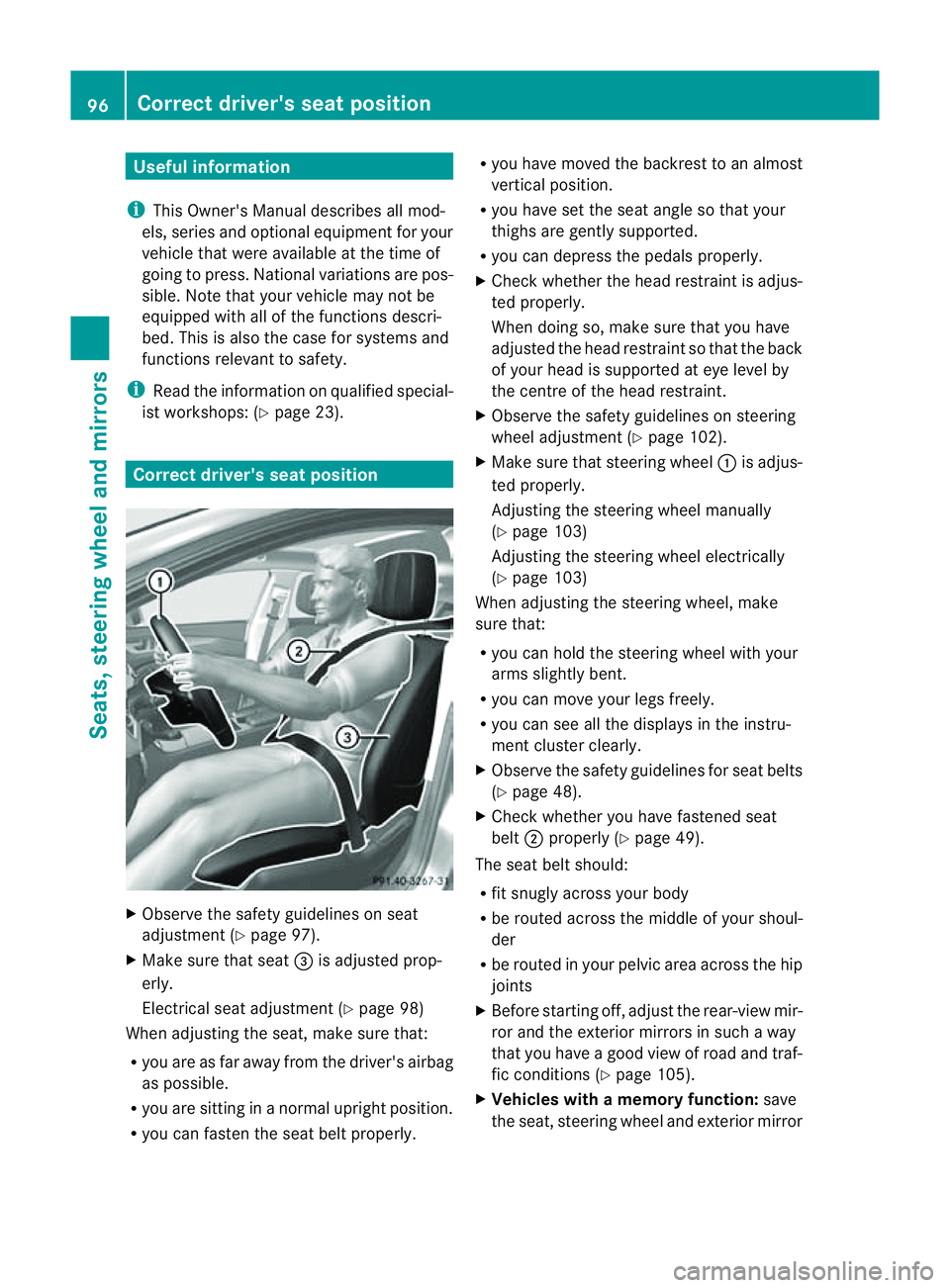
X
Observ ethe safet yguidelines on seat
adjustment (Y page 97).
X Make sure that seat =is adjusted prop-
erly.
Electrical seat adjustment (Y page 98)
When adjusting the seat, make sure that:
R you are as far away from the driver' sairbag
as possible.
R you are sitting in anormal upright position.
R you can faste nthe seat belt properly. R
you have moved the backrest to an almost
vertical position.
R you have set the seat angle so that your
thighs are gently supported.
R you can depress the pedals properly.
X Check whether the head restraint is adjus-
ted properly.
When doing so, make sure that you have
adjusted the head restraint so that the back
of your head is supported at eye level by
the centre of the head restraint.
X Observe the safety guidelines on steering
wheel adjustment (Y page 102).
X Make sure that steering wheel :is adjus-
ted properly.
Adjustingt he steering wheel manually
(Y page 103)
Adjustingt he steering wheel electrically
(Y page 103)
When adjusting the steering wheel, make
sure that:
R you can hold the steering wheel with your
arms slightly bent.
R you can move your legs freely.
R you can see all the displays in the instru-
ment cluster clearly.
X Observe the safety guidelines for seat belts
(Y page 48).
X Check whether you have fastened seat
belt ;properly (Y page 49).
The seat belt should:
R fit snugly across your body
R be routed across the middle of your shoul-
der
R be routed in your pelvic area across the hip
joints
X Before startingo ff, adjust the rear-view mir-
ror and the exterior mirrors in such away
that you have agood view of road and traf-
fic conditions( Ypage 105).
X Vehicles with amemory function: save
the seat, steering wheel and exterior mirror 96
Correct driver's seat positionSeats, steering wheela
nd mirrors