wheel MERCEDES-BENZ E-CLASS CABRIOLET 2010 Owners Manual
[x] Cancel search | Manufacturer: MERCEDES-BENZ, Model Year: 2010, Model line: E-CLASS CABRIOLET, Model: MERCEDES-BENZ E-CLASS CABRIOLET 2010Pages: 333, PDF Size: 7.64 MB
Page 286 of 333
X
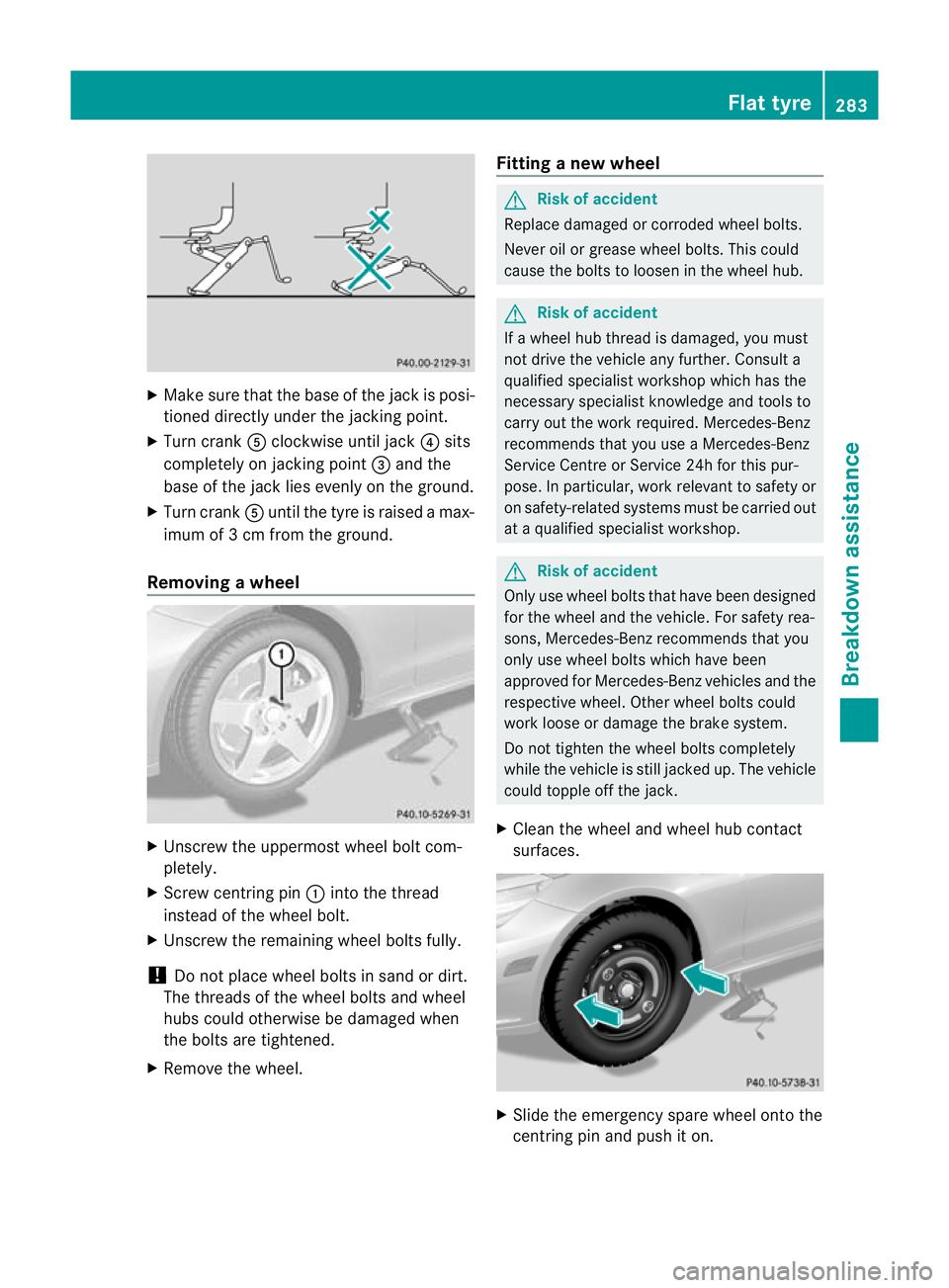
Make sur ethat the base of the jac kisp osi-
tioned directly under the jackin gpoint.
X Tur ncrank Aclockwise unti ljack ?sits
completely on jackin gpoint =and the
base of the jac klies evenly on the ground.
X Turn crank Auntil the tyre is raised amax-
imum of 3cmfrom th eground.
Removin gawheel X
Unscre wthe uppermost wheel bolt com-
pletely.
X Screw centring pin :into the thread
instead of the wheel bolt.
X Unscrew the remaining wheel bolts fully.
! Do not place wheel bolts in sand or dirt.
The threads of the wheel bolts and wheel
hubs could otherwise be damaged when
the bolts are tightened.
X Remove the wheel. Fitting
anew wheel G
Risk of accident
Replac edamaged or corroded wheel bolts.
Never oil or grease wheel bolts. This could
cause the bolts to loosen in the wheel hub. G
Risk of accident
If aw heel hub thread is damaged, you must
not drive the vehicle any further. Consult a
qualified specialist workshop whic hhas the
necessary specialis tknowledge and tool sto
carry out the work required. Mercedes-Be nz
re commends that you use aMercedes-Benz
Ser vice Centre or Service 24h for thi spur-
pose .Inp articular, work relevant to safety or
on safety-related systems must be carried out
at aq ualified specialist workshop. G
Risk of accident
Only use wheel bolts that have been designed
for the wheel and the vehicle. For safety rea-
sons, Mercedes -Benz recommends that you
only use wheel bolts which have been
approved for Mercedes-Benz vehicles and the
respective wheel. Other wheel bolts could
work loose or damage the brak esystem.
Do not tighten the whee lbolts completely
while the vehicle is still jac kedu p. The vehicle
could topple off the jack.
X Clean the wheel and wheel hub contact
surfaces. X
Slide the emergency spare wheel ont othe
cen tring pin and push it on. Flat tyre
283Breakdown assistance
BA 207ECE ÄJ 2010/1a; 1; 2, en-GB
mkalafa Version: 3.0.2.11 2010-01-26T13:03:22+01:00-Seite 283 Z
Page 287 of 333
X
Tighten the wheel bolts until they are fin-
ger- tight.
X Unscrew the cen tring pin.
X Tighten the last wheel bolt until it is finger-
tight.
Lowering the vehicle X
Turn the cran kofthe jac kanti-clockwise
until the vehicl eisonce agai nstanding
firmly on the ground.
X Place the jack to one side. X
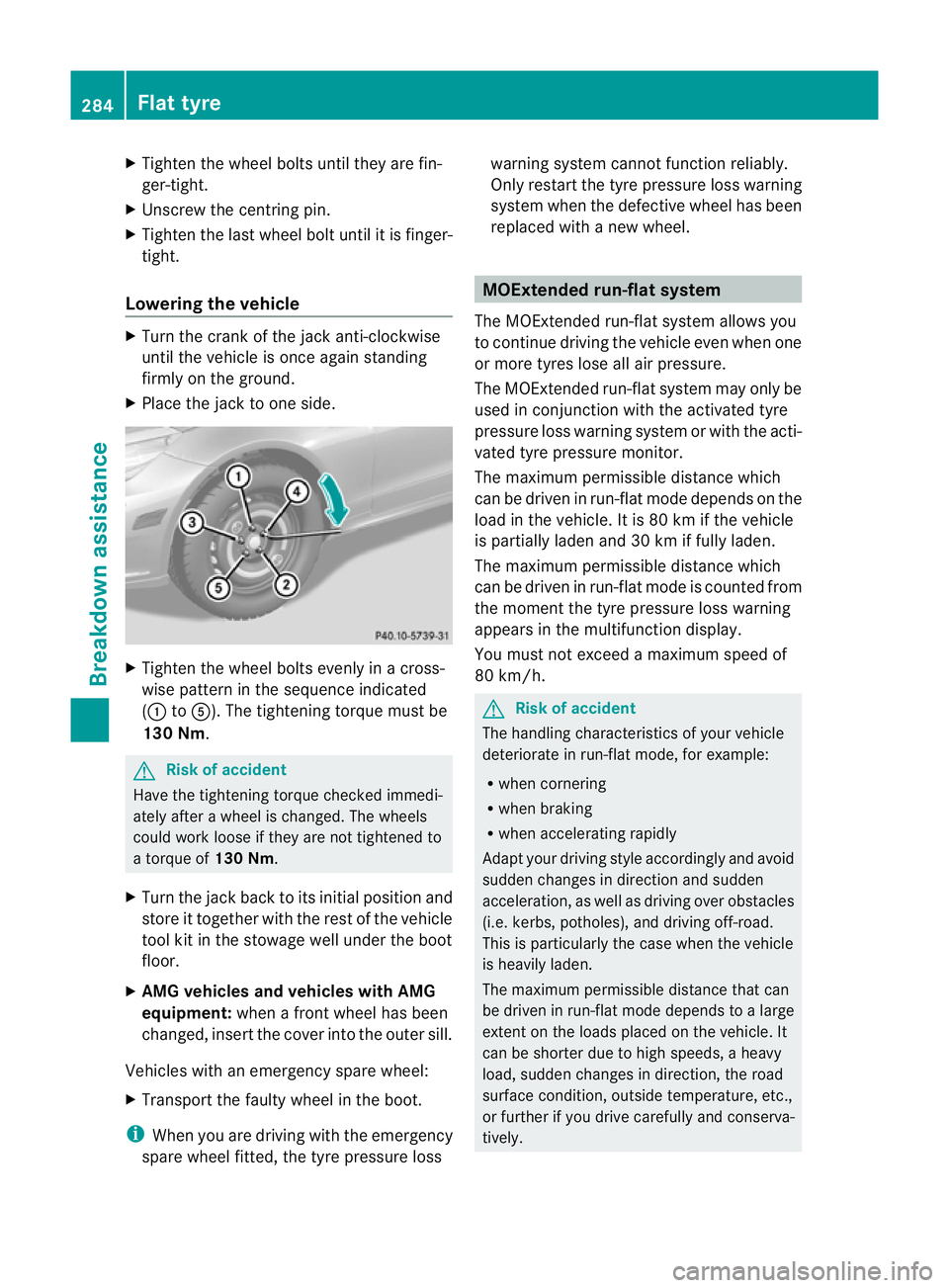
Tighten the whee lbolts evenly in across-
wis epattern in the sequence indicated
(: toA). The tightening torque must be
130 Nm. G
Risk of accident
Have the tightening torque checked immedi-
ately after awheel is changed. The wheels
coul dwork loose if they are not tightened to
at orqu eof130 Nm.
X Turn the jack back to its initia lposition and
stor eitt ogether with the rest of the vehicle
tool kit in the stowage well under the boot
floor.
X AM Gvehicles and vehicles with AMG
equipment: whenafront whee lhas been
changed, insert the cover into the outer sill.
Vehicles with an emergency spare wheel:
X Transport the faulty wheel in the boot.
i When you are driving with the emergency
spare wheel fitted, the tyre pressure loss warning system cannot function reliably.
Only restart the tyre pressure loss warning
system when the defective wheel has been
replaced with
anew wheel. MOExtended run-
flat system
Th eM OEx tended run-flat system allo wsyou
to continue driving the vehicle even when one
or more tyres los eall air pressure.
The MOExtended run-flat system may only be
used in conjunction with the activated tyre
pressure loss warnin gsystem or with the acti-
vated tyre pressure monitor.
The maximum permissible distance which
can be driven in run-flat mode depends on the
load in the vehicle. It is 80 km if the vehicle
is partially laden and 30 km if fully laden.
The maximum permissible distance which
can be driven in run-flat mode is counted from
the moment the tyre pressure los swarning
appears in the multifunction displ ay.
Yo um ust not exceed amaximum spee dof
80 km/h. G
Ris
kofa ccident
The handling characteristics of your vehicle
deteriorate in run-flat mode, for example:
R when cornering
R when braking
R when accelerating rapidly
Adapt your driving style accordingly and avoid
sudden changes in direction and sudden
acceleration, as well as driving over obstacles
(i.e. kerbs, potholes), and driving off-road.
This is particularly the case when the vehicle
is heavily laden.
The maximum permissible distance that can
be driven in run-flat mode depends to alarge
exten tonthe loads placed on the vehicle. It
can be shorter due to high speeds, aheavy
load, sudden changes in direction, the road
surface condition, outside temperature, etc.,
or further if you driv ecarefully and conserva-
tively. 284
Flat tyreBreakdown assistance
BA 207 ECE ÄJ 2010/1a; 1; 2, en-GB
mkalaf
aV ersion: 3.0.2.11
2010-01-26T13:03:22+01:0
0-Seite 284
Page 288 of 333
Do not continue to drive in run-flat mod
eif:
R youh earb anging noises.
R the vehicl estarts to shake.
R yous ee smoke and smell rubber.
R ESP ®
is intervening constantly.
R there are tears in the sidewall softhe tyre.
After driving in run-flat mode, you must have
the wheel(s) checked for damage at aquali-
fie ds pecialist workshop whic hhas the nec-
essary specialis tknowledge and tool stocarry
out the work required. The faulty tyre must be
replaced in every case.
Mercedes-Benz recommends that you use a
Mercedes-Benz Service Centre for this pur-
pose .Inp articular, work relevant to safety or
on safety-related systems must be carried out
at aq ualified specialist workshop.
i Whe nreplacing one or all tyres, make
sure that you only use tyres marked
MOExtended and of the specified size for
the vehicle.
i Vehicles featuring the MOExtended run-
flat system are not equipped with the
TIREFI Tkit. It is therefor erecommended
that you additionally equip your vehicle
with the TIREFI Tkit if you fit tyres that do
not featur erun-flat properties ,e.g. winter
tyres .You can obtain aTIREFIT kit from a
Mercedes-Benz Service Centre ,for exam-
ple. Ba
ttery Important safety notes
In order for the battery to achieve the maxi-
mum possible service life, it must always be
sufficiently charged.
Have the battery charge checked more fre-
quently if you use the vehicle mainly for short
trips or if you leave it standing idle for a
lengthy period. To prevent damage from corrosion, only
replace the battery with one that has
acentral
ven tilation cover.
Only replace abattery with abattery that has
been recommended by Mercedes-Benz.
Consult aMercedes-Benz Servic eCentr eif
you wish to leave your vehicle parked up for
al ong period of time. G
Risk of inju
ry
Comply with safety precautions and take pro-
tective measures when handling batteries. Risk of explosion
Fire, naked flames and
smoking are prohibited
when handling the battery.
Avoid creatin
gsparks. Battery acid is caustic.
Avoid contact with the skin,
eyes or clothing.
Wear suitable protec
tive
clothing, in particular
gloves, an apro nand aface
mask.
Immediately rinse acid
splashes off with clean
water. Consult adoctor if
necessary. Wear eye protection.
Keep children away.
Observ
ethis Owner's Man-
ual. H
Environmental note
Do not dispose of batteries in the household
rubbish. Dispose of defective batteries in an
environmen tally responsible manner .Take Battery
285Breakdown assistance
BA 207ECE ÄJ 2010/1a; 1; 2, en-GB
mkalafa Version: 3.0.2.11 2010-01-26T13:03:22+01:00-Seite 285 Z
Page 294 of 333
Befor
etowing away ,make sur ethat the steer-
ing can be mov edand is not locked.
If yo utow or tow- start another vehicle, its
weigh tmustn ot excee dthe maximum per-
missible gross vehicle weigh tofyour vehicle. G
Risk of accident
The vehicle is braked when the HOL Dfunction
or DISTRONIC PLUS is activated. Therefore,
deactivate HOLD and DISTRONIC PLUS if the
vehicle is to be towed.
It is better to have the vehicle transported
than to have it towed.
! Whe ntowing, pull away slowly and
smoothly. If the tractive power is too high,
the vehicles coul dbedamaged.
! Do not use the towing eye for recovery,
as this could damage the vehicle. If in
doubt, recover the vehicle with acrane.
! Youm ay tow the vehicle for amaximum
of 50 km. Atowing speed of 50 km /h must
no tbee xceeded.
For towing distances over 50 km, the entire
vehicl emust be lifted up and transported.
! On vehicles with KEYLESS-GO, use the
key instead of the Start/Stop button .Turn
the key to position 2in the ignition lock and
shif tthe automatic transmission to N.
Then, turn the key back to 0and leave it in
the ignitio nlock.
! Only secur ethe tow cable or towing bar
to the towing eyes. You could otherwise
damage the vehicle.
Please note:
R vehicles with an automatic transmission
must not be tow-started.
R if you ar etowing the vehicle over alonger
distance, this must be done with the rear
axle raised.
R the ignition must be switched off if you are
towin gthe vehicle with the rea raxle raised. Intervention by ESP
®
could otherwis edam-
age the brake system.
R if the vehicle has suffered transmission
damage, only tow it with the propelle rshaft
disconnected.
R if the engin edoes not start, tr yjump-start-
ing it (Y page 289).
R if it is not possible to jump-start the vehicle,
have it towed to the nearest qualified spe-
cialist workshop, e.g. aMercedes-Benz
Servic eCentre.
R the automatic transmission must be in
position Nwhen the vehicle is being towed.
Before towing the vehicle, mak esure that the
battery is connected and charged. You will
otherwis ebeunable to switch on the ignition
or shift the transmissio ntoNin vehicles with
an automatic transmission.
i Switch off the automatic locking feature
before the vehicle is towed (Y page 208).
You could otherwise be locked out when
pushing or towing the vehicle. Fitting the towing eye
Vehicles with atrailer to whitch: if you intend
to use the vehicle for towing, fold out the ball
coupling and connect the towbar to it
(Y page 186).
X Take the towing eye and the wheel wrench
from the vehicle tool kit (Y page 274).
The mountings for the removable towing eyes
are located in the bumpers. They are at the
front and at the rear ,under the covers. Towing and tow-starting
291Breakdown assistance
BA 207 ECE ÄJ 2010/1a;1;2,e n-GB
mkalafa Version: 3.0.2.11 2010-01-26T13:03:22+01:00-Seite 291 Z
Page 295 of 333
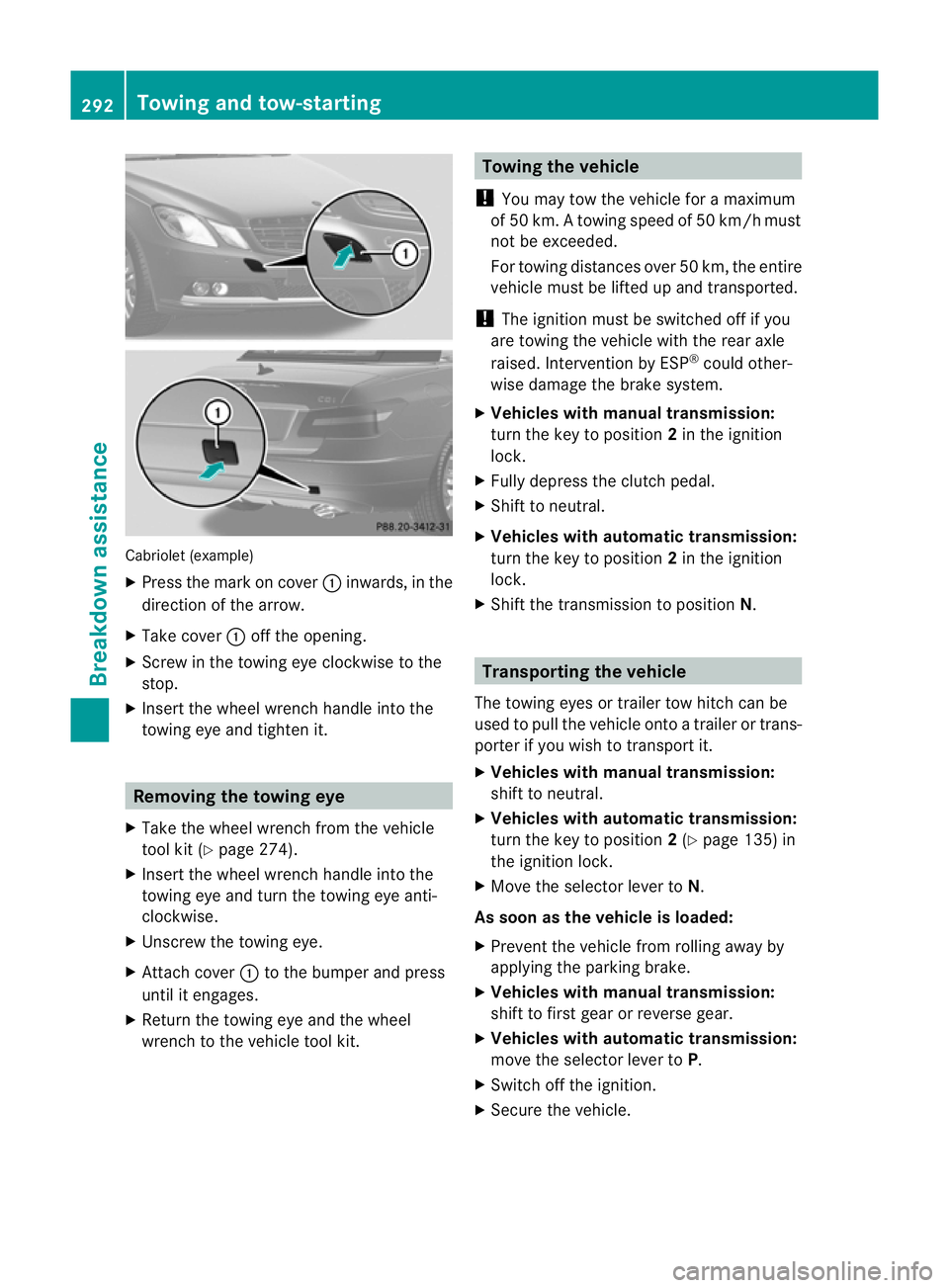
Cabriolet (example)
X
Press the mark on cover :inwards, in the
direction of the arrow.
X Take cover :off the opening.
X Screw in the towing eye clockwise to the
stop.
X Insert the wheel wrench handle into the
towin geye and tighte nit. Removing the towing eye
X Take the whee lwrenc hfrom th evehicle
tool kit (Y page 274).
X Insert the wheel wrench handle into the
towing eye and tur nthe towing eye anti-
clockwise.
X Unscrew the towing eye.
X Attach cover :to the bumper and press
until it engages.
X Return the towing eye and the wheel
wrenc htothe vehicle tool kit. Towing th
evehicle
! You may tow the vehicle for amaximum
of 50 km. Atowing speed of 50 km/h must
not be exceeded.
For towin gdistances over 50 km, the entire
vehicle must be lifted up and transported.
! The ignition must be switched off if you
are towing the vehicle with the rear axle
raised. Interven tion by ESP ®
coul dother-
wise damage the brake system.
X Vehicles with manua ltransmission:
turn the key to position 2in the ignition
lock.
X Fully depress the clutch pedal.
X Shift to neutral.
X Vehicles with automatic transmission:
turn the key to position 2in the ignition
lock.
X Shift the transmission to position N. Transporting the vehicle
The towing eyes or trailer tow hitch can be
used to pull the vehicle onto atrailer or trans-
porter if yo uwish to transport it.
X Vehicles with manu altransmission:
shift to neutral.
X Vehicles with automatic transmission:
turn the key to position 2(Y page 135) in
the ignition lock.
X Move the selector lever to N.
As soon as the vehicl eisloaded:
X Prevent the vehicle from rolling away by
applying the parking brake.
X Vehicles with manua ltransmission:
shift to first gear or reverse gear.
X Vehicles with automatic transmission:
move the selector lever to P.
X Switch off the ignition.
X Secure the vehicle. 292
Towing and tow-startingBreakdown assistance
BA 207 ECE ÄJ 2010
/1a;1;2,e n-GB
mkalafa Version: 3.0.2.11 2010-01-26T13:03:22+01:00-Seite 292
Page 296 of 333
!
Only lash the vehicle down by the wheels
or wheel rims, not by parts of the vehicle
suc hasa xle or steering components. Oth-
erwise, the vehicl ecould be damaged. Tow-star
ting (emergency engine
starting)
Please note:
R vehicles with an automatic transmission
must not be tow-started.
R the batter ymust be connected.
R the engine and catalytic converter must be
cold.
R avoid repeated and lengthy starting
attempts.
Vehicles with manual transmission:
X Turn the key to position 2in the ignition
lock.
X Fully depres sthe clutc hpedal.
X Shif tton eutral.
X Tow the vehicle or let it roll.
X Shif ttoas uitable gear and bring the clutch
pedal up slowly. Do not depres sthe accel-
erator pedal.
The engin eisstarted. Fuses
Important safet
ynotes
The fuses in your vehicle serve to close down
faulty circuits. If afuse blows, all the compo-
nen tson th ecircuit and their function swill
fail. G
Ris
koff ire
Only use fuses that have been approve dfor
Mercedes-Ben zvehicles and which have the
cor rect fuse rating for the systems con-
cerned. Do not attempt to repai rorbridge
faulty fuses .Otherwise, acircuit overload
could cause afire. Have the cause traced and
rectified at aqualified specialist workshop,
e.g. aMercedes-Benz Ser vice Centre. Blow
nfuses must be replaced with fuses of
the same rating, which you can recognise by
the colour and value. The fuse ratings are lis-
ted in the fuse allocation chart .AMercedes-
Ben zService Cent rewill be happy to advise
you.
If the newly inserted fuse also blows, have the
cause traced and rectified at aqualified spe-
cialist workshop, e.g. aMercedes-Benz
Ser vice Centre.
! Onlyuse fuses that hav ebeen approved
for Mercedes-Ben zvehicles and which
have the cor rect fuse rating for the system
concerned. Otherwise, compo nentso rsys-
tems could be damaged. Befor
echangin gafuse
X Park th evehicle and apply the parking
brake.
X Swit choff all elect rical consumers.
X Remove the key from the ignitio nlock.
The fuses ar elocated in variou sfuse boxes:
R fuse box on the driver' sside of the dash-
board
R fuse box in the engin ecompartmen tonthe
driver's side
R fuse box in the boot on the right when
viewed in the direction of travel
The fuse allocation char tisl ocated in the
vehicle tool kit (Y page 274)in the stowage
compar tment under the boot floor. Fuse box under the dashboard
! Do not use apointed objec tsuch as a
screwdriver to open the cover in the dash-
board. You could damage the dashboard or
the cover. Fuses
293Breakdown assistance
BA 207ECE ÄJ 2010/1a; 1; 2, en-GB
mkalafa Version:3.0.2.11
2010-01-26T13:03:22+01:00
-Seite 293 Z
Page 300 of 333
Vehicl
eequipment ............................ 298
Important safet ynotes .................... 298
Directives to be observed ................298
Maintenance and car eofwheels
and tyres ............................................ 299
Tyr epressures .................................. 299
Direction of rotation .........................302
Interchanging the wheels ................302
Wheel and ty recombinations ..........303 297Tyres and wheels
BA 20
7ECE ÄJ 2010/1a; 1; 2, en-GB
mkalafa Version:3.0.2.11
2010-01-26T13:03:22+01:0
0-Seite 297
Page 301 of 333
Vehicl
eequipment
i Thismanua ldesc ribe sallthe standard
and optional equipment of your vehicle
which wa savailable at th etime of pur-
chase. Countr y-specif ic differences are
possible. Bear in mind tha tyour vehicle
ma ynot featur eall function sdescribed
here. Important safet
ynotes G
Risk of accident
Tyres, wheels or accessories which have not
been approved by Mercedes-Benz for your
vehicle or are not used as they should be, can
impair drivin gsafety. As aresult, you could
cause an accident. Befor epurchasing and
using them, enquire about their suitability,
legal stipulatio nsand factory recommenda-
tions at aMercedes-Benz Ser vice Centre.
! For safety reasons ,Mercedes-Ben zrec-
ommends that you only use tyres, wheels
and accessories which have been approved
by Mercedes-Ben zspecifically for your
vehicle. These tyres have been specially
adapted for use with the contro lsystems,
such as AB SorESP®
,a nd are marked as
follows:
R MO =Mercedes-Ben zOriginal
R MOE =Mercedes-Ben zOriginal Extended
(tyres with run-flat characteristics)
R MO1 =Mercedes-Ben zOriginal (AMG)
Only use Mercedes-Benz Original Extended
tyres on wheels that have been specifically
approved by Mercedes-Benz.
If you use other tyres, wheels and acces-
sories, Mercedes-Benz cannot accept any
responsibility for damage that may result
from this. Further informat ionabout tyres,
wheels and approved combinations can be
obtained from any Mercedes-Benz Service
Centre. !
Retreaded tyres are neither tested nor
recommended by Mercedes-Benz, since
previous damage cannot alway sbedetec-
ted on retreaded tyres. As aresult,
Mercedes-Ben zcannot guarantee vehicle
safety if retreade dtyres are fitted. Do not
fit use dtyres if you have no information
about their previous usage.
Mod ification work on the brake system and
wheels is not permitted, nor is the use of
space rplates or brake dust shields .This inva-
lidates the Genera lOperating Permit for the
vehicle.
i Further information about tyres and
wheels can be obtained from any
Mercedes- Benz Servic eCentre. Directives to be observed
R Only fit tyres and wheels of the same type
and make.
R Only fit tyres of the correc tsize ont othe
wheels.
R Afterf itting new tyres, run them in at mod-
erate speeds for the first 100 km as they
only reach their full performanc eafter this
distance.
R Do not drive wit htyres which have too little
tread depth ,asthis significantly reduces
the traction on wet roads (aquaplaning).
R While driving, pay attention to vibrations,
noises and unusual handling characteris-
tics, e.g. pulling to one side. This ma yindi-
cate that the wheels or tyres are damaged.
If you suspect that atyre is defective,
reduce your speed immediately. Stop the
vehicle as soo naspossible to chec kthe
wheels and tyres for damage. Hidden tyre
damage could also be causing the unusual
handling characteristics. If you fin dno
signs of damage, hav ethe wheels and tyres
examined at aspecialist workshop, for 298
Directives to be observedTyres and wheels
BA 20
7ECE ÄJ 2010 /1a; 1; 2, en-GB
mkalafa Version: 3.0.2.11 2010-01-26T13:03:22+01:00 -Seite 298
Page 302 of 333
example at
aMercedes-Benz Ser vice
Centre.
R When parking your vehicle, make sure that
the tyres do not ge tdeformed by the kerb
or other obstacles. If it is necessary to drive
over kerbs, speed humps or simila releva-
tions, try to do so slowly and at an obtuse
angle. Otherwise, the tyres, particularly the
sidewalls, can get damaged. Maintenance and care of wheels and
tyres
Checking wheels and tyres
R Regularly chec kthe wheels and tyres of
your vehicle for damage (e.g. cuts, punctu-
res, tears, bulges on tyres and deformation,
crack sorseverecorrosion on wheels), at
least ever y14d ays, as well as after driving
off-road or on rough roads. Damaged
wheels can cause aloss of tyr epressure.
R Regu larly check th etyre tread depth and
the conditio nofthe tread across the whole
widt hofthe tyr e(Ypage 299). If neces-
sary, tur nthe front wheels to full lock in
orde rtoi nspect the inner sid eofthe tyre
surface.
R All wheels must hav eavalve cap to protect
the valve against dirt and moisture. Do not
fit anything onto the valve (such as tyre
pressure monitorin gsystems) othe rthan
the standar dvalve cap or other valve caps
approved by Mercedes-Ben zfor your vehi-
cle.
R Regularly chec kthe pressur eofall the tyres
including the emergenc yspare wheel or the
spare wheel, particularly prior to long trips,
and correc tthe pressur easnecessary
(Y page 299). Ty
re tr ead G
Risk of accident
Bear in mind that:
R tyre grip decreases rapidly on wet roads
when the tread depth is less than 3mm.
Thus ,you should repl acet yres that have
insufficient tread.
R winter tyres sho uld bereplaced when the
trea ddepth is 4mmorl ess as they will no
longer provide adequat egrip.
R thet rea donat yre may not wear evenly.
Thus ,you should regularly chec kthe tread
depth and the condition of the tread across
the entire widt hofall tyres. If necessary,
turn the steerin gwheel so that you can see
the tyr etrea dm ore easily.
You coul dotherwise los econtrol of the vehi-
cle and cause an acciden tdue to the reduced
grip of the tyres on the road. Storing tyres
Store tyres that are not being used in acool,
dry and preferably dar kplace. Protect the
tyres against oil, grease, petrol and diesel. Cleaning tyres
! Do not use ahigh pressure jet with circu-
lar jet nozzles (concentrated-power jets) to
clean the tyres. The high pressure of the
water jet could damage the tyres. Always
replace damaged tyres. Tyr
epressures Recommended ty
repressures
You will find atable of tyre pressures for var-
ious operating conditions on the inside of
your vehicle's fuel filler flap.
The applicable value for the emergency spare
wheel is stated on the spare wheel and in the
technical data section. Tyr
epressures
299Tyresa nd wheels
BA 20 7ECE ÄJ 2010/1a; 1; 2, en-GB
mkalafa Version:3.0.2.11
2010-01-26T13:03:22+01:0
0-Seite 299 Z
Page 303 of 333
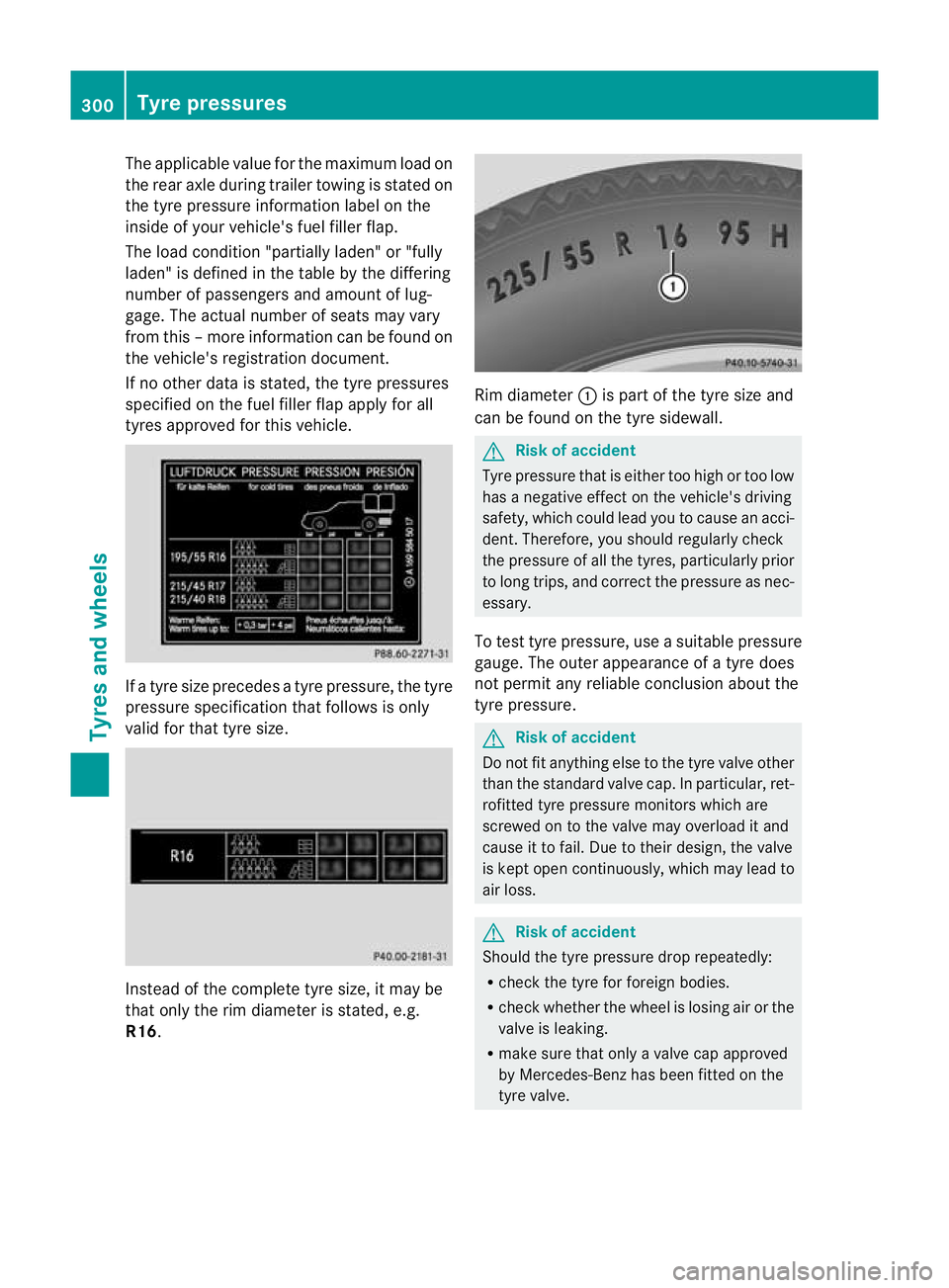
The applicable value for the maximum load on
the rea raxle during trailer towing is state don
the tyre pressure information label on the
insid eofy our vehicle' sfuel filler flap.
The load condition "partially laden" or "fully
laden" is defined in the table by the differing
number of passengers and amount of lug-
gage. The actual number of seats may vary
from this –more information can be found on
the vehicle' sregistra tion document.
If no other data is stated, the tyr epressures
specifie donthe fuel filler fla papply for all
tyres approved for this vehicle. If
at yre size precede satyre pressure, the tyre
pressure specification that follows is only
valid for that tyre size. Instead of the complete tyre size, it may be
that only the rim diameter is stated ,e.g.
R16. Rim diameter
:is part of the tyre size and
can be found on the tyre sidewall. G
Risk of accident
Tyre pressure that is either too hig hortoo low
has anegativ eeffect on the vehicle's driving
safety ,which coul dlead you to cause an acci-
dent. Therefore, you should regularly check
the pressur eofall the tyres, particularly prior
to long trips, and correc tthe pressure as nec-
essary.
To test tyr epressure, us easuitable pressure
gauge. The outer appearance of atyre does
not permit any reliabl econclusion about the
tyr ep ressure. G
Ris
kofa ccident
Do not fit anything else to the tyre valve other
than the standard valve cap. In particular, ret-
rofitted tyre pressure monitors which are
screwed on to the valve may overload it and
cause it to fail. Due to their design, the valve
is kept open continuously ,which ma ylead to
air loss. G
Risk of accident
Should the tyr epressure dro prepeatedly:
R check the tyr efor foreign bodies.
R chec kwhether the wheel is losing air or the
valve is leaking.
R make sur ethat only avalve cap approved
by Mercedes-Benz has been fitte donthe
tyre valve. 300
Tyre pressuresTyres and wheels
BA 20
7ECE ÄJ 2010/1a; 1; 2, en-GB
mkalafa Version: 3.0.2.11 2010-01-26T13:03:22+01:00-Seite 300