airbag MERCEDES-BENZ E-CLASS CABRIOLET 2010 User Guide
[x] Cancel search | Manufacturer: MERCEDES-BENZ, Model Year: 2010, Model line: E-CLASS CABRIOLET, Model: MERCEDES-BENZ E-CLASS CABRIOLET 2010Pages: 333, PDF Size: 7.64 MB
Page 39 of 333
Fron
tairbags The fron
tairbags increase protection for the
driver' sand front-passenger' shead and
chest. Driver
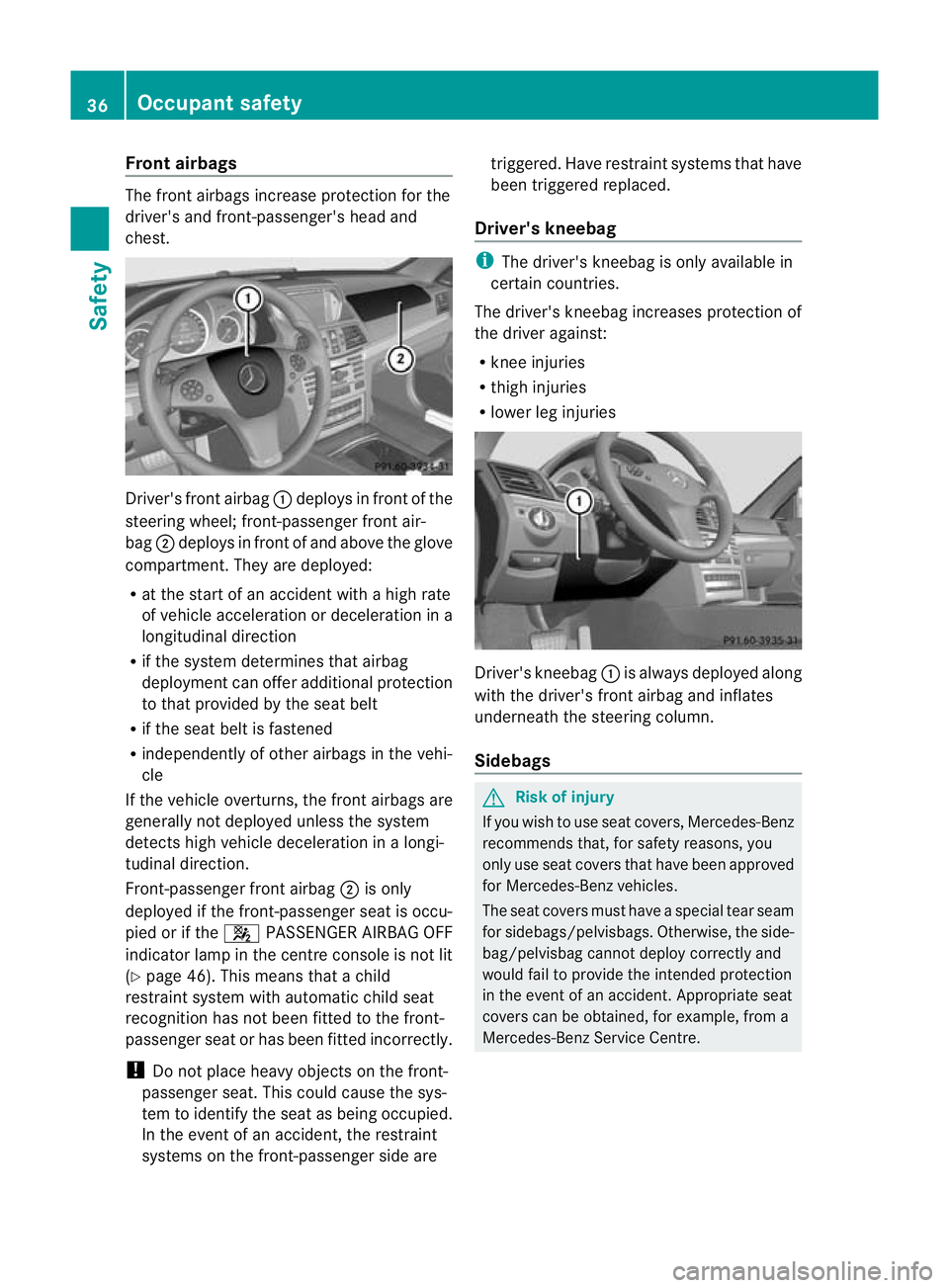
's front air bag:deploys in front of the
steerin gwheel; front-passenger front air-
bag ;deploys in front of and above the glove
compartment .They ar edeployed:
R at the star tofanaccident with ahigh rate
of vehicle acceleration or deceleration in a
longitudinal dire ction
R if the system determines that airbag
deploymen tcan offer additional protec tion
to that provide dbytheseat belt
R if th eseat belt is fastened
R independently of other airbag sinthe vehi-
cle
If the vehicle overturns ,the front airbags are
generally not deployed unless the system
detec tshigh vehicle deceleration in alongi-
tudinal direction.
Front-passenger front airbag ;is only
deployed if the front-passenger seat is occu-
pied or if the 4PASSENGER AIRBA GOFF
indicato rlamp in the centre console is not lit
(Y page 46). This means that achild
restraint system with automatic chil dseat
recognition has not been fitted to the front-
passenger seat or has been fitted incorrectly.
! Do not place heavy object sonthe front-
passenger seat. This could cause the sys-
tem to identify the seat as being occupied.
In the even tofanaccident, the restraint
systems on the front-passenger sid eare triggered
.Have restraint systems that have
been triggered replaced.
Driver's kneebag i
The driver' skneebag is only available in
certain countries.
The driver's kneebag increases protection of
the driver against:
R knee injuries
R thig hinjuries
R lowe rleg injuries Driver's kneebag
:is always deployed along
with the driver' sfront airbag and inflates
underneath th esteering column.
Sidebags G
Risk of injury
If you wish to use seat covers, Mercedes-Benz
recommends that, for safety reasons ,you
only use seat covers that have been approved
for Mercedes-Ben zvehicles.
The seat cover smust have aspecial tear seam
for sidebags/pelvisbags. Otherwise, the side-
bag/pelvisbag cannot deploy correctly and
would fail to provide the intended protection
in the event of an accident. Appropriate seat
cover scan be obtained, for example, from a
Mercedes-Benz Service Centre. 36
Occupant safetySafety
BA 207 ECE ÄJ 201
0/1a; 1; 2, en-GB
mkalafa Version: 3.0.2.11 2010-01-26T13:03:22+01:00-Seite 36
Page 40 of 333
When deployed, the sidebags offer additional
protection for the thorax of the vehicle occu-
pant sont he side of the vehicle on whic hthe
impac toccurs. However, the ydonot protect
the:
R head
R neck
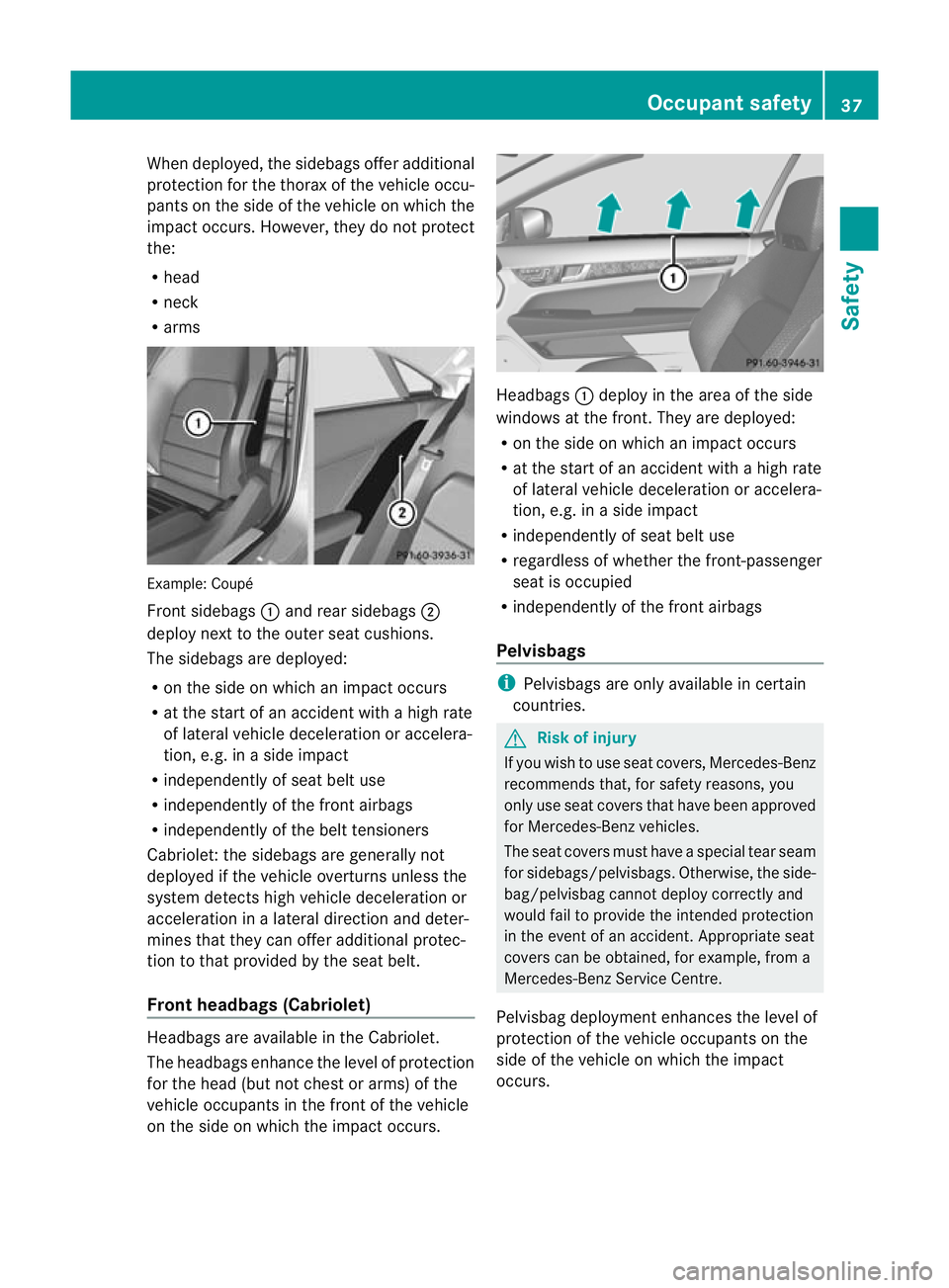
R arms Example: Coupé
Fron
tsidebags :and rear sidebags ;
deploy nex ttothe outer seat cushions.
The sidebags ar edeployed:
R on the side on which an impact occurs
R at the star tofanaccident with ahigh rate
of lateral vehicle deceleration or accelera-
tion, e.g. in aside impact
R independently of seat belt use
R independently of the front airbags
R independently of the belt tensioners
Cabriolet: the sidebags are generally not
deployed if the vehicle overturn sunles sthe
system detec tshigh vehicle deceleration or
acceleration in alateral direction and deter-
mines that they can offer additional protec-
tion to that provided by the seat belt.
Front headbags (Cabriolet) Headbags are available in the Cabriolet.
The headbags enhanc
ethe level of protection
for the head (but not chest or arms) of the
vehicle occupan tsin the front of the vehicle
on the side on which the impact occurs. Headbags
:deploy in the area of the side
windows at the front .They ar edeployed:
R on the side on which an impact occurs
R at the star tofanaccident with ahigh rate
of lateral vehicle deceleration or accelera-
tion, e.g. in aside impact
R independently of seat belt use
R regardless of whether the front-passenger
seat is occupied
R independently of the front airbags
Pelvisbags i
Pelvisbags are only available in certain
countries. G
Risk of injury
If you wish to use seat covers, Mercedes-Benz
recommends that, for safety reasons, you
only use seat cover sthat hav ebeen approved
for Mercedes-Ben zvehicles.
The seat cover smust have aspecial tear seam
for sidebags/pelvisbags. Otherwise, the side-
bag/pelvisbag cannot deploy correctly and
would fail to provide the intended protection
in the event of an accident. Appropriate seat
cover scan be obtained, for example, from a
Mercedes-Benz Service Centre.
Pelvisbag deployment enhances the level of
protection of the vehicle occupant sonthe
side of the vehicle on whic hthe impact
occur s. Occupant safety
37Safety
BA 207ECE ÄJ 2010/1a; 1; 2, en-GB
mkalafa Version: 3.0.2.11 2010-01-26T13:03:22+01:00-Seite 37 Z
Page 41 of 333
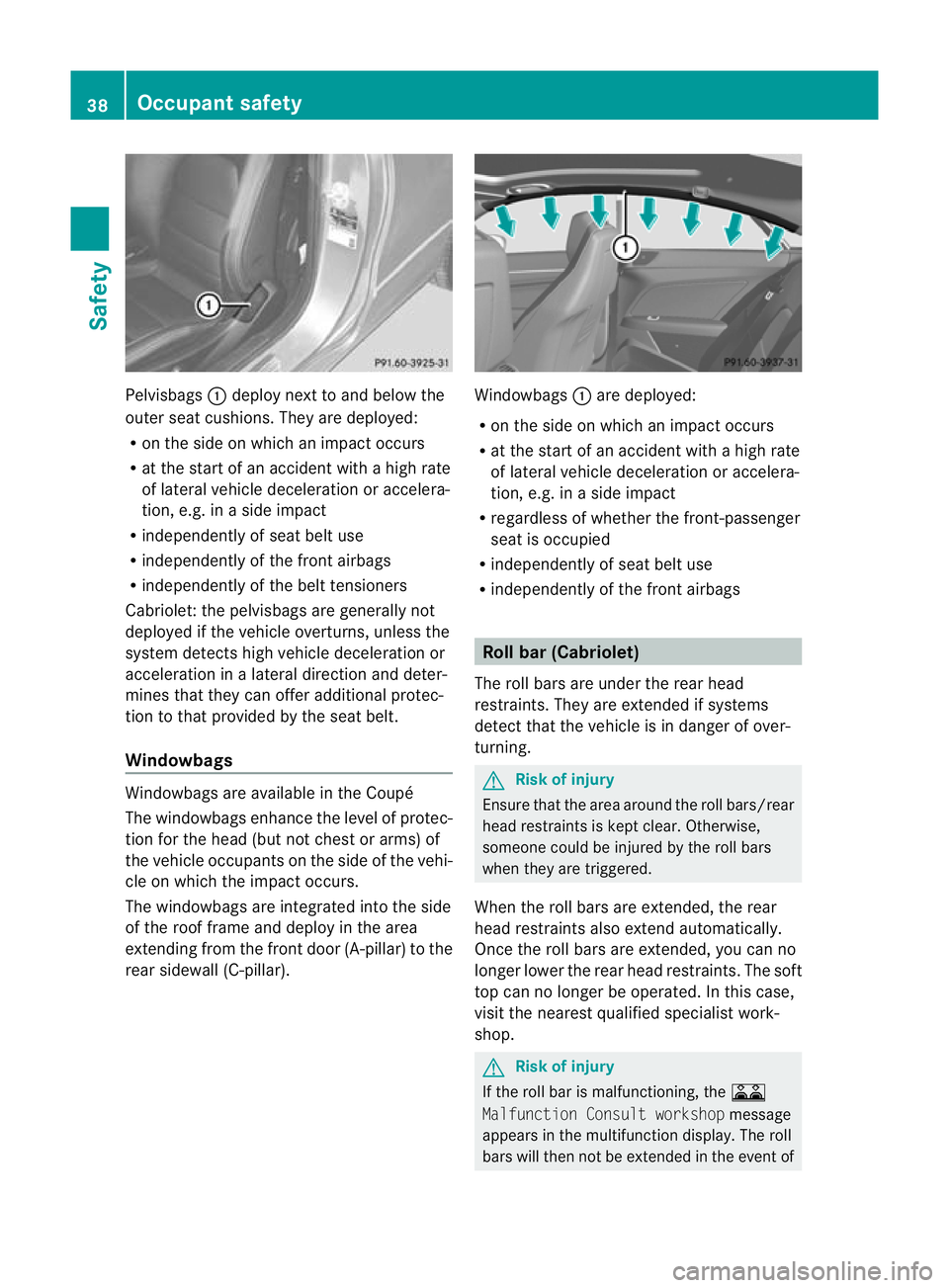
Pelvisbags
:deploy next to and below the
outer seat cushions. They are deployed:
R on the side on which an impact occurs
R at the star tofanaccident with ahigh rate
of lateral vehicle deceleration or accelera-
tion, e.g. in aside impact
R independently of seat belt use
R independently of the fron tairbags
R independen tlyo fthe belt tensioners
Cabriolet :the pelvisbags ar egenerally not
deployed if the vehicle overturns ,unles sthe
system detec tshigh vehicle deceleration or
acceleration in alateral direction and deter-
mines that they can offer additional protec-
tion to that provided by the seat belt.
Windowbags Windowbag
sare availabl eint he Coupé
The windowbags enhance the level of protec-
tion for the head (but not chest or arms) of
the vehicle occupants on the side of the vehi-
cle on whic hthe impac toccurs.
Th ew indowbags are integrated into the side
of the roof frame and deploy in the area
extending from the front door (A-pillar )tothe
rea rsidewall (C-pillar). Windowbags
:are deployed:
R on the side on which an impact occurs
R at the start of an accident with ahigh rate
of lateral vehicle deceleration or accelera-
tion, e.g. in aside impact
R regardless of whether the front-passenger
seat is occupied
R independently of seat belt use
R independently of the front airbags Roll bar (Cabriolet)
The roll bars are under the rear head
restrain ts.T hey ar eextended if systems
detect that the vehicl eisindanger of over-
turning. G
Risk of injury
Ensure that the area around the roll bars/rear
head restraint siskept clear .Otherwise,
someone could be injured by the roll bars
when they are triggered.
Whe nthe rol lbars are extended, the rear
head restraint salso exten dautomatically.
Once the roll bars are extended, you can no
longer lower the rear head restraints. The soft
top can no longer be operated. In this case,
visit the nearest qualified specialist work-
shop. G
Risk of injury
If the roll bar is malfunctioning, the A
Malfunctio nConsult workshop message
appears in th emultifunction display .The roll
bar sw ill then not be extended in the event of 38
Occupant safetySafety
BA 207 ECE ÄJ 2010/1a; 1; 2, en-GB
mkalafa
Version: 3.0.2.11 2010-01-26T13:03:22+01:00-Seite 38
Page 46 of 333
belt. If the vehicle is stationar
yand adoor is
opened, the 7seat belt warnin glamp
goes out and the warning ton eceases.
For cer tain countries only: regardless of
whether the driver or the fron tpassenger
have fastened their seat belts, the 7seat
belt warning lamp lights up for 6seconds
after the engin eisstarted. It then goe sout
onc ethe driver and the fron tpassenger have
fastened their seat belts.
i For mor einformation on the 7seat
bel twarning lamp, see "Indicator and warn-
in gl am ps in the instrument cluster ,seat
belt" (Y page 236).
Rear seat belt status indicator The rear-compartment sea
tbelt status indi-
cator tells you if the rear passengers have
their seat belts fastened.
The rear-compartment seat belt status indi-
cator indicates the rear seat on which the belt
is fastened.
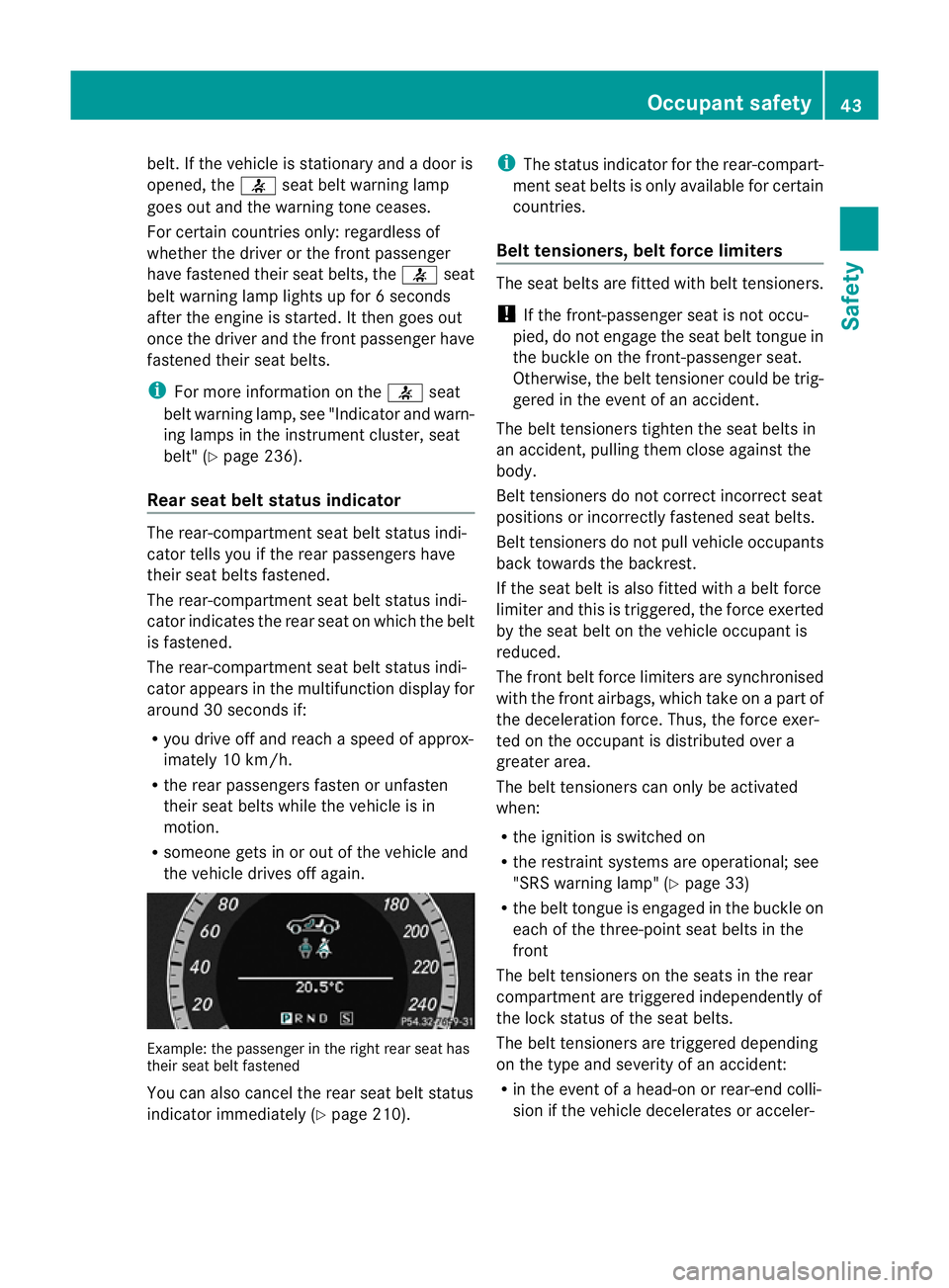
The rear-compartment seat belt status indi-
cator appear sint he multifunction displa yfor
around 30 seconds if:
R you drive off and reach aspeed of approx-
imately 10 km/h.
R the rear passengers fasten or unfasten
their seat belts while the vehicle is in
motion.
R someon egets in or out of the vehicle and
the vehicle drives off again. Example: the passenger in the right rea
rseat has
their seat belt fastened
You can also cancel the rear seat belt status
indicator immediately (Y page 210). i
The status indicator for the rear- compart-
ment seat belts is only available for certain
countries.
Bel ttensioners, belt force limiters The seat belts are fitted with belt tensioners.
!
If the front-passenger seat is not occu-
pied, do not engage the seat belt tongue in
the buckle on the front-passenger seat.
Otherwise, the belt tensioner could be trig-
gered in the event of an accident.
The belt tensioners tighten the seat belts in
an accident, pulling them close against the
body.
Belt tensioners do not correct incorrect seat
positions or incorrectly fastened seat belts.
Belt tensioners do not pull vehicle occupants
back towards the backrest.
If the seat belt is also fitted with abelt for ce
limiter and this is triggered, the forc eexerted
by the sea tbelt on the vehicle occupan tis
red uced.
Th ef ront be ltforce limiter sare synchronised
wit hthe front airbags, whic htake on apart of
the deceleration force. Thus, the force exer-
ted on the occupant is distributed over a
greater area.
The belt tensioners can only be activated
when:
R the ignition is switched on
R the restraint systems are operational; see
"SRS warning lamp" (Y page 33)
R the belt tongue is engaged in the buckle on
each of the three-point seat belts in the
front
The belt tensioners on the seats in the rear
compartment are triggered independently of
the lock status of the seat belts.
The belt tensioners are triggered depending
on the type and severity of an accident:
R in the event of ahead-on or rear-end colli-
sion if the vehicle decelerates or acceler- Occupant safety
43Safety
BA 207ECE ÄJ 2010 /1a; 1; 2, en-GB
mkalafa Version: 3.0.2.11 2010-01-26T13:03:22+01:00 -Seite 43 Z
Page 47 of 333
ates rapidly in
alongitudinal dir ectiondur-
ing the initial stages of the impact
R in the even tofaside impact, on th eside
opposit ethe im pactift he vehicle deceler-
ates or accelerates rapidly in alateral direc-
tion
R Cabriolet: in certain situations if the vehicle
overturns and the system determines that
it can provide additional protection.
If the airbags are deplo yed,you will hear a
bang and asmall amount of powder may also
be released. Only in rare cases will th ebang
affect your hearing. The powde rthat is
released generally does not constitute a
healt hhazard. The 6SRS warning lamp
lights up. G
Risk of injury
If the seat belt tensioners have been trig-
gered, they provide no additional protection
in the event of another accident. Therefore,
have belt tensioners which have been trig-
gered replaced at aqualified specialist work-
shop.
Comply with safety regulations when dispos-
ing of belt tensione rs.A ny Mercedes-Be nz
Service Centre can provid edetails of these
regulations. Children in the vehicle
Impor
tantsafety notes G
Ris
kofi njury
Do not leav echildren unsupervised in the
vehicle, even if they ar esecured in achild
restraint system .They coul dinjure them-
selves on parts of the vehicle. The ycould also
be seriously or even fatally injure dbypro-
longe dexposure to extreme hea torcold.
Do not expose the child restraint system to
direct sunlight. Part softhe chil drestraint sys-
tem could heat up and the child could burn
herself/himself on them.
If ac hild opens adoor, the child or other per-
sons coul dbeinjured as aresult. They could get out and injure themselves or be injured by
ap
assing vehicle. G
Risk of injury
Unsecured or incorrectly positioned loads
increase the risk of injury for children and all
other occupants in the event of:
R an accident
R ab raking manoeuvre
R as udden change of direction
Do not carry heavy or hard objects inside the
vehicle unless they are secured. You will find
further information under "Loading guide-
lines" in the index.
If ac hild is travellin ginyour vehicle, secure
the child using achild restraint system which
is appropriate to the size, weight and age of
the chil dand recommended for Mercedes-
Benz vehicles. You should fit the restraint sys-
tem to asuitable rear seat. Make sure that
the child is secured in achild restraint system
throughout the trip.
You can obtai ninformation abou tthe correct
chil drestraint system from any Mercedes-
Benz Servic eCentre.
i It is advisable to use Mercedes-Ben zcare
product stocleanc hildr estraint systems.
You can obtain informatio nabout this from
any Mercedes-Benz Ser vice Centre. Chil
drestraint systems
Importan tsafety notes Mercedes-Benz reco
mmends that you only
use the child restraint system slisted at
(Y page 53). G
Risk of injury
To reduce the risk of serious or even fatal
injury to the child in the event of asudden
change in direction, brakin goranaccident:
R Children less than 1.5 0mtall and under
twelv eyears of age must alway sbesecured 44
Children in th
evehicleSafety
BA 20 7ECE ÄJ 2010/1a; 1; 2, en-GB
mkalafa Version: 3.0.2.11 2010-01-26T13:03:22+01:00-Seite 44
Page 49 of 333
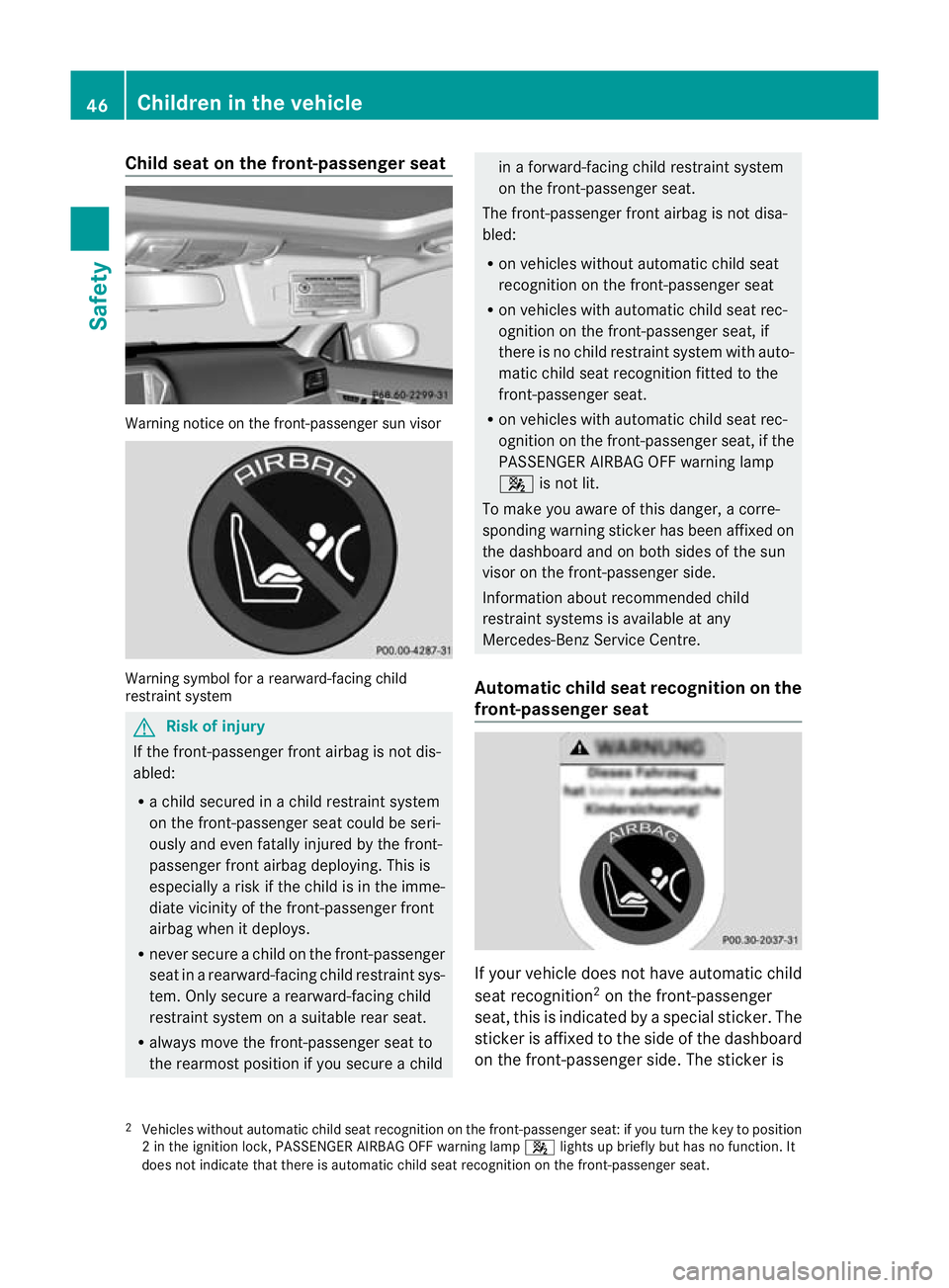
Child seat on th
efront-passenger seat War
ning notic eonthe front-pa ssenger sun visor War
ning symbol for arearward-facing child
restraint system G
Ris
kofi njury
If th efront-p assenger front airbag is not dis-
abled:
R ac hilds ecured in achildr estraint system
on th efront-p assenger seat could be seri-
ously and even fatally injured by the front-
passenger front airbag deploying .This is
especially arisk if the child is in the imme-
diate vicinity of the fron t-passenger front
airba gwhen it deploys.
R never secur eachild on the front-passenger
seat in arearward-facing child restraint sys-
tem. Only secur earearward-facing child
restraint system on asuitable rear seat.
R always move the front-passenger seat to
the rearmost position if you secure achild in
af orward-facing child restraint system
on the front-passenger seat.
The front-passenger front airbag is not disa-
bled:
R on vehicles withou tautomatic child seat
recognition on the front-passenger seat
R on vehicles with automatic child seat rec-
ognition on the front-passenger seat, if
there is no child restraint system with auto-
matic child seat recognition fitted to the
front-passenger seat.
R on vehicles with automatic child seat rec-
ognition on the front-passenger seat, if the
PASSENGER AIRBAG OFF warning lamp
4 is not lit.
To make you aware of this danger, acorre-
spondin gwarning sticker has been affixed on
the dashboard and on both sides of the sun
visor on the front-passenger side.
Infor mation about recommended child
restraint systems is available at any
Mercedes-Benz Service Centre.
Automatic child seat recognitio nonthe
front-passenge rseat If your vehicle does not have automatic child
seat recognition
2
on the fron t-passenger
seat, this is indicated by aspecial sticker. The
sticker is affixed to the side of the dashboard
on the front-passenger side. The sticker is
2 Vehicles withou tautomatic child seat recognition on the front-passenger seat: if you turn the key to position
2int he ignition lock ,PASSENGER AIRBAG OFF warning lamp 4lights up briefly but has no function. It
doe snot indicat ethat ther eisa utomatic child seat recognition on the front-passenger seat. 46
Children in th
evehicleSafety
BA 20 7ECE ÄJ 2010/1a; 1; 2, en-GB
mkalafa Version:3.0.2.11
2010-01-26T13:03:22+01:00
-Seite 46
Page 50 of 333
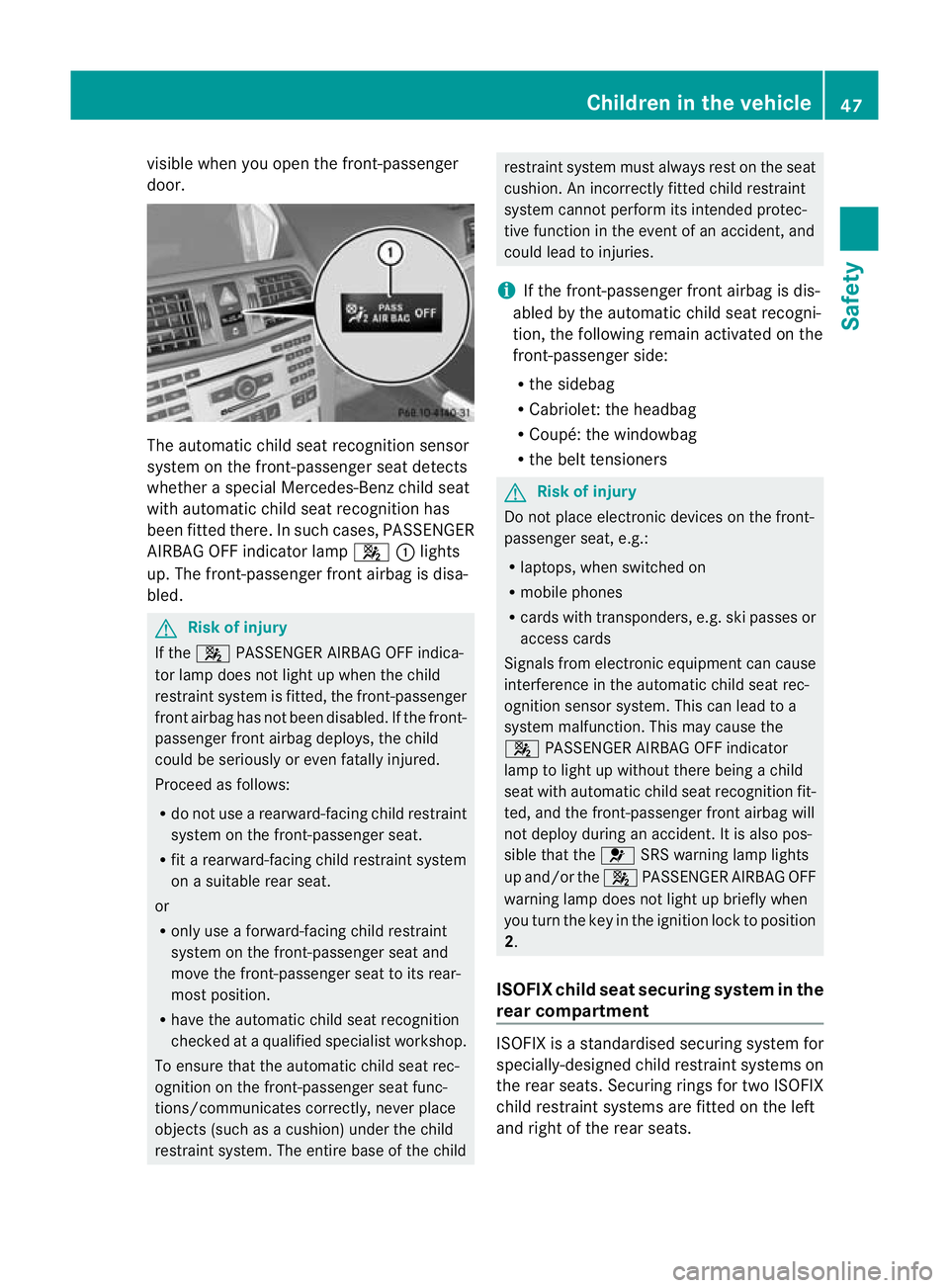
vis
iblew hen you open the front-passenger
door. The automatic chil
dseat recognition sensor
syste mont he front-passenger seat detects
whether aspecial Mercedes-Ben zchild seat
with automatic chil dseat recognition has
been fitted there. In such cases, PASSENGER
AIRBA GOFF indicato rlamp 4 :lights
up. The front-passenger front airbag is disa-
bled. G
Risk of injury
If the 4 PASSENGER AIRBA GOFF indica-
tor lamp doe snot light up when the child
restraint system is fitted, the front-passenger
front airbag has not been disabled. If the front-
passenger front airbag deploys, the child
coul dbes eriously or even fatally injured.
Proceed as follows:
R do not use arearward-facing child restraint
system on the front-passenger seat.
R fit arearward-facing child restraint system
on asuitable rear seat.
or
R only use aforward-facing child restraint
system on the front-passenger seat and
mov ethe front-passenger seat to its rear-
most position.
R hav ethe automatic chil dseat recognition
checked at aqualified specialist workshop.
To ensure that the automatic child seat rec-
ognitio nonthe front-passenger seat func-
tions/communicates correc tly, never place
objects (such as acushion) under the child
restraint system. The entire base of the child restraint system must always rest on the seat
cushion. An incorrectly fitted child restraint
system cannot perform its intended protec-
tive function in the event of an accident, and
could lead to injuries.
i If the front-passenger front airbag is dis-
abled by the automatic child seat recogni-
tion, the following remain activated on the
front-passenger side:
R the sidebag
R Cabriolet: the headbag
R Coupé :the windowbag
R the belt tensioners G
Risk of injury
Do not plac eelectronic devices on the fron t-
passenger seat, e.g.:
R laptops, when switched on
R mobile phones
R cards with transponders, e.g. ski passes or
access cards
Signal sfrom electroni cequipmen tcan cause
interference in the automatic child seat rec-
ognition senso rsystem. This can lead to a
syste mmalfunction. This may cause the
4 PASSENGER AIRBA GOFF indicator
lamp to light up without there being achild
seat with automatic chil dseat recognition fit-
ted, and the front-passenger front airba gwill
not deploy during an accident .Itisalso pos-
sible that the 6SRS warnin glamp lights
up and/or the 4PASSENGER AIRBA GOFF
warning lamp does not light up briefly when
you turn the key in the ignitio nlock to position
2.
ISOFIX chil dseat securing system in the
rear compar tment ISOFI
Xisas tandardised securing system for
specially-designed child restraint systems on
the rear seats .Securing rings for two ISOFIX
child restraint system sare fitted on th eleft
and right of the rear seats. Children in the vehicle
47Safety
BA 207ECE ÄJ 2010 /1a;1;2,e n-GB
mkalafa Version: 3.0.2.11 2010-01-26T13:03:22+01:00-Seite 47 Z
Page 53 of 333
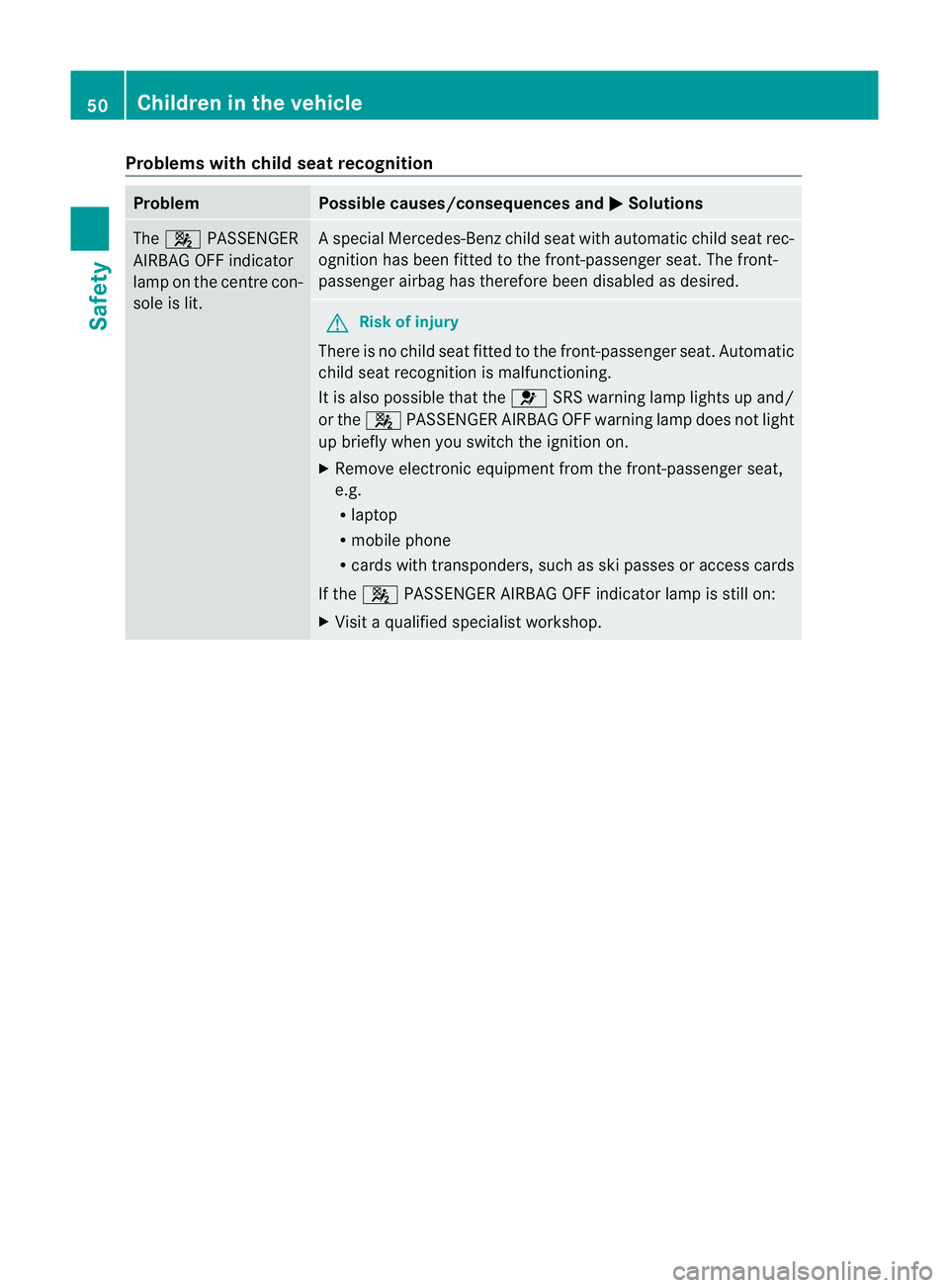
Problems wit
hchilds eat recognition Problem Possible causes/consequences and
M Solutions
The
4 PASSENGER
AIRB AGOFF indicator
lam ponthe cen trecon-
sole is lit. As
pecial Mercedes-Benz child seat with automatic child seat rec-
ognition has been fit tedtot he front-passenger seat. The front-
passenger airbag has therefor ebeen disabled as desired. G
Risk of inju
ry
There is no child seat fit tedtot he front-passenger seat. Aut omatic
chil dseat recognition is malfun ctioning.
It is also possible that the 6SRS warnin glamp lights up and/
or the 4PASSENGER AIRBAG OFF warning lamp does not light
up briefly when you switch the ignition on.
X Remove electronic equipment from the front-passenger seat,
e.g.
R
laptop
R mobile phone
R cards with transponde rs,s uch as ski passes or access cards
If the 4 PASSENGER AIRBAG OFF indicator lamp is still on:
X Visit aqualified specialist workshop. 50
Children in th
evehicleSafety
BA 20 7ECE ÄJ 2010/1a; 1; 2, en-GB
mkalafa Version:3.0.2.11
2010-01-26T13:03:22+01:0
0-Seite 50
Page 54 of 333
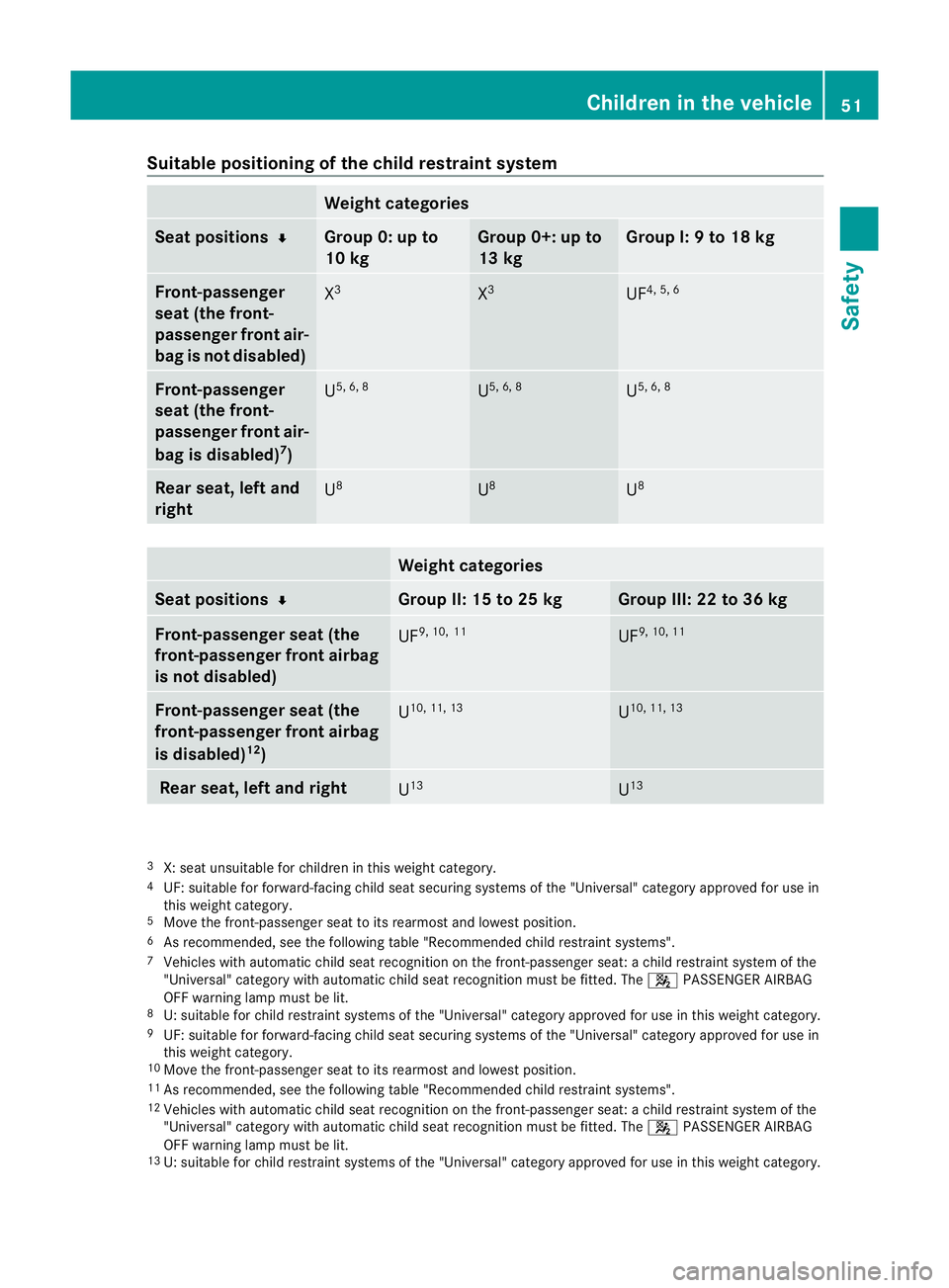
Suitabl
epositioning of the child restraint system Weight categories
Seat positions
¬ Grou
p0:upto
10 kg Group 0+: up to
13 kg Group I:
9to18kg Front-passenger
seat (the front-
passenger front air-
bag is not disabled)
X
3 X
3 UF
4, 5, 6 Front-passenger
seat (the front-
passenger front air-
bag is disabled)
7
) U
5, 6, 8 U
5, 6, 8 U
5, 6, 8 Rear seat, left and
right
U
8 U
8 U
8 Weight categories
Seat positions
¬ Group II: 15 to 25 kg Group III
:22to36kg Front-passenger seat (the
front-passenger front airbag
is not disabled)
UF
9, 10, 11 UF
9, 10, 11 Front-passenger seat (the
front-passenger front airbag
is disabled)
12
) U
10, 11, 13 U
10, 11, 13 Rear seat, left and right
U
13 U
13 3
X: seat unsuitable for children in this weight category.
4 UF: suitable for forward-facin gchild seat securing system softhe "Universal" category approved for use in
this weight category.
5 Move the front-passenger seat to its rearmost and lowest position.
6 As recommended, see the following table "Recommended child restraint systems".
7 Vehicles with automatic child seat recognition on the front-passenger seat: achild restraint system of the
"Universal "category with automatic child seat recognition must be fitted. The 4PASSENGER AIRBAG
OFF warning lamp must be lit.
8 U: suitable for child restraint systems of the "Universal" category approved for use in this weight category.
9 UF: suitable for forward-facing child seat securing systems of the "Universal" category approved for use in
this weight category.
10 Move the front-passenger seat to its rearmost and lowest position.
11 As recommended, see the following table "Recommended child restraint systems".
12 Vehicles with automatic child seat recognition on the front-passenger seat: achild restraint system of the
"Universal "category with automatic child seat recognition must be fitted. The 4PASSENGER AIRBAG
OFF warning lamp must be lit.
13 U: suitable for child restraint systems of the "Universal" category approved for use in this weight category. Childre
ninthe vehic le
51Safety
BA 207ECE ÄJ 2010 /1a; 1; 2, en-GB
mkalafa Version: 3.0.2.11 2010-01-26T13:03:22+01:00 -Seite 51 Z
Page 96 of 333
Seats
Important safety notes
G
Ris
kofi njury
The seats can still be adjusted when there is
no key in the ignition lock. For this reason,
children should never be left unsupervised in
the vehicle. They could adjust the seats and
becom etrapped. G
Ris
kofa ccident
Only adjust the driver' sseat when the vehicle
is stationary .You will otherwise be distracted
from the road and traffic condition sand you
could los econtrol of the vehicle as aresult of
the seat moving. This could cause an acci-
dent. G
Risk of injury
Make sure that nobody can becom etrapped
when adjustin gthe seats.
Observ ethe note sonairbags.
Secur echildren as recommended; see the
"Childre ninthe vehicle" section. G
Risk of injury
Make sur ethat the bac kofyour head is sup-
ported at eye level by the cen tralarea of the
head restraint. If your head is not supported
correctly by th ehead restraint ,you coul dsuf-
fer asever eneck injury in the event of an
accident .Never driv eifthe head rest raints are
not engaged and set correctly.
! To avoid damage to the seats and the seat
heating, observe the following information:
R do not spill any liquids on the seats. If
liquid is spilled on the seats, dry them as
soon as possible.
R if the seat cover sare damp or wet, do not
switc hont he seat heating. The seat
heating should also not to be used to dry
the seats. R
clea nthe seat cover sasrecommended;
see the "In terior care" section.
R do not transport heav yloads on the
seats. Do not plac eshar pobjects on the
seat cushions ,e.g. knives, nails or tools.
Th es eats should only be occupied by
passengers, if possible.
R when the seat heatin gisinoperation ,do
not cover the seats with insulating mate-
rials, e.g. blanke ts,c oats, bags, seat cov-
ers, child seats or booster seats.
! When you mov ethe seats, make sur ethat
ther eare no objects in th efootwell or
behind the seats. Otherwise, you could
damage the seats and the objects.
i The head restraint sinthe fron tseats are
fit tedw ith the NECK -PRO system
(Y page 39). For this reason, it is not pos-
sibl etor emov ethe head restraint sfrom
th ef ront seats.
Please contact aMercedes-Ben zService
Cent refor more info rmation.
i Related topics:
R Through-loading feature in the rear
bench seat 19
(folding the rear bench seat
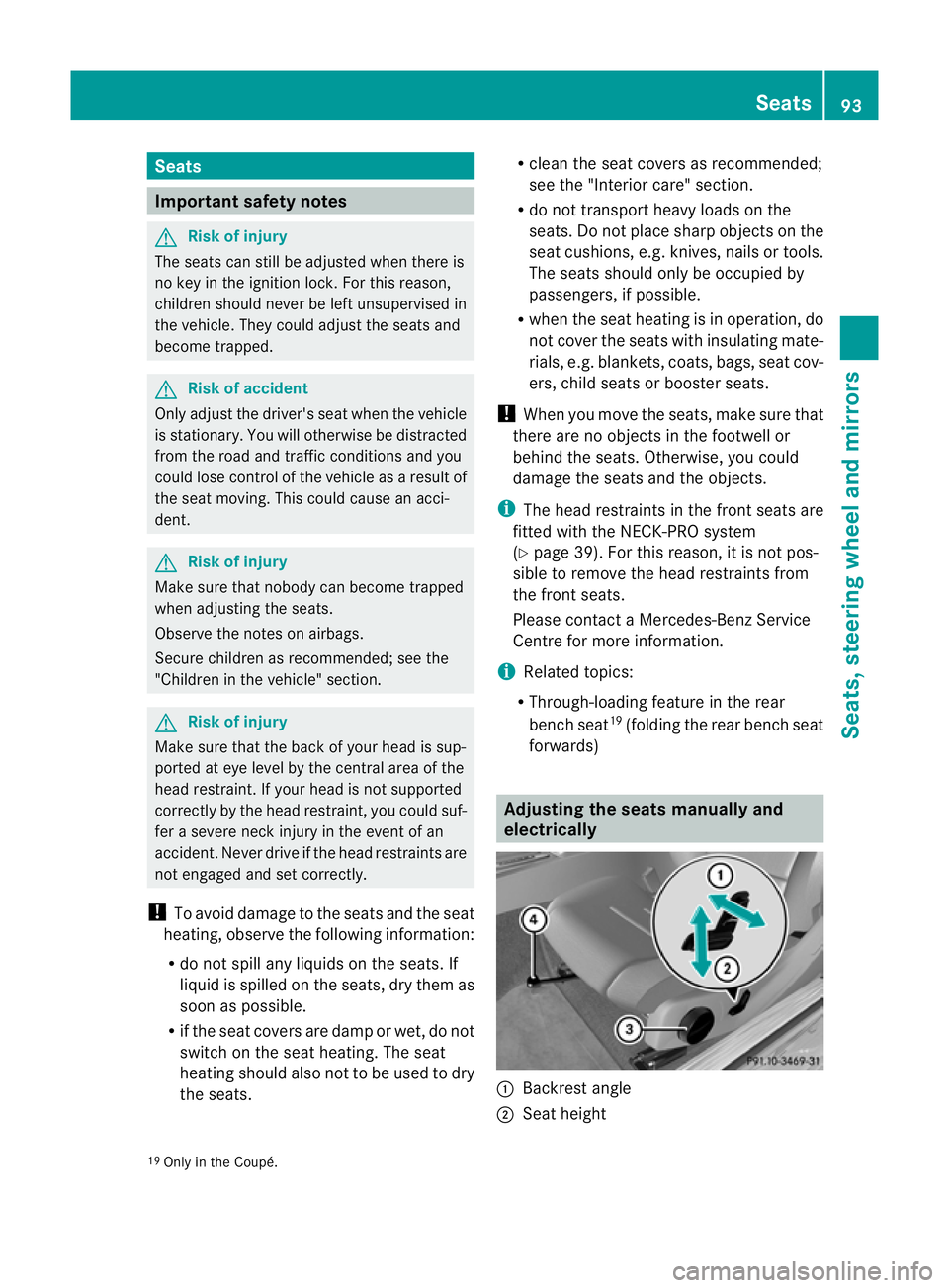
forwards) Adjusting the seats manually and
electrically
:
Backrest angle
; Seat height
19 Only in the Coupé. Seats
93Seats,steering wheel and mirrors
BA 207 ECE ÄJ 201 0/1a; 1; 2, en-GB
mkalafa Version: 3.0.2.11 2010-01-26T13:03:22+01:00-Seite 93 Z