airbag MERCEDES-BENZ E-CLASS CABRIOLET 2010 Owners Manual
[x] Cancel search | Manufacturer: MERCEDES-BENZ, Model Year: 2010, Model line: E-CLASS CABRIOLET, Model: MERCEDES-BENZ E-CLASS CABRIOLET 2010Pages: 333, PDF Size: 7.64 MB
Page 7 of 333
1, 2,
3...
12 Vsocket ........................................ 253 A
ABS (Anti-lock Braking System) Display message ............................ 215
Function/notes ................................ 55
Warn ingl am p................................. 238
Accident (notes) ................................ 273
Activ elight function (display mes-
sage) ................................................... 220
Activ eService System PLUS
se eA SSYSTP LUS service interval
display
ADAPTIV EBRAKE ................................ .59
Adaptive bra kelamps ......................... 57
Adaptive Highbeam Assist Activating/deactivating .................108
Adaptive Main-Beam Assist
Display message ............................ 220
Switch ingo n/off (on-board com-
puter) ............................................. 206
Additional spe edometer ................... 204
Airbag Hea dbag .......................................... 37
Important safety gu idelines ............. 34
Airbags
Activati on......................................... 33
Front airba g(driver, front
passenger) ....................................... 36
Kneeba g.......................................... .36
Pelvi sairbag .................................... 37
Sid ebag ............................................ 36
Windowba g...................................... 38
AIRCAP ................................................. 84
AIRCA P(cle anin ginstructions) ........266
Ai rc onditioning
3-zon eTHERMOTRO NICl uxury
automatic air conditioning .............122
Activating/deactivating .................124
Activating/deactivating air-recir-
culatio nmode ................................ 128
Contro lling automatically ...............124
Co oling with air dehumidificatio n..1 24
Demist ingt he windscreen .............127
Rea rcontrol panel ......................... 123Setting the ai
rdistribution .............126
Setting the airflo w......................... 126
Setting the ai rvent s...................... 130
Setting the temperature ................125
Setting the temperature (re ar
compartment) ................................ 125
Switch ingt he residual heat func-
tion on/of f..................................... 129
THERMATIC 2-zone automatic cli-
mate control .................................. 121
Air-co nditionin gsyst em
se eC limate control
Ai rd ehumidification
Activating/deactivating with cool-
ing ................................................. 124
Ai rd istribution
Settin g........................................... 126
Ai rf ilter (whit edisplay message) ....224
Airflow Setting ........................................... 126
Ai rp ressure
see Tyr epres sure
Air-recirculation mode
Activating/ deactivating ................. 128
AIRSC ARF............................................. 98
Setting the vent s........................... 131
Ai rv ents ............................................ .130
Glove comp artment ....................... 130
Important safety informatio n......... 130
Rea r............................................... 131
Setting the AIRSCA RFvent s.......... 131
Setting the centre ai rvents ........... 130
Setting the si deairv ents ............... 130
Switch ingA IRSCAR Fon/off ............ 98
Alarm system
seeA TA
Alertness Assistant
see ATTENTION ASSIST
Anti-glare film .................................... 255
Ant i-loc kB rake System
see ABS
Anti-Theft Alarm system
see ATA
Anti-theft system
ATA (Anti-Theft Alarm system) .........61
Immob iliser ...................................... 604
Index BA 207 ECE ÄJ 2010/1a; 1; 2, en-GB
mkalafa
Version: 3.0.2.11 2010-01-26T13:03:22+01:00-Seite 4
Page 13 of 333
H
Headbag ............................................... 37
Headlamp clean ings yst em .............. 110
Headlamp flasher .............................. 110
Headlamps Clean ing. ........................................ 267
Head level heating
AIRSCAR F........................................ 98
Head restraint
Lowering manually (re ar)................. 95
Head restraints
Adjusting (e lectrically )..................... 94
Adjusting (manually )........................ 94
Adjusting (re ar)................................ 95
se eN ECK-PR Ohead restraints
Hea ting
see Air conditioning
High-pressu recleaners .................... 264
Hill star tassist .................................. 137
HOLD function ................................... 172
HOLD functio n(display message) ...225 I
Immobili ser.......................................... 60
Ind icator and warn ingl amps
ABS ................................................ 238
Brake s........................................... 236
Co olan t.......................................... 241
DISTRONI CPLUS ........................... 242
Engine di agnostics ......................... 240
ESP ®
.............................................. 238
ESP ®
OFF ....................................... 239
Fue ltank ........................................ 241
Overview .......................................... 25
PASSENGER AIRBAG OFF ................46
Reserve fuel ................................... 241
Sea tbelt. ....................................... 236
SRS ................................................ 240
Instrument cluster
Overview .......................................... 24
Submenu (on-bo ardc omputer )...... 204
Warn inga nd indicator lamps ...........25
Instrument li ghting ............................. 24
se eI nstrument cluster lighting Intelligen
tLight System
Display message ............................ 221
Setting di pped-beam headlamps
for driving on the right/left (on-
board computer) ............................ 206
Switch ingo n/off (on-board com-
puter) ............................................. 206
Int erior lighting
Automatic control system ..............112
Del ayed swit ch-off (on-bo ard
computer) ...................................... 207
Emergency lighting ........................112
Manual control ............................... 112
Reading lamp ................................. 112
Int erior motion sensor ........................62
IS OFIX child seat securing system ....47 J
Jack Storage locatio n............................ 274
Using ............................................. 281
Jump-starting ..................................... 289
se eJ ump-st arting K
Key Changing the battery .......................68
Ch ecking the battery .................66, 68
Convenience closing feat ure. ........... 75
Convenience op ening feature ..........75
Display message ............................ 234
Ma lfunction ...... ................................ 69
Modifying the programming .............67
Opening/closing soft top .................78
Starting the engine ........................136
KEYLES S-GO
Button ............................................ 135
Convenience closing ........................76
Display message ............................ 234
Locking ............................................ 66
Starting the engine ........................136
Unlockin g......................................... 66
Ke yp ositions
Key ................................................ 135
KEYLESS GO .................................. 135
Kickdown ................................... 144, 14710
Index BA 207 ECE ÄJ 2010/1a; 1; 2, en-GB
mkalafa
Version: 3.0.2.11 2010-01-26T13:03:22+01:00-Seite 10
Page 16 of 333
Problem
......................................... 177
Sensor rang e................................. 175
Traile rtowing ................................. 176
Warn ingd ispla y............................. 175
PA SSENGER AIRBAG OF Fwarning
lamp ...................................................... 46
Pe rman ent displa y(on-boar dcom-
puter) .................................................. 205
Permanent Speedtronic ....................171
Plastic trim (cleanin ginstructions) .269
Po we rsupply (trail er)....................... 189
Po we rw indows
see Side windows
Pre-emptive occupant safety system
see PRE-SAFE ®
PRE-SAFE ®
Brak e(vehicles with
DISTRONIC PLUS) Activating/deactivatin g(on-
board computer) ............................ 203
Display message ............................ 212
Function/notes ................................ 59
PRE-SAFE ®
Brake (v ehicles with
DISTRONI CPLUS)
Warning lamp ................................ .242
PRE-SAFE ®
system
Display message ............................ 211
Operatio n......................................... 39
Program sele ctor button .................. 144
Pul ling away
Automatic transmission .................137
Manual transmission ...................... 136 R
Radar se nsor system
Country overview ........................... 324
Display message ............................ 225
Radar syste msensors
Switching on/off (on-board com-
puter) ............................................ .208
Radio
Changing astatio n(on-board
computer )...................................... 199
se es eparat eoperating instructions
Rain closing feature
Panorama sliding sunroo f................ 88
Rang e(on-boa rd computer) .............197Rear compartment
Setting the ai rvent s...................... 131
Setting the temperature ................125
Rear-c ompartment seat bel tsta-
tus indicator ........................................ 43
Rear foglamp (di splay message) ...... 219
Rear seat backrest Display message ............................ 232
Fol ding forwards/back ..................246
Rear seat backres t(display mes-
sage) ................................................... 232
Rear-vie wmirror
Anti-dazzle mode (automatic) ........102
Dipping (manual) ........................... 101
Rear windo wblind ............................ 251
Rear windo wheating
Malfunction ................................... .128
Switch ingo n/off ........................... 128
Refuell ing.......................................... .148
Res erve (fuel tank)
see Fuel
Reserve fuel
Display message ............................ 223
Warn ingl am p................................. 241
Residual heat
Switch ingo n/off ........................... 129
Restrain tsyst ems
se eS RS
Rev counter ........................................ 192
Reverse gear Engaging (manual transmission) ....142
Rev ersing camera ............................. 180
Rev ersing camera (cleaning
instructions) ...................................... 268
Rev ersing lamp (display message) ..220
Rol lbar
Display message ............................ 212
Operatio n......................................... 38
Rolle rblind
see Roller sunblind
Roller sunblind
Opening/closin g.............................. 89
Panorama sl iding sunroof ................ 88
Rea rwindow .................................. 251
Roof
seeS oft top
Roo fcarrier ................................ 248, 249 Index
13 BA 207 ECE ÄJ 2010/1a; 1; 2, en-GB
mkalafa
Version: 3.0.2.11 2010-01-26T13:03:22+01:00-Seite 13
Page 23 of 333
Inform Mercedes-Benz as soon as poss
ible
abou tany change in address or vehicl eown-
ership. Correct use
Observe the following info rmation when using
your vehicle:
R the safety notes in this manual
R the "Technical data” section in this manual
R national road traffic regulations
R national road traffic licensing regulations G
Risk of injury
Various warning stickers are affixed to your
vehicle. Their purpose is to draw your atten-
tion, and the attention of others, to various
dangers. Therefore, do not remove any warn-
ing stickers unless the sticker clearly states
that you may do so.
If you remove the warning stickers, you or
others could be injured by failing to recognise
certain dangers. Implied warranty
! Follow the instructions in this manual
about the proper operation of your vehicle
as well as about possible vehicle damage.
Damage to your vehicle that arises from
culpable contraventions against these
instructions are not covered either by
Mercedes -Benz implied warranty or by the
New or Used-Vehicle Warrant yof
Daimler AG. Data stored in the vehicle
Fault data
Compone ntsc ritical for vehicl eoperation are
equipped with fault data memories as stand-
ard. There are also memories dedicated to
storing the technica lreactions of vehicle
component stodriving situations (e.g. the
trigge ring of an airbag ,ESP ®
intervention). This data is used exclusively to:
R assist in the rectification of faults and
defects
R help Mercedes-Benz optimise and develop
vehicle functions
The data cannot be used to trac ethe vehicle's
movements.
When your vehicle is serviced by Mercedes-
Ben z,this technical information can be read
out from the fault memory. Thi sisperformed
by authorised employees of the Mercedes-
Benz service network using special diagnos-
tic computers.
Af teraf ault has been rectified, the informa-
tion is deleted from the memory. Other mem-
ory data is constantly overwritten. Other devices tha
tstore data
Depe nding on the equipment level, your vehi-
cle may featur ecommunication sand/or
entertainment systems (e.g .navigation devi-
ces, telephone systems). Thes eallow you to
save and edit data required for the operation
of the respective device.
Fur ther information on operation (e.g. on
deletin gdata) can be found in the separate
operating instructions. 20
Introduction BA 207 ECE ÄJ 201
0/1a; 1; 2, en-GB
mkalafa Version: 3.0.2.11 2010-01-26T13:03:22+01:00-Seite 20
Page 30 of 333
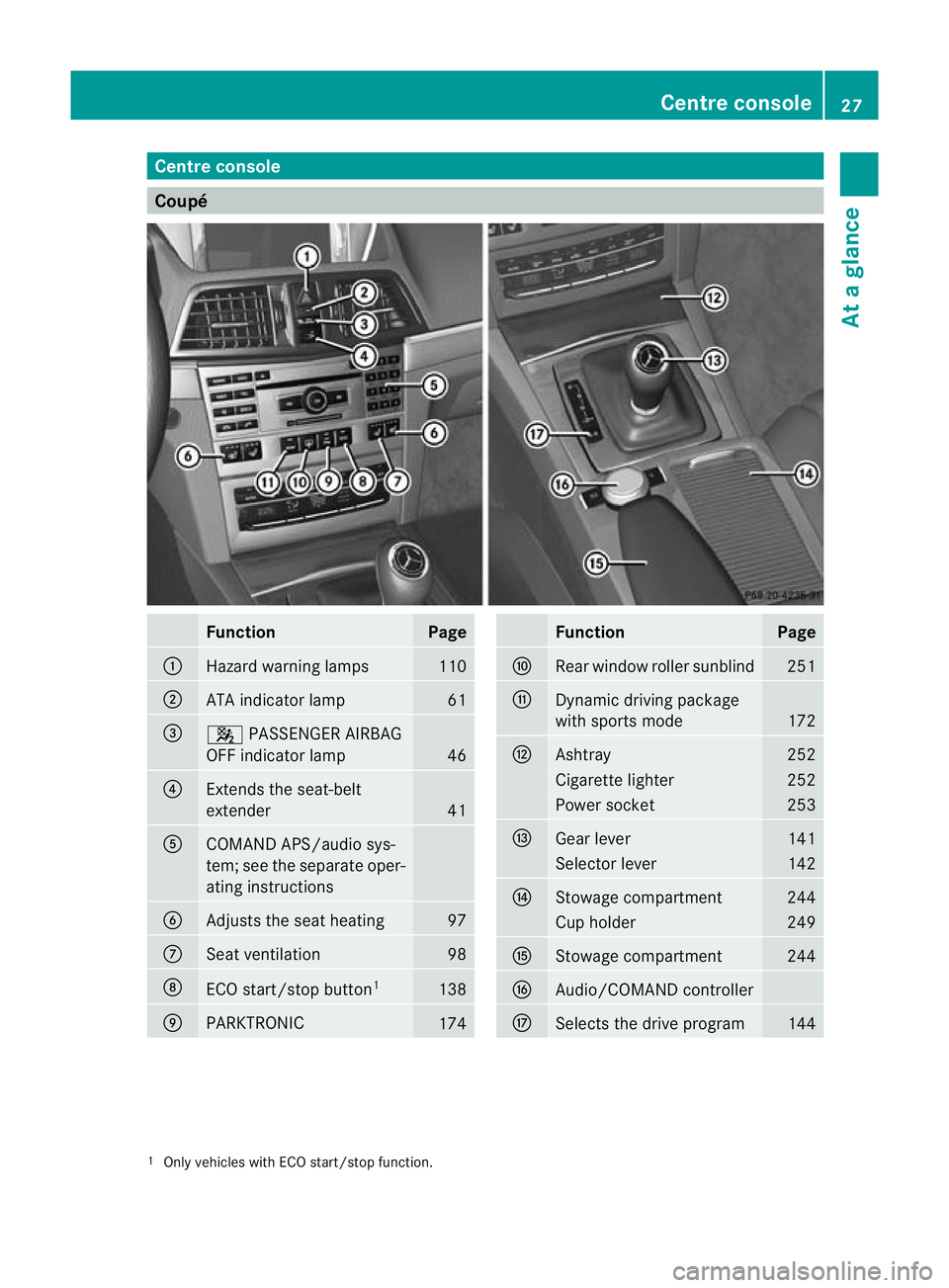
Centre console
Coupé
Function Page
:
Hazard warning lamps 110
;
AT
Ai ndicator lamp 61
=
4
PASSENGER AIRBAG
OFF indicator lamp 46
?
Extend
sthe seat-belt
extender 41
A
COMAND APS/audi
osys-
tem ;see th eseparate oper-
atin ginstructions B
Adjusts the sea
theating 97
C
Seat ventilation 98
D
ECO start/sto
pbutton 1 138
E
PARKTRONIC
174 Function Page
F
Rear window roller sunblind 251
G
Dynamic driving package
with sports mode
172
H
Ashtray 252
Cigarett
elighter 252
Power socket 253
I
Gear lever 141
Selector lever 142
J
Stowage compartment 244
Cup holder 249
K
Stowage compartment 244
L
Audio/COMAND controller
M
Select
sthe driv eprogram 144
1
Only vehicles with ECO start/stop function. Centre console
27Atag lance
BA 20 7ECE ÄJ 2010/1a; 1; 2, en-GB
mkalafa Version:3.0.2.11
2010-01-26T13:03:22+01:00
-Seite 27
Page 31 of 333
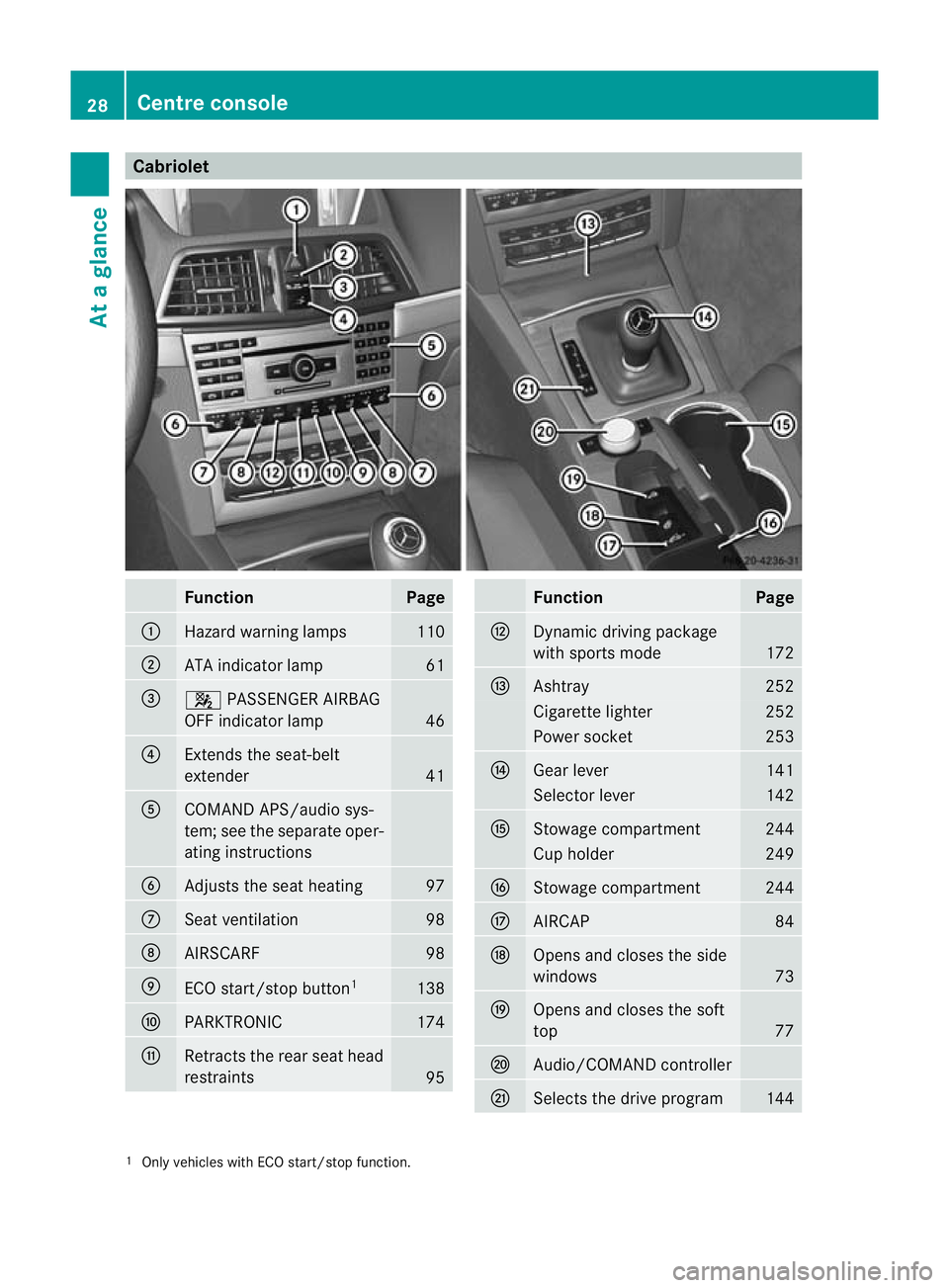
Cabriolet
Function Page
:
Hazard warning lamps 110
;
AT
Ai ndicator lamp 61
=
4
PASSENGER AIRBAG
OFF indicator lamp 46
?
Extend
sthe seat-belt
extender 41
A
COMAND APS/audi
osys-
tem ;see th eseparate oper-
atin ginstructions B
Adjusts the sea
theating 97
C
Seat ventilation 98
D
AIRSC
ARF 98
E
ECO start/stop button
1 138
F
PARKTRONIC 174
G
Retracts the rear seat head
restrain
ts 95 Func
tion Page
H
Dynamic driving package
wit
hsports mode 172
I
Ashtray 252
Cigar
ettelighter 252
Power socket 253
J
Gear lever 141
Selector lever 142
K
Stowage compartment 244
Cup holder 249
L
Stowage compartment 244
M
AIRCAP 84
N
Open
sand closes the side
windows 73
O
Ope
nsand closes the soft
top 77
P
Audio/COMAN
Dcontroller Q
Selec
tsthe driv eprogram 144
1
Only vehicles with ECO start/stop function. 28
Centre consoleAt
ag lance
BA 20 7ECE ÄJ 2010/1a; 1; 2, en-GB
mkalafa Version:3.0.2.11
2010-01-26T13:03:22+01:00
-Seite 28
Page 35 of 333
Vehicl
eequipment
i Thismanua ldesc ribe sallthe standard
and optional equipment of your vehicle
which wa savailable at th etime of pur-
chase. Countr y-specif ic differences are
possible. Bear in mind tha tyour vehicle
ma ynot featur eall function sdescribed
here. Occupant safety
Important safet
ynotes
Seat belts, together with belt tensioners, belt
forc elimiter sand airbags, are complemen-
tary, coordi nated restraint systems. They
reduce the risk of injur yinspecific ,pre-
define dtypes of accident situa tions and
thereby increase occupan tsafety. However,
seat belts and airbags generally do not pro-
tec tagainst objec tspenetratin gthe vehicle
from the outside.
To ensur ethat the restraint system scan
deliver their full potential protection, make
sure that:
R the seat and head restraint are adjusted
properly (Y page 92).
R the seat belt has been fastened properly
(Y page 41)
R the airbags can inflate unrestricted if
deployed (Y page 34)
R the steering wheel is adjusted properly
(Y page 92)
R the restraint systems have not been modi-
fied.
i An airbag increases the protection of
vehicle occupant swearing aseat belt. As
such they are only an additional restraint
system which complemen ts,b ut does not
replace, the seat belt. All vehicle occupants
must wear their seat belt correctly at all
times, even if the vehicle is equipped with
airbags. Airbags are not deployed in all
types of accidents, e.g. in situations where
airbag deployment would not increase the protection afforded by
acorrectly worn
seat belt. Airbag deployment only provides
increased protection if the seat belt is worn
correctly, because:
R the seat belt helps to keep the vehicle
occupan tinthe best position in relation
to the airbag
R for example, in ahead-on collision ,the
seat belt can mor eadequately prevent
the occupant from being propelled
towards the point of the impact, and is
thus better suited to prevent injury.
Therefore, in accident situations where an
airba gisd eployed, it only provides protec-
tion in addition to the seat belt if the seat
belt is being worn correctly. G
Risk of accident and inju
ry
Always have maintenance work carried out at
aq ualified specialist workshop which has the
necessary specialist knowledg eand tool sto
carry out the work required.
Mercedes-Benz recommends that you use a
Mercedes-Benz Service Centre for thi spur-
pose.
In particular, work relevant to safety or on
safety-related systems must be carried out at
aq ualified specialist workshop .Ifthis wor kis
not carried out correctly, the operating safety
of your vehicl emay be affected. There is arisk
of an accident and injury. G
Risk of injury
The restrain tsystem may not work as inten-
ded if the following components have been
modified or work on thes ecomponents has
not been performed correctly:
R restraint system ,consisting of the seat
belts and anchorages, belt tensioners, belt
force limiters, airbags
R wiring
R networked electronic systems
Airbags or belt tensioners coul dthen fail, e.g.
in the even tofanaccident in which the decel-
eratio nforc ew ould normally be high enough
to trigger the systems, or they coul dbetrig- 32
Occupant safetySafety
BA 207 ECE ÄJ 2010/1a; 1; 2, en-GB
mkalafa
Version: 3.0.2.11 2010-01-26T13:03:22+01:00-Seite 32
Page 36 of 333
gered unintentionally
.Never carry out any
modifications on the restraint systems.
Never tamper with electronic components
and their software. SRS (Supplemental Restraint System)
Introd uction SRS reduces the risk of occupants coming
into contact with the vehicle's interio
rinthe
even tofana ccident. It can als oreduce the
effect of the forces to which occupant sare
subjected during an accident.
SRS consists of:
R 6 SRS warning lamp
R airbags
R airbag con trol unit (with crash sensors)
R belt tensioners
R belt force limiters
SRS warning lamp SRS func
tions ar echecked regularly when
you switc honthe ignition and when the
engin eisrunning. Therefore, malfunctions
can be detected in good time.
The 6 SRS warning lamp in the instrument
cluster lights up when the ignition is switched
on. It goes out no later than afew seconds
after the engine is star ted. G
Risk of inju
ry
If SR Sism alfunctioning, individual systems
may be activated unintentionally or may not
be triggered in the event of an accident with
ah igh rate of vehicle deceleration.
Am alfunction has occurred if:
R the 6 SRS warning lamp does not light
up after the ignition is switched on.
R the engine is runnin gand the 6SRS
warning lamp doe snot go out after afew
seconds.
R the engine is runnin gand the 6SRS
warning lamp lights up again. In this case, have SRS checked immediately
at
aq ualified specialist workshop .Mercedes-
Benz recommends that you use aMercedes-
Benz Servic eCentr efor this purpose.
In particular ,work relevant to safet yoron
safety-related systems must be carried out at
aq ualified specialist workshop.
Triggering of belt tensioners, belt force
limiters and airbags In the event of
acollision ,the airbag con trol
unit evaluates important physical data relat-
ing to the vehicle deceleration or acceleration
during the first stage of the collision, such as:
R duration
R direction
R magnitude
Based on the evaluation of this data ,the air-
bag con trol unit pre-emptivel ytriggers the
belt tensioners in th efirst stage.
i The belt tensioners can only be triggered
if the seat belt tongues are correctly
engaged in the seat belt buckles.
The front airbags are also deployed if there is
an even higher rate of vehicle deceleration in
al ongitudinal direction.
Your vehicle has adaptive, dual-stage front
airbags. In the even tofacollision, the airbag
control unit evalu atesthe vehicle decelera-
tion. Whe nthe first deploymen tthreshol dis
reached, th efront airbag is fille dwith enough
gas to reduce the risk of injuries. The front
airbag is fully deployed if asecon ddeploy-
men tthreshold is exceeded withi nafew mil-
liseconds.
Th eb elt tensioner and airbag triggering
thresholds are variable and are adapted to the
rat eofd eceleration of the vehicle. This proc-
ess is pre-emptiv einnature. The triggering
process must take place in good time at the
start of the collision.
i Not all airbags are deployed in an acci-
dent. The different airbag systems work
independently of each other. Occupant safety
33Safety
BA 207ECE ÄJ 2010 /1a;1;2,e n-GB
mkalafa Version: 3.0.2.11 2010-01-26T13:03:22+01:00-Seite 33 Z
Page 37 of 333
However, the trig
gering of each ind ividual
system depends on the following factors as
determined in the initial stages of the col-
lision:
R the type of accident
- head-on collision
- sid eimpact
- rea rimpact
- Cabriolet: overturn
R thes everity of the accident, in particular
- the vehicle's rat eofdeceleration
- the vehicle's rat eofacceleration
Th ev ehicle deceleration or acceleration and
the direction of force ar ebasicall ydeter-
min edby:
R the distri bution of force sduring the colli-
sion
R the collision angle
R the deform ation characteristics of the vehi-
cle
R the characteristics of the object with which
the vehicle collides
Factors which can only be see nand measured
after acollision has occ urreddon ot play a
decisive role in the deployment of an airbag
nor do they provid eanindicatio nofairbag
deployment.
The vehicle may be deformed significantly,
e.g. the bonnet or the wing, withou tanairbag
being deployed. This is the case if only parts
which are relatively easily deformed are affec-
ted and the deploymen tthreshol disnot
reached. Conversely ,airbags may be
deployed even though the vehicle suffer sonly
minor deformation. Thi sisthe case if, for
example, ver yrigid vehicle parts such as lon-
gitudinal body member sare hi tand sufficient
deceleratio noccurs as aresult. Airbags
Important safety notes Airbag deployment slows down and restricts
the movemen
tofthe vehicle occupant.
If the airbags ar edeployed, you will hear a
bang and asmall amount of powder may also
be released. Only in rare cases will th ebang
affect your hearing. The powde rthat is
released generally does not constitute a
healt hhazard. The 6SRS warning lamp
lights up.
The SRS/AIRBAG symbol indicates the instal-
lation location of the airbags. G
Risk of injury
Airbags provide additional protection; they
are not, however, asubstitute for seat belts.
Observe the following notes to reduce the risk
of serious or even fatal injury caused by airbag
deployment:
R All vehicle occupants –inparticular ,preg-
nant women –must wear their seat belt
correctly at all times and lean back against
the backrest, which should be posi tioned
as close to th evertical as possible. The
head restraint must support th eback of the
head at about eye level.
R Always secur echildren less than 1.50 mtall
and under 12 years of age in suitable child
restraint systems.
R All vehicle occupant smust select aseat
position that is as far away from the airbag
as possible. The driver' sseat position must
allow the vehicle to be driven safely .The
driver's chest should be as fa raway from
the centre of the driver' sfront airba gcover
as possible.
R Move the fr ont-passengers eat as far back
as possible. This is especially impor tantif
you have secured achild in achild rest raint
system on the front-passenger seat. 34
Occupant safetySafety
BA 207 ECE ÄJ 201
0/1a; 1; 2, en-GB
mkalafa Version: 3.0.2.11 2010-01-26T13:03:22+01:00-Seite 34
Page 38 of 333
R
Vehicl eoccupant s–inparticular ,children
–m ust not lean their head in the area of the
window where:
- Coupé: the sidebag/windowbag
deploys.
- Cabriolet: the sidebag/headbag
deploys.
R Rearward-facin gchild rest raint systems
must not be fitted to the front-passenger
seat unless the front-passenger fron tair-
bag has been disabled. On the front-
passenger seat, the front-passenger front
airbag is onl ydisabled if achild restraint
system with automatic chil dseat recogni-
tion is fitted to the front-passenger seat.
The 4 PASSENGER AIRBA GOFF indica-
tor lamp must be continuou slyl it.
If the front-passenge rseat of your vehicle
does not have automati cchild seat recog-
nition, or your rearward-facin gchild
rest raint system does not have automatic
child seat recognition, children must be
secured in achild rest raint system on a
suitable seat in the rear. If you secure a
forward-facin gchild rest raint system to the
front-passenger seat, you must move the
front-passenger seat as far back as possi-
ble.
R Make sure there are no heavy or sharp-
edged objects in pockets of clothing.
R Do not lean forwards, e.g. over the cover of
the driver's/front-passenger fron tairbag,
particularly when the vehicle is in motion.
R Do not put your feet on the dashboard.
R Only hold the steerin gwheel by the rim.
This allow sthe airbag to deploy fully. You
coul dbei njured if the airbag is deployed
and you are holding the inside of the steer-
ing wheel.
R Do not lean on the doors/rear sidewalls
from the inside.
R Make sure that there are no people, ani-
mals or obje ctsb etween the vehicle occu-
pants and the area of deployment of the
airbag. R
Do not place any objects between the seat
back rest and the door.
R Do not hang any har dobjects, for example,
coat hangers, on the grab handles or coat
hooks.
R Do not atta chaccessories such as drinks
can holders to the doors/rear sidewalls.
It is not possible to rule out arisk of injuries
caused by an airbag due to the high speed at
which the airbag must deploy. G
Risk of injury
The airbag' sfunctionality can only be assured
if the following parts are not covered and no
badge sorstickers are attached to them:
R padded steerin gwheel boss
R knee airbag cover below the steerin gcol-
umn
R front-passenger fron tairbag cover
R outer side of fron tseat bolsters
R side tri mnexttot he rea rseat back rest
R Cabriolet :door trim G
Risk of inju
ry
As mall amo untofp owder is released when
an air bagisd eployed. The powder could
cause short-term breathing difficulties in peo-
ple with asthma or other respirator yprob-
lems.
In order to prevent bre athing difficulties ,you
should leave the vehicle as soon as it is safe
to do so. You can also open the window to
allow fresh air to enter the interior .The pow-
der does not constitute ahealth hazar dand
doe snot indicat ethat ther eisaf ire in the
vehicle. G
Risk of injury
The airbag parts are hot after the airbag has
been deployed. Do not touch them as you
could burn yourself.
Have the airbags replaced at aqualified spe-
cialist workshop .Otherwise, occupants are
not protected by the airbags in the event of
another accident. Occupant safety
35Safety
BA 207 ECE ÄJ 2010/1a; 1; 2, en-GB
mkalafa Version:3.0.2.11
2010-01-26T13:03:22+01:00
-Seite 35 Z