fuel MERCEDES-BENZ E-CLASS CABRIOLET 2010 User Guide
[x] Cancel search | Manufacturer: MERCEDES-BENZ, Model Year: 2010, Model line: E-CLASS CABRIOLET, Model: MERCEDES-BENZ E-CLASS CABRIOLET 2010Pages: 333, PDF Size: 7.64 MB
Page 70 of 333
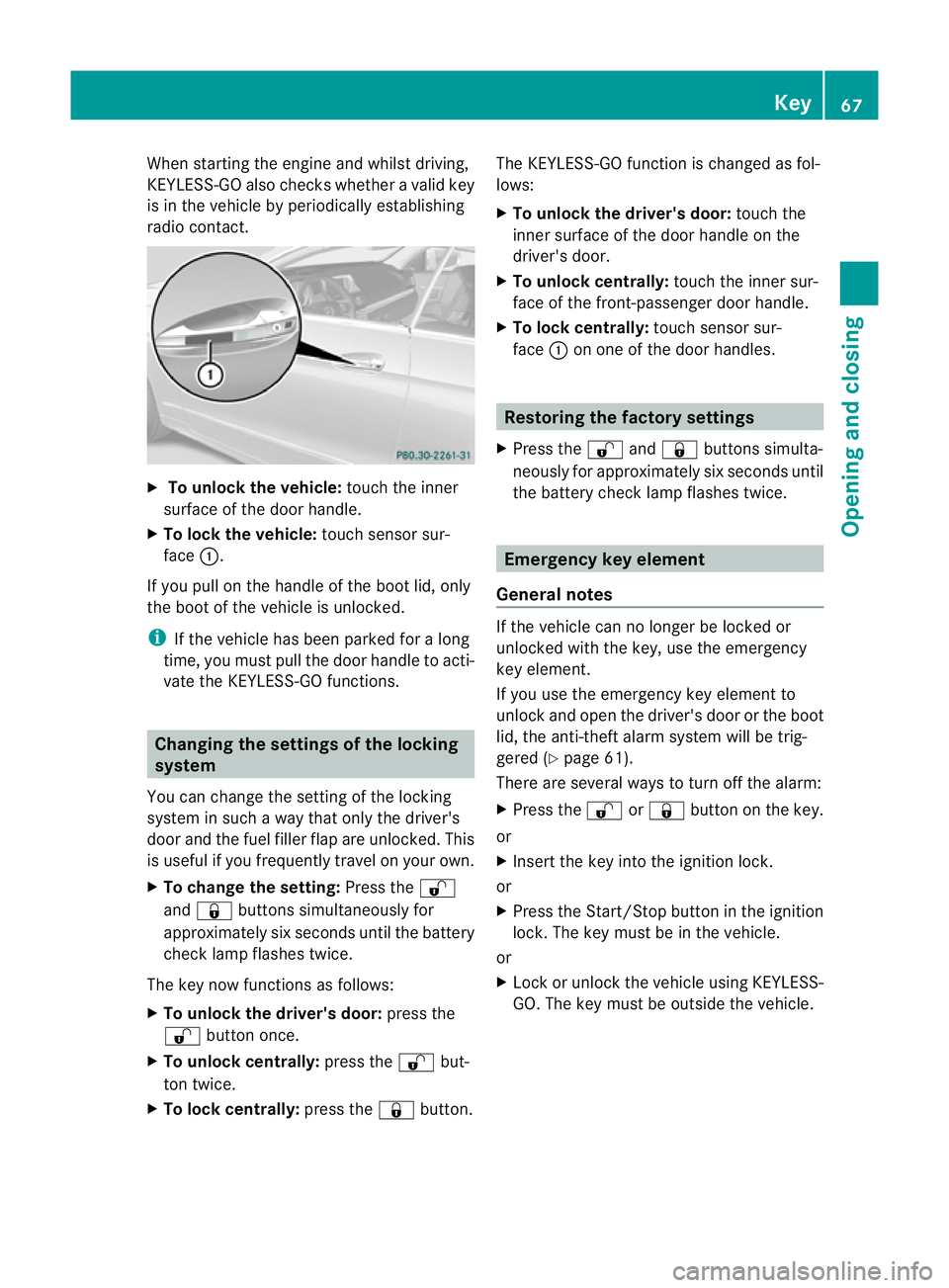
When star
ting the engine and whilst driving,
KEYLESS-GO also checks whether avalid key
is in the vehicle by periodicall yestablishing
radio con tact. X
To unlock the vehicle: touch the inner
surface of the door handle.
X To lock the vehicle: touch sensorsur-
face :.
If you pull on the handle of the boot lid, only
the boot of the vehicle is unlocked.
i If the vehicle has been parked for along
time, you must pull the door handl etoacti-
vate the KEYLESS-GO functions. Changing the setting
softhe locking
system
Yo uc an change the setting of the locking
system in such away that only the driver's
door and the fuel filler flap are unlocked. This
is useful if you frequently travel on your own.
X To change the setting: Press the%
and & buttons simultaneously for
approximately six seconds until the battery
check lamp flashes twice.
The key now functions as follows:
X To unlock the driver's door: press the
% button once.
X To unlock centrally: press the%but-
ton twice.
X To lock centrally: press the&button. The KEYLESS-GO function is changed as fol-
lows:
X
To unlock the driver's door: touch the
inner surface of the door handle on the
driver' sdoor.
X To unlock centrally: touchthe inner sur-
face of the front-passenger door handle.
X To lock centrally: touchsensor sur-
face :on one of the door handles. Restoring the factor
ysettings
X Press the %and& buttons simulta-
neously for approximately six seconds until
the battery check lamp flashes twice. Emergency key element
General notes If the vehicle can no longer be locked or
unlocked with the key, use the emergency
key element.
If you use the emergency key element to
unlock and open the driver's door or the boot
lid, the anti-theft alarm system will be trig-
gered (Y
page 61).
There are several ways to turn off the alarm:
X Press the %or& button on the key.
or
X Insert the key into the ignition lock.
or
X Press the Star t/Stop butto ninthe ignition
lock .The key must be in the vehicle.
or
X Loc koru nlock the vehicl eusing KEYL ESS-
GO. The key must be outside the vehicle. Key
67Opening and closing
BA 207 ECE ÄJ 2010/1a; 1; 2, en-GB
mkalafa Version:3.0.2.11
2010-01-26T13:03:22+01:00
-Seite 67 Z
Page 136 of 333

Vehicl
eequipment ............................ 134
Running-in notes ............................... 134
Driving ............................................... 134
Manual transmission ........................141
Automati ctran smission ................... 142
Refuelling ........................................... 148
Parking ............................................... 153
Driving tips ........................................ 154
Driving systems ................................ 158
Trailer towing .................................... 186 133Driving and parking
BA 20
7ECE ÄJ 2010/1a; 1; 2, en-GB
mkalafa Version:3.0.2.11
2010-01-26T13:03:22+01:0
0-Seite 133
Page 141 of 333

Vehicles with manual transmission
X
Shift to eithe rfirst or reverse gear R.
X Turn the key to position 0in the ignition
lock and remove it.
The immobiliser is activated.
X Apply the parkin gbrake firmly.
Vehicles with automati ctransmission X
Shift the transmission to position P.
With the key
X Turn the key to position 0in the ignition
lock and remove it.
The immo biliserisa ctivated.
X Apply the parking brake firmly.
i Thek ey can only be removed if the trans-
mission is in position P.
Usin gKEYLESS -GO
X Press the Start/Sto pbutton (Y page 135).
The engine stop sand al lthe indicator
lamps in the instrument cluster go out.
X Apply the parkin gbrake firmly.
i Thee ngine can be turne doff whil ethe
vehicle is in mot ionb ypress inga nd holding
the Start/Sto pbutton for thre eseconds. EC
Os tart/sto pfunction
Gen eral notes i
TheE CO start/stop function is only avail-
abl efor the E200 CG IBlueEFFICIENCY
model with manu altransmission.
The ECO start/sto pfunction switches the
engine off automatically in certain situations.
The engine starts automatically whe nyou pull
away again.
The ECO star t/stopfunction thereby helps
you to reduce the fuel consumption and emis-
sions of your vehicle. The ECO start/stop function is activated each
time the engine is switched on. The system is
operational when ECO symbol
:is shown in
the multifunction display.
! Always switch the ignition off and take the
key with you when leaving the vehicle.
Automatic engin eswitch-off The ECO start/stop function switche
soff the
engine automatically if you:
R apply th ebrake and bring th evehicle to a
standstill
R operat ethe clutc hpedal R
engage neutral N(follow gearshif tinstruc-
tion ;to engage neutral N,ifnecessary)
R release the clutch pedal
The engine is only switched off if:
R the outside temperature is within the range
which is suitabl efor the system.
R the engin eisatnormal operatin gtemper-
ature.
R the set temperature for the vehicle interior
has been reached. 138
DrivingDriving and parking
BA 20
7ECE ÄJ 2010 /1a; 1; 2, en-GB
mkalafa Version: 3.0.2.11 2010-01-26T13:03:22+01:00 -Seite 138
Page 143 of 333

Problems wit
hthe engine Problem Possible causes/consequences and
M Solutions
Th
ee ngine doe snot
start. The HOL
Dfunction or DISTRONIC PLUS is activated.
X Deactivat ethe HOL Dfunction (Y page 172)orDISTRONIC
PLUS (Y page 160).
X Try to start th eengine again. The engine doe
snot
start. The starter motor
can be heard. R
There is amalfunction in the engine electronics.
R There is amalfunction in the fuel supply.
R The on-board voltage is too low because the starter battery is
too weak or discharged.
X Before attempting to start the engine again, turn the key in the
ignition back to position 0or press the Start/Stop button
repeatedly until all indicator lamps in the instrumen tcluster go
out.
X Try to star tthe engin eagain (Y page 136). Avoid excessively
long and frequen tattempt stostart the engine as thes ewill drain
the battery.
If the engine does not start after several attempts:
X Consult aqualified specialist workshop. The engine does not
start
.The starter motor
can be heard. The
reserve fuel warning
lam pisl it and the fuel
gauge displa yshows 0. The fuel tan
kise mpty.
X Refue lthe vehicle. The engin
edoes not
start. You cannot hear
the starter motor. The on-boar
dvoltage is too low because the starter battery is too
weak or discharged.
X Jump-start the vehicle (Y page 289).
If the engin edoes not star tdespite attempt stojump-start it:
X Consult aqualified specialist workshop. The starter motor was exposed to
athermal load that was too high.
X Allo wthe starter motor to cool down for approximatel ytwo
minutes.
X Try to start the engine again.
If the engine still does not start:
X Consult aqualified specialist workshop. 140
DrivingDrivin
gand pa rking
BA 20 7ECE ÄJ 2010 /1a;1;2,e n-GB
mkalafa Version: 3.0.2.11 2010-01-26T13:03:22+01:00-Seite 140
Page 144 of 333

Problem Possible causes/consequences and
M Solutions
Vehicles with
apetrol
engine:
The engine is not run-
ning smoothly and is
misfiring. There is
amalfunction in the engine electronics or amechanical
componen tofthe engin emanagement system.
X Only depress the accelerator pedal slightly.
X Have the cause rectified immediately at aqualified specialist
workshop.
Otherwise, non-combusted fuel may get into the catalytic con-
verter and damage it. The coolant tempera-
ture display is showing
more than 120 †. The
coolant warning lamp
may also be lit and a
warning tone may
sound. (Y
page 192). The coolant level is too low. The coolant is too hot and the engine
is no longer being cooled sufficiently.
X
Stop as soo naspossible and allow the engin eand the coolant
to cool down.
X Check the coolant level (Y page261). Observe the warning
notes as you do so and top up the coolan tifnecessary. If the coolan
tlevel is correc t,the radiator fan may be faulty. The
coolant is too hot and the engine is no longe rbeing cooled suffi-
cien tly.
X If the coolant temperature is less than 120 †, you can continue
driving to the nearest qualified specialist workshop.
X Avoid heavy loads on the engine as you do so, e.g. driving on
mountain roads and stop/start driving. Manual transmission
Gear lever
Gear lever
!
Whe nshifting between 5thand 6thgear,
you should always push the gear lever all
the way to the right. Otherwise, you could
shift uninte ntionally into 3rdor4th gear
and damage the transmission. Do not exceed the maximum speed for the
individual gears.
Shiftin
gdown at too high aspeed (trans-
mission braking) can cause the engine to
overrev ,leading to engine damage.
! On long and steep downhill gradients,
especiall yifthe vehicle is laden or towing
at railer, yo umust shift into gear 1, 2or3
in good time. This uses the engine's braking
effect .This relieves the load on the brake
system and prevents the brakes from over-
heating and wearing too quickly. Neutral
Nwhen the ECO start/stop
functio nisactive
In neutral N,the engin eisswitched off when
the vehicle speed is below acertain threshold
and the clut chpedal is not depressed. Manual transmission
141Driving and parking
BA 207ECE ÄJ 2010/1a; 1; 2, en-GB
mkalafa Version:3.0.2.11
2010-01-26T13:03:22+01:0
0-Seite 141 Z
Page 148 of 333

Steering wheel gearshif
tpaddles :
Left-hand steerin gwheel gearshift paddle
; Right-han dsteering whee lgearshif tpad-
dle
In the automatic drive program, you can
restric torderestrict the shift range by using
the steerin gwheel gearshift paddles or the
selector lever (Y page 145).
In the manua ldrive program, yo ucan change
gear using the steering wheel gearshift pad-
dles or the selector lever (Y page 145).
i You can only change gear with the steer-
ing wheel gearshift paddle swhen the trans-
mission is in position D.Automatic drive program
Drive program Eis characterised by the fol-
lowing:
R optimal fuel consumption resultin gfrom
th ea utomatic transmission shifting up
sooner
R the vehicle pulling away more gently in
forward and reverse gears, unless the
accelerator pedal is depressed fully
R increased sensitivity; this improves driving
stability on slippery road surfaces, for
example.
R the automatic transmission shifting up
sooner, which results in the vehicle being
driven at lower engine speeds and the
wheel sbeing less likely to spin Drive program
Sis characterised by the fol-
lowing:
R sporty engine and suspension configura-
tion
R the vehicle pulling away in first gear
R the automatic transmission shiftin gup
later
R the fuel consumption possibly being higher
as aresult of the later automatic transmis-
sion shift points Shif
tranges
Introduction When the automatic trans
mission is in posi-
tion D,itisp ossible to restric torderestrict
the shift range (Y page 145).
The shift range selected is shown in the mul-
tifunction display .The automatic transmis-
sion shift sonly as far as the selected gear. Driving situations
=
You can use the engi
ne'sbraking
effect. 5
To use the brakin
geffect of the
engine on do wnhill gradients and
for driving:
R on steep mounta inroads
R in mountainou sterrain
R in arduous conditions 4
To use the braking effect of the
engine on extremely steep downhill
gradients and long downhill
stretches
Restricting th
eshift range X
Press th eselector lever to the left towards
D– .
or
X Pull left -hand steering wheel gearshift pad-
dle.
The shift range is restricted. Automatic transmission
145Driving and parking
BA 207 ECE ÄJ 2010/1a; 1; 2, en-GB
mkalafa Version:3.0.2.11
2010-01-26T13:03:22+01:00
-Seite 145 Z
Page 151 of 333

Problems wit
hthe transmission Problem Possible causes/consequences and
M Solutions
Th
et rans mission has
problem sshifting gear. The transmission is losing oil.
X
Hav ethe transmission chec kedataq ualified specialist work-
sho pimmediately. Th
ea cceleratio nability
is deteriorating.
The transmission no
longer changes gear. The transmission is in emergency mode.
It is only possible to shift into
2ndgear and reverse gear.
X Stop the vehicle.
X Shift the transmission to position P.
X Turn the key to position 0in the ignition lock or press the Star t/
Stop butto nrepeatedly until all indicator lamps in the instru-
men tcluster go out.
X Wait at least 10 seconds before restarting the engine.
X Shift the transmission to position Dor R.
If D is selected, the transmission shifts into 2ndgear; if Ris
selected, the transmission shifts into reverse gear.
X Hav ethe transmission chec kedataq ualified specialist work-
sho pimmediately. Releasin
gthe parking lock manually
In th eevent of an electrica lfault, it is possible
to release the selector lever lock manually to
move it out of position P,e.g. if you wis hto
tow the vehicle away. X
Depres sthe parkin gbrake firmly.
X Prise ou tselector lever gaiter :with aflat,
blunt object ,(e.g. ascrewdriver wrappe dinclot
h)from th eright-hand edge, pulling it
up and out.
X Pres sreleas ebutton ;dow nand simul-
taneousl ymove the select or lever ou tof
position P.
The selector lever can now be moved freely
unti litisr eturnedtop osition P. Refuelling
Important safet
ynotes G
Risk of explosion
Fuel is highly flammable. Fire, naked flames
and smoking are therefore prohibited when
handling fuels.
Switc hoff the engine before refuelling. G
Ris
kofi njury
Do not com einto contact with fuels. 148
RefuellingDriving and parking
BA 207 ECE ÄJ 2010/1a; 1; 2, en-GB
mkalafa
Version: 3.0.2.11 2010-01-26T13:03:22+01:00-Seite 148
Page 152 of 333

It is hazard
oustoy our health if your skin
comes into direct contact with fuels or you
breathe in fuel vapours. G
Risk of fire
Do not use petrol to refuel vehicles with adie-
sel engine. Never mix diesel with petrol. This
causes damage to the fuel system and engine
and could result in the vehicle catching fire.
! Do not use petrol to refuel vehicles with a
diesel engine. Do not use diesel to refuel
vehicles with apetrol engine. Even asmall
quantity of th ewrong fue lwill damage the
fuel system and engine.
! If the wrong fuel has been added by mis-
take, do not switch on the ignition .Ifyou
do, the fuel coul denter the fuel lines .The
fuel tan kand the fuel lines must then be
drained .Inform aqualified specialist work-
sho pand have the fuel tank and the fuel
lines drained comple tely. Petrol (EN 228)
Fuel grade !
Only refuel using unleaded premium-
grade petrol with at least
95 RON/8 5MON, whic hconforms to Euro-
pean standar dEN2 28.
Yo uc an otherwise impair engine output or
damage the engine.
! Do not use the following:
R E85 (petrol with 85 %ethanol)
R E10 0(100 %ethanol)
R M15 (petro lwith 15 %methanol)
R M85 (petrol with 85 %methanol)
R M10 0(100 %methanol)
R diesel
Do not mix these fuel swith petrol and do
not use any special additives. Otherwise,
this can lead to damage to the engine. This
does not include additives for the removal and prevention of residue build-up on the
inlet valves.
i If the recommended fuel is not available,
but only as atemporary measure, you may
also use regula runleaded petrol,
91 RON/82.5 MON. Thi smay reduce
engine performance and increase fuel con-
sumption. Avoid driv ingatf ull throttle.
In some countries, the fuel grad eavail able
may not be adequate and could cause res-
idu etob uild up around the inlet valve. In
such cases, and in consultation with a
Mercedes-Benz Service Centre, the petrol
may be mixed with the additive recommen-
ded by Mercedes-Benz (part no.
A000989254510). You must observe the
note sand mixing ratios specified on the
container.
For further information on "Fuel" ,see
(Y page 313). Diesel (EN 590, DIN 51628)
Fuel grade !
Only refuel with diesel that conform sto
Europea nstandard EN 590 or German
standard DIN 5162 8orthe equivalent. You
can otherwise impair engin eoutput or dam-
age the engine.
! Vehicles with diesel particle filters: in
countries outsid ethe EU ,only use low sul-
phu rEuro diesel with asulphu rcontent of
under 50 ppm. Otherwise, the emission
con trol system coul dbedamaged.
! Vehicles without adiesel particle fil-
ter: the engin eoil should be changed more
frequently in countries in which diesel with
ah igher sulphur conten tisavailable .More
information about intervals for changing
the engin eoil can be obtained from any
Mercedes-Benz Service Centre.
! Using fuel that does not confor mtoEuro-
pean standard EN 590 or German standard
DIN 51628 can lead to increased wear, Refuelling
149Drivingand pa rking
BA 20 7ECE ÄJ 2010/1a; 1; 2, en-GB
mkalafa Version: 3.0.2.11 2010-01-26T13:03:22+01:00-Seite 149 Z
Page 153 of 333

engin
edamage and damage to the exhaust
system.
Do not use the following:
R marine diesel
R heating oil
R bio-diesel
R vegetable oil
R petrol
R paraffin
R kerosene
Do not mix these fuels with diese lfuels and
do not use any special additives. Other-
wise, this can lead to damage to the engine.
This excludes flow improver ,see "Low out-
side temperatures".
! When refuellin gusing afuel can, use afil-
ter or use aclean clot hasafilter. Other-
wise, particles from the fuel can may block
the fuel lines and/or the diesel injection
system.
For further information on "Fuel", see
(Y page 313).
Low outsid etemperatures Diesel fuel with improved cold flow qualities
is available during the winter months. In
Europe, various climate-dependent low-tem-
perature classes are defined in EN 590. Refu-
elling with diesel fuel which complies with the
climatic specification sofstandard EN 590
can hel ptoprevent operatin gproblems. At
exceptionall ylow tempera tures, it is possible
that the flow properties of the fuel ma ybe
inadequate. This is also the case for fuel that
has not been adapted to the climatic specifi-
cations ,e.g. diese lfuel for warmer areas.
i Further information about country-spe-
cific fuel properties can be obtained from
oil companies, e.g. at filling stations.
Flow improver Flow improvers can be added to improve the
cold resistance of diesel fuel. The effective- ness of
aflow improver is not guaranteed with
every fuel.
Correc tdosage and thorough mixing ar edeci-
sive factor sinensuring improvement in low-
temperature resistance. Under certain cir-
cumstances, an excessive dosage may
actually decreas elow-temperatur eresist-
anc eand should therefor ebeavoided. Follow
th em anufacturer's dosing instructions.
Mix the additive with the diese ling ood time,
befor ethe flo wproperties of th ediesel
become inadequate. Malfunction scan other-
wise only be rectified by heating the entire
fuel system, e.g. by parking the vehicle in a
heated garage.
Observe the information provided by the man-
ufacturer when using aflow improver. Only
use flow improvers that have been tested and
approved by Mercedes-Benz. You can obtain
further infor mation from any Mercedes-Benz
Servic eCentre. Refuelling
Fuel filler flap The fuel filler fla
pisunlocke dorlockedauto-
matically when you open or close the vehicle
with the key or using KEYLESS-GO.
The position of the fuel filler flap is to the rear
on the right. The position of the fuel filler cap
is displayed in the instrument cluster 8.
The arrow next to the filling pump indicates
the side of the vehicle. 150
RefuellingDrivin
gand pa rking
BA 20 7ECE ÄJ 2010 /1a; 1; 2, en-GB
mkalafa Version: 3.0.2.11 2010-01-26T13:03:22+01:00 -Seite 150
Page 154 of 333

Coupé (example)
:
To open the fuel filler flap
; To insert the fuel filler cap
= Tyre pressure table
? Fuel type
Opening X
Press the fuel filler flap in the direction of
arrow :.
The fuel filler flap opens sligh tly.
X Ope nthe fuel filler flap.
X Tur nthe fuel filler cap anti-clockwise and
rem ove it.
X Ins ert the fuel filler cap int othe holder
bra cket on the insid eoffiller flap ;.
X Completely inser tthe filler nec kofthe fuel
pum pnozzle int othe tan kand refuel.
X Only fill the tank until the pump nozzle
switches off.
! Overfilling the fuel tank could damage the
fuel system.
Clos ing X
Replace the fuel filler cap and turn it to the
right. The fuel filler cap audibly engages.
X Clos ethe fuel filler flap. Refuelling
151Driving and pa rking
BA 20 7ECE ÄJ 2010 /1a;1;2,e n-GB
mkalafa Version: 3.0.2.11 2010-01-26T13:03:22+01:00-Seite 151 Z