fuel MERCEDES-BENZ E-CLASS CABRIOLET 2010 Owner's Manual
[x] Cancel search | Manufacturer: MERCEDES-BENZ, Model Year: 2010, Model line: E-CLASS CABRIOLET, Model: MERCEDES-BENZ E-CLASS CABRIOLET 2010Pages: 333, PDF Size: 7.64 MB
Page 155 of 333

Problems wit
hthe fuel and fuel tank Problem Possible causes/consequences and
M Solutions
Fue
lisl eakin gfrom the
vehicle. G
Ris
kofe xplosion or fire
The fuel line or the fuel tan kisd efective.
X Turn the key to position 0(Ypage 135) in the ignition lock
immediately and remove it.
X Do not restart the engine under any circumstances.
X Consult aqualified specialist workshop. The fuel filler flap can-
not be opened. The fuel filler flap is not unlocked.
or
The key batteries are discharged.
X
Unlock the vehicle (Y page 66).
or
X Unlock the vehicle using the emergency key element
(Y page 67). The fuel filler flap is unlocked, but the opening mechanism is jam-
med.
X
Consult aqualified specialist workshop. The fuel tank in
adiesel
engine vehicle has
been run completely
dry and the engine will
not start. There is air in the fuel system.
X
Refuel the vehicle with at least 5litres of diesel.
X Turn the ignition on for at least 10 seconds. Turn the key to
position 2(Ypage 135 )inthe igni tion lock.
X Star tthe engine continuously for up to 10 seconds until it runs
smoothly.
or
X Star tthe engine via the touch-star tfunction .Todothis, tur nthe
key to position 3(Ypage 135) in the ignition lock and then
release it immediately.
The fuel system is now free of air.
If the engin edoes not star t:
X Tur nthe ignition on again for at least 10 seconds. Tur nthe key
to position 2(Ypage 135) in the ignition lock.
X Star tthe engin eagain con tinuously for up to 10 seconds until
it runs smoothly.
or
X Start the engine agai nvia the touch-start func tion.
If the engin edoes not star tafter three attempts: 152
RefuellingDri
ving and parking
BA 207 ECE ÄJ 2010/1a; 1; 2, en-GB
mkalafa Version: 3.0.2.11 2010-01-26T13:03:22+01:00-Seite 152
Page 160 of 333

characteristics cause
dbythe differ enttyres.
You shoul dtherefor eadapt your drivin gstyle
and drive carefully.
Have the spare whee lreplaced at the nearest
qualified specialist workshop which has the
necessar yspecialist knowledge and tools to
carry out the work required. Mercedes- Benz
recommends that you use aMercedes-Benz
Ser vice Centre for thi spurpose. In particular,
work relevant to safety or on safety-related
systems must be carried out at aqualified
specialist workshop.
Snow chains For safety reasons
,Mercedes-Benz recom-
mends that you only use snow chain swhich
hav ebeen speciall yapproved for your vehicle
by Mercedes-Benz ,ora re of acorresponding
standar dofquality.
If you intend to fit snow chains, pleas ebear
the following point sinmind:
R you may not attac hsnow chains to all
wheel-tyre combinations ;see the "Tyres
and wheels" section in the "Techni caldata"
chapter.
R snow chains must not be fitted to emer-
gency spare wheels ,e.g. a"Minispare"
emergency spar ewheel.
R fit snow chains only in pair sand only to the
rear wheels .Observ ethe manufacturer's
installation instructions.
Do not exceed the maximum permissible
speed of 50 km /h.
i You may wish to deactivat eESP®
when
pulling away with snow chains fitted
(Y page 57). This way you can allow the
wheels to spin in acontrolled manner, ach-
ieving an inc reased driving forc e(cutting
actio n).
Slipper yroad surfaces G
Risk of accident
Do not shift down for additional engine brak-
ing on aslippery road surface. This could cause the drive wheels to lose their grip and
the vehicle could skid.
You should drive particularly carefully on slip-
pery road surfaces. Avoid sudden accelera-
tion ,steering and braking manoeuvres.
If the vehicle threatens to skid or cannot be
stopped when movin gatlow speed:
X Vehicles with manua ltransmission: engage
neutral.
X Vehicles wit hautomatic transmission: shift
the transmission to position N.
X Try to bring the vehicle under control using
corrective steering.
i For more information on driving with
snow chains, see (Y page 157). Drivin
gabroad
General notes An extensiv
eMercedes–Benz Ser vice net-
work is als oavailable in othe rcountries. The
Ser vice Hotline's current telephone numbers
for use whe nyou ar eabroad are to be found
in the "Service24h" section of the Ser vice
Boo klet.
Only low-oc tane fuel is available in certain
countries.
You can find further information about fuel
grade son(Ypage 14 8).
Sym metrical dipped-beam headlamps If your journey takes you to countries where
vehicle
sare driven on th eopposite side of the
road to the country in which the vehicle is
registered, your headlamps must be switched
to symmetrical dipped beam. This prevents
oncomin gtraffic from being dazzled.
Have th eheadlamps conver tedasc lose as
possible to the border before drivin ginthese
countries. When usin gsymmetrical lights, the
edg eoft he carriageway is not lit as widely
and as fa rahead as nor mal. Drivin
gtips
157Driving and parking
BA 207ECE ÄJ 2010/1a; 1; 2, en-GB
mkalafa Version:3.0.2.11
2010-01-26T13:03:22+01:0
0-Seite 157 Z
Page 191 of 333
Gen
eral information i
When towing atrail er,s et the tyr epres-
sure on th erear axle of the towing vehicle
for am aximum load; se ethe tyr epressure
table in th efuel filler flap.
You will find installatio ndimensions and loads
in the "Technical data” section
(Y page 322).
The maximum permissible trailer drawbar
noseweight on the ball coupling is 75 kg.
However ,the actual noseweight must not
exceed the value given on the trailer tow hitch
and trailer identification plates. The lowest
weight applies.
! Use anoseweight as close as possible to
the maximum permissible noseweight .Do
not use anoseweight of less than 50 kg,
otherwise the trailer ma ycome loose.
Bear in min dthat the payload and the rear
axl eload ar ereduced by the actual nose-
weight.
Please not ethat when towing atrailer, PARK-
TRONIC (Y page 174) and parkin gguidance
(Y page 177 )are onl yavail ablew ith limita-
tions, or not at all.
i The height of the ball coupling changes
with the load of the vehicle. If necessary,
use atrailer wit haheight-adjustable draw-
bar.
Driving tips i
Observ ethe notes on ESP ®
trailer stabi-
lisation (Y page 58).
In Germany, the maximum permissible speed
for vehicle/ trailer combinations depends on
the type of trailer and is either 80 km/ hor
100 km/h. In some countries ,higher maxi-
mum speeds are permissible for vehicle/
trailer combinations. Befor ebeginnin gthe
journey ,check the trailer's documen tsto see
what the maximum permitted speed is.
For certain Mercedes-Benz vehicles, the max-
imum permissible rear axle load is increased
when towing atrailer. Refer to th e"Technical data
"section to fin dout whether this applies
to your vehicle. If you utilise any of the added
maximum rear axle load when towing atrailer,
th ev ehicle/ trailer combination may not
exceed amaximum spee dof100 km/h for
reasons concerning the operating permit.
This als oapplies in countries in which the
permissible maximum speed for vehicle/
trailer combinations is above 10 0km/h.
When towing atrailer, your vehicle's handling
characteristics wil lbedifferent in comparison
to when drivin gwithout atrailer.
Th ev ehicle/ trailer combination:
R is heavier
R is restricted in its acceleration and gradi-
ent-climbin gcapability
R has an increased braking distance
R is affected more by stron gcrosswinds
R demand smore sensitive steering
R consume smore fuel
On long and steep downhil lgradients ,you
must shift to alower gear in good time, or on
vehicles with automatic transmission ,select
the shift range 1,2or 3.
i This also applies if you have activated
cruise control, SPEEDTRONIC or DI S-
TRONIC PLUS.
This will use the brakin geffect of th eengine,
so les sbraking wil lberequired to maintain
the speed. This relieves the load on the brake
system and prevent sthe brakes from over-
heating and wearing too quickly .Ifyou need
additional braking, depress the brake pedal
repeatedly rather than con tinuously.
Driving tips R
Maintain agreater distance from th evehi-
cle in front than when driving without a
trailer.
R Avoid braking abruptly. If possible, brake
gently at first to allow the trailer to run on.
Then increase the braking force rapidly.
R The values given for gradient-climbing
capabilities from astandstill refer to sea 188
Trailer towingDrivin
gand pa rking
BA 20 7ECE ÄJ 2010 /1a; 1; 2, en-GB
mkalafa Version: 3.0.2.11 2010-01-26T13:03:22+01:00 -Seite 188
Page 195 of 333
Vehicl
eequipment
i Thismanua ldesc ribe sallthe standard
and optional equipment of your vehicle
which wa savailable at th etime of pur-
chase. Countr y-specif ic differences are
possible. Bear in mind tha tyour vehicle
ma ynot featur eall function sdescribed
here. Important safet
ynotes
You will find an illustration of the instrument
cluster in the "At aglance" section
(Y page 24). G
Risk of accident
Only use the on-board computer when road
and traf ficc ondition spermit .You would oth-
erwise be distracted and unable to concen-
trate properly on driving, and coul dcause an
accident. G
Risk of accident
If the instrument cluster or multifunc tion dis-
play fails, no messages can be displayed.
This means that you will not see information
about the driving situation ,such as the speed,
outside temperature, warning/indicator
lamps, display message sorsystem failures.
Handling characteristics may be affected.
Adapt your driving style and speed accord-
ingly.
Immediately consult aqualified specialist
workshop which has the necessary specialist
knowledg eand tool stocarry out the work
required. Mercedes-Benz recommends that
you use aMercedes-Benz Servic eCentr efor
this purpose. In particular ,work relevant to
safet yorons afety-related systems must be
carried out at aqualified specialist workshop. G
Risk of accident
The on-board computer only records and dis-
plays malfunctions and warnings from certain
systems. For this reason, you should always make sure that your vehicle is safe to use. You
could otherwis
ecause an accident by driving
an unsafe vehicle. G
Risk of accident and injury
The operating safety of your vehicle could be
jeopardise difmaintenance work is carried
out incorrectly. As aresult, you could lose
control of the vehicle and cause an accident.
In addition ,the safety system smay no longer
be able to protec tyou or other sasthey are
designe dtodo.
Always have maintenanc ework carried out at
aq ualified specialist workshop .The qualified
specialist workshop must hav ethe necessary
specialist knowledge and tools to carry out
the wor krequired. Mercedes-Benz recom-
mends that you use aMercedes-Benz Service
Centr efor this purpose. In particular ,work
relevant to safet yoronsafety-related sys-
tems must be carried out at aqualified spe-
cialist workshop. Displays and operation
Coolant temperature gauge
The coolant temperature gauge is in the
instrument cluster on the right-hand side.
Under normal operating conditions and with
the specified coolant level, the coolant tem-
perature may rise to 120 †.
The coolant temperature may rise to the top
end of the scale at high outsid etemperatures
and on long uphill stretches. Rev counter
The red band in the rev coun terindicate sthe
engine' soverrevving range.
! Do not drive in th eoverrevving range.
Doing so wil ldamage the engine.
The fuel supply is interrupted to protec tthe
engin ewhen the red band is reached. 192
Displays and operationOn-boar
dcompu tera nd displays
BA 20 7ECE ÄJ 2010 /1a;1;2,e n-GB
mkalafa Version: 3.0.2.11 2010-01-26T13:03:22+01:00-Seite 192
Page 200 of 333
Trip menu
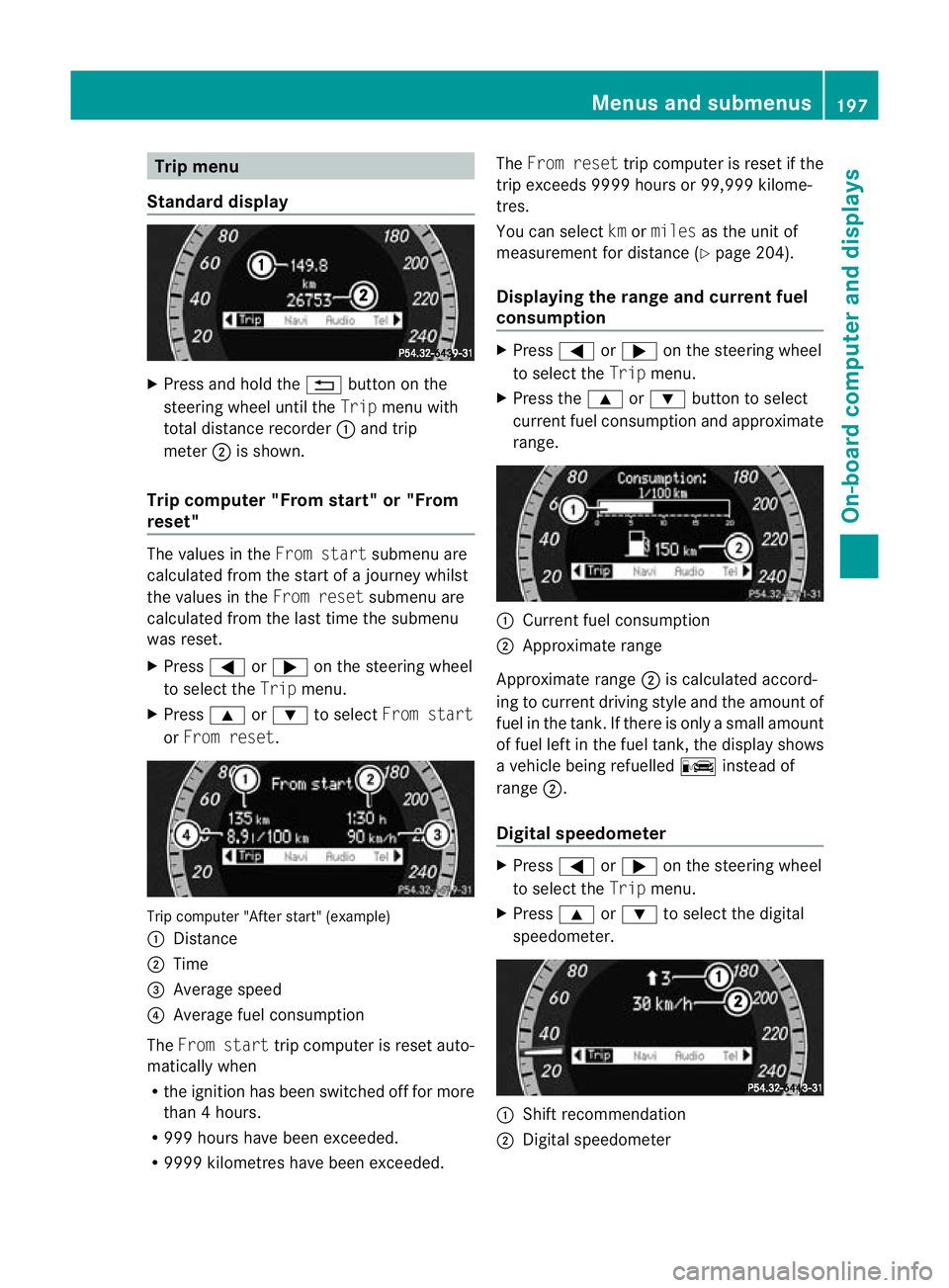
Standard display X
Press and hol dthe % button on the
steering whee lunti lthe Trip menuwith
tota ldistance recorder :and trip
meter ;is shown.
Trip computer "Fro mstart" or "From
reset" The val
uesint heFrom start submenu are
calculate dfromt he star tofajourney whilst
the values in the Fromreset submenu are
calculated fro mthe last tim ethe submenu
was reset.
X Press =or; on the steering wheel
to selec tthe Trip menu.
X Press 9or: to select From start
or From reset. Tri
pc omputer "After start" (example)
: Distan ce
; Time
= Average speed
? Average fue lconsumption
The From start trip computer is reset auto-
matically when
R the ignition has been switched off for more
than 4hours.
R 99 9h our shave been exceeded.
R 999 9kilometres have been exceeded. The
From reset trip computer is reset if the
trip exceeds 999 9hour sor99,999 kilome-
tres.
Yo uc an select kmormiles as the unit of
measurement for distance (Y page 204).
Displaying the range and current fuel
consumption X
Press =or; on the steering wheel
to select the Tripmenu.
X Press the 9or: button to select
current fuel consumption and approximate
range. :
Current fuel consumption
; Approximate range
Approximate range ;is calculated accord-
ing to current driving style and the amount of
fuel in the tank .Ifthere is only asmall amount
of fue lleft in the fuel tank ,the display shows
av ehicle being refuelled Cinstead of
range ;.
Digital speedometer X
Press =or; on the steerin gwheel
to selec tthe Trip menu.
X Press 9or: to selec tthe digital
speedometer. :
Shif trecommendation
; Digita lspeedometer Menus and submenus
197On-board computer and displays
BA 207ECE ÄJ 2010 /1a;1;2,e n-GB
mkalafa Version: 3.0.2.11 2010-01-26T13:03:22+01:00-Seite 197 Z
Page 226 of 333
Displa
ymessages Possible causes/consequences and
M Solutions
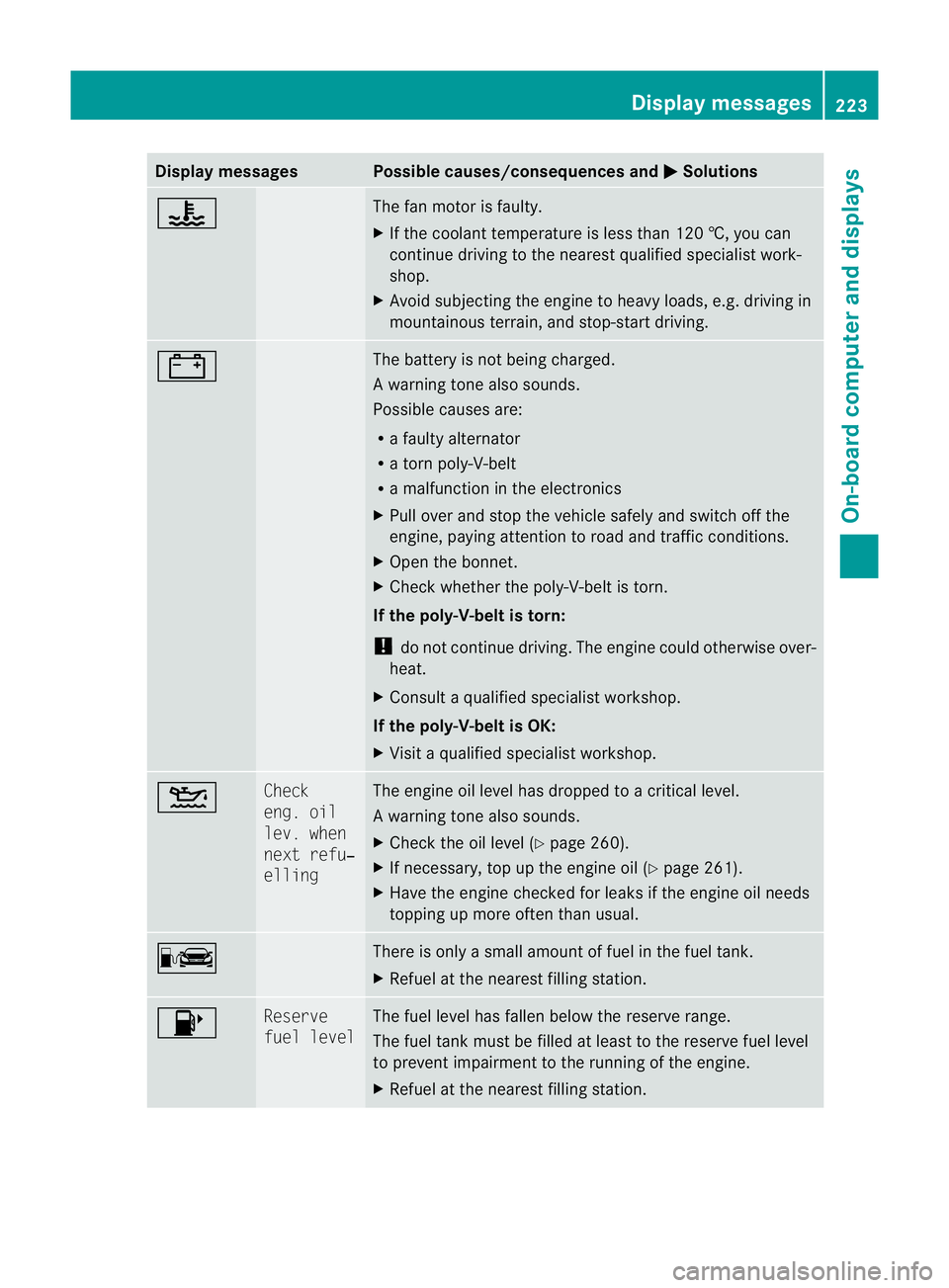
? The fan motor is faulty.
X
If th ecoolant tem perature is less than 12 0†,you can
continue drivin gtothe nearest qual ified specialist work-
shop.
X Avoid subjecting th eenginetoh eavy loads, e.g. driving in
mountainous terrain, and stop-star tdriving. # Th
eb attery is not being charged.
Aw arning ton ealso sounds.
Possible causes are:
R af ault yalternator
R at orn poly-V-belt
R am alfunction in the elect ronics
X Pul lover and stop the vehicle safel yand switch off the
engine ,payin gattentio ntoroad and traffic conditions.
X Open the bonnet.
X Check whether the poly-V-belt is tor n.
If the poly-V -belt is torn:
! do not continue driving. The engine could otherwise over-
heat.
X Consult aqualified specialist workshop.
If the poly-V-belt is OK:
X Visit aqualified specialist workshop. 4 Check
eng. oil
lev. when
next refu‐
elling The engine oil level has dropped to
acriticallevel.
Aw arning ton ealso sounds.
X Chec kthe oil level (Y page 260).
X If necessary, top up the engin eoil (Y page 261).
X Hav ethe engin echecked for leak sifthe engin eoil needs
topping up more often than usual. C There is only
asmall amount of fue linthe fuel tan k.
X Refuel at the nearest filling station. 8 Reserve
fue
llevel Th
ef uel level has fallen below the reserve range.
The fuel tank must be filled at least to the reserve fuel level
to prevent impairment to the running of the engine.
X Refuel at the nearest filling station. Display messages
223On-board computer and displays
BA 207 ECE ÄJ 2010/1a; 1; 2, en-GB
mkalafaV ersion: 3.0.2.11
2010-01-26T13:03:22+01:0
0-Seite 223 Z
Page 227 of 333
Displa
ymessages Possible causes/consequences and
M Solutions
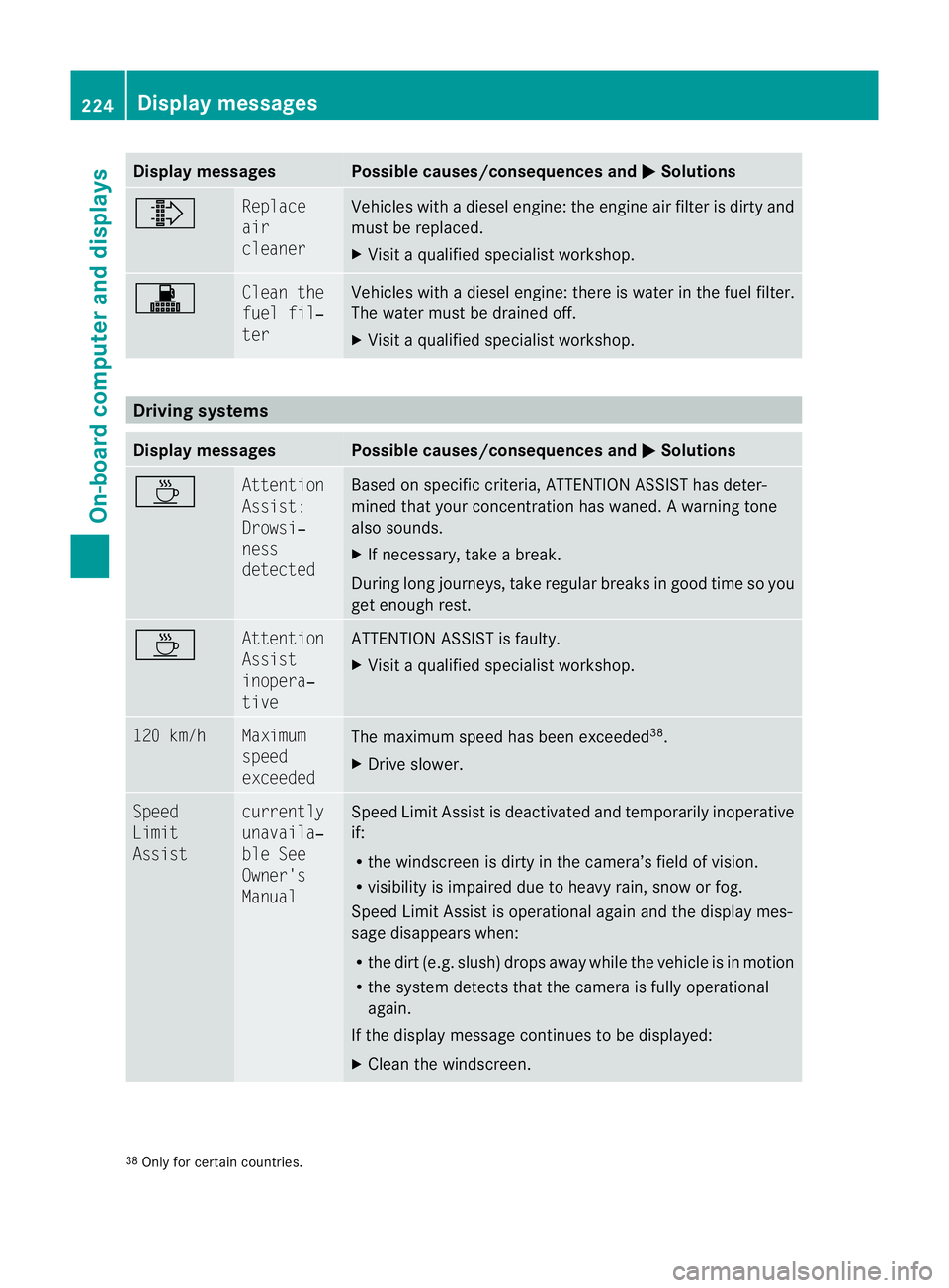
¸ Re
place
air
cleaner Vehicles with
adiesel engine: th eenginea ir filte risdirty and
must be replaced.
X Visit aqualified special istworkshop. ! Clea
nthe
fuel fil‐
ter Vehicles with
adiesel engine: there is water in the fuel filter.
The water must be drained off.
X Visit aqualified special istworkshop. Driving systems
Display messages Possibl
ecauses/ consequences and M Solutions
À Attention
Assist:
Drowsi‐
ness
detected Based on specific criteria, ATTENTION ASSIS
Thas deter-
mined that your concentration has waned. Awarning tone
also sounds.
X If necessary, take abreak.
During long journeys ,take regula rbreaks in good time so you
ge te noug hrest. À Attention
Assist
inopera‐
tive ATTENTION ASSIS
Tisf aulty.
X Visi taq ualifieds pecialist workshop. 12
0k m/h Maximum
speed
exceeded
Th
em aximum spee dhas been exceeded 38
.
X Driv eslower. Speed
Limit
Assist currently
unavaila‐
bl
eS ee
Owner's
Manual Spee
dLimit Assist is deactivated and temporarily inoperative
if:
R the windscreen is dirty in the camera’s field of vision.
R visibility is impaired due to heavy rain, snow or fog.
Speed Limit Assist is operational again and the display mes-
sage disappears when:
R the dirt (e.g. slush) drops away while the vehicle is in motion
R the system detects that the camera is fully operational
again.
If the display message continues to be displayed:
X Clean the windscreen. 38
Only for certain countries. 224
Display messagesOn-boar
dcomputer and displays
BA 20 7ECE ÄJ 2010/1a; 1; 2, en-GB
mkalafa Version:3.0.2.11
2010-01-26T13:03:22+01:0
0-Seite 224
Page 243 of 333
Problem Possible causes/consequences and
M Solutions
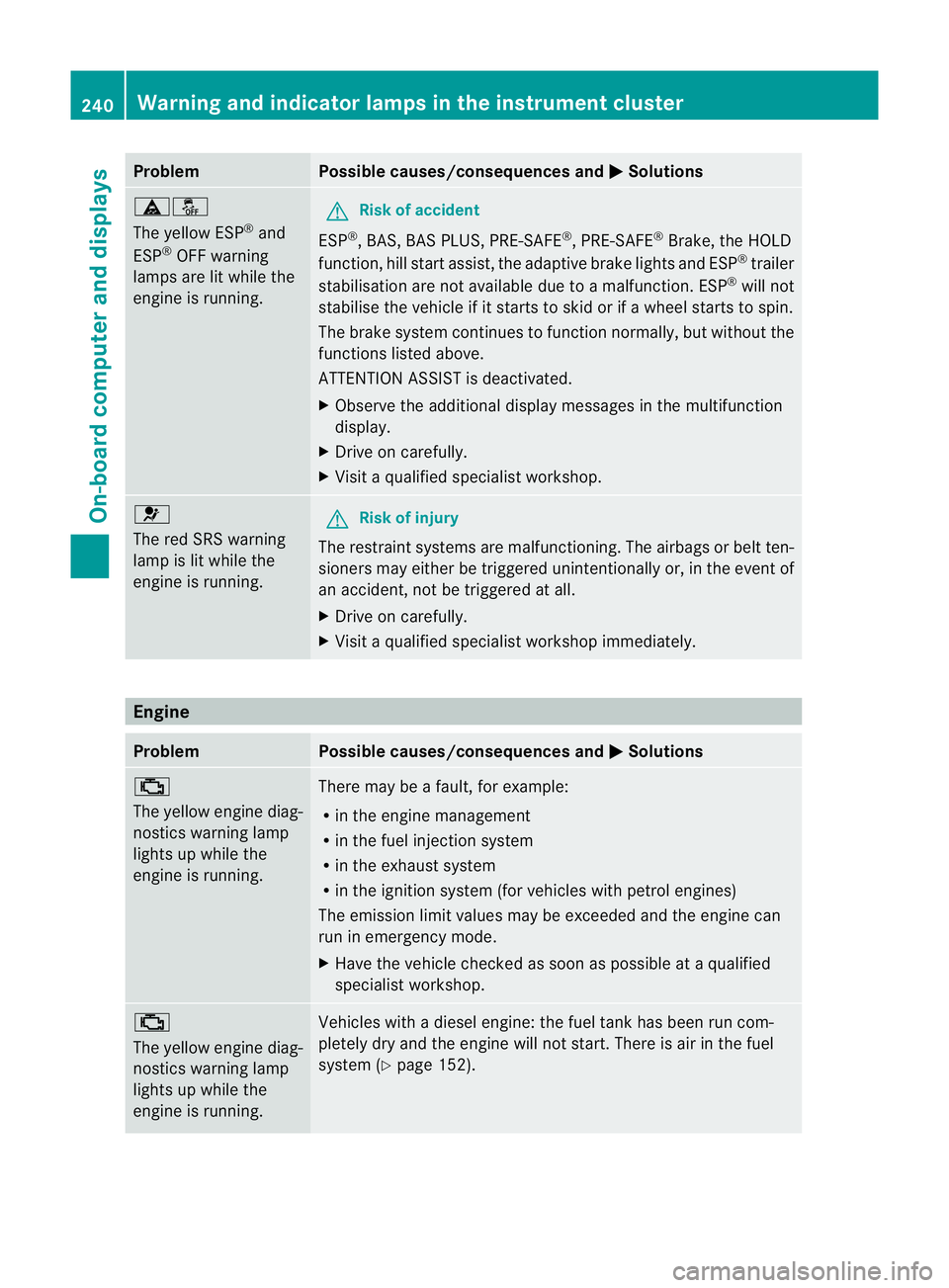
äå
The yellow ESP
®
and
ESP ®
OFF warning
lamps ar elit while the
engine is running. G
Risk of accident
ESP ®
,B AS ,BAS PLUS, PRE-SAFE ®
,P RE-SAFE ®
Brake, the HOLD
function, hill start assist, the adaptive brake lights and ESP ®
trailer
stabilisatio nare not availabl edue to amalfunction .ESP ®
will not
stabilise the vehicl eifitstarts to skid or if awheel starts to spin.
The brake system con tinues to function normally, but without the
functions listed above.
ATTENTION ASSIST is deactivated.
X Observe the additional displa ymessages in the multifunction
display.
X Drive on carefully.
X Visit aqualified specialist workshop. 6
The red SRS warning
lamp is lit while the
engine is running.
G
Risk of injury
The restraint systems are malfunctioning. The airbags or belt ten-
sioners may either be triggered unintentionally or, in the event of
an accident, not be triggered at all.
X Drive on carefully.
X Visit aqualified specialist worksho pimmediately. Engine
Problem Possible causes/consequence
sand M Solutions
;
The yellow engine diag-
nostic
swarning lamp
lights up while the
engine is running. There may be
afault, for example:
R in the engine management
R in the fuel injection system
R in the exhaust system
R in the ignition system (for vehicles with petrol engines)
The emissio nlimit values may be exceeded and the engine can
run in emergenc ymode.
X Hav ethe vehicle chec kedass oon as possible at aqualified
specialist workshop. ;
The yellow engine diag-
nostics warning lamp
lights up while the
engine is running.
Vehicles with
adiesel engine: the fuel tank has been run com-
pletely dry and the engine will not start. There is air in the fuel
system (Y page 152). 240
Warning and indicator lamp
sinthe instrument clusterOn-board computer and displays
BA 207 ECE ÄJ 2010/1a; 1; 2, en-GB
mkalafa Version: 3.0.2.11 2010-01-26T13:03:22+01:00-Seite 240
Page 244 of 333
Problem Possible causes/consequences and
M Solutions
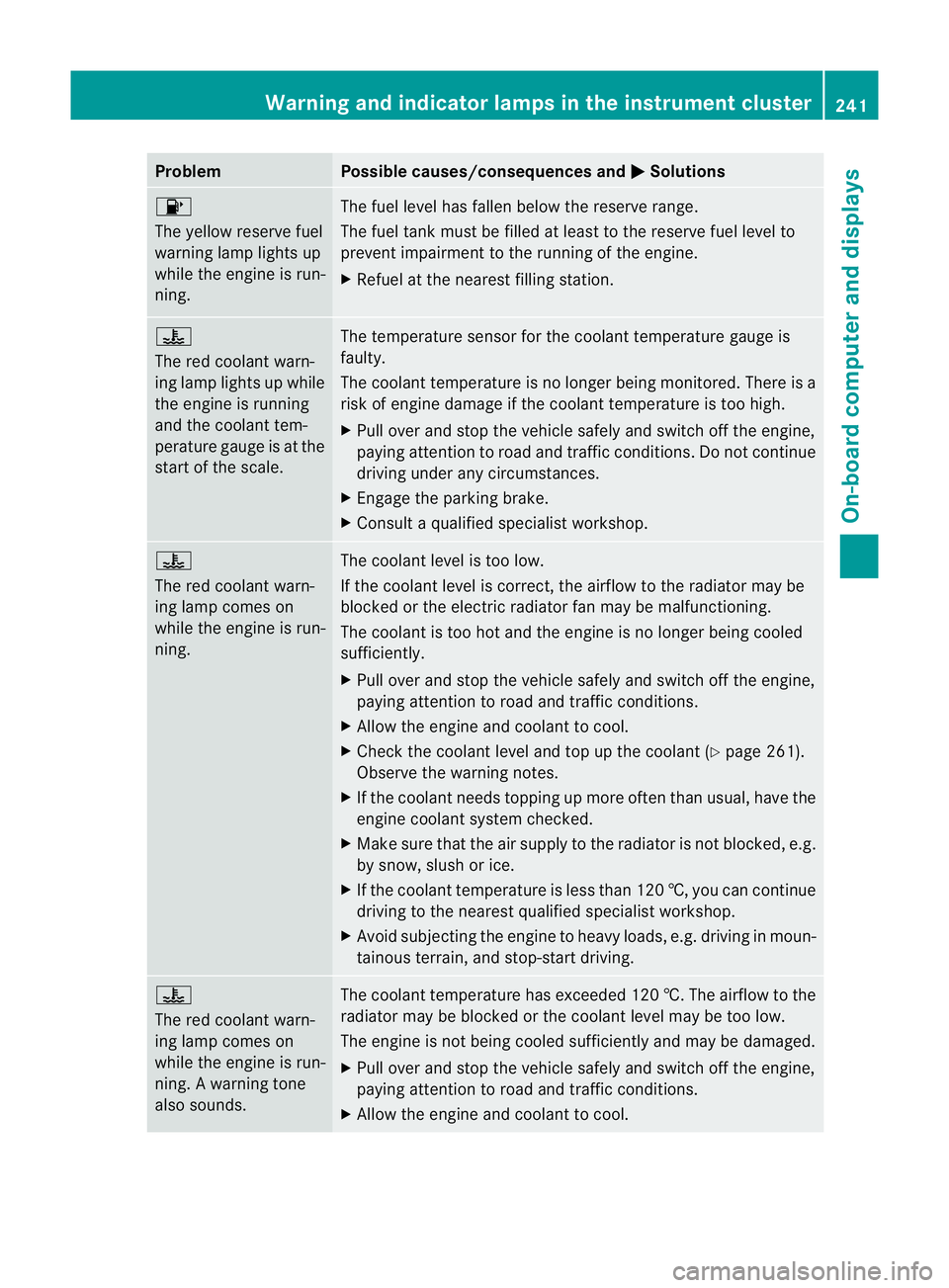
8
The yellow reserve fuel
warnin
glamp lights up
while the engine is run-
ning. The fuel level has fallen below the reserve range.
The fuel tank must be filled at least to the reserve fuel level to
prevent impairment to the running of the engine.
X Refuel at the nearest filling station. ?
The red coolant warn-
ing lamp lights up while
the engine is running
and the coolant tem-
perature gauge is at the
start of the scale.
The temperature senso
rfor the coolant temperatur egauge is
faulty.
The coolant temperature is no longer being monitored. There is a
risk of engine damage if the coolant temperature is too high.
X Pull over and stop the vehicle safely and switch off the engine,
paying attention to road and traffic conditions. Do not continue
driving under any circumstances.
X Engage the parking brake.
X Consult aqualified specialist workshop. ?
The red coolant warn-
ing lamp comes on
while the engine is run-
ning.
The coolant level is too low.
If the coolant level is correct, the airflow to the radiator may be
blocked or the electric radiator fan may be malfunctioning.
The coolant is too hot and the engine is no longer being cooled
sufficiently.
X Pull over and stop the vehicle safely and switch off the engine,
paying attention to road and traffic conditions.
X Allow the engine and coolant to cool.
X Check the coolant level and top up the coolant (Y page 261).
Observe the warning notes.
X If the coolant needs topping up more often than usual, have the
engine coolant system checked.
X Make sure that the air suppl ytot he radiator is not blocked, e.g.
by snow, slush or ice.
X If the coolant temperature is less than 12 0†,you can con tinue
driving to the neares tqualified specialist workshop.
X Avoid subjecting the engine to heavy loads ,e.g. driving in moun-
tainous terrain, and stop-s tart driving. ?
Th
er ed coolan twarn-
ing lamp comes on
while the engine is run-
ning. Awarning tone
also sounds. The coolant temperature has exceeded 120 †. The airflow to the
radiator may be blocked or the coolant level may be too low.
The engine is not being cooled sufficiently and may be damaged.
X Pull over and stop the vehicle safely and switch off the engine,
paying attention to road and traffic conditions.
X Allow the engine and coolant to cool. Warnin
gand indicator lam psin th einstru ment cluster
241On-board computer and displays
BA 207ECE ÄJ 2010 /1a;1;2,e n-GB
mkalafa Version: 3.0.2.11 2010-01-26T13:03:22+01:00-Seite 241 Z
Page 268 of 333
brak
epads, thus drying them .The vehicle
can then be parked up.
Cleaning th epaintwork Scratches, corrosive deposits, area
saffected
by corrosion and damage caused by inade-
quate care canno talways be completely
repaired. In such cases, visit aqualified spe-
cialist worksho pimmediately, e.g .a
Mercedes-Ben zService Centre.
X Remov eimpurities immediately, where
possible ,whilst avoidin grubbing too hard.
X Soak insect remains with insect remover
and rinse off the treated areas afterwards.
X Soak bird droppings with water and rinse
off the treated areas afterwards.
X Remove coolant, brake fluid, tree resin,
oils ,fuels and greases by rubbing gently
with acloth soaked in petroleum ether or
lighter fluid.
X Use tar remover to remov etar stains.
X Use silicone remover to remove wax.
! Do not affix:
R stickers
R films
R magnetic plates or similar items
to painted surfaces. You could otherwise
damage the paintwork.
Care and treatment of mat tpaintwork If you
rvehicle has aclear matt finish, observe
the following instruc tions in order to avoid
damage to the paintwor kdue to incorrect
care.
! Under no circumstances should you pol-
ish the vehicle. Polishing will make the
paintwork shine.
! Do not use paintwork cleaner, grinding or
polishing products or glos spreservers such
as wax .These product sare onl ysuitable for
high-glos ssurfaces. Using them on vehi-
cles with matt paintwork can cause severe damage to the surface (shiny, mottled
patches).
Always have paintwork repairs performed
at
aq ualified specialist workshop, e.g. a
Mercedes-Ben zService Centre.
! Do not use wash programs with ahot wax
treatmen tunder any circumstances.
i Use only insect remover and car shampoo
from the range of recommended and
approved Mercedes-Be nz care products.
Cleanin gthe cabriolet soft top X
Light soiling: you can clean the sof ttop
whil eitisd ry or rinse it with clear water.
X Norma ltoheavy soiling: clean theroof
wit hab rush and clear water. Clean stains
and othe rdirt wit habrush and aMercedes-
Ben zrecom mended and approved cleani ng
agent. Always brush from fron ttoback in
the direction of the fabric.
! Never use any of the following to clean the
soft top:
R petrol
R thinner
R tar or stain remover
R other organic solvents
! Remove bird droppings immediately as
they are corrosive and, therefore, can make
the soft- topf abric leak. Do not use high-
pressure cleanin gequipmen ttoclean the
vehicle. Do not use sharp-edged equipment
to remov eice and snow.
Frequent cleaning reduce sthe resistanc eto
dirt of the soft top.
To restore this resistanc etodirt, clean the
soft top using soft top cleanin gagents that
have been recommended and approved by
Mercedes-Benz.
In co rrect cleaning and care, as well as ageing,
can cause th esoft top seam stoleak. Have
the soft-top seams sealed at aqualified spe-
cialist workshop, e.g. at aMercedes-Benz
Servic eCentre. Care
265Maintenance and care
BA 207ECE ÄJ 2010/1a; 1; 2, en-GB
mkalafa Version: 3.0.2.11 2010-01-26T13:03:22+01:00-Seite2 65 Z