lock MERCEDES-BENZ E-CLASS CABRIOLET 2010 Owner's Manual
[x] Cancel search | Manufacturer: MERCEDES-BENZ, Model Year: 2010, Model line: E-CLASS CABRIOLET, Model: MERCEDES-BENZ E-CLASS CABRIOLET 2010Pages: 333, PDF Size: 7.64 MB
Page 57 of 333
Wei
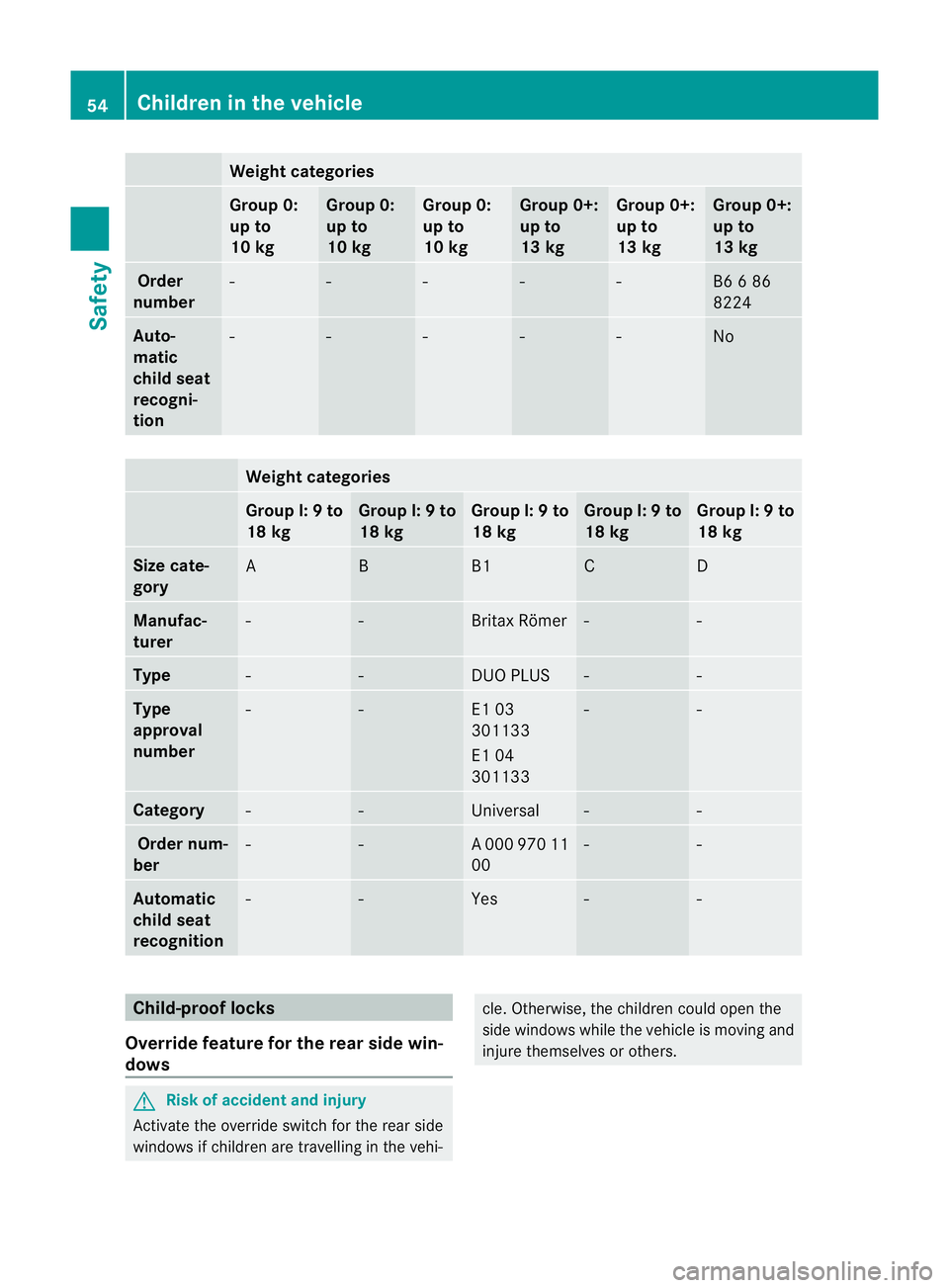
ghtc ategori es Group 0:
up to
10 kg Group 0:
up to
10 kg Group 0:
up to
10 kg Group 0+:
up to
13 kg Group 0+:
up to
13 kg Group 0+:
up to
13 kg
Order
number - - - - - B6
686
8224 Auto-
matic
chil
dseat
recogni-
tion - - - - - No
Weigh
tcateg ories Grou
pI:9to
18 kg Grou
pI:9 to
18 kg Group I:
9to
18 kg Grou
pI:9 to
18 kg Group I:
9to
18 kg Size cate-
gory
A B B1 C D
Manufac-
turer
- - Britax Römer - -
Ty
pe - - DUO PLUS - -
Type
approval
number
- - E1 03
301133
E1 04
301133 - -
Category
- - Universal - -
Order num-
ber - - A0
00 970 11
00 - -
Automatic
chil
dseat
recognition - - Yes - -
Child-proof locks
Overrid efeature for the rear side win-
dows G
Risk of accident and injury
Activat ethe over ride switch for the rear side
windows if children are travelling in the vehi- cle. Otherwise, the children could open the
side windows while the vehicl
eismovingand
injure themselves or othe rs.54
Children in th
evehicleSafety
BA 20 7ECE ÄJ 2010/1a; 1; 2, en-GB
mkalafa Version:3.0.2.11
2010-01-26T13:03:22+01:0
0-Seite 54
Page 58 of 333
X
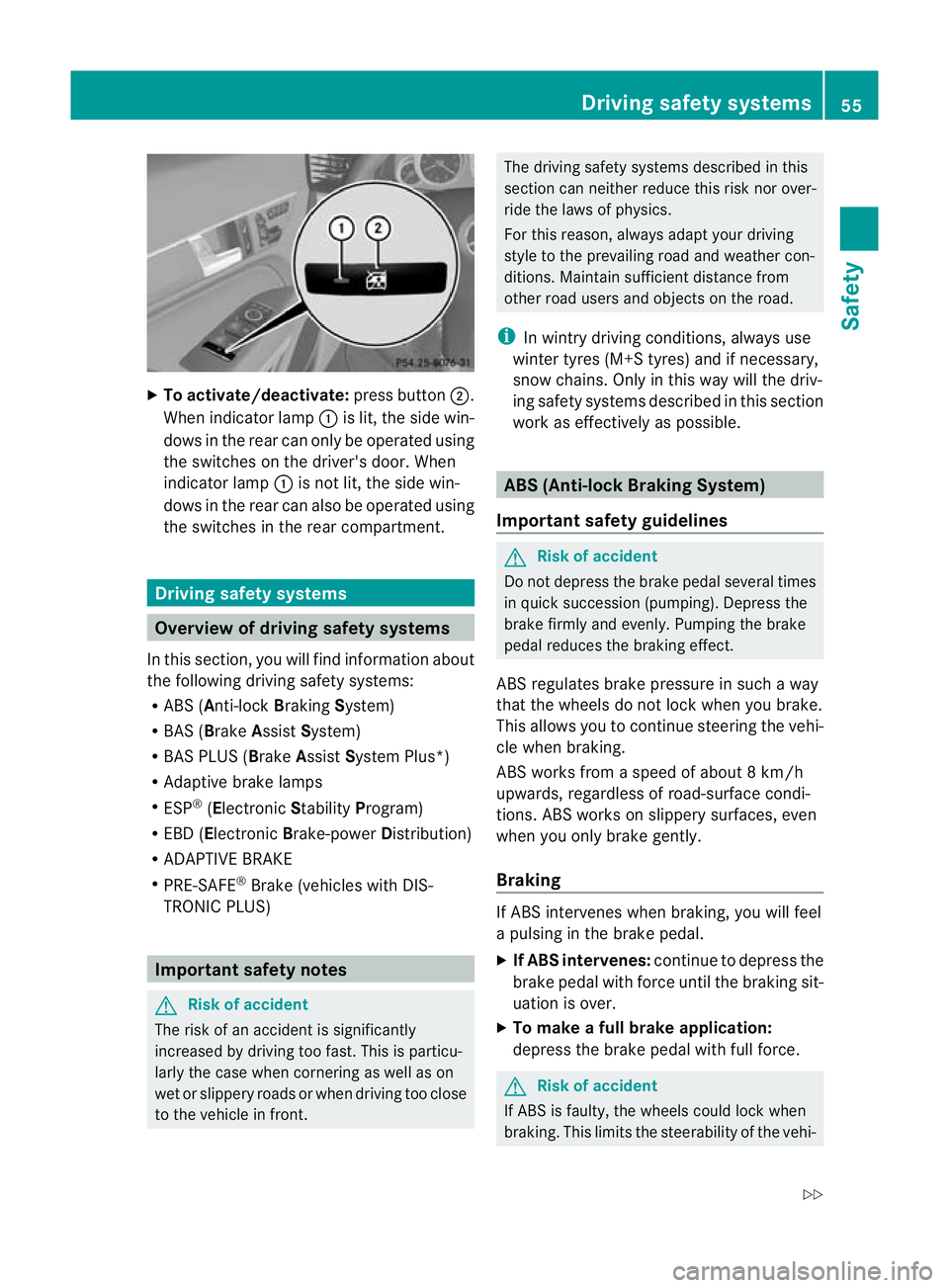
To activate/deactivate: press button;.
Whe nindicato rlamp :is lit, the side win-
dows in the rear can only be operated using
the switches on the driver' sdoor .When
indicator lamp :is not lit, the side win-
dows in the rea rcan also be operated using
the switches in the rear compartment. Driving safety systems
Overview of driving safety systems
In this section, you will find information about
the following driving safety systems:
R ABS ( Anti-lock BrakingSystem)
R BAS ( Brake Assist System)
R BAS PLUS ( BrakeAssist System Plus*)
R Adaptive brake lamps
R ESP ®
(Electronic StabilityProgram)
R EBD ( Electronic Brake-power Distribution)
R ADAPTIVE BRAKE
R PRE-SAFE ®
Brake (vehicles with DIS-
TRONIC PLUS) Important safety notes
G
Risk of accident
The risk of an accident is significantly
increased by driving too fast. This is particu-
larly the case when cornerin gaswell as on
wet or slippery roads or when driving too close
to the vehicle in front. The driving safet
ysystems described in this
sectio ncan neither reduce this risk nor over-
ride the laws of physics.
For this reason, always adapt your driving
style to the prevailing road and weather con-
ditions. Maintain sufficient distance from
other road users and objects on the road.
i In wintry driving conditions, always use
winter tyres (M+S tyres) and if necessary,
snow chains. Only in this way will the driv-
ing safety systems described in this section
work as effectively as possible. ABS (Anti-loc
kBrakin gSystem)
Im portan tsafety guidelines G
Ris
kofa ccident
Do not depress the brak epedal several times
in quick succession (pumping). Depress the
brak efirmly and evenly. Pumping the brake
pedal reduces the braking effect.
ABS regulates brake pressure in such away
that the wheels do not lock when you brake.
This allows you to continue steerin gthe vehi-
cle when brakin g.
AB Sw orksfrom aspeed of about 8km/h
upwards, regardless of road-surface condi-
tions. ABS works on slippery surfaces, even
when yo uonly brake gently.
Braking If ABS intervenes whe
nbraking, yo uwill feel
ap ulsing in the brake pedal.
X If ABS intervenes: continue to depressthe
brake pedal with for ceuntil the braking sit-
uation is over.
X To mak eafull brake application:
depress th ebrake peda lwith full force. G
Risk of accident
If ABS is faulty, the wheels could lock when
braking. This limits the steerability of the vehi- Driving safet
ysystems
55Safety
BA 207 ECE ÄJ 2010/1a; 1; 2, en-GB
mkalafa Version: 3.0.2.11 2010-01-26T13:03:22+01:00 -Seite 55 Z
Page 59 of 333
cle whe
nbraking and th ebraking dist ance
may increas e.
If ABS is de activated due to amalfunction,
then BAS and ESP are als odeactivated. There
is an increase drisk of you rvehicle skidding in
cer tain situations.
You should always adapt your drivin gstyle to
suit the prevailing road and weather condi-
tions.
The pulsating brake pedal can be an indica-
tion of hazardous road conditions and func-
tions as areminder to take extra car ewhile
driving. BAS (Br
akeA ssist)
BA So perates in emergency braking situa-
tions. If you depress the brak epedal quickly,
BAS automatically boosts the braking for ce,
thus shortening the stopping distance.
X Keep the brake peda lfirmly depressed until
the emergency brakin gsituation is over.
ABS prevents the wheels from locking.
The brakes will function as usual onc eyou
release the brake pedal. BA Sisd eactiva ted. G
Risk of accident
If BAS has malfunctioned, the braking system
remains available with ful lbrake boosting
effect. However, braking force is not auto-
matically increased in emergency braking sit-
uations and th estoppi ngdistanc emay
increase. BAS PLUS (Brake Assis
tPLUS)
BAS PLU Sprovide sbraking assistance in haz-
ardou ssituation sand use sradar senso rtech-
nology to assess the traffic situation. G
Risk of accident
BAS PLU Siso nly an aid to assist you when
driving. You are responsible for maintaining a
safe distanc efrom other vehicles ,for the vehi-
cle' sspeed and for braking in good time. Alway
spay attention to the traffic conditions.
Otherwise, you may recognise dangers too
late, cause an acciden tand injure yourself
and others.
BAS PLUS can detect obstacle sthat ar einthe
pat hofyour vehicle for an extended period of
time. Should you appr oachad etected obsta-
cle quickly, BA SPLUSc alculates the braking
force necessary to avoid arear-end collision.
Should you additionally apply th ebrakes, BAS
PLUS wil lautomatically increase the braking
force to alevel suitabl efor the traffic condi-
tions.
If BA SPLUS demands particularl yhigh brak-
ing force, PRE-SAFE ®
is activated simultane-
ously.
X Keep the brak epedal depressed until the
emergency braking situation is over.
AB Sp revents th ewheels fr om lockin g.
The bra kesw ill work normally again when:
R you release the brak epedal
R no obstacle is detected in fr ontof your
vehicle
R there is no longer any danger of arear-end
collision
BA SP LUS is then deactivated.
At speeds up to appro ximately 70 km/h ,BAS
PLU Scan also detect stationary obstacles,
for example, stopped or parked vehicles.
The radar sensor system is switched off auto-
matically in the vicinit yofradio telescope
facilities (Y page 324).
For BA SPLUS to assist yo uwhen driving, the
radar sensor system must be switched on and
operational. You can chec kthis by activating
DI ST RONIC PLUS (Y page 160) or via the
"rada rsensor "function in the on-board com-
puter (Y page 208). G
Risk of accident
Only clearly identified obstacles will initiate
brakin gassistanc ebyBAS PLUS. In particular,
the dete ction of obstacles can be restricted if
there is: 56
Drivin
gsafety systemsSafety
BA 207 ECE ÄJ 2010/1a; 1; 2, en-GB
mkalafa Version: 3.0.2.11
2010
-01-26T13:03:22+01:00 -Seite 56
Page 61 of 333
Traction control remains active if you deacti-
vat
eE SP®
. G
Risk of accident
Tractio ncontrol can notreduce the risk of an
accident if you driv etoo fast .Traction con trol
can noto verride th elaws of physics.
Deactivating/activating ESP ®ESP
®
is activated automatically when the
engine is running.
It may be best to deactivate ESP ®
in the fol-
lowing situations:
R when using snow chains
R in deep snow
R on sand or gravel G
Risk of accident
Activate ESP ®
as soon as the situations
described above no longer apply. ESP ®
will
otherwise not be able to stabilis ethe vehicle
if the vehicle star tsto skid or awheel star ts
to spin.
If you deactivate ESP ®
:
R ESP ®
no longer improves driving stability.
R the engine's torque is no longer limited and
the drive wheels can spin. The spinnin gof
the wheels results in acutting action, which
provides better grip.
R traction control is still activated.
R ESP ®
still provides support when you
brake.
If ESP ®
is deactivated and one or more wheels
start to spin, the äwarning lamp in the
instrument cluster flashes .Insuch situations,
ESP ®
will not stabilise the vehicle.
X To deactivate:(Y page 203).
The å warning lamp in the instrument
cluster lights up. G
Risk of accident
If the å warning lamp in the instrument
cluster lights up when the engine is running, ESP
®
is deactivated or is unavailable due to a
malfunc tion. The risk that your vehicle may
star ttos kid then increase sincertain situa-
tions.
Alway sadapt your driving style to the prevail-
ing road and weather conditions.
X To activate:(Y page 203).
The å warning lamp in the instrument
cluster goes out.
ESP ®
trailer stabilisation If your trailer begins to lurch, you can only
stabilise the vehicle/
trailer combination by
depressing the brake firmly.
In this situation, ESP ®
assists you and can
detect if the trailer begins to lurch. ESP ®
slows the vehicle down by brakin gand limit-
ing the engine output until the vehicle/trailer
combination has stabilised.
Traile rstabilisatio nisa ctive above speed sof
about 65 km/h. G
Risk of accident
If road and weather conditions are poor,
trailer stabilisatio nwill not be able to prevent
the trailer from swerving and will thus be
unable to reduce the risk of an accident .Trail-
ers wit hahigh centr eofgravity can tip over
before ESP ®
can detec tthis.
Trailer stabilisation does not work if ESP ®
is
deactivated or disable dbecause of amal-
function. EBD (Electronic Brake-force Distribu-
tion)
EBD monitors and controls the brake pres-
sure on the rear wheels to improve driving
stability while braking. G
Risk of accident
If EBV is malfunctioning, the brake system is
still available with full brake boosting effect.
However, the rear wheels can still lock, e.g. 58
Driv
ings afety systemsSafety
BA 207 ECE ÄJ 2010/1a; 1; 2, en-GB
mkalafa Version: 3.0.2.11 2010-01-26T13:03:22+01:00-Seite 58
Page 64 of 333
X
To activate with the key: remove the key
from the ignition lock.
X To activate with KEYLESS-GO: switch the
ignition off and open the driver's door.
X To deactivate: switch on the ignition.
i The immo biliserisa lway sdeactivated
when yo ustart the engine. ATA (Anti-Theft Alarm system)
Av isual and audible alarm is triggered if the
alarm system is prime dand you ope n:
R ad oor
R the vehicle with the emergency key ele-
ment
R the boot lid
R the bonnet
The alar misnot switched off ,even if you
close th eopen door that has triggere dit, for
example. X
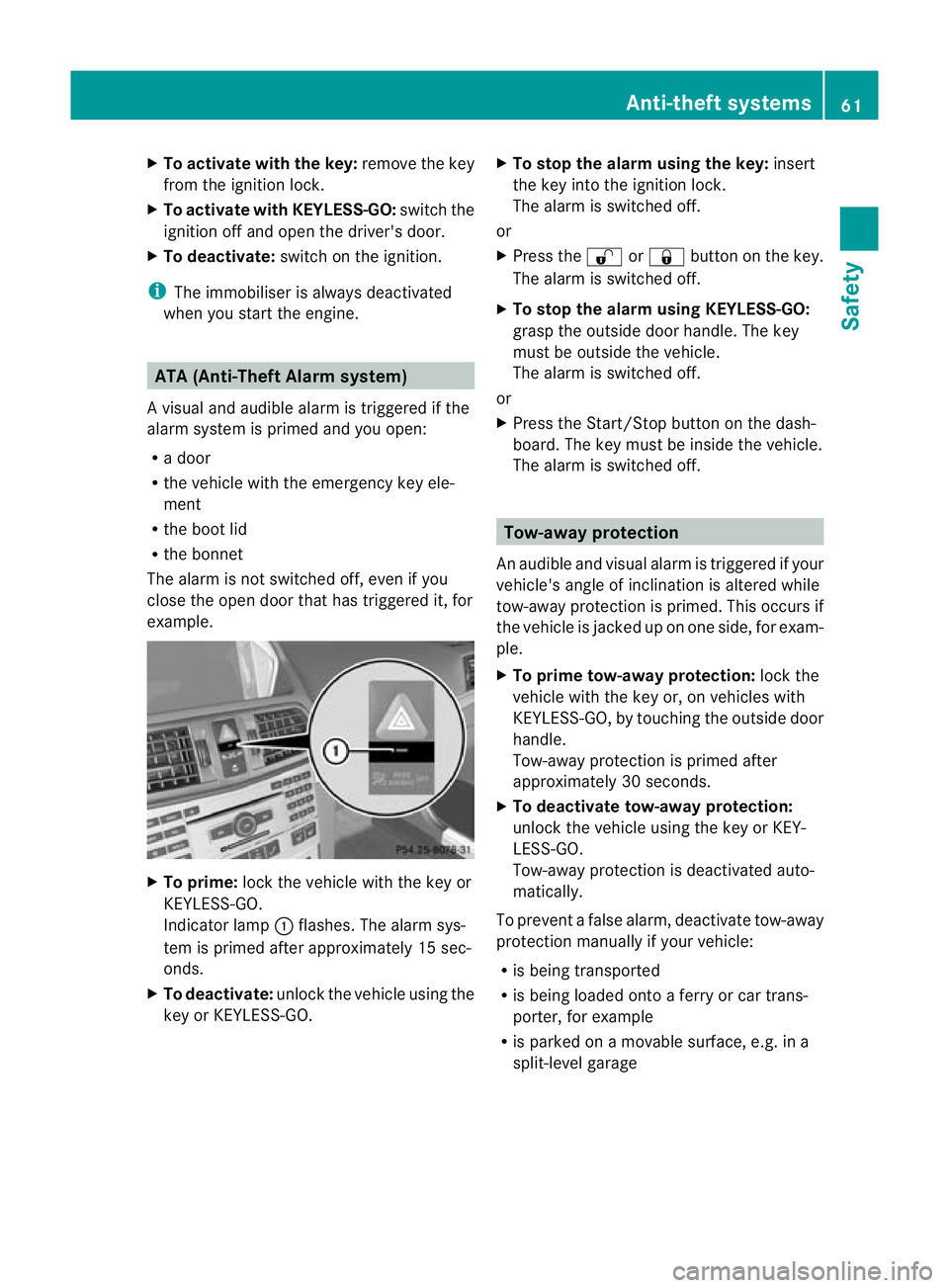
To prime: lock the vehicle with the key or
KEYLESS-GO.
Indicator lamp :flashes. The alarm sys-
tem is primed after approximately 15 sec-
onds.
X To deactivate: unlock the vehicle using the
key or KEYL ESS-GO. X
To stop th ealarm using the key: insert
the key into the ignition lock.
The alarm is switched off.
or
X Press the %or& button on the key.
The alarm is switched off.
X To stop the alarm using KEYLESS-GO:
grasp the outside door handle. The key
must be outside the vehicle.
The alarm is switched off.
or
X Press the Star t/Stop butto nonthe dash-
board. The key must be insid ethe vehicle.
The alar misswitched off. Tow-away protection
An audible and visual alarm is triggered if your
vehicle's angle of inclination is altered while
tow-away protection is primed. This occurs if
the vehicle is jacked up on one side, for exam-
ple.
X To prim etow-away protection: lock the
vehicle with the key or, on vehicles with
KEYL ESS-GO ,bytouching the outside door
handle.
Tow-away protection is primed after
approximately 30 seconds.
X To deactivate tow-awa yprotection:
unlock the vehicle using the key or KEY-
LESS-GO.
Tow-away protection is deactivate dauto-
matically.
To prevent afalse alarm, deactivate tow-away
protection manually if your vehicle:
R is being transported
R is being loaded onto aferr yorc ar trans-
porter, for example
R is parked on amovable surface, e.g. in a
split-leve lgarage Anti-theft systems
61Safety
BA 207 ECE ÄJ 2010/1a; 1; 2, en-GB
mkalafa Version:3.0.2.11
2010-01-26T13:03:22+01:00
-Seite 61 Z
Page 65 of 333
X
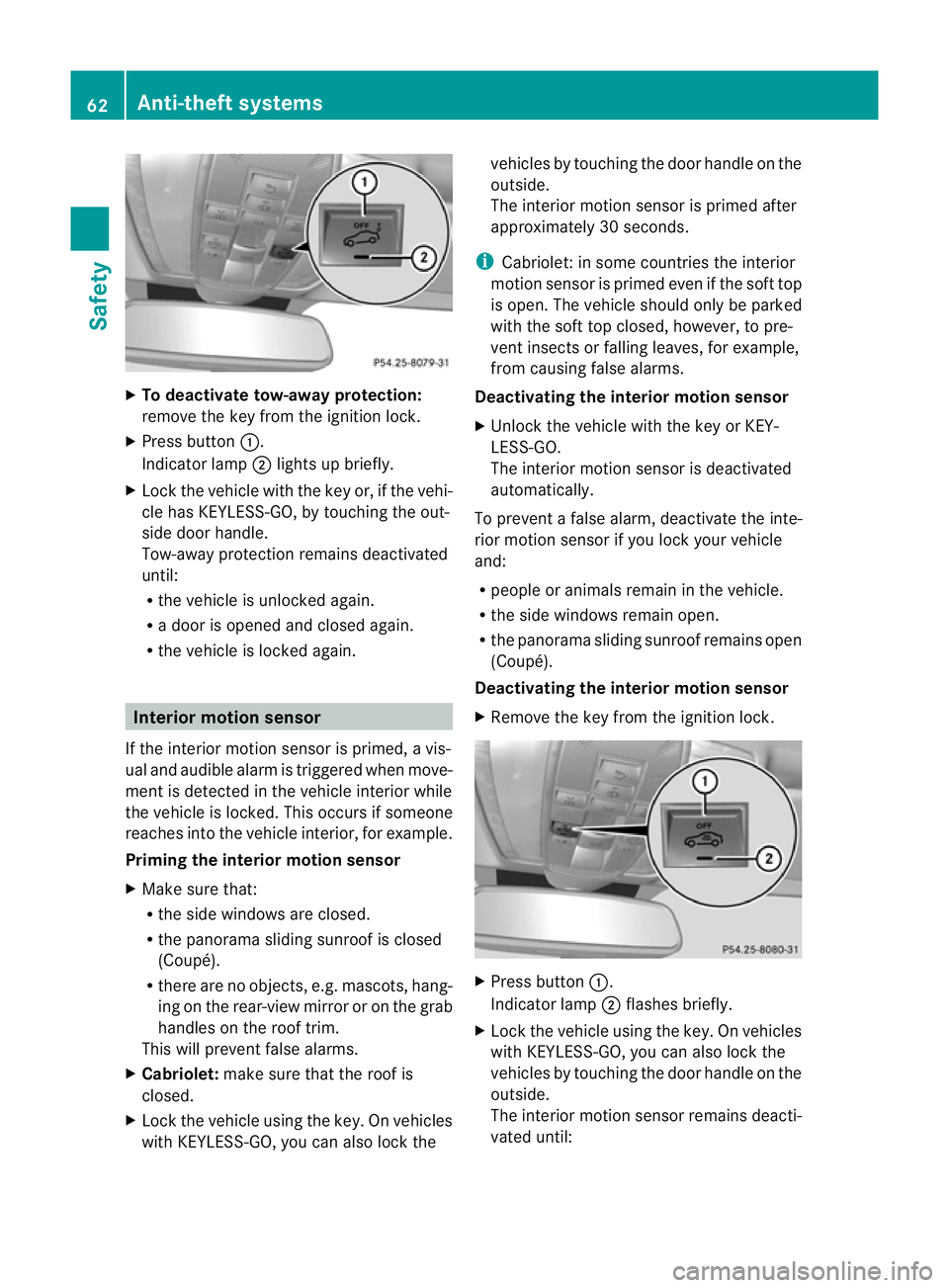
To deactivate tow-away protection:
remove the key from the ignition lock.
X Press button :.
Indicato rlamp ;lights up briefly.
X Loc kthe vehicle with the key or, if the vehi-
cle has KEYL ESS-GO,bytouching the out-
side door handle.
Tow-away protection remains deactivated
until:
R the vehicle is unlocked again.
R ad oor is opened and closed again.
R the vehicle is locked again. Interior motion sensor
If the interior motion sensor is primed, avis-
ual and audible alarm is triggered when move-
ment is detected in the vehicle interior while
the vehicle is locked. This occur sifsomeone
reaches int othe vehicle interior, for example.
Priming th einterior motion sensor
X Make sure that:
R
the side windows are closed.
R the panorama sliding sunroof is closed
(Coupé).
R there are no objects, e.g. mascots, hang-
ing on the rear-view mirror or on the grab
handles on the roof trim.
This will prevent false alarms.
X Cabriolet: makesure that the roof is
closed.
X Lock the vehicle using the key. On vehicles
with KEYLESS-GO, you can also lock the vehicles by touching the door handle on the
outside.
The interior motion senso
risp rime dafter
approximately 30 seconds.
i Cabrio let: in some countries the interior
motion sensor is primed even if the soft top
is open. The vehicle should only be parked
with the soft top closed, however, to pre-
vent insects or falling leaves ,for example,
from causing false alarms.
Deactivating th einterior motion sensor
X Unlock the vehicle with the key or KEY-
LE SS -GO.
The interio rmotion sensor is deactivated
automatically.
To prevent afalse alarm, deactivate the inte-
rior motion senso rifyou lock your vehicle
and:
R people or animals remain in the vehicle.
R the side window sremai nopen.
R the panorama sliding sunroof remains open
(Coupé).
Deactivating the interio rmotion sensor
X Remove the key from the ignition lock. X
Press button :.
Indicator lamp ;flashes briefly.
X Lock the vehicle using the key. On vehicles
with KEYL ESS-GO,you can also lock the
vehicles by touching the door handle on the
outside.
The interior motion sensor remains deacti-
vated until: 62
Anti-thef
tsystemsSafety
BA 207 ECE ÄJ 2010/1a; 1; 2, en-GB
mkalafa Version: 3.0.2.11 2010-01-26T13:03:22+01:00 -Seite 62
Page 66 of 333

R
the vehicl eisunlocke dagain.
R ad ooriso peneda nd close dagain.
R the vehicl eislocked again. Anti-thef
tsystems
63Safety
BA 207ECE ÄJ 2010/1a ;1;2,en-GB
mkalafa Version: 3.0.2.11 2010-01-26T13:03:22+01:00-Seite 63 Z
Page 69 of 333
Vehicl
eequipment
i Thismanua ldesc ribe sallthe standard
and optional equipment of your vehicle
which wa savailable at th etime of pur-
chase. Countr y-specif ic differences are
possible. Bear in mind tha tyour vehicle
ma ynot featur eall function sdescribed
here. Key
Key functions
Locking and unlocking centr ally The key centrally locks/unlocks:
R
the doors
R the boot lid
R the fuel filler flap G
Risk of accident
If children are left unsupervised in the vehicle,
they could:
R open adoor from inside the vehicle at any
time, even if it has been locked
R star tthe vehicle usin gakey which has been
left in the vehicle
R release the parking brake
They could thereby endanger themselves and
others. Never leave children unsupervised in
the vehicle. Alway stake the key with you
when leaving the vehicle, even if you are only
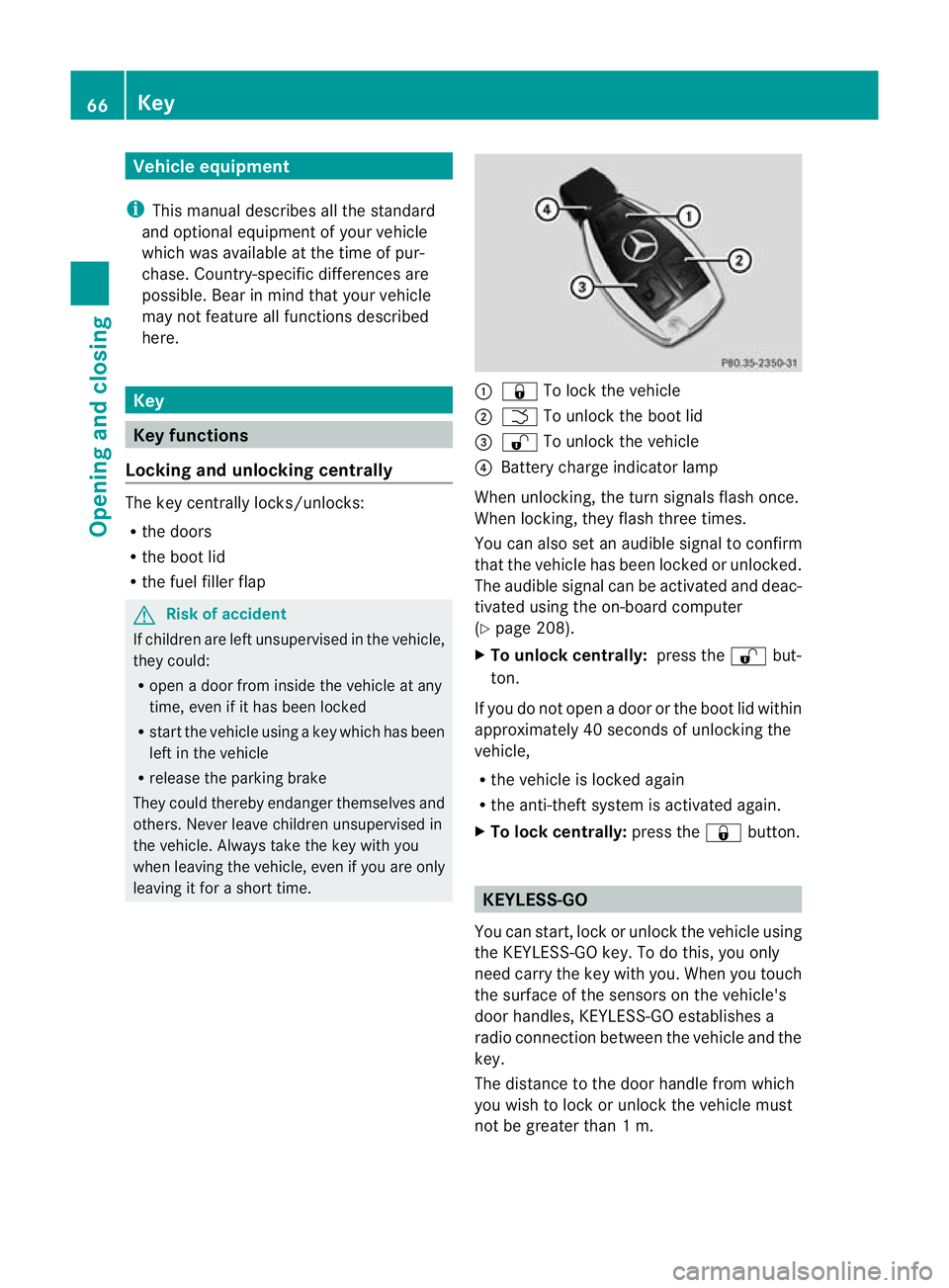
leaving it for ashort time. :
& To lock the vehicle
; F To unloc kthe boot lid
= % To unlock the vehicle
? Battery charge indicator lamp
When unlocking ,the tur nsignals flash once.
When locking, they flash three times.
You can also set an audible signal to confirm
that the vehicle has been locked or unlocked.
The audible signal can be activated and deac-
tivated using the on-board computer
(Y page 208).
X To unlock centrally: press the%but-
ton.
If you do not open adoor or the boot lid within
approximately 40 second sofunlocking the
vehicle,
R the vehicl eislocke dagain
R the anti-thef tsystem is activated again.
X To lock centrally: press the&button. KEYLESS-GO
You can start, lock or unlock the vehicle using
the KEYLESS-GO key. To do this ,you only
need carry the key with you. When you touch
the surface of the sensor sonthe vehicle's
door handles, KEYL ESS-GO establishes a
radio connection between the vehicle and the
key.
Th ed istance to the door handle from which
you wish to lock or unlock the vehicle must
not be greater than 1m.66
KeyOpening and closing
BA 20
7ECE ÄJ 2010 /1a; 1; 2, en-GB
mkalafa Version: 3.0.2.11 2010-01-26T13:03:22+01:00 -Seite 66
Page 70 of 333
When star
ting the engine and whilst driving,
KEYLESS-GO also checks whether avalid key
is in the vehicle by periodicall yestablishing
radio con tact. X
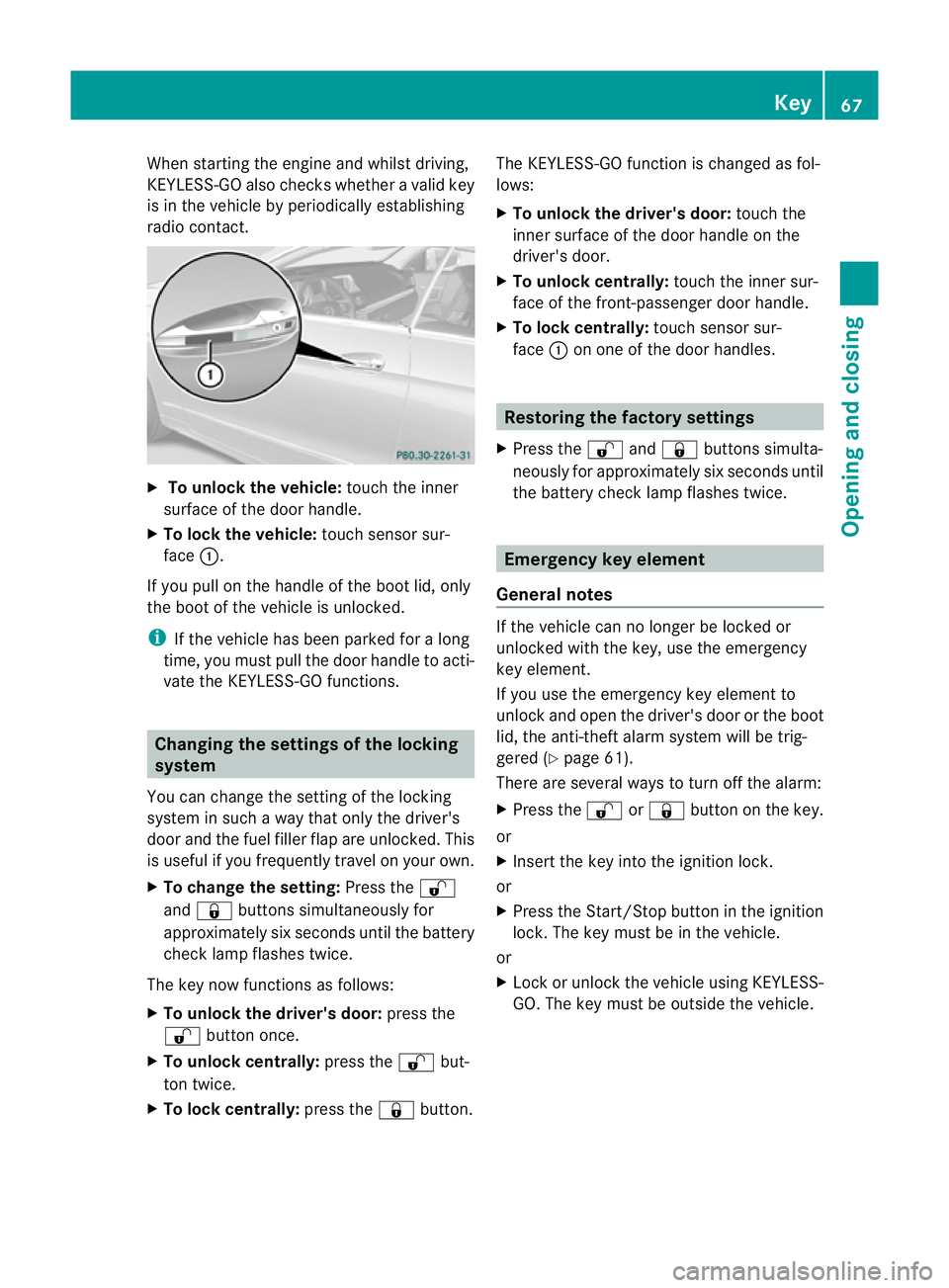
To unlock the vehicle: touch the inner
surface of the door handle.
X To lock the vehicle: touch sensorsur-
face :.
If you pull on the handle of the boot lid, only
the boot of the vehicle is unlocked.
i If the vehicle has been parked for along
time, you must pull the door handl etoacti-
vate the KEYLESS-GO functions. Changing the setting
softhe locking
system
Yo uc an change the setting of the locking
system in such away that only the driver's
door and the fuel filler flap are unlocked. This
is useful if you frequently travel on your own.
X To change the setting: Press the%
and & buttons simultaneously for
approximately six seconds until the battery
check lamp flashes twice.
The key now functions as follows:
X To unlock the driver's door: press the
% button once.
X To unlock centrally: press the%but-
ton twice.
X To lock centrally: press the&button. The KEYLESS-GO function is changed as fol-
lows:
X
To unlock the driver's door: touch the
inner surface of the door handle on the
driver' sdoor.
X To unlock centrally: touchthe inner sur-
face of the front-passenger door handle.
X To lock centrally: touchsensor sur-
face :on one of the door handles. Restoring the factor
ysettings
X Press the %and& buttons simulta-
neously for approximately six seconds until
the battery check lamp flashes twice. Emergency key element
General notes If the vehicle can no longer be locked or
unlocked with the key, use the emergency
key element.
If you use the emergency key element to
unlock and open the driver's door or the boot
lid, the anti-theft alarm system will be trig-
gered (Y
page 61).
There are several ways to turn off the alarm:
X Press the %or& button on the key.
or
X Insert the key into the ignition lock.
or
X Press the Star t/Stop butto ninthe ignition
lock .The key must be in the vehicle.
or
X Loc koru nlock the vehicl eusing KEYL ESS-
GO. The key must be outside the vehicle. Key
67Opening and closing
BA 207 ECE ÄJ 2010/1a; 1; 2, en-GB
mkalafa Version:3.0.2.11
2010-01-26T13:03:22+01:00
-Seite 67 Z
Page 72 of 333
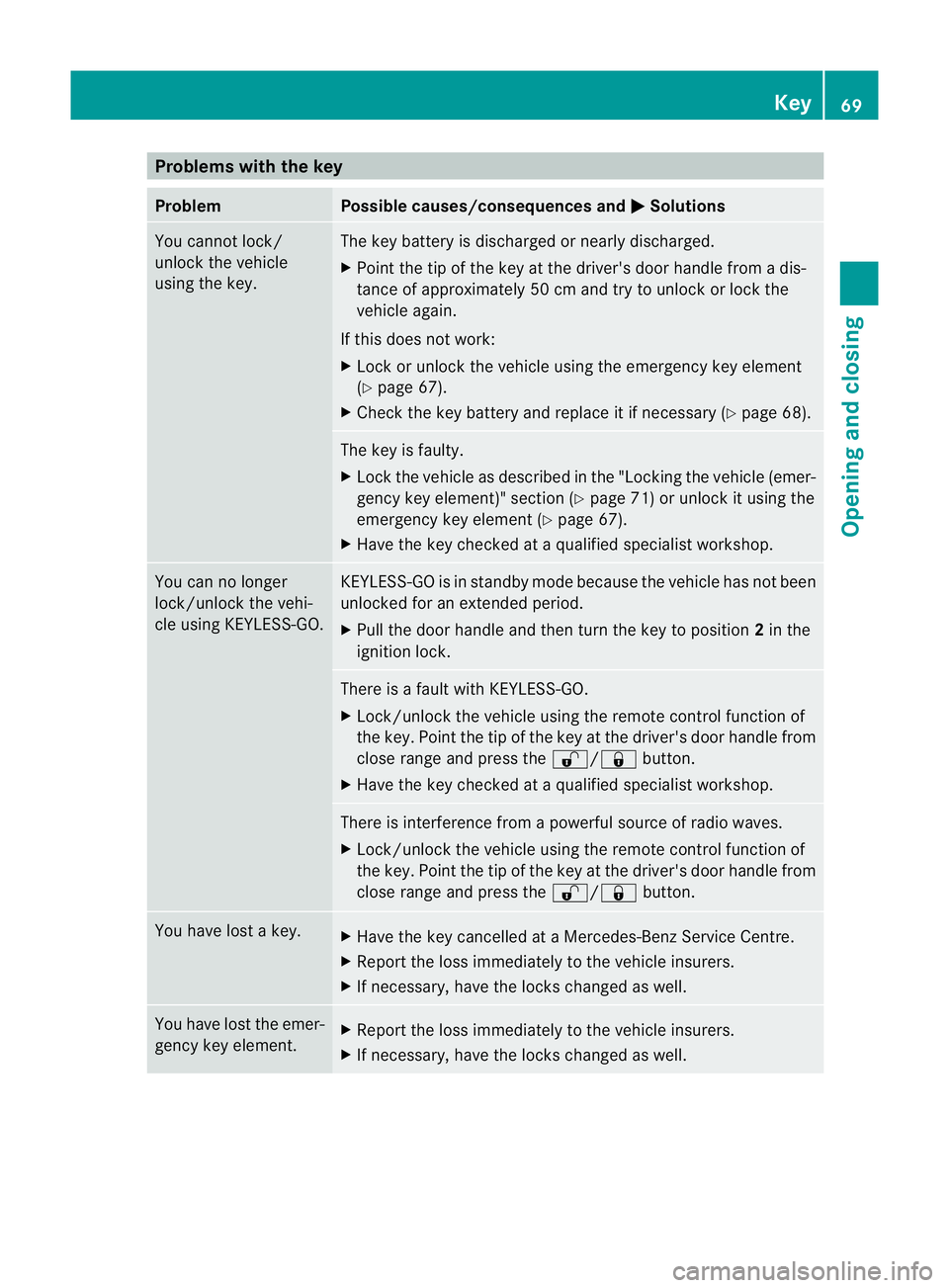
Problems wit
hthe key Problem Possible causes/consequences and
M Solutions
Yo
uc annot lock/
unlock the vehicle
using the key. The key battery is discharged or nearly discharged.
X
Point the tip of the key at the driver' sdoor handl efrom adis-
tanc eofa pproximately 50 cm and try to unloc korlock the
vehicle again.
If this does not work:
X Loc koru nlock the vehicl eusing the emergenc ykey element
(Y page 67).
X Check the key batter yand replace it if necessary (Y page68). Th
ek ey is faulty.
X Loc kthe vehicle as described in the "Locking the vehicle (emer-
genc ykey element)" section (Y page 71)orunlock it using the
emergency key element (Y page67).
X Have the key checked at aqualified specialist workshop. You can no longer
lock/unlock the vehi-
cle using KEYLESS-GO. KEYLESS-GO is in standby mode because the vehicle has not been
unlocked for an extended period.
X
Pull the door handle and then turn the key to position 2in the
ignition lock. There is
afault with KEYLESS-GO.
X Lock/unlock the vehicle using the remote control function of
the key. Point the tip of the key at the driver' sdoor handl efrom
close rang eand pres sthe %/ &button.
X Hav ethe key chec kedataq ualified specialist workshop. There is interference from
apowerfu lsource of radio waves.
X Lock/unloc kthe vehicle usin gthe remote con trolfunction of
the key. Point the tip of the key at the driver' sdoor handl efrom
close rang eand pres sthe %/ &button. You hav
elost akey. X
Hav ethe key cancelled at aMercedes-Benz Servic eCentre.
X Report the loss immediately to the vehicle insurers.
X If necessary, have the locks changed as well. You have lost the emer-
gency key element.
X
Report the loss immediately to the vehicle insurers.
X If necessary, have the locks changed as well. Key
69Opening and closing
BA 207ECE ÄJ 2010 /1a; 1; 2, en-GB
mkalafa Version: 3.0.2.11 2010-01-26T13:03:22+01:00 -Seite 69 Z