warning MERCEDES-BENZ E-CLASS CABRIOLET 2010 Owner's Manual
[x] Cancel search | Manufacturer: MERCEDES-BENZ, Model Year: 2010, Model line: E-CLASS CABRIOLET, Model: MERCEDES-BENZ E-CLASS CABRIOLET 2010Pages: 333, PDF Size: 7.64 MB
Page 54 of 333
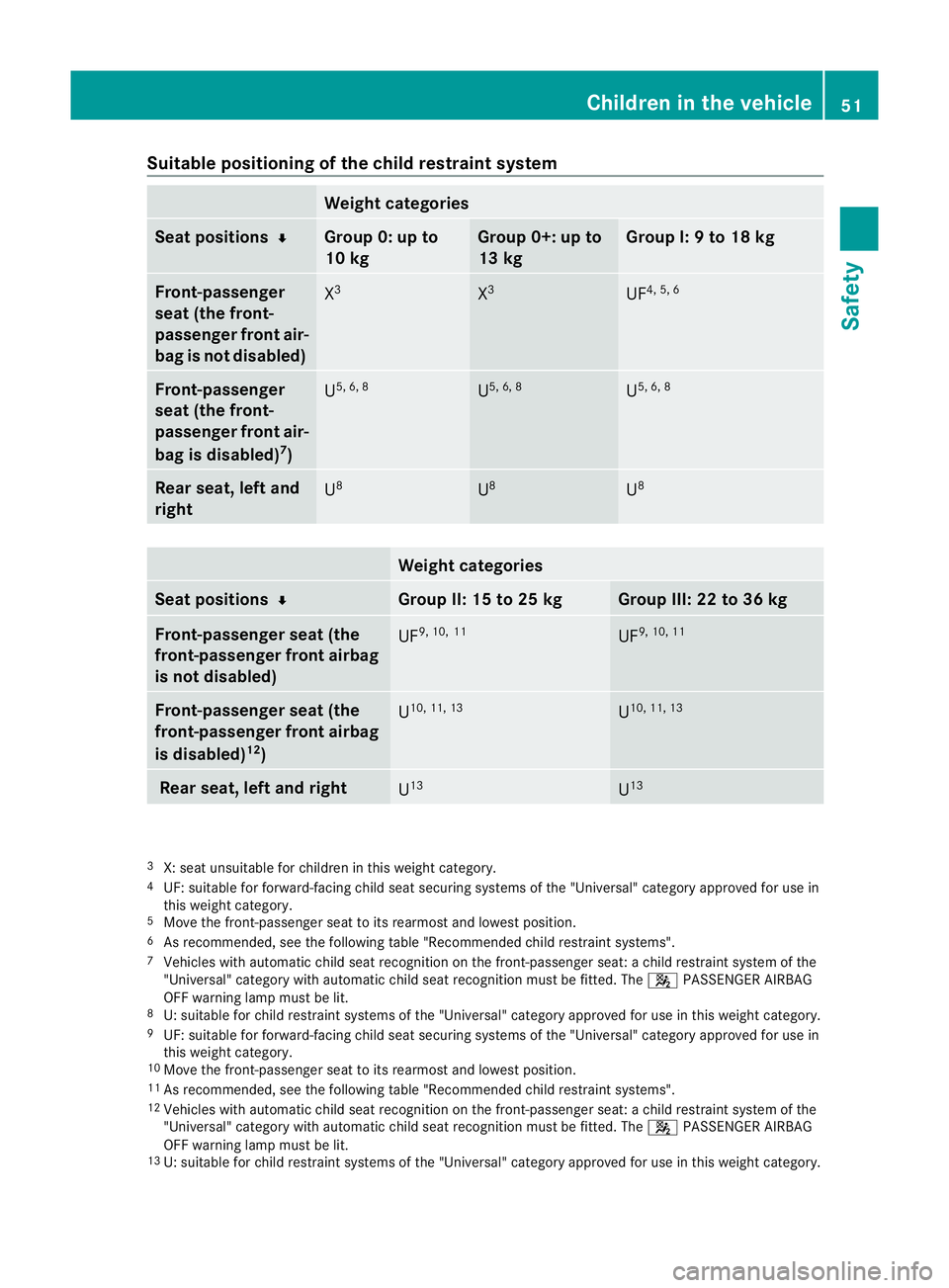
Suitabl
epositioning of the child restraint system Weight categories
Seat positions
¬ Grou
p0:upto
10 kg Group 0+: up to
13 kg Group I:
9to18kg Front-passenger
seat (the front-
passenger front air-
bag is not disabled)
X
3 X
3 UF
4, 5, 6 Front-passenger
seat (the front-
passenger front air-
bag is disabled)
7
) U
5, 6, 8 U
5, 6, 8 U
5, 6, 8 Rear seat, left and
right
U
8 U
8 U
8 Weight categories
Seat positions
¬ Group II: 15 to 25 kg Group III
:22to36kg Front-passenger seat (the
front-passenger front airbag
is not disabled)
UF
9, 10, 11 UF
9, 10, 11 Front-passenger seat (the
front-passenger front airbag
is disabled)
12
) U
10, 11, 13 U
10, 11, 13 Rear seat, left and right
U
13 U
13 3
X: seat unsuitable for children in this weight category.
4 UF: suitable for forward-facin gchild seat securing system softhe "Universal" category approved for use in
this weight category.
5 Move the front-passenger seat to its rearmost and lowest position.
6 As recommended, see the following table "Recommended child restraint systems".
7 Vehicles with automatic child seat recognition on the front-passenger seat: achild restraint system of the
"Universal "category with automatic child seat recognition must be fitted. The 4PASSENGER AIRBAG
OFF warning lamp must be lit.
8 U: suitable for child restraint systems of the "Universal" category approved for use in this weight category.
9 UF: suitable for forward-facing child seat securing systems of the "Universal" category approved for use in
this weight category.
10 Move the front-passenger seat to its rearmost and lowest position.
11 As recommended, see the following table "Recommended child restraint systems".
12 Vehicles with automatic child seat recognition on the front-passenger seat: achild restraint system of the
"Universal "category with automatic child seat recognition must be fitted. The 4PASSENGER AIRBAG
OFF warning lamp must be lit.
13 U: suitable for child restraint systems of the "Universal" category approved for use in this weight category. Childre
ninthe vehic le
51Safety
BA 207ECE ÄJ 2010 /1a; 1; 2, en-GB
mkalafa Version: 3.0.2.11 2010-01-26T13:03:22+01:00 -Seite 51 Z
Page 60 of 333
R
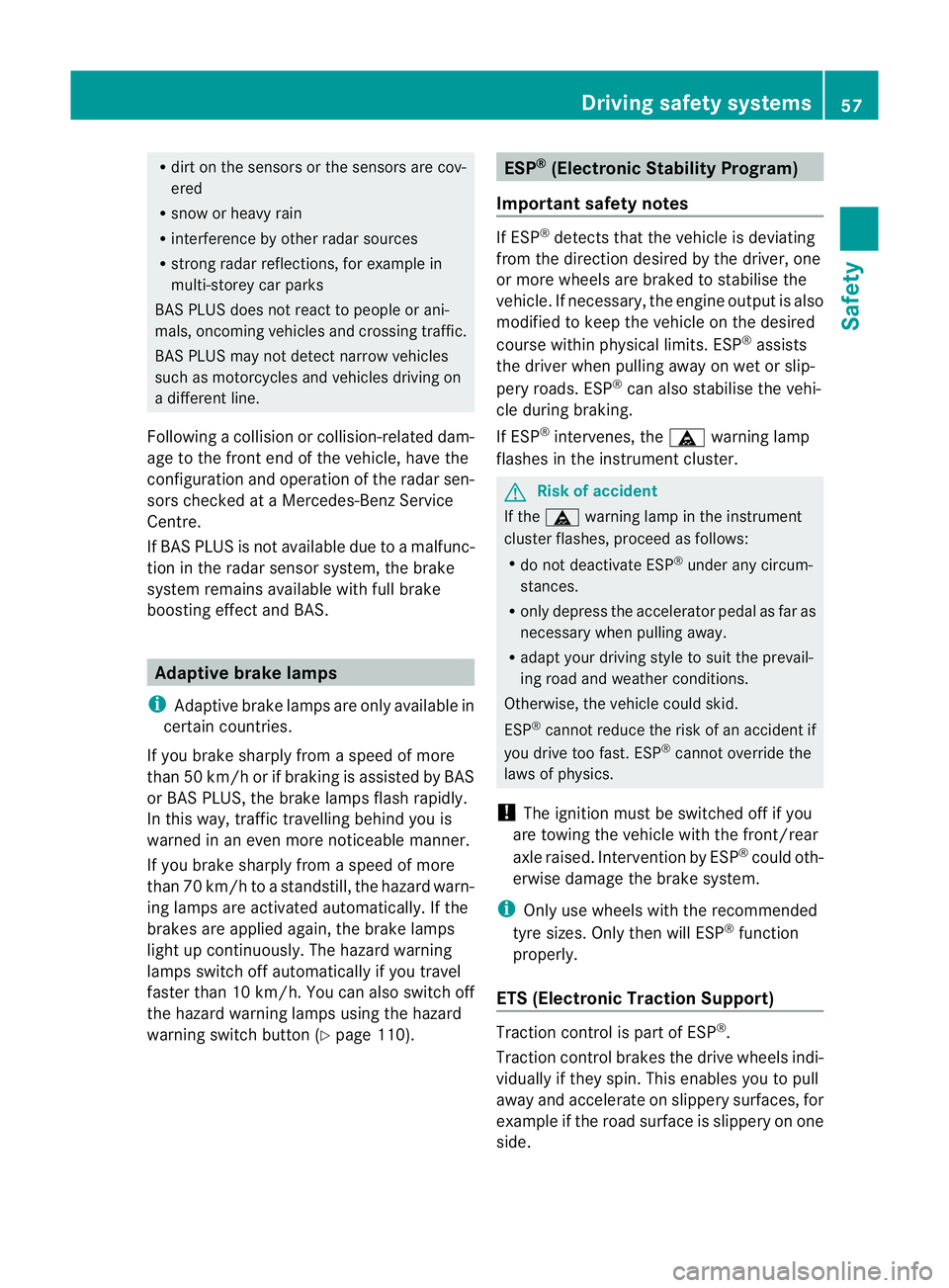
dirt on the sensor sorthe sensor sare cov-
ered
R sno worh eavy rain
R interferenc ebyother radar sources
R strong radar reflections, for example in
multi-storey car parks
BA SP LUS does no treact to people or ani-
mals, oncomin gvehicles and crossin gtraffic.
BAS PLUS may not detect narrow vehicles
such as motorcycle sand vehicles driving on
ad ifferen tline.
Following acollision or collision-related dam-
age to the fron tend of the vehicle, have the
configuratio nand operatio nofthe radar sen-
sors chec kedataM ercedes-Ben zService
Centre.
If BAS PLU Sisn ot available due to amalfunc-
tion in the radar senso rsystem, the brake
syste mremains available with ful lbrake
boostin geffect and BAS. Adaptiv
ebrake lamps
i Adaptive brake lamps are only available in
certain countries.
If you brake sharply from aspeed of more
than 50 km/ horifbraking is assisted by BAS
or BAS PLUS, th ebrake lamp sflash rapidly.
In this way, traffic travelling behind you is
warned in an even more noticeable manner.
If you brake sharply from aspeed of more
than 70 km/ htoastandstill, the hazard warn-
ing lamps are activated automatically .Ifthe
brakes ar eapplied again, the brak elamps
light up continuously .The hazard warning
lamps switc hoff automatically if you travel
faster than 10 km/h .You can also switc hoff
th eh azard warning lamps using the hazard
warning switch button (Y page 110). ESP
®
(Electronic Stability Program)
Important safety notes If ESP
®
detect sthat the vehicle is deviating
from the direction desired by the driver ,one
or more wheels are braked to stabilis ethe
vehicle. If necessary, the engin eoutput is also
modified to keep the vehicle on the desired
course within physical limits. ESP ®
assists
the driver when pulling away on wet or slip-
pery roads. ESP ®
can also stabilise the vehi-
cle during braking.
If ESP ®
intervenes, the äwarning lamp
flashes in the instrument cluster. G
Risk of accident
If the ä warning lamp in the instrument
cluster flashes, proceed as follows:
R do not deactivate ESP ®
under any circum-
stances.
R only depress the accelerator pedal as far as
necessary when pulling away.
R adapt your driving style to suit the prevail-
ing road and weather conditions.
Otherwise ,the vehicle coul dskid.
ESP ®
cannot reduce the risk of an accident if
you drive too fast. ESP ®
cannot override the
laws of physics.
! The ignition must be switched off if you
are towing the vehicl ewith the front/rear
axle raised. Interven tion by ESP ®
coul doth-
erwise damage the brake system.
i Only use wheels with the recommended
tyre sizes. Only then will ESP ®
function
properly.
ETS (Electronic Traction Support) Traction control is part of ESP
®
.
Traction control brakes the drive wheels indi-
viduall yifthey spin. This enables you to pull
away and accelerate on slipper ysurfaces, for
example if the road surface is slippery on one
side. Driving safety systems
57Safety
BA 207 ECE ÄJ 2010/1a; 1; 2, en-GB
mkalafaV ersion: 3.0.2.11
2010-01-26T13:03:22+01:00
-Seite 57 Z
Page 61 of 333
Traction control remains active if you deacti-
vat
eE SP®
. G
Risk of accident
Tractio ncontrol can notreduce the risk of an
accident if you driv etoo fast .Traction con trol
can noto verride th elaws of physics.
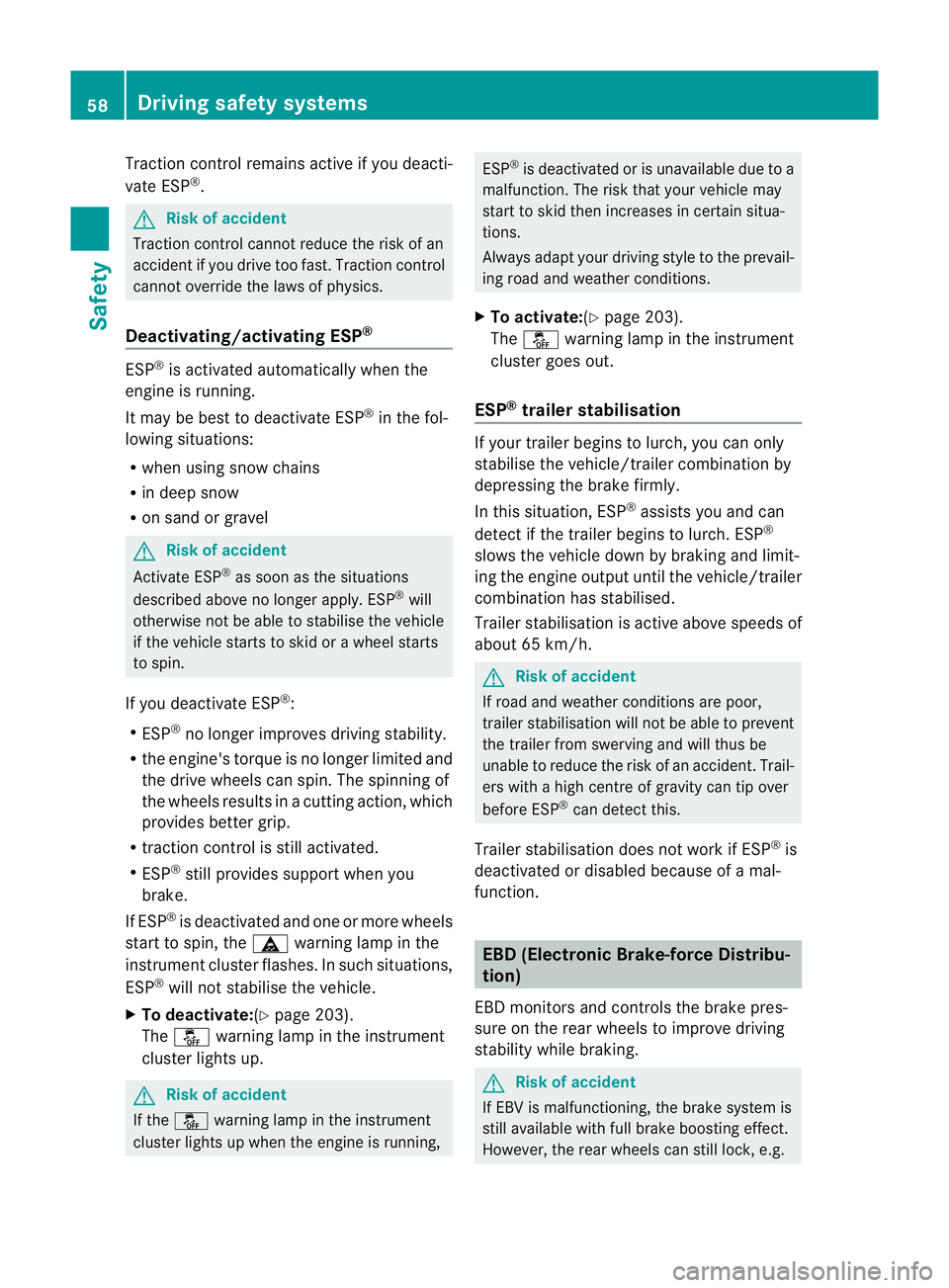
Deactivating/activating ESP ®ESP
®
is activated automatically when the
engine is running.
It may be best to deactivate ESP ®
in the fol-
lowing situations:
R when using snow chains
R in deep snow
R on sand or gravel G
Risk of accident
Activate ESP ®
as soon as the situations
described above no longer apply. ESP ®
will
otherwise not be able to stabilis ethe vehicle
if the vehicle star tsto skid or awheel star ts
to spin.
If you deactivate ESP ®
:
R ESP ®
no longer improves driving stability.
R the engine's torque is no longer limited and
the drive wheels can spin. The spinnin gof
the wheels results in acutting action, which
provides better grip.
R traction control is still activated.
R ESP ®
still provides support when you
brake.
If ESP ®
is deactivated and one or more wheels
start to spin, the äwarning lamp in the
instrument cluster flashes .Insuch situations,
ESP ®
will not stabilise the vehicle.
X To deactivate:(Y page 203).
The å warning lamp in the instrument
cluster lights up. G
Risk of accident
If the å warning lamp in the instrument
cluster lights up when the engine is running, ESP
®
is deactivated or is unavailable due to a
malfunc tion. The risk that your vehicle may
star ttos kid then increase sincertain situa-
tions.
Alway sadapt your driving style to the prevail-
ing road and weather conditions.
X To activate:(Y page 203).
The å warning lamp in the instrument
cluster goes out.
ESP ®
trailer stabilisation If your trailer begins to lurch, you can only
stabilise the vehicle/
trailer combination by
depressing the brake firmly.
In this situation, ESP ®
assists you and can
detect if the trailer begins to lurch. ESP ®
slows the vehicle down by brakin gand limit-
ing the engine output until the vehicle/trailer
combination has stabilised.
Traile rstabilisatio nisa ctive above speed sof
about 65 km/h. G
Risk of accident
If road and weather conditions are poor,
trailer stabilisatio nwill not be able to prevent
the trailer from swerving and will thus be
unable to reduce the risk of an accident .Trail-
ers wit hahigh centr eofgravity can tip over
before ESP ®
can detec tthis.
Trailer stabilisation does not work if ESP ®
is
deactivated or disable dbecause of amal-
function. EBD (Electronic Brake-force Distribu-
tion)
EBD monitors and controls the brake pres-
sure on the rear wheels to improve driving
stability while braking. G
Risk of accident
If EBV is malfunctioning, the brake system is
still available with full brake boosting effect.
However, the rear wheels can still lock, e.g. 58
Driv
ings afety systemsSafety
BA 207 ECE ÄJ 2010/1a; 1; 2, en-GB
mkalafa Version: 3.0.2.11 2010-01-26T13:03:22+01:00-Seite 58
Page 62 of 333
under full braking. This coul
dcause you to
lose control of your vehicle and cause an acci-
dent. You shoul dtherefore adapt your driving
styl etot he different handling characteristics. ADAPTIVE BRAKE
ADAPTIV EBRAKE enhances braking safety
and offers increased braking comfort .Inaddi-
tion to the brakin gfunction ,ADAPTIVE BRAKE
also ha sthe HOL Dfunctio n(Ypage 17 2)and
hill start assist (Y page137).For further
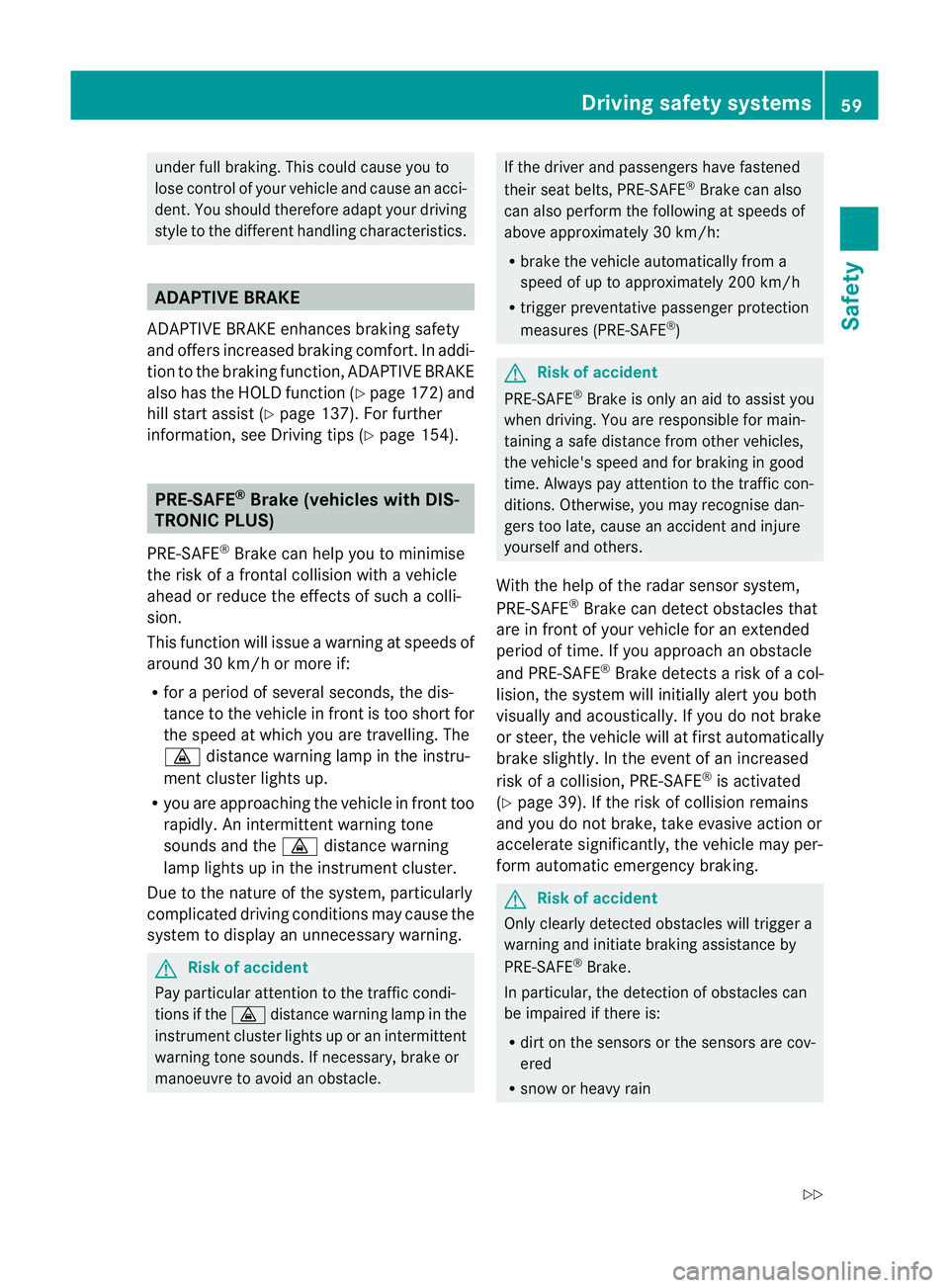
inf ormation, se eDriving tip s(Ypage 154). PRE-SAFE
®
Brake (vehicles with DIS-
TRON IC PLUS)
PRE-SAFE ®
Brake can hel pyou to minimise
the ris kofaf rontal col lisionwithavehicle
ahead or reduce the effects of such acolli-
sion.
This function will issu eawarning at spe edsof
around 30 km/h or more if:
R for aperiod of sever alseconds, the dis-
tance to the vehicl einfront is to oshort for
the speed at which you ar etrave lling. The
· distance warning lamp in the instru-
ment cluster lights up.
R you are approaching the vehicle in front too
rapidly .Anintermittent warning tone
so unds and the ·distance warning
lamp lights up in the instrument cluster.
Due to the nature of the system, particularly
complicated driving conditions may caus ethe
system to displa yanunneces sary warning. G
Ris
kofa ccident
Pay particula rattention to the traffic condi-
tions if the ·distance warning lam pinthe
instrument clu ster lights up or an intermittent
warning tone sounds. If necessary, brak eor
manoeuvre to avo idan obstacle. If the driver and passengers have fastened
thei
rseat belts, PRE-SAFE ®
Brak ecan also
can also perform the following at speeds of
above approximately 30 km/h:
R brake the vehicle automatically from a
spee dofuptoa pproximately 20 0km/h
R trigge rpreventative passenge rprote ction
measures (PRE-SAFE ®
) G
Risk of accident
PRE-SAFE ®
Brak eiso nly an aid to assist you
whe ndriving. Yo uare responsible for main-
taining asafe distanc efrom other vehicles,
th ev ehicle' sspeed and for braking in good
time. Alway spay attention to the traffic con-
ditions. Otherwise, you may recognise dan-
gers too late, cause an acciden tand injure
yoursel fand others.
With the hel pofthe radar sensor system,
PRE-SAFE ®
Brak ecan detect obstacles that
are in fron tofyour vehicle for an extended
period of time. If you approach an obstacle
and PRE- SAFE®
Brake detects arisk of acol-
lision, the system will initially aler tyou both
visually and acoustically .Ify ou do not brake
or steer ,the vehicle will at first automatically
brake slightly. In the even tofanincreased
risk of acollision ,PRE-SAFE ®
is activated
(Y page 39). If the risk of collision remains
and you do not brake, take evasive action or
accelerat esignificantly, the vehicle may per-
form automatic emergency braking. G
Risk of accident
Only clearl ydetected obstacles will trigger a
warning and initiat ebraking assistance by
PRE-SAFE ®
Brake.
In particular, th edetection of obstacles can
be impaired if there is:
R dirt on the sensor sorthe sensor sare cov-
ered
R snow or heavy rain Dri
ving sa fety systems
59Safety
BA 207 ECE ÄJ 2010/1a; 1; 2, en-GB
mkalafa Version: 3.0.2.11 2010-01-26T13:03:22+01:00 -Seite 59 Z
Page 63 of 333
R
interference by other radar sources
R the possibility of strong radar reflections,
for example in multi-storey car parks
PRE-SAFE ®
Brak edoes not react to persons,
animals ,oncoming vehicles, crossing traffic
or whe ncornering.
PRE-SAFE ®
Brak emay not detect narrow
vehicles such as motorcycles and vehicles
drivin gona different line. G
Ri
sk of accident
Dependin gonthe cur rent speed, PRE-SAFE ®
Brak edecelerat es your ve hicle by up to
4m /s2
befo reperformin gpossible emer-
genc ybraking .This is equivalen ttoapprox-
imately 40 %ofthe maximum brakin gpower
of the vehicle. You must additionally apply the
brakes yourself in order to prevent acollision
or minimise an impact. Automatic emergency
brakin gisnot performed until immediately
prior to an accident in the even tthat you are
unable to avoid one by, for instance, taking
evasive action.
In order to maintain the appropriate distance
to the vehicle in front and thus prevent acol-
lision, you must apply the brakes yourself.
At speeds up to approximately 70 km /h,
PRE- SAFE ®
Br ake can also detect stationary
obstacles ,for example stopped or parked
vehicles. G
Risk of accident
If ,inac ritical driving situation, yo udonot
receive avisual and acoustic warning:
R PRE-SAFE ®
Brak edid not detect the risk of
ac ollision
R PRE- SAFE ®
Br ake is switched off
R PRE-SAFE ®
Brake has failed
You must then brake to avoid acollision.
X To activate: activate PRE-SAFE®
Br ake in
the on-board computer (Y page 203).
The Ä symbol appears in the lower mul-
tifunction display ,aslong as the HOLD
func tion is not activated (Y page 172).On vehicles with parkin
gguidance, the P
gear must be engage dfor the icon to be
displayed.
The radar sensor system is switched off auto-
matically in the vicinit yofradio telescope
facilities (Y page 324).
For PRE-SAFE ®
Brake to assis tyou when driv-
ing, the radar sensor system must be
switched on and operational.
PRE- SAFE ®
Br ake does not always detect
complex traffic situations properly. You can
terminate the braking action of PRE-SAFE ®
Brake in anon-critical drivin gsituation at any
time if:
R an acoustic and visual warnin goccurs
R the vehicle brakes
To end this, you can either depress the accel-
erato rpedal further, activate kickdown or
release the brak epedal.
The braking action of PRE- SAFE®
Br ake is
ended automatically if:
R you manoeuvre to avoid the obstacle
R you drive slowe rthan approximately
15 km /h
R there is no longe ranobstacle detected in
front of your vehicle
R there is no longer any danger of acollision
Following acollision or collision-related dam-
age to the front end of the vehicle, have the
con figuration and operation of the radar sen-
sors chec ked. Choose aqualified specialist
worksho pfor this which has the necessary
specialist knowledge and tools for the work
required .Mercedes-Benz recommends that
you use aMercedes-Benz Servic eCentr efor
this purpose. Anti-theft systems
Immobiliser
The immobiliser prevent syour vehicle from
being star tedw ithout the correc tkey. 60
Anti-thef
tsystemsSafety
BA 207 ECE ÄJ 2010/1a; 1; 2, en-GB
mkalafa Version: 3.0.2.11
2010-01-26T13:03:22+01:00
-Seite 60
Page 86 of 333
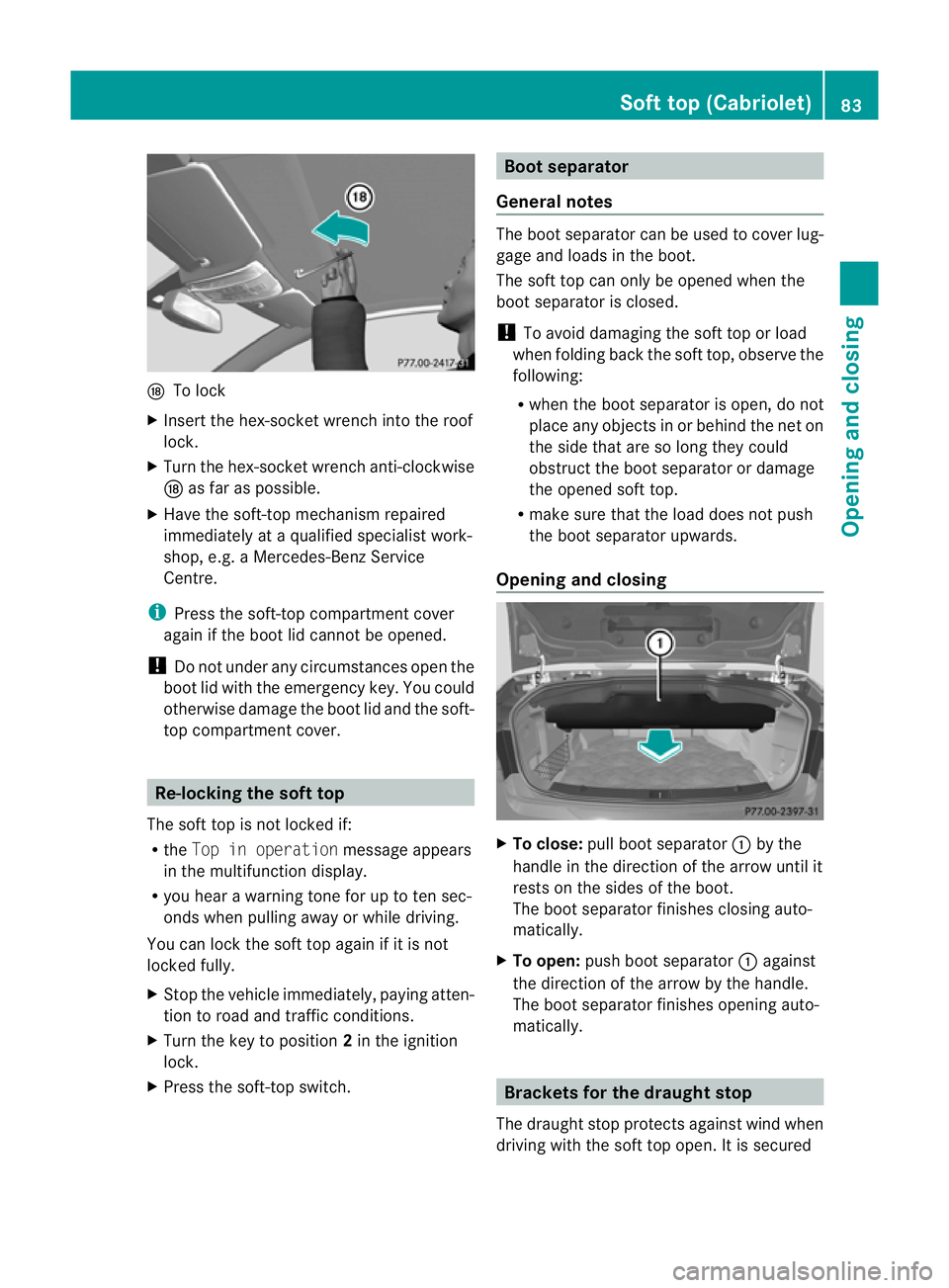
N
To lock
X Insert the hex-socket wrench int othe roof
lock.
X Tur nthe hex- socket wrench anti-clockwi se
N as fa rasp ossible.
X Hav ethe soft -top mechanism repaired
immediately at aqualified specialist work-
shop, e.g. aMercedes-Benz Service
Centre.
i Press the soft-top compartmen tcover
again if the boot lid can notb eo pened.
! Do not under any circumstances open the
boot lid with the emergenc ykey. You could
otherwise damage the boot lid and the soft-
top compartmen tcover. Re-locking th
esoft top
The soft top is not locked if:
R the Topino peration message appears
in th emultifunction display.
R you hear awarning ton efor up to ten sec-
onds when pullin gaway or while driving.
You can lock the soft top again if it is not
locked fully.
X Stop the vehicle immediately, paying atten-
tion to road and traf ficc onditions.
X Tur nthe key to position 2in the ignition
lock.
X Press the soft -top switch. Boot sepa
rator
General notes The boot separator can be used to cover lug-
gage and loads in the boot.
The soft top can only be opened when the
boot separator is closed.
!
To avoid damaging the soft top or load
when folding back the soft top, observe the
following:
R when the boot separator is open, do not
place any object sinorbehind the net on
the side that are so long they could
obstruct the boot separator or damage
the opened soft top.
R mak esure that the load does not push
the boot separator upwards.
Openin gand closing X
To close: pull boot separator :by the
handle in the direction of the arrow until it
rest sont he sides of the boot.
The boot separator finishes closing auto-
matically.
X To open: push boot separator :against
the direction of the arrow by the handle.
The boot separator finishes opening auto-
matically. Brackets fo
rthe draught stop
Th ed raught stop protects against wind when
driving with th esoft top open. It is secured Soft top (Cabriolet)
83Opening and closing
BA 207ECE ÄJ 2010 /1a; 1; 2, en-GB
mkalafa Version: 3.0.2.11 2010-01-26T13:03:22+01:00 -Seite 83 Z
Page 109 of 333
Vehicl
eequipment
i Thismanua ldesc ribe sallthe standard
and optional equipment of your vehicle
which wa savailable at th etime of pur-
chase. Countr y-specif ic differences are
possible. Bear in mind tha tyour vehicle
ma ynot featur eall function sdescribed
here. Exterio
rlighting Important safet
ynotes
For reasons of safety, Mercedes-Ben zrecom-
mends that you driv ewith the lights switched
on even during the daytime. In some coun-
tries, operation of the headlamps varies due
to legal requirement sand self-imposed obli-
gations. In these countries, the daytime driv-
ing lights are automatically switche donwhen
the engin eisstarted. Notes on driving abroad
Converting to symmetrical dipped beam
when drivin gabroad: switch the headlamps
to symmetrical dipped beam in countries in
which traffic drives on the opposite side of the
road to the countr ywhere the vehicle is reg-
istered. This prevents oncomi ngtraffic from
being dazzled .Symmetrical lights do not illu-
minate as large an area of the edg eofthe
carriageway.
Convert the headlamps as close to the border
as possible before drivin ginthese countries
(Y page 206).
Converting to asymmetrica ldipped beam
after retu rning: conver tthe headlamps back
to asymmetrical dipped beam as soon as pos-
sible after crossing the border when returning
(Y page 206).
Vehicle swith Intelligent Light System: if
the headlamps are converted to symmetrical
dipped beam, not all light functions are avail- able. "Motorway mode" and the "extended
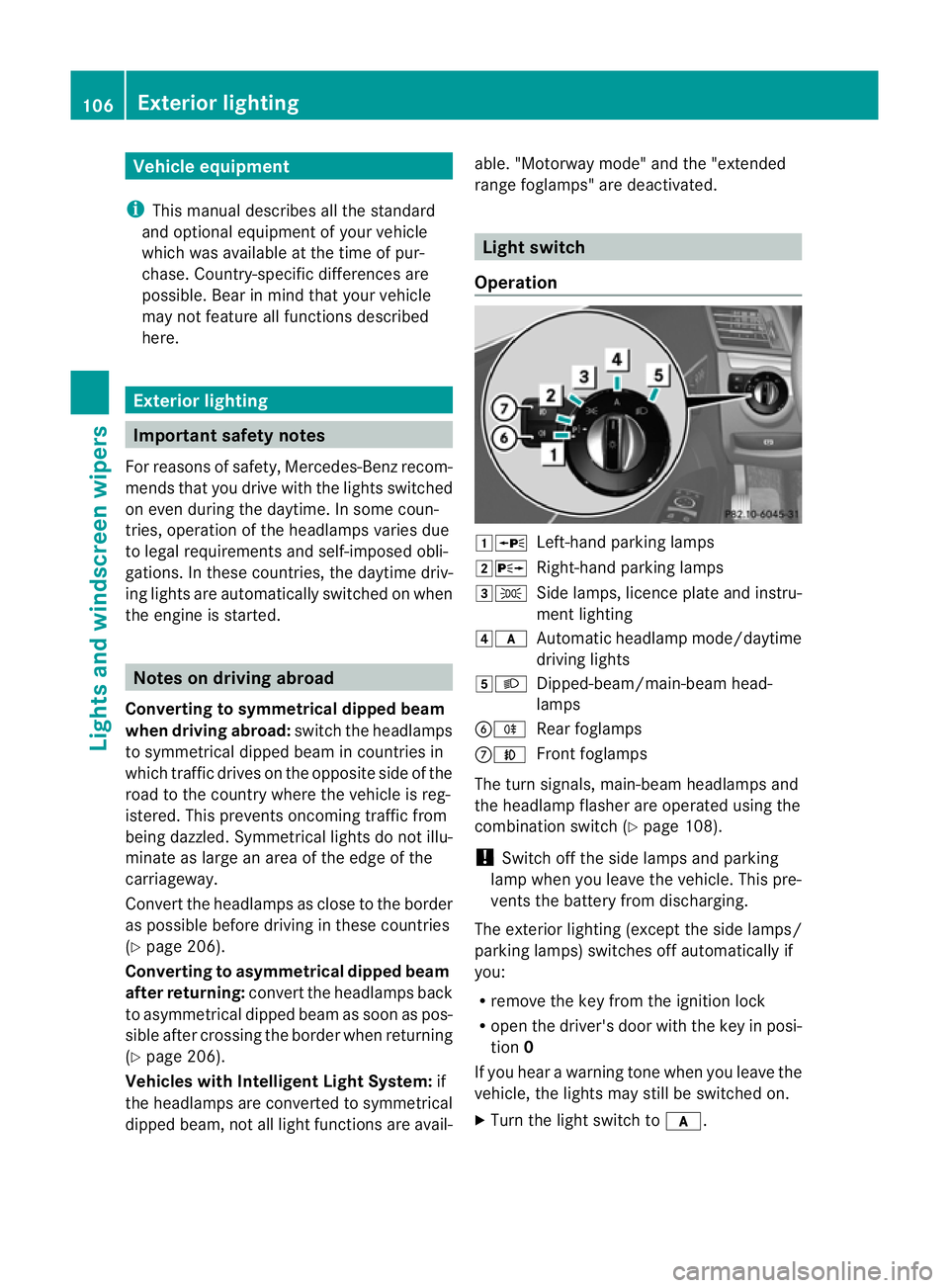
range foglamps" are deactivated. Light switch
Opera tion 1W
Left-hand parking lamps
2X Right-hand parking lamps
3T Side lamps, licence plate and instru-
ment lighting
4c Automatic headlamp mode/daytime
driving lights
5L Dipped-beam/main-beam head-
lamps
BR Rear foglamps
CN Front foglamps
The turn signals ,main-beam headlamps and
the headlamp flasher are operated using the
combination switch (Y page 108).
! Switch off the side lamps and parking
lamp when you leave the vehicle. This pre-
vent sthe battery from discharging.
The exterior lighting (except the side lamps/
parkin glamps) switches off automatically if
you:
R remove the key from the ignition lock
R open the driver' sdoor with the key in posi-
tion 0
If you hear awarning tone when you leave the
vehicle, the lights may still be switched on.
X Turn the light switch to c.106
Exterior lightingLights and windscree
nwipers
BA 207ECE ÄJ 2010 /1a;1;2,e n-GB
mkalafa Version: 3.0.2.11 2010-01-26T13:03:22+01:00-Seite 106
Page 113 of 333
indicator lamp in the instrumen
tcluster
stays on.
X To deactivate: movethe combina tion
switc hback to its normal posi tion.
The _ indicator lam pinthe instrument
cluster goes out.
Headlam pflasher X
To switch on: turnthe key in the igni tion
lock to position 1or 2or star tthe engine.
X Pull the combina tion switc hbrieflyint he
direction of arrow =.Ha
zard warning lamps The hazar
dwarnin glamps automatically
switc hon:
R if an airbag is deployed
R if the vehicle decelerates rapidl yfrom a
speed of more than 70 km/h and comes to
as tandstill
X To switch on the hazar dwarning lamps:
press button :.
All turn signals flash. If you now switch on
at urn signal using the combination switch,
only the turn signal lamp on the corre-
sponding side of the vehicle will flash.
X To switch off the haza rdwarning
lamps: press button :.
The hazard warning lamp switche soff auto-
matically if th evehicle reaches aspeed of
over 10 km/ hagain after full brake applica-
tion. i
The hazard warnin glamps still operate if
the ignition is switched off. Adjusting the headlamp range (halo-
gen headlamps)
The headlamp range control allow syou to
adjust the con eoflight from the headlamps
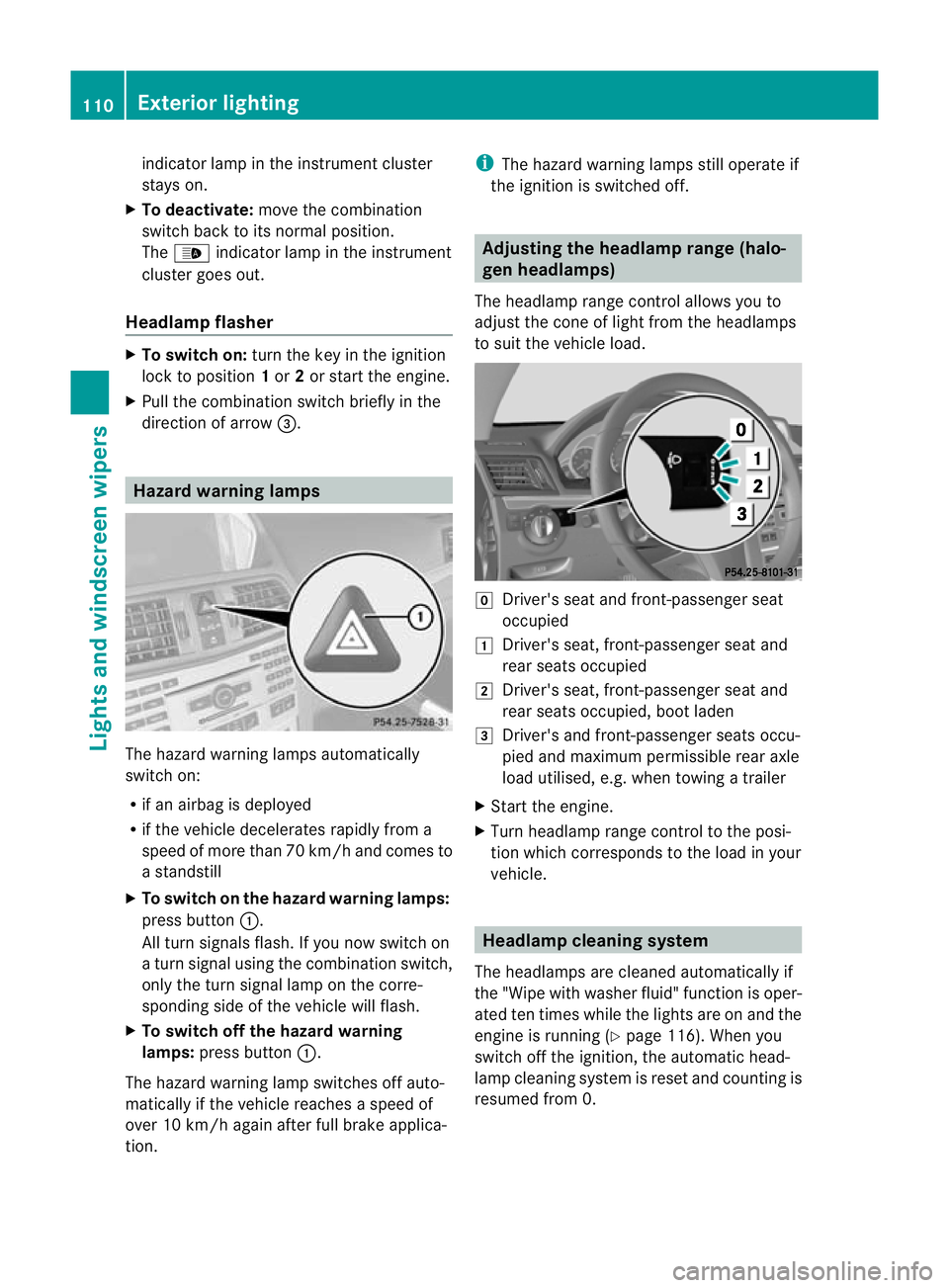
to suit the vehicle load. g
Driver' sseat and front-passenger seat
occupied
1 Driver's seat, front-passenger seat and
rear seats occupied
2 Driver's seat, front-passenger seat and
rear seats occupied, boot laden
3 Driver's and front-passenger seats occu-
pied and maximu mpermissible rear axle
load utilised, e.g. when towing atrailer
X Start th eengine.
X Turn headlamp range control to the posi-
tion which corresponds to the load in your
vehicle. Headlamp clean
ings ystem
Th eh eadlamps are cleaned automatically if
the "Wipe with washer fluid" function is oper-
ated ten times while the lights are on and the
engine is running (Y page 116). When you
switc hoff th eignition, the automatic head-
lam pcleaning system is reset and countin gis
resume dfrom 0. 110
Exterior lightingLi
gh ts and windscreen wipers
BA 207 ECE ÄJ 2010/1a; 1; 2, en-GB
mkalafa Version:3.0.2.11
2010-01-26T13:03:22+01:0
0-Seite 110
Page 115 of 333
Active:
if you are driving at speeds below
70 km/h and you switc honthe rear foglamp.
No tactive: if you are driving at speeds above
10 0k m/h or yo uswitch off the rear foglamp
following activat ion. Interior lighting
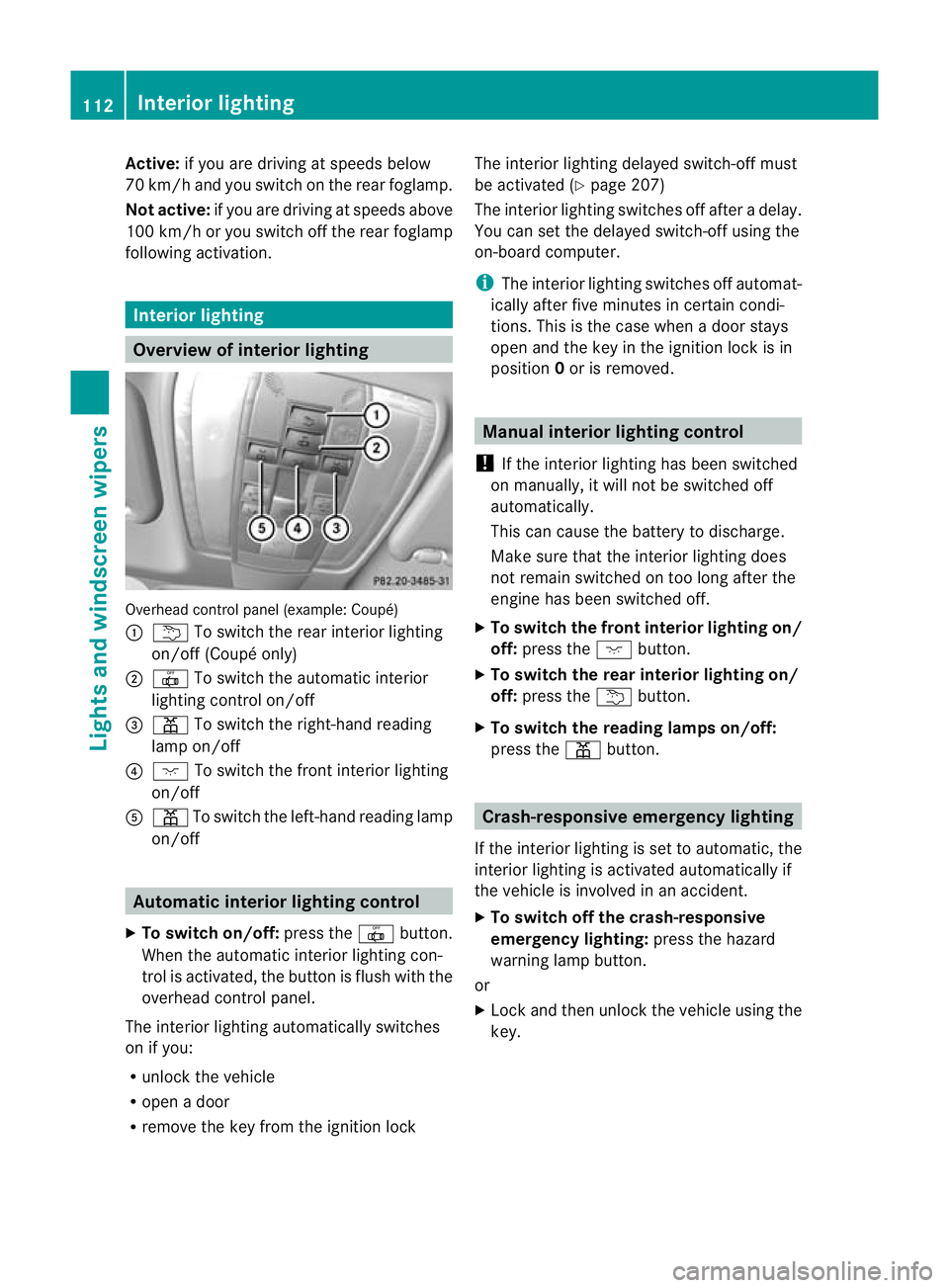
Overv
iewofi nterio rlighting Overhead control panel (example: Coupé)
:
u To switc hthe rea rinterior lighting
on/off (Coupé only)
; | To switc hthe automa tici nterior
lighting control on/off
= p To switc hthe right-han dreading
lam pon/off
? c To switch the fron tinterior lighting
on/off
A p To switch the left-hand reading lamp
on/off Automatic interior lighting control
X To switch on/off: pressthe | button.
When the automatic interior lighting con-
trol is activa ted, the button is flush with the
overhead control panel.
The interior lighting automatically switches
on if you:
R unloc kthe vehicle
R open adoor
R remove the key from the ignition lock The interior lightin
gdelayed switch-off must
be activated (Y page 207)
The interior lightin gswitches off after adelay.
You can set the delayed switch-off using the
on-board computer.
i The interior lighting switches off automat-
icall yafter five minutes in certain condi-
tions. This is th ecase when adoor stays
open and the key in the ignition lock is in
position 0or is removed. Manua
linterior lighting control
! If the interior lightin ghas been switched
on manually, it will not be switched off
automatically.
This can cause the batter ytodischarge.
Make sure that the interior lighting does
not remain switched on too long after the
engine has been switched off.
X To switch the front interior lighting on/
off: press the cbutton.
X To switch the rear interior lighting on/
off: press the ubutton.
X To switch the reading lamp son/off:
press the pbutton. Crash-responsive emergency lighting
If the interior lightin gisset to automatic ,the
interior lighting is activated automatically if
the vehicle is involved in an accident.
X To switch of fthe crash-responsive
emergenc ylighting: press the hazard
warning lamp button.
or
X Lock and then unlock the vehicle using the
key. 112
Interior lightingLights and windscreen wipers
BA 20
7ECE ÄJ 2010 /1a; 1; 2, en-GB
mkalafa Version: 3.0.2.11 2010-01-26T13:03:22+01:00 -Seite 112
Page 143 of 333

Problems wit
hthe engine Problem Possible causes/consequences and
M Solutions
Th
ee ngine doe snot
start. The HOL
Dfunction or DISTRONIC PLUS is activated.
X Deactivat ethe HOL Dfunction (Y page 172)orDISTRONIC
PLUS (Y page 160).
X Try to start th eengine again. The engine doe
snot
start. The starter motor
can be heard. R
There is amalfunction in the engine electronics.
R There is amalfunction in the fuel supply.
R The on-board voltage is too low because the starter battery is
too weak or discharged.
X Before attempting to start the engine again, turn the key in the
ignition back to position 0or press the Start/Stop button
repeatedly until all indicator lamps in the instrumen tcluster go
out.
X Try to star tthe engin eagain (Y page 136). Avoid excessively
long and frequen tattempt stostart the engine as thes ewill drain
the battery.
If the engine does not start after several attempts:
X Consult aqualified specialist workshop. The engine does not
start
.The starter motor
can be heard. The
reserve fuel warning
lam pisl it and the fuel
gauge displa yshows 0. The fuel tan
kise mpty.
X Refue lthe vehicle. The engin
edoes not
start. You cannot hear
the starter motor. The on-boar
dvoltage is too low because the starter battery is too
weak or discharged.
X Jump-start the vehicle (Y page 289).
If the engin edoes not star tdespite attempt stojump-start it:
X Consult aqualified specialist workshop. The starter motor was exposed to
athermal load that was too high.
X Allo wthe starter motor to cool down for approximatel ytwo
minutes.
X Try to start the engine again.
If the engine still does not start:
X Consult aqualified specialist workshop. 140
DrivingDrivin
gand pa rking
BA 20 7ECE ÄJ 2010 /1a;1;2,e n-GB
mkalafa Version: 3.0.2.11 2010-01-26T13:03:22+01:00-Seite 140