Electric MERCEDES-BENZ E-CLASS CABRIOLET 2010 Owner's Guide
[x] Cancel search | Manufacturer: MERCEDES-BENZ, Model Year: 2010, Model line: E-CLASS CABRIOLET, Model: MERCEDES-BENZ E-CLASS CABRIOLET 2010Pages: 333, PDF Size: 7.64 MB
Page 282 of 333
i
First, TIREFIT is pumpe dinto the tyre .The
pressur ecan briefly rise to approximately
500 kPa (5 bar/73 psi).
Do not switch off the electric pum pdur-
in gt his phase.
X Let th eelectric pump run for fiv eminutes.
The tyre should then have attained apres-
sure of at le ast180 kPa (1.8 bar/ 26 psi).
! Do not operate the el ectric ai rpump for
longe rthan eight minutes at atime without
ab reak. It may otherwis eoverheat.
Th ea ir pump can be operated again once
it has cooled down.
If after fiv eminutes apressure of 180 kPa
(1.8 bar/26 psi) ha sbeen achieved, see
(Y page 279).
If after fiv eminutes apressure of 180 kPa
(1.8 bar/26 psi) ha snot been achieved, see
(Y page 279).
Tyre pressur eof180 kPa (1.8 bar, 26
psi) is not reached If after fiv
eminutes apressure of 180 kPa
(1.8 bar/26 psi) ha snot been achieved:
X Press the on/off switch on the electri cair
pump to 0.
The electric air pump is switched off.
X Unscrew the filler hose from the valv e.
X Very slowly drive forwards or reverse
ap proximately 10 m.
X Pum pupt he tyreagain. G
Risk of accident
If after fiv eminutes apressure of 180 kPa
(1 8 bar/26 psi) cannot be achieved ,the tyre
is too severel ydamaged.
Do not drive any further. Consult aqualified
specialist workshop which has the necessary
specialist knowledge and tools to carry out
the work required. Mercedes-Benz recom-
mends that you use aMercedes-Ben zService
Centr efor this pur pose.Inp articular, work
relevant to safety or on safety-related sys- tems must be carrie
dout at aqualified spe-
cialist workshop.
Tyre pressure of 180 kPa (1.8 bar, 26
psi) is reached X
Press the on/off switch on the electric air
pump to 0.
The electric air pump is switched off.
X Remove the TIREFIT kit from the wheel. G
Warning
The air hos emay still be hot. Exercise proper
cautio ntoavoidb urning yourself when
detaching the electric air pump.
! After use, excess TIREFIT may run out of
the filler hose. This may cause stains.
Therefore, place the filler hos einthe plastic
bag whic hcontaine dthe TIREFIT kit.
X Stow away the TIREFIT kit ,the electric air
pum pand the warning triangle.
X Pull away immediately. G
Risk of accident
Do not exceed the maximum speed of
80 km/h.
The "max. 80 km/h" labe lmust be affixed in
the driver's field of vision.
The vehicle's handling characteristics may be
affected.
X Stop after driving for approximately ten
minutes and check the tyre pressure with
the electric air pump. G
Risk of accident
If the tyre pressure is less than 130 kPa
(1.3 bar/26 psi), the tyre is too severely dam-
aged. Do not drive any further. Consult a
qualified specialist workshop which has the
necessary specialist knowledg eand tool sto
carry out the work required. Mercedes-Benz
recommends that you use aMercedes-Benz
Ser vice Centre for thi spurpose. In particular,
work relevant to safety or on safety-related Flat tyre
279Breakdown assistance
BA 207 ECE ÄJ 2010/1a; 1; 2, en-GB
mkalafa Version: 3.0.2.11 2010-01-26T13:03:22+01:00-Seite 279 Z.
Page 283 of 333
systems must be carried out at
aqualified
specialist workshop.
X Correct the tyre pressure if it is at least
130 kPa(1.3 bar/26 psi) (for the value ssee
the fuel filler flap).
X To increase th etyre pressure: switch on
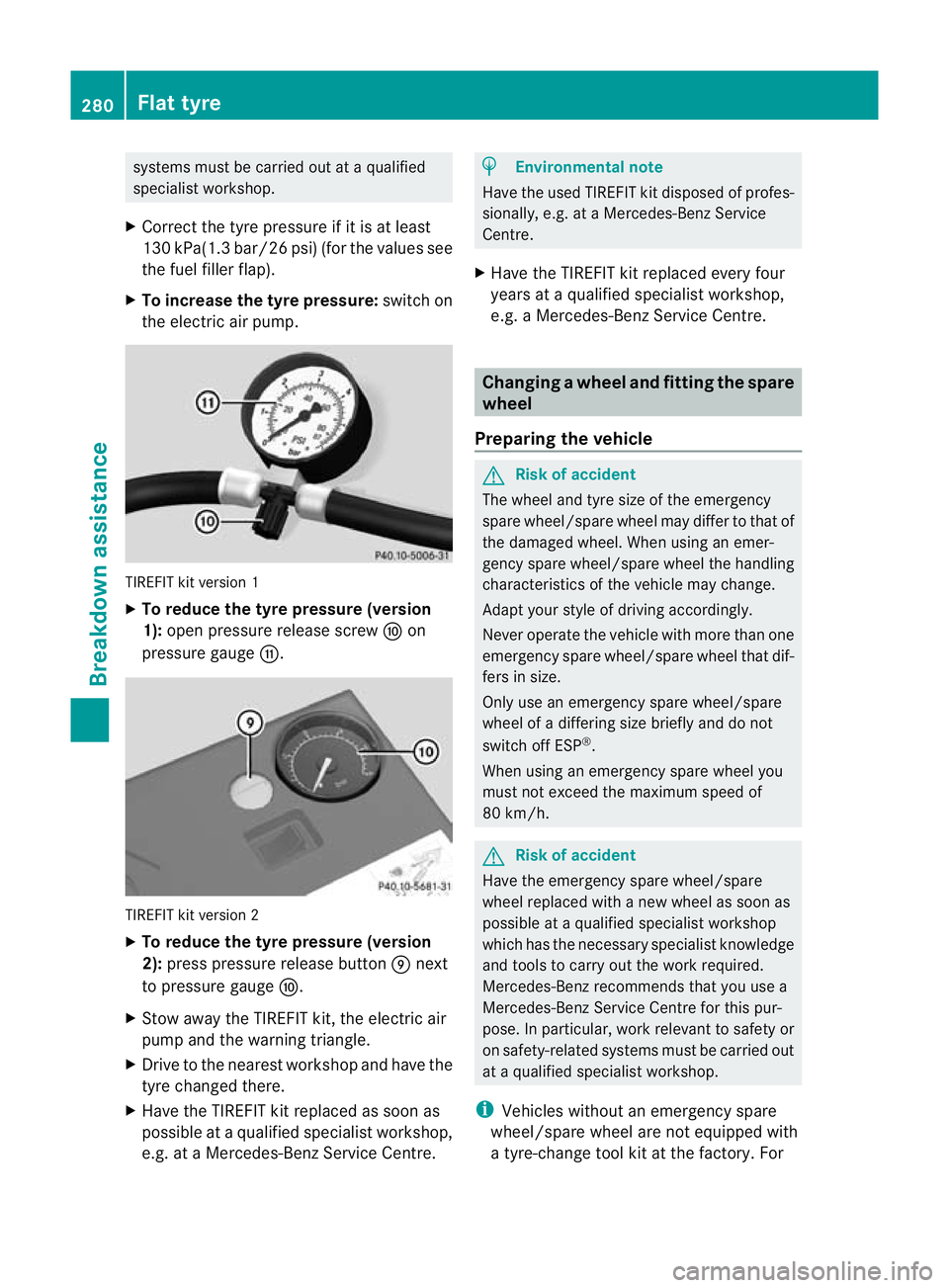
th ee lectric air pump. TIREFIT kit version 1
X
To reduce the tyr epressure (version
1): ope npressure release screw Fon
pressure gauge G. TIREFIT kit versio
n2
X To reduce the tyre pressure (version
2): pres spressure release button Enext
to pressure gauge F.
X Sto wa waythe TIREFIT kit ,the electric air
pum pand the warning triangle.
X Drive to the neares tworkshop and have the
tyr ec hange dthere.
X Hav ethe TIREFIT kit replaced as soon as
possible at aqualified special istworkshop,
e.g. at aMercedes-Ben zService Centre. H
Environmenta
lnote
Have the used TIREFI Tkit dispose dofprofes-
sionall y, e.g. ataM ercedes-Ben zService
Centre.
X Hav ethe TIREFIT kit replaced ever yfour
year sataq ualified special istworkshop,
e.g. aMercedes-Ben zService Centre. Changing
awhee land fitting th espare
wheel
Preparing the vehicle G
Risk of accident
The wheel and tyre size of the emergency
spare wheel/s pare wh eelm ay differ to tha tof
the damaged wheel. Whe nusing an emer-
genc yspare wheel/spar ewheel the handling
characteristic softhe vehicle ma ychange.
Adap tyour style of driving accordingly.
Never operate the vehicle with mor ethan one
emergenc yspare wheel/spar ewheel that dif-
fer sins ize.
Only use an emergenc yspare wheel/spare
wheel of adiffering size briefly and do not
switch off ESP ®
.
When using an emergenc yspare wheel you
must not exceed the maximum speed of
80 km/h. G
Risk of accident
Hav ethe emergenc yspare wheel/spare
wheel replaced with anew wheel as soon as
possible at aqualified specialist workshop
which has the necessary specialist knowledge
and tools to carry out the work required.
Mercedes-Benz recommends that you use a
Mercedes-Benz Service Centre for this pur-
pose .Inp articular, work relevant to safety or
on safety-related systems must be carried out
at aq ualified specialist workshop.
i Vehicles withou tanemergency spare
wheel/spare whee lare not equippe dwith
at yre-change tool kit at the factory. For 280
Flat tyreBreakdown assistance
BA 207 ECE ÄJ 2010
/1a; 1; 2, en-GB
mkalafa Version: 3.0.2.11 2010-01-26T13:03:22+01:00 -Seite 280
Page 289 of 333
the
mtoa Mercedes-Benz Service Centre or
to as pecial collectio npoint for old batteries. G
Risk of inju
ry
Fo rs afety reasons, Mercedes-Benz recom-
mends that you only use batteries which have
been tested and approved for your vehicle by
Mercedes-Benz. Thes ebatteries provide
increased impact protection to prevent vehi-
cle occupant sfrom suffering aci dburns
should the battery be damaged in the event
of an accident.
To prevent acid burns, observe the following
safety notes when handling batteries:
R do not lean over the battery.
R do not place any metal objects on abattery.
Otherwise ,you coul dcause ashort circuit
and the battery's gas mixtur ecould ignite.
R mak esure that you do not create an elec-
trostatic charge, e.g. by wearing synthetic
clothing or as aresult of friction on fabrics.
Therefore, you should not pull or slide the
batter yover carpets or other synthetic
materials.
R neve rtouch the battery first. To discharge
ap ossible electrostatic charge, step out of
the vehicle first and touc hthe bodywork.
R do not wipe the battery usin gacloth. The
battery may explode as aresult of electro-
static charge or due to flying sparks.
! Switc hoff th eengine and remove the key
before disconnectin gthe termi nalclamps
from the battery .Onvehicles with KEY-
LE SS -GO, make sure that the ignition is
switched off. Check that all the indicator
lamps in the instrument cluste rare off.
Otherwise, yo umay destroy electronic
components, such as the alternator.
i Remove the key if you park the vehicle
and do not require any electrical consum-
ers. The vehicle will then use very little
energy, thus conserving battery power.
Mercedes-Benz recommends that you do not
carr yout work on batteries yourself, e.g.
removing, charging or replacing. Always have this work performed at
aqualified specialist
workshop, e.g. aMercedes-Ben zService
Cent re. Installation location of the battery
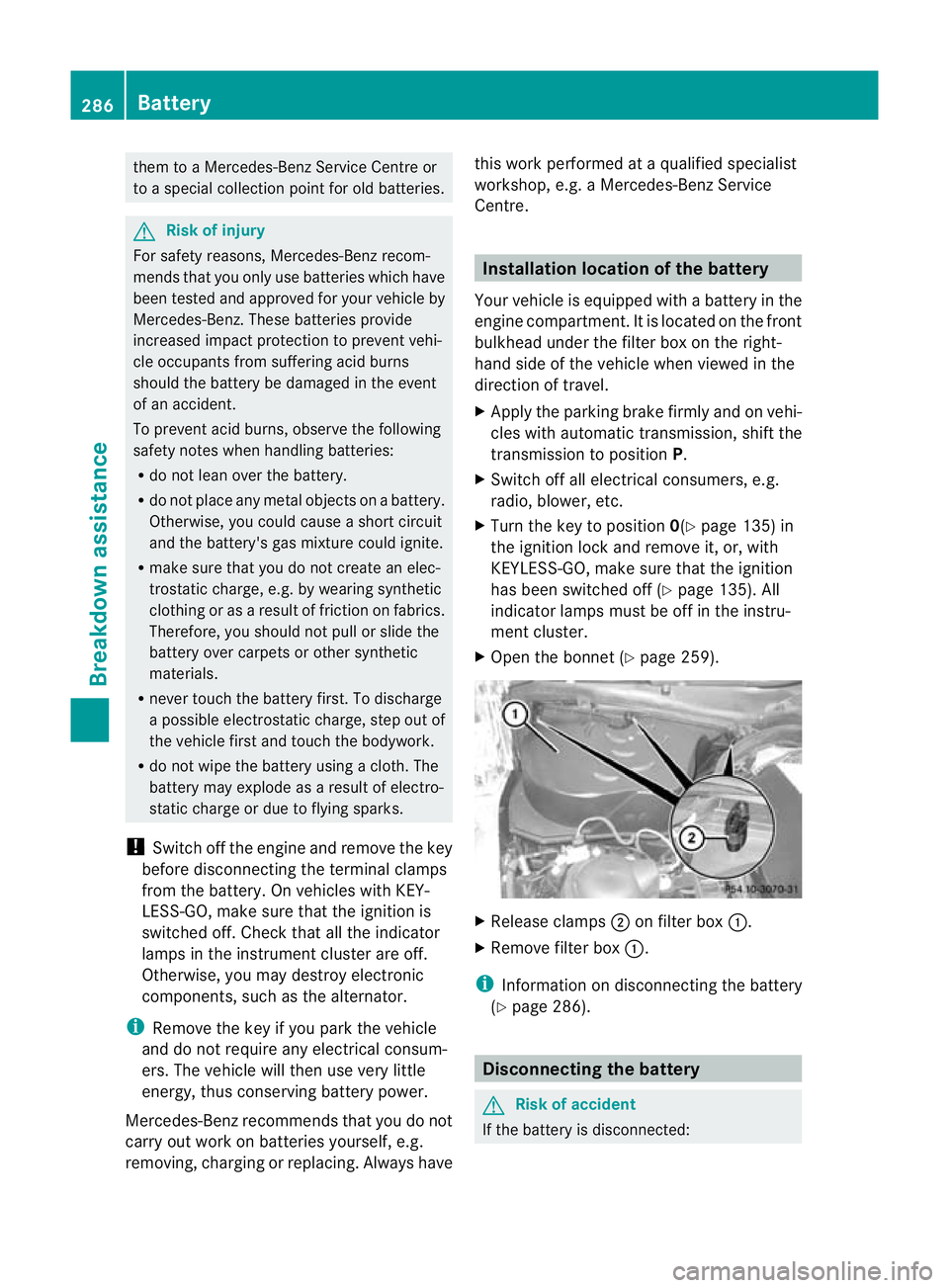
Your vehicle is equippe dwithabatter yint he
engin ecompartmen t. Itis located on the front
bulkhea dunder the filter box on the right-
hand sid eofthe vehicle when viewed in the
direction of travel.
X Appl ythe parkin gbrake firml yand on vehi-
cles with automati ctransmission, shift the
transmission to position P.
X Switch off all electrica lconsumers, e.g.
radio, blower ,etc.
X Turn the key to position 0(Ypage 135) in
the ignition lock and remove it, or, with
KEYLESS-GO, make sure that the ignition
has bee nswitched off (Y page 135). All
indicator lamps must be off in the instru-
ment cluster.
X Open the bonnet (Y page 259). X
Release clamps ;on filter box :.
X Remove filter box :.
i Information on disconnecting the battery
(Y page 286). Disconnecting the battery
G
Risk of accident
If the battery is disconnected: 286
BatteryBreakdown assistance
BA 207 ECE ÄJ 2010/1a; 1; 2, en-GB
mkalafa
Version: 3.0.2.11 2010-01-26T13:03:22+01:00-Seite 286
Page 292 of 333
Jum
p-starting G
Risk of injury
There is arisk of acid burns when jump-starting avehicle due to the gases which escape from
the battery. Do not lean over the batter ywhile the engin eisbeing jump-started. G
Risk of explosion
Gases escapin gfrom th ebattery during jump-starting may cause minor explosions. Avoid cre-
ating sparks. Keep naked flames away from the battery, and do not smoke.
Comply with safety precautions when handling batteries. You will find these under "Battery" in
the index.
! Avoid repeated and lengthy startin gattempts. Otherwise, non-combuste dfuel may dam-
age the catalytic converter 41
and create arisk of fire.
Do not use arapid-charging device to start the engine.
Make sure the jump leads are not damaged.
Make sure the jump leads are not touching any other metal objects when they are connected
to the battery.
If your vehicle's battery is discharged ,the engin ecan be jump-started from another vehicle
or from asecond batter yusing jum pleads.
Observ ethe followin gpoints:
X The battery is not accessible in all vehicles. If the other vehicle' sbattery is not accessible,
jump-start the vehicle using asecond batter yorajump-star ting device.
X Only jump-start the vehicl ewhen th eengineisc old an dthe catalytic converter system has
cooled down 42
.
X Do no tstart the engine if the battery is frozen. Let the battery thaw first.
X Jump-starting may only be performed from batterie swithanominal voltage of 12 V.
X Only use jum pleads which have asufficient cross-section and insulated terminal clamps.
X Make sure that the jump leads cannot come into contact with parts, such as the pulley or
the fan. Thes eparts move when the engine is started and while it is running.
X If the battery is fully discharged ,leave the batter ythat is being used to jump-star tconnected
for afew minutes befor eattempting to start. This charges the battery alittle.
i Jump leads and further information about jump-startin gcan be obtained from any
Mercedes-Ben zService Centre.
X Make sure that the two vehicles do not touch.
X Apply the parking brak efirmly.
X Manual transmission: engage neutral.
X Automatic transmission: move the selector lever toP.
X Switch off all electrical consumer s(e.g. radio, blower, etc.).
X Open the bonnet (Y page 259).
41 Only vehicles with apetrol engine.
42 Only vehicles with apetrol engine. Jump-starting
289Breakdown assistance
BA 207ECE ÄJ 2010 /1a;1;2,e n-GB
mkalafa Version: 3.0.2.11 2010-01-26T13:03:22+01:00-Seite 289 Z
Page 293 of 333
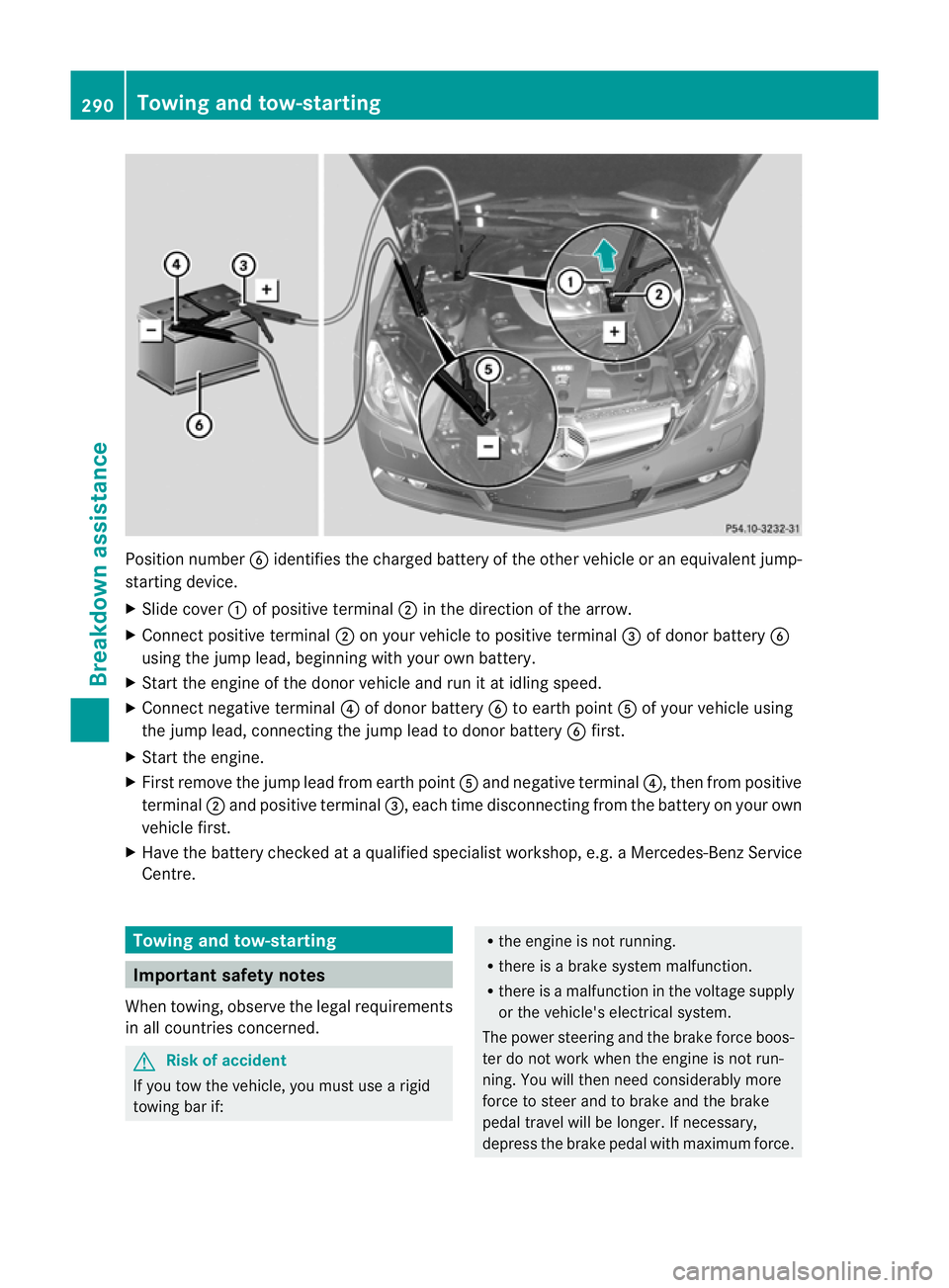
Position number
Bidentifie sthe charged batter yofthe other vehicle or an equivalen tjump-
starting device.
X Slide cover :of positive terminal ;in the direction of the arrow.
X Connec tpositiv eterminal ;on your vehicle to positiv eterminal =of donor battery B
using the jum plead, beginning with your own battery.
X Start the engine of the donor vehicle and run it at idling speed.
X Connect negative terminal ?of donor battery Bto eart hpoint Aof your vehicle using
the jum plead, connectin gthe jum plead to donor battery Bfirst.
X Start the engine.
X First remove the jum plead from eart hpoint Aand negative terminal ?,then from positive
terminal ;and positive terminal =,each time disconnecting from the battery on your own
vehicle first.
X Have the battery checked at aqualified specialist workshop, e.g. aMercedes-Ben zService
Cent re. Towin
gand tow-star ting Important safet
ynotes
When towing, observe the legal requirements
in all countries concerned. G
Risk of accident
If you tow the vehicle, you must use arigid
towing bar if: R
the engin eisnot run ning.
R there is abrake system malfunction.
R there is amalfunction in the voltage supply
or the vehicle's electrical system.
The power steering and the brake forc eboos-
ter do not work when the engin eisnot run-
nin g. Yo uwill then need considerably more
forc etos teer and to brake and the brake
peda ltrave lwill be longer. If necessary,
depress the brake pedal with maximum force. 290
Towing and tow-startingBreakdown assistance
BA 207 ECE ÄJ 2010/1a; 1; 2, en-GB
mkalafa
Version: 3.0.2.11
2010-01-26T13:03:22+01:00
-Seite 290