trailer MERCEDES-BENZ E-CLASS CABRIOLET 2010 Owner's Guide
[x] Cancel search | Manufacturer: MERCEDES-BENZ, Model Year: 2010, Model line: E-CLASS CABRIOLET, Model: MERCEDES-BENZ E-CLASS CABRIOLET 2010Pages: 333, PDF Size: 7.64 MB
Page 271 of 333
zle
.Informatio nabout the correct distance
is ava ilable fromt he equipment manufac-
turer.
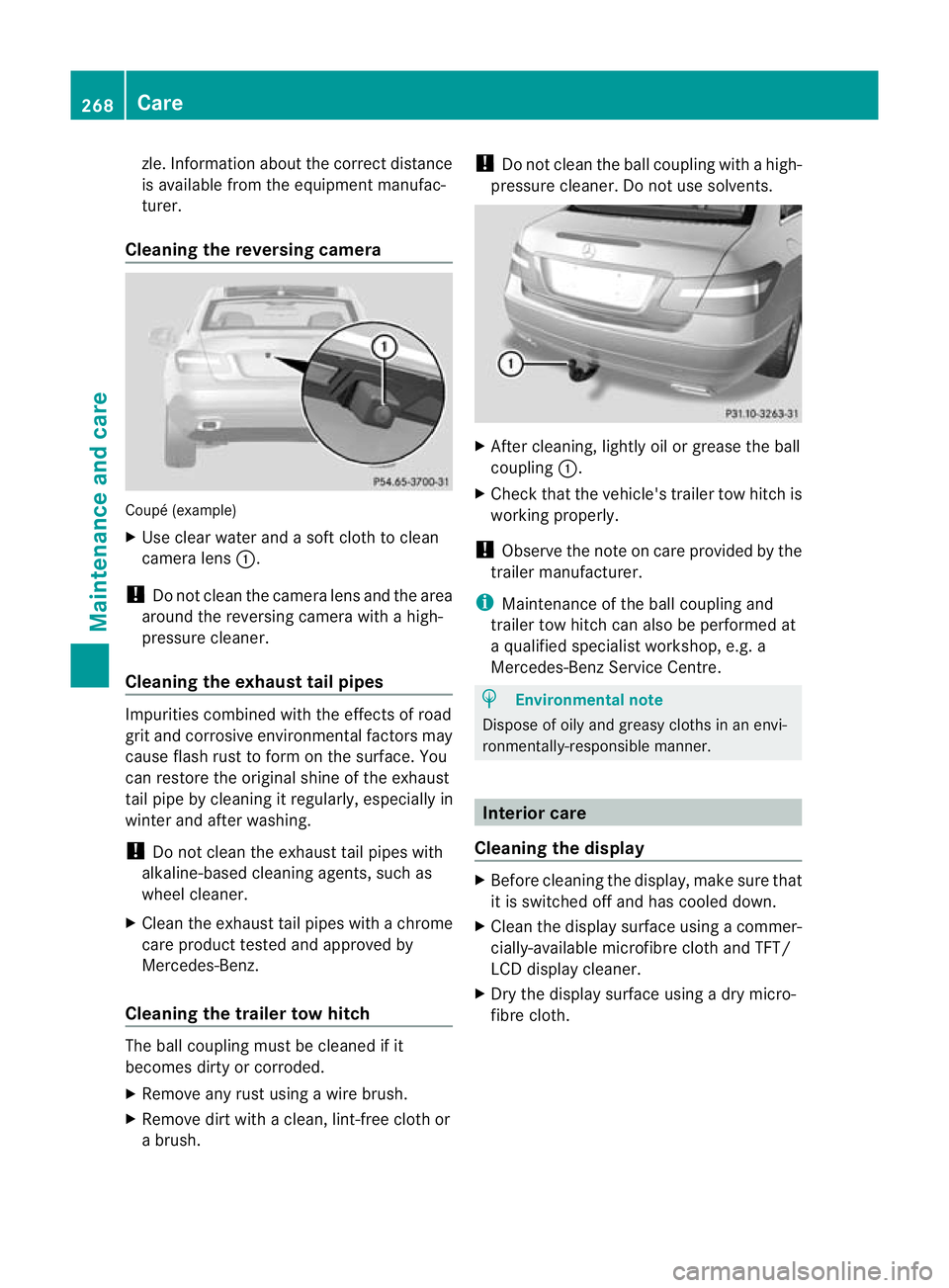
Cleaning th ereversing camera Coupé (example)
X
Use clear water and asoft clot htoclean
camera lens :.
! Do not clean the camera lens and the area
around the reversing camera with ahigh-
pressure cleaner.
Cleanin gthe exhaust tail pipes Impuritie
scombined with the effect sofroad
grit and corrosiv eenvironmental factors may
cause flash rust to form on the surface. You
can restore the original shine of the exhaust
tail pip ebycleaning it regularly, especiall yin
winter and after washing.
! Do not clean the exhaust tail pipes with
alkaline-based cleaning agents, such as
wheel cleaner.
X Clea nthe exhaust tai lpipes with achrome
car eproduct tested and approved by
Mercedes-Benz.
Cleanin gthe trailer tow hitch Th
eb all coupling must be cleaned if it
becomes dirty or corroded.
X Remove any rust using awire brush.
X Remove dirt with aclean, lint-free cloth or
ab rush. !
Do not clean th eball coupling with ahigh-
pressure cleaner. Do not use solvents. X
After cleaning, lightly oil or grease the ball
coupling :.
X Check that the vehicle' strailer to whitch is
working properly.
! Observe the note on care provided by the
trailer manufacturer.
i Maintenanc eofthe ball couplin gand
trailer tow hitch can also be performed at
aq ualified specialist workshop, e.g. a
Mercedes-Ben zService Centre. H
Environmenta
lnote
Dispose of oily and greasy cloths in an envi-
ronmentally-responsible manner. Interior care
Cleanin gthe display X
Before cleaning th edisplay, make sure that
it is switched off and has cooled down.
X Clean the displa ysurface using acommer-
cially-available microfibr ecloth and TFT/
LCD displa ycleaner.
X Dry the displa ysurface using adry micro-
fibre cloth. 268
CareMaintenance an
dcare
BA 207 ECE ÄJ 2010/1a; 1; 2, en-GB
mkalafa Version: 3.0.2.11 2010-01-26T13:03:22+01:00-Seite 268
Page 294 of 333
Befor
etowing away ,make sur ethat the steer-
ing can be mov edand is not locked.
If yo utow or tow- start another vehicle, its
weigh tmustn ot excee dthe maximum per-
missible gross vehicle weigh tofyour vehicle. G
Risk of accident
The vehicle is braked when the HOL Dfunction
or DISTRONIC PLUS is activated. Therefore,
deactivate HOLD and DISTRONIC PLUS if the
vehicle is to be towed.
It is better to have the vehicle transported
than to have it towed.
! Whe ntowing, pull away slowly and
smoothly. If the tractive power is too high,
the vehicles coul dbedamaged.
! Do not use the towing eye for recovery,
as this could damage the vehicle. If in
doubt, recover the vehicle with acrane.
! Youm ay tow the vehicle for amaximum
of 50 km. Atowing speed of 50 km /h must
no tbee xceeded.
For towing distances over 50 km, the entire
vehicl emust be lifted up and transported.
! On vehicles with KEYLESS-GO, use the
key instead of the Start/Stop button .Turn
the key to position 2in the ignition lock and
shif tthe automatic transmission to N.
Then, turn the key back to 0and leave it in
the ignitio nlock.
! Only secur ethe tow cable or towing bar
to the towing eyes. You could otherwise
damage the vehicle.
Please note:
R vehicles with an automatic transmission
must not be tow-started.
R if you ar etowing the vehicle over alonger
distance, this must be done with the rear
axle raised.
R the ignition must be switched off if you are
towin gthe vehicle with the rea raxle raised. Intervention by ESP
®
could otherwis edam-
age the brake system.
R if the vehicle has suffered transmission
damage, only tow it with the propelle rshaft
disconnected.
R if the engin edoes not start, tr yjump-start-
ing it (Y page 289).
R if it is not possible to jump-start the vehicle,
have it towed to the nearest qualified spe-
cialist workshop, e.g. aMercedes-Benz
Servic eCentre.
R the automatic transmission must be in
position Nwhen the vehicle is being towed.
Before towing the vehicle, mak esure that the
battery is connected and charged. You will
otherwis ebeunable to switch on the ignition
or shift the transmissio ntoNin vehicles with
an automatic transmission.
i Switch off the automatic locking feature
before the vehicle is towed (Y page 208).
You could otherwise be locked out when
pushing or towing the vehicle. Fitting the towing eye
Vehicles with atrailer to whitch: if you intend
to use the vehicle for towing, fold out the ball
coupling and connect the towbar to it
(Y page 186).
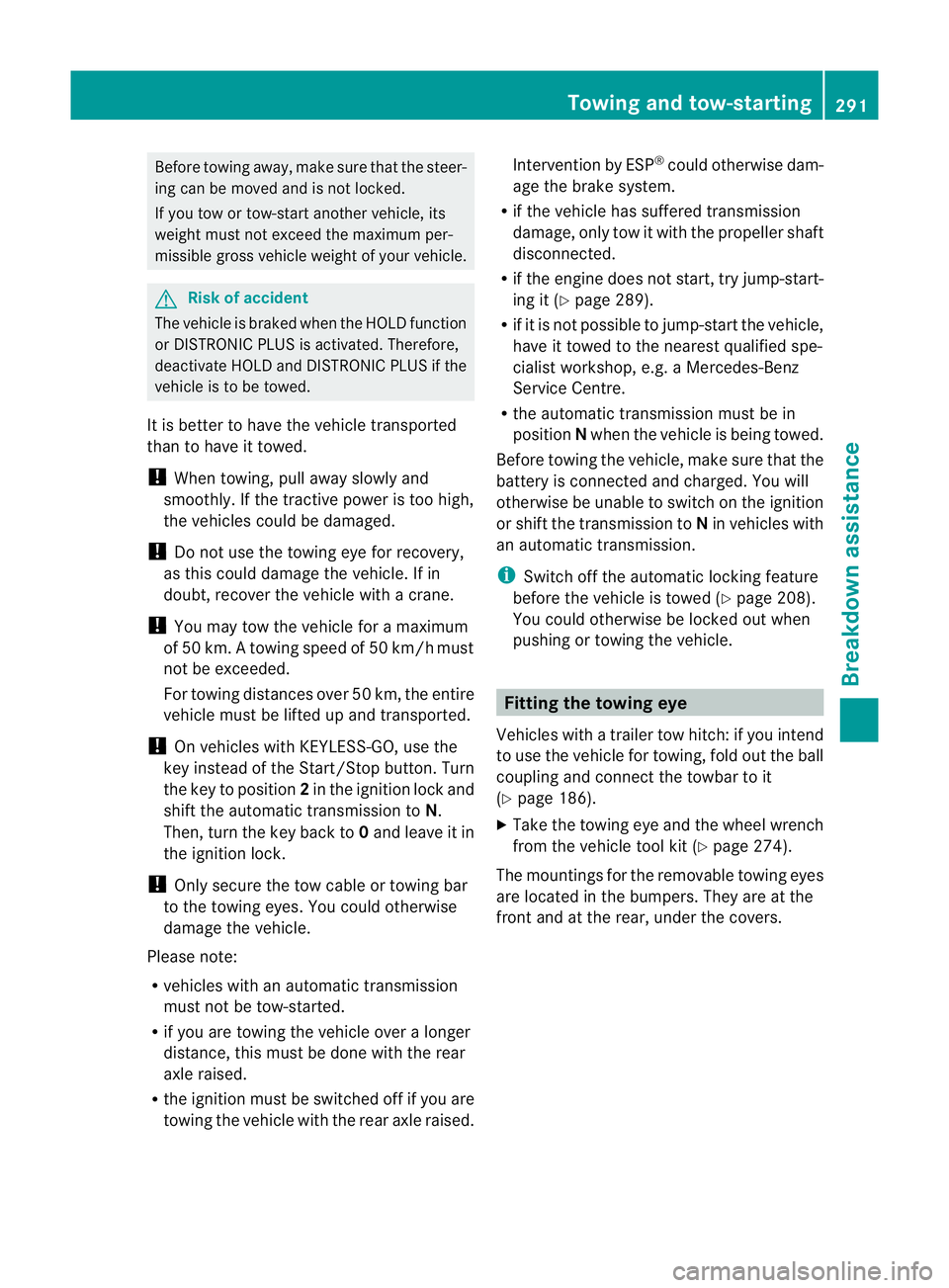
X Take the towing eye and the wheel wrench
from the vehicle tool kit (Y page 274).
The mountings for the removable towing eyes
are located in the bumpers. They are at the
front and at the rear ,under the covers. Towing and tow-starting
291Breakdown assistance
BA 207 ECE ÄJ 2010/1a;1;2,e n-GB
mkalafa Version: 3.0.2.11 2010-01-26T13:03:22+01:00-Seite 291 Z
Page 295 of 333
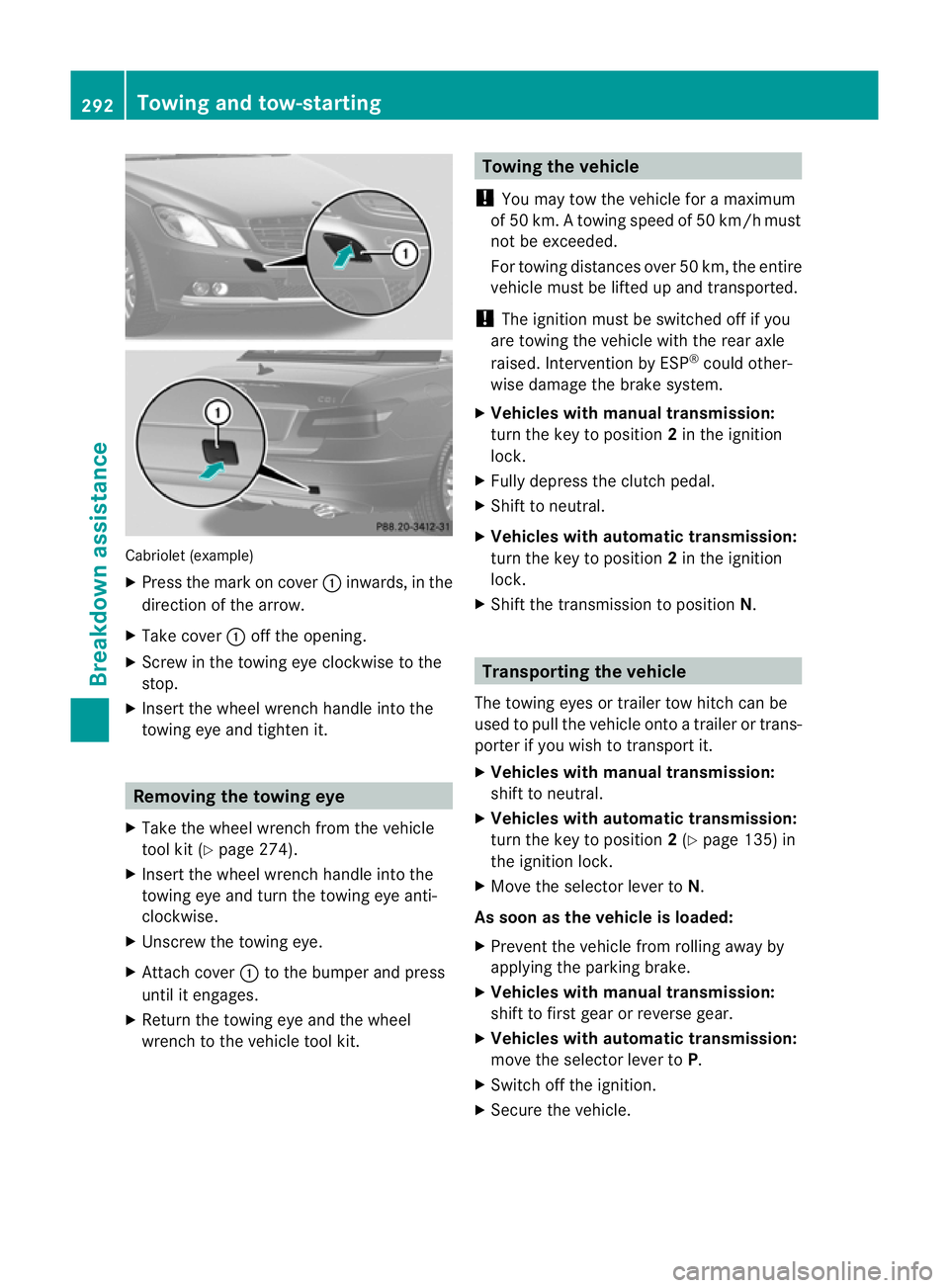
Cabriolet (example)
X
Press the mark on cover :inwards, in the
direction of the arrow.
X Take cover :off the opening.
X Screw in the towing eye clockwise to the
stop.
X Insert the wheel wrench handle into the
towin geye and tighte nit. Removing the towing eye
X Take the whee lwrenc hfrom th evehicle
tool kit (Y page 274).
X Insert the wheel wrench handle into the
towing eye and tur nthe towing eye anti-
clockwise.
X Unscrew the towing eye.
X Attach cover :to the bumper and press
until it engages.
X Return the towing eye and the wheel
wrenc htothe vehicle tool kit. Towing th
evehicle
! You may tow the vehicle for amaximum
of 50 km. Atowing speed of 50 km/h must
not be exceeded.
For towin gdistances over 50 km, the entire
vehicle must be lifted up and transported.
! The ignition must be switched off if you
are towing the vehicle with the rear axle
raised. Interven tion by ESP ®
coul dother-
wise damage the brake system.
X Vehicles with manua ltransmission:
turn the key to position 2in the ignition
lock.
X Fully depress the clutch pedal.
X Shift to neutral.
X Vehicles with automatic transmission:
turn the key to position 2in the ignition
lock.
X Shift the transmission to position N. Transporting the vehicle
The towing eyes or trailer tow hitch can be
used to pull the vehicle onto atrailer or trans-
porter if yo uwish to transport it.
X Vehicles with manu altransmission:
shift to neutral.
X Vehicles with automatic transmission:
turn the key to position 2(Y page 135) in
the ignition lock.
X Move the selector lever to N.
As soon as the vehicl eisloaded:
X Prevent the vehicle from rolling away by
applying the parking brake.
X Vehicles with manua ltransmission:
shift to first gear or reverse gear.
X Vehicles with automatic transmission:
move the selector lever to P.
X Switch off the ignition.
X Secure the vehicle. 292
Towing and tow-startingBreakdown assistance
BA 207 ECE ÄJ 2010
/1a;1;2,e n-GB
mkalafa Version: 3.0.2.11 2010-01-26T13:03:22+01:00-Seite 292
Page 303 of 333
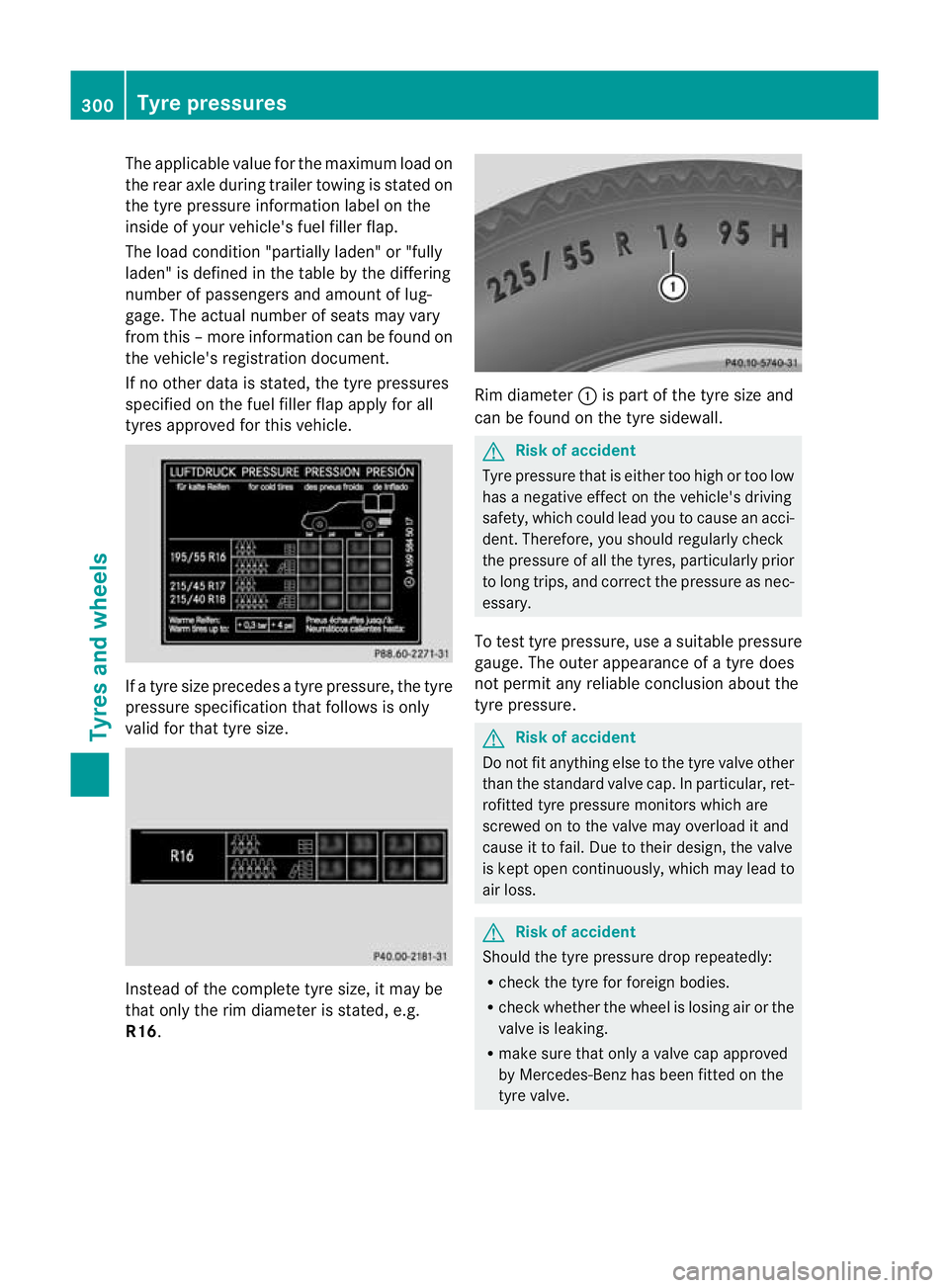
The applicable value for the maximum load on
the rea raxle during trailer towing is state don
the tyre pressure information label on the
insid eofy our vehicle' sfuel filler flap.
The load condition "partially laden" or "fully
laden" is defined in the table by the differing
number of passengers and amount of lug-
gage. The actual number of seats may vary
from this –more information can be found on
the vehicle' sregistra tion document.
If no other data is stated, the tyr epressures
specifie donthe fuel filler fla papply for all
tyres approved for this vehicle. If
at yre size precede satyre pressure, the tyre
pressure specification that follows is only
valid for that tyre size. Instead of the complete tyre size, it may be
that only the rim diameter is stated ,e.g.
R16. Rim diameter
:is part of the tyre size and
can be found on the tyre sidewall. G
Risk of accident
Tyre pressure that is either too hig hortoo low
has anegativ eeffect on the vehicle's driving
safety ,which coul dlead you to cause an acci-
dent. Therefore, you should regularly check
the pressur eofall the tyres, particularly prior
to long trips, and correc tthe pressure as nec-
essary.
To test tyr epressure, us easuitable pressure
gauge. The outer appearance of atyre does
not permit any reliabl econclusion about the
tyr ep ressure. G
Ris
kofa ccident
Do not fit anything else to the tyre valve other
than the standard valve cap. In particular, ret-
rofitted tyre pressure monitors which are
screwed on to the valve may overload it and
cause it to fail. Due to their design, the valve
is kept open continuously ,which ma ylead to
air loss. G
Risk of accident
Should the tyr epressure dro prepeatedly:
R check the tyr efor foreign bodies.
R chec kwhether the wheel is losing air or the
valve is leaking.
R make sur ethat only avalve cap approved
by Mercedes-Benz has been fitte donthe
tyre valve. 300
Tyre pressuresTyres and wheels
BA 20
7ECE ÄJ 2010/1a; 1; 2, en-GB
mkalafa Version: 3.0.2.11 2010-01-26T13:03:22+01:00-Seite 300
Page 304 of 333
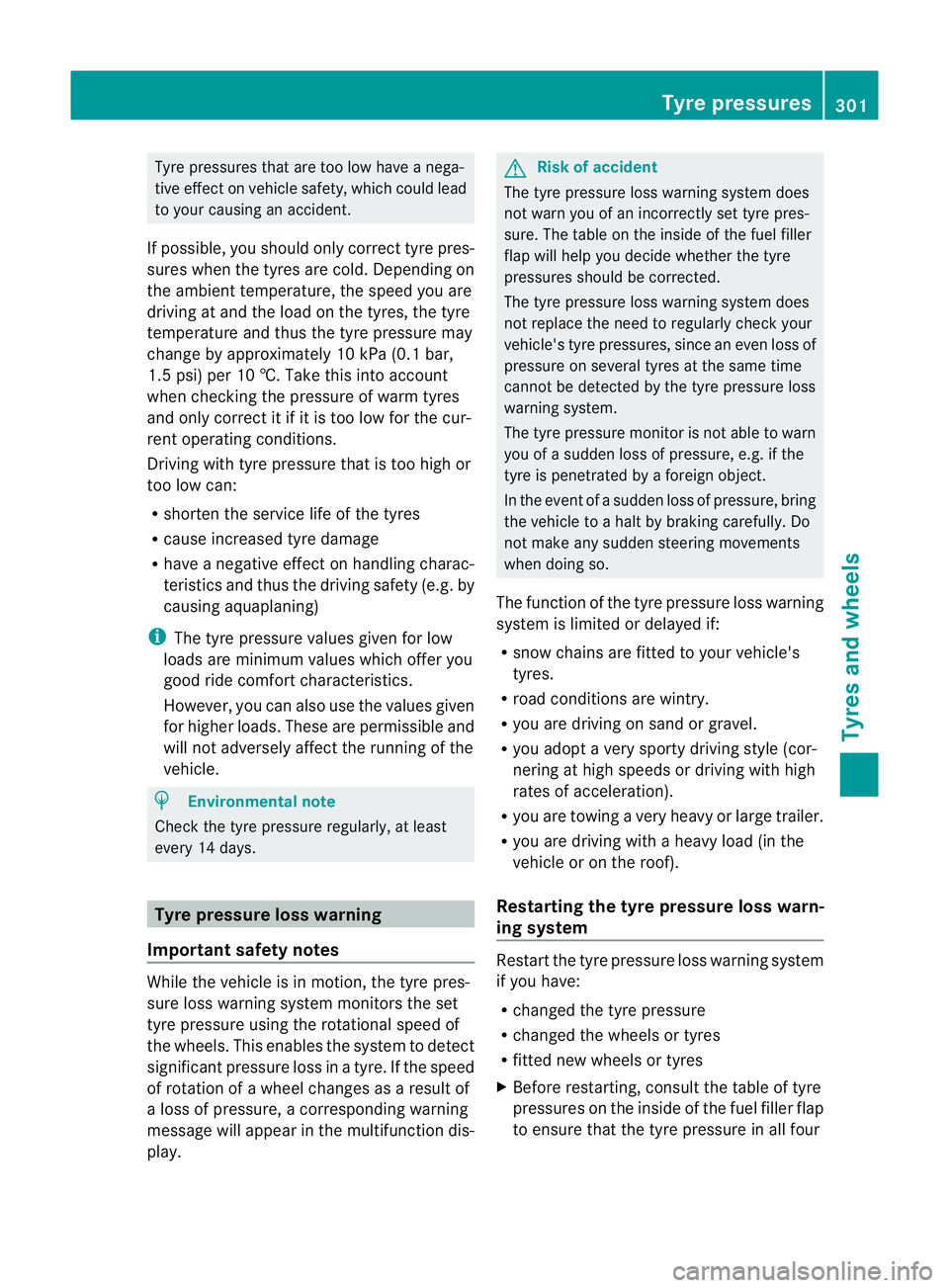
Tyr
ep ressures that are too lo whave anega-
tiv ee ffect on vehicl esafety, which could lead
to your causing an accident.
If possible, you should only correc ttyre pres-
sures when the tyres are cold. Depending on
the ambien ttemperature, the speed you are
driving at and the load on the tyres, the tyre
temperatur eand thus the tyre pressure may
chang ebyapproximately 10 kPa (0. 1bar,
1.5 psi) per 10 †. Take this int oaccount
whe ncheckin gthe pressur eofwarm tyres
and only correct it if it is too low for the cur-
rent operating conditions.
Driving with tyre pressure that is too high or
too low can:
R shorten the servic elife of the tyres
R cause increased tyre damage
R have anegativ eeffect on handling charac-
teristi csand thus the driving safet y(e.g. by
causing aquapla ning)
i The tyr epressure values given for low
load sare minimum values which offe ryou
good rid ecomfor tcharacteristics.
However ,you can also use the values given
for higher loads. These ar epermissible and
will not adversely affect the running of the
vehicle. H
Environmenta
lnote
Check the tyre pressure regularly, at least
every 14 days. Tyr
epressure loss warning
Important safety notes Whil
ethe vehicle is in motion, the tyr epres-
sure loss warning system monitors th eset
tyr ep ressure using th erotational speed of
the wheels. This enables the system to detect
significant pressure loss in atyre. If the speed
of rotation of awheel changes as aresult of
al oss of pressure, acorrespondin gwarning
message will appea rinthe multifunction dis-
play. G
Risk of accident
The tyr epressure loss warning system does
not warn you of an incorrectly se ttyre pres-
sure. The table on the insid eofthe fuel filler
fla pw ill help you decide whether the tyre
pressures should be corrected.
The tyre pressure loss warnin gsystem does
not replace the need to regularly check your
vehicle's tyre pressures, since an even loss of
pressure on several tyres at the same time
cannot be detecte dbythe tyr epressure loss
warning system.
Th et yre pressure monitor is not able to warn
you of asudden loss of pressure, e.g. if the
tyre is penetrated by aforeign objec t.
In the event of asudden loss of pressure, bring
the vehicle to ahalt by braking carefully. Do
not make any sudden steering movements
when doing so.
The function of the tyre pressure loss warning
system is limited or delayed if:
R snow chains are fitted to your vehicle's
tyres.
R road conditions are wintry.
R you are driving on sand or gravel.
R you adopt avery sporty driving style (cor-
nering at high speeds or driving with high
rates of acceleration).
R you are towin gavery heavy or large trailer.
R you are driving with aheavy load (in the
vehicle or on the roof).
Resta rting the ty re pressur eloss warn-
ing system Restart the tyre pressure loss warnin
gsystem
if you have:
R changed the tyre pressure
R changed the wheels or tyres
R fitted new wheels or tyres
X Before restarting, consult the table of tyre
pressures on the insid eofthe fuel filler flap
to ensur ethat the tyr epressure in all four Tyre pressures
301Tyres andwheels
BA 207 ECE ÄJ 2010/1a; 1; 2, en-GB
mkalafa Version: 3.0.2.11 2010-01-26T13:03:22+01:00-Seite 301 Z
Page 312 of 333

Vehicl
eequipment ............................ 310
Notes on the technical data .............310
Genuine Mercedes-Benz parts .........310
Vehicle electronics ...........................310
Vehicle identification pla tes............ 312
Service products and capacities .....313
Vehicle da ta...................................... 317
Boot lid opening dimensions ...........322
Trailer tow hitch ................................ 322
24-GHz radar sensor system (coun-
tr yo verview) ..................................... 324 309Technical data
BA 20
7ECE ÄJ 2010/1a; 1; 2, en-GB
mkalafa Version:3.0.2.11
2010-01-26T13:03:22+01:0
0-Seite 309
Page 317 of 333

Switch off the engine before refuelling.
G
Ris
kofi njury
Do not come into contac twithf uels.
It is hazardou stoyourh ealth if your skin
com esinto direct contact with fuels or you
breathe in fuel vapo urs.
Tank capacity Total capacity 66 l
Of which reserve fuel Approx-
imately 8l !
Do not us epetrol to ref uelvehicles with a
dies elengine. Do not use dies elto refuel
vehicles with apetrol engine. Nev ermix
diesel with petrol. Even small amou ntsof
the wron gfuel result in damage to the
injection system. Damage resulting from
adding the wron gfuel is not covered by the
implied warranty.
Further information on refuelling and on fuels
(Y page 148).
Notes on fuel consump tion The vehicle will use mor
efuel than usual in
the following situations:
R at very low temperatures
R in urban traffic
R on sho rttrips
R when towing atrailer
R in mountainous terrain
i Only for certain countries: the respec tive
current consump tion and emission values
of your vehicle can be fou ndin the COC
papers (EC CERTIFICAT EOFCONFORM-
ITY). These documents ar esupplied when
the vehicle is delivered.
The consumption figures for vehicles up to
the EURO4 standard have been determined
in accordance with EU Directive 80/1 268/
EEC while figures for vehicles complying wit
hthe EURO5 standar dorhigher have
been determined in accordance with Reg-
ulation (EC) No. 715/2007 ,ineach case
based on the currently applicable version.
Deviations from these value smay occur
under norma loperating conditions.
! Do not use any special additives, as they
can cause malfunc tions and engin edam-
age. Damage resulting from the use of such
additives is not covered by the Mercedes-
Benz implied warranty. H
Environmental note
CO 2(carbon dioxide) is the gas which scien-
tists believe to be principally responsibl efor
global warmin g(the greenhouse effect). Your
vehicle's CO 2emissions are directly related to
fuel consumption and therefore depend on:
R efficient use of the fuel by the engine
R driving style
R othe rnon-technical factors, such as envi-
ronmental influences or road conditions
You can minimise your vehicle' sCO
2emis-
sions by driving carefull yand having it serv-
iced regularly. 314
Service products and capacitiesTechnical data
BA 207 ECE ÄJ 2010
/1a;1;2,e n-GB
mkalafa Version: 3.0.2.11 2010-01-26T13:03:22+01:00-Seite 314
Page 325 of 333

Vehicl
edata, E350 CD IBlueEFFI-
CIENCY Veh
icle dimensions Vehicle lengt
h(ECE) Coupé
4698 mm
Cabriolet
4698 mm
Vehicle width including exterior mirrors
Coupé
2028 mm
Cabriolet
2015 mm
Vehicle height
69 Coupé
1397 mm
Cabriolet
1402 mm
Wheelbase
Coupé
2760 mm
Cabriolet
2760 mm
Vehicle weights
Unladen weigh
t(in accor dance with EC
directive) Coupé
17
30 kg Cabriolet
184
5kg The unladen weight includes the driver
(68 kg), luggage (7 kg) and all fluids (fuel
tan k90% full) .Items of optional equipment
increase the unladen weight and reduce the
maximu mpayload. Maximu
mroof
load ,Coup éonly 10
0kg Maximum boot
load
100 kg
Vehicle-specific weight information can be
fou ndon th evehicle identification plate
(Y page 312). Boot lid opening dimensions
:
Tailgat eopening height :
Coupé
1678
–1683mm Cabriolet
1550 mm
i
The values specifie dmay differ from the
actual values, dependin gonthe tyres ,load,
optional equipmen tand the state of the
suspension. Trailer tow hitch
Installation dimensions
G
Ris
kofa ccident
Only have atrailer to whitch retrofitted at a
qualified specialist workshop whic hhas the
necessary specialist knowledge and tools to
carry out the work required. Mercedes-Benz
69 The values specifie dmay differ from the actual values ,depending on the tyres, load, optional equipment
and the state of the suspension. 322
Trailer tow hitchTechnical data
BA 20
7ECE ÄJ 2010/1a; 1; 2, en-GB
mkalafa Version: 3.0.2.11 2010-01-26T13:03:22+01:00-Seite 322
Page 326 of 333
recommend
sthat you use aMercedes-Benz
Ser vice Centre for thi spurpose. In particular,
work relevant to safety or on safety-related
systems must be carried out at aqualified
specialist workshop.
! If you have atrailer to whitchr etrofit ted,
changes to the cooling system may be nec-
essary, depending on the vehicle type.
If you have atrailer to whitchr etrofit ted,
observe the anchorage point sonthe chas-
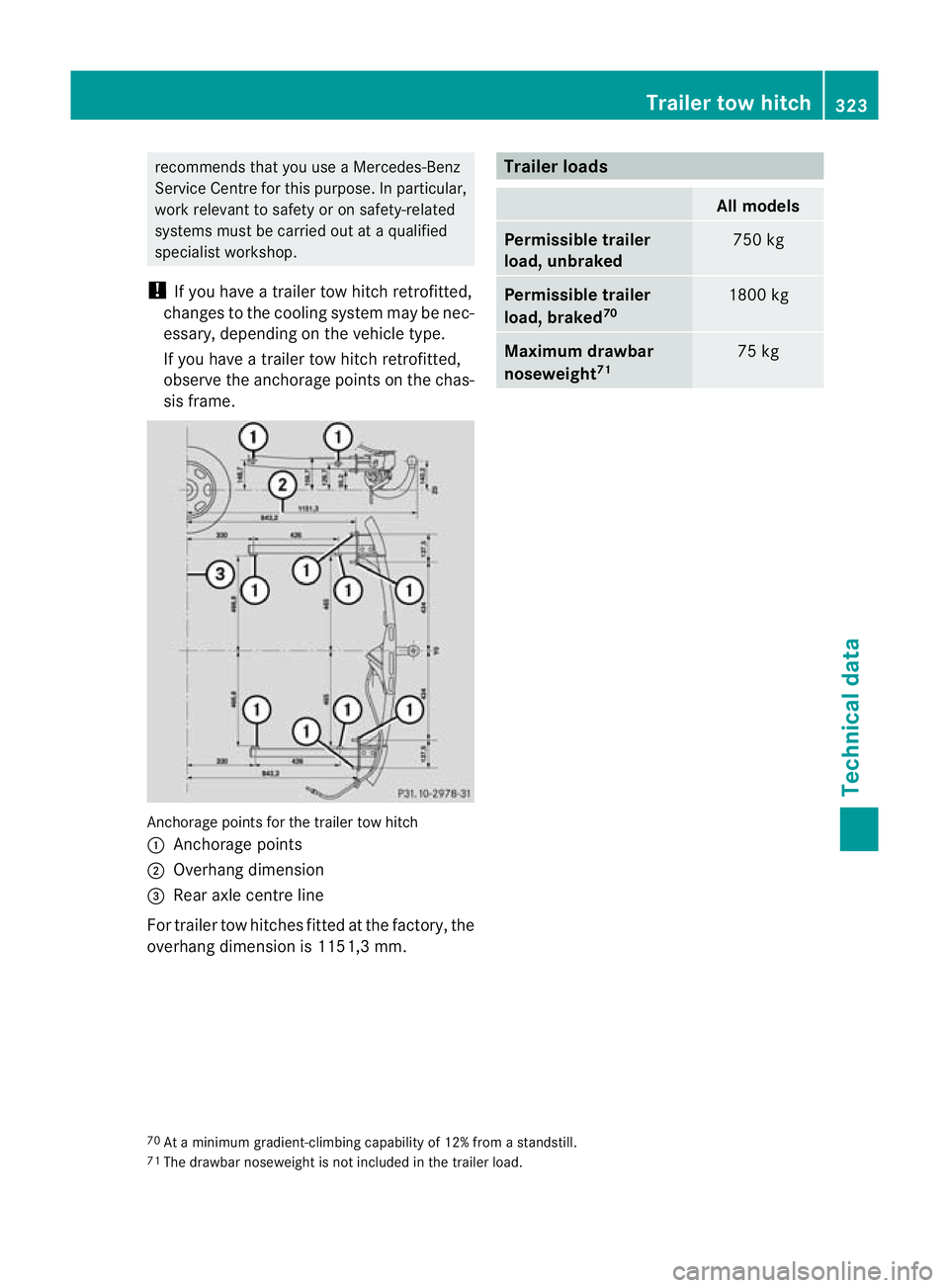
sis frame. An
chorage point sfor the trailer tow hitch
: Anchorage points
; Overhang dimension
= Rear axle centre line
For trailer tow hitches fitted at the factory ,the
overhang dimension is 1151,3 mm. Trailer loads
All models
Permissible trailer
load, unbraked
75
0kg Permissible trailer
load, braked
70 1800 kg
Maximu
mdrawbar
nose weight71 75 kg
70
At am inimum gradient-climbing capability of 12% from astandstill.
71 The drawbar noseweigh tisnot included in the trailer load. Trailer tow hitch
323Technical data
BA 207ECE ÄJ 2010 /1a;1;2,e n-GB
mkalafa Version: 3.0.2.11 2010-01-26T13:03:22+01:00-Seite 323 Z
Page 327 of 333
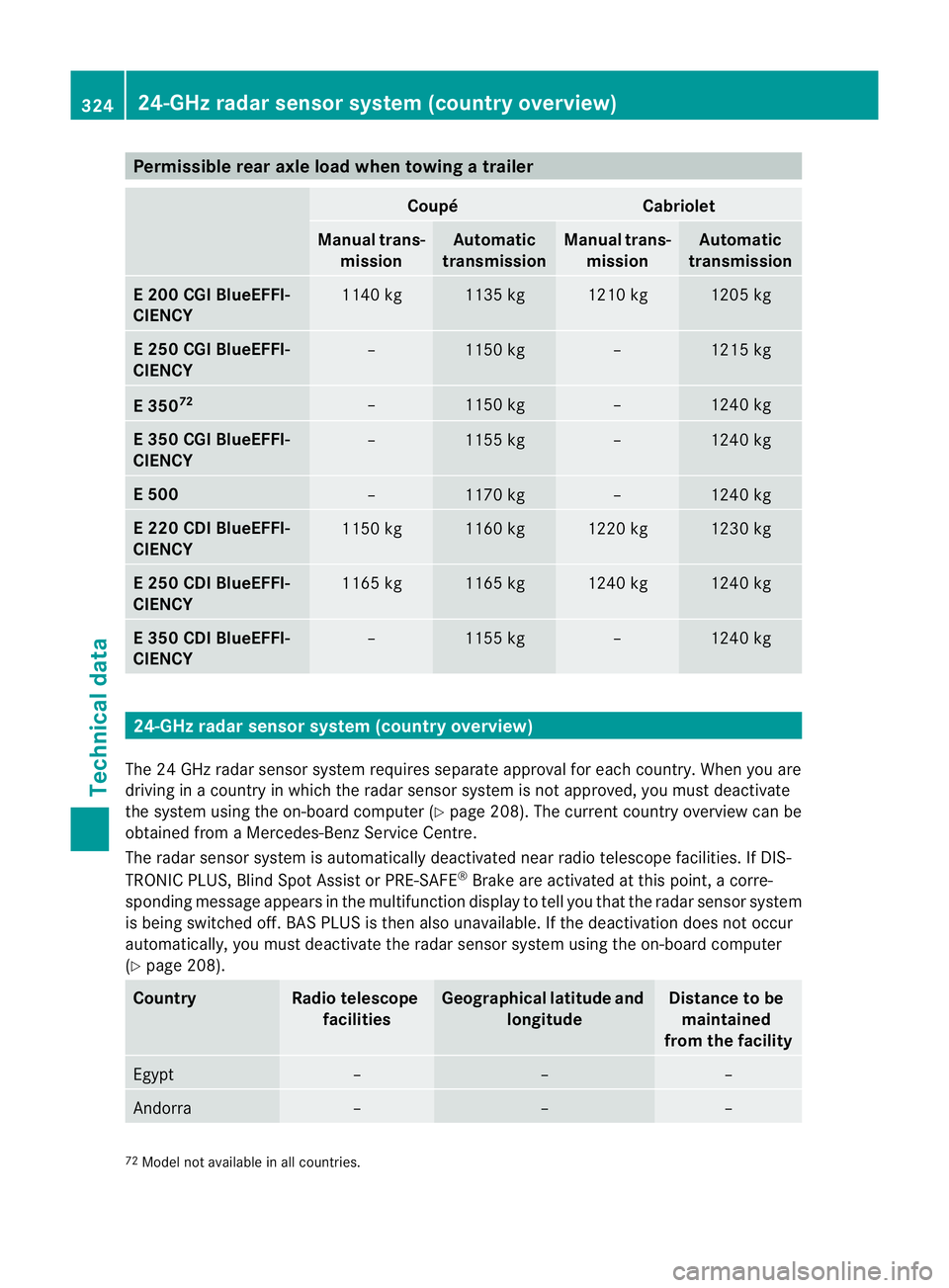
Permissible rea
raxle loa dwhen towin gatrailer Coupé Cabriolet
Manual trans-
mission Automatic
transmission Manual trans-
mission Automatic
transmission E2
00 CGI BlueEFFI-
CIENCY 114
0kg 1135 kg 1210 kg 1205 kg
E2
50 CGI BlueEFFI-
CIENCY – 115
0kg – 1215 kg
E3
5072 – 115
0kg – 1240 kg
E3
50 CGI BlueEFFI-
CIENCY – 115
5kg – 1240 kg
E5
00 – 1170 kg – 1240 kg
E2
20 CDIBlueEFFI-
CIENCY 1150 kg 1160 kg 1220 kg 1230 kg
E2
50 CDIBlueEFFI-
CIENCY 1165 kg 1165 kg 1240 kg 1240 kg
E3
50 CDIBlueEFFI-
CIENCY – 1155 kg – 1240 kg
24-GHz radar sensor syste
m(coun try overview)
Th e24G Hz radar sensor system requires separate approval for each country. Whe nyou are
dri ving in acoun tryinw hichthe ra dar sensor system is no tapproved, you must deacti vate
the syste musing the on-boar dcompu ter( Ypage 20 8).T he curren tcountry over view can be
obtain ed fromaMercedes-Benz Ser vice Centre.
Th er adar sensor sys temi sautomatically deactivated near radi otelescope facilities. If DIS-
TRONIC PLUS, Blind Spot Assist or PRE-SAFE ®
Brake are activa tedatt hisp oint, acorre-
spondin gmessage appears in th emultifunction display to tell you that th eradar sensor system
is being switche doff. BAS PLUS is then also unavailable. If the deactivation doe snot occur
automatically, you must deactivate the radar sensor system using the on-board computer
(Y page 208). Country Radio telescope
facilities Geographical latitude and
longitude Distance to be
maintained
from the facility Egypt – – –
Andorra – – –
72
Model not available in all countries. 324
24-GHz radar sensor system (country overview)Technical data
BA 207 ECE ÄJ 201
0/1a; 1; 2, en-GB
mkalafa Version: 3.0.2.11 2010-01-26T13:03:22+01:00-Seite 324