ESP MERCEDES-BENZ E-CLASS CABRIOLET 2011 Owners Manual
[x] Cancel search | Manufacturer: MERCEDES-BENZ, Model Year: 2011, Model line: E-CLASS CABRIOLET, Model: MERCEDES-BENZ E-CLASS CABRIOLET 2011Pages: 353, PDF Size: 8.42 MB
Page 323 of 353
Only winter tyres bearing the
isnowflake
symbol in addition to the M+S marking pro-
vide the best possibleg rip in wintry road con-
ditions. Only these tyres will allowd riving
safety systems such as ABS and ESP ®
to
function optimally in winter, as these tyres
have been designed specificallyf or driving on
snow.
Use M+S tyres of the same make and tread
on all wheels to maintain safe handling char-
acteristics. G
WARNING
M+S tyres with atread depth of less than
4mmm ust be replaced. They are no longer
suitable for winter use and can no longer pro-
vide sufficient grip .This could cause you to
lose control of your vehicle and cause an acci-
dent.
Always observe the maximum permissible
speed specified for the M+S tyres you have
fitted.
If you fit M+S tyres which have alower max-
imum permissible speed than that of the vehi-
cle, affix an appropriate warning sign in the
driver's field of vision. This can be obtained
at aq ualified specialist workshop, e.g. at a
Mercedes-Ben zService Centre.
Under these circumstances, you should also
restrict the maximum speed of the vehicle
using permanent SPEEDTRONIC so that it
does not exceed the maximum permissible
speed for the M+S tyres (Y page 183).
When you have fitted the M+S tyres:
X Check the tyre pressures (Y page 321).
X Restart the tyre pressure loss warning sys-
tem (Y page 322). G
WARNING
If you fit the spare wheel when driving with M
+S tyres, bear in mind that driving stability will
be impaired due to unstable corneringc har-
acteristics caused by the different tyres. You
should therefore adapt your driving style and
drive carefully. Have the spare wheel replaced at the nearest
qualified specialist workshop which has the
necessary specialist knowledge and tools to
carry out the work required. Mercedes-Benz
recommends that you use
aMercedes-Benz
Service Centr efor this purpose. In particular,
work relevant to safety or on safety-related
systems must be carried out at aqualified
specialist workshop. Snow chains
For safety reasons, Mercedes-Benz recom-
mends that you only use snow chains that
have been specially approved for your vehicle
by Mercedes-Benz ,orthat are of acorre-
spondin gstandard of quality.
If you inten dtofit snow chains, please bear
the following point sinmind:
R it is not permissible to attac hsnow chains
to all wheel-tyre combinations; see the
information under "Wheel/tyre combina-
tions" in the "Wheels and tyres" section.
R snow chains must not be fitted to emer-
genc yspare wheels, e.g. a"Minispare"
emergency spare wheel.
R fit snow chains only in pairs and only to the
rear wheels. Observe the manufacturer's
installation instructions.
! Vehicles with steel wheels: if you wish
to fit snow chains to steel wheels, make
sure that you remove the respective
wheels' hubcaps first .The hubcaps may
otherwise be damaged.
Do not exceed the maximum permissible
speed of 50 km/h.
i You may wish to deactivate ESP ®
(Y page 64) when pulling away with snow
chains fitted. This way you can allow the
wheels to spin in acontrolled manner, ach-
ieving an increased driving force (cutting
action). 320
Winter operationWheels and tyres
Page 325 of 353
is kept open continuously, which may lead to
air loss. G
WARNING
Should the tyre pressure drop repeatedly:
R chec kthe tyre for foreign bodies.
R check whether the wheel is losing air or the
valve is leaking.
R make sure that only avalve cap approved
by Mercedes-Ben zisfitted on the tyre
valve.
Tyre pressures that are too low have anega-
tive effect on vehicle safety, which could lead
you to cause an accident.
If possible, only correct tyre pressures when
the tyres are cold. The tyres are cold when
the vehicle has been parked for at least three
hours or has been driven less than 1.5 km.
Depending on the ambient temperature, the
speed you are driving at and the load on the
tyres, the tyre temperature and thus the tyre
pressure may change by approximately
10 kPa (0.1 bar/1.5 psi) per 10 †. Take this
into account when checking the pressure of
warm tyres and only correct it if it is too low
for the current operating conditions.
Driving with tyre pressure that is too high or
too low can:
R shorten the service life of the tyres
R cause increased tyre damage
R have anegative effect on handling charac-
teristics and thus the driving safety (e.g. by
causing aquaplaning)
i The tyre pressure values given for low
loads are minimum values which offer you
good ride comfort characteristics.
However, you can also use the values given
for higher loads. These are permissible and
will not adversely affect the running of the
vehicle. H
Environmental note
Check the tyre pressure regularly,atl east
every 14 days. Tyrep
ressur eloss warning system
Important safety notes While the vehicle is in motion, the tyre pres-
sure loss warning system monitors the set
tyre pressure using the rotational speed of
the wheels. This enables the system to detect
significant pressure loss in
atyre. If the speed
of rotation of awheel changes as aresult of
al oss of pressure, acorresponding warning
message will appearint he multifunction dis-
play. G
WARNING
The tyre pressure loss warning system does
not warn you of an incorrectly set tyre pres-
sure. The table on the inside of the fuel filler
flap will help you decide whether the tyre
pressures should be corrected.
The tyre pressure loss warning system does
not replace the need to regularly check your
vehicle's tyre pressures, since an even loss of
pressure on several tyres at the same time
cannot be detected by the tyre pressure loss
warning system.
The tyre pressure monitor is not able to warn
you of asudden loss of pressure, e.g. if the
tyre is penetrated by aforeign object.
In the event of asudden loss of pressure, bring
the vehicle to ahalt by braking carefully. Do
not make any sudden steering movements
when doing so.
The function of the tyre pressure loss warning
system is limited or delayed if:
R snow chains are fitted to your vehicle's
tyres.
R road conditionsa re wintry.
R you are driving on sand or gravel.
R you adopt avery sporty driving style (cor-
nering at high speeds or driving with high
rates of acceleration).
R you are towing avery heavy or large trailer.
R you are driving with aheavy load (in the
vehicle or on the roof). 322
Tyrep
ressureWheels and tyres
Page 326 of 353
Restarting the tyre pressure loss warn-
in gs ystem Restar
tthe tyre pressure loss warning system
if you have:
R changed the tyre pressure
R changed the wheels or tyres
R fitted new wheels or tyres
X Before restarting, consult the table of tyre
pressures on the inside of the fuel filler flap
to ensure that the tyre pressure in all four
tyres is set correctly for the respective
operating conditions.
X Observe the notes in the section on tyre
pressures (Y page 321). G
WARNING
The tyre pressure loss warning system can
only give reliablew arnings if you have set the
correct tyre pressure.
If an incorrectt yre pressure is set, these
incorrectv alues will be monitored.
At yre wit hinsufficien tpressure results in
vehicl einstability when driving, thus increas-
ing the risk of an accident.
X Make sure that the key is in position 2
(Y page1 47) in the ignitio nlock.
X Press =or; on the steering wheel
to select the Service menu.
X Press 9or: to select Tyre pres‐ sure .
X Press the abutton.
The Run Flat Indicato ractive Restart possible with OK message
appears in the multifunction display. If you wishtoc
onfirm the restart:
X Press the abutton.
The Tyre pressure now OK? message
appears in the multifunction display.
X Press the 9or: button to select
Yes .
X Press the abutton.
The Run Flat Indicato rrestarted message appears in the multifunction dis-
play.
After
ateach-in period, the tyre pressure
loss warning system willm onitor the set
tyre pressures of all four tyres.
If you wishtoc ancel the restart:
X Press the %button.
or
X If the Tyre press. now OK? message
appears, press 9or: to select
Cancel .
X Press the abutton.
The tyre pressure values stored at the last
restart willc ontinue to be monitored. Changing
awheel Flat tyre
The "Breakdown assistance" section
(Y pag e296) contains information and notes
on how to dea lwith aflatt yre. It also provides
instruction sonchangin gaw heelorf itting the
spar ewhee lore mergency spar ewheel. Interchangin
gthe wheels G
WARNING
Interchange th efront and rea rwheels only if
they hav ethe sam edimensions ,for example
size, offset, etc.
After every whee linterchange/change, have
the tightening torque checked at aquali fied
specialist worksho pthath as th enecessary
specialist knowledg eand tools to carry out Changing
awheel
323Wheels and tyres
Z
Page 333 of 353
Useful information
i This Owner's Manual describes all models
and all standard and optional equipment
available to your vehicle at the time of pub-
lication of the Owner's Manual. Country-
specific deviation sare possible. Please
not ethat your vehicle may not be equipped
with all feature sdescribed. This also
applies to safety-relevan tsystems and
functions.
i Pleas ereadt he information on qualified
specialist workshop s(Ypage 22). Note
sont hetechnical data
i The technical dat awas determined in
accordance wit hECDirectives .Alldata
applies to th evehicle's standard equip-
ment. Therefore, th edatam ay differ for
vehicles wit hoptional equipment. You can
obtain further information from a
Mercedes-Ben zServi ce Centre.
You can fin dtechnic al dataonthe Internet at:
http://www.mercedes-benz.com Genuin
eMercedes-Ben zparts
Mercedes-Ben ztests genuine parts and con-
version parts and accessories which have
been specifically approved for your vehicle for
their reliability, safety and suitability. Despite
ongoin gmarket research ,Mercedes-Benz is
unable to evaluate other parts. Mercedes-
Benzt herefore accepts no responsibility for
the use of such parts in Mercedes-Ben zvehi-
cles, even if they have been independently or
officially approved.
In Germany and some other countries, certain
parts are only officially approved for installa-
tion or modification if they comply with legal
requirements. All genuine Mercedes-Benz
parts meet this requirement .The use of non- approved parts may invalidate the vehicle's
general operating permit. This is the case if:
R
they cause achange of the vehicle type
from that for which the vehicle's general
operating permit was granted.
R other road users could be endangered.
R the emission or noise levels are adversely
affected. G
WARNING
Driving safety may be impaired if non-
approved parts, tyres and wheels or safety-
relevant accessories are used.
This could lead to malfunctions in safety-rel-
evant systems, e.g. the brake system. This
could cause you to lose control of your vehicle
and cause an accident.
For this reason, Mercedes-Ben zrecommends
that you use genuine Mercedes-Benz parts or
parts of equal quality. Only use tyres, wheels
and accessories that have been specifically
approved for your vehicle.
! Airbags and seat belt tensioners, as well
as control units and sensor sfor these
restraint systems may be installed in the
following areas of your vehicle:
R doors
R door pillars
R door sills
R seats
R dashboard
R instrument cluster
R centre console
Do not install accessories such as audio
systems in these areas. Do not carry out
repairs or welding. You could impair the
operatin gefficiency of the restraint sys-
tems.
Have aftermarket accessories installed at
aq ualified specialist workshop. Mercedes-
Benz recommends that you use a
Mercedes-Benz Service Centr efor this pur-
pose. 330
Genuine Mercedes-Benz partsTechnical data
Page 335 of 353
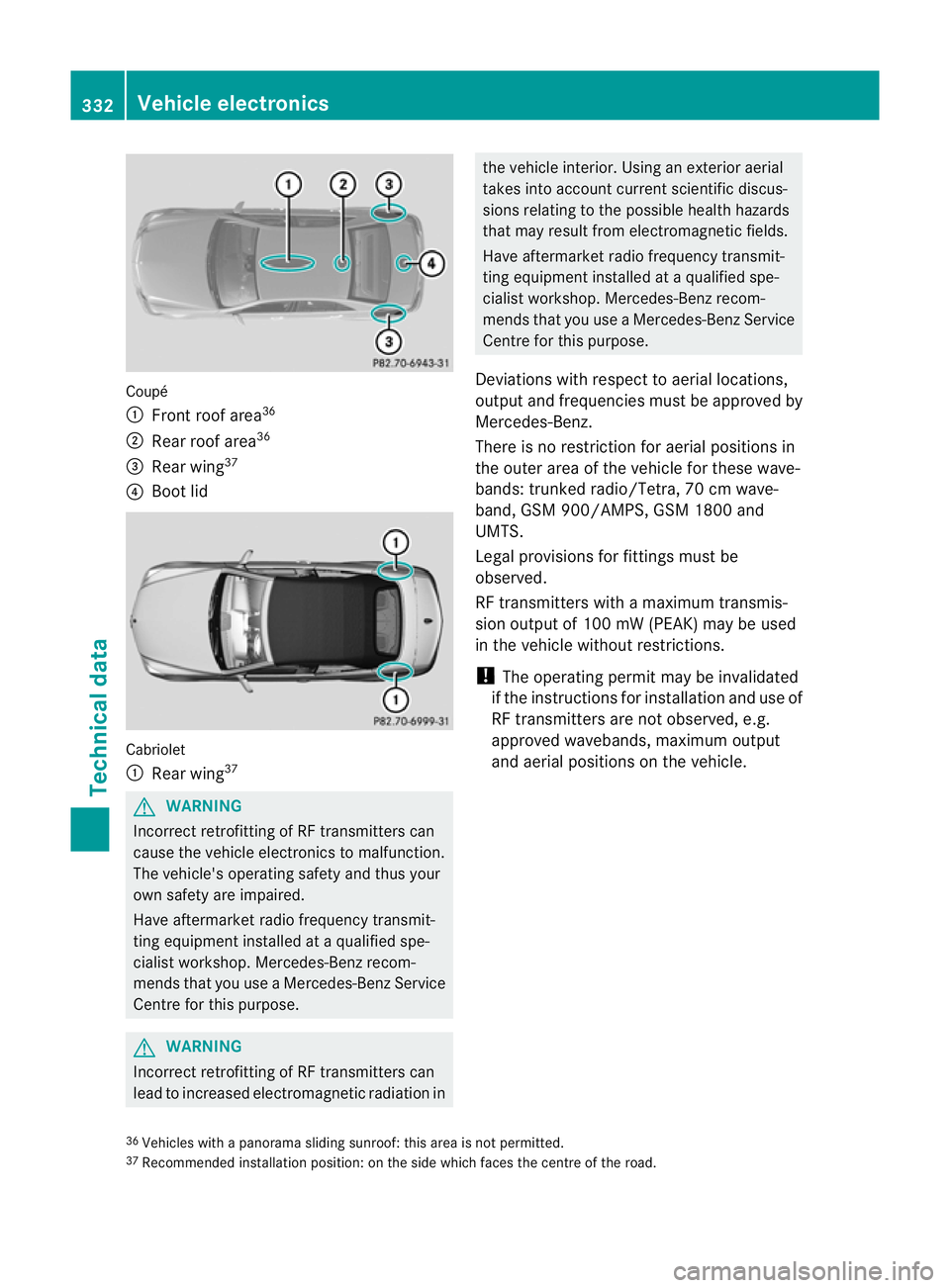
Coupé
:
Fron troo fa rea 36
; Rear roo farea 36
= Rearw ing37
? Boot lid Cabriolet
:
Rear wing 37 G
WARNING
Incorrec tretrofitting of RF transmitters can
cause the vehicle electronics to malfunction.
The vehicle's operating safet yand thus your
own safet yare impaired.
Have aftermarket radio frequenc ytransmit-
tin ge quipmen tinstalled at aquali fied spe-
cialist workshop .Mercedes-Benz recom-
mends that you use aMercedes-Benz Service
Centr efor this purpose. G
WARNING
Incorrec tretrofitting of RF transmitters can
lead to increased electromagnetic radiation in the vehicle interior. Using an exterior aerial
takes into account curren
tscientific discus-
sions relating to the possible health hazards
that may result from electromagnetic fields.
Have aftermarket radio frequenc ytransmit-
ting equipment installed at aqualified spe-
cialist workshop. Mercedes-Benz recom-
mends that you use aMercedes-Benz Service
Centr efor this purpose.
Deviations with respect to aerial locations,
output and frequencies must be approved by
Mercedes-Benz.
There is no restriction for aerial position sin
the outer area of the vehicle for these wave-
bands: trunked radio/Tetra, 70 cm wave-
band, GSM 900/AMPS, GSM 1800a nd
UMTS.
Legal provision sfor fittings must be
observed.
RF transmitters with amaximum transmis-
sion output of 100 mW (PEAK) may be used
in the vehicle without restrictions.
! The operatin gpermit may be invalidated
if the instructions for installation and use of
RF transmitters are not observed, e.g.
approved wavebands, maximum output
and aerial position sonthe vehicle.
36 Vehicles with apanorama sliding sunroof :this area is not permitted.
37 Recommended installation position: on the side which faces the centre of the road. 332
Vehicle electronicsTechnical data
Page 336 of 353
Vehicl
eidentificatio nplates Vehicl
eidentificatio nplate with vehi-
cl ei dentificatio nnumber (VIN) and
pain tcode number X
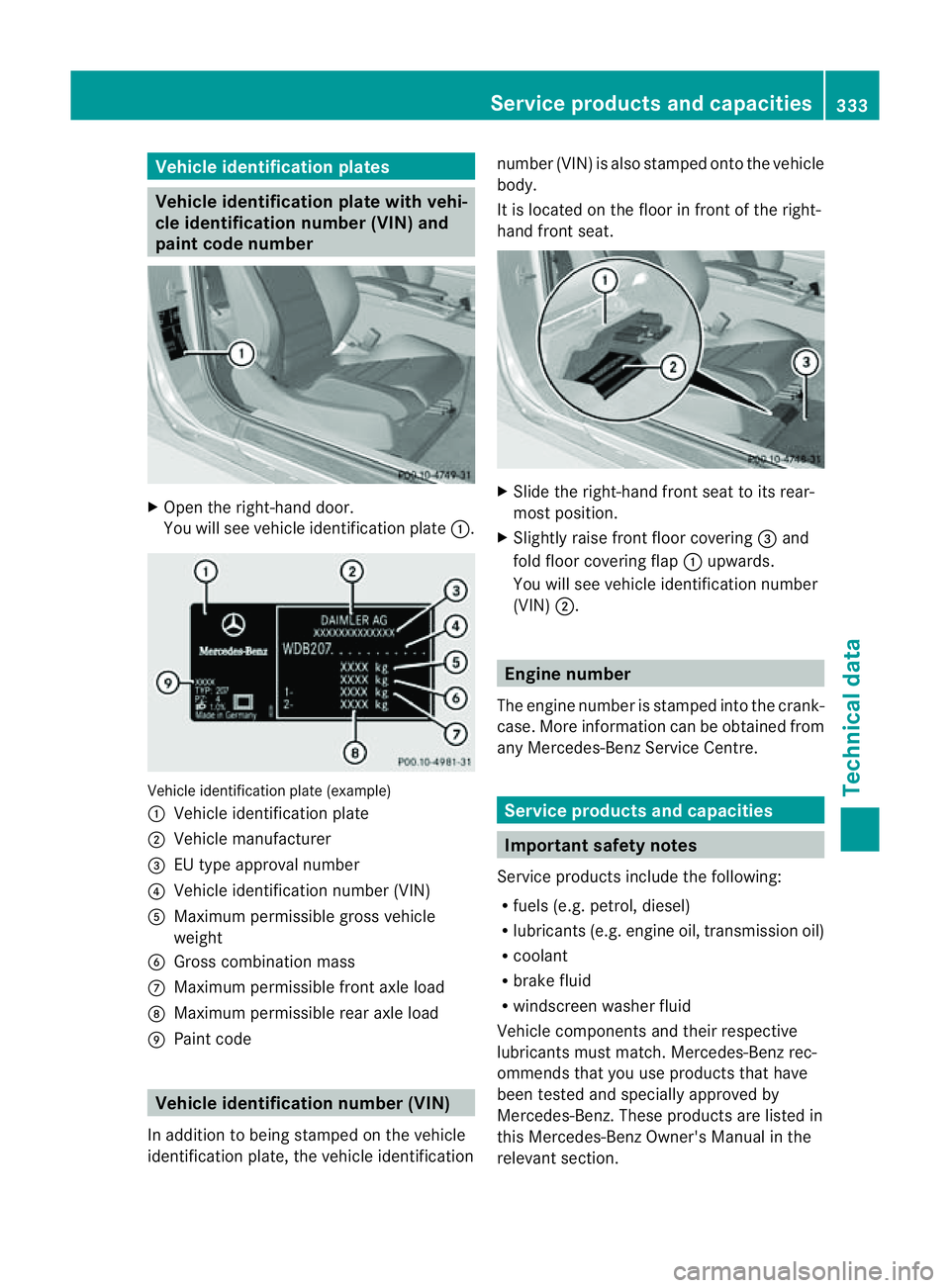
Open th eright-han ddoor.
You will see vehicle identification plate :.Vehicle identification plat
e(example)
: Vehicle identification plate
; Vehicle manufacturer
= EU type approval number
? Vehicle identification number (VIN)
A Maximum permissible gross vehicle
weight
B Gros scombinatio nmass
C Maximum permissible fron taxle load
D Maximu mpermissible rear axle load
E Paint code Vehicle identification number (VIN)
In addition to being stamped on the vehicle
identification plate, the vehicle identification number (VIN) is also stamped ontot
he vehicle
body.
It is located on the floor in fron tofthe right-
hand fron tseat. X
Slide the right-hand fron tseat to its rear-
most position.
X Slightly raise fron tfloor covering =and
fold floor coverin gflap :upwards.
You will see vehicle identification number
(VIN) ;. Engine number
The engine number is stamped int othe crank-
case. More information can be obtained from
any Mercedes-Ben zServic eCentre. Service products and capacities
Important safety notes
Servic eproducts include the following:
R fuels (e.g .petrol, diesel)
R lubricant s(e.g. engin eoil, transmission oil)
R coolant
R brake fluid
R windscreen washer fluid
Vehicle componentsa nd their respective
lubricant smust match. Mercedes-Benzr ec-
ommends that you use product sthat have
been tested and specially approved by
Mercedes-Benz.T hese productsare listed in
this Mercedes-BenzO wner's Manual in the
relevant section. Service products and capacities
333Technical data Z
Page 337 of 353
You can recognise service products approved
by Mercedes-Ben zbythefollowing inscrip-
tion on th econtaine rs:
R MB-Freigabe (e.g. MB-Freigabe 229.51)
R MB Approval (e.g. MB Approval 229.51)
Other designation sorrecommendation sthat
relat etoal evel of qualit yoras pecification in
accordance wit hanMBSheet number (such
as MB 229.5) hav enot necessarily been
approved by Mercedes-Benz.
You can obtain further information from any
Mercedes-Benz Servic eCentre. G
WARNING
When handling, storin gand disposing of any
service products, please observe the relevant
regulations, as you could otherwise endanger
yourself and others.
Keep service products away from children.
To protect your health, do not allow service
products to come into contact with your eyes
or open wounds. See adoctor immediately if
any service product is swallowed. H
Environmental note
Dispose of service products in an environ-
mentally-responsible manner. Fuel
Important safety notes G
WARNING
Fuel is highly flammable. Fire, naked flames
and smokin gare therefor eprohibited when
handling fuels.
Switch off the engine and the auxiliary heating
before refuelling. G
WARNING
Do not come into contact with fuels.
It is hazardous to your health if your skin
comes into direct contact with fuels or you
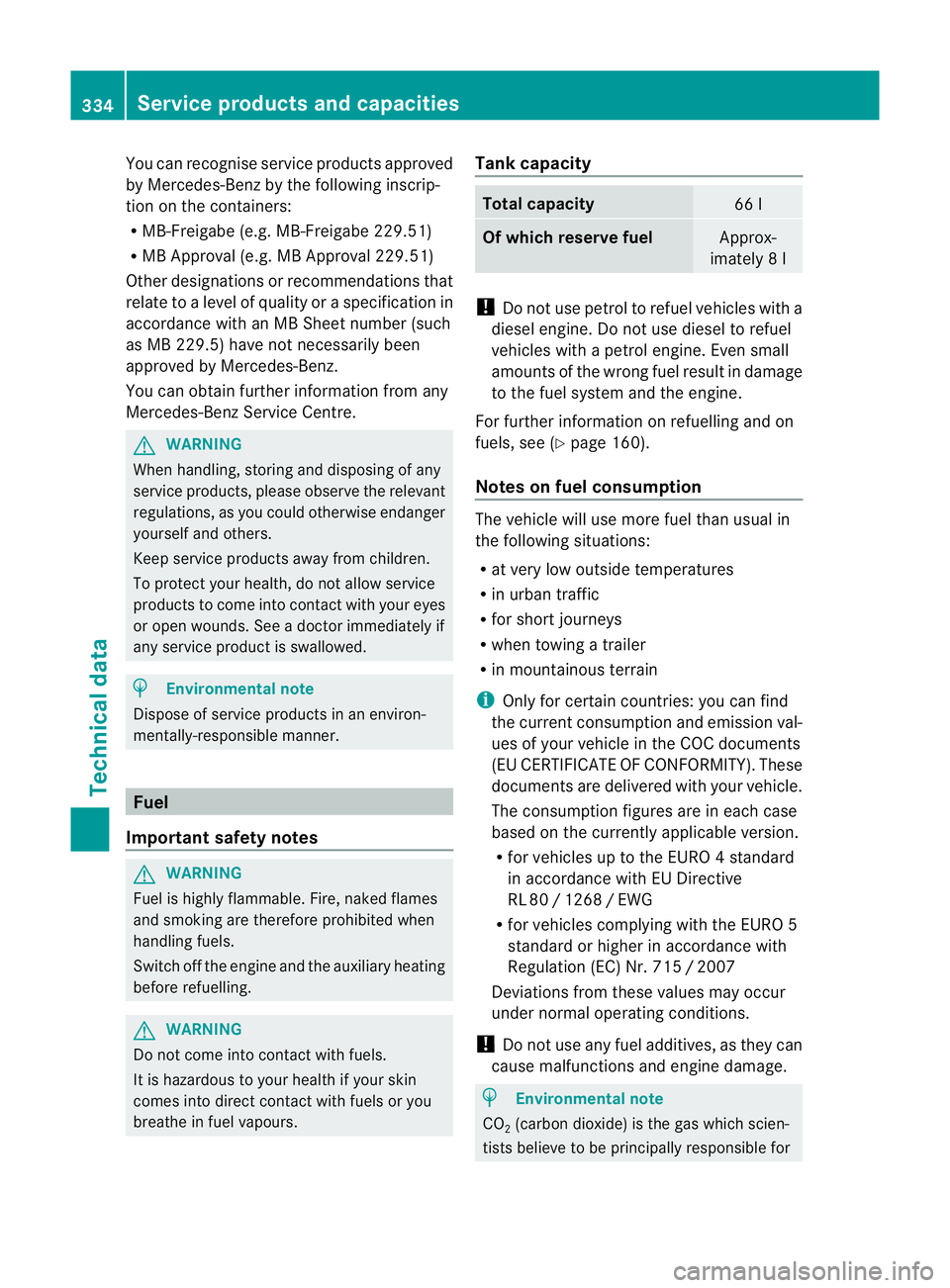
breathe in fuel vapours. Tank capacity Total capacity
66 l
Of which reserve fuel
Approx-
imately 8l !
Do not use petrol to refuel vehicles with a
diesel engine. Do not use diesel to refuel
vehicles with apetrol engine. Even small
amounts of the wrong fuel result in damage
to the fuel system and the engine.
For further information on refuelling and on
fuels, see (Y page 160).
Notes on fuel consumption The vehicle will use more fuel than usualin
the following situations:
R
at very low outside temperatures
R in urban traffic
R for short journeys
R when towing atrailer
R in mountainous terrain
i Only for certain countries: you can find
the current consumption and emission val-
ues of your vehicle in the COC documents
(EU CERTIFICATE OF CONFORMITY).T hese
documents are delivered with your vehicle.
The consumption figures are in each case
based on the currently applicable version.
R for vehicles up to the EURO 4standard
in accordance with EU Directive
RL 80 /1268 /EWG
R for vehicles complying with the EURO 5
standard or higher in accordance with
Regulation (EC) Nr. 715 /2007
Deviations from these values may occur
unde rnormal operating conditions.
! Do not use any fuel additives, as they can
cause malfunctions and engine damage. H
Environmental note
CO 2(carbon dioxide) is the gas which scien-
tists believe to be principally responsible for 334
Service products and capacitiesTechnical data
Page 338 of 353
global warming (the greenhouse effect). Your
vehicle's CO 2emissions are directly related
to fuel consumption and therefor edepend on:
R efficient use of the fuel by the engine
R driving style
R other non-technical factors, such as envi-
ronmental influences or road conditions
You can minimise your vehicle's CO 2emis-
sions by driving carefully and having it serv-
iced regularly. Engine oil
Please bear the following in mind The quality of engine oils is decisive for the
function and service life of an engine. After
extensive tests, Mercedes-Benz approves
engine oils which correspon dtothe current
technical standard.
Therefore, only Mercedes-Benz approved
engine oils may be used in Mercedes-Benz
engines.
Further information on tested and approved
engine oils can be obtained from any
Mercedes-Benz Service Centre. Mercedes-
Benz recommends that you have the oil
change carried out at aMercedes-Benz
Service Centre. Mercedes-Benz approval is
indicated on the oil container by the inscrip-
tion "MB Approval" and the corresponding
designation, e.g. MB Approval 229.51.
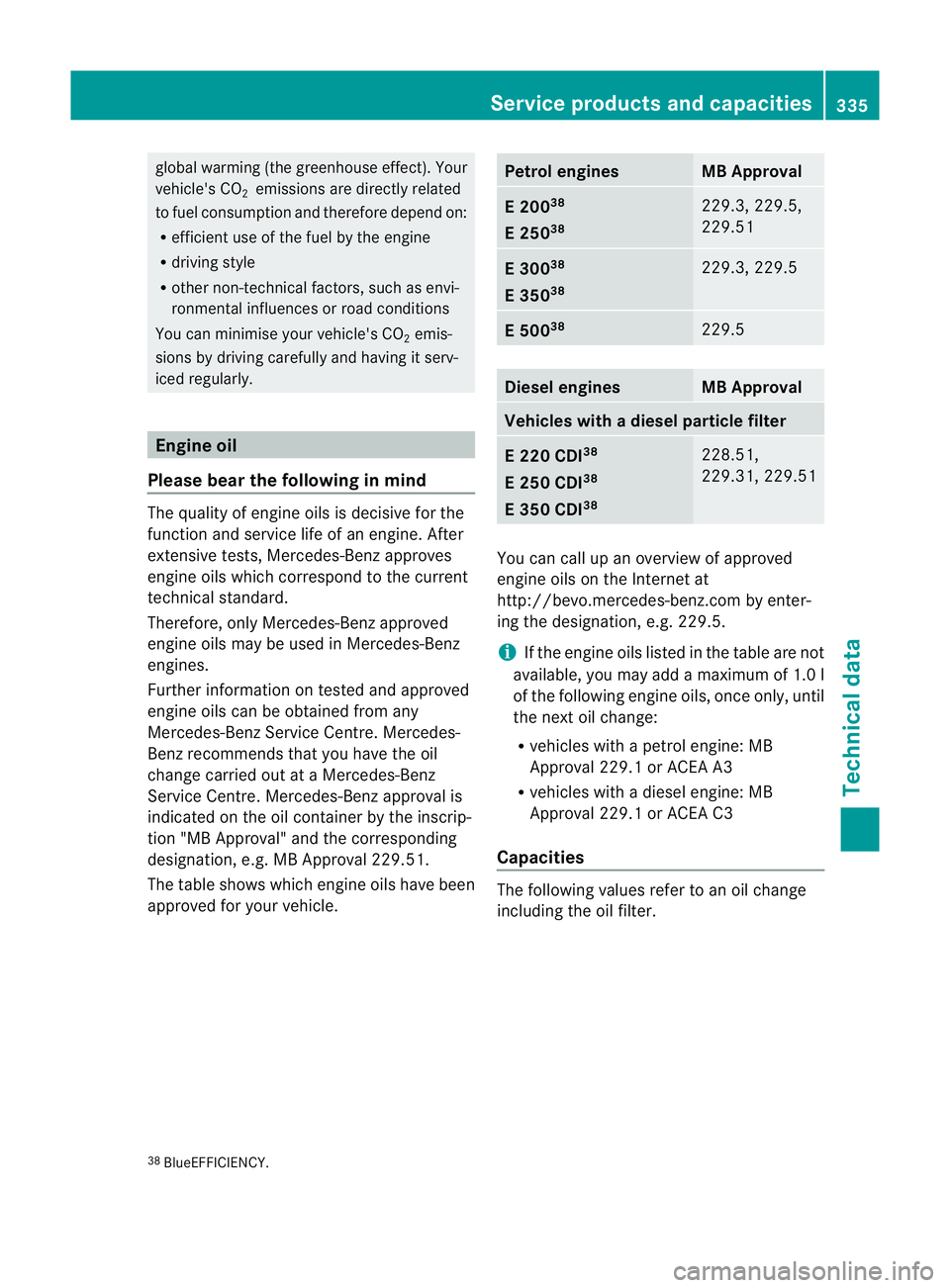
The table shows which engine oils have been
approved for your vehicle. Petrol engines MB Approval
E2
0038
E2 5038 229.3, 229.5,
229.51
E3
0038
E3 5038 229.3, 229.5
E5
0038 229.5
Diesele
ngines MB Approval
Vehicles with
adiesel particle filter E2
20 CDI 38
E2 50 CDI 38
E3 50 CDI 38 228.51,
229.31, 229.51
You can call up an overview of approved
engin
eoils on the Internet at
http://bevo.mercedes-benz.com by enter-
ing the designation ,e.g. 229.5.
i If the engin eoils listed in the table are not
available, you may add amaximum of 1. 0l
of the following engine oils, once only, until
the next oil change:
R vehicles with apetrol engine: MB
Approval 229.1orA CEA A3
R vehicles with adiesel engine: MB
Approval 229.1orA CEA C3
Capacities The following values refer to an oil change
including the oil filter.
38 BlueEFFICIENCY. Service products and capacities
335Technical data Z
Page 339 of 353
Vehicl
emodel Capacity including
oilf ilter 39 E2
0040
E2 5040 5.5 l
E3
0040
E3 5040
E2 20 CDI 40
E2 50 CDI 40 6.5 l
E3
50 CDI 40 8.0 l
E5
0040 Additives
!
Do not us eaddit ivesine ngine oil. This
could damag ethe engine.
Engine oi lviscosity Viscosity describe
sthe flo wcharacteristics
of afluid .Ifane ngine oi lhas ah ighv iscosity,
thi sm eans tha titisthick;alow viscosity
means that it is thin.
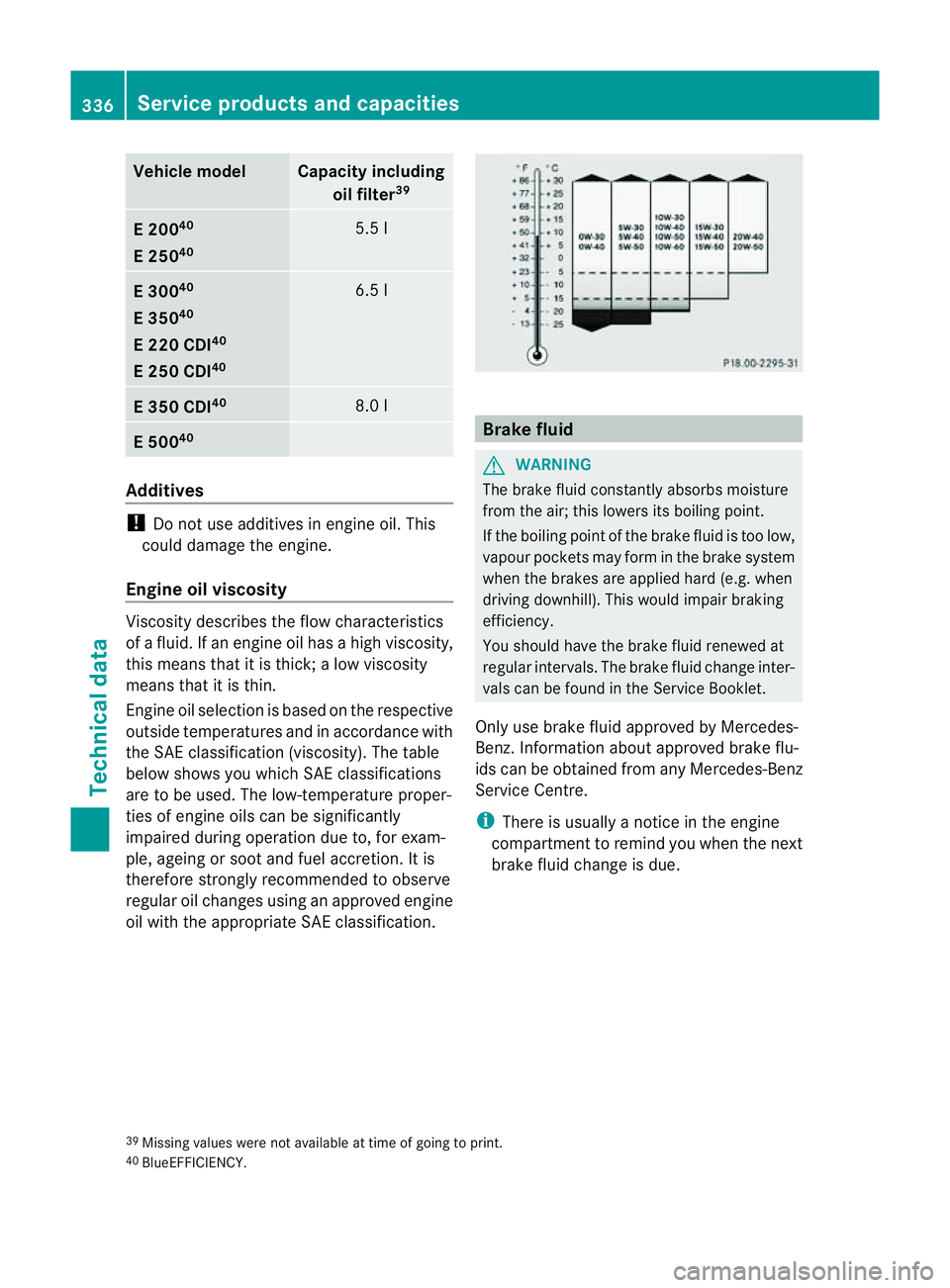
Engine oil selection is based on the respective
outside temperatures and in accordance with
the SAE classification (viscosity). The table
below shows you which SAE classifications
are to be used. The low-temperature proper-
ties of engine oils can be significantly
impaired during operation due to, for exam-
ple, ageing or soot and fuel accretion. It is
therefore strongly recommended to observe
regularo il changes using an approved engine
oil with the appropriate SA Eclassification. Brake fluid
G
WARNING
The brak efluid constantly absorb smoisture
fro mt he air; this lowers its boiling point.
If the boiling point of the brake fluid is too low,
vapour pockets may form in the brake system
when the brakes are applied hard (e.g. when
driving downhill). This would impair braking
efficiency.
You should have the brake fluid renewed at
regular intervals. The brake fluid change inter-
vals can be found in the Service Booklet.
Only use brake fluid approved by Mercedes-
Benz.I nformation about approved brake flu-
ids can be obtained from any Mercedes-Benz
Service Centre.
i There is usually anotic eint he engine
compartmenttor emind you when the next
brake fluid change is due.
39 Missing values were not availabl eattime of going to print.
40 BlueEFFICIENCY. 336
Service product
sand capacitiesTechnical data