coolant MERCEDES-BENZ E-CLASS CABRIOLET 2011 User Guide
[x] Cancel search | Manufacturer: MERCEDES-BENZ, Model Year: 2011, Model line: E-CLASS CABRIOLET, Model: MERCEDES-BENZ E-CLASS CABRIOLET 2011Pages: 353, PDF Size: 8.42 MB
Page 263 of 353
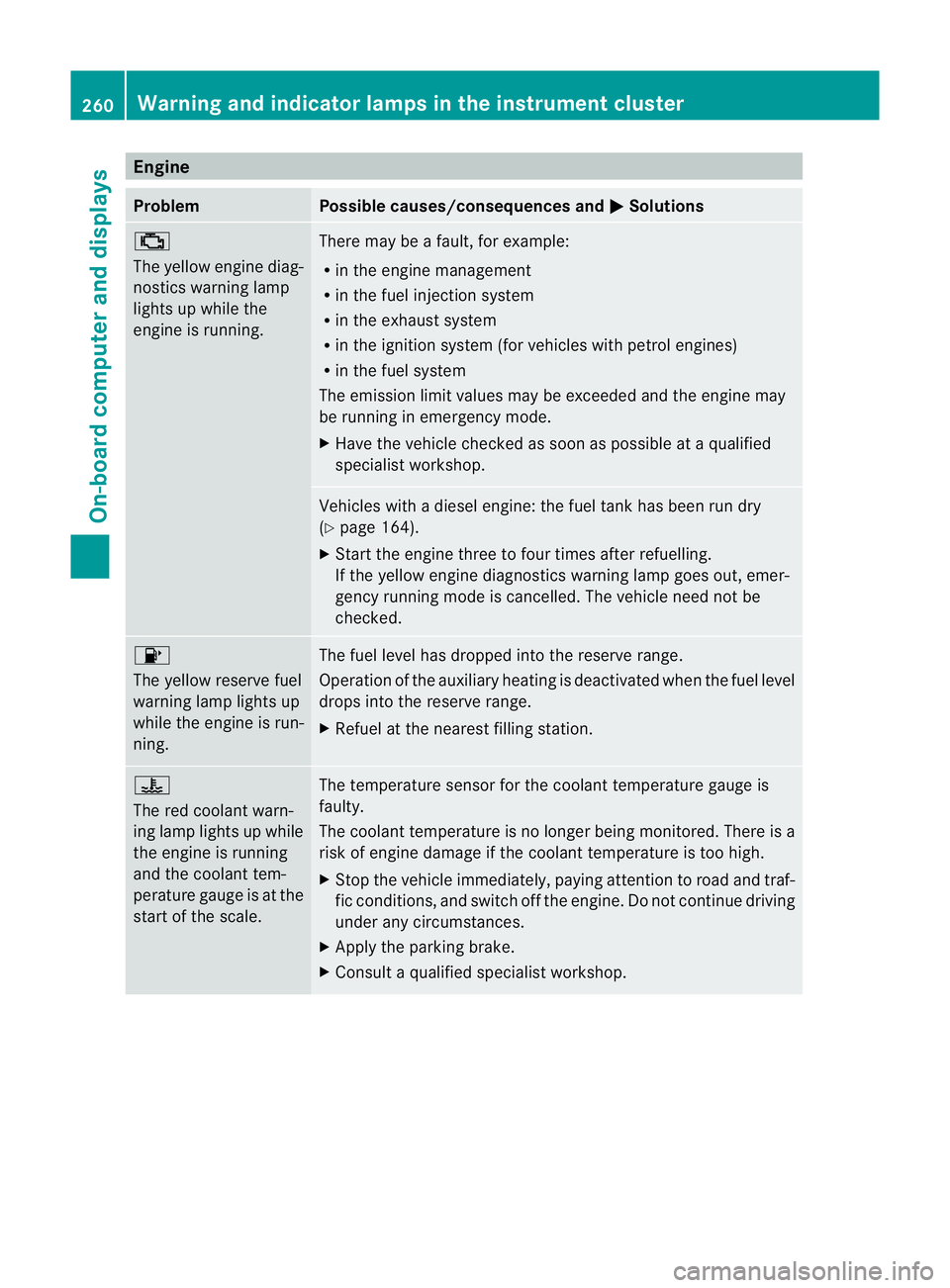
Engine
Problem Possible causes/consequences and
M Solutions
;
The yellow engin
ediag-
nostics warning lamp
light supw hile the
engin eisrunning. Ther
emay be afault ,for example:
R in th eenginem anagement
R in th efuel injection system
R in th eexhaust system
R in th eignition system (for vehicle swith petrol engines)
R in th efuel system
The emission limit values may be exceeded and th eenginem ay
be runnin ginemergenc ymode.
X Hav ethe vehicle checked as soon as possible at aqualified
specialist workshop. Vehicle
swithad ieseleng ine: th efuel tan khas been run dry
(Y page 164).
X Start th eenginet hree to four times after refuelling.
If th eyellow engin ediagnostics warning lamp goes out ,emer-
gency runnin gmodeisc ancelled. The vehicle need no tbe
checked. 8
The yellow reserve fuel
warning lamp lights up
whil
ethe engine is run-
ning. The fue
llev el ha sdroppe dinto the reserve range.
Operation of the auxiliary heating is deactivated when the fue llev el
drops into the reserve range.
X Refue latthe nearest filling station. ?
The red coolant warn-
ing lamp lights up while
the engine is running
and the coolant tem-
perature gaug
eisatthe
star toft he scale. The temperature sensor for the coolant temperature gauge is
faulty.
The coolant temperature is no longer being monitored. There is a
risk of engine damage if the coolant temperature is too high.
X
Stop the vehicle immediately, paying attention to road and traf-
fic conditions, and switch off the engine. Do not continue driving
under any circumstances.
X Apply the parking brake.
X Consult aqualified specialist workshop. 260
Warning and indicator lampsint
he instrument clusterOn-board computer and displays
Page 264 of 353
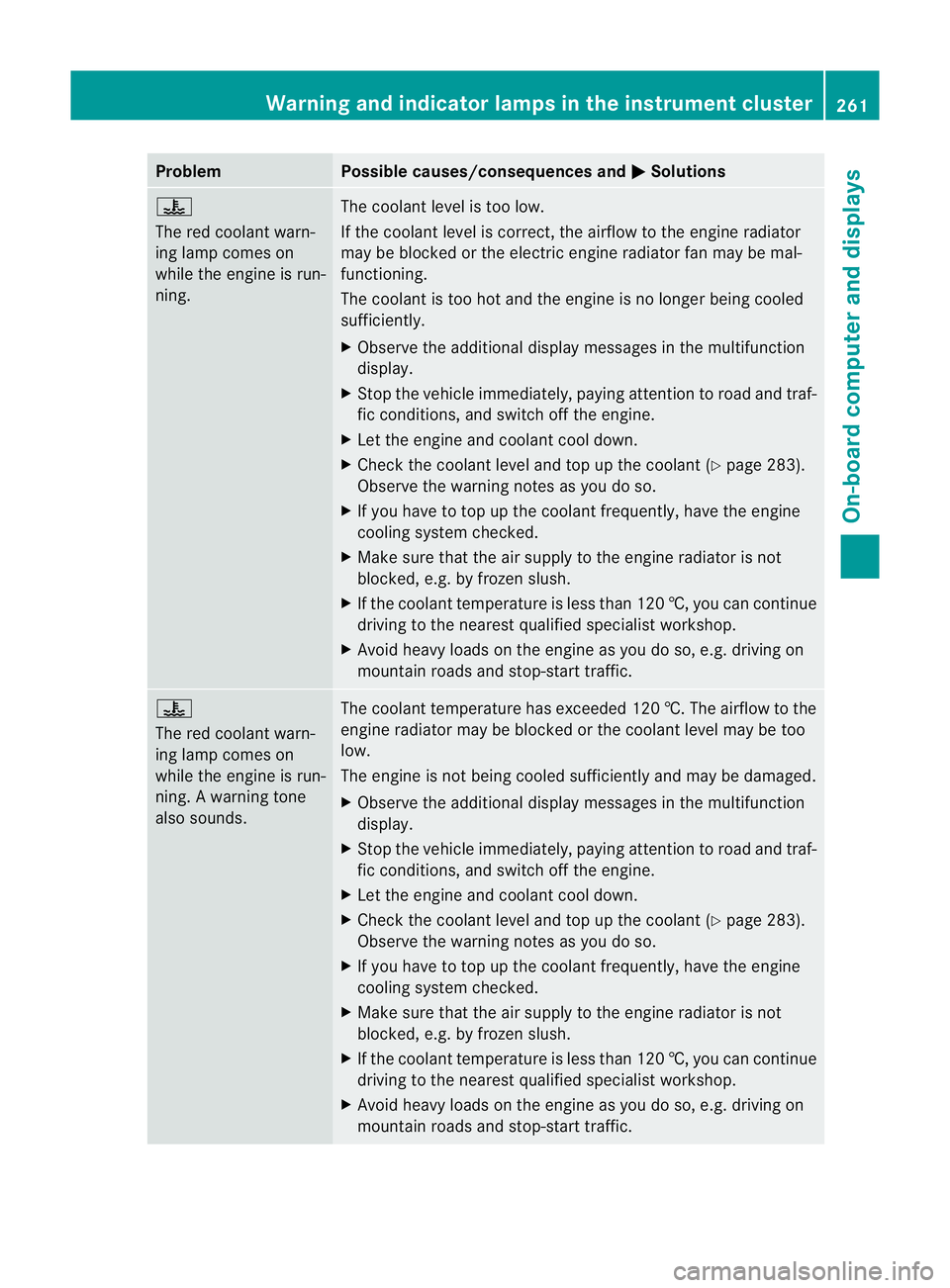
Problem Possible causes/consequences and
M Solutions
?
The red coolant warn-
ing lamp comes on
while the engine is run-
ning.
The coolant level is too low.
If the coolant level is correct, the airflow to the engine radiator
may be blocked or the electric engine radiator fan may be mal-
functioning.
The coolant is too hot and the engine is no longer being cooled
sufficiently.
X
Observe the additional display messages in the multifunction
display.
X Stop the vehicle immediately, paying attention to road and traf-
fic conditions, and switch off the engine.
X Let the engine and coolant cool down.
X Check the coolant level and top up the coolant (Y page 283).
Observe the warning notes as you do so.
X If you have to top up the coolant frequently, have the engine
cooling system checked.
X Make sure that the air supply to the engine radiator is not
blocked, e.g. by frozen slush.
X If the coolant temperature is less than 120 †, you can continue
driving to the nearest qualified specialist workshop.
X Avoid heavy loads on the engine as you do so, e.g. driving on
mountain roads and stop-start traffic. ?
The red coolant warn-
ing lamp comes on
while the engine is run-
ning.
Awarning tone
also sounds. The coolant temperature has exceeded 120 †. The airflow to the
engine radiator may be blocked or the coolant level may be too
low.
The engine is not being cooled sufficiently and may be damaged.
X
Observe the additional display messages in the multifunction
display.
X Stop the vehicle immediately, paying attention to road and traf-
fic conditions, and switch off the engine.
X Let the engine and coolant cool down.
X Check the coolant level and top up the coolant (Y page 283).
Observe the warning notes as you do so.
X If you have to top up the coolant frequently, have the engine
cooling system checked.
X Make sure that the air supply to the engine radiator is not
blocked, e.g. by frozen slush.
X If the coolant temperature is less than 120 †, you can continue
driving to the nearest qualified specialist workshop.
X Avoid heavy loads on the engine as you do so, e.g. driving on
mountain roads and stop-start traffic. Warning and indicator lampsint
he instrument cluster
261On-board computer and displays Z
Page 286 of 353
X
Slowl yslide oi ldipstick :into the guide
tub etot he stop ,and take it ou tagain.
The oil level is correc tifthe level is between
MIN mark =and MAX mark ;.
X Top up the oil if necessary.
Adding engine oil H
Environmental note
When topping up the oil, take care not to spill
any. If oil enters the soil or waterways, it is
harmful to the environment. G
WARNING
If engine oil comes into contact with hot
engine parts, it may ignite and you could burn
yourself. Do not spill any engine oil on hot
engine parts. Example: engine oil cap
X
Turn cap :anti-clockwise and remove it.
X Top up with the amount of oil required.
Fill carefully to the maximum mark on the oil
dipstick.
i Depending on the engine, the difference
between the minimum mark and the maxi-
mum mark is approximately 1.5 –2litres.
! Do not add too much oil. If the oil level is
above the "max" mark on the dipstick, too
much oil has been added. This can lead to
damage to the engine or the catalytic con-
verter. Have excess oil siphoned off.
For further information on engine oil, see
(Y page 335). X
Replace cap :on the filler neck and
tighten clockwise.
Ensure that the cap locks into place
securely. Checking and adding other service
products
Checking the coolant level Only check the coolant level when the vehicle
is on alevel surface and the engine has cooled
down.
X Turn the key to position 2(Y page 147) in
the ignition lock.
On vehicles with KEYLESS-GO, press the
Start/Stop button twice (Y page 147).
X Check the coolant temperature displayin
the instrumentc luster. G
WARNING
The cooling system is pressurised. Therefore,
only unscrew the cap once the engine has
cooled down. The coolant temperature gauge
must display less than 70 †.Otherwise, you
could be scalded if hot coolant escapes. X
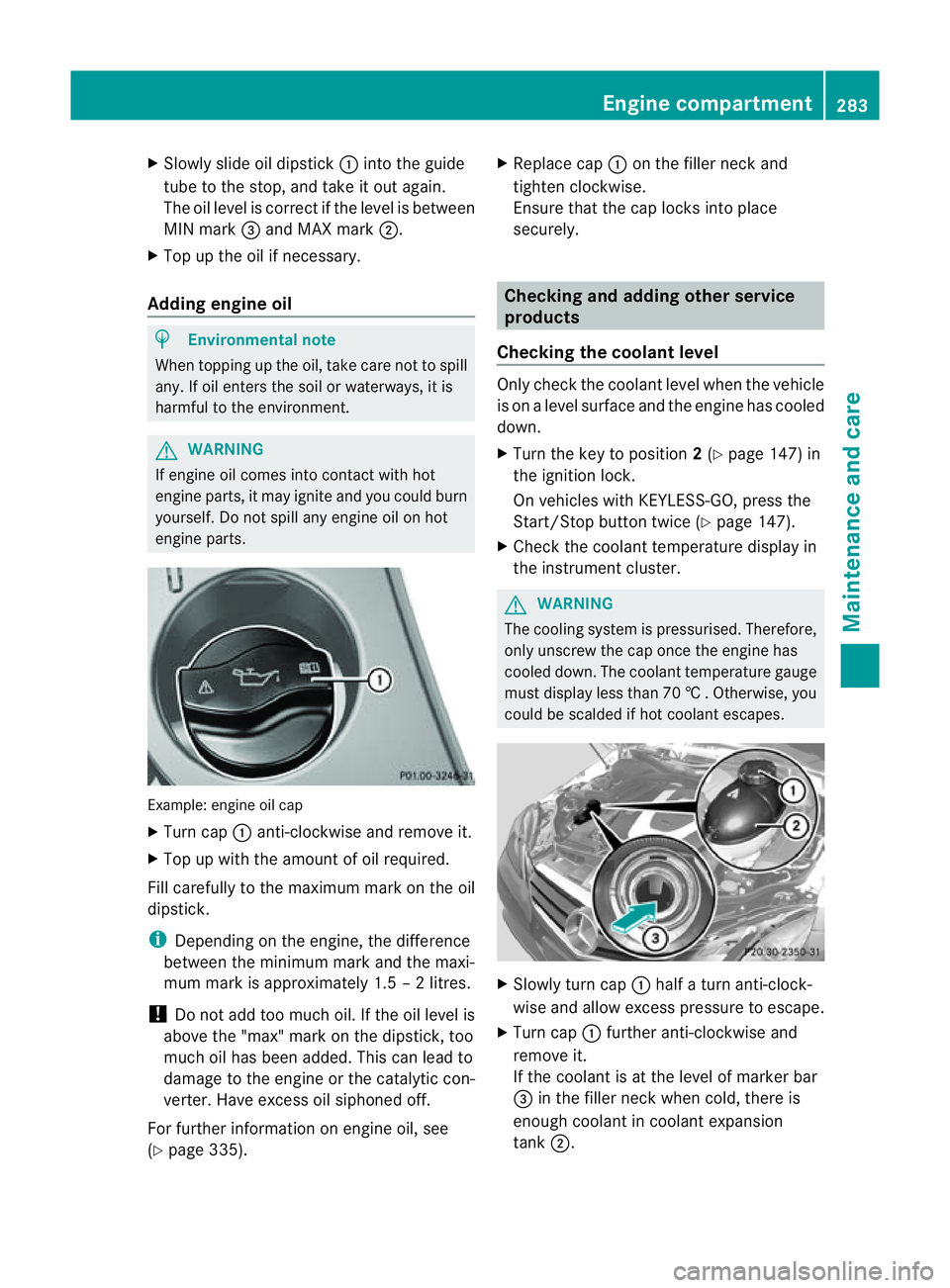
Slowl yturnc ap : half aturna nti-clock-
wise and allow exces spressure to escape.
X Turn cap :further anti-clockwis eand
remove it.
If th ecoolan tisatt heleve lofm arkerbar
= in th efille rneck when cold, there is
enough coolant in coolant expansion
tank ;. Engine compartment
283Maintenance and care Z
Page 287 of 353
If the coolant level is approximately 1.5 cm
above marker bar =in the filler neck when
warm, there is enough coolant in coolant
expansio ntank ;.
X If necessary, to pupwithc oolan tthat has
been tested and approved by Mercedes-
Benz.
X Replace cap :and turn it clockwise as far
as it will go.
For further information on coolant, see
(Y page 337).
Windscreen washer system and head-
lamp cleanings ystemThe washer fluid reservoir is used for both the
windscreen washer system and the headlamp
cleaning system.
i
Components and service products must
be matched. Mercedes-Ben zrecommends
that you use products tested and approved
by Mercedes-Benz. They are listed in this
Mercedes-Ben zOwner's Manual in the
appropriat esection.
You can identif yservice product sapproved
by Mercedes-Ben zbythe followin ginscrip-
tions on the container:
R MB-Freigabe (e.g. MB-Freigabe 371.0)
R MB-Approval (e.g. MB-Approval 371.0)
Other labels and recommendations that
make reference to quality level or aspeci-
fication according to an MB Sheet no. (e.g.
MB 371.0) are not necessarily approved by
Mercedes-Benz.
You can obtain further information from
any Mercedes-Benz Servic eCentre. G
WARNING
Windscreen washer fluid is highly flammable.
Fire, naked flames and smokin gare prohibi-
ted when handling washer fluid concentrate.
! Only use washer fluid concentrate which
is suitable for plastic lamp lenses. Unsuit-
able washer fluid concentrate could dam- age the plastic lamp lenses of the head-
lamps.
! Do not use distilled or de-ionised water in
the washer fluid reservoir. Otherwise, the
level sensor may be damaged.
i Add windscreen washer concentrate, e.g.
MB SummerFit, to the washer fluid all year
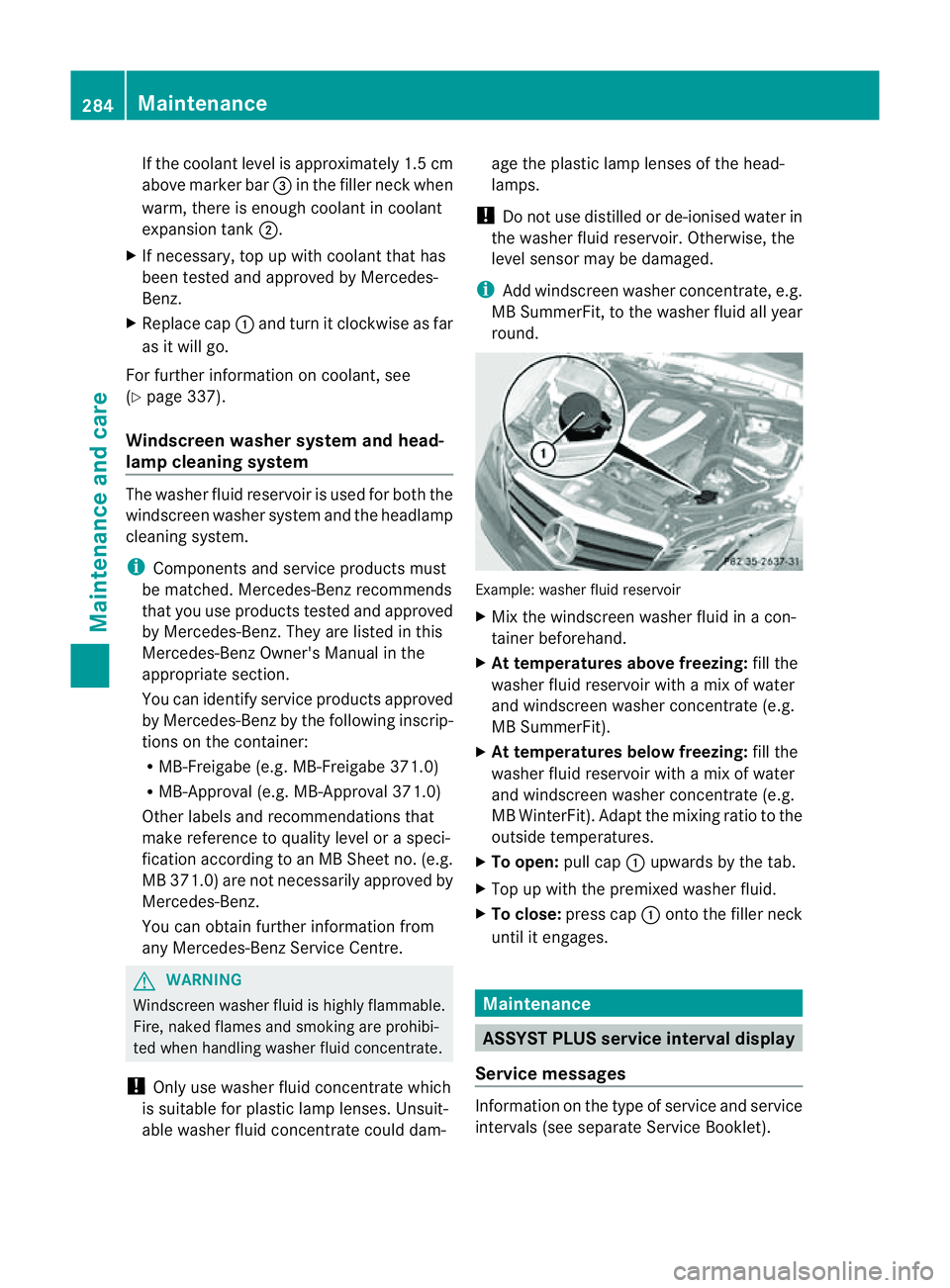
round. Example: washer fluid reservoir
X
Mix the windscreen washer fluid in acon-
tainer beforehand.
X At temperatures above freezing: fill the
washer fluid reservoir with amix of water
and windscreen washer concentrate (e.g.
MB SummerFit).
X At temperatures below freezing: fill the
washer fluid reservoir with amix of water
and windscreen washer concentrate (e.g.
MB WinterFit). Adapt the mixing ratio to the
outside temperatures.
X To open: pull cap:upwards by the tab.
X Top up with the premixed washer fluid.
X To close: press cap :ontothe filler neck
until it engages. Maintenance
ASSYST PLUS service interval display
Service messages Information on the type of service and service
intervals (see separat
eServic eBooklet). 284
MaintenanceMaintenance and care
Page 290 of 353
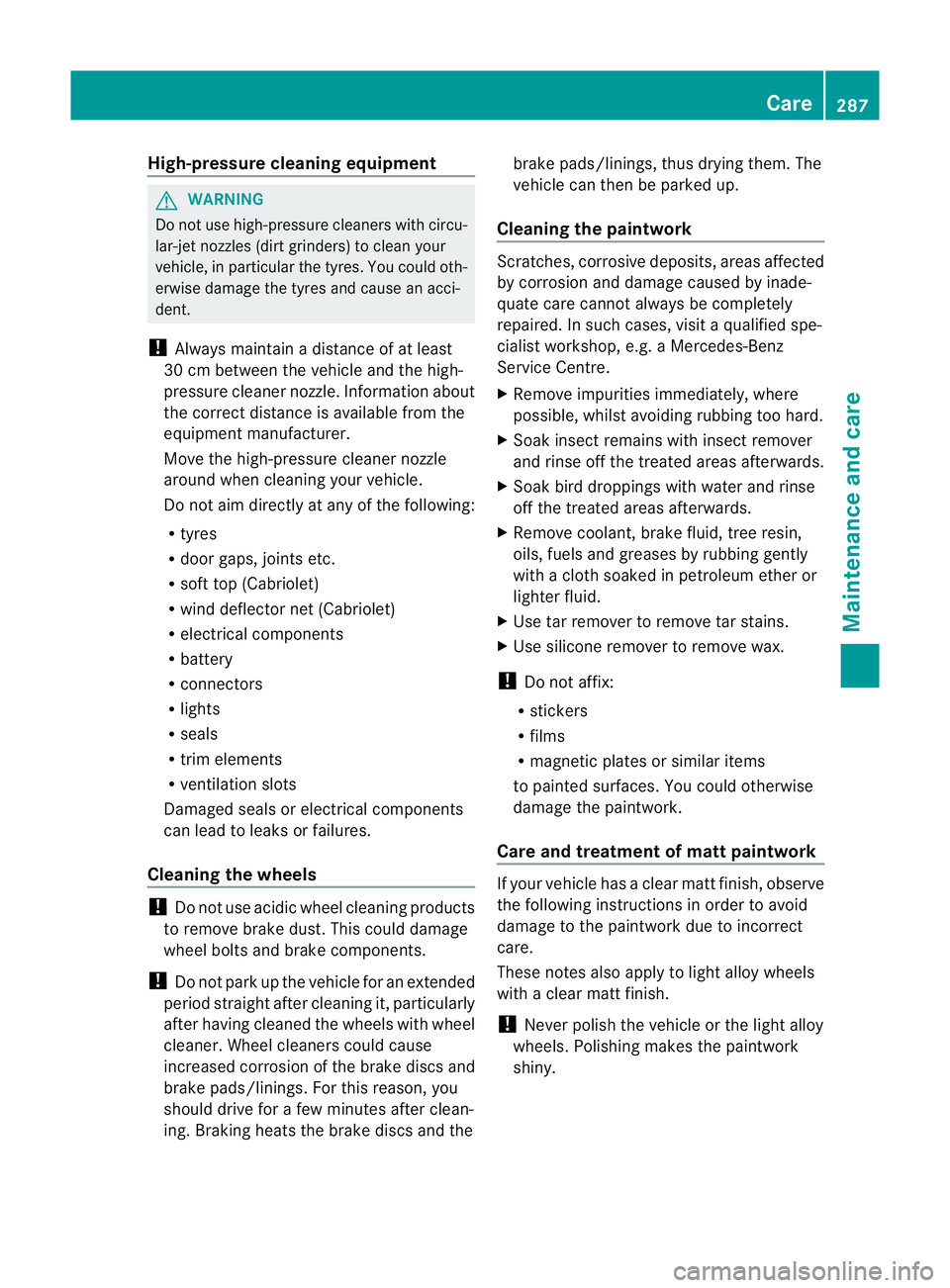
High-pressure cleaning equipment
G
WARNING
Do not use high-pressure cleaners with circu-
lar-jet nozzles (dirt grinders) to clea nyour
vehicle, in particular the tyres. You could oth-
erwise damage the tyres and cause an acci-
dent.
! Always maintain adistance of at least
30 cm between the vehicle and the high-
pressure cleaner nozzle. Information about
the correc tdistanc eisavailable fro mthe
equipment manufacturer.
Move the high-pressure cleaner nozzle
around when cleaning your vehicle.
Do not aim directly at any of the following:
R tyres
R door gaps, jointse tc.
R soft top (Cabriolet)
R wind deflector net (Cabriolet)
R electrical components
R battery
R connectors
R lights
R seals
R trim elements
R ventilation slots
Damaged seals or electrical components
can lead to leaks or failures.
Cleaningt he wheels !
Do not use acidic wheel cleaning products
to remove brake dust. This could damage
wheel bolts and brake components.
! Do not park up the vehicle for an extended
period straight after cleaning it, particularly
after having cleaned the wheels with wheel
cleaner. Wheel cleaners could cause
increased corrosion of the brake discs and
brake pads/linings. For this reason, you
should drive for afew minutes after clean-
ing. Braking heats the brake discs and the brake pads/linings, thus drying them. The
vehicle can then be parked up.
Cleaningt he paintwork Scratches, corrosive deposits, areas affected
by corrosion and damage caused by inade-
quate care cannot always be completely
repaired. In such cases, visit aqualified spe-
cialist workshop, e.g. aMercedes-Benz
Service Centre.
X Remove impurities immediately, where
possible, whilst avoiding rubbing too hard.
X Soak insect remains with insect remover
and rinse off the treated areas afterwards.
X Soak bird droppings with water and rinse
off the treated areas afterwards.
X Remove coolant, brake fluid, tree resin,
oils, fuels and greases by rubbing gently
with acloth soaked in petroleum ether or
lighter fluid.
X Use tar remover to remove tar stains.
X Use silicone remover to remove wax.
! Do not affix:
R stickers
R films
R magnetic plates or similar items
to painted surfaces. You could otherwise
damage the paintwork.
Care and treatment of mattp aintwork If your vehicle has
aclear matt finish, observe
the following instructions in order to avoid
damage to the paintwork due to incorrect
care.
These notes also apply to light alloy wheels
with aclear matt finish.
! Never polish the vehicle or the light alloy
wheels. Polishing makes the paintwork
shiny. Care
287Maintenance and care Z
Page 336 of 353
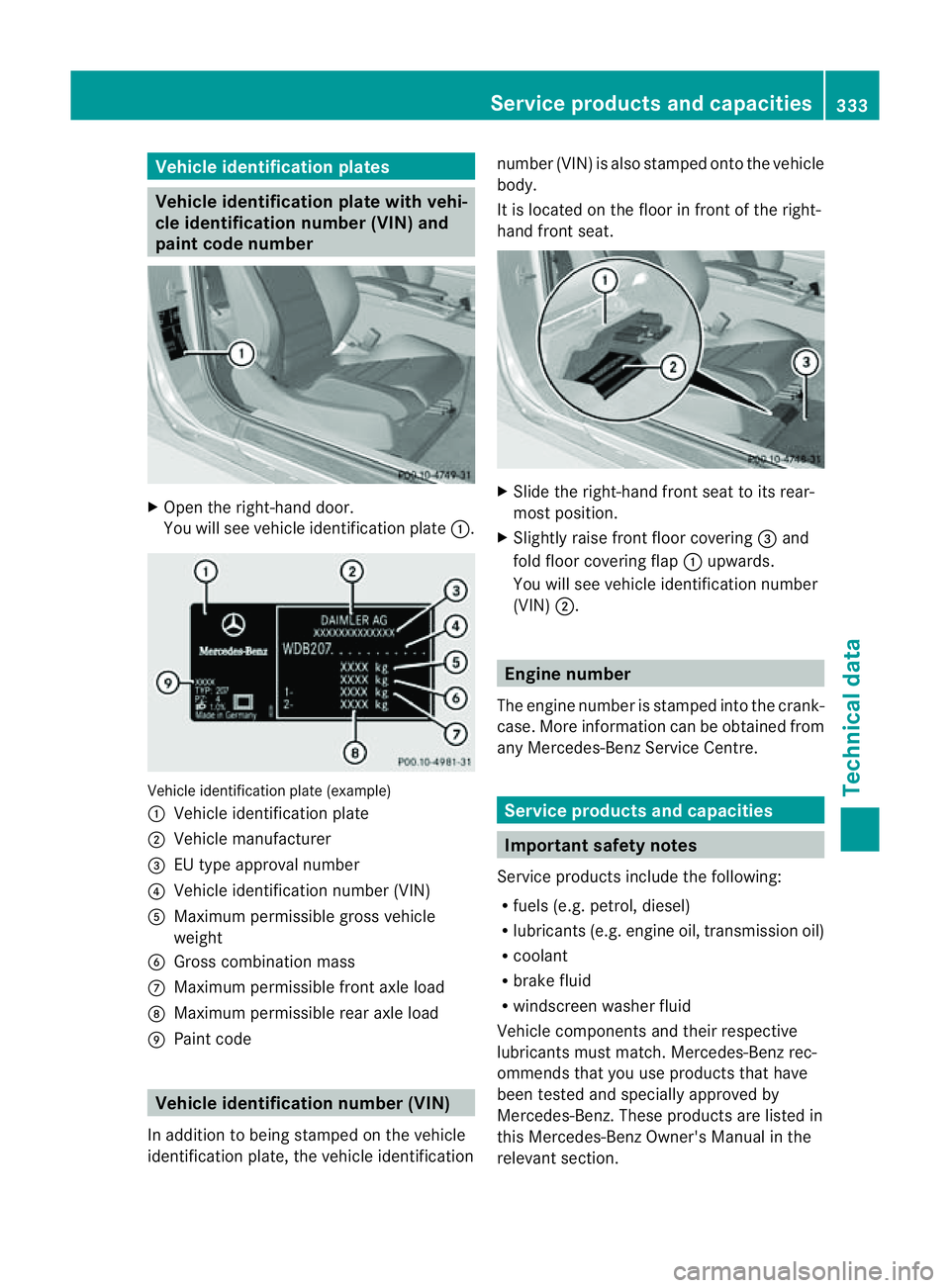
Vehicl
eidentificatio nplates Vehicl
eidentificatio nplate with vehi-
cl ei dentificatio nnumber (VIN) and
pain tcode number X
Open th eright-han ddoor.
You will see vehicle identification plate :.Vehicle identification plat
e(example)
: Vehicle identification plate
; Vehicle manufacturer
= EU type approval number
? Vehicle identification number (VIN)
A Maximum permissible gross vehicle
weight
B Gros scombinatio nmass
C Maximum permissible fron taxle load
D Maximu mpermissible rear axle load
E Paint code Vehicle identification number (VIN)
In addition to being stamped on the vehicle
identification plate, the vehicle identification number (VIN) is also stamped ontot
he vehicle
body.
It is located on the floor in fron tofthe right-
hand fron tseat. X
Slide the right-hand fron tseat to its rear-
most position.
X Slightly raise fron tfloor covering =and
fold floor coverin gflap :upwards.
You will see vehicle identification number
(VIN) ;. Engine number
The engine number is stamped int othe crank-
case. More information can be obtained from
any Mercedes-Ben zServic eCentre. Service products and capacities
Important safety notes
Servic eproducts include the following:
R fuels (e.g .petrol, diesel)
R lubricant s(e.g. engin eoil, transmission oil)
R coolant
R brake fluid
R windscreen washer fluid
Vehicle componentsa nd their respective
lubricant smust match. Mercedes-Benzr ec-
ommends that you use product sthat have
been tested and specially approved by
Mercedes-Benz.T hese productsare listed in
this Mercedes-BenzO wner's Manual in the
relevant section. Service products and capacities
333Technical data Z
Page 340 of 353
Coolant
Important safety notes The coolan
tisamixture of water and anti-
freeze/corrosion inhibitor. It performs the
following tasks:
R anti-corrosion protection
R antifreeze protection
R raising the boiling point
i When the vehicle is first delivered, it is fil-
led with acoolant mixture that ensures
adequate antifreeze and corrosion protec-
tion.
! Only add coolant that has been premixed
with the desired antifreeze protection. The
engine could otherwise be damaged.
Further information on coolants and on fill-
ing can be found in the Mercedes-Benz
Specifications for Service Products, MB
Approval 310.1,e .g. on the Internet at
http://bevo.mercedes-benz.com .You can
also consult aMercedes-Benz Service
Centre.
! Always use asuitable coolant mixture,
even in countries where high temperatures
prevail.
Otherwise, the cooling system will not be
sufficiently protected from corrosion ,and
the boiling point will be too low.
If antifreeze/corrosion inhibitor is present in
the correc tconcentration, the boiling point of
the coolant will be around 130 †.
The antifreeze/corrosion inhibitor concentra-
tion in the engine cooling system should:
R be at least 50%. This will protec tthe engine
cooling system against freezing down to
around -37 †.
R not exceed 55% (antifreeze protection
down to -45 †);otherwise, heat will not be
dissipated as effectively. If the vehicle has lost coolant, top it up with
equal amount
sofwater and antifreeze/cor-
rosion inhibitor. Mercedes-Benz recom-
mends an antifreeze/corrosion inhibitor
which has been approved for Mercedes-Benz.
! The engin ecoolin gsystem is filled with
coolan tthat must be renewed after 15
years, or after 250,000 km at the latest. Vehicle data
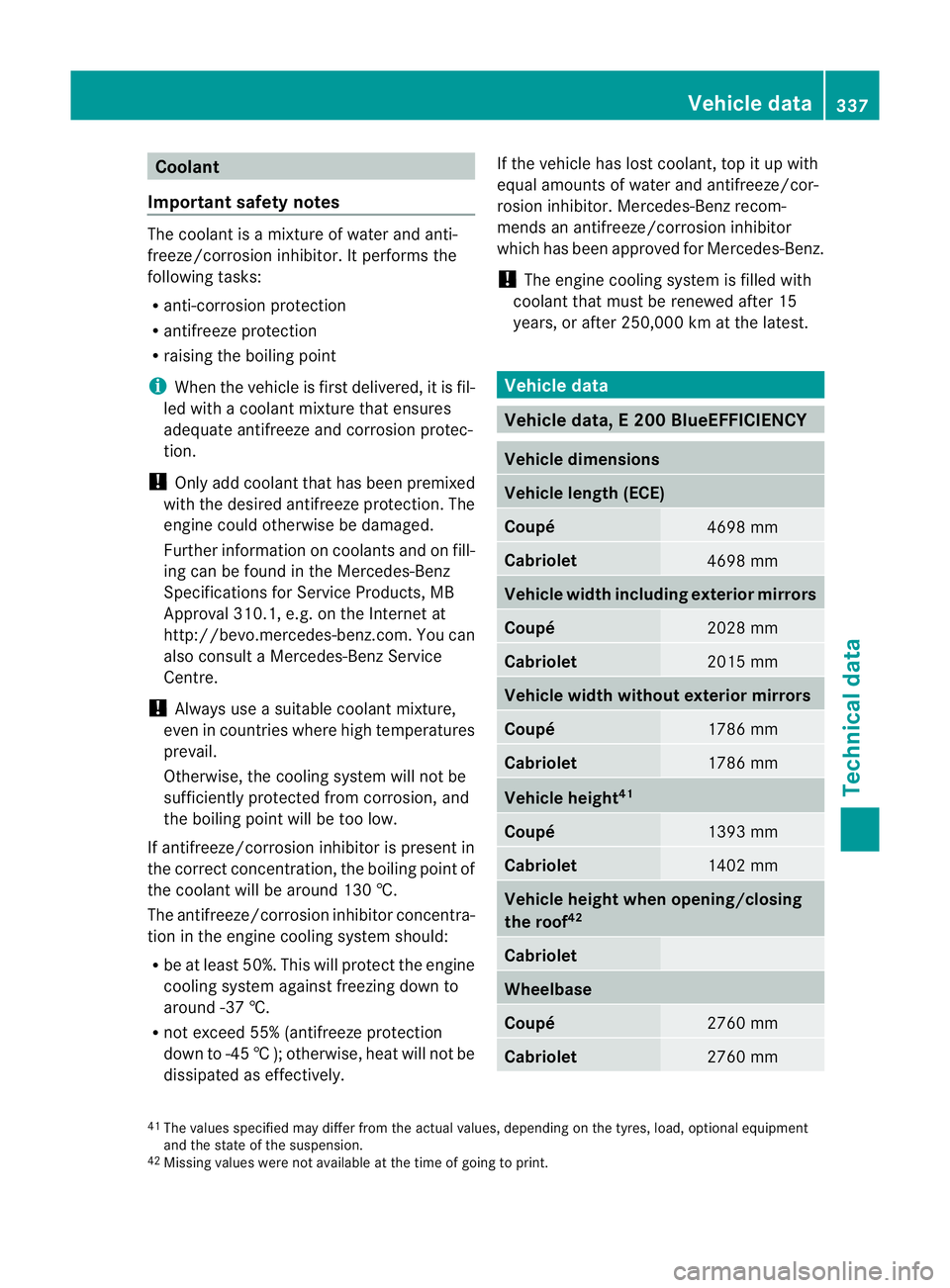
Vehicle data,
E200 BlueEFFICIENCY Vehicle dimensions
Vehicle length (ECE)
Coupé
469
8mm Cabriolet
469
8mm Vehicle width including exterior mirrors
Coupé
202
8mm Cabriolet
201
5mm Vehicle width withou
texterior mirrors Coupé
178
6mm Cabriolet
178
6mm Vehicle height
41 Coupé
139
3mm Cabriolet
140
2mm Vehicle height when opening/closing
ther
oof42 Cabriolet
Wheelbase
Coupé
276
0mm Cabriolet
276
0mm 41
The values specified may differ from the actual values, dependin gonthe tyres ,load, optional equipment
and the stat eofthe suspension.
42 Missin gvalues were not available at the time of going to print. Vehicle data
337Technical data Z