belt MERCEDES-BENZ E-CLASS CABRIOLET 2011 Owner's Manual
[x] Cancel search | Manufacturer: MERCEDES-BENZ, Model Year: 2011, Model line: E-CLASS CABRIOLET, Model: MERCEDES-BENZ E-CLASS CABRIOLET 2011Pages: 353, PDF Size: 8.42 MB
Page 59 of 353
X
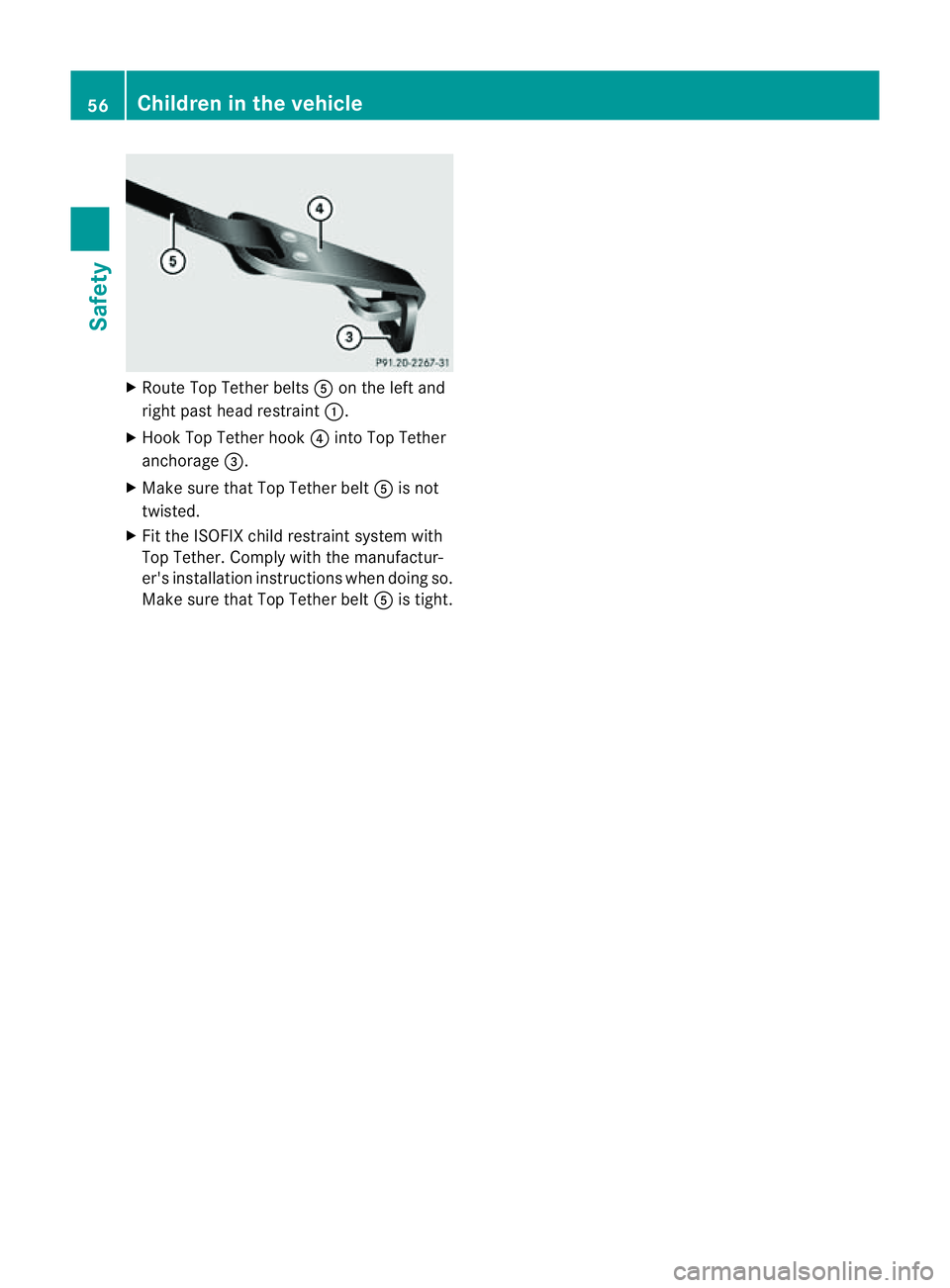
Rout eTop Tether belts Aon th elefta nd
right past head restraint :.
X Hook Top Tether hook ?into Top Tether
anchorage =.
X Mak esuret hatT op Tether belt Ais not
twisted.
X Fit th eISOFI Xchild restrain tsystem with
Top Tether .Comply with the manufactur-
er's installation instructions when doing so.
Make sure that Top Tether belt Ais tight. 56
Children in the vehicleSafety
Page 69 of 353
driving style to the differen
thandling charac-
teristics.
X Observ ethe note sonw arning and indicator
lamps (Y page 257) as well as display mes-
sages ( Ypage 234). ADAPTIV
EBRAKE
ADAPTIV EBRAKE enhances braking safety
and offers increased braking comfort. In addi-
tio ntot he brakin gfunction, ADAPTIVE BRAKE
alsoh as the HOLD function (Y page184) and
hills tart assist (Y page149). For further
information, see Driving tips (Y page167). PRE-SAFE
®
Brake
PRE-SAFE ®
Brake is only available in vehicles
with DISTRONIC PLUS.
i Observe the "Important safety notes" sec-
tion (Y page61).
PRE-SAFE ®
Brake can help you to minimise
the risk of afrontal collision with avehicle
ahead or reduce the effects of such acolli-
sion. If PRE-SAFE ®
Brake has detected arisk
of collision, you willbew arned visuallya nd
acoustically as wellasbya utomatic braking.
PRE-SAFE ®
Brake cannot prevent acollision
without youri ntervention.
Thi sfun ctio nwill issue awarnin gats peeds of
aroun d30k m/horm orei f:
R for aperiod of several seconds ,the dis-
tance to the vehicle in front is too shor tfor
the speed at which you are travelling. The
· distance warning lamp then lights up
in the instrument cluster.
R you are rapidly approaching the vehicle in
front.Ani ntermittent warning tonew ill
then sound and the ·distance warning
lamp will light up in the instrument cluster. X
Brake immediately in order to increase the
distance from the vehicle in front.
or
X Take evasive action provided it is safe to do
so.
If the driver and passengers have fastened
their seat belts, PRE-SAFE ®
Brake can also
can also perform the following at speeds of
above approximately 30 km/h:
R brake the vehicle automatically from a
speed of up to approximately 200 km/h
R trigger preventative passenger protection
measures (PRE-SAFE ®
)( Ypage 45)
Due to the nature of the system, particularly
complicated driving conditions may cause
unnecessary warnings or the unnecessary
intervention of PRE-SAFE ®
Brake. To end this,
you can either depress the accelerator pedal
further, activate kickdown or release the
brake pedal.
The braking action of PRE-SAFE ®
Brake is
ended automatically if:
R you drive slower than approximately
15 km/h.
R you manoeuvre to avoid the obstacle.
R there is no longer any danger of arear-end
collision.
R there is no longer an obstacle detected in
front of your vehicle.
With the help of the radar sensor system,
PRE-SAFE ®
Brake can detect obstacles that
are in front of your vehicle for an extended
period of time.
At speeds up to approximately 70 km/h,
PRE-SAFE ®
Brake may also detect stationary
obstacles, for example stopped or parked
vehicles.
If you approach an obstacle and PRE-SAFE ®
Brake detect sarisk of acollision, the system
will initially alert you both visually and acous-
tically. If you do not brake or take evasive
action, the system will warn you by automat-
ically braking the vehicle gently. If there is an
increased risk of collision, preventative 66
Driving safety systemsSafety
Page 96 of 353
stationary or when driving up to
aspeed of
160 km/h.
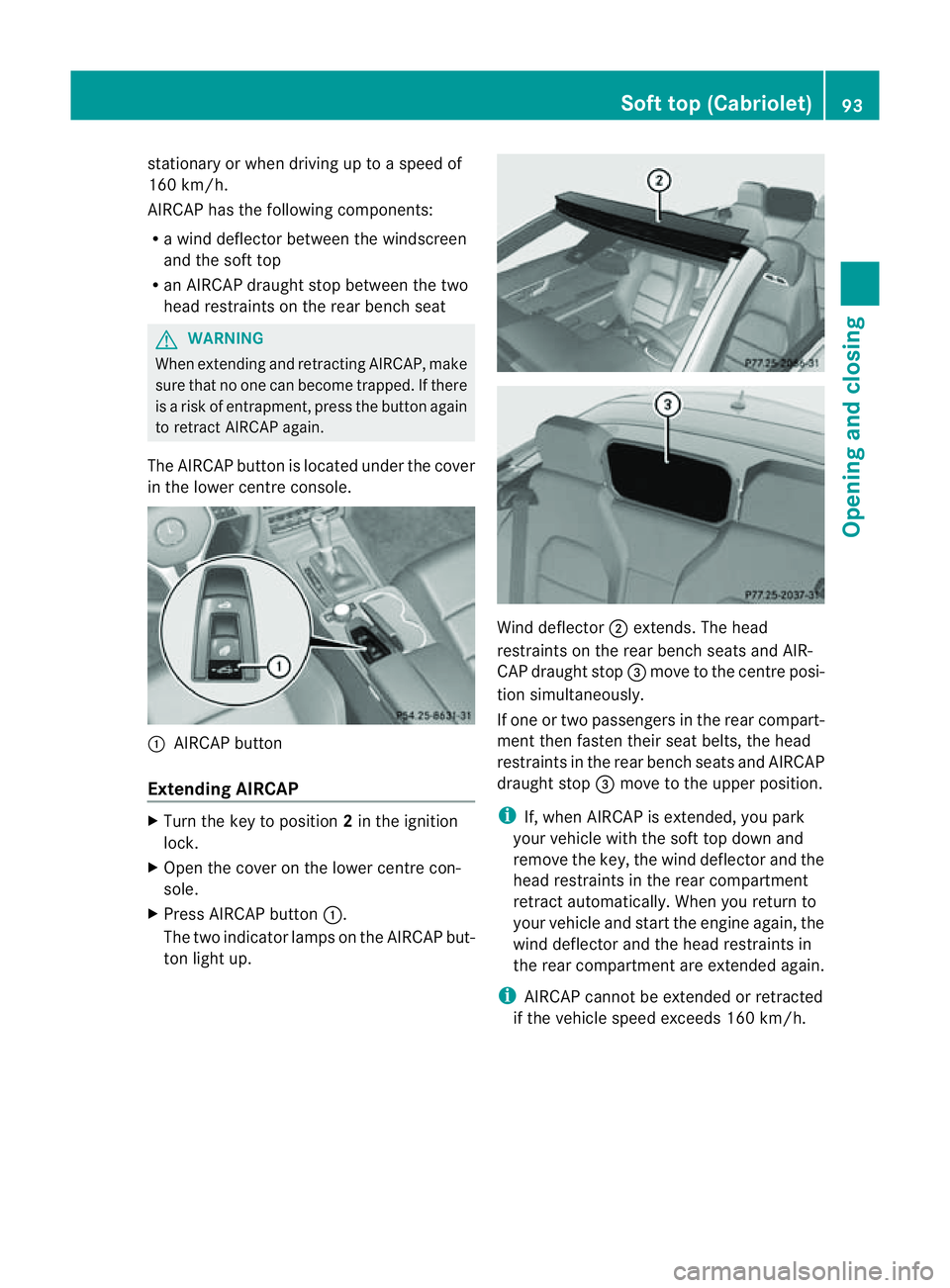
AIRCAP has the following components:
R aw ind deflector between the windscreen
and the soft top
R an AIRCAP draught stop between the two
head restraints on the rear bench seat G
WARNING
When extending and retractingA IRCAP, make
sure that no one can become trapped. If there
is ar isk of entrapment,p ress the button again
to retract AIRCAP again.
The AIRCAP button is located under the cover
in the lower centre console. :
AIRCAP button
Extending AIRCAP X
Turn the key to position 2in the ignition
lock.
X Open the cover on the lower centre con-
sole.
X Press AIRCAP button :.
The two indicator lamps on the AIRCAP but-
ton light up. Wind deflector
;extends. The head
restraints on the rear bench seats and AIR-
CAP draught stop =move to the centre posi-
tion simultaneously.
If one or two passengers in the rear compart-
ment then fasten their seat belts, the head
restraints in the rear bench seats and AIRCAP
draught stop =move to the upper position.
i If, when AIRCAP is extended, you park
your vehicle with the soft top down and
remove the key, the wind deflector and the
head restraints in the rear compartment
retract automatically. When you return to
your vehicle and start the engine again, the
wind deflector and the head restraints in
the rear compartment are extended again.
i AIRCAP cannot be extended or retracted
if the vehicle speed exceeds 160 km/h. Soft top (Cabriolet)
93Opening and closing Z
Page 97 of 353
Retracting AIRCAP
X
Turn the key to position 2in the ignition
lock.
X Ope nthe cove ronthe lowe rcentre con-
sole.
X Press AIRCAP button :.
The two indicator lamps on the AIRCAP but-
ton go out. Wind deflector ;retracts. The
hea drestraints on the rea rbenchs eats and
AIRCAP draught stop =move to the low-
est position simultaneously.
i If ther eare passengers wearing seat belts
in the rear compartment ,the head
restraint sonthe rear bench seats and the
AIRCAP draught stop remain in the upper
position.
Retracting the head restraint sonthe
rear bench seats from the driver's seat To improve the rear view, you can retract the
head restraint
sonthe rear bench seats indi-
vidually (Y page 103). The wind deflector
remains in its curren tposition. Fitting/removing the AIRCAP draught
stop
Preparation You will need
a4mmhex-socket wrench to
fit/remove the AIRCAP draught stop.
Before fitting or removing the AIRCAP draught
stop:
X Turn the key to position 2in the ignition
lock.
X Open the folding roof full y(Ypage 86).
X Exten dthe head restraint sinthe rear com-
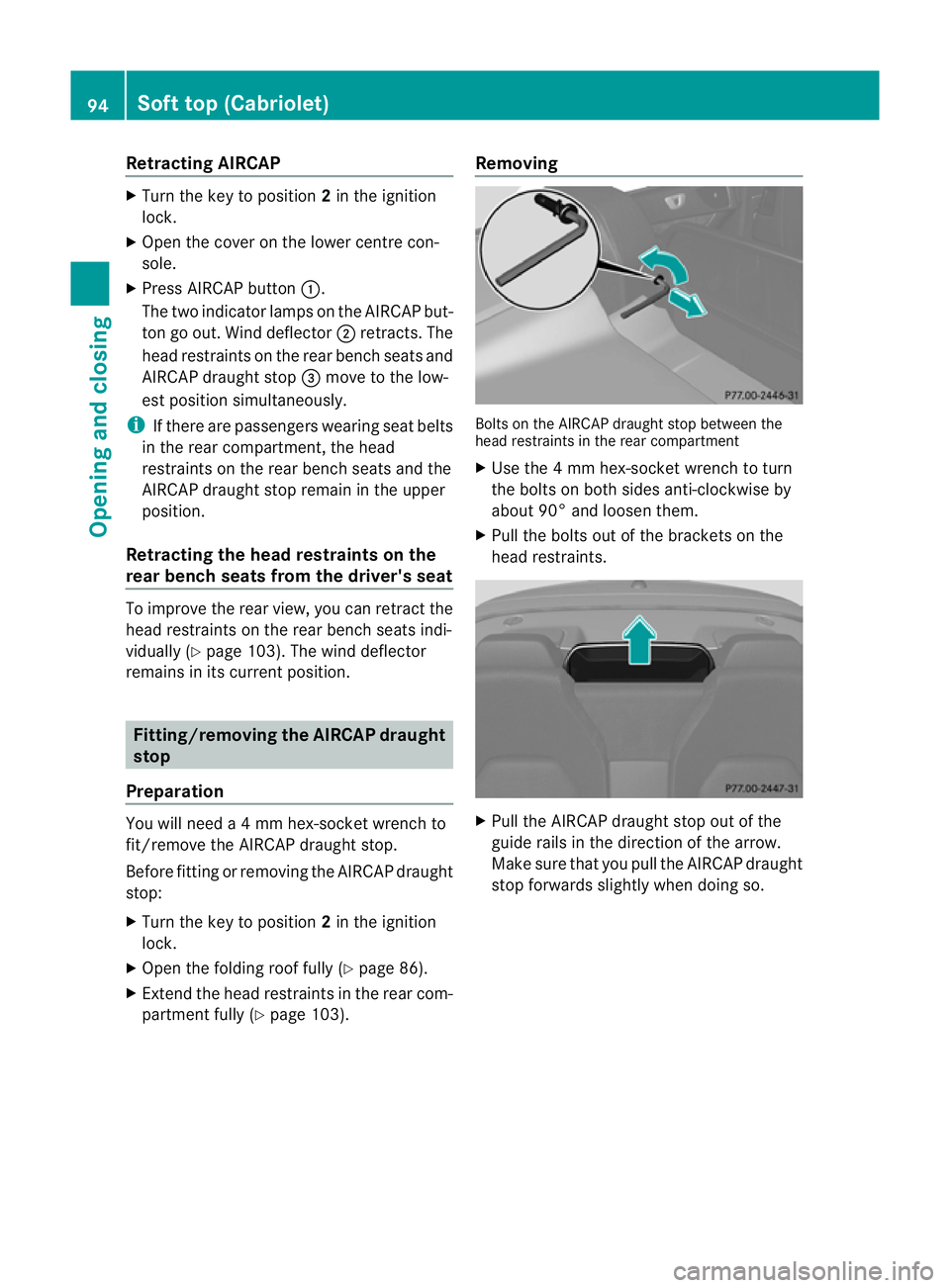
partment fully (Y page 103). Removing Bolt
sont he AIRCAP draught stop between the
head restraint sinthe rear compartment
X Use the 4mmhex-socket wrenc htoturn
the bolts on both sides anti-clockwise by
about 90° and loosen them.
X Pull the bolts out of the brackets on the
head restraints. X
Pull the AIRCAP draught stop out of the
guide rails in the direction of the arrow.
Make sure that you pull the AIRCAP draught
stop forwards slightly when doing so. 94
Soft top (Cabriolet)Opening and closing
Page 100 of 353
G
WARNING
The glass in the panorama sunroof could
brea kinana ccident. If yo uare not wearing a
sea tbelt, there is arisk that you could be
thrown through the opening in the event of the
vehicle overturning .Therefore, always wear a
seat belt to reduce the risk of injuries.
! Only open the panorama sliding sunroof
if it is free of snow and ice. Otherwise, mal-
functions may occur.
Do not allow anything to protrude from the
sliding sunroof. Otherwise, the seals could
be damaged.
i Resonance noises can occur in addition
to the usuala irflow noises when the sliding
sunroof is open. They are caused by minor
pressure fluctuations in the vehicle interior.
Change the position of the sliding sunroof
or open aside window slightly to reduce or
eliminate these noises. Operating the panoramas
liding sun-
roof
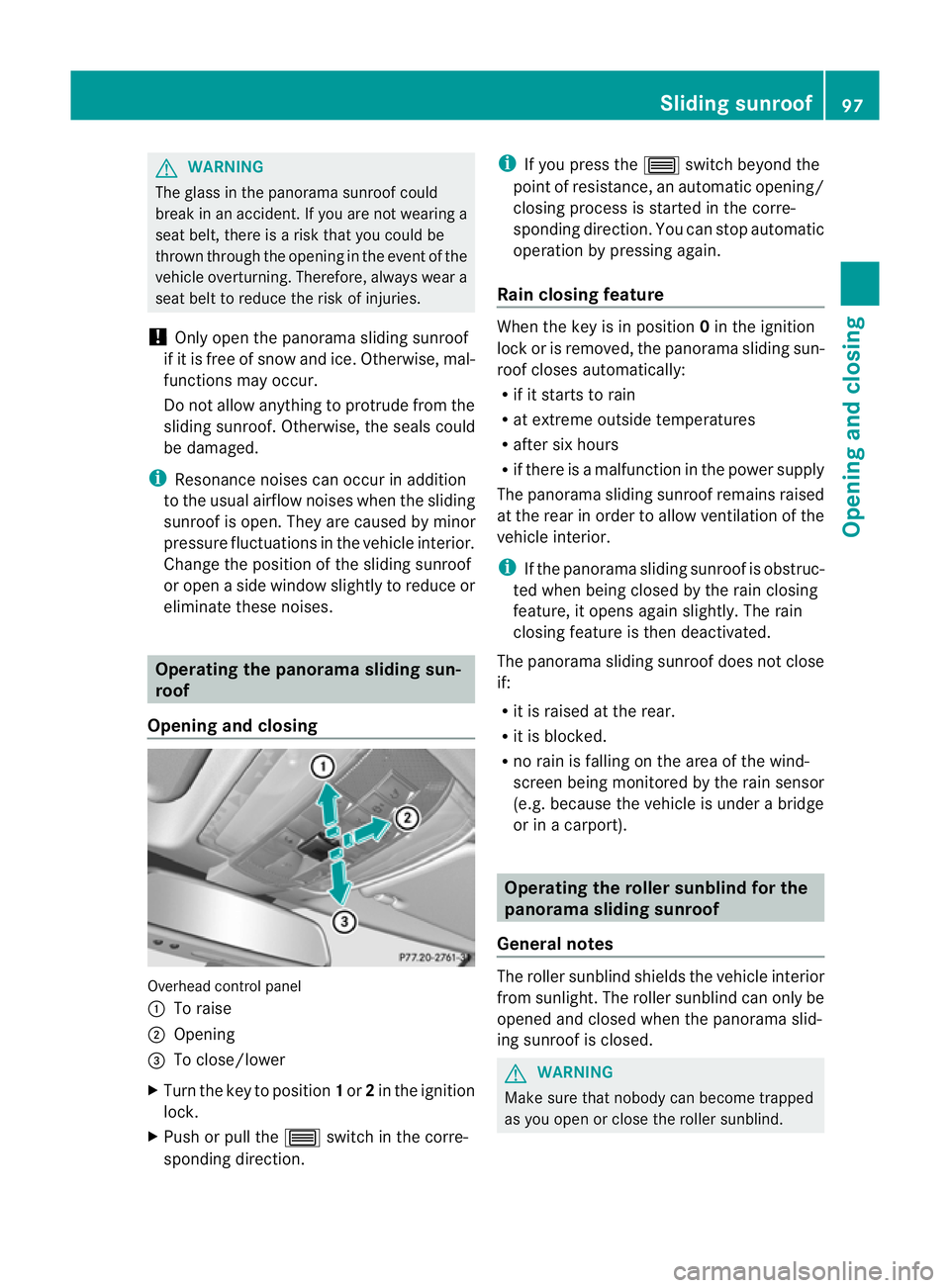
Opening and closing Overhead control panel
:
To raise
; Opening
= To close/lower
X Turn the key to position 1or 2in the ignition
lock.
X Push or pull the 3switch in the corre-
sponding direction. i
If you press the 3switch beyond the
point of resistance, an automatic opening/
closing process is started in the corre-
sponding direction. You can stop automatic
operation by pressing again.
Rain closing feature When the key is in position
0in the ignition
lock or is removed, the panorama sliding sun-
roof closes automatically:
R if it starts to rain
R at extreme outside temperatures
R after six hours
R if there is amalfunction in the power supply
The panorama sliding sunroof remains raised
at the rear in order to allow ventilation of the
vehicle interior.
i If the panorama sliding sunroof is obstruc-
ted when being closed by the rain closing
feature, it opens again slightly. The rain
closing feature is then deactivated.
The panorama sliding sunroof does not close
if:
R it is raised at the rear.
R it is blocked.
R no rain is falling on the area of the wind-
screen being monitored by the rain sensor
(e.g. because the vehicle is under abridge
or in acarport). Operating the roller sunblind for the
panoramas
liding sunroof
General notes The roller sunblin
dshields the vehicle interior
from sunlight. The roller sunblin dcan only be
opened and close dwhen the panorama slid-
ing sunroof is closed. G
WARNING
Make sure that nobody can becom etrapped
as you open or close the roller sunblind. Sliding sunroof
97Opening and closing Z
Page 103 of 353
Useful information
i This Owner's Manual describes all models
and all standard and optional equipment
available to your vehicle at the time of pub-
lication of the Owner's Manual. Country-
specific deviation sare possible. Please
not ethat your vehicle may not be equipped
with all feature sdescribed. This also
applies to safety-relevan tsystems and
functions.
i Pleas ereadt he information on qualified
specialist workshop s(Ypage 22). Correct driver's sea
tposition Observe th
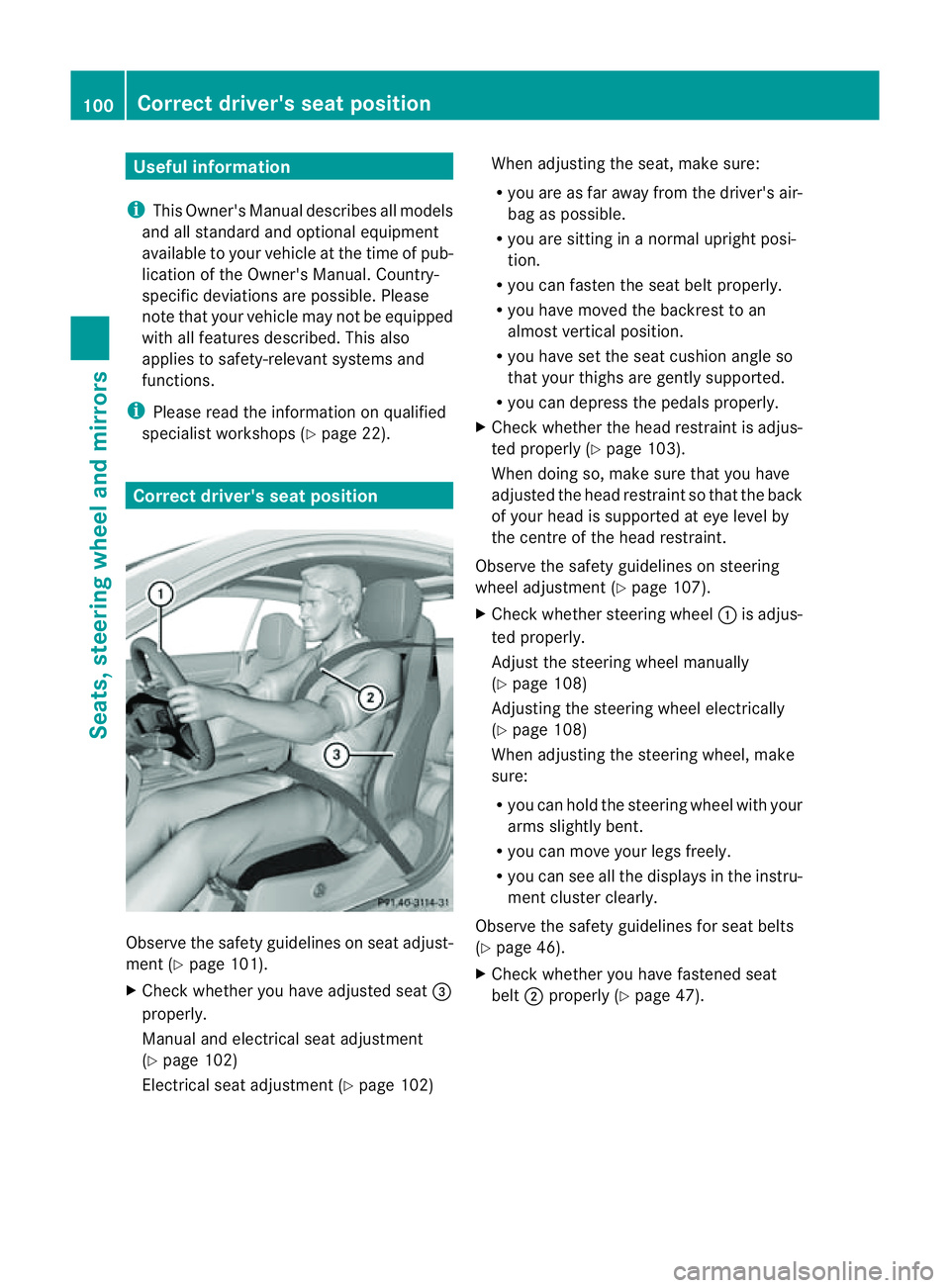
esafety guidelines on seat adjust-
men t(Ypage 101).
X Chec kwhether you have adjusted seat =
properly.
Manual and electrical seat adjustment
(Y page 102)
Electrical seat adjustment (Y page 102)When adjusting the seat, make sure:
R
you are as far away from the driver's air-
bag as possible.
R you are sitting in anormal upright posi-
tion.
R you can fasten the seat belt properly.
R you have moved the backrest to an
almost vertical position.
R you have set the seat cushion angle so
that your thighs are gently supported.
R you can depress the pedals properly.
X Check whether the head restraint is adjus-
ted properly (Y page 103).
When doing so, make sure that you have
adjusted the head restraint so that the back
of your head is supported at eye level by
the centre of the head restraint.
Observe the safety guidelines on steering
wheel adjustment (Y page 107).
X Check whether steering wheel :is adjus-
ted properly.
Adjust the steering wheel manually
(Y page 108)
Adjustingt he steering wheel electrically
(Y page 108)
When adjusting the steering wheel, make
sure:
R you can hold the steering wheel with your
arms slightly bent.
R you can move your legs freely.
R you can see all the displays in the instru-
ment cluster clearly.
Observe the safety guidelines for seat belts
(Y page 46).
X Check whether you have fastened seat
belt ;properly (Y page 47).100
Correct driver's seat positionSeats, steering wheela
nd mirrors
Page 104 of 353
The seat belt should:
R
fit snugly across your body
R be routed across the middle of your
shoulder
R be routed in your pelvic area across the
hip joints
X Before starting off, adjust the rear-view mir-
ror and the exterior mirrors (Y page 109)
in such away that you have agood view of
road and traffic conditions.
X Vehicles with amemor yfunction: save
the seat, steerin gwheel and exterior mirror
settings (Y page 112). Seats
Important safety notes
G
WARNING
The seats can still be adjusted when there is
no key in the ignition lock. For this reason,
children should never be left unsupervised in
the vehicle. They could adjust the seats and
become trapped. G
WARNING
Only adjust the driver's seat when the vehicle
is stationary. You will otherwise be distracted
from the road and traffic conditions and you
could lose control of the vehicle as aresult of
the seat moving. This could cause an acci-
dent. G
WARNING
If you adjust the seat height carelessly, you or
others could be trapped and thereby injured.
Children in particular could unintentionally
press the button stoelectrically adjust the
seats and become trapped.
Take care that:
R while moving the seats, your hands do not
get under the lever assembly of the seat
adjustmen tsystem.
R children in th evehicl edon ot slide their
hands under the levers. G
WARNING
Make sure that nobody can becom etrapped
when adjusting the seats.
Observe the notes on airbags.
Secure children as recommended; see the
"Children in the vehicle" section. G
WARNING
Make sure that the back of your head is sup-
ported at eye level by the central area of the
head restraint .Ifyour head is not supported
correctly by the head restraint ,you could suf-
fer asevere neck injury in the event of an
accident .Never drive if the head restraints are
not engaged and set correctly. G
WARNING
As eat belt can only offer its intended degree
of protection when the backrest is almost ver-
tical and the occupant is sitting upright. Avoid
seat position sthat do not allow the seat belt
to be routed correctly. Adjust the backrest so
that it is as upright as possible. Never travel
with the backrest reclined too far backwards.
You could otherwise be seriously or even
fatally injured in the event of an acciden tor
sudden braking.
! To avoid damage to the seats and the seat
heating, observe the following information:
R do not spill any liquids on the seats. If
liquid is spilled on the seats, dry them as
soon as possible.
R if the seat cover sare damp or wet, do not
switch on the seat heating. The seat
heating should also not be used to dry
the seats.
R clean the seat cover sasrecommended;
see the "Interior care" section.
R do not transport heavy loads on the
seats. Do not place sharp objects on the
seat cushions ,e.g. knives, nails or tools.
The seats should only be occupied by
passengers, if possible.
R when the seat heating is in operation ,do
not cover the seats with insulating mate- Seats
101Seats, steering wheel and mirrors Z
Page 106 of 353
position if it was previously in an unfavour-
able position.
i You can stor ethe seat settings using the
memor yfunction (Y page 112).
i Vehicles with the through-loading feature
and memor yfunction :ifyou fold down a
rear seat backrest, the respective front
seat is moved forwards slightly if neces-
sary.
i Vehicles with memor yfunction :when the
seat is moved forwards or backwards, the
headrest is moved up or down automati-
cally. Adjusting the head restraints
Adjusting the head restraints manually Adjusting the head restraint height
X
To raise: pull the head restraint up to the
desired position.
X To lower: press release catch :and push
the head restraint down to the desired posi-
tion.
Adjusting the head restraints electri-
cally X
To adjust the head restraint height: slide
the switch for head restraint adjustment
(Y page 102) up or down in the direction of
the arrow. Rear seat head restraints Lowering and extending the rear seat
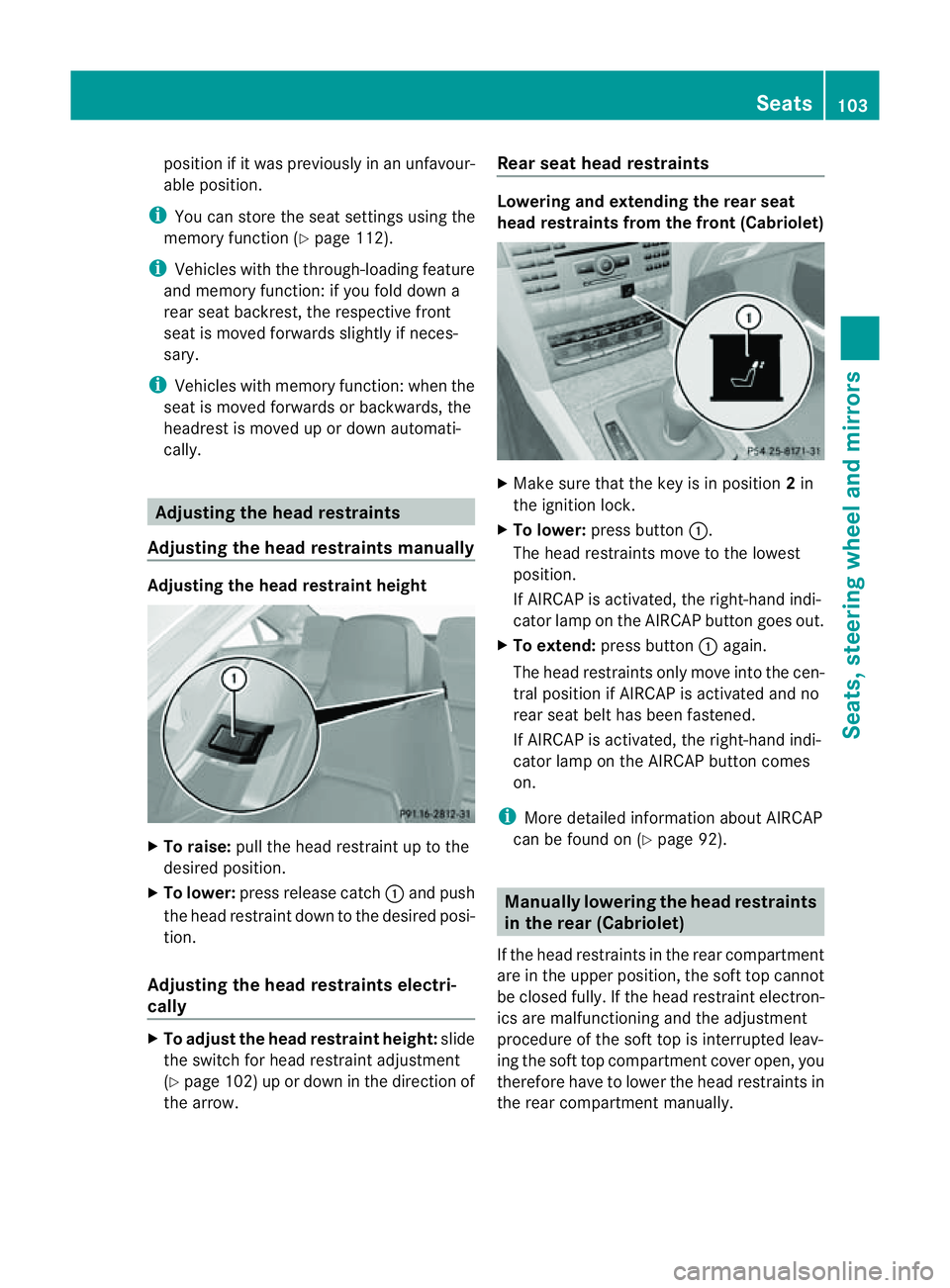
head restraints from the front (Cabriolet)
X
Make sure that the key is in position 2in
the ignition lock.
X To lower: press button :.
The head restraintsm ove to the lowest
position.
If AIRCAP is activated, the right-hand indi-
cator lamp on the AIRCAP button goes out.
X To extend: press button :again.
The head restraintso nly move into the cen-
tral position if AIRCAP is activated and no
rear seat belt has been fastened.
If AIRCAP is activated, the right-hand indi-
cator lamp on the AIRCAP button comes
on.
i More detailed information about AIRCAP
can be found on (Y page 92). Manually lowering the head restraints
in the rear (Cabriolet)
If the head restraintsint he rear compartment
are in the upper position, the soft top cannot
be closed fully.Ift he head restraint electron-
ics are malfunctionin gand the adjustment
procedure of the soft top is interrupted leav-
ing the soft top compartmentc over open, you
therefor ehave to lower the head restraints in
the rear compartment manually. Seats
103Seats, steering wheel and mirrors Z
Page 153 of 353
G
WARNING
Never leave the vehicl ewhen it is held by hill
start assist. After approximatel yone second,
hills tart assist willnol onger brake yourv ehi-
cle and it could roll away.
X Take your foot off the brake pedal.
i Oncey ou have taken your foot off the
brake pedal, the vehicle is held for around
one second.
X Pull away.
Hill start assist will not function if:
R you are pulling away on alevel road or a
downhill gradient.
R on vehicles with automatic transmission,
the transmission is in position N.
R the parking brake is applied.
R ESP ®
is malfunctioning. ECO start/stop function
General notes The ECO start/stop function is only available
for the
E200 CGI BlueEFFICIENCY model with
manual transmission.
The ECO start/stop function switches the
engine off automatically in certain situations.
The engine start sautomatically when you pull
away again. The ECO start/stop function
thereby helps you to reduce the fuel con-
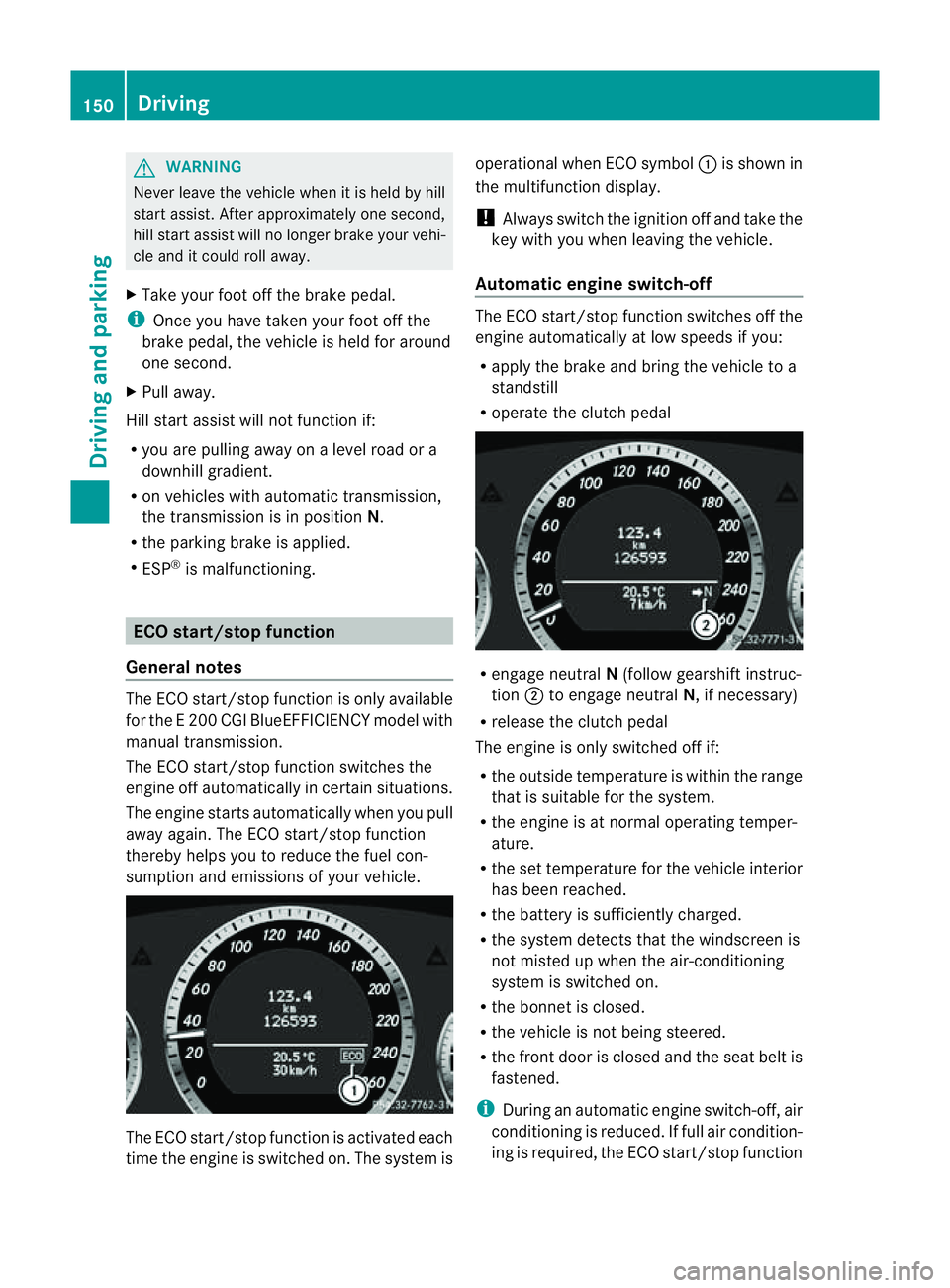
sumption and emissions of your vehicle. The ECO start/stop function is activated each
time the engine is switched on. The system is operational when ECO symbol
:is shown in
the multifunction display.
! Always switch the ignition off and take the
key with you when leaving the vehicle.
Automatic engine switch-off The ECO start/stop function switches off the
engine automatically at low speeds if you:
R
apply the brake and bring the vehicle to a
standstill
R operate the clutc hpedal R
engage neutral N(follow gearshift instruc-
tion ;to engage neutral N,ifnecessary)
R release the clutc hpedal
The engine is only switched off if:
R the outside temperature is within the range
that is suitable for the system.
R the engine is at normal operatin gtemper-
ature.
R the set temperature for the vehicle interior
has been reached.
R the batter yissufficiently charged.
R the system detects that the windscreen is
not misted up when the air-conditioning
system is switched on.
R the bonnet is closed.
R the vehicle is not being steered.
R the fron tdoor is closed and the seat belt is
fastened.
i During an automatic engine switch-off, air
conditioning is reduced. If full air condition-
ing is required, the ECO start/stop function 150
DrivingDriving and parking
Page 154 of 353
can be switched off with the ECO button
(Y page 151).
Automatic engine start If the engine ha
sbeens witched off by the
ECO start/stop function ,itrestart sautomat-
ically if you:
R depress th eclutch pedal
R depress th eaccelerator pedal
The engine is started automatically if:
R theE CO start/stop function is deactivated
by pressin gthe ECO button.
R thev ehicle start storoll.
R theb rak esystem requires this.
R thes ystem detect smoistur eont he wind-
screen when the air-conditioning system is
switched on.
R the battery's charge status is too low.
R the driver's seat belt is removed or the driv-
er's door is opened.
R you steer the vehicle.
! Only engage gear when the clutch pedal
is depressed.
Deactivating/activating the ECO start/
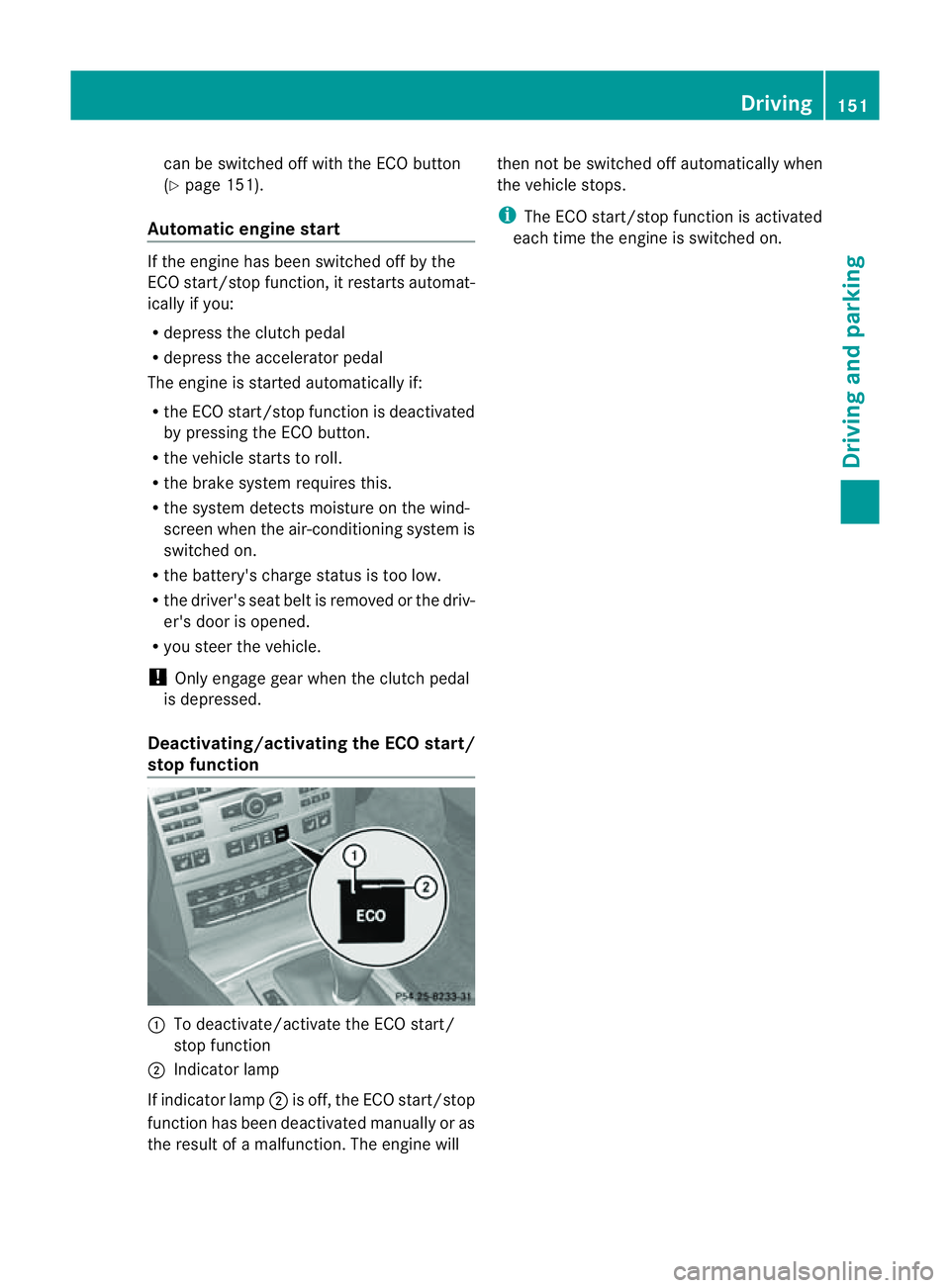
stop function :
To deactivate/activate the ECO start/
stop function
; Indicator lamp
If indicator lamp ;is off, the ECO start/stop
function has been deactivated manually or as
the result of amalfunction. The engine will then not be switched off automatically when
the vehicle stops.
i
The ECO start/stop function is activated
each time the engine is switched on. Driving
151Driving and parking Z