weight MERCEDES-BENZ E-CLASS CABRIOLET 2011 Owners Manual
[x] Cancel search | Manufacturer: MERCEDES-BENZ, Model Year: 2011, Model line: E-CLASS CABRIOLET, Model: MERCEDES-BENZ E-CLASS CABRIOLET 2011Pages: 353, PDF Size: 8.42 MB
Page 22 of 353
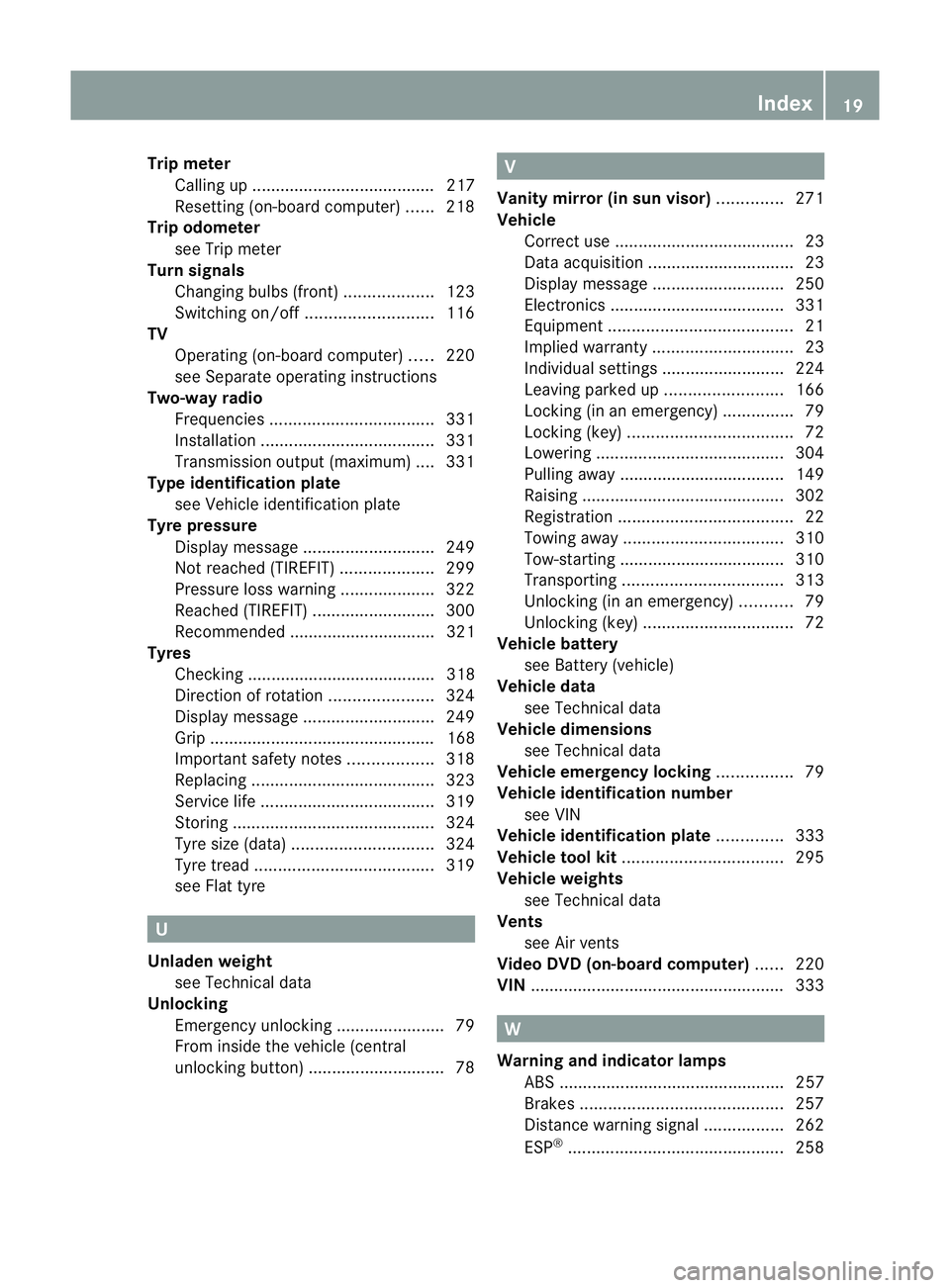
Trip meter
Calling up ....................................... 217
Resetting (on-boar dcomputer) ......218
Trip odometer
see Trip meter
Turn signals
Changing bulbs (front) ...................123
Switching on/off ........................... 116
TV
Operating (on-board computer) .....220
see Separate operating instructions
Two-way radio
Frequencies ................................... 331
Installatio n..................................... 331
Transmission output (maximum ).... 331
Type identification plate
see Vehicle identification plate
Tyre pressure
Display message ............................ 249
Not reached (TIREFIT) ....................299
Pressure loss warning ....................322
Reached (TIREFIT) ..........................300
Recommended ............................... 321
Tyres
Checking ........................................ 318
Directio nofrotation ...................... 324
Display message ............................ 249
Gri p................................................ 168
Important safety notes ..................318
Replacing ....................................... 323
Service life ..................................... 319
Storing ........................................... 324
Tyr esize (data) .............................. 324
Tyr etread ...................................... 319
see Flat tyre U
Unladen weight see Technical data
Unlocking
Emergency unlocking .......................79
From insid ethe vehicle (central
unlocking button) ............................. 78 V
Vanity mirror (in sun visor) ..............271
Vehicle Correct use ...................................... 23
Data acquisition ............................... 23
Display message ............................ 250
Electronics ..................................... 331
Equipment ....................................... 21
Implied warranty .............................. 23
Individua lsettings .......................... 224
Leaving parked up .........................166
Locking (in an emergency) ...............79
Locking (key )................................... 72
Lowering ........................................ 304
Pulling away ................................... 149
Raising ........................................... 302
Registration ..................................... 22
Towing away .................................. 310
Tow-starting ................................... 310
Transporting .................................. 313
Unlocking (in an emergency) ...........79
Unlocking (key )................................ 72
Vehicle battery
see Battery (vehicle)
Vehicle data
see Technical data
Vehicle dimensions
see Technical data
Vehicle emergency locking ................79
Vehicle identification number see VIN
Vehicle identification plate ..............333
Vehicle tool kit .................................. 295
Vehicle weights see Technical data
Vents
see Air vents
Video DVD (on-board computer) ......220
VIN ...................................................... 333 W
Warning and indicator lamps ABS ................................................ 257
Brakes ........................................... 257
Distance warning signa l................. 262
ESP ®
.............................................. 258 Index
19
Page 23 of 353
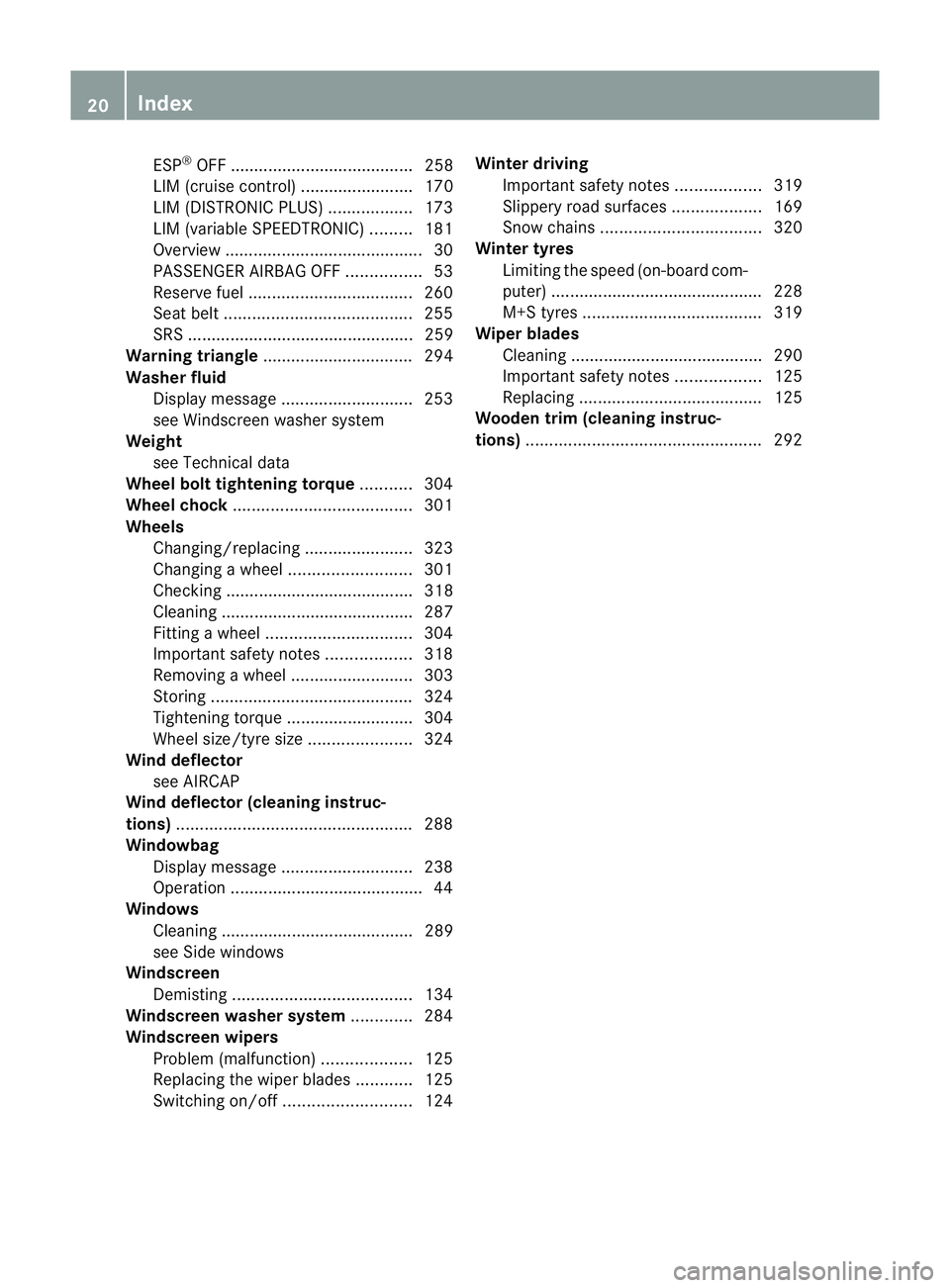
ESP
®
OFF ....................................... 258
LIM (cruise control) ........................ 170
LIM (DISTRONI CPLUS) .................. 173
LIM (variable SPEEDTRONIC )......... 181
Overview .......................................... 30
PASSENGER AIRBAG OFF ................53
Reserve fuel ................................... 260
Seat bel t........................................ 255
SRS ................................................ 259
Warning triangle ................................ 294
Washer fluid Display message ............................ 253
see Windscreen washer system
Weight
see Technical data
Whee lboltt ightening torque ...........304
Whee lchock ...................................... 301
Wheels Changing/replacing .......................323
Changing awheel .......................... 301
Checking ........................................ 318
Cleaning ......................................... 287
Fitting awheel ............................... 304
Important safety notes ..................318
Removing awheel .......................... 303
Storing ........................................... 324
Tightening torqu e........................... 304
Whee lsize/tyre size ...................... 324
Wind deflector
see AIRCAP
Wind deflector (cleaning instruc-
tions) .................................................. 288
Windowbag Display message ............................ 238
Operation ........................................ .44
Windows
Cleaning ......................................... 289
see Side windows
Windscreen
Demisting ...................................... 134
Windscreen washe rsystem ............. 284
Windscree nwipers
Problem (malfunction) ...................125
Replacing the wiper blades ............125
Switching on/off ........................... 124Winte
rdriving
Important safety note s.................. 319
Slippery road surfaces ...................169
Snow chains .................................. 320
Winte rtyres
Limiting the spee d(on-board com-
puter) ............................................. 228
M+S tyres ...................................... 319
Wiper blades
Cleaning ......................................... 290
Important safety notes ..................125
Replacing ....................................... 125
Wooden trim (cleaning instruc-
tions) .................................................. 29220
Index
Page 24 of 353
Protection of the environment
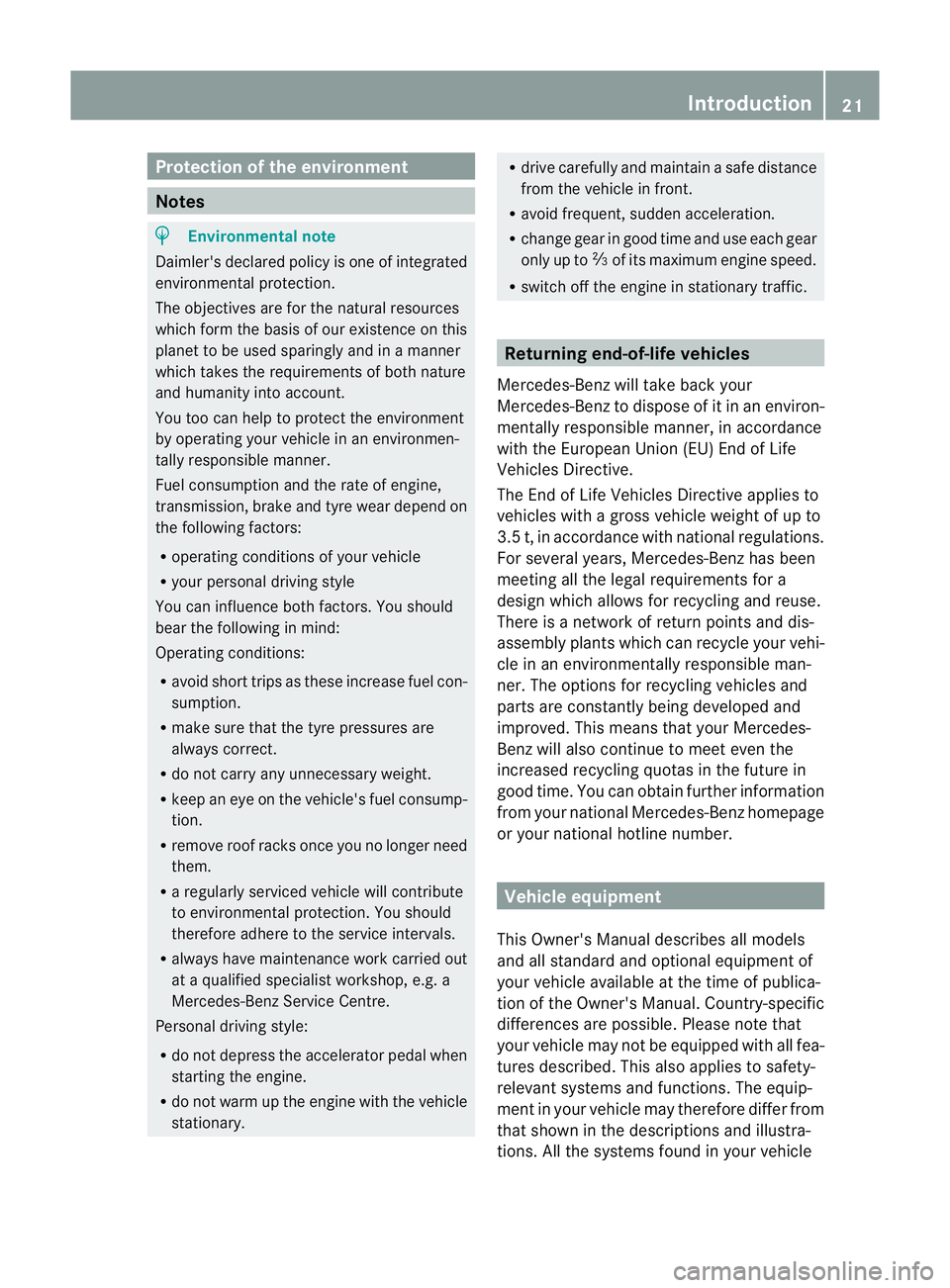
Notes
H
Environmental note
Daimler's declared policy is one of integrated
environmental protection.
The objectives are for the natural resources
which form the basis of our existence on this
planet to be used sparingly and in amanner
which takes the requirements of both nature
and humanity into account.
You too can help to protect the environment
by operating your vehicle in an environmen-
tally responsible manner.
Fuel consumption and the rate of engine,
transmission, brake and tyre wear depend on
the following factors:
R operating condition sofyour vehicle
R your personal driving style
You can influence both factors. You should
bear the following in mind:
Operating conditions:
R avoid short trips as these increase fuel con-
sumption.
R make sure that the tyre pressures are
always correct.
R do not carry any unnecessary weight.
R keep an eye on the vehicle's fuel consump-
tion.
R remove roof racks once you no longer need
them.
R ar egularly serviced vehicle will contribute
to environmental protection. You should
therefore adhere to the service intervals.
R always have maintenance work carried out
at aq ualified specialist workshop, e.g. a
Mercedes-Benz Service Centre.
Personal driving style:
R do not depress the accelerator pedal when
startingt he engine.
R do not warm up the engine with the vehicle
stationary. R
drive carefully and maintain asafe distance
from the vehicle in front.
R avoid frequent, sudden acceleration.
R change gear in good time and use each gear
only up to Ôof its maximum engine speed.
R switch off the engine in stationary traffic. Returning end-of-life vehicles
Mercedes-Benz will take back your
Mercedes-Benz to dispose of it in an environ-
mentally responsible manner, in accordance
with the European Union (EU) End of Life
Vehicles Directive.
The End of Life Vehicles Directive applies to
vehicles with agross vehicle weight of up to
3.5 t, in accordance with national regulations.
For several years, Mercedes-Benz has been
meeting all the legal requirements for a
design which allowsf or recycling and reuse.
There is anetwork of return points and dis-
assembly plants which can recycle your vehi-
cle in an environmentally responsible man-
ner. The options for recycling vehicles and
parts are constantly being developed and
improved. This means that your Mercedes-
Benz will also continue to meet even the
increased recycling quotas in the future in
good time. You can obtain further information
from your national Mercedes-Benz homepage
or your national hotline number. Vehicle equipment
This Owner's Manual describes all models
and all standard and optional equipment of
your vehicle available at the time of publica-
tion of the Owner's Manual. Country-specific
differences are possible. Please note that
your vehicle may not be equipped with all fea-
tures described. This also applies to safety-
relevant systems and functions. The equip-
ment in your vehicle may therefore differ from
that shown in the descriptions and illustra-
tions. All the systems found in your vehicle Introduction
21 Z
Page 54 of 353
Children in th
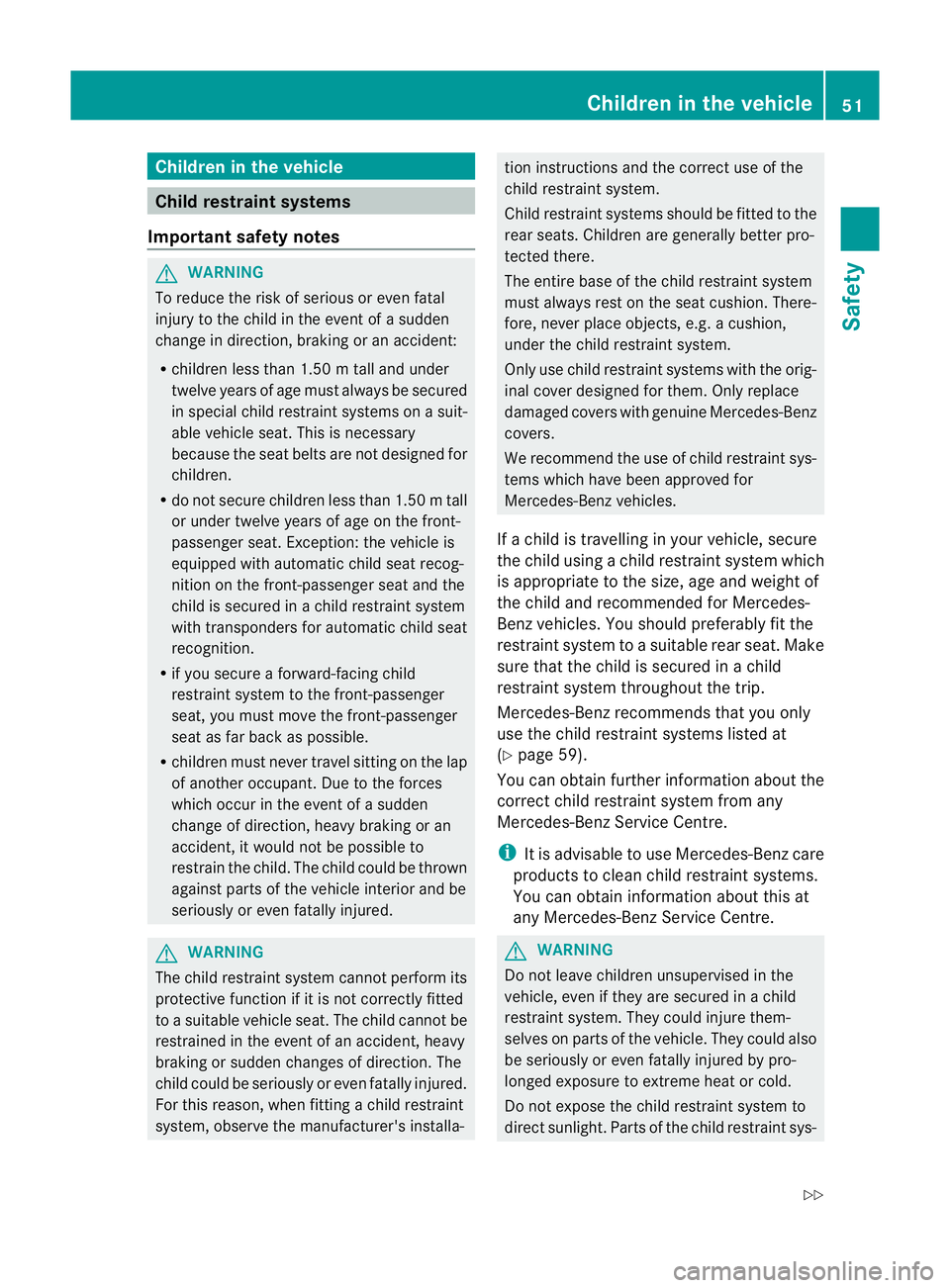
evehicle Child restraint systems
Important safety notes G
WARNING
To reduc ethe riskofs erious or even fatal
injury to the child in the event of asudden
change in direction, braking or an accident:
R children less than 1.50mt all and under
twelve years of age must alway sbesecured
in special child restraint systems on asuit-
able vehicle seat. This is necessary
because the seat belts are not designed for
children.
R do not secure children less than 1.50mt all
or unde rtwelve years of age on th efront-
passenger seat .Exception: the vehicl eis
equipped with automatic child sea trecog-
nition on the front-passenger seat and the
child is secured in achild restraint system
with transponders for automatic child seat
recognition.
R if you secure aforward-facing child
restraint system to the front-passenger
seat, you must move the front-passenger
seat as far back as possible.
R children must never travel sitting on the lap
of another occupant .Due to the forces
which occur in the event of asudden
change of direction, heavy braking or an
accident, it would not be possible to
restrain the child. The child could be thrown
against parts of the vehicle interior and be
seriously or even fatally injured. G
WARNING
The child restraint system cannot perform its
protective function if it is not correctly fitted
to as uitable vehicle seat. The child cannot be
restrained in the event of an accident, heavy
braking or sudden changes of direction. The
child could be seriously or even fatally injured.
For this reason, when fitting achild restraint
system, observe the manufacturer's installa- tion instructions and the correct use of the
child restraint system.
Child restraint systems should be fitted to the
rear seats. Children are generally better pro-
tected there.
The entire base of the child restraint system
must alway
srest on the seat cushion. There-
fore, never place objects, e.g. acushion,
under the child restraint system.
Only use child restraint systems with the orig-
inal cover designed for them. Only replace
damaged cover swith genuine Mercedes-Benz
covers.
We recommend the use of child restraint sys-
tems which have been approved for
Mercedes-Benz vehicles.
If ac hild is travellin ginyour vehicle, secure
the child using achild restraint system which
is appropriate to the size, age and weight of
the child and recommended for Mercedes-
Benz vehicles. You should preferably fit the
restraint system to asuitable rear seat. Make
sure that the child is secured in achild
restraint system throughout the trip.
Mercedes-Benz recommends that you only
use the child restraint systems listed at
(Y page 59).
You can obtain further information about the
correct child restraint system from any
Mercedes-Benz Service Centre.
i It is advisable to use Mercedes-Benz care
product stoclean child restraint systems.
You can obtain information about this at
any Mercedes-Benz Service Centre. G
WARNING
Do not leave children unsupervised in the
vehicle, even if they are secured in achild
restraint system. They could injure them-
selves on parts of the vehicle. They could also
be seriously or even fatally injured by pro-
longed exposure to extreme heat or cold.
Do not expose the child restraint system to
direct sunlight. Parts of the child restraint sys- Children in the vehicle
51Safety
Z
Page 60 of 353
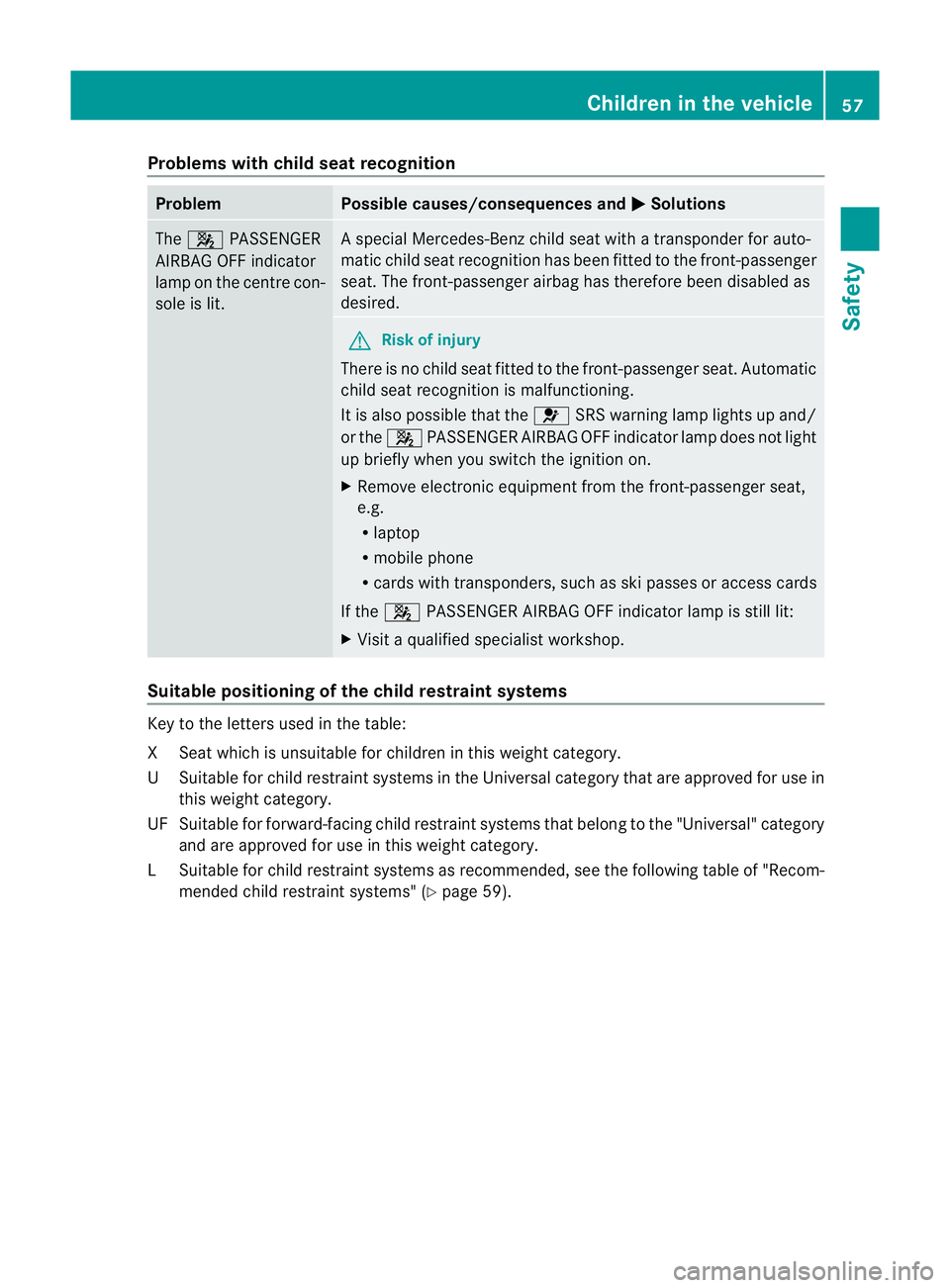
Problems with child seat recognition
Problem Possible causes/consequences and
M Solutions
The
4 PASSENGER
AIRBAGO FF indicator
lamp on the centre con-
sole is lit. As
pecial Mercedes-Benz child seat with atransponder for auto-
matic child seat recognition has been fitted to the front-passenger
seat. The front-passenger airbag has therefore been disabled as
desired. G
Risk of injury
There is no child seat fitted to the front-passenger seat. Automatic
child seat recognition is malfunctioning.
It is also possible that the 6SRS warning lamp lights up and/
or the 4PASSENGER AIRBAG OFF indicator lamp does not light
up briefly when you switc hthe ignition on.
X Remove electronic equipment from the front-passenger seat,
e.g.
R
laptop
R mobile phone
R cards with transponders, such as ski passes or access cards
If the 4 PASSENGER AIRBAG OFF indicator lamp is still lit:
X Visit aqualified specialist workshop. Suitable positioning of the child restraint systems
Key to the letters used in the table:
XS
eat which is unsuitable for children in this weight category.
US uitable for child restraint systems in th eUniversal categor ytha ta re approve dfor use in
this weigh tcategory.
UF Suitable for forward-facing child restraint systems that belon gtothe"Universal" category
and are approved for use in this weigh tcategory.
LS uitable for child restraint systems as recommended, see th efollowin gtable of "Recom-
mended child restraint systems "(Ypage 59). Children in th
evehicle
57Safety Z
Page 61 of 353
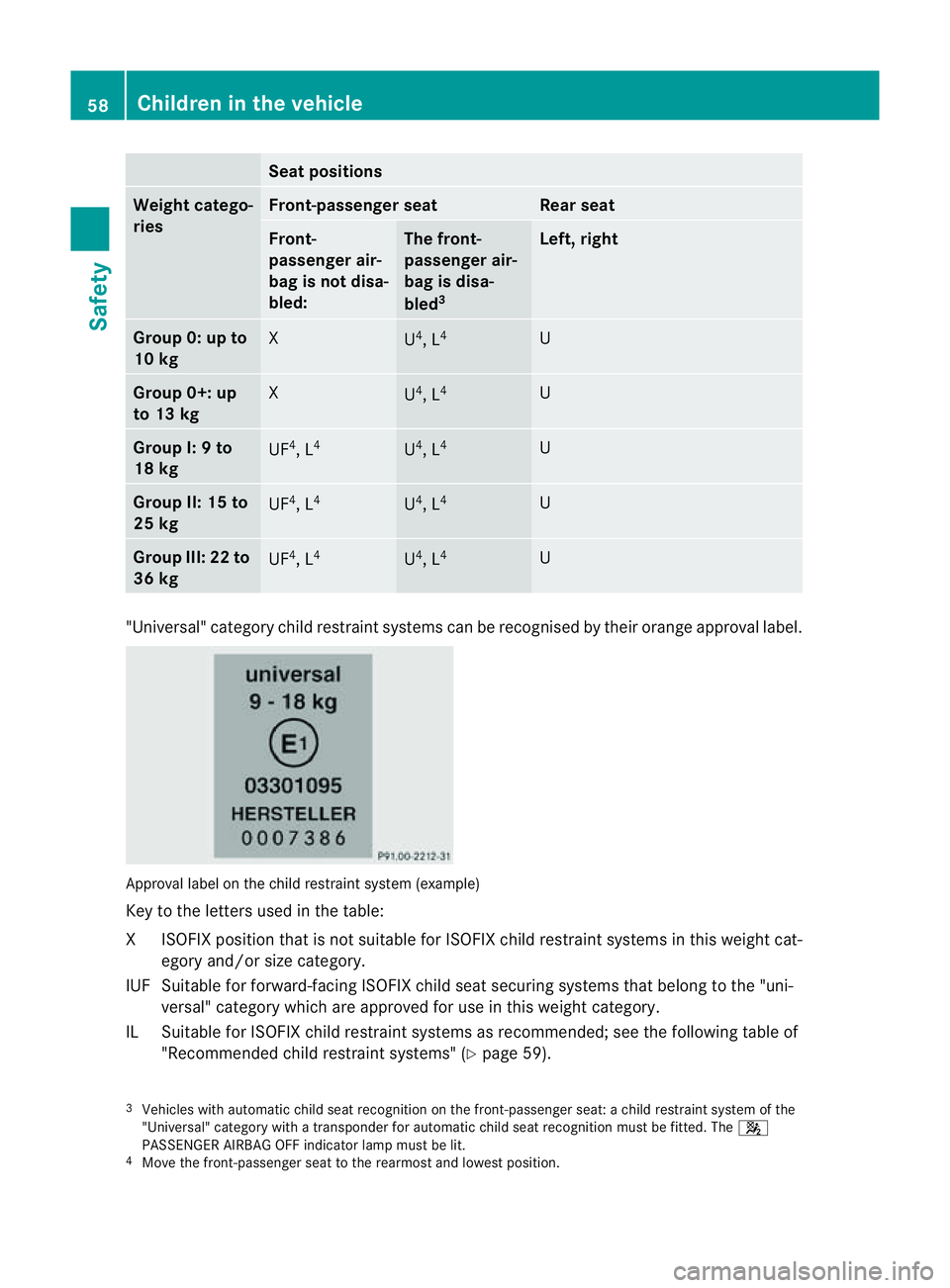
Seat positions
Weight catego-
ries Front-passenger seat Rear seat
Front-
passenger air-
bag is not disa-
bled: The front-
passenger air-
bag is disa-
bled
3 Left, right
Group 0: up to
10 kg
X
U
4
,L 4 U
Group 0+: up
to 13 kg
X
U
4
,L 4 U
Group I:
9to
18 kg UF
4
,L 4 U
4
,L 4 U
Group II: 15 to
25 kg
UF
4
,L 4 U
4
,L 4 U
Group III:22to
36 kg
UF
4
,L 4 U
4
,L 4 U
"Universal" category child restraint systems can be recognised by their orange approval label.
Approval label on the child restraint system (example)
Key to the letters used in the table:
XI
SOFIX position tha tisnot suitablef or ISOFIX child restraint systems in this weight cat-
egory and/or size category.
IUF Suitable for forward-facing ISOFIX child seat securing systems that belong to the "uni- versal" category which are approved for use in this weight category.
IL Suitable for ISOFIX child restraint systems as recommended; see the following table of "Recommended child restraint systems" (Y page 59).
3 Vehicles with automatic child seat recognition on the front-passenger seat: achild restraint system of the
"Universal" category with atransponder for automatic child seat recognition must be fitted. The 4
PASSENGER AIRBAG OFF indicator lamp must be lit.
4 Move the front-passenger seat to the rearmost and lowest position. 58
Children in the vehicleSafety
Page 62 of 353

Suitability of the rea
rseats for attaching ISOFIX child restraint systems Weight categories Size category Equipment Rear seat, left and
right
Carry-cot
F ISO/L1 X
G ISO/L2 X
0: up to 10 kg
up to approximately 6
months
E ISO/R1 IL
0+: up to 13 kg
up to approximately
15 months
E ISO/R1 IL
D ISO/R2 IL
C ISO/R3 IL
I:
9to18kg
between approx-
imately 9month sand
4y ears D ISO/R2 IL
C ISO/R3 IL
B ISO/F2 IUF
B1 ISO/F2X IUF
A ISO/F3 IUF
Recommended child restraint systems
If you fit
achild restraint system without atransponder for automatic child seat recognition
to the front-passenger seat, position the front-passenger seat in its rearmost position. Weight catego-
ries Manufac-
turer Type Approval
number
(E1 ...) Order num-
ber
(A 000 ...) Automatic
child seat
recognition
Group 0: up to
10 kg
up to approx-
imately 6
months Britax
Römer BABY
SAFE
PLUS 03 301146
04 301146 970 10 00 Yes
Group 0+: up
to 13 kg
up to approx-
imately 15
months Britax
Römer BABY
SAFE
PLUS 03 301146
04 301146 970 10 00 Yes
Group I:
9to
18 kg
between
approximately Britax
Römer DUO
PLUS 03 301133
04 301133 970 11 00 YesChildren in thev
ehicle
59Safety Z
Page 63 of 353
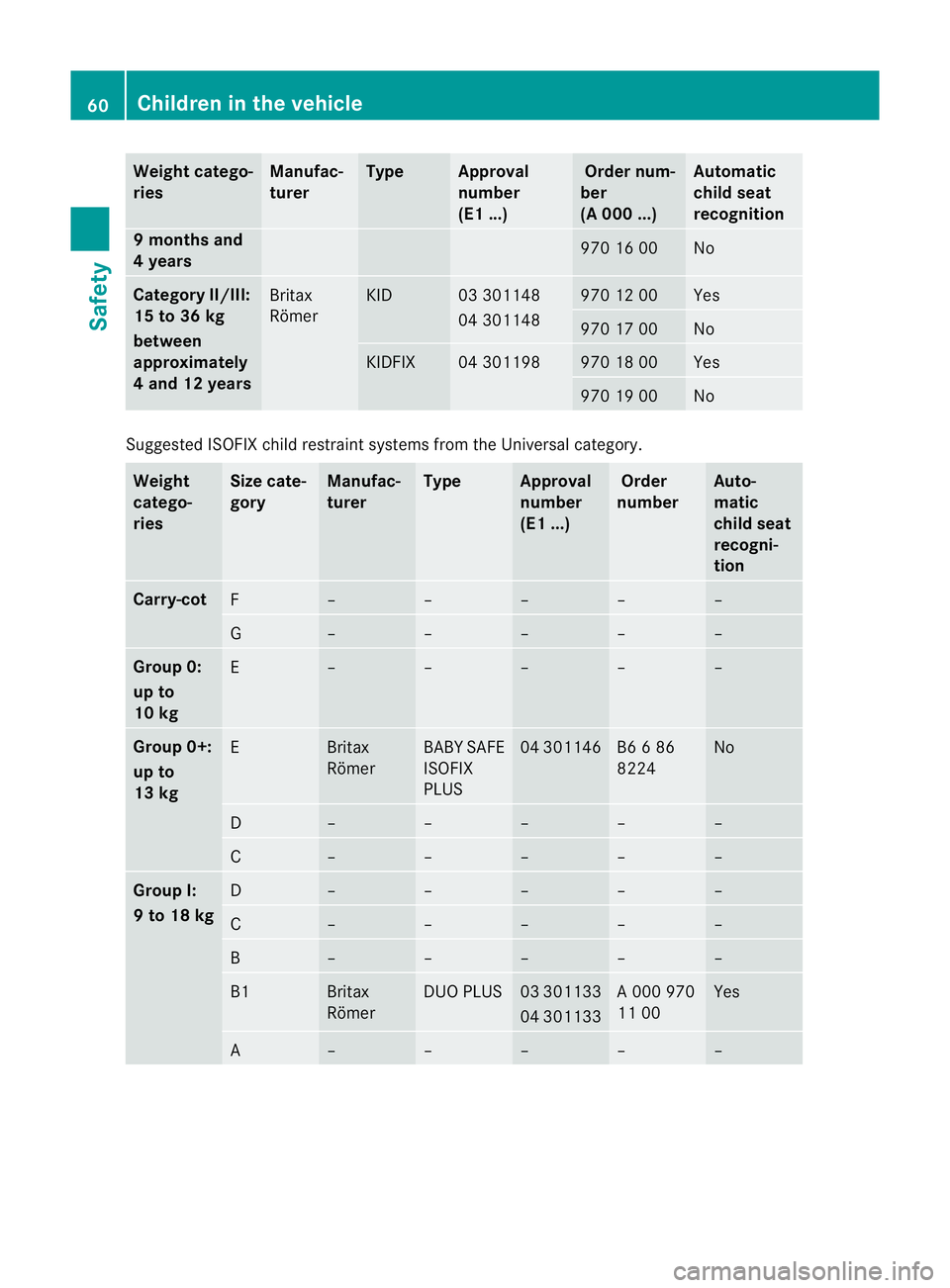
Weight catego-
ries Manufac-
turer Type Approval
number
(E1 ...) Order num-
ber
(A 000 ...) Automatic
chil
dseat
recognition 9m
onths and
4y ears 97
01600 No
Category II/III:
15 to 36 kg
between
approximately
4a
nd 12 years Britax
Römer KID 03 301148
04 301148 97
01200 Yes
97
01700 No
KIDFIX 04 301198 97
01800 Yes
97
01900 No
Suggested ISOFI
Xchildr estrain tsystems from th eUniversal category. Weight
catego-
ries Siz
ec ate-
gory Manufac-
turer Type Approval
number
(E1 ...) Order
number Auto-
matic
chil
dseat
recogni-
tion Carry-cot
F – – – – –
G – – – – –
Group 0:
up to
10 kg
E – – – – –
Group 0+:
up to
13 kg
E Britax
Römer BABY SAFE
ISOFIX
PLUS 04 301146 B6
686
8224 No
D – – – – –
C – – – – –
Group I:
9to18kg
D – – – – –
C – – – – –
B – – – – –
B1 Britax
Römer DU
OP LUS 03 301133
04 301133 A0
00970
11 00 Yes
A – – – – –60
Children in th
evehicleSafety
Page 75 of 353
Useful information
i This Owner's Manual describes all models
and all standard and optional equipment
available to your vehicle at the time of pub-
lication of the Owner's Manual. Country-
specific deviation sare possible. Please
not ethat your vehicle may not be equipped
with all feature sdescribed. This also
applies to safety-relevan tsystems and
functions.
i Pleas ereadt he information on qualified
specialist workshop s(Ypage 22). Key
Key functions
Locking an dunlocking centrally The key centrally locks/unlocks:
R
the doors
R the boot lid
R the fuel filler flap G
WARNING
Only for the United Kingdom: if the vehicle
has been locked with the key, the double lock
function is activated as standard. It is then not
possible to open the doors from inside the
vehicle.
Therefore, do not leave any people behind in
the vehicle, particularly children ,elderly peo-
ple or people in need of special assistanc eif
the vehicle has been locked with the key. As
ar esult, they may not be able to free them-
selves in the event of an emergency. As a
result, they could be seriously or even fatally
injured by prolonged exposure to extremely
high or low temperatures, for example. In this
case, rescuin gpeople from outside the vehi-
cle is difficult.
Deactivate the interior motion sensor before
you lock the vehicle with the key. The doors
can then be opened from the inside after the vehicle has been locked from the outside with
the key.
G
WARNING
If children are left unsupervised in the vehicle,
they could:
R open adoor from inside the vehicle at any
time, even if it has been locked
R start the vehicle using akey which has been
left in the vehicle
R release the parking brake
They could thereby endanger themselves and
others. Never leave children unsupervised in
the vehicle. Always take the key with you
when leaving the vehicle, even if you are only
leaving it for ashort time. G
WARNING
If ak ey ring is too heavy or too large, the
weight actin gonthe key could cause it to turn
in the ignition lock or catc honthe steering
wheel. This could cause the engine to be
switched off suddenly. You may lose control
of the vehicle and cause an accident. Do not
attac hany heavy or large key rings to the key
that is inserted in the ignition. :
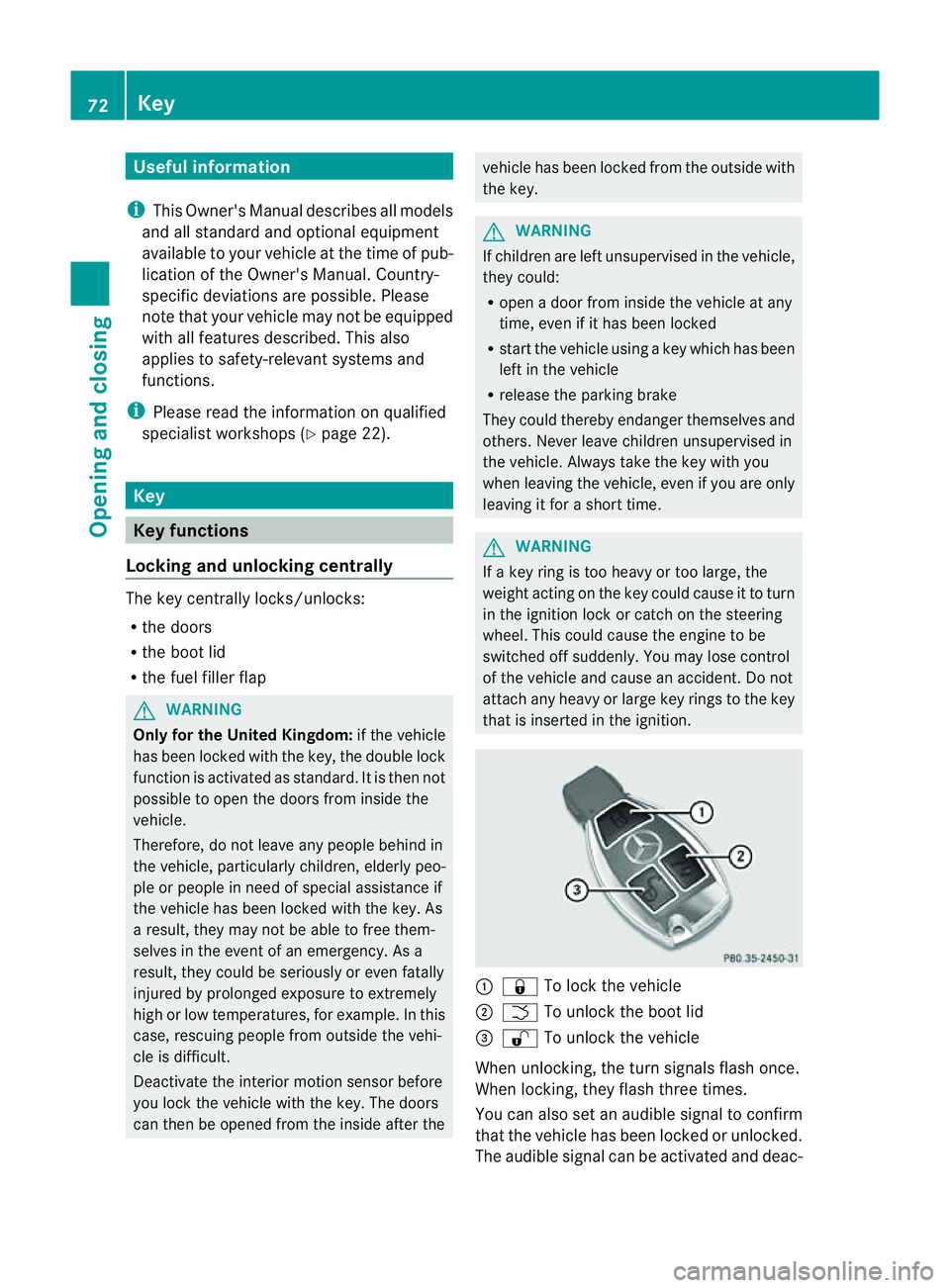
& To lock the vehicle
; F To unlock the boot lid
= % To unlock the vehicle
When unlocking, the turn signals flash once.
When locking, they flash three times.
You can also set an audible signal to confirm
that the vehicle has been locked or unlocked.
The audible signal can be activated and deac- 72
KeyOpening and closing
Page 208 of 353
Make sure that the following values are not
exceeded:
R the permissible trailer drawbar noseweight
R the permissible trailer load
R the permissible rear axle load of the towing
vehicle
R the maximum permissible gross vehicle
weight of both the towing vehicle and the
trailer
You will find the applicable permissible val-
ues, which must not be exceeded, in the vehi-
cle documents.
You will find the values approved by the man-
ufacturer on the vehicle identification plates
and those for the towing vehicle in the "Tech-
nical data" section. G
WARNING
If the Check trailer hitch locking mechanism message appears in the multi-
function display while the vehicle is in motion,
pull over immediately and check whether the
ball coupling is correctly engaged. G
WARNING
Always observe the maximum speed permit-
ted in Germany for vehicle/trailer combina-
tions, even in countries where higher speeds
are permitted. This lowers the risk of an acci-
dent. G
WARNING
Never depress the brake pedal continuously
while the vehicle is in motion, e.g. never cause
the brakes to rub by applying constant slight
pedal pressure. This causes the brake system
to overheat, increases the braking distance
and can lead to the brakes failing completely. G
WARNING
On no account should you attempt to draw the
vehicle/trailer combination out by increasing
speed. General information i
When towing atrailer, set the tyre pres-
sure on the rear axle of the towing vehicle
for am aximum load; see the tyre pressure
table in the fuel filler flap (Y page 321).
You will find installation dimensions and loads
in the "Technical data" section
(Y page 343).
The maximum permissible trailer drawbar
noseweight on the ball coupling is 75 kg.
However, the actual noseweight must not
exceed the value given on the trailer tow hitch
and trailer identification plates. The lowest
weight applies.
! Use anoseweight as close as possible to
the maximum permissible noseweight. Do
not use anoseweight of less than 50 kg,
otherwise the trailer may come loose.
Bear in mind that the payload and the rear
axle load are reduced by the actual nose-
weight.
Please note that when towing atrailer, PARK-
TRONIC (Y page 185) and parking guidance
(Y page 189) are only available with limita-
tions, or not at all.
i The height of the ball coupling changes
with the load of the vehicle. If necessary,
use atrailer with aheight-adjustable draw-
bar.
Driving tips i
Observe the notes on ESP ®
trailer stabi-
lisation (Y page 65).
In Germany, the maximum permissible speed
for vehicle/trailer combinations depends on
the type of trailer, and is either 80 km/h or
100 km/h. In some countries, higher maxi-
mum speeds are permissible for vehicle/
trailer combinations. Before beginning the
journey, check the trailer's documents to see
what the maximum permitted speed is.
For certain Mercedes-Ben zvehicles, the max-
imum permissible rear axle load is increased
when towing atrailer. Refer to the "Technical Trailer towing
205Driving and parking Z