belt MERCEDES-BENZ E-CLASS CABRIOLET 2015 Owner's Manual
[x] Cancel search | Manufacturer: MERCEDES-BENZ, Model Year: 2015, Model line: E-CLASS CABRIOLET, Model: MERCEDES-BENZ E-CLASS CABRIOLET 2015Pages: 349, PDF Size: 12.51 MB
Page 54 of 349
Immediately replace child restraint systems
that have been damaged or subjected to a
load in an accident. Have the child restraint
securing systems checked in a qualified spe-
cialist workshop before fitting a child restraint
system again.
Securing systems for child restraint systems
include:
R the seat belt system
R the ISOFIX securing rings
If it is absolutely necessary to fit a child restraint system on the co-driver's seat, be sure to
observe the notes on "Child restraint systems
on the co-driver's seat" (Y page 53). Informa-
tion about deactivating the co-driver's front air- bag can also be found there.
Observe the warning labels in the vehicle inte-
rior and on the child restraint system.
i It is advisable to use Mercedes-Benz care
products to clean child restraint systems rec- ommended by Mercedes-Benz. You can
obtain information at a qualified specialist
workshop. ISOFIX child seat securing system
G
WARNING
ISOFIX child restraint systems do not offer
sufficient protective effect for children whose weight is greater than 22 kg who are securedusing the safety belt integrated in the child
restraint system. The child could, for example, not be restrained correctly in the event of an
accident. This poses an increased risk of
injury or even fatal injury.
If the child weighs more than 22 kg, only use
ISOFIX child restraint systems with which the child is also secured with the vehicle seat belt. Also secure the child restraint system with the
Top Tether belt, if available.
Always observe the notes on using the child
restraint system (Y page 55) as well as the
installation and operating instructions provided
by the manufacturer for the child restraint sys-
tem being used. Before each journey, make sure that the ISOFIX
child restraint system is properly engaged in
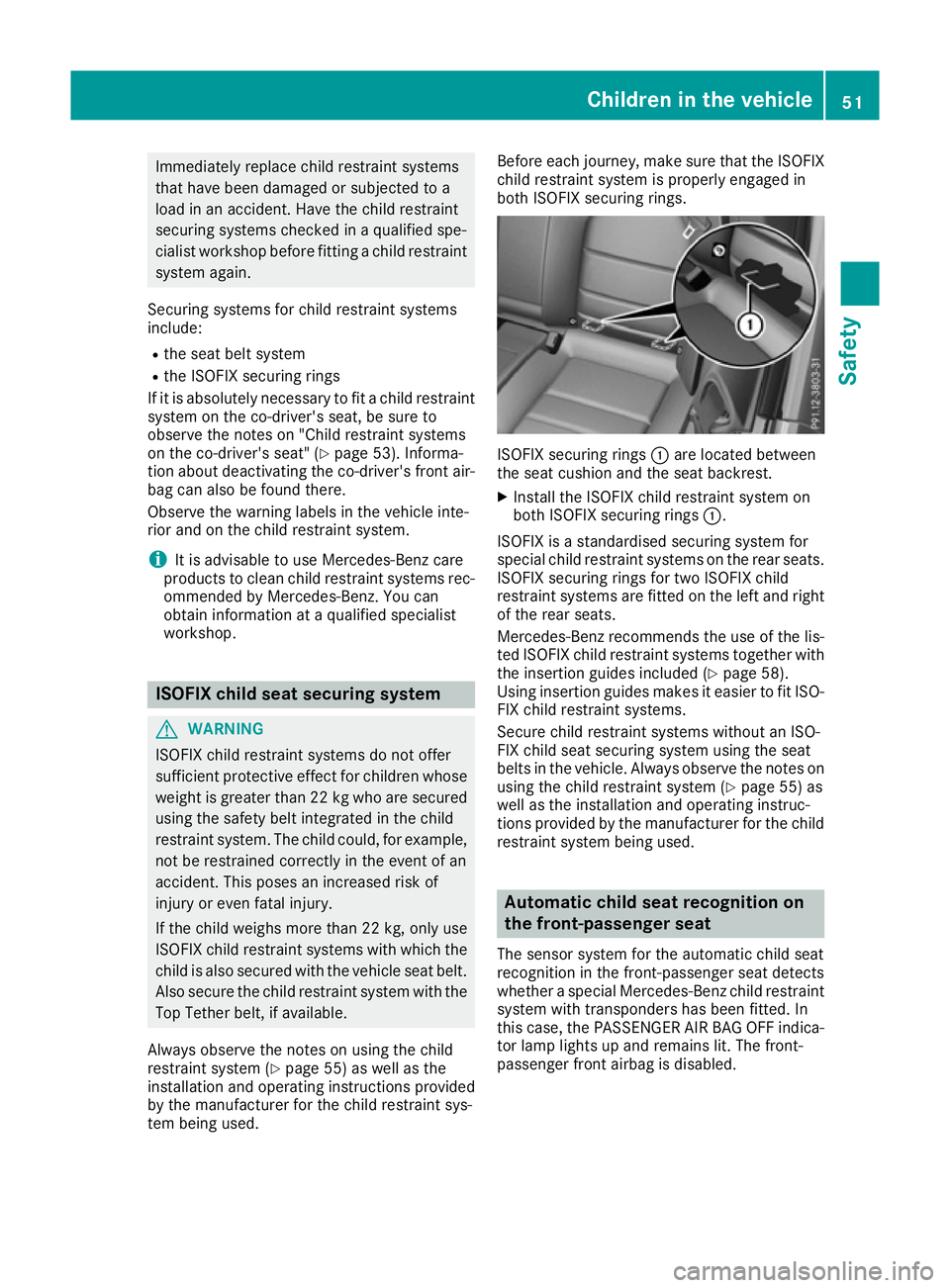
both ISOFIX securing rings. ISOFIX securing rings
:are located between
the seat cushion and the seat backrest.
X Install the ISOFIX child restraint system on
both ISOFIX securing rings :.
ISOFIX is a standardised securing system for
special child restraint systems on the rear seats.
ISOFIX securing rings for two ISOFIX child
restraint systems are fitted on the left and right of the rear seats.
Mercedes-Benz recommends the use of the lis-
ted ISOFIX child restraint systems together with the insertion guides included (Y page 58).
Using insertion guides makes it easier to fit ISO- FIX child restraint systems.
Secure child restraint systems without an ISO-
FIX child seat securing system using the seat
belts in the vehicle. Always observe the notes on
using the child restraint system (Y page 55) as
well as the installation and operating instruc-
tions provided by the manufacturer for the child restraint system being used. Automatic child seat recognition on
the front-passenger seat
The sensor system for the automatic child seat
recognition in the front-passenger seat detects
whether a special Mercedes-Benz child restraint system with transponders has been fitted. In
this case, the PASSENGER AIR BAG OFF indica-
tor lamp lights up and remains lit. The front-
passenger front airbag is disabled. Children in the vehicle
51Safety Z
Page 55 of 349
i
If the front-passenger front airbag is disa-
bled by the automatic child seat recognition,
the following remain enabled on the front-
passenger side:
R the sidebag
R the pelvisbag
R the headbag
R the belt tensioner G
WARNING
If you secure a child in a child restraint system on the front-passenger seat and the
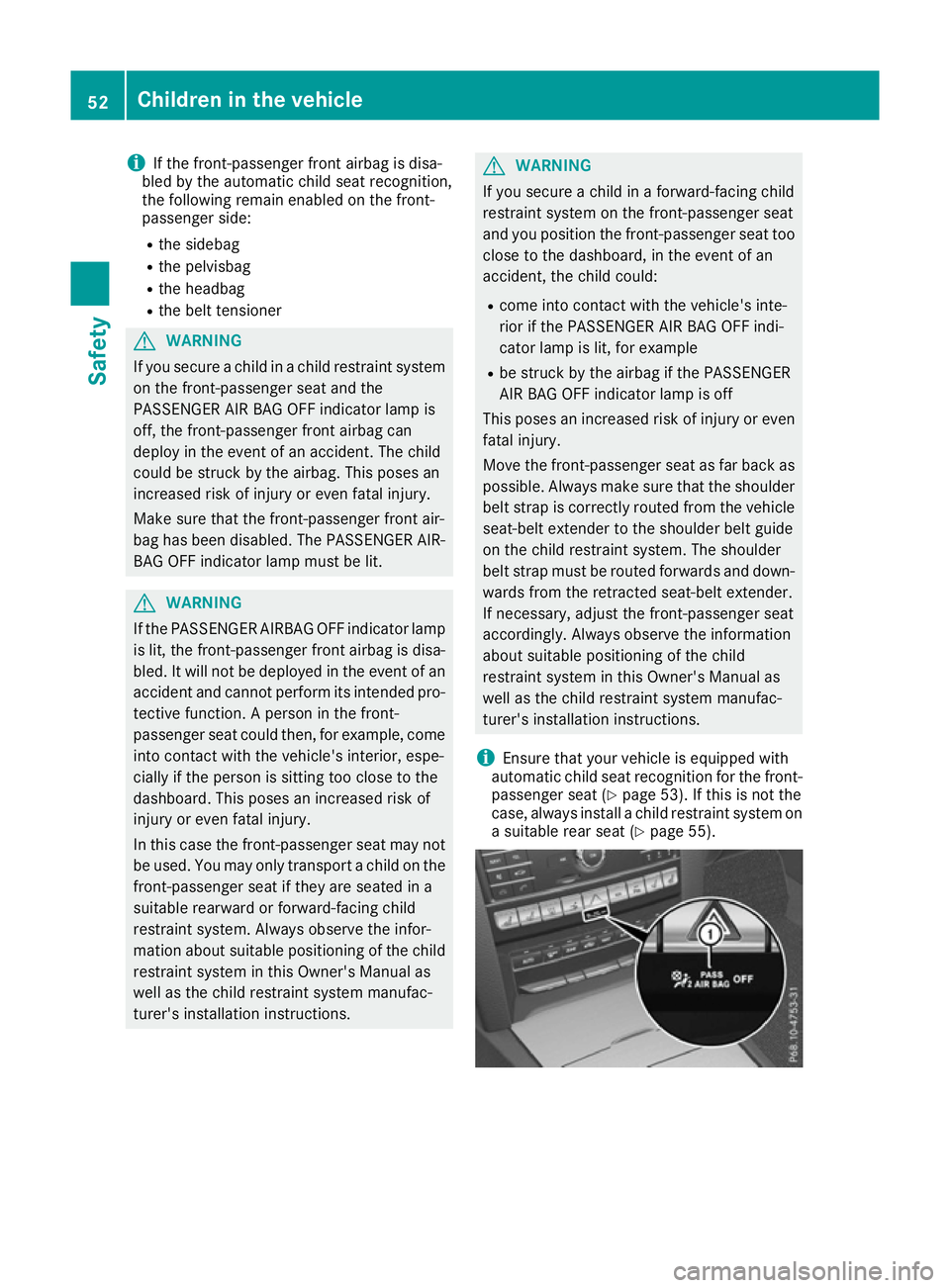
PASSENGER AIR BAG OFF indicator lamp is
off, the front-passenger front airbag can
deploy in the event of an accident. The child
could be struck by the airbag. This poses an
increased risk of injury or even fatal injury.
Make sure that the front-passenger front air-
bag has been disabled. The PASSENGER AIR- BAG OFF indicator lamp must be lit. G
WARNING
If the PASSENGER AIRBAG OFF indicator lamp is lit, the front-passenger front airbag is disa-
bled. It will not be deployed in the event of an
accident and cannot perform its intended pro-
tective function. A person in the front-
passenger seat could then, for example, come
into contact with the vehicle's interior, espe-
cially if the person is sitting too close to the
dashboard. This poses an increased risk of
injury or even fatal injury.
In this case the front-passenger seat may not be used. You may only transport a child on the
front-passenger seat if they are seated in a
suitable rearward or forward-facing child
restraint system. Always observe the infor-
mation about suitable positioning of the child restraint system in this Owner's Manual as
well as the child restraint system manufac-
turer's installation instructions. G
WARNING
If you secure a child in a forward-facing child
restraint system on the front-passenger seat
and you position the front-passenger seat too close to the dashboard, in the event of an
accident, the child could:
R come into contact with the vehicle's inte-
rior if the PASSENGER AIR BAG OFF indi-
cator lamp is lit, for example
R be struck by the airbag if the PASSENGER
AIR BAG OFF indicator lamp is off
This poses an increased risk of injury or even fatal injury.
Move the front-passenger seat as far back as
possible. Always make sure that the shoulder belt strap is correctly routed from the vehicle
seat-belt extender to the shoulder belt guide
on the child restraint system. The shoulder
belt strap must be routed forwards and down-
wards from the retracted seat-belt extender.
If necessary, adjust the front-passenger seat
accordingly. Always observe the information
about suitable positioning of the child
restraint system in this Owner's Manual as
well as the child restraint system manufac-
turer's installation instructions.
i Ensure that your vehicle is equipped with
automatic child seat recognition for the front-
passenger seat (Y page 53). If this is not the
case, always install a child restraint system on a suitable rear seat (Y page 55).52
Children in the vehicleSafety
Page 57 of 349
Vehicles without automatic child seat
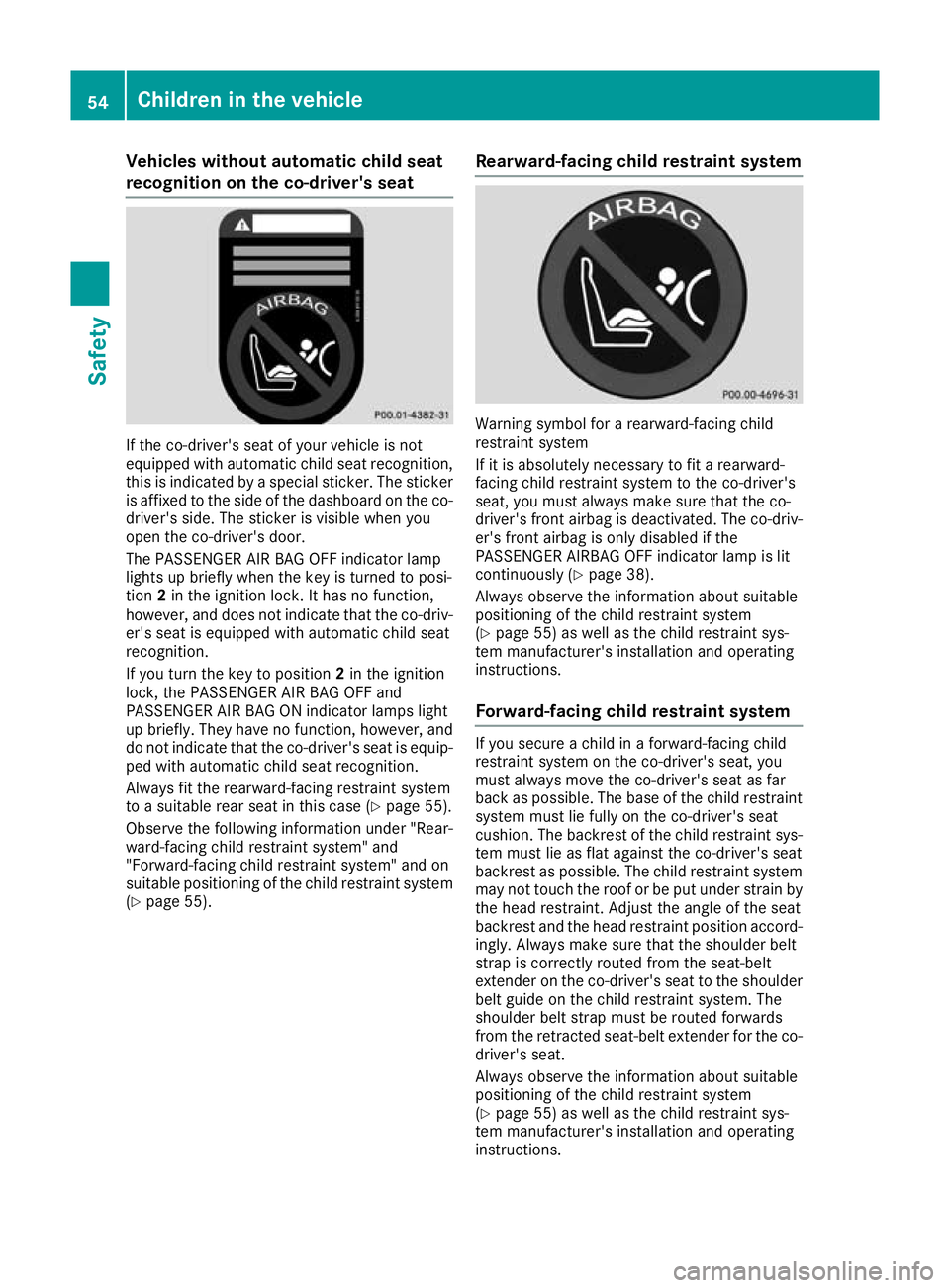
recognition on the co-driver's seat If the co-driver's seat of your vehicle is not
equipped with automatic child seat recognition,
this is indicated by a special sticker. The sticker
is affixed to the side of the dashboard on the co-
driver's side. The sticker is visible when you
open the co-driver's door.
The PASSENGER AIR BAG OFF indicator lamp
lights up briefly when the key is turned to posi-
tion 2in the ignition lock. It has no function,
however, and does not indicate that the co-driv- er's seat is equipped with automatic child seat
recognition.
If you turn the key to position 2in the ignition
lock, the PASSENGER AIR BAG OFF and
PASSENGER AIR BAG ON indicator lamps light
up briefly. They have no function, however, and do not indicate that the co-driver's seat is equip-
ped with automatic child seat recognition.
Always fit the rearward-facing restraint system
to a suitable rear seat in this case (Y page 55).
Observe the following information under "Rear-
ward-facing child restraint system" and
"Forward-facing child restraint system" and on
suitable positioning of the child restraint system
(Y page 55). Rearward-facing child restraint system Warning symbol for a rearward-facing child
restraint system
If it is absolutely necessary to fit a rearward-
facing child restraint system to the co-driver's
seat, you must always make sure that the co-
driver's front airbag is deactivated. The co-driv-
er's front airbag is only disabled if the
PASSENGER AIRBAG OFF indicator lamp is lit
continuously (Y page 38).
Always observe the information about suitable
positioning of the child restraint system
(Y page 55) as well as the child restraint sys-
tem manufacturer's installation and operating
instructions.
Forward-facing child restraint system If you secure a child in a forward-facing child
restraint system on the co-driver's seat, you
must always move the co-driver's seat as far
back as possible. The base of the child restraint system must lie fully on the co-driver's seat
cushion. The backrest of the child restraint sys-
tem must lie as flat against the co-driver's seat
backrest as possible. The child restraint system may not touch the roof or be put under strain by
the head restraint. Adjust the angle of the seat
backrest and the head restraint position accord-
ingly. Always make sure that the shoulder belt
strap is correctly routed from the seat-belt
extender on the co-driver's seat to the shoulder belt guide on the child restraint system. The
shoulder belt strap must be routed forwards
from the retracted seat-belt extender for the co-driver's seat.
Always observe the information about suitable
positioning of the child restraint system
(Y page 55) as well as the child restraint sys-
tem manufacturer's installation and operating
instructions. 54
Children in the vehicleSafety
Page 58 of 349
Problems with automatic child seat recognition
Problem
Possible causes/consequences and
M
MSolutions The PASSENGER AIR
BAG OFF indicator lamp
on the centre console is
lit. A special Mercedes-Benz child restraint system with a transponder for
automatic child seat recognition has been fitted to the front-
passenger seat. The front-passenger front airbag has therefore been
disabled as desired. G
WARNING
There is no child restraint system fitted to the front-passenger seat.
Automatic child seat recognition is malfunctioning, for example due to
electronic devices on the front-passenger seat.
There is a risk of injury.
X Remove electronic equipment from the front-passenger seat, e.g.:
R laptop
R mobile phone
R a card with a transponder, such as a ski pass or access pass
If the PASSENGER AIR BAG OFF indicator lamp remains lit, the front- passenger seat may not be used.
X Consult a qualified specialist workshop. When you switch the
ignition on, the
6
restraint system warning lamp lights up and/or
the PASSENGER AIR
BAG OFF indicator lamp
does not light up briefly. G
WARNING
Automatic child seat recognition is malfunctioning.
Do not install a child restraint system on the front-passenger seat.
It is recommended that you fit the child restraint system to a suitable rear seat.
X Consult a qualified specialist workshop.
X Please also refer to the notes about the restraint system warning
lamp (Y page 235). Suitable positioning of the child
restraint system
Introduction Only child restraint systems which are approved
in accordance with the ECE standard ECE R44
are permitted for use in the vehicle.
For certain child restraint systems in weight cat-
egories II or III, this can mean that the area of
use is restricted. The maximum size setting of
the child restraint system is not possible due to possible contact with the roof.
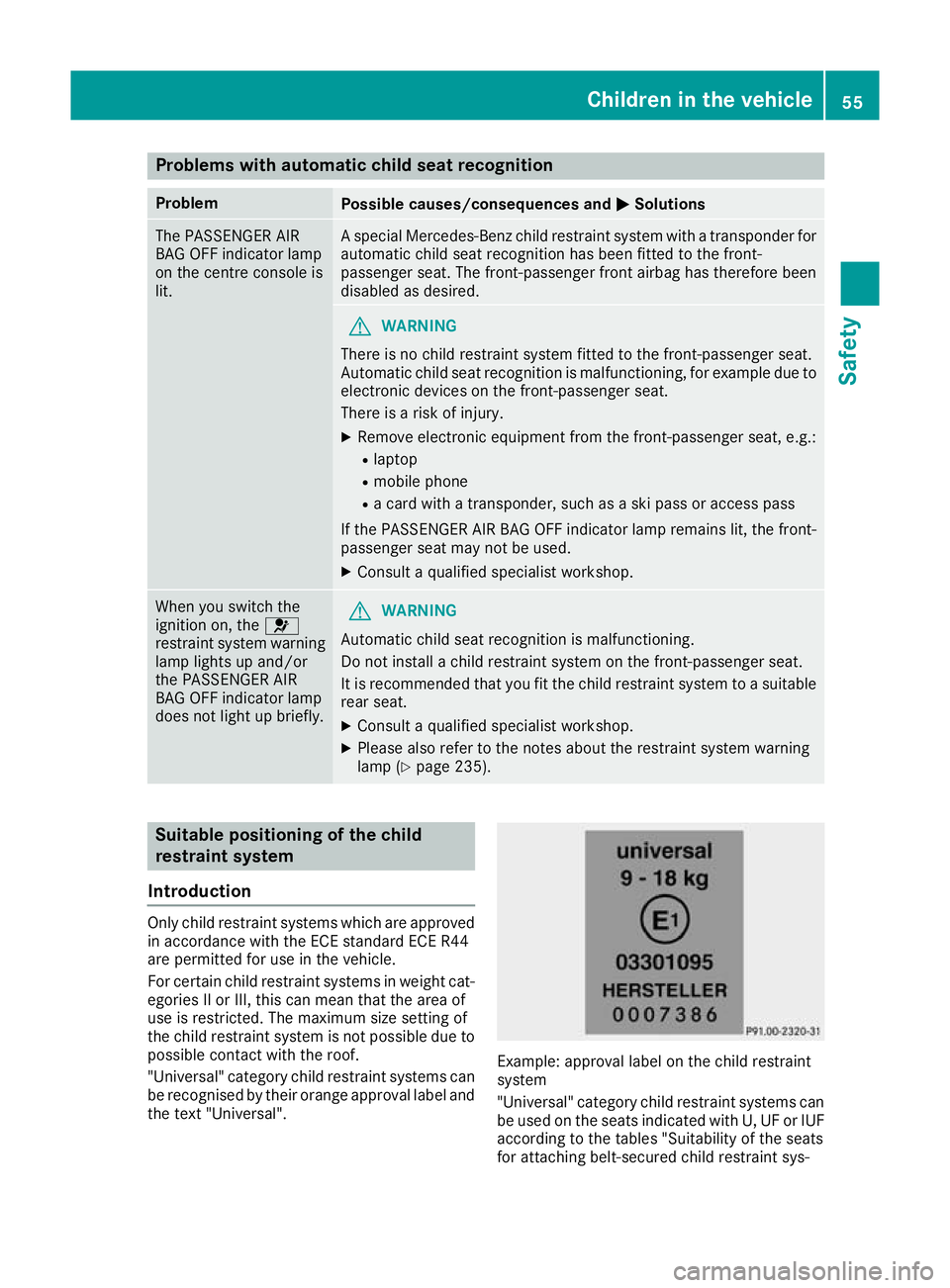
"Universal" category child restraint systems can
be recognised by their orange approval label and the text "Universal". Example: approval label on the child restraint
system
"Universal" category child restraint systems can
be used on the seats indicated with U, UF or IUF according to the tables "Suitability of the seats
for attaching belt-secured child restraint sys- Children in the vehicle
55Safety Z
Page 59 of 349
tems" or "Suitability of the seats for attaching an
ISOFIX child restraint system".
Semi-universal child restraint systems are indi-
cated by the text "semi-universal" on the
approval label. These can be used if the vehicle and the seat are listed in the child restraint sys-
tem manufacturer's vehicle model list. For more
information, contact the child restraint system
manufacturer or visit their website.
If it is absolutely necessary to fit a child restraint system to the front-passenger seat:
X Always pay attention to the instructions under
"Child restraint system on the front-
passenger seat" (Y page 53).
There you will find instructions on how to cor- rectly route the shoulder belt strap from the
vehicle seat-belt extender or belt outlet to the
shoulder belt guide on the child restraint sys-
tem (Y page 54).
X Move the front-passenger seat as far back as
possible and into the lowest position.
X Move the backrest to an almost vertical posi-
tion.
The entire base of the child restraint system
must always rest on the seat cushion of the
front-passenger seat. The backrest of the
forward-facing child restraint system must, as far as possible, be resting on the backrest of
the front-passenger seat. The child restraint
system must not touch the roof or be put
under strain by the head restraint. Adjust the
angle of the seat backrest and the head
restraint position accordingly. Also observe
the child restraint system manufacturer's
installation instructions. 56
Children in the vehicleSafety
Page 60 of 349
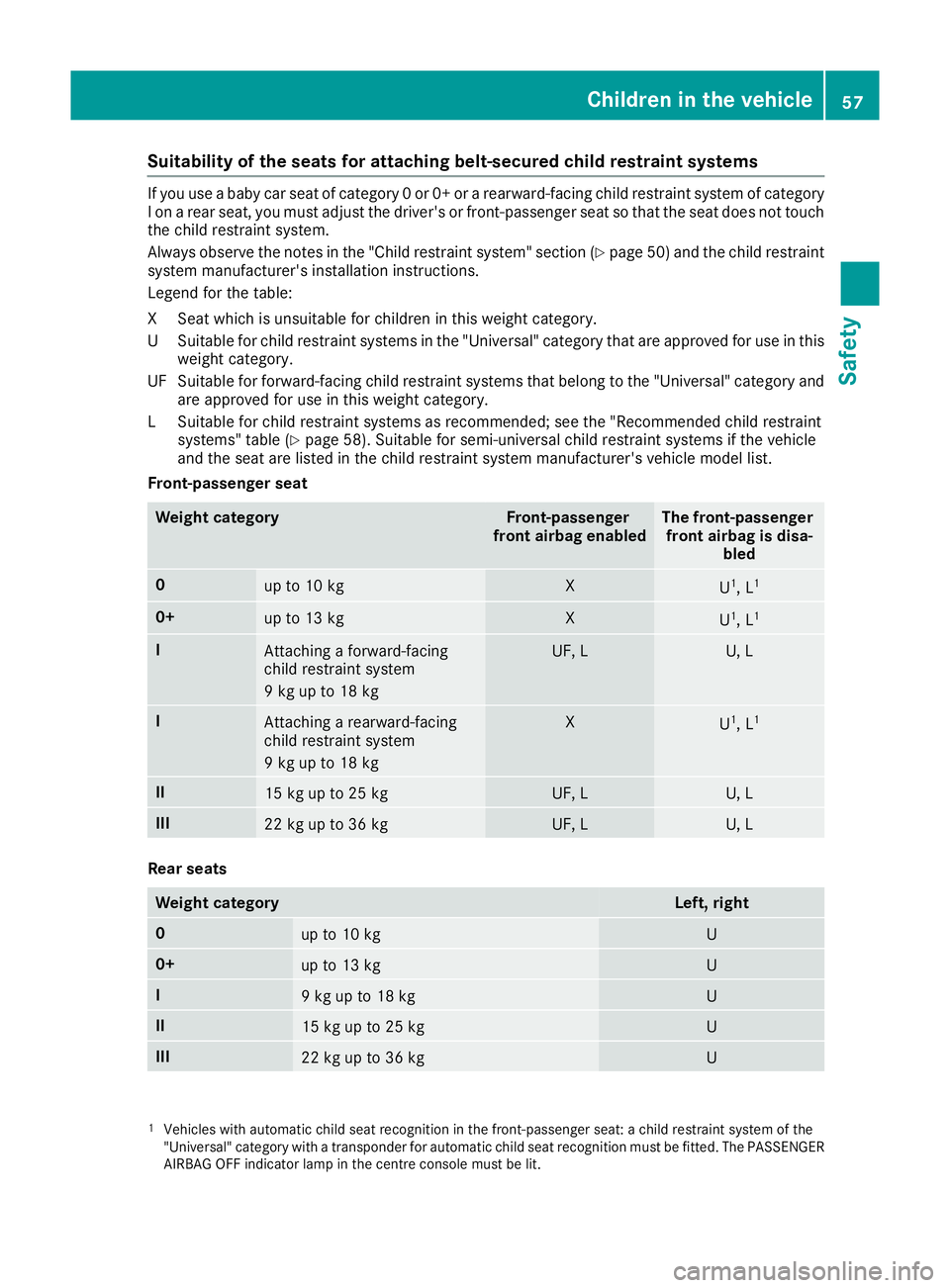
Suitability of the seats for attaching belt-secured child restraint systems
If you use a baby car seat of category 0 or 0+ or a rearward-facing child restraint system of category
I on a rear seat, you must adjust the driver's or front-passenger seat so that the seat does not touch
the child restraint system.
Always observe the notes in the "Child restraint system" section (Y page 50) and the child restraint
system manufacturer's installation instructions.
Legend for the table:
XS eat which is unsuitable for children in this weight category.
US uitable for child restraint systems in the "Universal" category that are approved for use in this
weight category.
UF Suitable for forward-facing child restraint systems that belong to the "Universal" category and are approved for use in this weight category.
LS uitable for child restraint systems as recommended; see the "Recommended child restraint
systems" table (Y page 58). Suitable for semi-universal child restraint systems if the vehicle
and the seat are listed in the child restraint system manufacturer's vehicle model list.
Front-passenger seat Weight category Front-passenger
front airbag enabled The front-passenger
front airbag is disa- bled 0
up to 10 kg X
U
1
, L 1 0+
up to 13 kg X
U
1
, L 1 I
Attaching a forward-facing
child restraint system
9 kg up to 18 kg UF, L U, L
I
Attaching a rearward-facing
child restraint system
9 kg up to 18 kg X
U
1
, L 1 II
15 kg up to 25 kg UF, L U, L
III
22 kg up to 36 kg UF, L U, L
Rear seats
Weight category Left, right
0
up to 10 kg U
0+
up to 13 kg U
I
9 kg up to 18 kg U
II
15 kg up to 25 kg U
III
22 kg up to 36 kg U
1
Vehicles with automatic child seat recognition in the front-passenger seat: a child restraint system of the
"Universal" category with a transponder for automatic child seat recognition must be fitted. The PASSENGER AIRBAG OFF indicator lamp in the centre console must be lit. Children in the vehicle
57Safety Z
Page 62 of 349
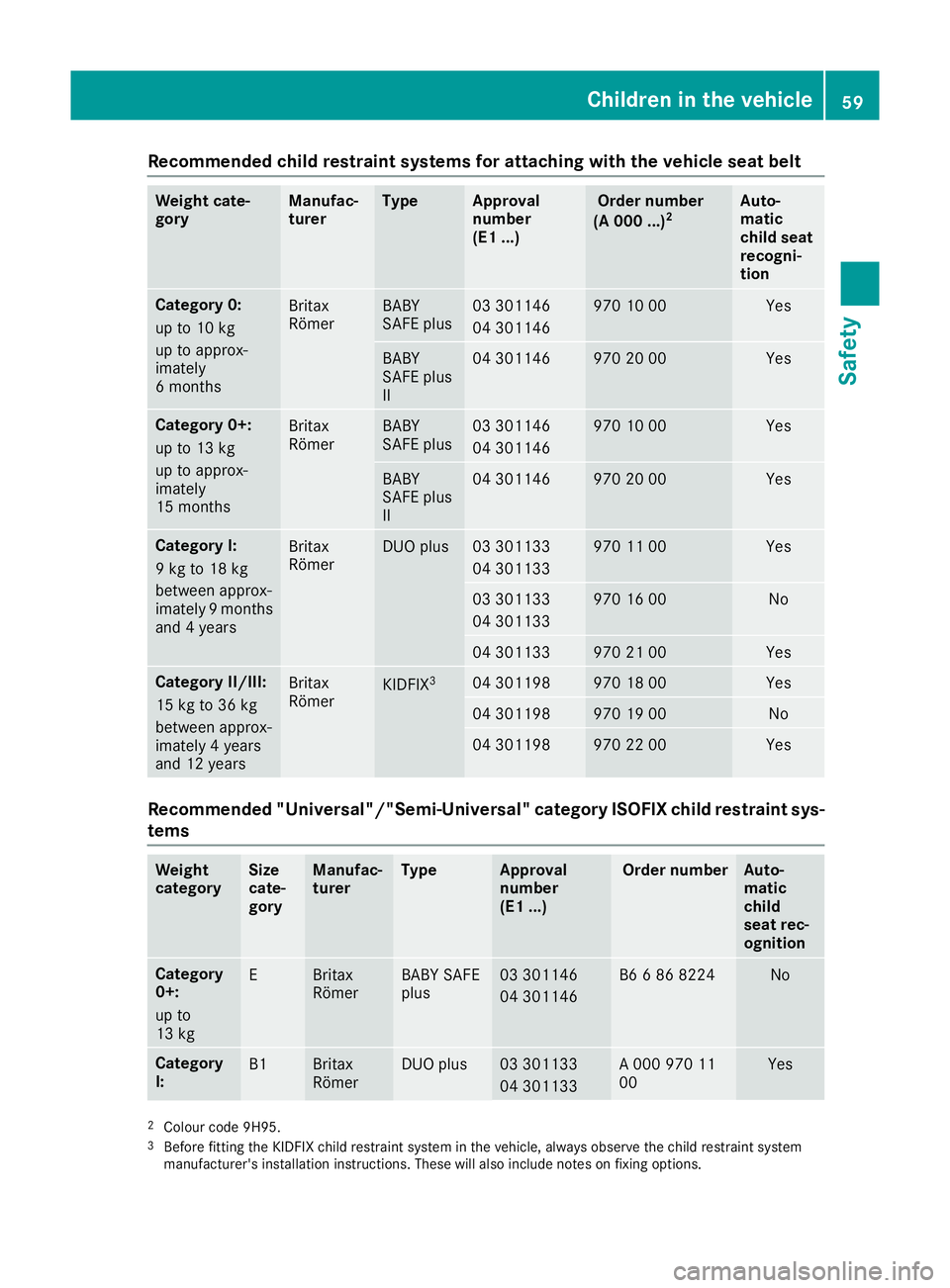
Recommended child restraint systems for attaching with the vehicle seat belt
Weight cate-
gory Manufac-
turer Type Approval
number
(E1 ...) Order number
(A 000 ...) 2 Auto-
matic
child seat
recogni-
tion Category 0:
up to 10 kg
up to approx-
imately
6 months
Britax
Römer BABY
SAFE plus 03 301146
04 301146 970 10 00 Yes
BABY
SAFE plus
II 04 301146 970 20 00 Yes
Category 0+:
up to 13 kg
up to approx-
imately
15 months
Britax
Römer BABY
SAFE plus 03 301146
04 301146 970 10 00 Yes
BABY
SAFE plus
II 04 301146 970 20 00 Yes
Category I:
9 kg to 18 kg
between approx-
imately 9 months
and 4 years Britax
Römer DUO plus 03 301133
04 301133 970 11 00 Yes
03 301133
04 301133 970 16 00 No
04 301133 970 21 00 Yes
Category II/III:
15 kg to 36 kg
between approx-
imately 4 years
and 12 years
Britax
Römer
KIDFIX
3 04 301198 970 18 00 Yes
04 301198 970 19 00 No
04 301198 970 22 00 Yes
Recommended "Universal"/"Semi-Universal" category ISOFIX child restraint sys-
tems Weight
category Size
cate-
gory Manufac-
turer Type Approval
number
(E1 ...) Order number Auto-
matic
child
seat rec-
ognition
Category
0+:
up to
13 kg
E Britax
Römer BABY SAFE
plus 03 301146
04 301146 B6 6 86 8224 No
Category
I:
B1 Britax
Römer DUO plus 03 301133
04 301133 A 000 970 11
00 Yes
2
Colour code 9H95.
3 Before fitting the KIDFIX child restraint system in the vehicle, always observe the child restraint system
manufacturer's installation instructions. These will also include notes on fixing options. Children in the vehicle
59Safety Z
Page 73 of 349
PRE-SAFE
®
Brake warns you. Terminate the
intervention in a non-critical driving situation. G
WARNING
PRE-SAFE ®
Brake cannot always clearly iden-
tify people, especially if they are moving. In
these cases, PRE-SAFE ®
Brake cannot inter-
vene. There is a risk of an accident.
Always pay particular attention to the traffic
situation and be ready to brake, especially if
PRE-SAFE ®
Brake warns you.
In order to maintain the appropriate distance to
the vehicle in front and thus prevent a collision, you must apply the brakes yourself. G
WARNING
PRE-SAFE ®
Brake does not react:
R to small people, e.g. children
R to animals
R to oncoming vehicles
R to crossing traffic
R when cornering
As a result, PRE-SAFE ®
Brake may neither
give warnings nor intervene in all critical sit-
uations. There is a risk of an accident.
Always pay careful attention to the traffic sit- uation and be ready to brake.
In the event of snowfall or heavy rain, detection can be impaired.
Detection by the radar sensor system is also
impaired in the event of:
R dirt on the sensors or obscured sensors
R interference by other radar sources
R strong radar reflections, for example, in multi-
storey car parks
R a narrow vehicle travelling in front, e.g. a
motorcycle
R a vehicle travelling in front on a different line
Detection by the camera system is also impaired in the event of:
R dirt on the camera or if the camera is covered
R glare on the camera system, e.g. from the sun
being low in the sky R
darkness
R if:
- pedestrians move quickly, e.g. into the path
of the vehicle
- the camera system no longer detects a
pedestrian as a person due to special cloth-
ing or other objects
- a pedestrian is concealed by other objects
- the typical outline of a person is not distin-
guishable from the background
Following damage to the front end of the vehicle, have the radar sensor settings and operation
checked at a qualified specialist workshop. This
also applies to collisions at slow speeds where
there is no visible damage to the front of the
vehicle.
Following damage to the windscreen, have the
configuration and operation of the camera sys-
tem checked at a qualified specialist workshop.
Function X
To activate/deactivate: activate or deacti-
vate PRE-SAFE ®
Brake in the on-board com-
puter (Y page 221).
If the PRE-SAFE ®
Brake is not activated, the
æ symbol appears in the multifunction dis-
play.
This function will issue a warning if: R at a speed of approximately 30 km/ho r more
the distance maintained to the vehicle travel- ling in front is insufficient for several seconds
The · distance warning lamp then lights
up in the instrument cluster.
R at a speed of approximately 7 km/h or more,
you rapidly approach a vehicle in front
An intermittent warning tone will then sound
and the ·distance warning lamp will light
up in the instrument cluster.
X Brake immediately to defuse the situation.
or X Take evasive action provided it is safe to do
so.
The PRE-SAFE ®
Brake function can also brake
the vehicle automatically under the following
conditions:
R the driver and front passenger have their seat
belts fastened 70
Driving safety systemsSafety
Page 98 of 349
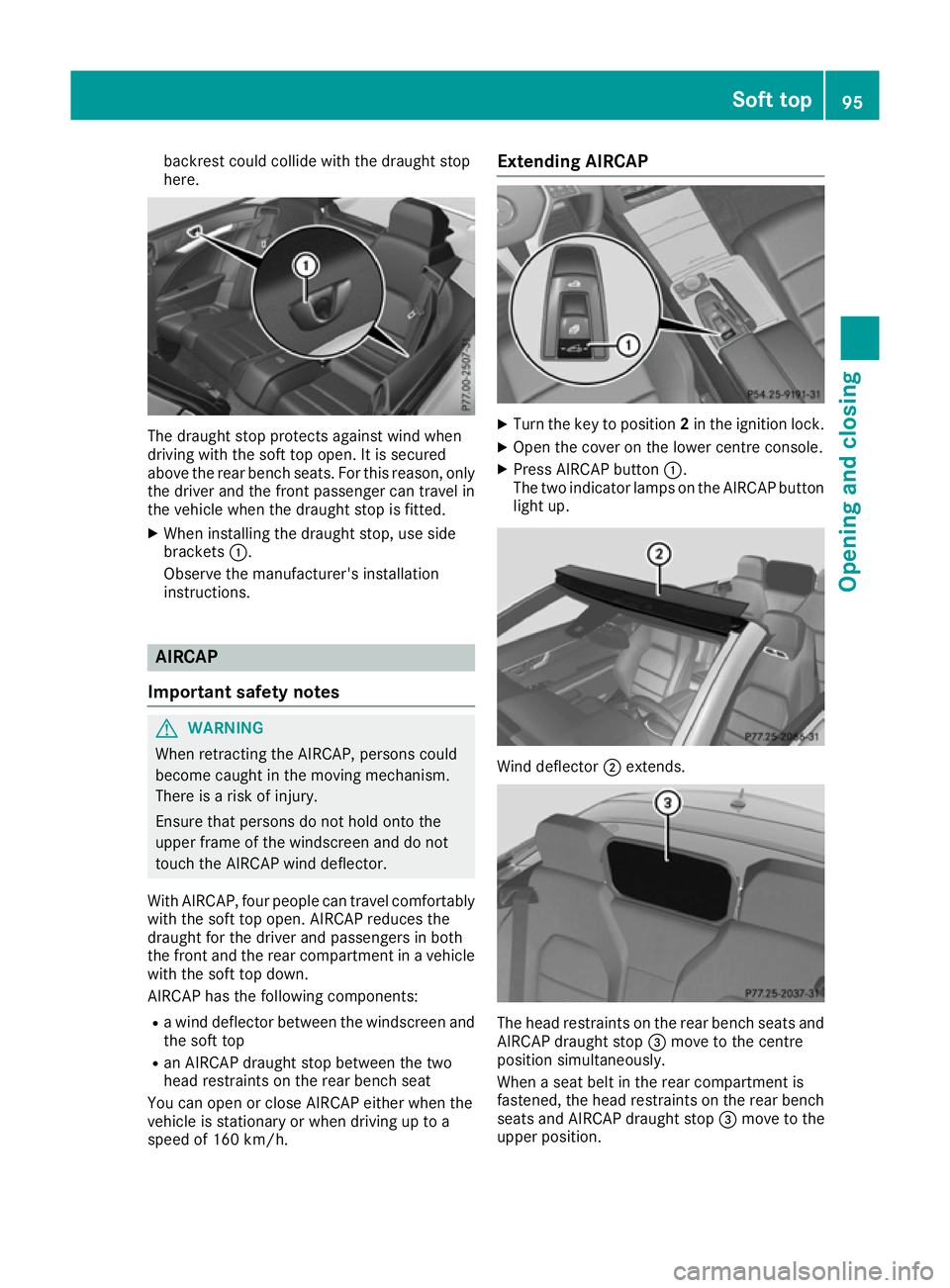
backrest could collide with the draught stop
here. The draught stop protects against wind when
driving with the soft top open. It is secured
above the rear bench seats. For this reason, only the driver and the front passenger can travel in
the vehicle when the draught stop is fitted.
X When installing the draught stop, use side
brackets :.
Observe the manufacturer's installation
instructions. AIRCAP
Important safety notes G
WARNING
When retracting the AIRCAP, persons could
become caught in the moving mechanism.
There is a risk of injury.
Ensure that persons do not hold onto the
upper frame of the windscreen and do not
touch the AIRCAP wind deflector.
With AIRCAP, four people can travel comfortably with the soft top open. AIRCAP reduces the
draught for the driver and passengers in both
the front and the rear compartment in a vehicle
with the soft top down.
AIRCAP has the following components:
R a wind deflector between the windscreen and
the soft top
R an AIRCAP draught stop between the two
head restraints on the rear bench seat
You can open or close AIRCAP either when the
vehicle is stationary or when driving up to a
speed of 160 km/h. Extending AIRCAP
X
Turn the key to position 2in the ignition lock.
X Open the cover on the lower centre console.
X Press AIRCAP button :.
The two indicator lamps on the AIRCAP button light up. Wind deflector
;extends. The head restraints on the rear bench seats and
AIRCAP draught stop =move to the centre
position simultaneously.
When a seat belt in the rear compartment is
fastened, the head restraints on the rear bench seats and AIRCAP draught stop =move to the
upper position. Soft top
95Opening and closing Z
Page 99 of 349
If you park your vehicle with the soft top down
and remove the key, the wind deflector and the
head restraints in the rear compartment retract automatically. When you restart your engine
after having been parked, the wind deflector and
the head restraints in the rear compartment
extend again automatically.
AIRCAP cannot be extended or retracted if the
vehicle speed exceeds approximately
160 km/h.
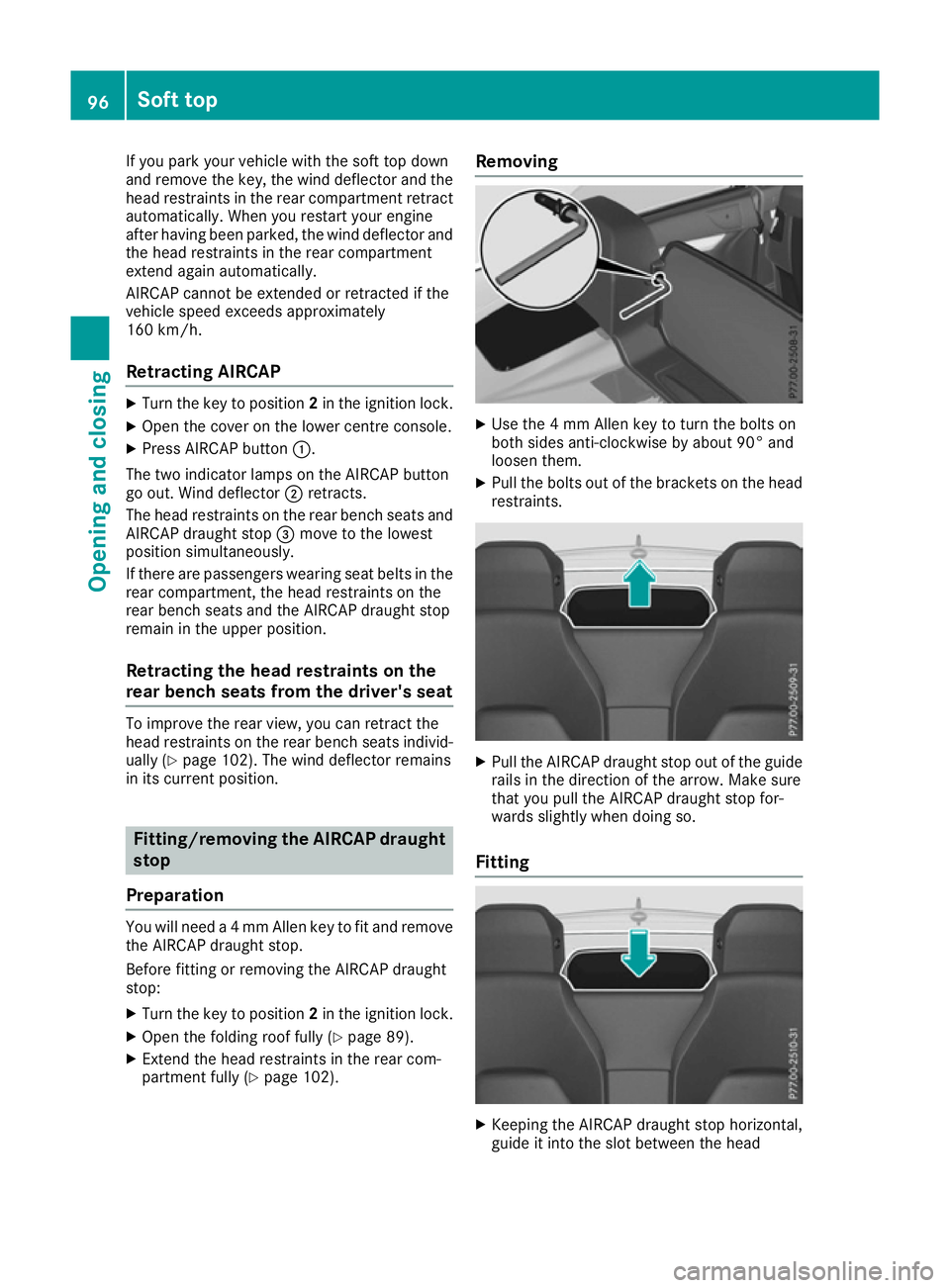
Retracting AIRCAP X
Turn the key to position 2in the ignition lock.
X Open the cover on the lower centre console.
X Press AIRCAP button :.
The two indicator lamps on the AIRCAP button
go out. Wind deflector ;retracts.
The head restraints on the rear bench seats and
AIRCAP draught stop =move to the lowest
position simultaneously.
If there are passengers wearing seat belts in the rear compartment, the head restraints on the
rear bench seats and the AIRCAP draught stop
remain in the upper position.
Retracting the head restraints on the
rear bench seats from the driver's seat To improve the rear view, you can retract the
head restraints on the rear bench seats individ- ually (Y page 102). The wind deflector remains
in its current position. Fitting/removing the AIRCAP draught
stop
Preparation You will need a 4 mm Allen key to fit and remove
the AIRCAP draught stop.
Before fitting or removing the AIRCAP draught
stop:
X Turn the key to position 2in the ignition lock.
X Open the folding roof fully (Y page 89).
X Extend the head restraints in the rear com-
partment fully (Y page 102). Removing
X
Use the 4 mm Allen key to turn the bolts on
both sides anti-clockwise by about 90° and
loosen them.
X Pull the bolts out of the brackets on the head
restraints. X
Pull the AIRCAP draught stop out of the guide
rails in the direction of the arrow. Make sure
that you pull the AIRCAP draught stop for-
wards slightly when doing so.
Fitting X
Keeping the AIRCAP draught stop horizontal,
guide it into the slot between the head 96
Soft topOpening and closing