airbag MERCEDES-BENZ E-CLASS CABRIOLET 2017 User Guide
[x] Cancel search | Manufacturer: MERCEDES-BENZ, Model Year: 2017, Model line: E-CLASS CABRIOLET, Model: MERCEDES-BENZ E-CLASS CABRIOLET 2017Pages: 521, PDF Size: 10.64 MB
Page 39 of 521
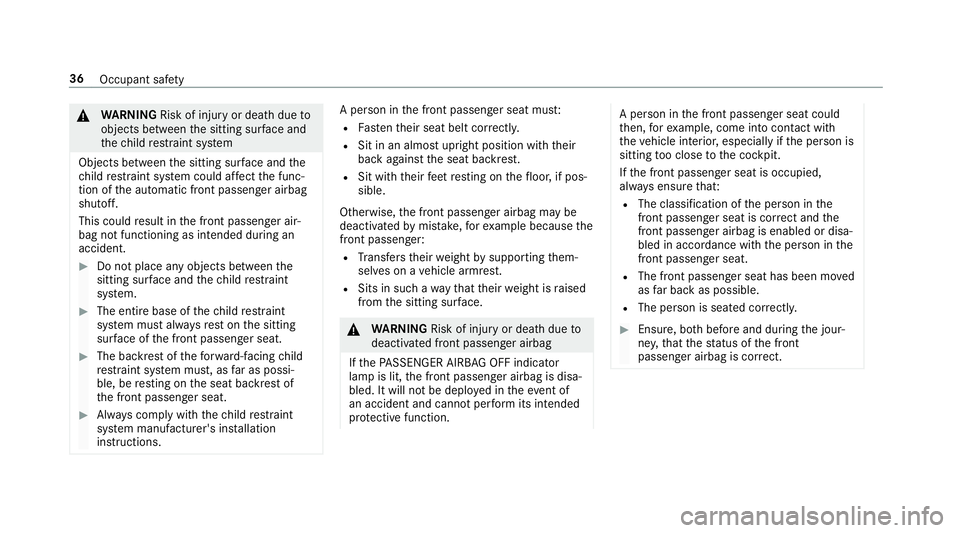
&
WARNING Risk of inju ryor death due to
objects between the sitting sur face and
th ech ild restra int sy stem
Objects between the sitting sur face and the
ch ild restra int sy stem could af fect the func‐
tion of the automatic front passenger airbag
shutoff.
This could result in the front passenger air‐
bag not functioning as intended during an
accident. #
Do not place any objects between the
sitting sur face and thech ild restra int
sy stem. #
The entire base of thech ild restra int
sy stem must alw aysre st on the sitting
sur face of the front passenger seat. #
The backrest of thefo rw ard-facing child
re stra int sy stem must, as far as possi‐
ble, be resting on the seat backrest of
th e front passenger seat. #
Alw ays comply with thech ild restra int
sy stem manufacturer's ins tallation
instructions. A person in
the front passenger seat mus t:
R Fasten their seat belt cor rectly.
R Sit in an almost up right position with their
back against the seat backrest.
R Sit with their feet resting on thefloor, if pos‐
sible.
Otherwise, the front passenger airbag may be
deactivated bymis take ,fo rex ample because the
front passenger:
R Trans fers their weight bysupporting them‐
selves on a vehicle armrest.
R Sits in such a wayth at their weight is raised
from the sitting sur face. &
WARNING Risk of inju ryor death due to
deactivated front passenger airbag
If th ePA SSENGER AIRB AGOFF indicator
lamp is lit, the front passenger airbag is disa‐
bled. It will not be deplo yed in theeve nt of
an accident and cannot pe rform its intended
pr otective function. A person in
the front passenger seat could
th en, forex ample, come into con tact wi th
th eve hicle interior, especially if the person is
sitting too close tothe cockpit.
If th e front passenger seat is occupied,
alw ays ensure that:
R The classification of the person in the
front passenger seat is cor rect and the
front passenger airbag is enabled or disa‐
bled in accordance with the person in the
front passenger seat.
R The front passenger seat has been mo ved
as far back as possible.
R The person is seated cor rectly. #
Ensure, bo thbefore and during the jour‐
ne y,that thest atus of the front
passenger airbag is cor rect. 36
Occupant saf ety
Page 40 of 521
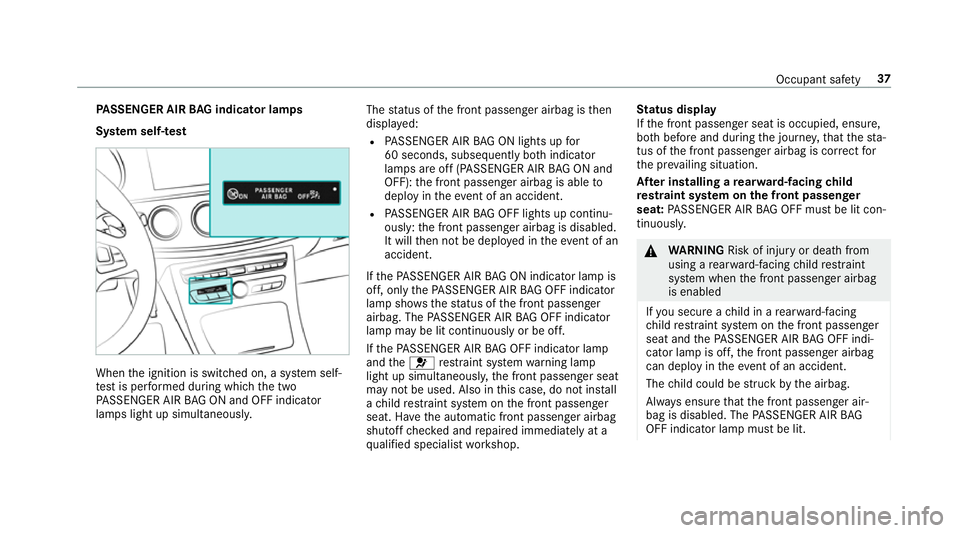
PA
SSENGER AIR BAG indicator lamps
Sy stem self- test When
the ignition is switched on, a sy stem self-
te st is per form ed during which the two
PA SSENGER AIR BAG ON and OFF indicator
lamps light up simultaneousl y.The
status of the front passenger airbag is then
displa yed:
R PASSENGER AIR BAG ON lights up for
60 seconds, subsequently bo thindicator
lamps are off (PASSENGER AIR BAG ON and
OFF): the front passenger airbag is able to
deploy in theeve nt of an accident.
R PASSENGER AIR BAG OFF lights up continu‐
ously: the front passenger airbag is disabled.
It will then not be deplo yed in theev ent of an
accident.
If th ePA SSENGER AIR BAG ON indicator lamp is
off, on lythePA SSENGER AIR BAG OFF indicator
lamp sho wsthest atus of the front passenger
airbag. The PASSENGER AIR BAG OFF indicator
lamp may be lit continuously or be off.
If th ePA SSENGER AIR BAG OFF indicator lamp
and the6 restra int sy stem warning lamp
light up simultaneousl y,the front passenger seat
may not be used. Also in this case, do not ins tall
a ch ild restra int sy stem on the front passenger
seat. Ha vethe automatic front passenger airbag
shutoff checked and repaired immediately at a
qu alified specialist workshop. St
atus display
If th e front passenger seat is occupied, ensure,
bo th before and during the journe y,that thest a‐
tus of the front passenger airbag is cor rect for
th e pr evailing situation.
Af ter in stalling a rear wa rd-facing child
re stra int sy stem on the front passenger
seat: PASSENGER AIR BAG OFF must be lit con‐
tinuousl y. &
WARNING Risk of inju ryor death from
using a rear wa rd-facing child restra int
sy stem when the front passenger airbag
is enabled
If yo u secure a child in a rear wa rd-facing
ch ild restra int sy stem on the front passenger
seat and thePA SSENGER AIR BAG OFF indi‐
cator lamp is off, the front passenger airbag
can deploy in theeve nt of an accident.
The child could be stru ck bythe airbag.
Alw ays ensure that the front passenger air‐
bag is disabled. The PASSENGER AIR BAG
OFF indicator lamp must be lit. Occupant saf
ety37
Page 41 of 521
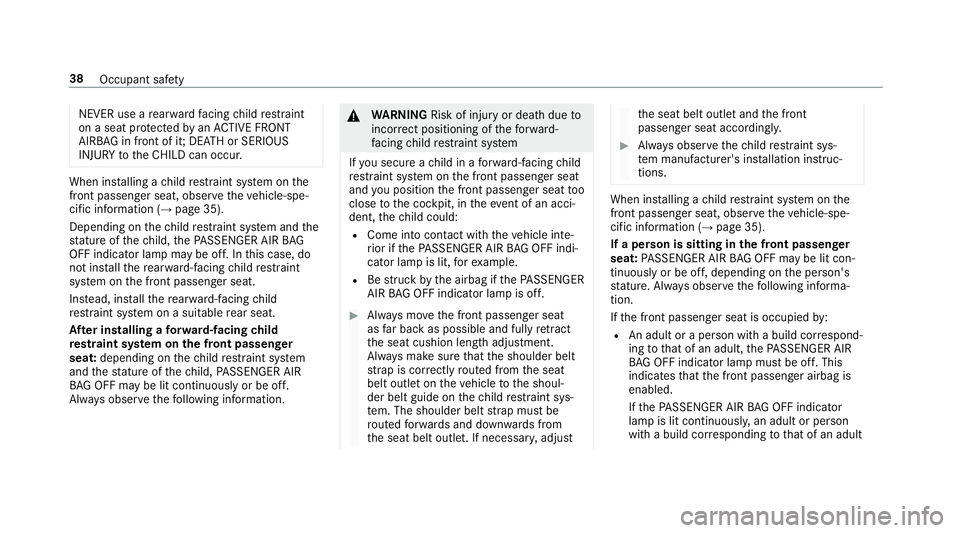
NEVER use a
rear wa rdfacing child restra int
on a seat pr otected byan ACTIVE FRONT
AIRB AGin front of it; DE ATH or SERIOUS
INJU RYtotheCH ILD can occur. When ins
talling a child restra int sy stem on the
front passenger seat, obse rveth eve hicle-spe‐
cific information (→ page 35).
Depending on thech ild restra int sy stem and the
st ature of thech ild, thePA SSENGER AIR BAG
OFF indicator lamp may be off. In this case, do
not ins tallth ere ar wa rd-facing child restra int
sy stem on the front passenger seat.
Ins tead, ins tallth ere ar wa rd-facing child
re stra int sy stem on a suitable rear seat.
Af ter in stalling a forw ard-facing child
re stra int sy stem on the front passenger
seat: depending on thech ild restra int sy stem
and thest ature of thech ild, PASSENGER AIR
BA G OFF may be lit continuously or be off.
Alw ays obser vethefo llowing information. &
WARNING Risk of inju ryor death due to
incor rect positioning of thefo rw ard-
fa cing child restra int sy stem
If yo u secure a child in a forw ard-facing child
re stra int sy stem on the front passenger seat
and you position the front passenger seat too
close tothe cockpit, in theeve nt of an acci‐
dent, thech ild could:
R Come into con tact wi th theve hicle inte‐
ri or if thePA SSENGER AIR BAG OFF indi‐
cator lamp is lit, forex ample.
R Bestru ck bythe airbag if thePA SSENGER
AIR BAG OFF indicator lamp is off. #
Alw ays mo vethe front passenger seat
as far back as possible and fully retract
th e seat cushion length adjustment.
Alw ays make sure that the shoulder belt
st ra p is cor rectly routed from the seat
belt outlet on theve hicle tothe shoul‐
der belt guide on thech ild restra int sys‐
te m. The shoulder belt stra p must be
ro uted forw ards and down wards from
th e seat belt outlet. If necessar y,adjust th
e seat belt outlet and the front
passenger seat accordingly. #
Alw ays obser vethech ild restra int sys‐
te m manufacturer's ins tallation instruc‐
tions. When ins
talling a child restra int sy stem on the
front passenger seat, obse rveth eve hicle-spe‐
cific information (→ page 35).
If a person is sitting in the front passenger
seat: PASSENGER AIR BAG OFF may be lit con‐
tinuously or be off, depending on the person's
st ature. Alw ays obser vethefo llowing informa‐
tion.
If th e front passenger seat is occupied by:
R An adult or a pe rson with a build cor respond‐
ing tothat of an adult, thePA SSENGER AIR
BA G OFF indicator lamp must be off. This
indicates that the front passenger airbag is
enabled.
If th ePA SSENGER AIR BAG OFF indicator
lamp is lit continuousl y,an adult or person
with a build cor responding tothat of an adult 38
Occupant saf ety
Page 42 of 521
should not use
the front passenger seat.
Ins tead, they should use a rear seat.
R A person with a smaller build (e.g. a teenager
or small adult), thePA SSENGER AIR BAG OFF
indicator lamp either lights up continuously
depending on there sult of the classification
or, alternatively, goes out.
- PASSENGER AIRB AGOFF is off: mo vethe
front passenger seat as far back as possi‐
ble or a person with a smaller build
should use a rear seat.
- Ifth ePA SSENGER AIRB AGOFF indicator
lamp is lit continuously: a person with a
smaller build should not use the front
passenger seat. &
WARNING Risk of inju ryor death when
th ePA SSENGER AIR BAG OFF indicator
lamp is lit
If th ePA SSENGER AIR BAG OFF indicator
lamp remains lit af terth e sy stem self-test,
th e front passenger airbag is disabled. It will
not be deplo yed in theeve nt of an accident.
In this case, the front passenger airbag can‐ not per
form its intended pr otective function,
e.g. when a person is seated in the front
passenger seat.
That person could, forex ample, come into
con tact wi th theve hicle interior, especially if
th e person is sitting too close tothe cockpit.
If th e front passenger seat is occupied,
alw ays ensure that:
R The classification of the person in the
front passenger seat is cor rect and the
front passenger airbag is enabled or disa‐
bled in accordance with the person in the
front passenger seat.
R The person is sea ted properly with a cor‐
re ctly fastened seat belt.
R The front passenger seat has been mo ved
as far back as possible. Fu
rther related subjects:
R Child restra int sy stem on the front passenger
seat (→ page47).
R Suitable positioning of thech ild restra int sys‐
te m (→ page 49). Ro
ll bar &
DANG ER Risk of injury or death caused
by a malfunction of thero ll bars
If th e function of thero ll bars is defective,
th ey may not extend in an accident forex am‐
ple.
Consequent ly,th ero ll bars cannot pr otect
ve hicle occupants as they are designed to
do. #
Have thero ll bars checked immediately
at a qualified specialist workshop. &
WARNING Risk of inju rywhen thero ll
bars are triggered
If th ero ll bars are triggered, there is a risk of
injur y.
Alw ays make sure that there is no thing in the
sweep behind there ar head restra ints. Occupant saf
ety39
Page 46 of 521
#
Make sure that the entire base of the
ch ild restra int sy stem alw aysre sts on
th e sitting sur face of the seat. #
Never place objects under or behind
th ech ild restra int sy stem, e.g. cush‐
ions. #
Alw ays use child restra int sy stems with
th e original co ver designed forth em. #
Alw aysre place damaged co vers with
ge nuine co vers. &
WARNING Risk of accident caused by
incor rectly ins talled child restra int sys‐
te ms
If th ech ild restra int sy stem is not cor rectly
ins talled or secured, it could release in the
ev ent of an accident, sudden braking or a
sudden change in direction.
The child restra int sy stem could be flung
around and hit vehicle occupants. This poses
an increased risk of injury or even death! #
Alw ays ins tallch ild restra int sy stems
cor rectl y,eve n when not in use. #
Alw ays comply with thech ild restra int
sy stem manufacturer's ins tallation
instructions. &
WARNING Risk of inju ryor death caused
by the use of damaged child restra int
sy stems
Child restra int sy stems or their retaining sys‐
te ms that ha vebeen subjec tedto a load in
an accident may then not be able toper form
th eir intended pr otective function.
The child cannot be restra ined in theeve nt of
an accident, heavy braking or a sudden
ch ange of direction. #
Alw aysre place child restra int sy stems
immediately that ha vebeen damaged or
in vo lved in an accident. #
Have the securing sy stems forth ech ild
re stra int sy stems checked at a qualified
specialist workshop before ins talling a
ch ild restra int sy stem again. %
Use Mercedes-Benz care products recom‐
mended byMercedes-Benz toclean child
re stra int sy stems. Further information can
be obtained at a qualified specialist work‐
shop.
The following no tes must be obser ved:
R When ins talling a child restra int sy stem on
th e front passenger seat, the information on
ins talling a child restra int sy stem on the front
passenger seat (→ page47).
R Notes on attaching suitable child restra int
sy stems (→ page 49).
R Notes on recommended child restra int sys‐
te ms (→ page 55).
R Instructions and saf ety no tes on the auto‐
matic front passenger airbag shutoff
(→ page 35).
R Safety no tes on the seat belt (→ page27).
R Information on the cor rect use of the seat
belt (→ page31). Occupant saf
ety43
Page 50 of 521
#
Tension TopTe ther belt 3from the boot. #
Make sure that there is enough seat belt
av ailable forfast ening. #
Alw ays comply with thech ild restra int sys‐
te m manufacturer's ins tallation instructions
when doing so. Child
restra int sy stems on the front
passenger seat Note
s onchild restra int sy stems on the front
passenger seat
Ac cident statistics show that children secured in
th ere ar seats are safer than children secured in
th e front seats. Forth is reason, Mercedes-Benz
stro ngly advises that you ins tall a child restra int
sy stem on a rear seat.
If it is absolutely necessary toins tall a child
re stra int sy stem on the front passenger seat,
alw ays obser vethe information on the automatic
front passenger airbag shutoff (→ page 35).By doing
this, you can avoidrisks caused by:
R Ach ild restra int sy stem that is not de tected
by the automatic front passenger airbag
shutoff.
R The unintentionally disabled front passenger
airbag.
R Incor rect positioning of thech ild restra int
sy stem. Wa
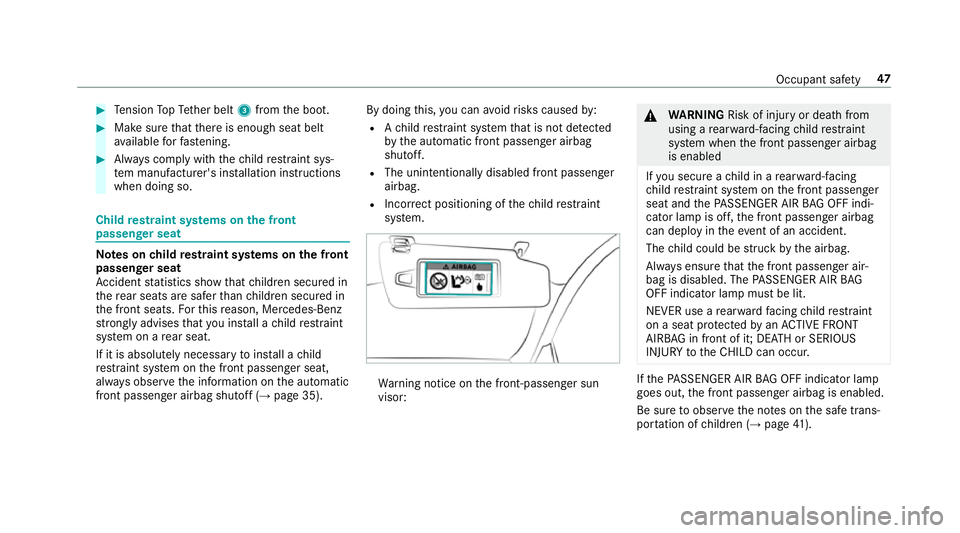
rning notice on the front-passen ger sun
visor: &
WARNING Risk of inju ryor death from
using a rear wa rd-facing child restra int
sy stem when the front passenger airbag
is enabled
If yo u secure a child in a rear wa rd-facing
ch ild restra int sy stem on the front passenger
seat and thePA SSENGER AIR BAG OFF indi‐
cator lamp is off, the front passenger airbag
can deploy in theev ent of an accident.
The child could be stru ck bythe airbag.
Alw ays ensure that the front passenger air‐
bag is disabled. The PASSENGER AIR BAG
OFF indicator lamp must be lit.
NEVER use a rear wa rdfacing child restra int
on a seat pr otected byan ACTIVE FRONT
AIRB AGin front of it; DE ATH or SERIOUS
INJU RYtotheCH ILD can occur. If
th ePA SSENGER AIR BAG OFF indicator lamp
goes out, the front passenger airbag is enabled.
Be sure toobser vethe no tes on the safe trans‐
por tation of children (→ page41). Occupant sa
fety 47
Page 51 of 521
Ve
hicles without the automatic front
passenger airbag shu toff
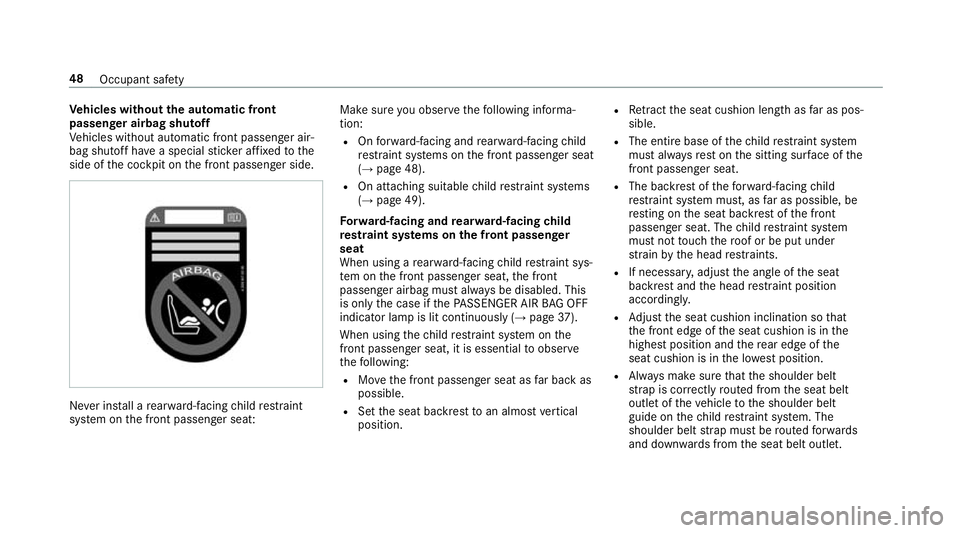
Ve hicles without automatic front passenger air‐
bag shutoff ha vea special sticke r af fixe dto the
side of the cockpit on the front passenger side. Ne
ver ins tall a rear wa rd-facing child restra int
sy stem on the front passenger seat: Make sure
you obse rveth efo llowing informa‐
tion:
R Onforw ard-facing and rear wa rd-facing child
re stra int sy stems on the front passenger seat
(→ page 48).
R On attaching suitable child restra int sy stems
(→ page 49).
Fo rw ard-facing and rear wa rd-facing child
re stra int sy stems on the front passenger
seat
When using a rear wa rd-facing child restra int sys‐
te m on the front passenger seat, the front
passenger airbag must alw ays be disabled. This
is only the case if thePA SSENGER AIR BAG OFF
indicator lamp is lit continuously (→ page37).
When using thech ild restra int sy stem on the
front passenger seat, it is essential toobser ve
th efo llowing:
R Movethe front passenger seat as far back as
possible.
R Set the seat backrest toan almost vertical
position. R
Retract the seat cushion length as far as pos‐
sible.
R The entire base of thech ild restra int sy stem
must alw aysre st on the sitting sur face of the
front passenger seat.
R The backrest of thefo rw ard-facing child
re stra int sy stem must, as far as possible, be
re sting on the seat backrest of the front
passenger seat. The child restra int sy stem
must not touch thero of or be put under
st ra in by the head restra ints.
R If necessar y,adjust the angle of the seat
backrest and the head restra int position
according ly.
R Adjust the seat cushion inclination so that
th e front edge of the seat cushion is in the
highest position and there ar edge of the
seat cushion is in the lo west position.
R Alw ays make sure that the shoulder belt
st ra p is cor rectly routed from the seat belt
outlet of theve hicle tothe shoulder belt
guide on thech ild restra int sy stem. The
shoulder belt stra p must be routed forw ards
and down wards from the seat belt outlet. 48
Occupant saf ety
Page 54 of 521
We
ight categories
Front passenger airbag enabled 1
Front passenger airbag disa‐
bled 1, 2 Re
ar seat left, right
Category 0: upto10 kg XU ,LU , L
Category 0+: upto13 kg XU ,LU , L
Category I: 9to 18 kg UF,LU ,LU , L
Category II: 15to25 kg UF,LU ,LU , L
Category III: 22to36 kg UF,LU ,LU , L
1 Ad just the seat cushion inclination tothe highest/s teepest position and set the seat backrest toan upright position.
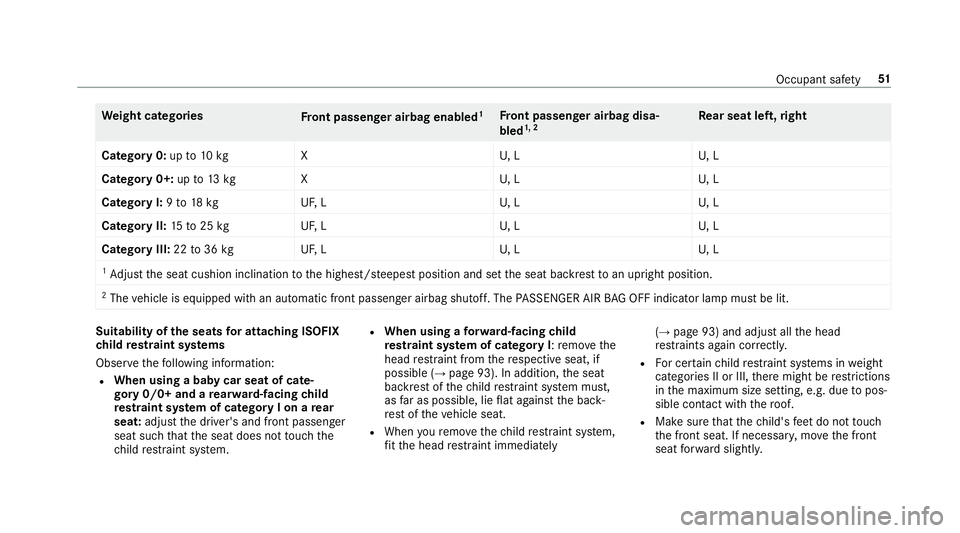
2 The vehicle is equipped with an automatic front passenger airbag shutoff. The PASSENGER AIR BAG OFF indicator lamp must be lit. Suitability of
the seats for attaching ISOFIX
ch ild restra int sy stems
Obser vethefo llowing information:
R When using a baby car seat of cate‐
gory 0/0+ and a rear wa rd-facing child
re stra int sy stem of category I on a rear
seat: adjustthe driver's and front passenger
seat such that the seat does not touch the
ch ild restra int sy stem. R
When using a forw ard-facing child
re stra int sy stem of category I: remo vethe
head restra int from there spective seat, if
possible (→ page 93). In addition, the seat
backrest of thech ild restra int sy stem must,
as far as possible, lie flat against the back‐
re st of theve hicle seat.
R When youre mo vethech ild restra int sy stem,
fi t th e head restra int immediately (→
page 93) and adjust all the head
re stra ints again cor rectl y.
R For cer tain child restra int sy stems in weight
categories II or III, there might be restrictions
in the maximum size setting, e.g. due topos‐
sible con tact wi th thero of.
R Make sure that thech ild's feet do not touch
th e front seat. If necessar y,mo vethe front
seat forw ard slightl y. Occupant saf
ety51
Page 90 of 521

Cor
rect driver's seat position &
WARNING Risk of inju rythro ugh adjust‐
ing vehicle settings while theve hicle is in
motion
Yo u could lose cont rol of theve hicle in the
fo llowing situations:
R ifyo u adjust the driver's seat, the head
re stra ints, thesteering wheel or the mir‐
ro r while theve hicle is in motion
R ifyo ufast enyour seat belt while theve hi‐
cle is in motion #
Before starting the engine: adjust the
driver's seat, the head restra ints, the
st eering wheel or the mir ror and fasten
yo ur seat belt. Obser
vethefo llowing when adjusting steering
wheel 1, seat belt 2and driver's seat 3:
R you are as faraw ay from the driver's airbag
as possible
R you are sitting in a no rmal upright position
R your thighs are slight lysuppor tedby the seat
cushion R
your legs are not entirely stre tched and you
can dep ress the pedals properly
R the back of your head is suppo rted at eye
le ve lby the cent reofthe head restra int
R you can hold thesteering wheel with your
arms slightly bent
R you can mo veyour legs freely
R you can see all the displa ysinthe instrument
clus ter clea rly
R you should ha vea good overview of traf fic
conditions
R the seat belt is pulled snugly against the
body and must be routed across the cent re
of your shoulder and across your hips in the
pelvic area Seats and
stowing 87
Page 91 of 521
Seats
Ad
justing the front seat mechanically and
electrically &
WARNING Risk of becoming trapped if
th e seats are adjus tedby children
Children could become trapped if they adjust
th e seats, particularly when unattended. #
When leaving theve hicle, alw aysta ke
th eke y with you and lock theve hicle.
This also applies tomobile phones if the
"Digital Car Key in the smartphone"
function is activated via the Mercedes
connect me web App. #
Never lea vechildren unat tended in the
ve hicle. The seats can be adjus
ted when the ignition is
switched off. &
WARNING Risk of becoming trapped
when adjusting the seats
When you adjust a seat, you or other vehicle
occupants could become trapped, e.g. on the
seat guide rail. #
Make sure when adjusting a seat that
no one has any body parts in the sweep
of the seat. Obser
vethe saf ety no tes on "Airbags" and "Chil‐
dren in theve hicle". &
WARNING Risk of accident due tothe
driver's seat not being engaged
If th e driver's seat is not engaged, it could
mo veunexpectedly while theve hicle is in
motion.
This could cause youto lose control of the
ve hicle. #
Alw ays make sure that the driver's seat
is engaged before starting theve hicle. &
WARNING Risk of becoming trapped if
th e seat height is adjus ted carelessly
If yo u adjust the seat height carelessly, you
or other vehicle occupants could be trapped
and thereby injured.
Children in particular could acciden tally
press the electrical seat adjustment buttons
and become trapped. #
While moving the seats, make sure that
hands or other body parts do not get
under the le ver assembly of the seat
adjustment sy stem. &
WARNING Risk of inju rydue tohead
re stra ints which are not fitted or are
adjus ted incor rectly
If head restra ints are not fitted or are adjus‐
te d incor rectl y,they cannot pr ovide pr otec‐
tion as intended.
There is an increased risk of injury in the
head and neck area, e.g. in theeve nt of an
accident or when braking. 88
Seats and stowing