service MERCEDES-BENZ E-CLASS CABRIOLET 2017 Workshop Manual
[x] Cancel search | Manufacturer: MERCEDES-BENZ, Model Year: 2017, Model line: E-CLASS CABRIOLET, Model: MERCEDES-BENZ E-CLASS CABRIOLET 2017Pages: 521, PDF Size: 10.64 MB
Page 359 of 521
Note
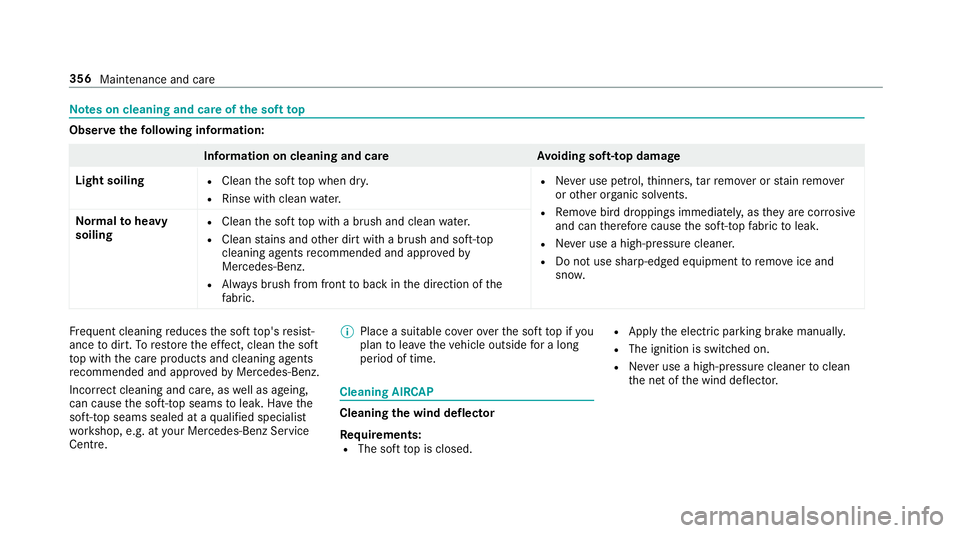
s on cleaning and care of the soft top Obser
vethefo llowing information: Information on cleaning and car
eAvoiding soft- top damage
Light soiling R
Clean the soft top when dr y.
R Rinse with clean water. R
Never use petrol, thinners, tarre mo ver or stain remo ver
or other or ganic sol vents.
R Remo vebird droppings immediatel y,as they are cor rosive
and can therefore cause the soft-to pfabric toleak.
R Never use a high-p ressure cleaner.
R Do not use sharp-edged equipment toremo veice and
sno w.
Norm
alto heavy
soiling R
Clean the soft top with a brush and clean water.
R Clean stains and other dirt with a brush and soft-top
cleaning agents recommended and appr ovedby
Mercedes-Benz.
R Alw ays brush from front toback in the direction of the
fa bric. Fr
equent cleaning reduces the soft top's resist‐
ance todirt. Torestore the ef fect, clean the soft
to p with the care products and cleaning agents
re commended and appr ovedby Mercedes-Benz.
Incor rect cleaning and care, as well as ageing,
can cause the soft-to p seams toleak. Ha vethe
soft-top seams sealed at a qualified specialist
wo rkshop, e.g. at your Mercedes-Benz Service
Centre. %
Place a suitable co verove rth e soft top if you
plan tolea vetheve hicle outside for a long
period of time. Cleaning AIRC
AP Cleaning
the wind deflector
Re quirements:
R The soft top is closed. R
Apply the electric parking brake manually.
R The ignition is switched on.
R Never use a high-p ressure cleaner toclean
th e net of the wind deflector. 356
Maintenance and care
Page 373 of 521
#
Therefore, place thefilling hose in the
plastic bag that con tained the TIREFIT
kit. +
ENVIRONMEN
TALNO TEEnvironmental
pollution caused byenvironmen tally ir re‐
sponsible disposal Ty
re sealant contains polluta nts.#
Have the tyre sealant bottle disposed of
professionall y,e.g. at a Mercedes-Benz
Service Centre. #
Switch off the tyre inflation compressor. #
Unscr ew thefilling hose from theva lve of the
defective tyre. #
Stow th e tyre sealant bottle, the tyre inflation
compressor and thewa rning triangle. #
Pull away immediatel y. #
Stop af ter driving for appro ximately ten
minutes and check the tyre pressure using
th e tyre inflation compressor.
The tyre pressure must now be at least
13 0 kPa (1.3 bar/19 psi). &
WARNING Risk of accident due tothe
specified tyre pressure not being ach‐
ie ved
If th e specified tyre pressure is not achie ved
af te r a brief drive, the tyre is too badly dam‐
aged. The tyre sealant cannot repair the tyre
in this ins tance.
Dama ged tyres and a tyre pressure that is
to o low can significantly impair braking and
handling characteristics. #
Do not drive on. #
Consult a qualified specialist workshop. Countries
that ha veMercedes-Benz
Service24h: ast icke r with the phone number
can also be found in your vehicle, e.g. on the
B‑pillar on the driver's side. #
Cor rect the tyre pressure if it is still at least
13 0 kPa (1.3 bar/19 psi). See the tyre pres‐
sure table on the fuel filler flap forva lues. #
Toincrease the ty repressure: switch on
th e tyre inflation compressor. #
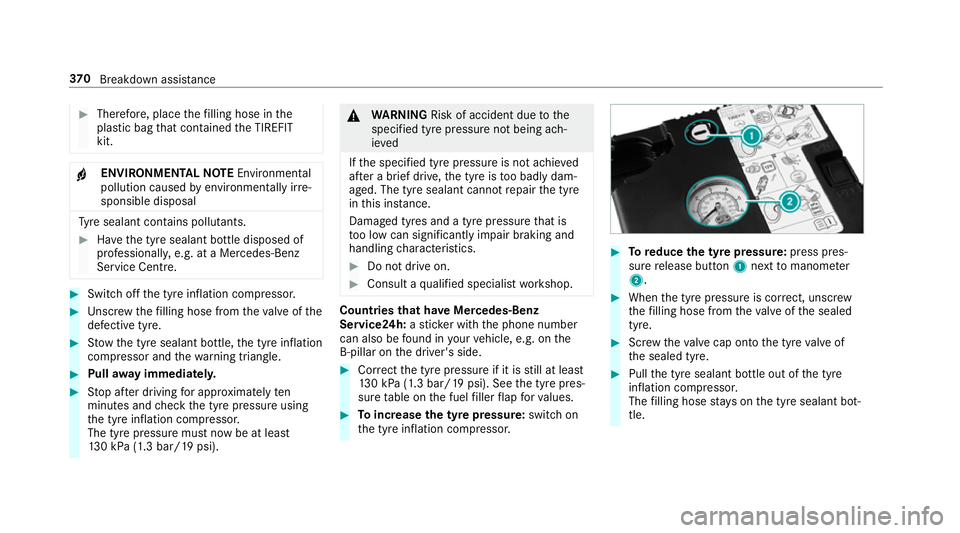
Toreduce the tyre pressure: press pres‐
su re re lease button 1next tomanome ter
2 . #
When the tyre pressure is cor rect, unscr ew
th efilling hose from theva lve of the sealed
tyre. #
Screw theva lve cap onto the tyre valve of
th e sealed tyre. #
Pull the tyre sealant bottle out of the tyre
inflation compressor.
The filling hose stay s on the tyre sealant bot‐
tle. 37 0
Breakdown assis tance
Page 376 of 521
St
arting assi stance and charging the12 V
battery Ve
hicles with a lithium-ion battery #
When charging the battery and during start‐
ing assis tance, al ways use the jump-s tart
connection point in the engine compartment.
* NO
TEDama getothe battery from over‐
vo ltage When
charging using a bat tery charge r with‐
out a maximum charging voltage, the battery
or the on-board electronics may be damaged. #
Only use battery charge rs with a maxi‐
mum charging voltage of 14.4 V. *
NO
TEShor tening the service life of the
battery bycharging the battery at low
te mp eratures Charging
the battery at very low temp era‐
tures may shor tenth e service life of the bat‐
te ry and ha vea negative ef fect on starting. #
Do not charge the battery at very low
te mp eratures. All
other vehicles #
When charging the battery and during start‐
ing assis tance, al ways use the jump-s tart
connection point in the engine compartment.
* NO
TEDamaging the battery thro ugh
ove rvoltage When using a battery
charge r without a maxi‐
mum charging voltage, the battery or the
ve hicle electronics may be damaged. #
Only use battery charge rs with a maxi‐
mum charging voltage of 14.8 V. &
WARNING Risk ofexplosion from hydro‐
ge nga s igniting
A battery generates hydrogen gas during the
ch arging process. If there is a short circuit or
spar ksstart toform ,th ere is a danger of the
hy drogen gas igniting. #
Make sure that the positive term inal of
th e connected battery does not come
into conta ct withvehicle parts. #
Never place me tal objects or tools on a
batter y. #
When connecting and disconnecting the
batter y,yo u must obse rveth e descri‐
bed order forth e battery clamps. #
When giving starting assis tance, al ways
make sure that you on lyconnect bat‐
te ry term inals with identical polarity. #
During starting assis tance, you must
obse rveth e described order for con‐
necting and disconnecting the jump
lead. #
Do not connect or disconnect the bat‐
te ry cla mp s while the engine is running. &
WARNING Risk ofexplosion during
ch arging process and starting assis tance
During thech arging process and starting
assis tance, the battery may release an explo‐
sive gas mixture. Breakdown assis
tance 373
Page 377 of 521
#
Avoid fire , naked flames, creating
spar ksand smoking. #
Make sure that there is suf ficient venti‐
lation du ring thech arging process and
during starting assis tance. #
Do not lean over a batter y. If
th e indicator/warning lamps in the instrument
clus ter do not light up at low temp eratures, it is
ve ry likely that the dischar ged battery has fro‐
zen. &
WARNING Risk ofexplosion from a fro‐
zen battery
A dischar ged battery may freeze at temp era‐
tures slightly abo veor below freezing point.
During starting assis tance or battery charg‐
ing, bat tery gas may be released. #
Alw aysth aw a frozen bat tery out first
before charging it or per form ing start‐
ing assis tance. The service li
feof a battery that has been
th awe d may be dramatically shor tened. It is
recommended that you ha veathaw ed bat‐
te ry checked at a qualified specialist workshop.
All vehicles
* NO
TEDama gecaused bynumerous or
ex tended attem ptsto start the engine Nume
rous or extended attem ptsto start the
engine may damage the catalytic con verter
due tonon-combu sted fuel. #
Avoid numerous and extended attem pts
to start the engine. Obser
vethefo llowing points during starting
assis tance and when charging the battery:
R Only use undamaged jump lead/charging
cables with a suf ficient cross-section and
insula tedte rm inal clamps.
R Non- insulated parts of thete rm inal clamps
must not come into con tact wi thother me tal
parts while the jump lead/charging cable is
connected tothe battery/jump-s tart connec‐
tion point. R
The jump leads/charging cable must not
come into contact wi thany parts which may
mo vewhen the engine is running.
R Alw ays make sure that nei ther you nor the
battery is elect rostatically charge d.
R Keep away from fire and naked flames.
R Do not lean overth e batter y.
R When charging: only use battery charge rs
te sted and appr ovedby Mercedes-Benz and
re ad the battery charge r's operating instruc‐
tions before charging the batter y.
Obser vethe additional following points during
st arting assis tance:
R Starting assis tance may only be pr ovided
using batteries with a nominal voltage of
12 V.
R The vehicles must not touch.
R Petrol engine: Only acceptstarting assis‐
ta nce if the engine and exhaust sy stem are
cold. #
Secure theve hicle byapplying the electric
parking brake. 374
Breakdown assis tance
Page 384 of 521
If
th e newly inser ted fuse also blo ws, ha vethe
cause traced and rectified at a qualified special‐
ist workshop, e.g. a Mercedes-Benz Service
Centre.
Ensure thefo llowing before replacing a fuse:
R The vehicle is secured against rolling away.
R All electrical consumers are switched off.
R The ignition is switched off.
The electrical fuses are located in various fuse
bo xes:
R Fuse box in the engine compartment on the
driver's side (→ page 381)
R Fuse box on the driver's side of the cockpit
(→ page 382)
R Fuse box in the front-passen gerfo ot we ll
(→ page 382)
R Fuse box in the boot on theright-hand side
of theve hicle, when vie wed in the direction
of tra vel (→ page 382) Fu
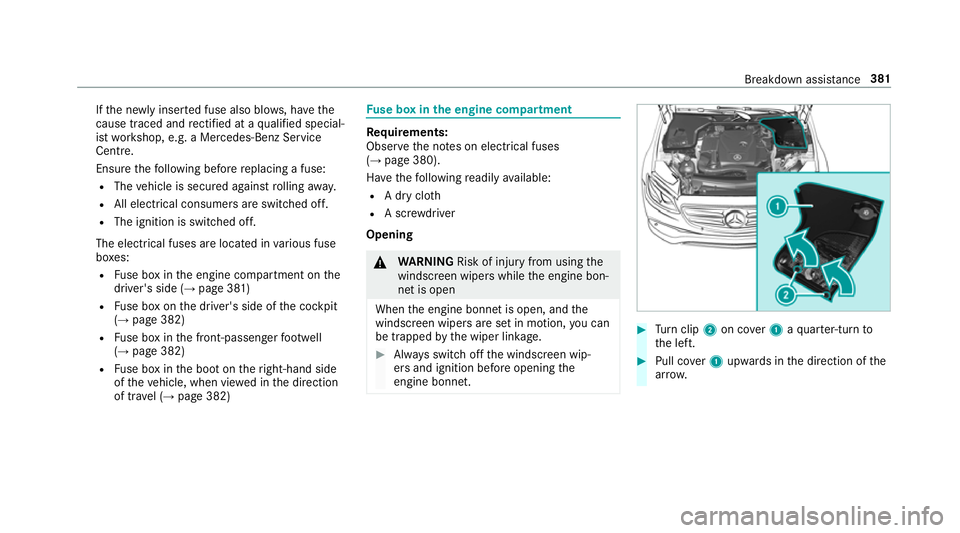
se box in the engine compa rtment Re
quirements:
Obser vethe no tes on electrical fuses
(→ page 380).
Ha ve thefo llowing readily available:
R A dry clo th
R A scr ewdriver
Opening &
WARNING Risk of inju ryfrom using the
windscreen wipers while the engine bon‐
net is open
When the engine bonn etis open, and the
windscreen wipers are set in motion, you can
be trapped bythe wiper linkage. #
Alw ays switch off the windscreen wip‐
ers and ignition before opening the
engine bonn et. #
Turn clip 2on co ver1 aqu arter-turn to
th e left. #
Pull co ver1 upwards in the direction of the
ar row. Breakdown assis
tance 381
Page 385 of 521
#
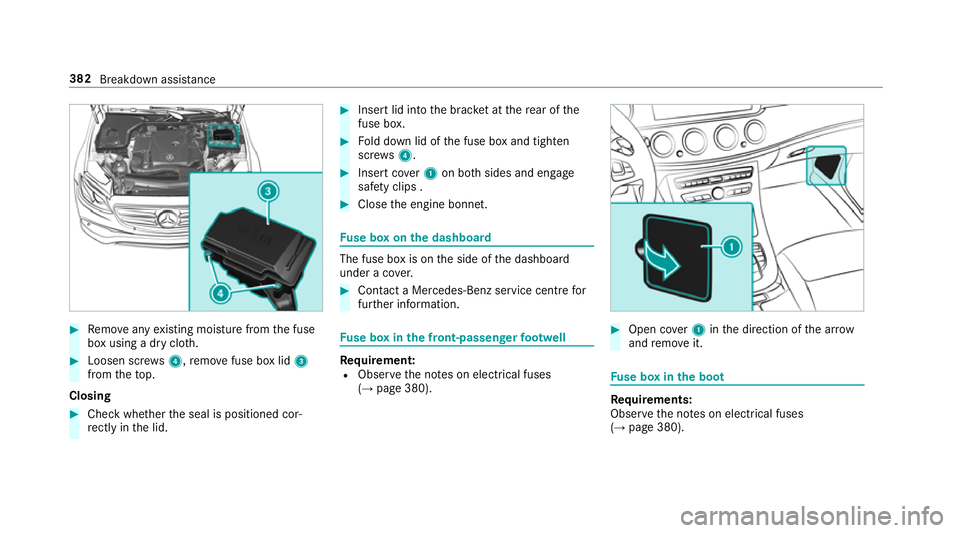
Remo veany existing moisture from the fuse
box using a dry clo th.#
Loosen scr ews4, remo vefuse box lid 3
from theto p.
Closing #
Check whe ther the seal is positioned cor‐
re ctly in the lid. #
Insert lid into the brac ket at there ar of the
fuse box. #
Fold down lid of the fuse box and tighten
scr ews4. #
Insert co ver1 on bo thsides and engage
saf ety clips . #
Close the engine bonn et. Fu
se box on the dashboa rd The fuse box is on
the side of the dashboard
under a co ver. #
Con tact a Mercedes-Benz service centre for
fur ther information. Fu
se box in the front-passenger foot we ll Re
quirement:
R Obser vethe no tes on electrical fuses
(→ page 380). #
Open co ver1 inthe direction of the ar row
and remo veit. Fu
se box in the boot Re
quirements:
Obser vethe no tes on electrical fuses
(→ page 380). 382
Breakdown assis tance
Page 388 of 521
This could cause damage
totheve hicle or
th e tyres. #
Neverfit snow chains on the front
wheels. #
Only fit snow chains on there ar wheels
in pairs. *
NO
TEDama getothe wheel trim from fit‐
te d snow chains If sn
ow ch ains are fitted tosteel wheels, the
wheel trims can be damaged. #
Remo vethe wheel trims of steel wheels
before fitting snow chains. R
Snow chains are on ly permissible for cer tain
wheel/tyre combinations. You can obtain
information about this from a Mercedes-Benz
Service Cent re.
R For saf etyre asons, on lyuse sn owchains that
ha ve been specifically appr ovedfo ryo ur
ve hicle byMercedes-Benz, or snow chains
with the same quality standard. R
If sn owchains are fitted, the maximum per‐
missible speed is 50 km/h.
R Vehicles with Parking Pilo t:Do not use
Pa rking Assist PARKTRONIC if sn ow chains
are fitted.
R Vehicles with AIR BODY CONT ROL:If snow
ch ains are fitted, only drive at raised vehicle
le ve l.
% You can permanently limit the maximum
ve hicle speed for driving with winter tyres
(→ page 180).
% You can deactivate ESP ®
to pull away
( → page 171). This allo ws the wheels tospin,
achieving an increased driving forc e. Ty
re pressure Note
s on tyre pressure &
WARNING Risk of accident due toinsuf‐
fi cient or excessive tyre pressure
Underinfla ted or overinfla ted tyres pose the
fo llowing risks:
R The tyres may bur st, especially as the
load and vehicle speed increase.
R The tyres may wearexc essively and/or
une venly, which may greatlyimpair tyre
traction.
R The driving characteristics, as well as
st eering and braking, may be greatly
impaired. #
Comply with there commended tyre
pressure and check the tyre pressure of
all tyres including the spare wheel regu‐
larly:
R at least once a month
R when the load changes Wheels and tyres
385
Page 389 of 521
R
before embarking on a longer journey
R if operating conditions change, e.g. off-
ro ad driving #
Adjust the tyre pressure as necessar y.Driving wi
thtyre pressu rethat is too high or too
low can:
R Sho rten the service life of the tyres.
R Cause increased tyre damage.
R Adversely af fect handling characteristics and
th us driving saf ety, e.g. due toaquaplaning. &
WARNING Risk of accident from repea‐
te d tyre pressure drop
If th e tyre pressure drops repeatedl y,the
wheel, valve or tyre may be damaged.
Insuf ficient tyre pressure can cause the tyres
to bur st. #
Inspect the tyre for signs of fore ign
objects. #
Check whe ther the wheel or valve has a
leak. #
Ifyo u are unable torectify the damage,
conta ct aqualified specialist workshop. Information on
there commended tyre pressure
fo rth eve hicle's factor y-fitted tyres can be found
on the tyre pressure table on the inside of the
fuel filler flap (→ page 386).
Use a suitable pressure gauge tocheck the tyre
pressure. The outer appearance of a tyre does
not permit any reliable conclusion about the tyre
pressure.
Ve hicles with a tyre pressure monitoring sys‐
te m: You can also check the tyre pressure using
th e on-board computer.
Only cor rect tyre pressures when the tyres are
cold. Conditions for cold tyres:
R The vehicle has been par ked with the tyres
out of direct sunlight for at least thre e hours.
R The vehicle has tr avelled less than 1.6 km.
A rise in the tyre temp erature of 10°C increases
th e tyre pressure byappr ox.10 kPa (0.1 ba r,1.
5 psi). Take this into account when checking
th e tyre pressure of warm tyres.
Tr ailer operation no tes
Alw ays inflate there ar axle tyres tothere com‐
mended tyre pressures on the tyre pressure
ta ble for increased load. Ty
re pressure table The tyre pressure
table is on the inside of the
fuel filler flap. 386
Wheels and tyres
Page 391 of 521
Sy
stem limitations
The tyre pressure monitoring sy stem does not
issue a warning:
R Ifth e tyre pressure is set incor rectl y.
R Ifth ere is a sudden pressure loss caused, for
ex ample byafo re ign object penetrating the
tyre.
R Ifth ere is a malfunction caused byano ther
ra dio signal source.
Make sure toobser vethefo llowing fur ther rela‐
te d subjec t:
R Notes on tyre pressure (→ page 385)
Checking the ty repressure with the tyre
pressure moni toring sy stem
Re quirement:
R The ignition is switched on.
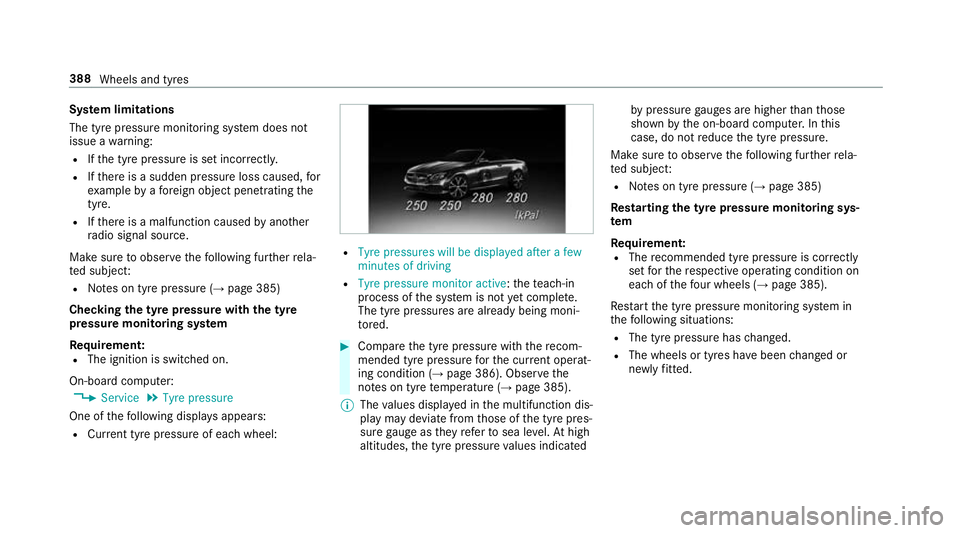
On-board computer: , Service .
Tyre pressure
One of thefo llowing displa ysappears:
R Cur rent tyre pressure of ea chwheel: R
Tyre pressures will be displayed after a few
minutes of driving
R Tyre pressure monitor active: thete ach-in
process of the sy stem is not yet compl ete.
The tyre pressures are already being moni‐
to re d. #
Compare the tyre pressure with there com‐
mended tyre pressure forth e cur rent operat‐
ing condition (→ page 386). Obse rvethe
no tes on tyre temp erature (→ page 385).
% The values displa yed in the multifunction dis‐
play may deviate from those of the tyre pres‐
sure gauge as they referto sea le vel.At high
altitudes, the tyre pressure values indicated by
pressure gauges are higher than those
shown bythe on-board computer. In this
case, do not reduce the tyre pressure.
Make sure toobser vethefo llowing fur ther rela‐
te d subjec t:
R Notes on tyre pressure (→ page 385)
Rest arting the ty repressure moni toring sys‐
tem
Requ irement:
R The recommended tyre pressure is cor rectly
set forth ere spective operating condition on
each of thefo ur wheels (→ page 385).
Re start the tyre pressure monitoring sy stem in
th efo llowing situations:
R The tyre pressure has changed.
R The wheels or tyres ha vebeen changed or
newly fitted. 388
Wheels and tyres
Page 392 of 521
On-board computer:
, Service .
Tyre pressure #
Swipe down wards on theTo uch Control on
th e left-hand side of thesteering wheel.
The Use current pressures as new reference
values message is shown in the multifunction
displa y. #
Press atoconfirm there start.
The Tyre press. monitor restarted message is
shown in the multifunction displa y.
Cur rent wa rning messages are dele ted and
th eh yellow warning lamp goes out.
Af teryo u ha vedriven for a few minutes, the
sy stem checks whe ther the cur rent tyre pres‐
su res are within the specified range. The cur‐
re nt tyre pressures are then accep ted as ref‐
erence values and monitored.
Make sure toobser vethefo llowing fur ther rela‐
te d subjec t:
R Notes on tyre pressure (→ page 385)Ra
dio-type appr oval of the ty repressure
moni toring sy stem
Ra dio equipment appr oval numbers Countr
yRadio equipment appr oval
number
Abu Dhabi TRA REGISTERED NO: ER3 7156/15.
DEALER NO: DA00470 74/10
Argentina AFTIC:H1 4788
Duba iT RA
REGI STERED NO: ER3 7156/15.
DEALER NO: DA00470 74/10
European
Union Hereb
y,Schrader Electronics
Ltd., declares that this TPMS is in
compliance with the essential
re qu irements and other pr ovi‐
sions of directive 1999/5/EC.
The declaration of conformity
may be consul ted at emcteam@
schrader.co.uk Countr
yRadio equipment appr oval
number
Jordan Kingdom of Jordan Type appr oval
fo rTy re Pressure sensor.
Manufacturer: Schrader Elect ron‐
ics Ltd. Model: AG5SP4
Ty pe Appr oval Numb er:
TRC/LPD/20 15/21
Kingdom of Jo rdan Type appr oval
fo rTy re Pressure sensor.
Manufacturer: Schrader Elect ron‐
ics Ltd. Model: MFR
Ty pe Appr oval Numb er:
TRC/LPD/20 15/223
Mal aysia RCDD/04A/0 615/S(15-2095)
Morocco AGREE PAR L'ANRT MA ROC
Nume rod'agrement :MR 10216
ANRT 20 15
Date d'agrement :18/3/20 15 Wheels and tyres
389