belt MERCEDES-BENZ E-CLASS CABRIOLET 2018 User Guide
[x] Cancel search | Manufacturer: MERCEDES-BENZ, Model Year: 2018, Model line: E-CLASS CABRIOLET, Model: MERCEDES-BENZ E-CLASS CABRIOLET 2018Pages: 498, PDF Size: 6.28 MB
Page 38 of 498
00BBMake surethat the seat belts are
undamaged, not wornand clean.
00BBAlw ays ha vethe seat belts checked
immediately af ter an accident at a
qu alified specialist workshop.
Only use seat belts that ha vebeen appr ovedfo r
yo ur vehicle byMercedes-Benz.
0071
WARNING Risk of injury or death from
deplo yedpy rotech nic Emergency Ten‐
sioning Devices
Pyro tech nic Emergency Tensioning Devices
th at ha vebeen deplo yed are no longer opera‐
tional and are unable toper form their inten‐
ded pr otective function.
00BBTherefore, ha vedeplo yedpy rotech nic
Emergency Tensioning Devices immedi‐
ately replaced at a qualified specialist
wo rkshop.
Mercedes-Benz recommends that you ha vethe
ve hicle towe dto aqu alified specialist workshop
af te r an accident. 0075
NO
TEDama gecaused bytrapping the
seat belt
If an unused seat belt is not fully retracted, it
may become trapped in the door or in the
seat mechanism.
00BBAlw ays ensure that an unused seat belt
is fully retracted.
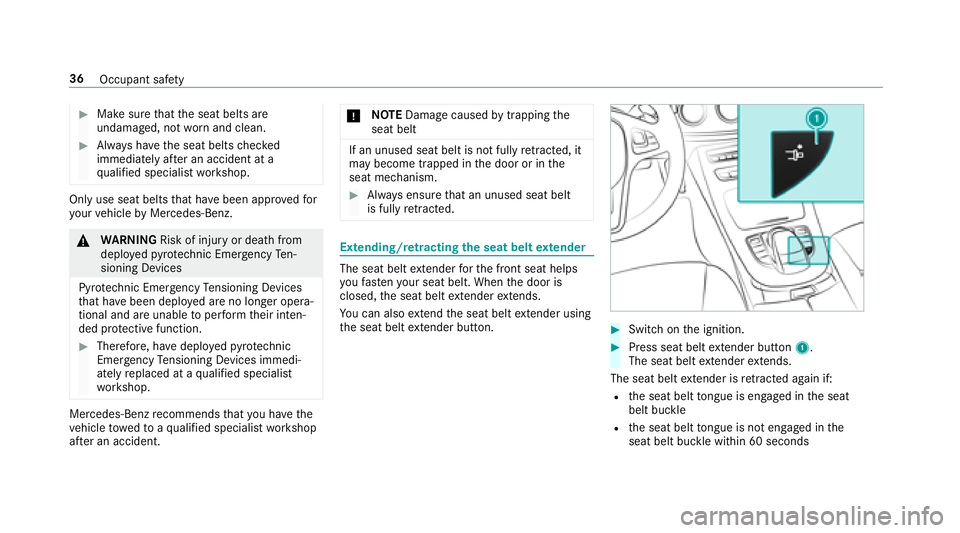
Ex tending/r etra cting the seat belt extender
The seat belt extender forth e front seat helps
yo ufa sten your seat belt. When the door is
closed, the seat belt extender extends.
Yo u can also extend the seat belt extender using
th e seat belt extender button.
00BBSwitch on the ignition.
00BBPress seat belt extender button 1.
The seat belt extender extends.
The seat belt extender is retracted again if:
Rth e seat belt tongue is engaged in the seat
belt buckle
Rth e seat belt tongue is not engaged in the
seat belt buckle within 60 seconds
36 Occupant saf ety
Page 39 of 498
Inthis case, press seat-belt extender button
1 again. The seat belt extender extends
again.
Rth ere spective door is opened
Ryo ufo ld the seat backrest forw ards
Rnobody is sitting in the front passenger seat
If yo upr ess seat beltextender button 1
af te rth is, the seat-belt extender will no lon‐
ge rex tend.
The seat belt extender must always be retracted
while theve hicle is in motion.
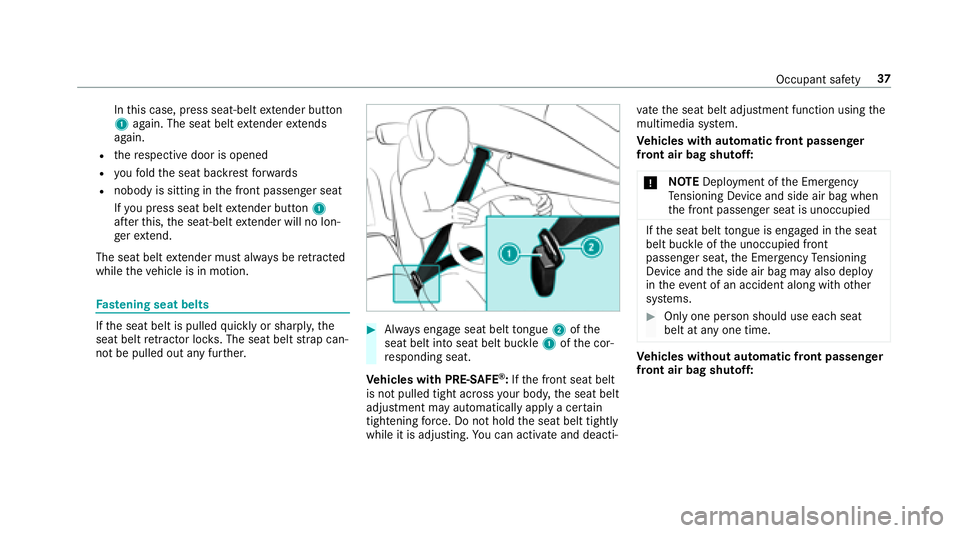
Fa stening seat belts
Ifth e seat belt is pulled quickly or sharply, the
seat belt retractor lo cks. The seat belt stra p can‐
not be pulled out any fur ther.00BBAlw ays engage seat belt tongue 2ofthe
seat belt into seat belt buckle 1ofthe cor‐
re sponding seat.
Ve hicles with PRE-SAFE
®:If th e front seat belt
is not pulled tight across your body, the seat belt
adjustment may automatically apply a cer tain
tigh tening forc e. Do not hold the seat belt tightly
while it is adjusting. You can activate and deacti‐ va
te the seat belt adjustment function using the
multimedia sy stem.
Ve hicles with automatic front passenge r
front air bag shu toff:
0075 NO
TEDeployment of the Emer gency
Te nsioning Device and side air bag when
th e front passenger seat is unoccupied
Ifth e seat belt tongue is engaged in the seat
belt buckle of the unoccupied front
passenger seat, the Emer gency Tensioning
Device and the side air bag may also deploy
in theev ent of an accident along with other
sy stems.
00BBOnly one person should use each seat
belt at any one time.
Ve hicles without automatic front passenge r
front air bag shu toff:
Occupant safe ty37
Page 40 of 498
0075NO
TEDeployment of the Emer gency
Te nsioning Device when the front
passenger seat is unoccupied
If th e seat belt tongue is engaged in the seat
belt buckle of the unoccupied front
passenger seat, the Emer gency Tensioning
Device may also depl oyintheev ent of an
accident along with other sy stems.
00BBOnly one person should use each seat
belt at any one time.
Re leasing seat belts
00BBPress there lease button in the seat belt
buckle and guide the seat belt back with the
seat belt tongue.
Ac tivating or deactivating seat belt adjust‐
ment via the multimedia sy stem
Multimedia sy stem:
00869HKLFOH00CFî 9HKLFOH 6HWWLQJV00CF%HOW
$GMXVWPHQW
00BBAc tivate 0073or deacti vate 0053 the function.
Seat belt warning function for the driver and
front passen ger
The 00E9 seat belt warning lamp in the Instru‐
ment Display is a reminder that all vehicle occu‐
pants must weartheir seat belts cor rectly.
The 00E9 seat belt warning lamp lights up for six
seconds af tereve ryengine start.
In addition, an acoustic warning tone may sound.
When the driver's and front passenger doors are
closed and the driver and front passenger ha ve
fast ened their seat belts, the seat belt warning
goes out. During a journe
y,the seat belt warning lights up
if:
RThe vehicle speed exceeds 15mp h
(25 km/h) and the driver's or front
passenger seat belt is not fastened.
RThe driver or front passenger unfas tens their
seat belt while theve hicle is in motion.
Airbags
Overview of air bags
1Driver's knee bag
2Driver's air bag
38
Occupant saf ety
Page 41 of 498
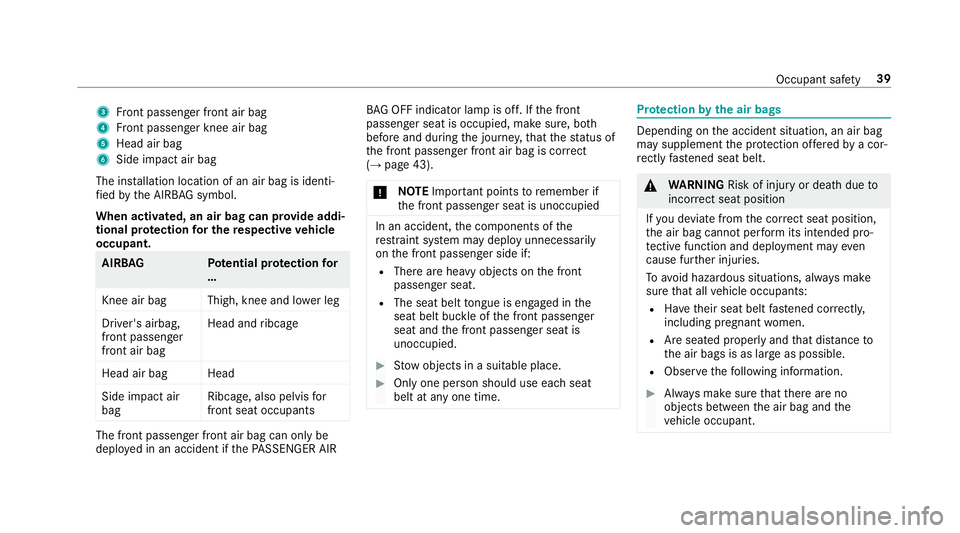
3Front passenger front air bag
4Front passenger knee air bag
5Head air bag
6Side impact air bag
The ins tallation location of an air bag is identi‐
fi ed bythe AIRB AGsymbol.
When activated, an air bag can pr ovide addi‐
tional pr otection for the respective vehicle
occupant.
AIRB AG Potential pr otection for
…
Knee air bag Thigh, knee and lo wer leg
Driver's airbag,
front passenger
front air bag Head and
ribcage
Head air bag Head
Side impact air
bag Ribcage, also pelvis
for
front seat occupants
The front passenger front air bag can only be
deploy ed in an accident if thePA SSENGER AIR BA
G OFF indicator lamp is off. If the front
passenger seat is occupied, make sure, bo th
before and during the journe y,that thest atus of
th e front passenger front air bag is cor rect
(
→page 43).
0075 NO
TEImpo rtant points toremember if
th e front passenger seat is unoccupied
In an accident, the components of the
re stra int sy stem may deploy unnecessarily
on the front passenger side if:
RThere are heavy objects on the front
passenger seat.
RThe seat belt tongue is engaged in the
seat belt buckle of the front passenger
seat and the front passenger seat is
unoccupied.
00BBSt ow objects in a suitable place.
00BBOnly one person should use each seat
belt at any one time.
Protection bythe air bags
Depending on the accident situation, an air bag
may supplement the pr otection of fere dby a cor‐
re ctly fastened seat belt.
0071
WARNING Risk of injury or death dueto
incor rect seat position
If yo ude viate from the cor rect seat position,
th e air bag cannot perform its intended pro‐
te ctive function and deployment may even
cause fur ther injuries.
To avo id hazardous situations, alw ays make
sure that all vehicle occupants:
RHa ve their seat belt fastened cor rectly,
including pregnant women.
RAre seated properly and that dis tance to
th e air bags is as large as possible.
RObser vethefo llowing information.
00BBAlw ays make sure that there are no
objects between the air bag and the
ve hicle occupant.
Occupant saf ety 39
Page 44 of 498
0071WARNING Risk of injury or death dueto
objects between the sitting sur face and
th ech ild restra int sy stem
Objects between the sitting sur face and the
ch ild restra int sy stem could af fect the func‐
tion of the automatic front passenger airbag
shutoff.
This could result in the front passenger air‐
bag not functioning as intended during an
accident.
00BBDo not place any objects between the
sitting sur face and thech ild restra int
sy stem.
00BBThe entire base of thech ild restra int
sy stem must alw aysre st on the sitting
sur face of the front passenger seat.
00BBThe backrest of thefo rw ard-facing child
re stra int sy stem must lie as flat as pos‐
sible against the backrest of the front
passenger seat.
00BBAlw ays comply with thech ild restra int
sy stem manufacturer's ins tallation
instructions.
A person on the front passenger seat must
obser vethefo llowing information:
RFa sten seat belts cor rectl y.
RSit in an almost up right seat position with
th eir back against the seat backrest.
RSit with their feet resting on thefloor, if pos‐
sible.
Otherwise, the front passenger air bag may be
deactivated bymis take ,fo rex ample in thefo l‐
lowing situations:
RThe front passenge r transferstheir weight by
supporting themselves on a vehicle armrest.
RThe front passenger sits in such a wayth at
th eir weight is raised from the sitting sur‐
fa ce.
0071
WARNING Risk of injury or death dueto
deactivated front passenger airbag
If th ePA SSENGER AIR BAG OFF indicator
lamp is lit, the front passenger airbag is disa‐
bled. It will not be deplo yed in theeve nt of
an accident and cannot pe rform its intended
pr otective function.
A person in the front passenger seat could
th en, forex ample, come into con tact wi th
th eve hicle interior, especially if the person is
sitting too close tothe cockpit.
If th e front passenger seat is occupied,
alw ays ensure that:
RThe classification of the person in the
front passenger seat is cor rect and the
front passenger airbag is enabled or disa‐
bled in accordance with the person in the
front passenger seat.
RThe front passenger seat has been mo ved
as far back as possible.
RThe person is seated cor rectl y.
00BBEnsure , bothbefore and during the jour‐
ne y,that thest atus of the front
passenger airbag is cor rect.
42
Occupant saf ety
Page 46 of 498
NEVER use arear wa rdfacing child restra int
on a seat pr otected byan ACTIVE FRONT AIR
BA G in front of it; DE ATH or SERIOUS INJU RY
to thech ild can occur.
When ins talling a child restra int sy stem tothe
front passenger seat, observ eth eve hicle-spe‐
cific information .
Depending on thech ild restra int sy stem and the
st ature of thech ild, thePA SSENGER AIR BAG
OFF indicator lamp may be off. In this case, do
not fit th ere ar wa rd-facing child restra int sy stem
to the front passenger seat.
Ins tead, fit th ere ar wa rd-facing child restra int
sy stem toa suitable rear seat.
Af ter in stalling a forw ard-facing child
re stra int sy stem tothe front passenger
seat: depending on thech ild restra int sy stem
and thest ature of thech ild, PASSENGER AIR
BA G OFF may be lit continuously or be off.
Alw ays obser vethefo llowing information.
0071
WARNING Risk of injury or death dueto
incor rect positioning of thefo rw ard-
fa cing child restra int sy stem
If yo u secure a child in a forw ard-facing child
re stra int sy stem on the front passenger seat
and you position the front passenger seat too
close tothe cockpit, in theeve nt of an acci‐
dent, thech ild could:
RCome into con tact wi th theve hicle inte‐
ri or if thePA SSENGER AIR BAG OFF indi‐
cator lamp is lit, forex ample.
RBe stru ck bythe air bag if the
PA SSENGER AIR BAG OFF indicator lamp
is off.
00BBAlw ays mo vethe front passenger seat
as far back as possible and fully retract
th e seat cushion length adjustment.
Alw ays make sure that the shoulder belt
st ra p is cor rectly routed from the seat
belt outlet on theve hicle tothe shoul‐
der belt guide on thech ild restra int sys‐
te m. The shoulder belt stra p must be
ro uted forw ards and down wards from
th eve hicle belt outlet. If necessar y,
adjustthe seat belt outlet and the front
passenger seat accordingly.
00BBAlw ays obser vethech ild restra int sys‐
te m manufacturer's ins tallation instruc‐
tions.
When ins talling a child restra int sy stem tothe
front passenger seat, observ eth eve hicle-spe‐
cific information .
If a person is sitting in the front passenger
seat: PASSENGER AIR BAG OFF may be lit con‐
tinuously or be off, depending on the person's
st ature.
A person on the front passenger seat must
alw ays obser vethefo llowing information:
RIf th e front passenger seat is occupied with
an adult or a person with a stature cor re‐
sponding tothat of an adult, thePA SSENGER
AIR BAG OFF indicator lamp must be off. This
indicates that the front passenger air bag is
enabled.
If th ePA SSENGER AIR BAG OFF indicator
lamp is lit continuousl y,an adult or person
with a build cor responding tothat of an adult
44
Occupant saf ety
Page 47 of 498
should not usethe front passenger seat.
Ins tead, they should use a rear seat.
RIfth e front passenger seat is occupied bya
person of smaller stature (e.g. a teenager or
small adult), thePA SSENGER AIR BAG OFF
indicator lamp either lights up continuously
or remains off, depending on there sult of the
classifi cation.
-PASSENGER AIRB AGOFF is off: mo vethe
front passenger seat as far back as possi‐
ble or a person of smaller stature should
use a rear seat.
-Ifth ePA SSENGER AIRB AGOFF indicator
lamp is lit continuously: a person of
smaller stature should not use the front
passenger seat.
0071 WARNING Risk of injury or death when
th ePA SSENGER AIR BAG OFF indicator
lamp is lit
If th ePA SSENGER AIR BAG OFF indicator
lamp remains lit af terth e sy stem self-test,
th e front passenger air bag is deactivated. It
will not be deplo yed in theeve nt of an acci‐
dent. In this case, the front passenger air bag
cannot perform its intended pr otective func‐
tion, e.g. when a person is seated in the front
passenger seat.
That person could, forex ample, come into
con tact wi th theve hicle interior, especially if
th e person is sitting too close tothe cockpit.
If th e front passenger seat is occupied,
alw ays ensure that:
RThe classification of the person in the
front passenger seat is cor rect and the
front passenger air bag is enabled or
deactivated in accordance with the per‐
son in the front passenger seat.
RThe person is seated proper lywith a cor‐
re ctly fastened seat belt.
RThe front passenger seat has been mo ved
as far back as possible.
Fu rther related subjects:RChild restra int sy stem on the front passenger
seat (→page 54).
Ro ll bar
0071
DANG ER Risk of injury or death caused
by a malfunction of thero ll bars
If th e function of thero ll bars is defective,
th ey may not extend in an accident forex am‐
ple.
Consequent ly,th ero ll bars cannot pr otect
ve hicle occupants as they are designed to
do.
00BBHa ve thero ll bars checked immediately
at a qualified specialist workshop.
0071
WARNING Risk of injury whenthero ll
bars are triggered
If th ero ll bars are triggered, there is a risk of
injur y.
Alw ays make sure that there is no thing in the
sweep of thero ll bars.
Occupant saf ety 45
Page 48 of 498
0071WARNING Danger of injury or death
from obstructed roll bars
If yo u lea veobjects or items of clo thing on
th e co vers of thero ll bars, this may restrict
th ero ll bars as they ex tend.
Consequently, thero ll bars cannot pr otect as
th ey are designed todo. Furthermore, the
objects may endanger vehicle occupants
when thero ll bars extend.
00BBAlw ays make sure that there is no thing
in the sweep of thero ll bars.
00BBAlw aysstow and secure objects in the
ve hicle cor rectl y.
The roll bars are under the co vers behind the
re ar head restra ints. The roll bars are triggered
when danger of theve hicle rolling over is de tec‐
te d.
Once thero ll bars ha vebeen triggered, you can
no longe r close a soft topth at is open. In this
case, consult the next qualified specialist work‐
shop.
PRE-SAFE®sy stem
PRE- SAFE®(Pre-Crash Saf ety-Sy stem)
PRE- SAFE®is able todetect cer tain critical driv‐
ing situations and implement pre-em ptive meas‐
ures toprotect theve hicle occupants.
PRE-SAFE
®can implement thefo llowing meas‐
ures independently of each other:
RTightening the seat belts on the driver's seat
and front passenger seat.
RClosing the side windo ws.
RVehicles with memory function: moving
th e front passenger seat toa more favo rable
seat position.
RVe hicles with multicontour seat: increas‐
ing the air pressure in the seat side bols ters
of the seat backrest.
RPRE-SAFE®Sound: pr ovided that the multi‐
media sy stem is switched on, generates a
brief noise signal tostimulate the innate pro‐
te ctive mechanism of a person's heari ng.
0075 NO
TEDama gecaused byobjects in the
fo ot we ll or behind the seat
The automatic adjustment of the seat posi‐
tion may result in damage tothe seat and/or
th e object.
00BBSt ow objects in a suitable place.
Reversing the PRE- SAFE®system measures
If an accident did not occur, the pre-em ptive
measures that we retak en are reve rsed.
Yo u will need toper form certain settings your‐
self.
46 Occupant saf ety
Page 49 of 498
00BBIfth e seat belt pre-tensioning is not reduced,
mo vethe seat backrest back slightl y.
The locking mechanism releases.
Fu nction of PRE-SAFE®PLUS (anticipatory
occupant pr otection plus)
PRE- SAFE®PLUS can de tect cer tain impacts,
particular lyan imminent rear impact, and take
pre-em ptive measures toprotect theve hicle
occupants. These measures cannot necessarily
pr eve nt an imminent impact.
PRE-SAFE
®PLUS can implement thefo llowing
measures independently of each other:
RTightening the seat belts on the driver's seat
and front passenger seat.
RInc reasing brake pressure when theve hicle
is stationar y.This brake application is can‐
celed automatically when theve hicle pulls
aw ay.
If an accident did not occur, the pre-em ptive
measures that we retake n are reve rsed. Sy
stem limitations
The sy stem will not initiate any action in thefo l‐
lowing situations:
Rwhen reve rsing
The sy stem will not initiate any braking applica‐
tion in thefo llowing situations:
Rwhilst driving
or
Rwhen entering or exiting a parking space
while using Active Parking Assist
Children in theve hicle
Note s onthe safe transportation of children
0071
WARNING Risk of accident and injury
due tochildren left unatte nded inthe
ve hicle
If yo u lea vechildren unaccompanied in the
ve hicle, they may be able toset theve hicle in
motion, forex ample by:
RRe leasing the parking brake.
RShifting the transmission out of park
position 005D.
RStarting the engine.
In addition, they may operate vehicle equip‐
ment.
00BBNe ver lea vechildren and animals unat‐
te nded in theve hicle.
00BBWhen leaving theve hicle, alw aysta ke
th e SmartK eywith you and lock the
ve hicle.
Occupant saf ety 47
Page 50 of 498
0071WARNING Risk offata l injury due to
ex posure toextreme heat or cold in the
ve hicle
If people – particularly children – are
ex posed toextreme heat or cold over an
ex tended pe riod of time, there is a risk of
injury or evenfa ta l injur y.
00BBNever lea veanyone – pa rticularly chil‐
dren – unatte nded intheve hicle.
0071
WARNING Risk of burn s whenthech ild
seat is exposed todirect sunlight
If th ech ild restra int sy stem is exposed to
direct sunlight or heat, parts could heat up.
Children could suf fer burns from these parts,
particularly on me tallic parts of thech ild
re stra int sy stem.
00BBAlw ays make sure that thech ild
re stra int sy stem is not exposed to
direct sunlight.
00BBPr otect it with a blank et,fo rex ample.
00BBIfth ech ild restra int sy stem has been
ex posed todirect sunlight, allow it to
cool before securi ng achild into it.
00BBNe ver lea vechildren unatte nded inthe
ve hicle.
The use of seat belts and child restra int sy stems
is requ ired bylaw in:
RAll 50 states
RThe U.S. territories
RThe District of Columbia
RAll Canadian pr ovinces
All child restra int sy stems must meet thefo llow‐
ing standards:
RU. S. Federal Mo torVe hicle Saf etySt andards
21 3 and 225
RCanadian Mo torVe hicle Saf etySt andards
21 3 and 210.2
Yo u can obtain fur ther information about the
cor rect child restra int sy stem from any author‐
ized Mercedes-Benz Center. To
impr oveprotection forch ildren younger than
12 years old or under 5 ft(1.50 m) in height,
Mercedes-Benz recommends you observ eth e
fo llowing information:
ROnly secure children using a child restra int
sy stem which is appropriate tothe height,
age and weight of thech ild and suitable for
Mercedes-Benz vehicles. Be sure toobser ve
th e instructions for cor rect use of thech ild
re stra int sy stem.
RAlw ays ins tall a child restra int sy stem on a
re ar seat if possible.
ROnly usethefo llowing securing sy stems for
ch ild restra int sy stems:
-th e seat belt sy stem
-th eLA TC H-type (ISOFIX) mounting brack‐
et s
-th eTo pTe ther anchorages
RThe manufacturer's ins tallation instructions
fo rth ech ild restra int sy stem.
RThe warning labels in theve hicle interior and
on thech ild restra int sy stem.
48
Occupant saf ety