belt MERCEDES-BENZ E-CLASS COUPE 2009 User Guide
[x] Cancel search | Manufacturer: MERCEDES-BENZ, Model Year: 2009, Model line: E-CLASS COUPE, Model: MERCEDES-BENZ E-CLASS COUPE 2009Pages: 313, PDF Size: 7.76 MB
Page 41 of 313
and you are holding th
einside of th esteer-
ing wheel.
R Do no tlean on th edoors/rear sidewalls
from th einside.
R Mak esure that there are no people, ani-
mals or object sbetween th evehicle occu-
pant sand th earea of deploymen tofthe
airbag.
R Do no tplace any object sbetween th eseat
backres tand th edoor.
R Do no thanga ny hard objects, for example,
coat hangers, on th egrab handles or coat
hooks.
R Do no tattach accessories suc hasdrinks
can holders to th edoors/rear sidewalls.
It is no tpossible to rule out arisk of injuries
caused by an airbag due to th ehigh spee dat
whic hthe airbag must deploy. G
Ris
kofi njury
The airbag's functionalit ycan only be assured
if th efollowin gpartsa re no tcovered and no
badges or stickers are attached to them:
R padded steering wheel boss
R knee airbag cover below th esteering col-
umn
R front-passenger fron tairbag cover
R outer side of fron tseat bolsters
R side trim nex ttotherear seat backrest
R Cabriolet :door trim G
Ris
kofi njury
When an airbag deploys, asmall amoun tof
powder is released. The powder may cause
short-term breathin gdifficulties to persons
sufferin gfroma sthma or other pulmonary
conditions.
In orde rtoprevent potential breathin gdiffi-
culties, you shoul dleave th evehicle as soon
as it is safe to do so. You can also open the
window to allow fresh air to enter th evehicle
interior. The powder generally does no tcon- stitut
eahealthhazard and does no tindicate
that there is afireint hevehicle. G
Ris
kofi njury
The airbag part sare hot after th eairbag has
been deployed. Do no ttou ch them as you
coul dburn yourself.
Hav ethe airbag sreplaced at aqualified spe-
cialis tworkshop .Otherwise, occupant sare
no tp rotected by th eairbag sintheeven tof
another accident.
Fron tairbags
The fron tairbag sare designed to increase
protection for th edriver' sand fron tpasseng-
er' sh ead and chest. The driver'
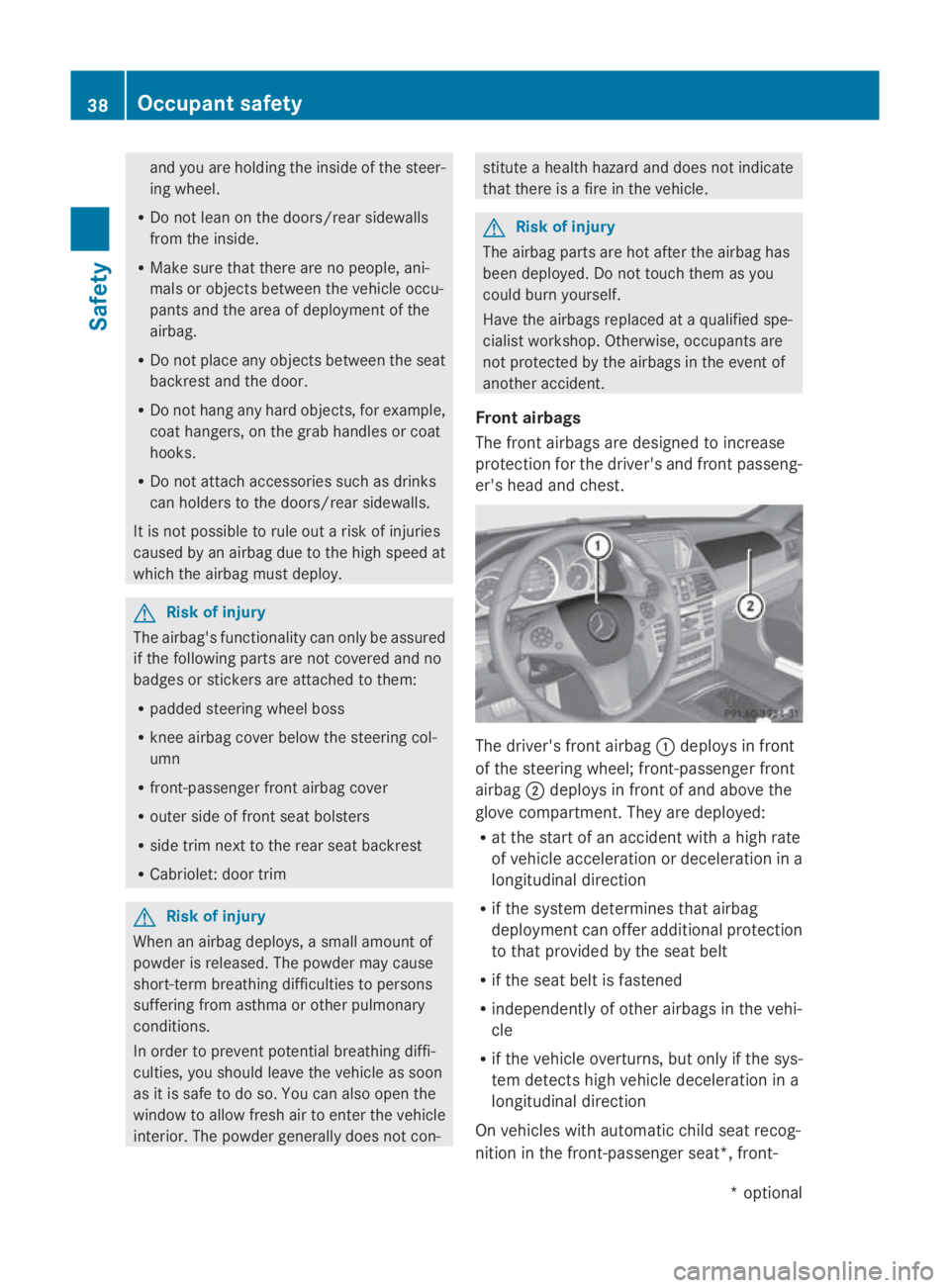
sfront airbag 0046deploys in front
of th esteering wheel; front-passenger front
airbag 0047deploys in fron tofand above the
glov ecompartment. They are deployed:
R at th estart of an acciden twith ahigh rate
of vehicle acceleratio nordeceleratio nina
longitudinal direction
R if th esystem determine sthata irbag
deployment can offer additional protection
to that provided by th eseat belt
R if th eseat belt is fastened
R independently of other airbag sinthevehi-
cle
R if th evehicle overturns, but only if th esys-
te md etect shigh vehicle deceleratio nina
longitudinal direction
On vehicle swith automatic child seat recog-
nition in th efront-pa ssenger seat*, front- 38
Occupant safetySafety
*o
ptional
207_AKB
;2;3,en-GB
mkalafa, Version:2.11.8.1
2009-07-23T10:23:49+02:00
-Seite 38
Page 42 of 313
passenger fron
tairbag 0047is only deployed if
the 007F PASSENGER AIRBAG OFF warning
lamp in the centre console is not lit
(Y page 44). This means that ther eisnot a
child restraint system with automatic child
seat recognition* fitted to the front-
passenger seat or that achild restraint sys-
tem with automatic child seat recognition*
has been fitted to the front-passenger seat
incorrectly.
Driver' sknee airbag
i The driver' skneea irbag is only available
in certain countries.
The driver' skneea irbag can help reduce the
risk of injury to the knees, thighs and lower
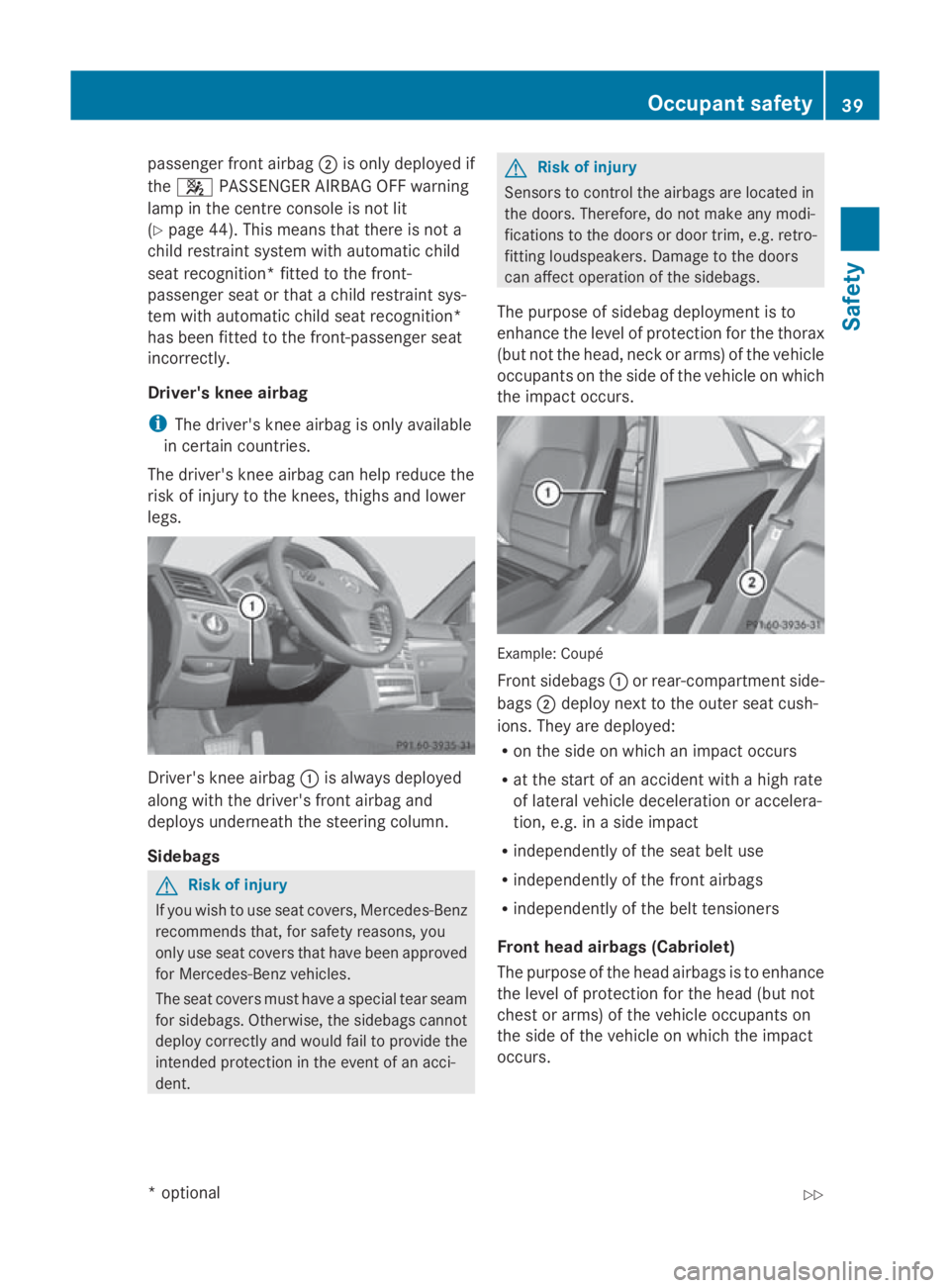
legs. Driver's knee airbag
0046is always deployed
along with the driver' sfron tairbag and
deploys underneath the steering column.
Sidebags G
Risk of injury
If you wish to use seat covers, Mercedes-Benz
recommends that ,for safety reasons ,you
only use seat cover sthat have been approved
for Mercedes-Benz vehicles.
The seat cover smust have aspecial tear seam
for sidebags. Otherwise, the sidebags cannot
deploy correctly and would fail to provide the
intended protection in the event of an acci-
dent. G
Risk of injury
Sensors to contro lthe airbags are located in
the doors. Therefore, do not make any modi-
fications to the doors or door trim ,e.g. retro-
fitting loudspeakers. Damage to the doors
can affect operation of the sidebags.
The purpose of sidebag deployment is to
enhance the level of protection for the thorax
(but not the head, nec korarms) of the vehicle
occupants on the side of the vehicle on which
the impact occurs. Example: Coupé
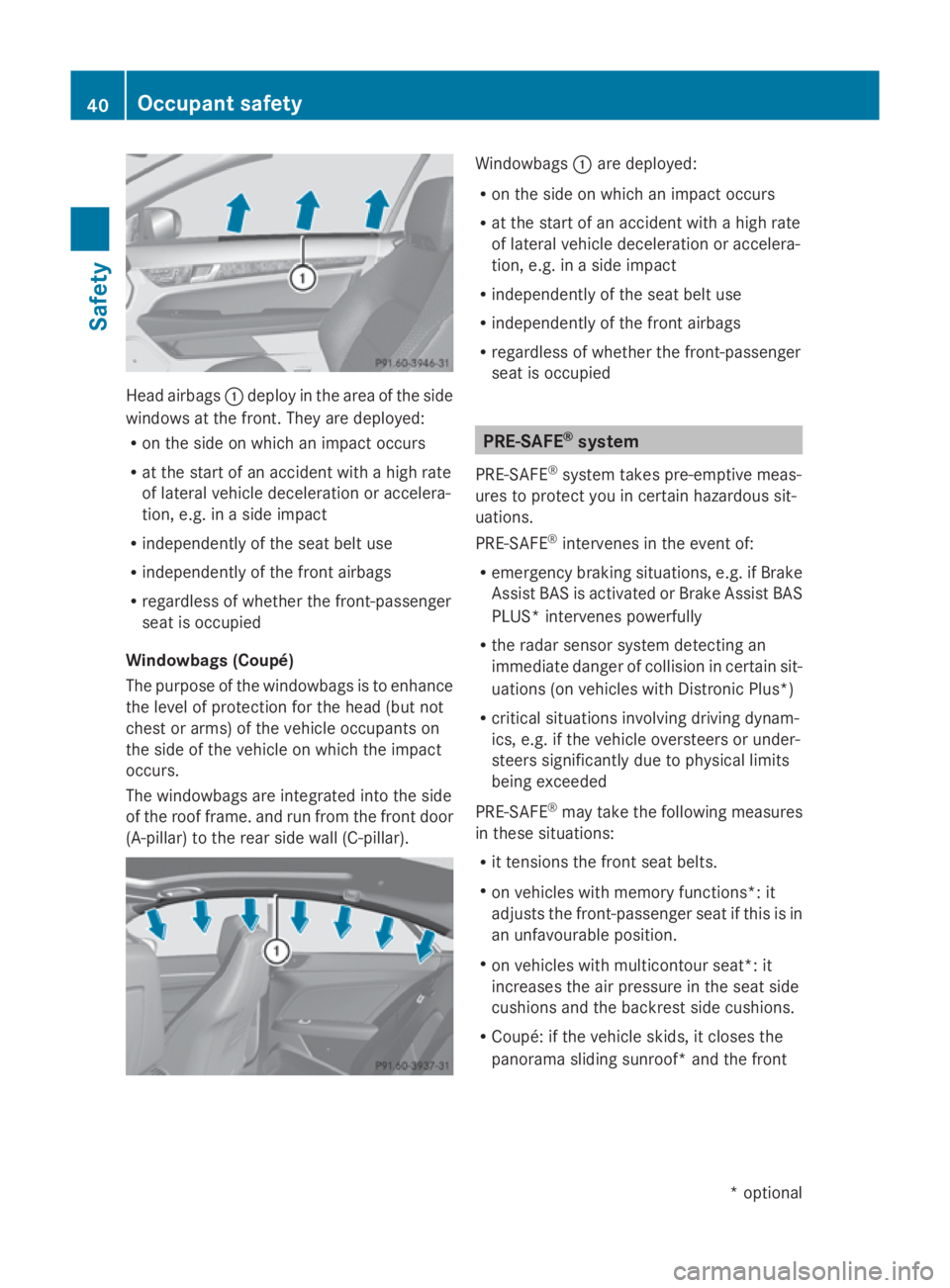
Fron
tsidebags 0046or rear-compartment side-
bags 0047deploy nex ttothe outer seat cush-
ions. They are deployed:
R on the side on which an impact occurs
R at the start of an acciden twith ahigh rate
of lateral vehicle deceleration or accelera-
tion ,e.g. in aside impact
R independently of the seat belt use
R independently of the fron tairbags
R independently of the belt tensioners
Front head airbags (Cabriolet)
The purpose of the head airbags is to enhance
the level of protection for the head (but not
chest or arms) of the vehicle occupants on
the side of the vehicle on which the impact
occurs. Occupant safety
39Safety
*optional
207_AKB
;2;3,en-GB
mkalafa, Version:2.11.8.1
2009-07-23T10:23:49+02:0
0-Seite 39 Z
Page 43 of 313
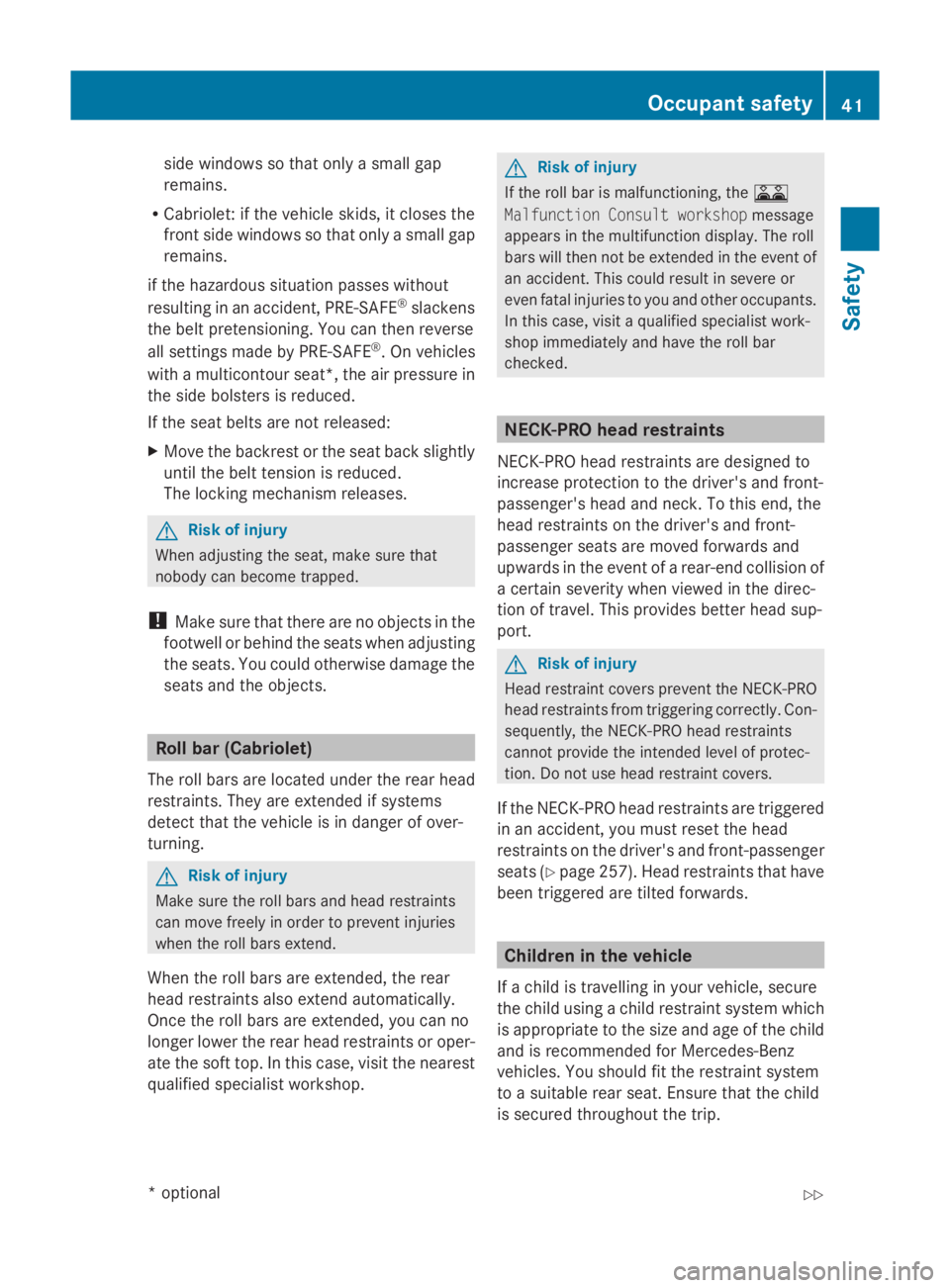
Hea
dairbags 0046deploy in the are aofthe side
window satthe front. The yare deployed:
R on the sid eonwhich an impact occurs
R at the start of an accident with ahighr ate
of latera lvehicle deceleration or accelera-
tion, e.g. in asidei mpact
R independently of the sea tbeltu se
R independently of the front airbags
R regardless of whether the front-passenger
sea tiso ccupied
Windowbags (Coupé)
The purpos eofthe windowbags is to enhance
the level of protection for the hea d(butn ot
chest or arms )ofthe vehicle occupants on
the sid eofthe vehicle on which the impact
occurs.
The windowbags are integrated into the side
of the roof frame. and run from the front door
(A-pillar) to the rea rsidew all( C- pillar). Windowbags
0046are deployed:
R on the sid eonwhich an impact occurs
R at the start of an accident with ahighr ate
of latera lvehicle deceleration or accelera-
tion, e.g. in asidei mpact
R independently of the sea tbeltu se
R independently of the front airbags
R regardless of whether the front-passenger
sea tiso ccupied PRE-SAFE
®
system
PRE-SAFE ®
system takes pre-emptiv emeas-
ure stop rotect yo uincertainhazardou ssit-
uations.
PRE-SAFE ®
intervenes in the event of:
R emergency braking situations, e.g. if Brake
Assis tBAS is activated or Brake Assis tBAS
PLUS* intervenes powerfully
R the radar senso rsystem detecting an
immediate danger of collision in certai nsit-
uations (on vehicles with Distroni cPlus*)
R critica lsituations involving driving dynam-
ics, e.g. if the vehicle oversteer sorunder-
steer ssignificantly du etophysica llim its
being exceeded
PRE-SAFE ®
may take the following measures
in these situations:
R it tensions the front sea tbelts.
R on vehicles with memory functions*: it
adjusts the front-passenger sea tifthis is in
an unfavourable position.
R on vehicles with multicontou rseat*: it
increases the ai rpressur einthe sea tside
cushions and the backrest sid ecushions.
R Coupé: if the vehicle skids, it closes the
panoram asliding sunroof* and the front 40
Occupan
tsafetySafety
*optional
207_AKB; 2; 3, en-GB
mkalafa
,V ersion: 2.11.8.1
2009-07-23T10:23:49+02:00
-Seite 40
Page 44 of 313
side windows so that only
asmall gap
remains.
R Cabriolet: if the vehicle skids, it closes the
front side windows so that only asmall gap
remains.
if the hazardous situation passes without
resulting in an accident, PRE-SAFE ®
slackens
the belt pretensioning. You can then reverse
all settings made by PRE-SAFE ®
.Onv ehicles
with amulticontour seat*, the air pressure in
the side bolsters is reduced.
If the seat belts are not released:
X Move the backrest or the seat back slightly
until the belt tension is reduced.
The locking mechanism releases. G
Risk of injury
When adjusting the seat, make sure that
nobody can become trapped.
! Make sure that there are no objects in the
footwell or behind the seats when adjusting
the seats. You could otherwise damage the
seats and the objects. Roll bar (Cabriolet)
The roll bars are located under the rear head
restraints. They are extended if systems
detect that the vehicle is in danger of over-
turning. G
Risk of injury
Make sure the roll bars and head restraints
can move freely in order to prevent injuries
when the roll bars extend.
When the roll bars are extended, the rear
head restraints also extend automatically.
Once the roll bars are extended, you can no
longer lower the rear head restraints or oper-
ate the soft top. In this case, visit the nearest
qualified specialist workshop. G
Risk of injury
If the roll bar is malfunctioning, the 0073
Malfunction Consult workshop message
appears in the multifunction display. The roll
bars will then not be extended in the event of
an accident. This could result in severe or
even fatal injuries to you and other occupants.
In this case, visit aqualified specialist work-
shop immediately and have the roll bar
checked. NECK-PRO head restraints
NECK-PRO head restraints are designed to
increase protection to the driver's and front-
passenger's head and neck.Tot his end, the
head restraints on the driver's and front-
passenger seats are moved forwards and
upwards in the event of arear-end collision of
ac ertain severity when viewed in the direc-
tion of travel. This provides better head sup-
port. G
Risk of injury
Head restraint covers prevent the NECK-PRO
head restraints from triggering correctly. Con-
sequently, the NECK-PRO head restraints
cannot provide the intended level of protec-
tion. Do not use head restraint covers.
If the NECK-PRO head restraints are triggered
in an accident, you must reset the head
restraints on the driver's and front-passenger
seats (Y page 257). Head restraints that have
been triggered are tilted forwards. Children in the vehicle
If ac hild is travelling in your vehicle, secure
the child using achild restraint system which
is appropriate to the size and age of the child
and is recommended for Mercedes-Benz
vehicles. You should fit the restraint system
to as uitabler ear seat. Ensure that the child
is secured throughout the trip. Occupant safety
41Safety
*optional
207_AKB;2;3,e
n-GB
mkalafa, Version: 2.11.8.1 2009-07-23T10:23:49+02:00-Seite 41 Z
Page 45 of 313
You can obtain information about the correct
child restraint system fro
many Mercedes-
Ben zService Centre.
i It is advisable to use Mercedes-Ben zcare
products to clean child restraint systems.
Informatio nabout this can be obtained
fro ma ny Mercedes-Ben zService Centre. G
Risk of injury
Do not leave children unsupervised in the
vehicle, even if the yare secured in achild
restraint system. Children could injure them-
selves on part softhe vehicle. They could also
be seriously or even fatally injured by pro-
longed exposure to extreme heat or cold.
Do not expose the child restraint system to
direc tsunlight. Part softhe child restraint sys-
tem could heat up and the child could burn
herself/himself on them.
If ac hild open sadoor, the child or other per-
son scould be injured as aresult .The child
could get out and be injured in the process or
be injured by apassin gvehicle. G
Risk of injury
An unsecured or an incorrectly positioned
load increases the risk of injury for the child
and all other occupants, during:
R an accident
R ab raking manoeuvre
R as udden change of direction
Do not carr yheavy or hard object sinside the
vehicle unless the yare secured. You will find
further information under "Loadin gguide-
lines "int he index.
Child restraint systems Mercedes-Ben
zrecommends that you only
use the child restraint systems liste don
( Ypage 47). G
Risk of injury
To reduc ethe risk of serious or even fatal
injury to the child in the even tofasudden
change in direction ,braking or an accident:
R children less than 1.50 mtall and under
twelv eyears of age must always be secured
in special child restraint systems on asuit-
able vehicle seat. This is necessary
because the seat belts are not designed for
children of this size.
R do not secur echildren less than 1.50 mtall
or under twelv eyears of age on the front-
passenger seat. Exception: the child is
secured in avehicle with automatic child
seat recognition on the front-passenger
seat* and is secured in achild restraint
system with automatic child seat recogni-
tion.
R if you secur eaforward-facin gchild
restraint system to the front-passenger
seat, you must move the front-passenger
seat as far back as possible.
R children must never travel sitting on the lap
of another occupant .Due to the forces
occurrin ginthe even tofasudden change
of direction ,heavy braking or an accident,
it would not be possible to restrain the
child. The child could be thrown against
part soft he vehicle interior and be seriously
or even fatally injured. G
Risk of injury
The child restraint system cannot perform its
protective function if it is not correctly fitted
to as uitable vehicle seat. The child cannot be
restraine dinthe even tofana ccident,heavy
braking or sudden changes of direction .The
child could be seriously or even fatally injured.
For this reason ,when fittin gachild restraint
system, observe the manufacturer' sinstalla-
tion instructions and the correc tuse of the
child restraint system. 42
Occupant safetySafety
*o
ptional
207_AKB; 2; 3, en-GB
mkalafa,
Version: 2.11.8.1 2009-07-23T10:23:49+02:00-Seite42
Page 52 of 313
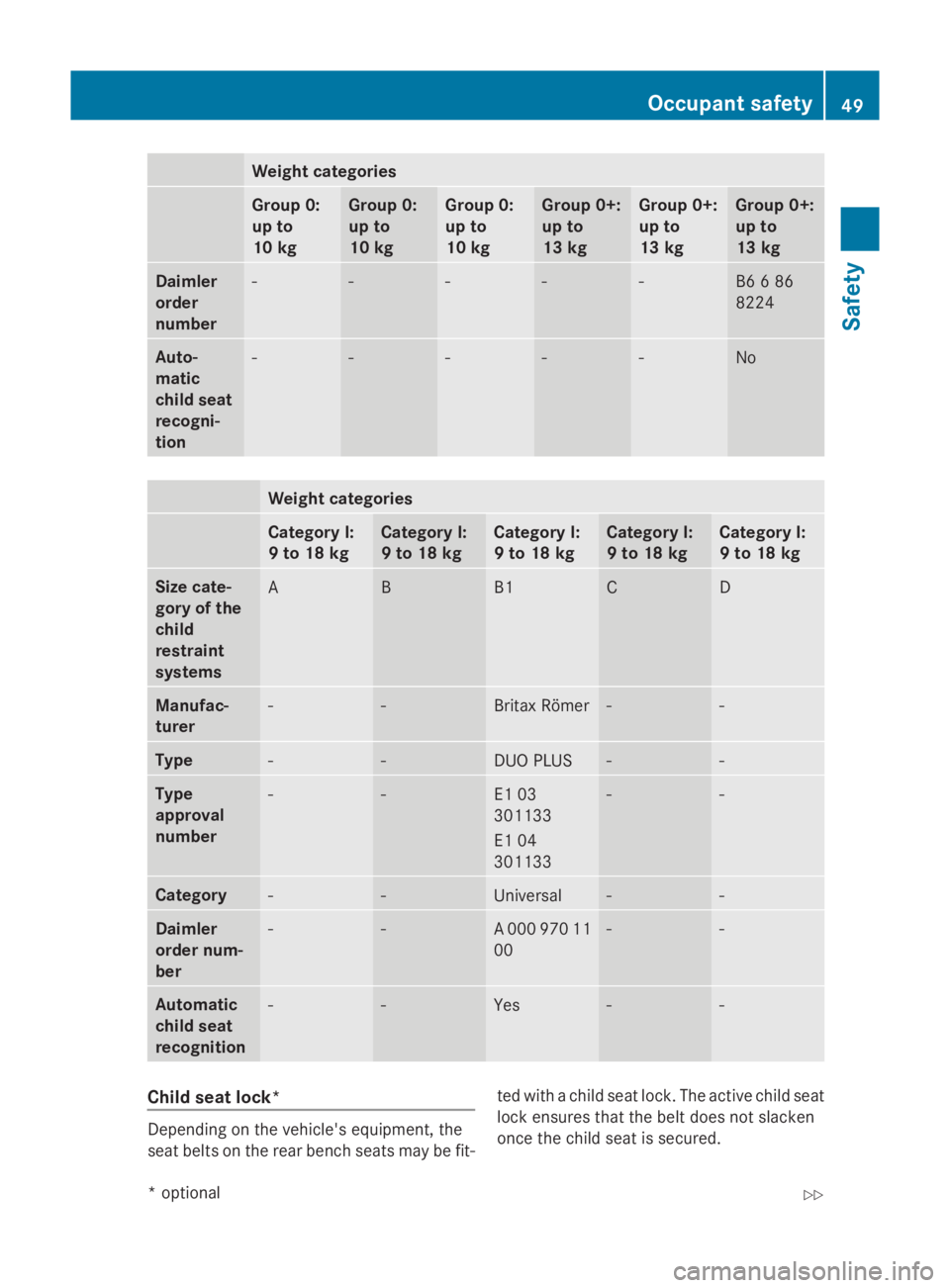
Weight categories
Group 0:
up to
10 kg Group 0:
up to
10 kg Group 0:
up to
10 kg Group 0+:
up to
13 kg Group 0+:
up to
13 kg Group 0+:
up to
13 kg
Daimler
order
number
- - - - - B6
686
8224 Auto-
matic
chil
dseat
recogni-
tion - - - - - No
Weight categories
Category I:
9to18kg Category I:
9to18kg Category I:
9to18kg Category I:
9to18kg Category I:
9to18kg
Size cate-
gory of the
child
restraint
systems
A B B1 C D
Manufac-
turer
- - Britax Römer - -
Type
- - DUO PLUS - -
Type
approval
number
- - E1 03
301133
E1 04
301133 - -
Category
- - Universal - -
Daimler
order num-
ber
- - A0
00 970 11
00 - -
Automatic
chil
dseat
recognition - - Yes - -
Chil
dseat lock* Depending on the vehicle's equipment, the
seatb
elts on the rear bench seats may be fit- ted with
achild seatl ock. The active child seat
lock ensure sthat the beltd oes not slacken
once the child seatiss ecured. Occupant safety
49Safety
*optional
207_AKB; 2; 3, en-GB
mkalafa,
Version: 2.11.8.1 2009-07-23T10:23:49+02:00-Seite 49 Z
Page 53 of 313
X
When installingt he childseat:
R comply with the manufacturer's installa-
tion instructions.
R pullt he belts moothlyfrom the inertia
reel.
R engag ethe seatb eltt ongue in the belt
buckle.
X Pullt he belto ut completely and let the iner-
tia reel retract it again.
Ar atcheting noise is audible whent he belt
is reeled back in. The child seatl ock is acti-
vated.
X When removin gthe chil dseat:
R comply with the manufacturer's installa-
tion instructions.
R press the release button of the belta nd
guide the beltt ongue to the belto utlet.
The child seatl ock is deactivated.
ISOFIXc hilds eat securing system in
the rear compartment ISOFIX is
astandardise dsecuring system for
speciallyd esigned child restraint systems on
the rear seats. Securing rings for two child
restraint system sare fitted on the left and
right of the rear seats.
Mercedes-Benz recommends the use of ISO-
FIX child restraint system slisted on
(Y page4 8) together with the insertio nguides
included. Fitting the ISOFIX child restraint
system is eased by using the insertio nguides. G
Risk of injury
Ac hild restraint system secure dbythe ISOFIX
child seat securing system does not provide
sufficient protection for children weighing
more than 22 kg. For this reason, do not
secure children weighing more than 22 kg in
ac hild restraint system secure dbythe ISOFIX
child seat securing system. If the child weighs
more than 22 kg, secure the child restraint
system using alap-shoulder belt. G
Risk of injury
The child restraint system cannot perform its
protective function if it is not correctly fitted
to as uitable vehicl eseat. The child cannot be
restrained in the event of an accident, heavy
braking or sudden changes of direction. The
child coul dbeseriousl yoreven fatally injured.
For this reason, when fitting achild restraint
system, observe the manufacturer's installa-
tion instructions and the correct use of the
child restraint system.
For reasons of safety ,only use child restraint
systems with the ISOFIX child seat securing
system on the rear seats.
We recommend the use of ISOFIX child
restraint system swhich have been approved
for Mercedes-Benz vehicles.
An incorrectly fitted child restraint system
coul dcome loos eand seriousl yoreven fatally
injure the child or other vehicl eoccupants.
When fitting the child restraint system ,always
make sure that it is engaged correctly in the
securing rings on both sides. G
Risk of injury
Please note that if child restraint systems, or
their retaining systems, are damaged or sub-
jected to aloa dinana ccident, they may not
be abl etoprovide their protective function.
This coul dresult in serious or even fatal inju-
ries to the secure dchild in the event of an
accident, heavy braking or asudden change
in direction.
For this reason, have child restraint systems
and their anchorages which have been dam-
age dors ubjected to aloa dinana ccident
checked immediatel yataqualified specialist
workshop. 50
Occupant safetySafety
207_AKB; 2; 3, en-GB
mkalafa,
Version: 2.11.8.1 2009-07-23T10:23:49+02:00-Seite 50
Page 54 of 313
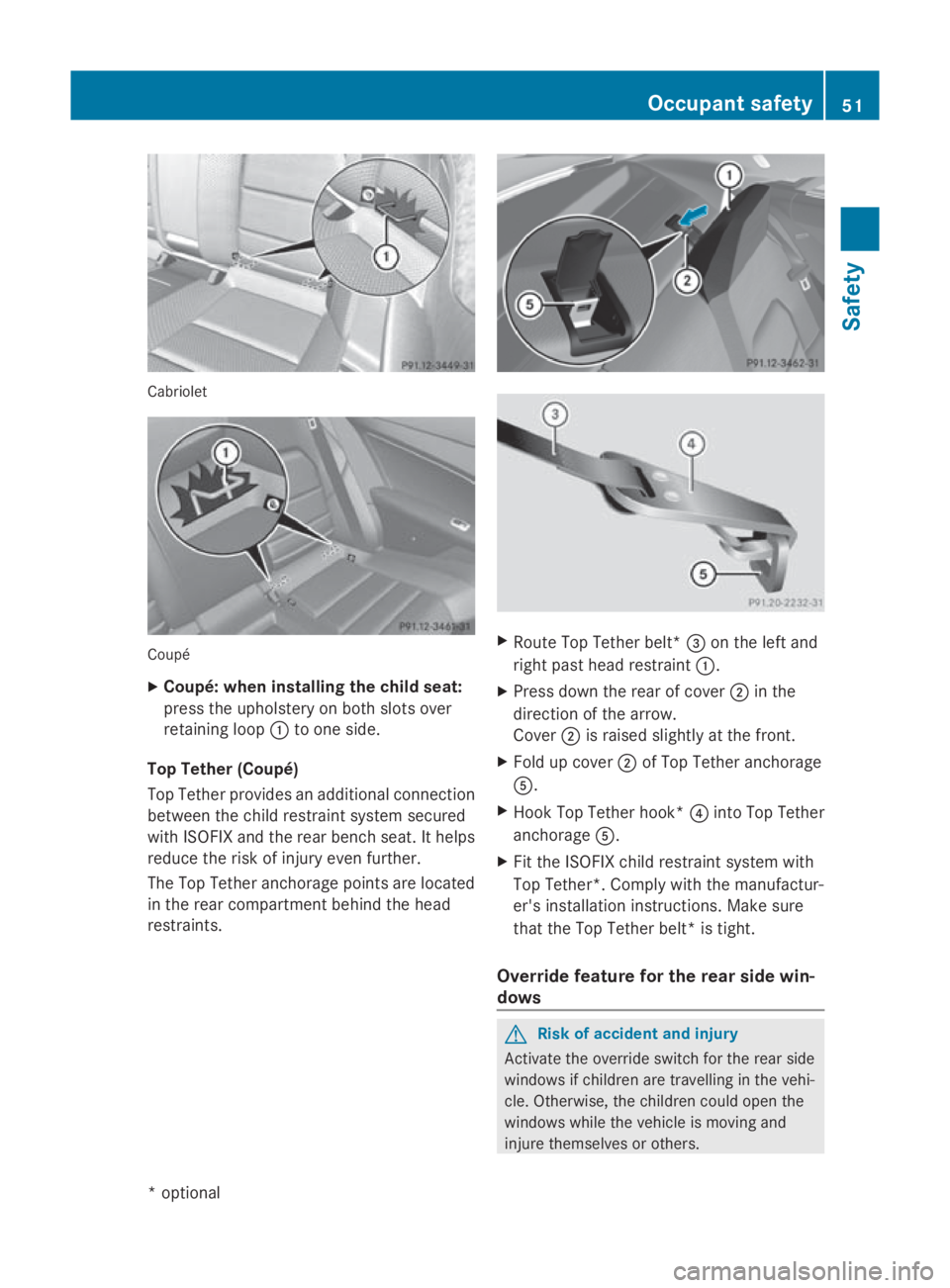
Cabriolet
Coupé
X
Coupé: when installin gthe child seat:
pres sthe upholstery on bot hslotso ver
retainin gloop 0046to on eside.
Top Tether (Coupé)
Top Tether provides an additional connection
between th echild restraint system secured
with ISOFIX and th erear bench seat .Ithelps
reduc ethe risk of injury even further.
The Top Tether anchorage points are located
in th erear compartmen tbehin dthe head
restraints. X
Route Top Tether belt* 008Aon th eleft and
righ tpast head restraint 0046.
X Pres sdown th erear of cover 0047in the
direction of th earrow.
Cover 0047is raise dslightly at th efront.
X Fol dupc over0047of Top Tether anchorage
0086.
X Hoo kTop Tether hook* 0088intoT op Tether
anchorage 0086.
X Fit th eISOFI Xchild restraint system with
Top Tether*. Compl ywith th emanufactur-
er' sinstallation instructions. Mak esure
that th eTop Tether belt *istight.
Overrid efeature for th erears idew in-
dows G
Ris
kofa ccident and injury
Activate th eoverride switch for th erear side
windows if childre nare travelling in th evehi-
cle .Otherwise, th echildre ncoul do pen the
windows while th evehicle is moving and
injure themselve sorothers. Occupant safety
51Safety
*optional
207_AKB
;2;3,en-GB
mkalafa, Version:2.11.8.1
2009-07-23T10:23:49+02:00
-Seite 51 Z
Page 64 of 313
Opening and closing
...........................62
Boot ...................................................... 64
Key positions ....................................... 65
Seats .................................................... 66
Steering wheel .................................... 71
Mirrors ................................................. 73
Memor yfunctions* ............................. 75
Seat belts ............................................. 76
Lights ................................................... 80
Windscreen wipers .............................94
Side windows ...................................... 94
Driving and parking ............................98
Transmission ..................................... 101
Instrument cluster ............................106
On-boar dcomputer .......................... 107
Driving systems ................................ 122
Air conditioning ................................. 147
Sliding sunroof (Coupé) ....................158
Soft top (Cabriolet) ...........................160
Loading and stowing ........................165
Features ............................................. 172 61Controls
207_AKB
;2;3,en-GB
mkalafa, Version:2.11.8.1
2009-07-23T10:23:49+02:0
0-Seite 61
Page 72 of 313
someone becoming trapped, press the seat
adjustment switch on the door.
Folding the backrest forwards X
Vehicles without the memory func-
tion*: if necessary, release the head
restraint and push it down.
X Pull seat release handle 0046forwards and
fold the backrest forwards, until the seat
backrest engages.
X Push the seat as far forwards as it will go.
X Vehicles with the memory function*:
pull seat release handle 0046forwards and
fold the backrest forwards as far as it will
go.
The seat moves automaticallytot he fore-
most position.
Folding back the backrest X
Vehicles without the memory func-
tion*: push the seat backrest back hori-
zontally until the seat reaches the position
that was previouslys et.
X Swing back the seat backrest evenly below
release handle 0046until it engages, doing so
in as mooth manner.
X If the head restraint has been moved, check
the position of the head restraint and set it
to the correct position after the seat back-
rest has been folded back.
X Vehicles with the memory function*:
swing back the seat backrest.
The seat moves automaticallytot he stored
position. G
Risk of injury
Make sure that the backrest engages fully.If
the seat backrest is not engaged, the mes-
sage Front right seat backrest not
locked orFront left seat backrest
not locked appears in the multi-function dis-
play.S top the vehicle as soon as road and
traffic conditions permit and remove any
objects that are blocking the backrest. Rear head restraint (Cabriolet)
Lowering and extending the head
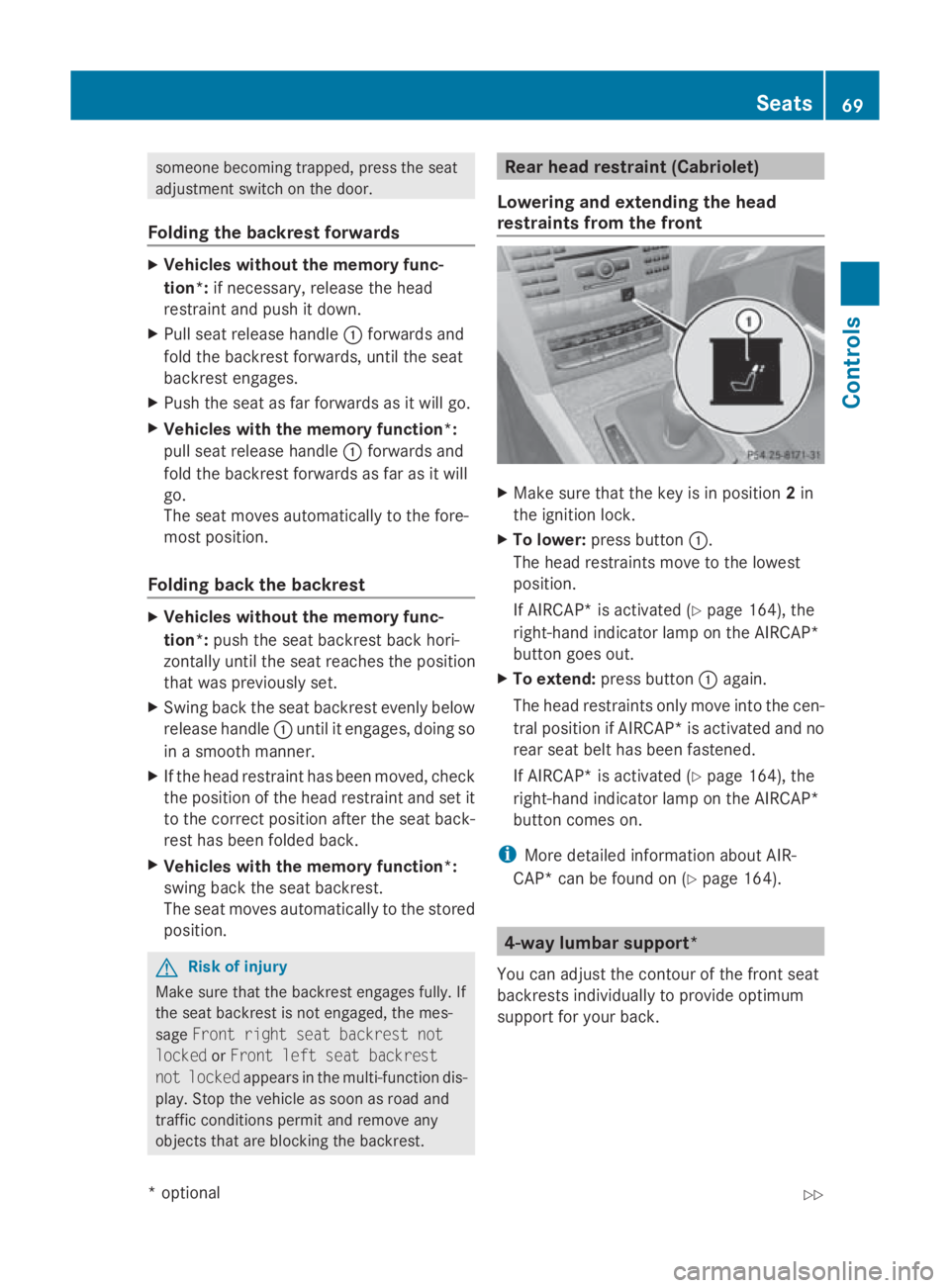
restraints from the front X
Make sure that the key is in position 2in
the ignition lock.
X To lower: press button 0046.
The head restraints move to the lowest
position.
If AIRCAP* is activated (Y page 164), the
right-hand indicator lamp on the AIRCAP*
button goes out.
X To extend: press button 0046again.
The head restraints only move into the cen-
tral position if AIRCAP* is activated and no
rear seat belt has been fastened.
If AIRCAP* is activated (Y page 164), the
right-hand indicator lamp on the AIRCAP*
button comes on.
i More detailed information aboutA IR-
CAP* can be found on (Y page 164). 4-way lumbar support*
You can adjust the contour of the front seat
backrests individually to provide optimum
support for your back. Seats
69Controls
*optional
207_AKB;2;3,e
n-GB
mkalafa, Version: 2.11.8.1 2009-07-23T10:23:49+02:00-Seite 69 Z