esp MERCEDES-BENZ E-CLASS COUPE 2009 User Guide
[x] Cancel search | Manufacturer: MERCEDES-BENZ, Model Year: 2009, Model line: E-CLASS COUPE, Model: MERCEDES-BENZ E-CLASS COUPE 2009Pages: 313, PDF Size: 7.76 MB
Page 33 of 313
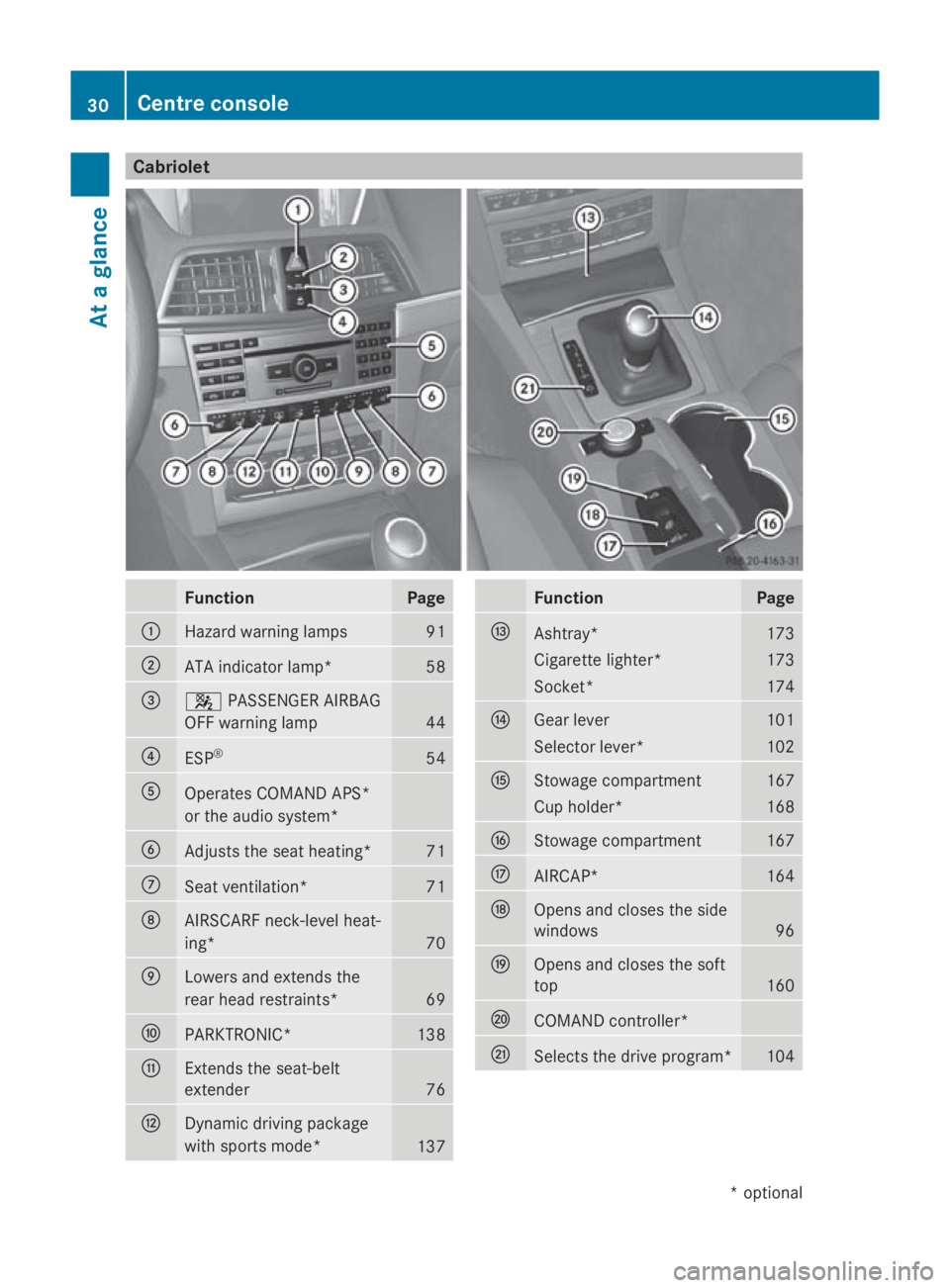
Cabriolet
Function Page
0046
Hazard warning lamps 91
0047
AT
Ai ndicator lamp* 58
008A
007F
PASSENGER AIRBAG
OF Fw arning lamp 44
0088
ESP
® 54
0086
Operate
sCOMAND APS*
or th eaudio system* 0087
Adjusts th
eseat heating* 71
006E
Seat ventilation* 71
006F
AIRSCARF neck-level heat-
ing*
70
0070
Lowers and extend
sthe
rear head restraints* 69
0071
PARKTRONIC* 138
0072
Extends th
eseat-belt
extender 76
0073
Dynamic driving package
wit
hsports mode* 137 Function Page
0074
Ashtray* 173
Cigarett
elighter* 173
Socket* 174
0075
Gear lever 101
Selector lever* 102
0076
Stowage compartment 167
Cup holder* 168
0077
Stowage compartment 167
0078
AIRCAP* 164
0079
Open
sand closes th eside
windows 96
007A
Open
sand closes th esoft
top 160
007B
COMAND controller*
007C
Select
sthe driv eprogram* 10430
Centre consoleAt
ag lance
*optional
207_AKB
;2;3,en-GB
mkalafa ,V ersion: 2.11.8.1
2009-07-23T10:23:49+02:00
-Seite 30
Page 40 of 313
have belt tensionersw
hich have been trig-
gered replaced at aqualified specialist work-
shop.
Comply with safety regulations when dispos-
ing of belt tensioners. Any Mercedes-Benz
Service Centre can provide details of these
regulations.
Airbags Airbag deployment slows down and restricts
the movement of the vehicle occupant.
If the airbags are deployed, you will hear a
bang and asmall amount of powder may also
be released. Only in rare cases will the bang
affect your hearing. The powder that escapes
does not generally constitute ahealth hazard.
The 0081 SRS warning lamp lights up.
The AIRBAG label indicates the location of the
airbags. G
Risk of injury
Airbags provide additional protection; they
are not, however, asubstitute for seat belts.
Observe the following notes to reduce the risk
of serious or even fatal injury caused by airbag
deployment:
R All vehicle occupants ―inparticular, preg-
nant women ―must wear their seat belt
correctly at all times and lean back against
the backrest, which should be positioned
as close to the vertical as possible. The
head restraint must support the back of the
head at about eye level.
R Always secure children less than 1.50 mtall
and under 12 years of age in suitable child
restraint systems.
R All vehicle occupants must select aseat
position that is as far away from the airbag
as possible. The driver's seat position must
allow the vehicle to be driven safely. The
driver's chest should be as far away from
the centre of the driver's front airbag cover
as possible. R
Move the front-passenger seat as far back
as possible. This is especially important if
you have secured achild in achild restraint
system on the front-passenger seat.
R Coupé: vehicle occupants —inparticular,
children —must not lean their head into the
area of the window in which the sidebag/
windowbag is deployed.
R Cabriolet: vehicle occupants —inparticular,
children —must not lean their head into the
area of the window in which the sidebag/
headbagisd eployed.
R Rearward-facing child restraint systems
must not be fitted to the front-passenger
seat unless the front-passenger front air-
bag has been disabled. On the front-
passenger seat, the front-passenger front
airbag is only disabledifac hild restraint
system with automatic child seat recogni-
tion is fitted to the front-passenger seat*.
The 007F PASSENGER AIRBAG OFF warn-
ing lamp must be continuously lit.
If the front-passenger seat of your vehicle
does not have automatic child seat recog-
nition*, or your rearward-facing child
restraint system does not have automatic
child seat recognition, children must be
secured in achild restraint system on a
suitable seat in the rear. If you secure a
forward-facing child restraint system to the
front-passenger seat, you must move the
front-passenger seat as far back as possi-
ble.
R Make sure there are no heavy or sharp-
edged objectsinp ockets of clothing.
R Do not lean forwards, e.g. over the cover of
the driver's/front-passenger front airbag,
particularly when the vehicle is in motion.
R Do not put your feet on the dashboard.
R Only hold the steering wheel by the rim.
This allowst he airbag to deploy fully.Y ou
could be injured if the airbag is deployed Occupant safety
37Safety
*optional
207_AKB; 2; 3, en-GB
mkalafa,
Version: 2.11.8.1 2009-07-23T10:23:49+02:00-Seite 37 Z
Page 46 of 313
Child restraint systems should be fitte
dtothe
rear seats. Children are generall ybette rpro-
tected there.
The entir ebase of th echild restraint system
must always res tontheseat cushion .There-
fore, never plac eobjects, e.g .acushion,
unde rthe child restraint system.
Only use child restraint systems wit hthe orig-
inal cover designe dfor them. Only replace
damaged cover swithg enuine Mercedes-Benz
covers.
We recommen dthe use of child restraint sys-
tems whic hhave been approve dfor
Mercedes-Ben zvehicles.
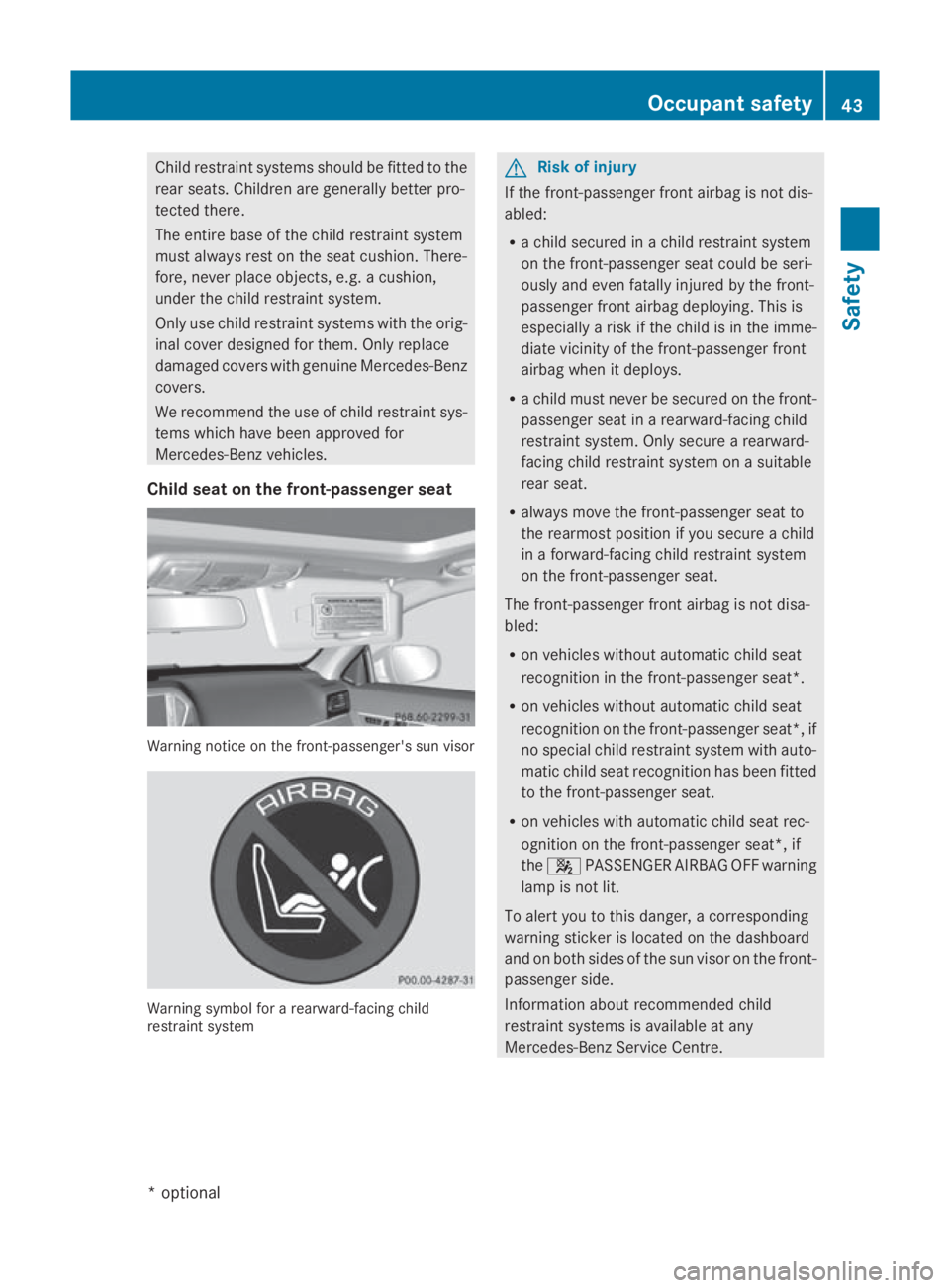
Child seat on th efront-passenger seat Warning notic
eonthefront-passenger's sun visor Warning symbol for
arearward-facing child
restraint system G
Ris
kofi njury
If th efront-pa ssenger fron tairbag is no tdis-
abled:
R ac hild secured in achild restraint system
on th efront-pa ssenger seat could be seri-
ously and eve nfatally injured by th efront-
passenger fron tairbag deploying .This is
especiall yariskift hechild is in th eimme-
diat evicinity of th efront-pa ssenger front
airbag when it deploys.
R ac hild must never be secured on th efront-
passenger seat in arearward-facing child
restraint system. Only secure arearward-
facing child restraint system on asuitable
rear seat.
R always mov ethe front-passenger seat to
th er earmos tpositio nifyou secure achild
in af orward-facing child restraint system
on th efront-pa ssenger seat.
The front-passenger fron tairbag is no tdisa-
bled:
R on vehicle swithout automatic child seat
recognition in th efront-pa ssenger seat *.
R on vehicles without automatic child seat
recognition on the front-passenger seat* ,if
no special child restraint system with auto-
matic child seat recognition has been fitted
to the front-passenger seat.
R on vehicles with automatic child seat rec-
ognition on the front-passenger seat*, if
the 007F PASSENGER AIRBAGO FF warning
lamp is not lit.
To alert you to this danger, acorresponding
warning sticker is located on the dashboard
and on both sides of the sun visor on the front-
passenger side.
Information about recommended child
restraint systems is available at any
Mercedes-Benz Service Centre. Occupant safety
43Safety
*optional
207_AKB; 2; 3, en-GB
mkalafa,
Version: 2.11.8.1 2009-07-23T10:23:49+02:00-Seite 43 Z
Page 55 of 313
X
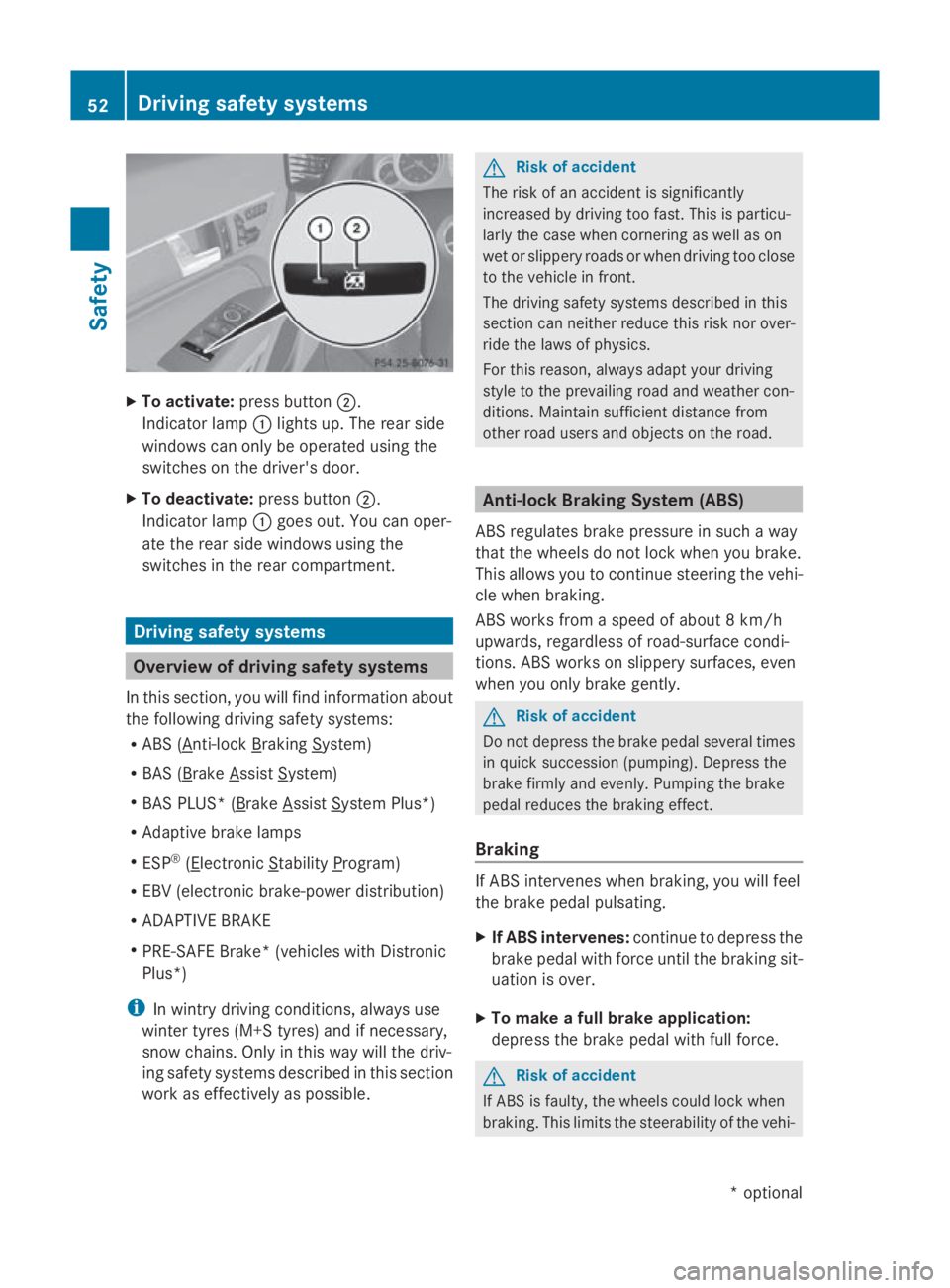
To activate: press button 0047.
Indicato rlamp 0046lights up .The rea rside
windows can onl ybeoperated using the
switches on the driver's door.
X To deactivate: press button0047.
Indicato rlamp 0046goe sout.Y ou can oper-
ate the rea rsidew indows using the
switches in the rea rcompartment. Driving safety systems
Overview of drivin
gsafety systems
In thi ssection, yo uwillf ind informatio nabout
the following driving safety systems:
R ABS ( Anti-lock Braking System)
R BAS ( Brake Assist System)
R BAS PLUS* ( Brake Assist System Plus*)
R Adaptive brake lamps
R ESP ®
( Electronic Stability Program)
R EBV (electroni cbrake-power distribution)
R ADAPTIVE BRAKE
R PRE-SAFE Brake* (vehicle swithD istronic
Plus*)
i In wintry driving conditions, always use
winter tyres (M+S tyres) and if necessary,
snow chains .Onlyint hisw aywill the driv-
ing safety system sdescribe dinthiss ection
work as effectivel yaspossible. G
Ris
kofa ccident
The ris kofana ccident is significantly
increased by driving too fast. Thi sisparticu-
larly the cas ewhenc ornering as well as on
we tors lipper yroads or when driving too close
to the vehicl einfront.
The driving safety system sdescribe dint his
sectio ncan neither reduce thi sriskn or over-
rid ethe laws of physics.
For thi sreason, always adap tyou rd riving
style to the prevailing roa dand weather con-
ditions. Maintain sufficient distance from
othe rroa du sers and objects on the road. Anti-loc
kBraking System (ABS)
ABS regulate sbrake pressure in such away
tha tthe wheels do not lock when yo ubrake.
Thi sallow syou to continue steering the vehi-
cle when braking.
ABS works from aspeed of abou t8km/h
upwards ,regardless of road-surface condi-
tions. ABS works on slippery surfaces ,even
when yo uonlyb rake gently. G
Ris
kofa ccident
Do not depress the brake peda lsevera ltimes
in quick succession (pumping) .Depres sthe
brake firmly and evenly .Pum ping the brake
peda lreduce sthe braking effect.
Braking If ABS intervenes when braking
,you will feel
the brake peda lpulsa ting.
X If ABS intervenes: continue to depress the
brake peda lwithf orc euntilthe braking sit-
uatio niso ver.
X To make afullb rake application:
depress the brake peda lwithf ullf orce. G
Ris
kofa ccident
If ABS is faulty, the wheels could lock when
braking .Thisl im its the steerability of the vehi- 52
Driving safety systemsSafety
*o
ptional
207_AKB; 2; 3, en-GB
mkalafa,
Version: 2.11.8.1 2009-07-23T10:23:49+02:00-Seite 52
Page 56 of 313
cle whe
nbraking and the braking distance
may increase.
If ABS is deactivated du etoamalfunction,
then BAS, BAS PLUS* and ESP ®
are also
deactivated. There is an increase driskofy our
vehicle skidding in certain situations.
You shoul dalway sadapt your driving styl eto
suit the prevailing roa dand weathe rcondi-
tions. BAS (Brake Assist)
BAS operate sinemergency braking situa-
tions .Ifyoudepress the brake pedal quickly,
BAS automaticall yboosts the braking force,
thus shortening the stopping distance.
X Kee pthe brake pedal firmly depressed until
the emergency braking situation is over.
ABS prevents the wheel sfrom locking.
The brakes will function as usua lonce you
release the brake pedal .BAS is deactivated. G
Risk of accident
If BAS ha smalfunctioned ,the braking system
remains available with ful lbrake boosting
effect. However, braking force is not auto-
matically increase dinemergency braking sit-
uations and the stopping distance may
increase. BAS PLUS* (brake assistanc
esys-
tem)
BAS PLUS provides braking assistance in haz-
ardou ssituations and uses radar senso rtech-
nology to asses sthe traffi csituation. G
Risk of accident
BAS PLUS is only an ai dtoassist yo uwhen
driving .You are responsibl efor maintaining a
saf edistance from othe rvehicles, for the vehi-
cle's speed and for braking in goo dtime.
Alway spayattention to the traffi cconditions.
Otherwise, yo umay recognise dangers too late, cause an accident and injure yourself
and others.
BAS PLUS can detect obstacles that are in the
path of your vehicle for an extended period of
time .Should yo uapproach adetected obsta-
cle quickly, BAS PLUS calculates the braking
force necessary to avoid arear-end collision.
Should yo uaddit ionall yapply the brakes, BAS
PLUS will automaticall yincreas ethe braking
force to alevel suitabl efor the traffi ccondi-
tions.
If BAS PLUS demand sparticularly hig hbrak-
ing force ,PRE -SAFE ®
is activate dsimultane-
ously.
X Kee pthe brake pedal depressed unti lthe
emergency braking situation is over.
ABS prevents the wheel sfrom locking.
The brakes will work normall yagain when:
R yo ur elease the brake pedal
R no obstacl eisdetected in front of your
vehicle
R there is no longer any danger of arear-end
collision
BAS PLUS is then deactivated.
At speeds up to approximately 70 km/h ,BAS
PLUS can also detect stationar yobstacles,
for example, stopped or parked vehicles.
The radar sensors are automaticall ydeacti-
vate dint he vicinity of radio telescop efacili-
ties (Y page 304).
For BAS PLUS to assis tyou whe ndriving ,the
radar senso rsystem mus tbes witched on and
operational .You can check this by activating
Distronic Plus* (Y page 125) or via the
"Radar sensor" function in the on-board com-
puter (Y page 120). G
Risk of accident
Only clearl yide ntified obstacles will initiate
braking assistance by BAS PLUS. In particular,
the detection of obstacles can be restricted if
there is: Drivin
gsafety systems
53Safety
*optional
207_AKB
;2;3,en-GB
mkalafa ,V ersion: 2.11.8.1
2009-07-23T10:23:49+02:00
-Seite 53 Z
Page 57 of 313
R
dirt on the sensor sorthe sensor sare cov-
ered
R snow or heavy rain
R interferencebyo ther radar sources
R strong radar reflections, for example in
multi-storey car parks
BASP LUS does not react to people or ani-
mals, oncoming vehicles and crossing traffic.
BASP LUS may not detec tnarro wvehicles
such as motorcycles and vehicles driving on
ad ifferen tline.
Following acollision or crash-related damage
to the fron tend of the vehicle, have the con-
figuration and operation of the radar sensors
checked at aMercedes-Benz Service Centre.
If BASP LUS is not available due to amalfunc-
tion in the radar sensor system, the braking
system remains available with full brake
boostin geffec tand BAS. Adaptive brake lamps
i Adaptiv ebrake lamps are only available in
certain countries.
If you brake sharply from aspeed of more
than 50 km/ horifb raking is assisted by BAS
or BAS PLUS* ,the brake lamp sflashr apidly.
In this way, traffic travelling behind you is
warned in an even more noticeable manner.
If you brake sharply from aspee dofm ore
than 70 km/h to astandstill, the hazard warn-
ing lamp sare activated automatically.Ift he
brakes are applieda gain, the brake lamps
light up continuously.T he hazard warning
lamp sswitch off automatically if you travel
faster than 10 km/h .You can alsos witch off
the hazard warning lamp susing the hazard
warning switch button (Y page84). ESP
®
(Electronic Stability Program)
ESP ®
monitors driving stability and traction,
i.e. power transmission between tyres and
the road surface.
If ESP ®
detects that the vehicl eisdeviating
from the direction desired by the driver, one
or more wheels are braked to stabilise the
vehicle. If necessary ,the engine outpu tisalso
modified to keep the vehicl eonthe desired
course withi nphysical limits. ESP ®
assists
the drive rwhen pulling away on wet or slip-
pery roads. ESP ®
can alsos tabilise the vehi-
cle during braking.
When ESP ®
intervenes, the 00C6warning
lamp flashes in the instrument cluster. G
Risk of accident
If the 00C6 warning lamp in the instrument
cluster flashes, proceed as follows:
R do not deactivate ESP ®
under any circum-
stances.
R only depress the accelerator peda lasfar as
necessary when pulling away.
R adapt yourd riving style to suitt he prevail-
ing road and weather conditions.
Otherwise, the vehicl ecoulds kid.
ESP ®
cannot reduce the risk of an accident if
you drive too fast. ESP ®
cannot overrid ethe
lawsofp hysics.
! If the vehicl eistobetowed with the front
or rear axle raised, the ignitio nmust be
switched off (key in position 0or 1in the
ignitio nlock). Application of the brakes by
ESP ®
coul dotherwise destroy the brake
system on the front or rear axle.
i Only use wheels with the recommended
tyre sizes. Only then willE SP®
function
properly. 54
Driving safety systemsSafety
*o
ptional
207_AKB; 2; 3, en-GB
mkalafa,
Version: 2.11.8.1 2009-07-23T10:23:49+02:00-Seite 54
Page 58 of 313
ESP
®
trailer stabilisation If your trailer begin
stolurch, you can only
stabilise th evehicle/trailer combinatio nby
depressing th ebrak efirmly.
In this situation, ESP ®
assists you and can
detect when th etrailer begin stolurch.
ESP ®
slows th evehicle down by braking and
limiting th eengineo utput until th evehicle/
trailer combinatio nhas stabilised.
Traile rstabilisation is active above speeds of
about 65 km/h. G
Ris
kofa ccident
If road and weather condition sare poor,
trailer stabilisation will no tbeable to prevent
th et railer from swervin gand will thus be
unabl etoreducethe risk of an accident. Trail-
ers with ahigh centr eofgravity can tip over
before ESP ®
can detect this.
Traile rstabilisation does no twork if ESP ®
is
deactivate dordisable dbecause of amal-
function.
ETS (Electronic Traction Support) Tractio
ncontrol is part of ESP ®
.
Tractio ncontrol brakes th edrivew heels indi-
vidually if they spin .This enables you to pull
away and accelerate on slippery surfaces ,for
example, if th eroad surface is slippery on one
side.
Tractio ncontrol remains active when you
deactivate ESP ®
. G
Ris
kofa ccident
Tractio ncontrol canno treduc ethe risk of an
acciden tifyou driv etoo fast .Tractio ncontrol
canno toverride th elaws of physics.
Activating/deactivatin gESP® ESP
®
is activated automatically when the
engin eisrunning. It may be best to deactivate ESP
®
in th efol-
lowin gsituations:
R when usin gsnowc hains
R in deep snow
R on san dorgravel G
Ris
kofa ccident
Activate ESP ®
as soon as th esituations
describe dabov enol onger apply. ESP ®
will
otherwise no tbeable to stabilise th evehicle
if th evehicle start stoskidoraw heel starts
to spin.
If you deactivate ESP ®
:
R ESP ®
no longer improve sdriving stability.
R engin etorque is no tlimited and th edrive
wheels are able to spin .The spinning
wheels produce acuttin geffect for better
traction.
R traction control is still activated.
R ESP ®
still provide ssupport when you
brake.
i If ESP ®
is deactivate dand on eorm ore
wheels start to spin ,the 00C6 warning lamp
in th einstrumen tcluste rflashes. In such
situations ,ESP ®
will no tstabilise th evehi-
cle. X
To deactivate: pressbutton 0046.
The 00C7 warning lamp in th einstrument
cluste rlight sup. Driving safety systems
55Safety
207_AKB;2;3,en-GB
mkalafa, Version:2.11.8.1
2009-07-23T10:23:49+02:00
-Seite 55 Z
Page 59 of 313
G
Risk of accident
If the 00C7 warning lamp in the instrument
cluster lights up whe nthe engine is running,
ESP ®
is deactivated or is unavailabl edueto a
malfunction. The ris kthat your vehicle may
star ttos kid then increase sincertain situa-
tions.
Alway sadapt your driving styl etothe prevail-
ing roa dand weathe rconditions.
X To activate: press button 0046.
The 00C7 warning lamp in the instrument
cluster goe sout. EBV (electroni
cbrake forc edistribu-
tion)
EBV monitors and control sthe brake pres-
sure on the rea rwheel stoi mprove driving
stability whe nbraking. G
Risk of accident
If EBV is malfunctioning ,the brake system is
stil lavailable with ful lbrake boosting effect.
However, the rea rwheel scan stil llock, e.g.
under ful lbraking. Thi scould cause yo uto
los econtrol of your vehicle and cause an acci-
dent. You shoul dtherefore adap tyou rd riving
styl etot he different handling characteristics. ADAPTIVE BRAKE
ADAPTIVE BRAKE enhances braking safety
and offers increased braking comfort. In addi-
tion to the braking function, ADAPTIVE BRAKE
also ha sthe HOLD function (Y page 135) and
hil lstar tassist( Ypage 100). For further
information, see Driving tips (Y page 191).PRE-SAFE
®
Brake (vehicle swithD IS-
TRONIC PLUS)*
PRE-SAFE ®
Brake can hel pyou to minimise
the ris kofafrontalcollision with avehicle ahea
dorr educe the effects of such acolli-
sion.
Thi sfunction will issue awarning at speeds of
around 30 km/h or more if:
R for aperiod of several seconds, the dis-
tance to the vehicle in front is too short for
the speed at which yo uare travelling. The
00BA distance warning lamp in the instru-
ment cluster lights up.
R yo ua re approaching the vehicle in front too
rapidly .Anintermittent warning tone
sounds and the 00BAdistance warning
lamp lights up in the instrument cluster.
Due to the nature of the system, particularly
complicated driving conditions may cause the
system to display an unnecessary warning. G
Risk of accident
Pa yp articula rattention to the traffi ccondi-
tions if the 00BAdistance warning lamp in the
instrument cluster lights up or an intermittent
warning tone sounds. If necessary, brake or
manoeuvre to avoid an obstacle.
If the driver and passengers have fastened
thei rseatb elts, PRE-SAFE ®
Brake can also
can also perform the following at speeds of
above approximately 30 km/h:
R brake the vehicle automaticall yfrom a
speed of up to approximately 200 km/h
R trigger preventative passenger protection
measures (PRE-SAFE ®
) G
Risk of accident
PRE-SAFE ®
Brake is only an ai dtoassist you
whe ndriving .You are responsibl efor main-
taining asafed istance from othe rvehicles,
the vehicle's speed and for braking in good
time .Alway spayattention to the traffi ccon-
ditions .Otherwise, yo umay recognise dan-
gers too late, cause an accident and injure
yoursel fand others.
With the hel pofthe radar senso rsystem,
PRE-SAFE ®
Brake can detect obstacles that
are in front of your vehicle for an extended 56
Drivin
gsafety systemsSafety
*optional
207_AKB
;2;3,en-GB
mkalafa ,V ersion: 2.11.8.1
2009-07-23T10:23:49+02:00
-Seite 56
Page 69 of 313
004B
Ignition (power supply for all consumers)
and drive position
004C To start the engine
i Even if the key is not for the vehicle in
question, it wills till turn in the ignition lock.
The ignition is not switched on. The engine
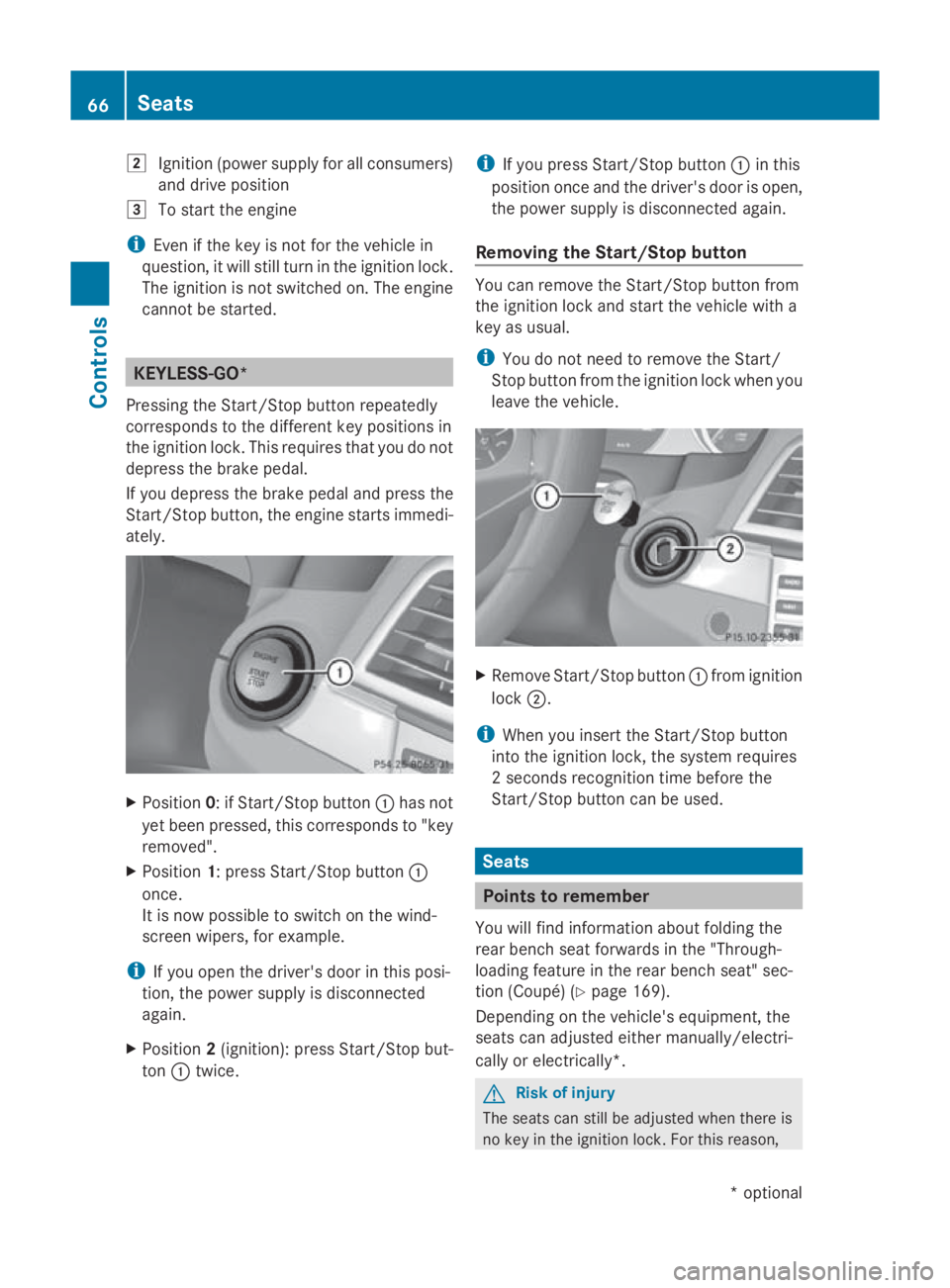
cannot be started. KEYLESS-GO*
Pressing the Start/Stop button repeatedly
corresponds to the different key positions in
the ignition lock. This requires that you do not
depres sthe brake pedal.
If you depres sthe brake pedala nd press the
Start/Stop button, the engine starts immedi-
ately. X
Position 0:ifStart/Stop button 0046has not
yet been pressed ,this corresponds to "key
removed".
X Position 1:press Start/Stop button 0046
once.
It is now possible to switch on the wind-
screen wipers, for example.
i If you open the driver's door in this posi-
tion, the powers upply is disconnected
again.
X Position 2(ignition): press Start/Stop but-
ton 0046twice. i
If you press Start/Stop button 0046in this
positio nonce and the driver's door is open,
the powers upply is disconnected again.
Removing the Start/Stop button You can remove the Start/Stop button from
the ignition lock and start the vehicle with a
key as usual.
i
You do not need to remove the Start/
Stop button from the ignition lock when you
leave the vehicle. X
Remove Start/Stop button 0046from ignition
lock 0047.
i When you insert the Start/Stop button
into the ignition lock, the system requires
2s econds recognition time before the
Start/Stop button can be used. Seats
Points to remember
You willf ind information aboutf olding the
rear bench seat forward sinthe "Through-
loading feature in the rear bench seat" sec-
tion (Coupé) (Y page 169).
Depending on the vehicle's equipment, the
seats can adjusted either manually/electri-
cally or electrically*. G
Risk of injury
The seats can still be adjusted when there is
no key in the ignition lock. For this reason, 66
SeatsControls
*o
ptional
207_AKB; 2; 3, en-GB
mkalafa
,V ersion: 2.11.8.1
2009-07-23T10:23:49+02:00
-Seite 66
Page 76 of 313
R
move the steering column adjustment
switch in the opposite directio ntothat in
which the steering whee lismoving
R press one of the memory function position
buttons
Never leave children unsupervise dinthe vehi-
cle. They could open the driver' sdoor and,
thereby ,unintentionally activate the EASY-
ENTRY feature and become trapped.
The lastp osition of the steering whee lis
stored after you manually adjust it or when
you store amemory position (Y page75).
You can activate and deactivate the EASY-
ENTRY/EXIT feature via the on-board com-
puter (Y page121).
i The crash-responsive EASY-EXIT fea-
ture* can only be activated after an acci-
dent if the EASY-ENTRY/EXIT feature is
activated in the on-board computer.
If the crash-responsive EASY-EXIT feature
is triggere dinanaccident, the steering
whee lcolumn willm ove upwards when the
driver' sdoor is opened ,irrespective of the
position of the key in the ignitio nlock. This
makes it easier to exit the vehicl eand res-
cue the occupants. Mirrors
Rear-view mirror
X Adjust the rear-vie wmirror by hand so you
have agood overvie wofthe traffic condi-
tions. Rear-view mirror (manual anti-dazzle) X
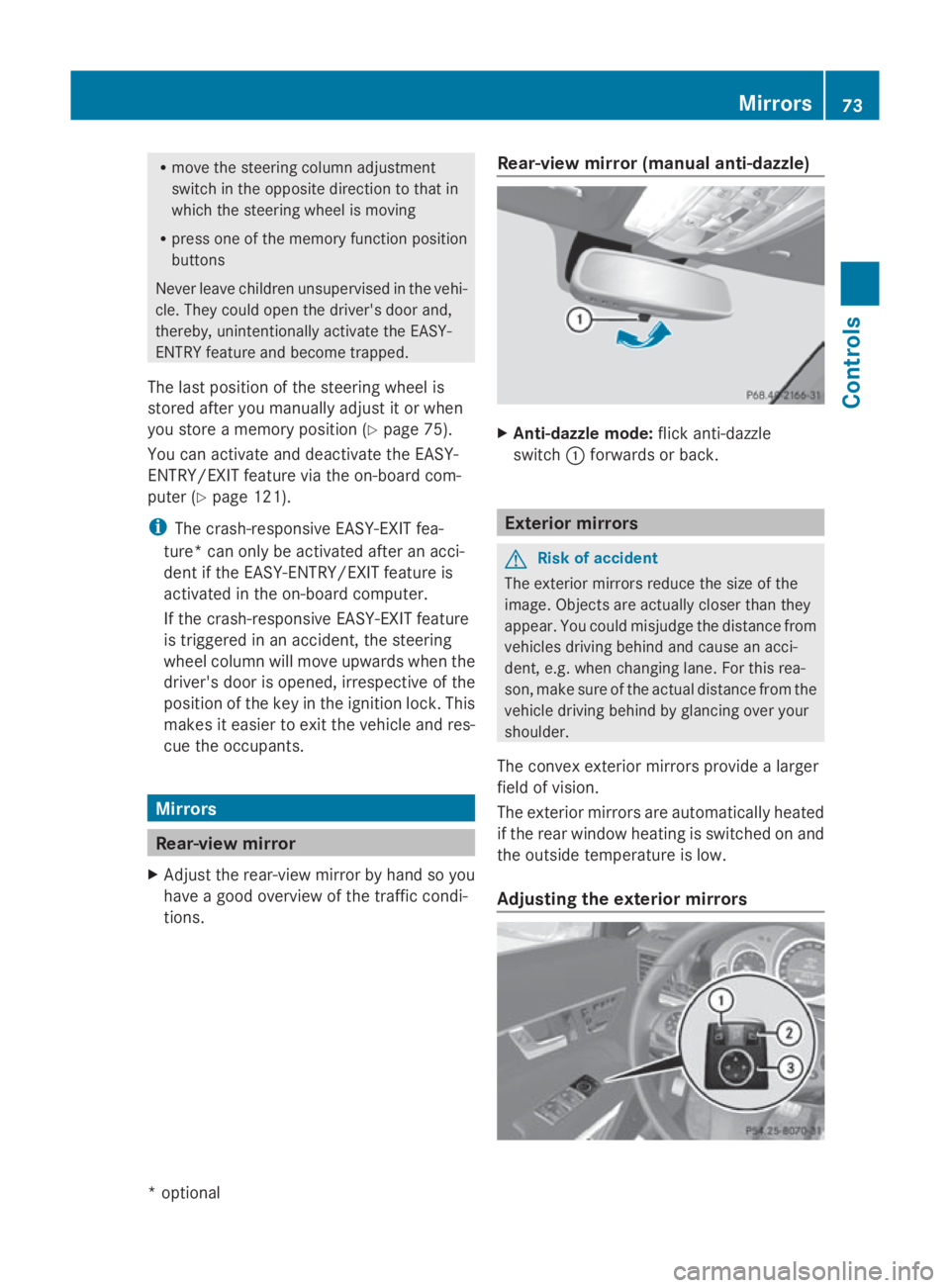
Anti-dazzle mode: flick anti-dazzle
switch 0046forwards or back. Exterio
rmirrors G
Risk of accident
The exterior mirrors reduce the size of the
image. Objects are actually closer than they
appear. You could misjudge the distance from
vehicles driving behind and cause an acci-
dent, e.g. when changing lane. For this rea-
son, make sure of the actua ldistance from the
vehicl edriving behind by glancing over your
shoulder.
The convex exterior mirrors provid ealarger
fiel dofv ision.
The exterior mirrors are automatically heated
if the rear windo wheating is switched on and
the outsid etemperature is low.
Adjusting the exterio rmirrors Mirrors
73Controls
*optional
207_AKB; 2; 3, en-GB
mkalafa
,V ersion: 2.11.8.1
2009-07-23T10:23:49+02:00
-Seite 73 Z