steering MERCEDES-BENZ E-CLASS COUPE 2009 User Guide
[x] Cancel search | Manufacturer: MERCEDES-BENZ, Model Year: 2009, Model line: E-CLASS COUPE, Model: MERCEDES-BENZ E-CLASS COUPE 2009Pages: 313, PDF Size: 7.76 MB
Page 41 of 313
and you are holding th
einside of th esteer-
ing wheel.
R Do no tlean on th edoors/rear sidewalls
from th einside.
R Mak esure that there are no people, ani-
mals or object sbetween th evehicle occu-
pant sand th earea of deploymen tofthe
airbag.
R Do no tplace any object sbetween th eseat
backres tand th edoor.
R Do no thanga ny hard objects, for example,
coat hangers, on th egrab handles or coat
hooks.
R Do no tattach accessories suc hasdrinks
can holders to th edoors/rear sidewalls.
It is no tpossible to rule out arisk of injuries
caused by an airbag due to th ehigh spee dat
whic hthe airbag must deploy. G
Ris
kofi njury
The airbag's functionalit ycan only be assured
if th efollowin gpartsa re no tcovered and no
badges or stickers are attached to them:
R padded steering wheel boss
R knee airbag cover below th esteering col-
umn
R front-passenger fron tairbag cover
R outer side of fron tseat bolsters
R side trim nex ttotherear seat backrest
R Cabriolet :door trim G
Ris
kofi njury
When an airbag deploys, asmall amoun tof
powder is released. The powder may cause
short-term breathin gdifficulties to persons
sufferin gfroma sthma or other pulmonary
conditions.
In orde rtoprevent potential breathin gdiffi-
culties, you shoul dleave th evehicle as soon
as it is safe to do so. You can also open the
window to allow fresh air to enter th evehicle
interior. The powder generally does no tcon- stitut
eahealthhazard and does no tindicate
that there is afireint hevehicle. G
Ris
kofi njury
The airbag part sare hot after th eairbag has
been deployed. Do no ttou ch them as you
coul dburn yourself.
Hav ethe airbag sreplaced at aqualified spe-
cialis tworkshop .Otherwise, occupant sare
no tp rotected by th eairbag sintheeven tof
another accident.
Fron tairbags
The fron tairbag sare designed to increase
protection for th edriver' sand fron tpasseng-
er' sh ead and chest. The driver'
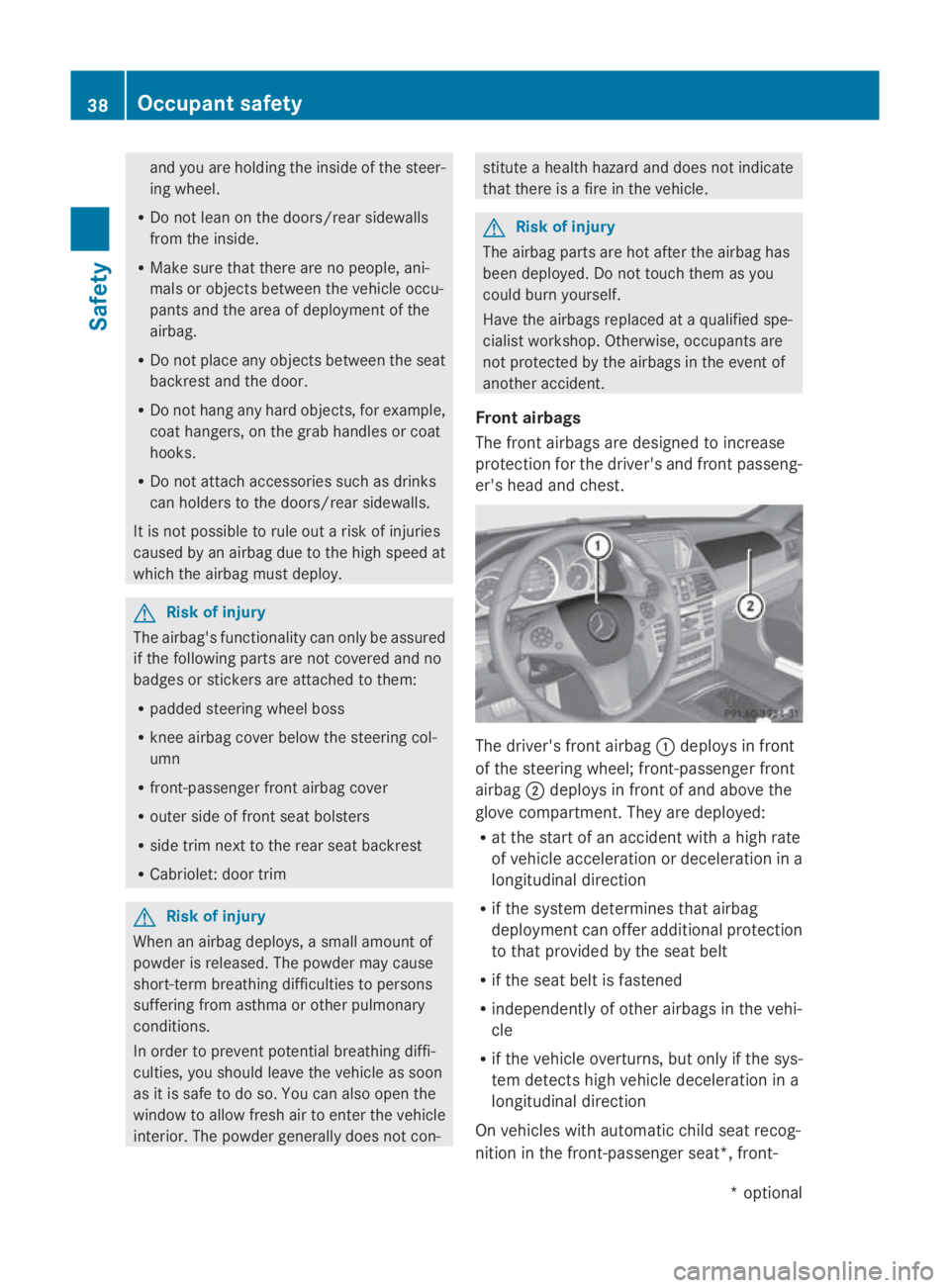
sfront airbag 0046deploys in front
of th esteering wheel; front-passenger front
airbag 0047deploys in fron tofand above the
glov ecompartment. They are deployed:
R at th estart of an acciden twith ahigh rate
of vehicle acceleratio nordeceleratio nina
longitudinal direction
R if th esystem determine sthata irbag
deployment can offer additional protection
to that provided by th eseat belt
R if th eseat belt is fastened
R independently of other airbag sinthevehi-
cle
R if th evehicle overturns, but only if th esys-
te md etect shigh vehicle deceleratio nina
longitudinal direction
On vehicle swith automatic child seat recog-
nition in th efront-pa ssenger seat*, front- 38
Occupant safetySafety
*o
ptional
207_AKB
;2;3,en-GB
mkalafa, Version:2.11.8.1
2009-07-23T10:23:49+02:00
-Seite 38
Page 42 of 313
passenger fron
tairbag 0047is only deployed if
the 007F PASSENGER AIRBAG OFF warning
lamp in the centre console is not lit
(Y page 44). This means that ther eisnot a
child restraint system with automatic child
seat recognition* fitted to the front-
passenger seat or that achild restraint sys-
tem with automatic child seat recognition*
has been fitted to the front-passenger seat
incorrectly.
Driver' sknee airbag
i The driver' skneea irbag is only available
in certain countries.
The driver' skneea irbag can help reduce the
risk of injury to the knees, thighs and lower
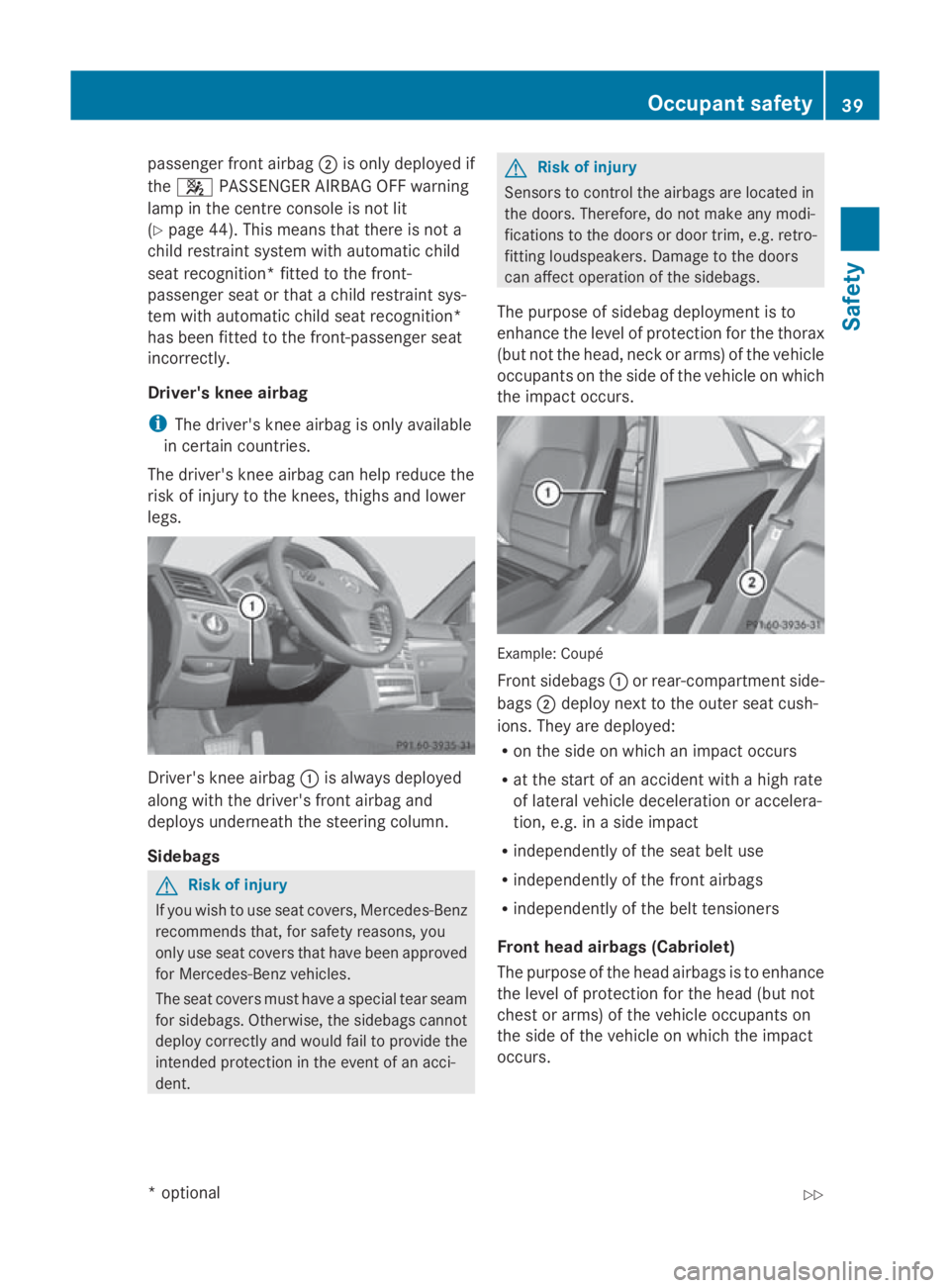
legs. Driver's knee airbag
0046is always deployed
along with the driver' sfron tairbag and
deploys underneath the steering column.
Sidebags G
Risk of injury
If you wish to use seat covers, Mercedes-Benz
recommends that ,for safety reasons ,you
only use seat cover sthat have been approved
for Mercedes-Benz vehicles.
The seat cover smust have aspecial tear seam
for sidebags. Otherwise, the sidebags cannot
deploy correctly and would fail to provide the
intended protection in the event of an acci-
dent. G
Risk of injury
Sensors to contro lthe airbags are located in
the doors. Therefore, do not make any modi-
fications to the doors or door trim ,e.g. retro-
fitting loudspeakers. Damage to the doors
can affect operation of the sidebags.
The purpose of sidebag deployment is to
enhance the level of protection for the thorax
(but not the head, nec korarms) of the vehicle
occupants on the side of the vehicle on which
the impact occurs. Example: Coupé
Fron
tsidebags 0046or rear-compartment side-
bags 0047deploy nex ttothe outer seat cush-
ions. They are deployed:
R on the side on which an impact occurs
R at the start of an acciden twith ahigh rate
of lateral vehicle deceleration or accelera-
tion ,e.g. in aside impact
R independently of the seat belt use
R independently of the fron tairbags
R independently of the belt tensioners
Front head airbags (Cabriolet)
The purpose of the head airbags is to enhance
the level of protection for the head (but not
chest or arms) of the vehicle occupants on
the side of the vehicle on which the impact
occurs. Occupant safety
39Safety
*optional
207_AKB
;2;3,en-GB
mkalafa, Version:2.11.8.1
2009-07-23T10:23:49+02:0
0-Seite 39 Z
Page 55 of 313
X
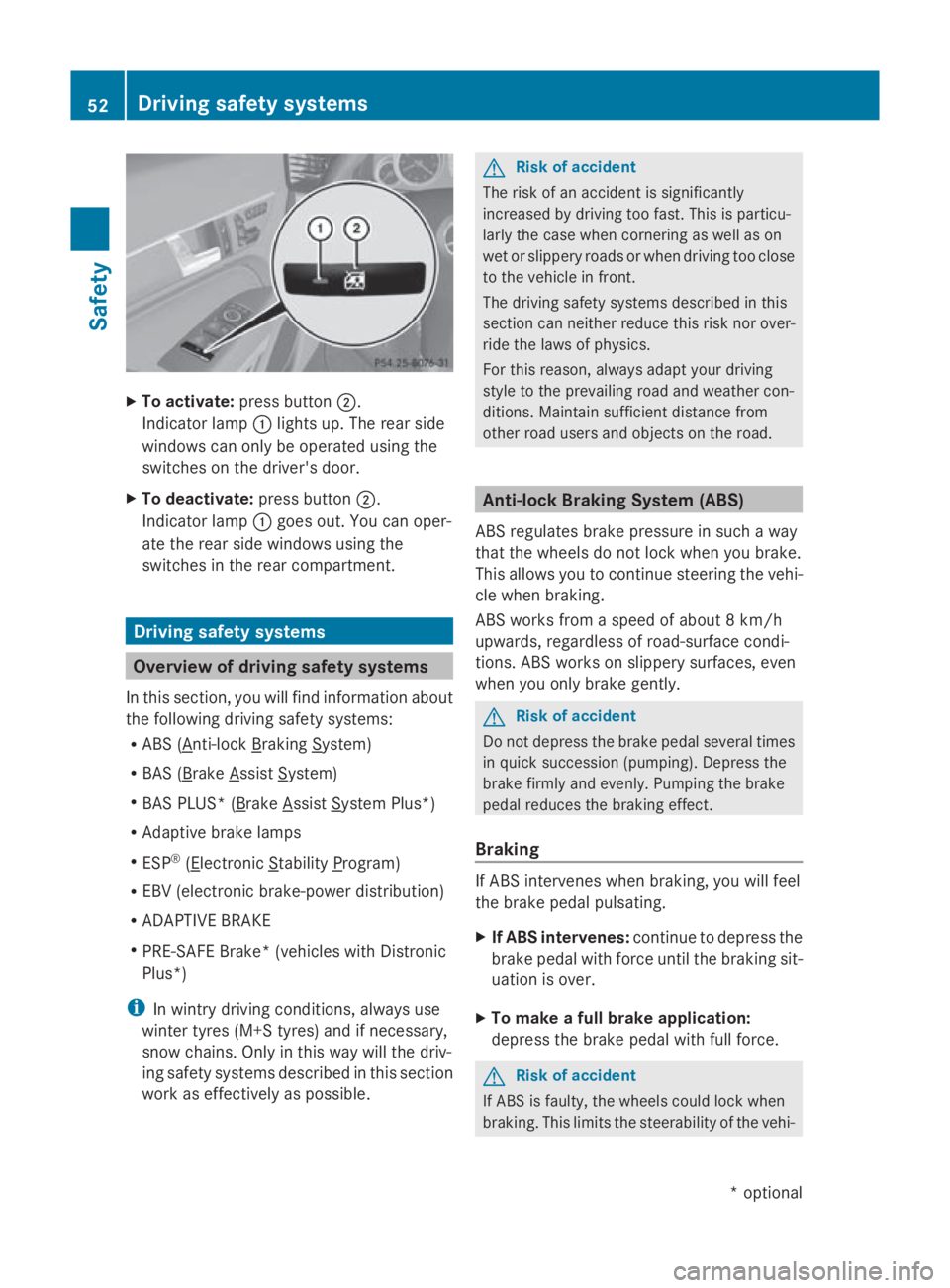
To activate: press button 0047.
Indicato rlamp 0046lights up .The rea rside
windows can onl ybeoperated using the
switches on the driver's door.
X To deactivate: press button0047.
Indicato rlamp 0046goe sout.Y ou can oper-
ate the rea rsidew indows using the
switches in the rea rcompartment. Driving safety systems
Overview of drivin
gsafety systems
In thi ssection, yo uwillf ind informatio nabout
the following driving safety systems:
R ABS ( Anti-lock Braking System)
R BAS ( Brake Assist System)
R BAS PLUS* ( Brake Assist System Plus*)
R Adaptive brake lamps
R ESP ®
( Electronic Stability Program)
R EBV (electroni cbrake-power distribution)
R ADAPTIVE BRAKE
R PRE-SAFE Brake* (vehicle swithD istronic
Plus*)
i In wintry driving conditions, always use
winter tyres (M+S tyres) and if necessary,
snow chains .Onlyint hisw aywill the driv-
ing safety system sdescribe dinthiss ection
work as effectivel yaspossible. G
Ris
kofa ccident
The ris kofana ccident is significantly
increased by driving too fast. Thi sisparticu-
larly the cas ewhenc ornering as well as on
we tors lipper yroads or when driving too close
to the vehicl einfront.
The driving safety system sdescribe dint his
sectio ncan neither reduce thi sriskn or over-
rid ethe laws of physics.
For thi sreason, always adap tyou rd riving
style to the prevailing roa dand weather con-
ditions. Maintain sufficient distance from
othe rroa du sers and objects on the road. Anti-loc
kBraking System (ABS)
ABS regulate sbrake pressure in such away
tha tthe wheels do not lock when yo ubrake.
Thi sallow syou to continue steering the vehi-
cle when braking.
ABS works from aspeed of abou t8km/h
upwards ,regardless of road-surface condi-
tions. ABS works on slippery surfaces ,even
when yo uonlyb rake gently. G
Ris
kofa ccident
Do not depress the brake peda lsevera ltimes
in quick succession (pumping) .Depres sthe
brake firmly and evenly .Pum ping the brake
peda lreduce sthe braking effect.
Braking If ABS intervenes when braking
,you will feel
the brake peda lpulsa ting.
X If ABS intervenes: continue to depress the
brake peda lwithf orc euntilthe braking sit-
uatio niso ver.
X To make afullb rake application:
depress the brake peda lwithf ullf orce. G
Ris
kofa ccident
If ABS is faulty, the wheels could lock when
braking .Thisl im its the steerability of the vehi- 52
Driving safety systemsSafety
*o
ptional
207_AKB; 2; 3, en-GB
mkalafa,
Version: 2.11.8.1 2009-07-23T10:23:49+02:00-Seite 52
Page 64 of 313
Opening and closing
...........................62
Boot ...................................................... 64
Key positions ....................................... 65
Seats .................................................... 66
Steering wheel .................................... 71
Mirrors ................................................. 73
Memor yfunctions* ............................. 75
Seat belts ............................................. 76
Lights ................................................... 80
Windscreen wipers .............................94
Side windows ...................................... 94
Driving and parking ............................98
Transmission ..................................... 101
Instrument cluster ............................106
On-boar dcomputer .......................... 107
Driving systems ................................ 122
Air conditioning ................................. 147
Sliding sunroof (Coupé) ....................158
Soft top (Cabriolet) ...........................160
Loading and stowing ........................165
Features ............................................. 172 61Controls
207_AKB
;2;3,en-GB
mkalafa, Version:2.11.8.1
2009-07-23T10:23:49+02:0
0-Seite 61
Page 74 of 313
i
The blower continues runnin gfor seven
seconds to cool down the heating ele-
ments.
i If the battery voltage is too low, the AIR-
SCARF neck-level heating may switch off. Seat ventilation*
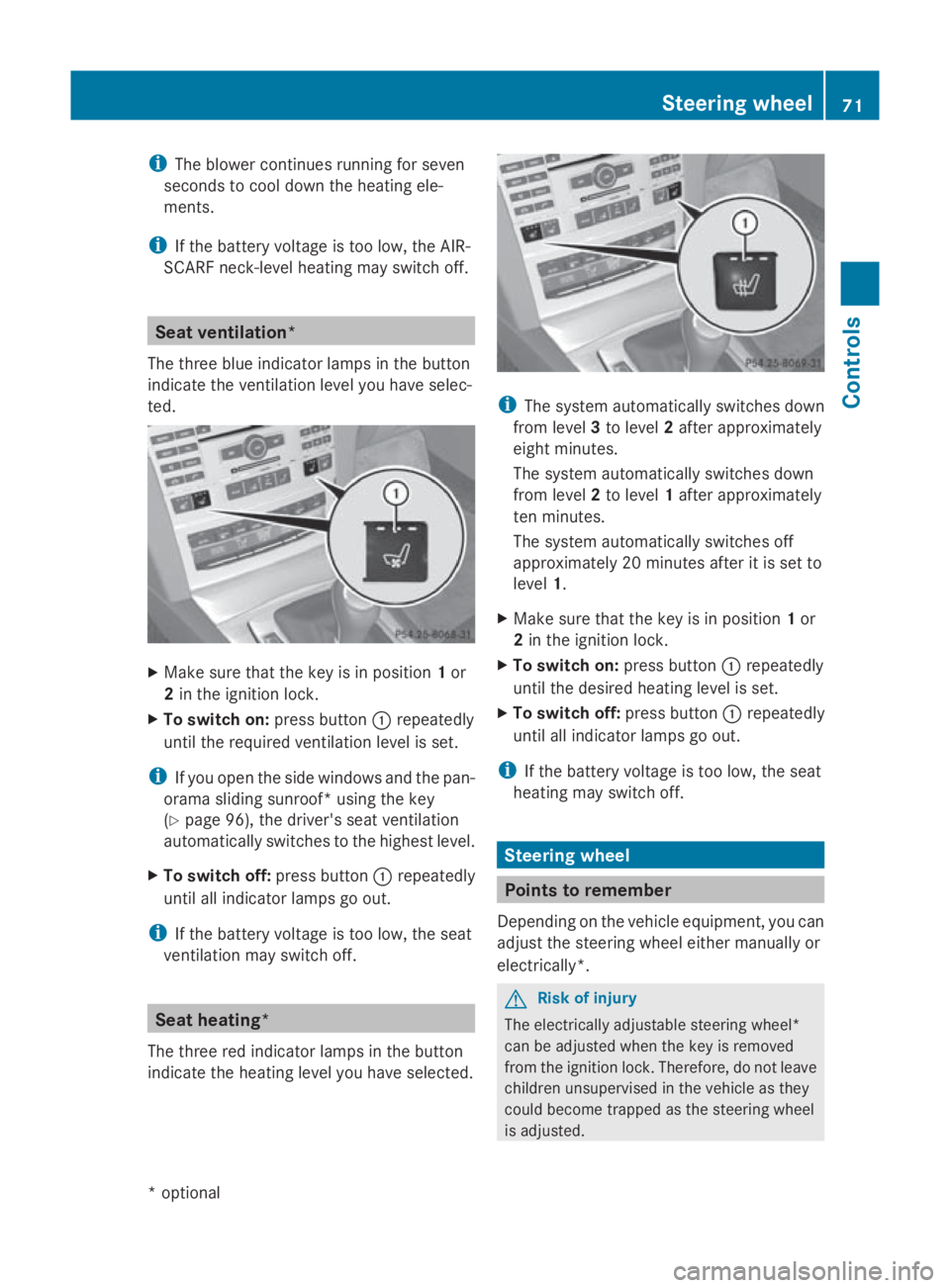
The three blue indicator lamps in the button
indicate the ventilation level you have selec-
ted. X
Make sure that the key is in position 1or
2 in the ignition lock.
X To switch on: press button0046repeatedly
until the required ventilation level is set.
i If you open the side windows and the pan-
orama sliding sunroof* using the key
(Y page 96), the driver's seat ventilation
automatically switches to the highest level.
X To switch off: press button0046repeatedly
until all indicator lamps go out.
i If the battery voltage is too low, the seat
ventilation may switch off. Seat heating*
The three red indicator lamps in the button
indicate the heating level you have selected. i
The system automatically switches down
from level 3to level 2after approximately
eight minutes.
The system automatically switches down
from level 2to level 1after approximately
ten minutes.
The system automatically switches off
approximately 20 minutes after it is set to
level 1.
X Make sure that the key is in position 1or
2 in the ignition lock.
X To switch on: press button0046repeatedly
until the desired heating level is set.
X To switch off: press button0046repeatedly
until all indicator lamps go out.
i If the battery voltage is too low, the seat
heating may switch off. Steering wheel
Points to remember
Dependin gonthe vehicle equipment, you can
adjust the steerin gwheel either manually or
electrically*. G
Ri
sk of injury
The electrically adjustable steerin gwheel*
can be adjusted when the key is removed
from the ignition lock. Therefore, do not leave
children unsupervised in the vehicle as they
could become trapped as the steerin gwheel
is adjusted. Steering wheel
71Controls
*optional
207_AKB; 2; 3, en-GB
mkalafa,
Version: 2.11.8.1 2009-07-23T10:23:49+02:00-Seite 71 Z
Page 75 of 313
G
Risk of accident
Only adjust the steering wheel whe nthe vehi-
cle is stationar yand do not pull away unti lthe
steering wheel adjustment mechanism is
locke dinposition. Otherwise, yo umight drive
withou tthe steering wheel adjustment mech-
anism being locke dinposition and be distrac-
ted from roa dand traffi cconditions by an
unexpecte dmovement of the steering wheel
and cause an accident.
However, the steerability of the vehicle is not
affected.
Whe nyou adjust the steering wheel ,make
sure that:
R the steering wheel can be reached with
your arm sslightl ybent
R yo uc an move your legs freely
R yo uc an see al lthe display sinthe instru-
ment cluster clearly Adjusting the steering wheel man-
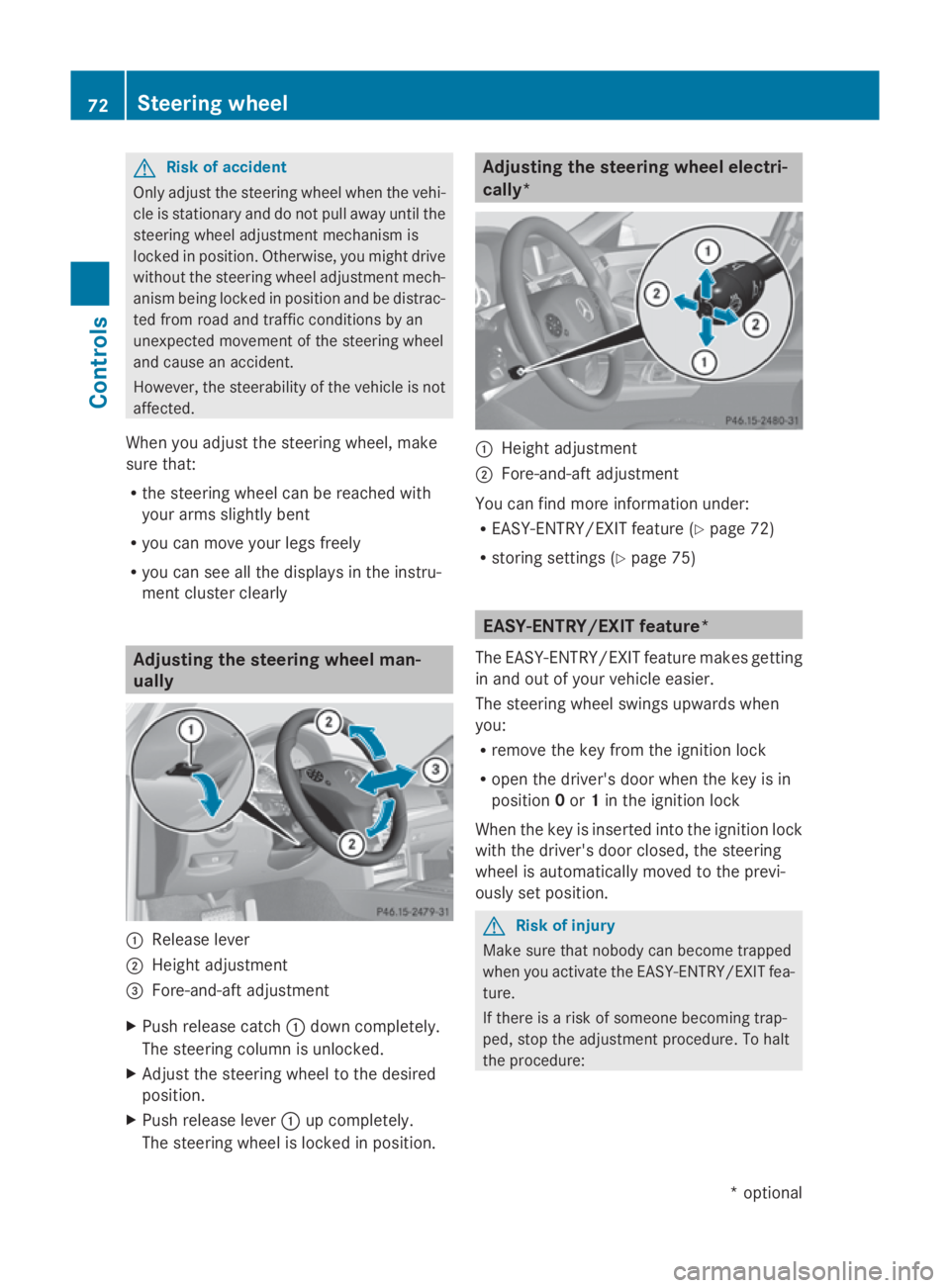
ually 0046
Releas elever
0047 Height adjustment
008A Fore-and-aft adjustment
X Push release catch 0046dow ncompletely.
The steering column is unlocked.
X Adjus tthe steering wheel to the desired
position.
X Push release lever 0046up completely.
The steering wheel is locke dinposition. Adjusting the steering wheel electri-
cally*
0046
Height adjustment
0047 Fore-and-aft adjustment
You can find more information under:
R EASY-ENTRY/EXIT feature (Y page 72)
R storing settings (Y page 75) EASY-ENTRY/EXI
Tfeature*
The EASY-ENTRY/EXIT feature make sgetting
in and ou tofyourv ehicle easier.
The steering wheel swings upwards when
you:
R remove the key from the ignition lock
R ope nthe driver' sdoorw hent he key is in
position 0or 1in the ignition lock
Whe nthe key is inserted into the ignition lock
with the driver' sdoorc losed, the steering
wheel is automaticall ymovedtot he previ-
ously set position. G
Risk of injury
Make sure that nobody can become trapped
whe nyou activate the EASY-ENTRY/EXIT fea-
ture.
If there is ariskofs omeone becoming trap-
ped ,stop the adjustment procedure. To halt
the procedure: 72
Steering wheelControls
*o
ptional
207_AKB
;2;3,en-GB
mkalafa ,V ersion: 2.11.8.1
2009-07-23T10:23:49+02:00
-Seite 72
Page 76 of 313
R
move the steering column adjustment
switch in the opposite directio ntothat in
which the steering whee lismoving
R press one of the memory function position
buttons
Never leave children unsupervise dinthe vehi-
cle. They could open the driver' sdoor and,
thereby ,unintentionally activate the EASY-
ENTRY feature and become trapped.
The lastp osition of the steering whee lis
stored after you manually adjust it or when
you store amemory position (Y page75).
You can activate and deactivate the EASY-
ENTRY/EXIT feature via the on-board com-
puter (Y page121).
i The crash-responsive EASY-EXIT fea-
ture* can only be activated after an acci-
dent if the EASY-ENTRY/EXIT feature is
activated in the on-board computer.
If the crash-responsive EASY-EXIT feature
is triggere dinanaccident, the steering
whee lcolumn willm ove upwards when the
driver' sdoor is opened ,irrespective of the
position of the key in the ignitio nlock. This
makes it easier to exit the vehicl eand res-
cue the occupants. Mirrors
Rear-view mirror
X Adjust the rear-vie wmirror by hand so you
have agood overvie wofthe traffic condi-
tions. Rear-view mirror (manual anti-dazzle) X
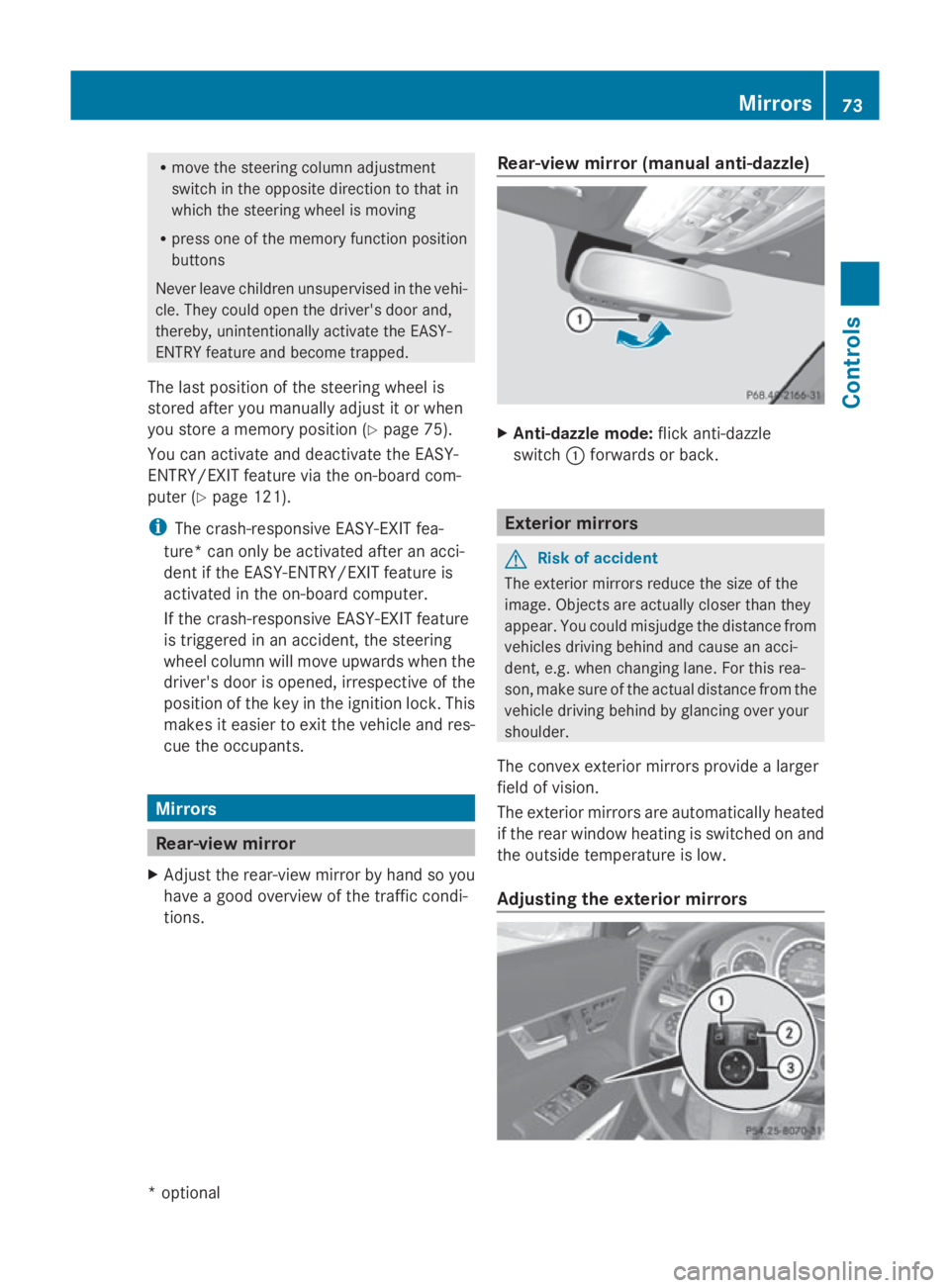
Anti-dazzle mode: flick anti-dazzle
switch 0046forwards or back. Exterio
rmirrors G
Risk of accident
The exterior mirrors reduce the size of the
image. Objects are actually closer than they
appear. You could misjudge the distance from
vehicles driving behind and cause an acci-
dent, e.g. when changing lane. For this rea-
son, make sure of the actua ldistance from the
vehicl edriving behind by glancing over your
shoulder.
The convex exterior mirrors provid ealarger
fiel dofv ision.
The exterior mirrors are automatically heated
if the rear windo wheating is switched on and
the outsid etemperature is low.
Adjusting the exterio rmirrors Mirrors
73Controls
*optional
207_AKB; 2; 3, en-GB
mkalafa
,V ersion: 2.11.8.1
2009-07-23T10:23:49+02:00
-Seite 73 Z
Page 78 of 313
Memory functions*
Storing settings
Using the memory button you can store up to
three different settings, e. g. for three differ-
ent people.
The following settings are stored as asingle
memory preset:
R position of the seat, backrest and head
restraint
R driver's side :steering whee lposition
R driver's side :position of the exterior mir-
rors on the driver's and front-passenger
sides G
Risk of injury
The memory function can still be use dwhen
the key has been removed .For this reason,
children should never be left unsupervised in
the vehicle. Otherwise, they coul dbecome
trappe dwhen moving the seat or the steering
wheel. G
Risk of accident
Only use the memory function on the driver's
side when the vehicl eisstationary. Other-
wise, you coul dbedistracted from the traffic
conditions by the steering whee land seat
moving of their own accord, and as aresult
caus eana ccident. X
Adjust the seat( Ypage6 6).
X On the driver's side ,alsoa djust the steer-
ing whee l(Y page7 1) and the mirrors
(Y page7 3).
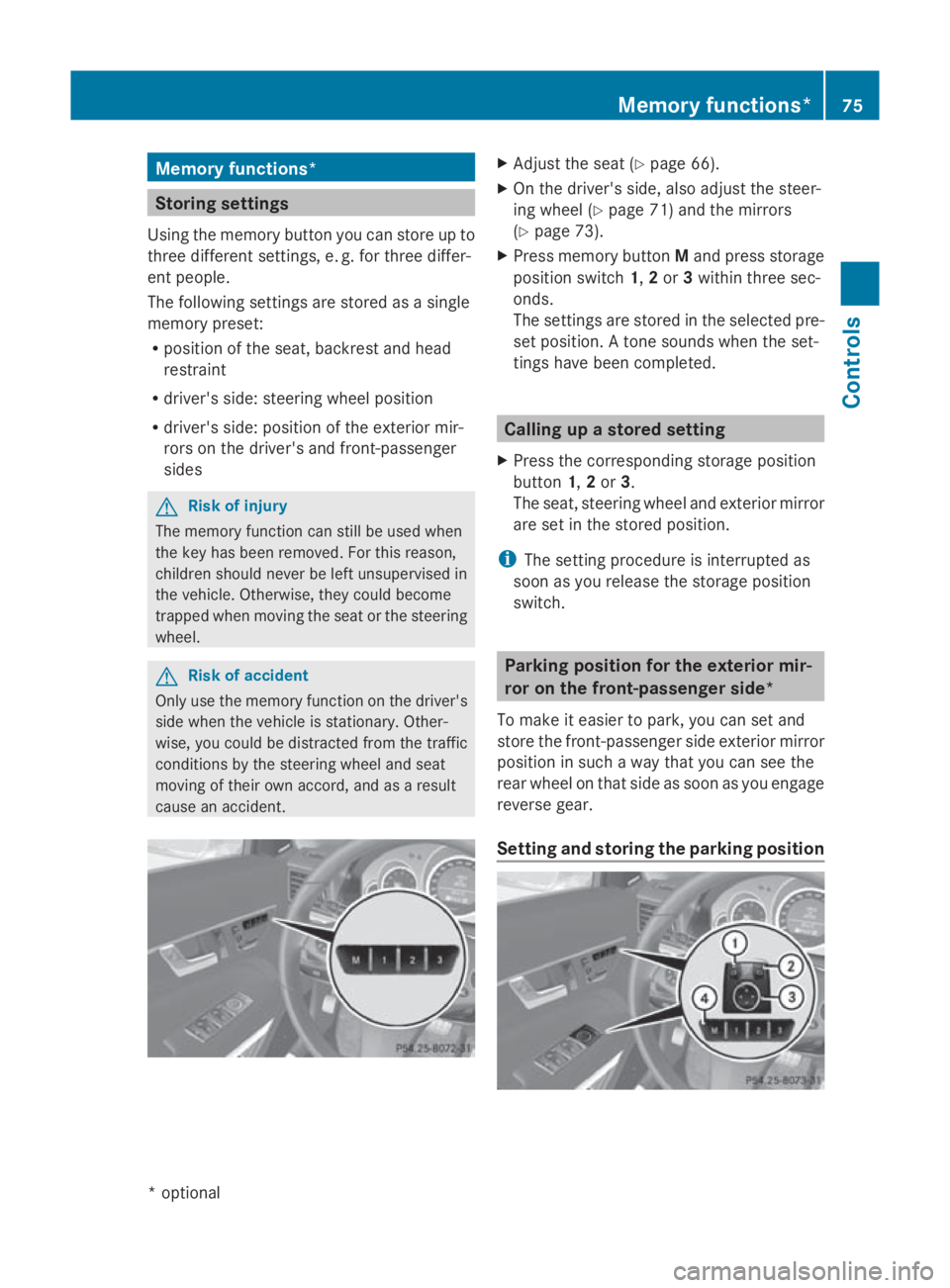
X Press memory button Mand press storage
position switch 1,2or 3withi nthree sec-
onds.
The settings are stored in the selected pre-
set position. Atone sound swhen the set-
tings have been completed. Calling up
astored setting
X Press the corresponding storage position
button 1,2or 3.
The seat, steering whee land exterior mirror
are set in the stored position.
i The setting procedure is interrupted as
soon as you release the storage position
switch. Parking position for the exterior mir-
ror on the front-passengers
ide*
To make it easier to park, you can set and
store the front-passenge rside exterior mirror
position in such awaythat you can see the
rear whee lonthat side as soon as you engage
reverse gear.
Setting and storing the parking position Memory functions*
75Controls
*o
ptional
207_AKB; 2; 3, en-GB
mkalafa,
Version: 2.11.8.1 2009-07-23T10:23:49+02:00-Seite 75 Z
Page 83 of 313
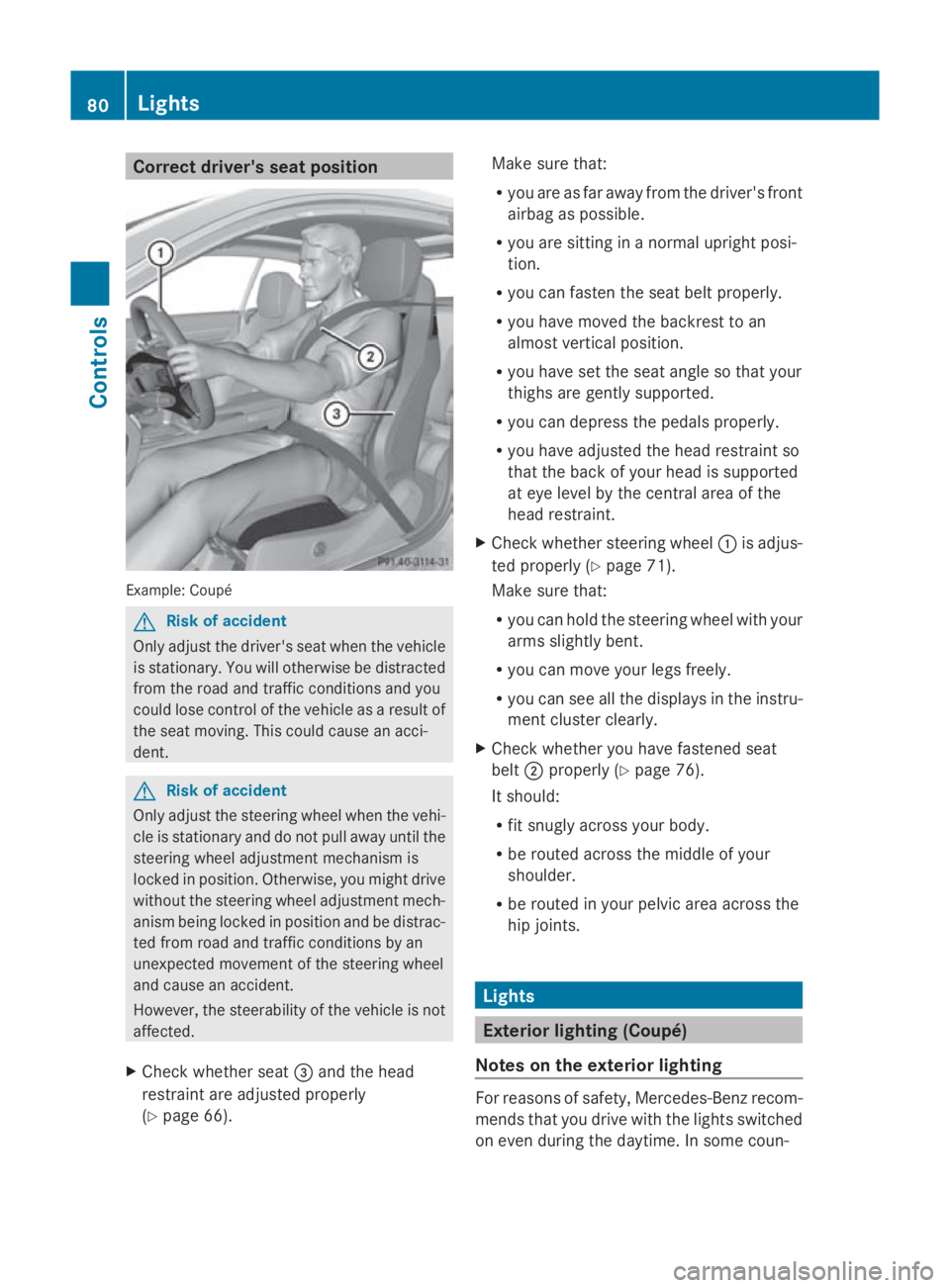
Correct driver's seat position
Example
:Coupé G
Ris
kofa ccident
Only adjust th edriver' sseat when th evehicle
is stationary. You will otherwise be distracted
from th eroad and traffic condition sand you
coul dlose control of th evehicle as aresult of
th es eat moving .This coul dcaus eana cci-
dent. G
Ris
kofa ccident
Only adjust th esteering wheel when th evehi-
cle is stationar yand do no tpull away until the
steering wheel adjustmen tmechanism is
locke dinposition. Otherwise, you migh tdrive
without th esteering wheel adjustmen tmech-
anis mbeinglocke dinp ositio nand be distrac-
te df romr oad and traffic condition sbyan
unexpected movement of th esteering wheel
and caus eanaccident.
However, th esteerabilit yofthevehicle is not
affected.
X Chec kwhether seat 008Aand th ehead
restraint are adjusted properly
(Y page 66). Mak
esure that:
R you are as far away from th edriver' sfront
airbag as possible.
R you are sittin ginanormalupright posi-
tion.
R you can fasten th eseat belt properly.
R you have moved th ebackres ttoan
almos tvertical position.
R you have set th eseat angle so that your
thighs are gently supported.
R you can depress th epedals properly.
R you have adjusted th ehead restraint so
that th eback of your head is supported
at eye leve lbythecentral area of the
head restraint.
X Chec kwhether steering wheel 0046is adjus-
te dp roperl y(Ypage 71).
Mak esure that:
R you can hold th esteering wheel wit hyour
arm sslightly bent.
R you can mov eyour legs freely.
R you can see all th edisplays in th einstru-
men tcluste rclearly.
X Chec kwhether you have fastened seat
belt 0047properl y(Ypage 76).
It should:
R fit snugly across your body.
R be routed across th emiddle of your
shoulder.
R be routed in your pelvic area across the
hip joints. Lights
Exterior lightin
g(Coupé)
Notes on th eexterior lighting For reason
sofsafety, Mercedes-Ben zrecom-
mends that you driv ewitht he light sswitched
on eve ndurin gthe daytime. In som ecoun- 80
LightsControls
207_AKB
;2;3,en-GB
mkalafa ,V ersion: 2.11.8.1
2009-07-23T10:23:49+02:00
-Seite 80
Page 88 of 313
The hazard warning lamps automatically
switch on if:
R
an airbag is deployed.
R you brake sharply and bring the vehicle to
ah alt from aspeed of more than
70 km/h.
The hazard warning lamps still operate if the
ignition is switched off.
X To switch on: press button0046.
All turn signals flash.
X To switch off: press button0046.
X To switch off the hazard warning lamps
using the combination switch: if the haz-
ard warning lamps are on, push the combi-
nation switch in the direction of arrow 0071
or 0073 beyond the pressure point
(Y page 82).
The indicator lamp on the corresponding
side of the vehicle flashes.
The hazard warning lamp switches off auto-
matically after full brake application if the
vehicle then reaches aspeed of over
10 km/ha gain.
Intelligent Light System* (bi-xenon
headlamps*) The Intelligent Light System is
asystem which
adjusts the headlamps automatically to suit
the prevailing driving and weather conditions.
The bi-xenon headlamps offer enhanced func-
tions to improve illumination of the road sur-
face, e.g. depending on the vehicle speed or
weather conditions. The system includes the
active light function, cornering light function,
motorway mode and extended range fog-
lamps. The system is only active when it is
dark.
You can activat eordeactivate the "Intelligent
Light System" using the on-board computer
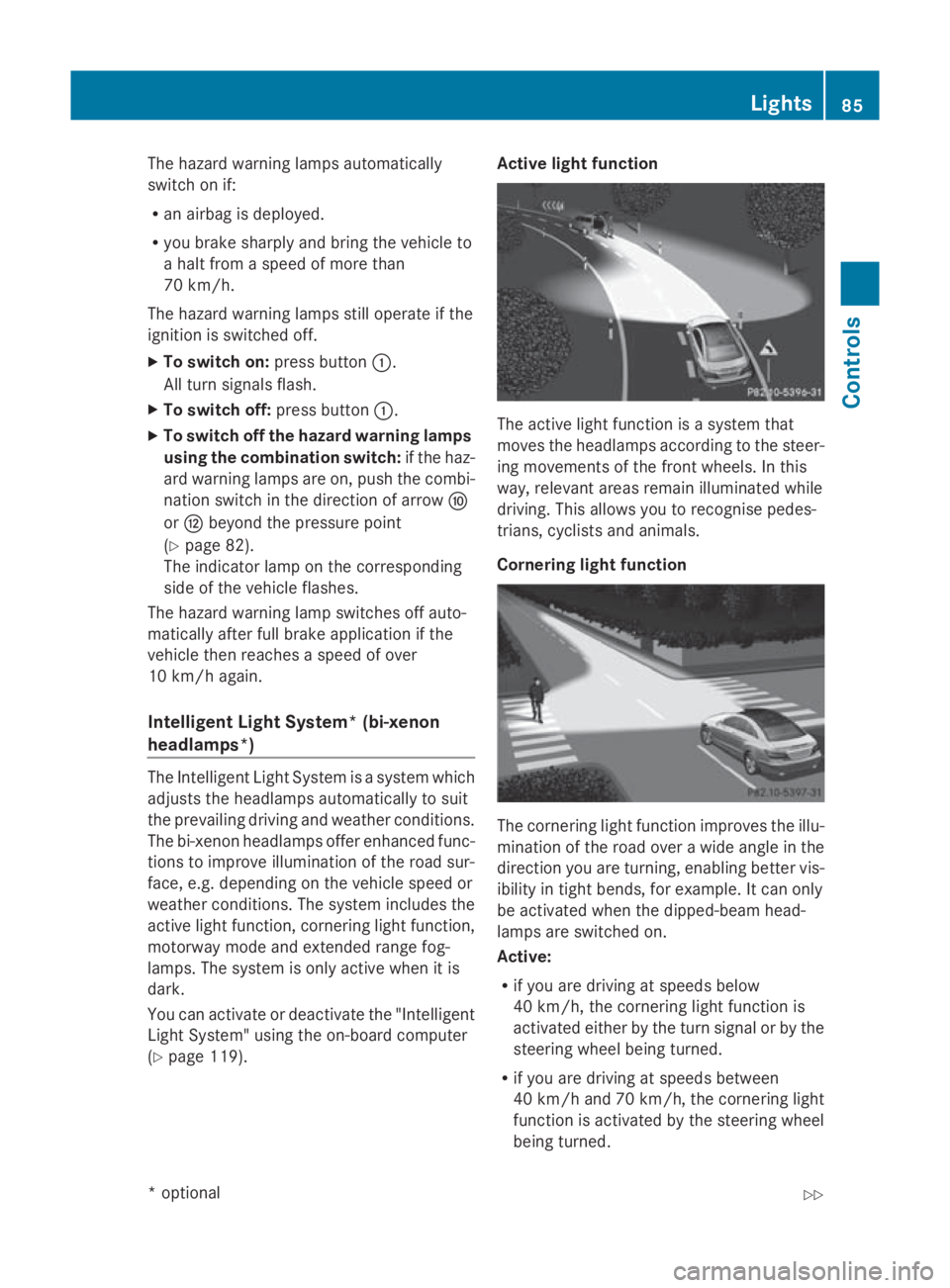
(Y page 119). Active light function
The active light function is
asystem that
moves the headlamps accordin gtothe steer-
ing movements of the frontw heels. In this
way, relevant areas remain illuminated while
driving. This allows you to recognise pedes-
trians, cyclists and animals.
Cornering light function The cornering light function improves the illu-
mination of the road over
awide angle in the
direction you are turning, enabling better vis-
ibility in tight bends, for example. It can only
be activated when the dipped-beam head-
lamps are switched on.
Active:
R if you are driving at speeds below
40 km/h, the cornering light function is
activated either by the turn signal or by the
steerin gwheel being turned.
R if you are driving at speeds between
40 km/ha nd 70 km/h ,the cornerin glight
function is activated by th esteering wheel
bein gturned. Lights
85Controls
*optional
207_AKB
;2;3,en-GB
mkalafa ,V ersion: 2.11.8.1
2009-07-23T10:23:49+02:00
-Seite 85 Z