stop start MERCEDES-BENZ E-CLASS COUPE 2009 User Guide
[x] Cancel search | Manufacturer: MERCEDES-BENZ, Model Year: 2009, Model line: E-CLASS COUPE, Model: MERCEDES-BENZ E-CLASS COUPE 2009Pages: 313, PDF Size: 7.76 MB
Page 162 of 313
i
If you press the switch beyond the point
of resistance, an automatic opening/clos-
ing process is started in the corresponding
direction. You can stop automatic opera-
tion by pressing again.
Closing with increased force and with-
out the anti-entrapment feature G
Risk of injury
You could be severel yoreven fatall yinjured
when closing the panorama sliding sunroof
with increased closing force or if the anti-
entrapment feature is deactivated. Make sure
that nobody can become trapped when clos-
ing the panorama sliding sunroof.
If the panorama sliding sunroof blocks during
closing:
X Immediately after the panorama sliding
sunroof blocks, pullt he switch again to the
point of resistance in the direction of
arrow 0047until the panorama sliding sun-
roof is closed.
The panorama sliding sunroof is closed
with more force.
If the panorama sliding sunroof blocks during
closing again:
X Immediately after the panorama sliding
sunroof blocks, pullt he switch again to the
point of resistance in the direction of
arrow 0047until the panorama sliding sun-
roof is closed.
The panorama sliding sunroof is closed
withou tthe anti-entrapment feature.
Rain closing feature* When the key is in position
0in the ignition
lock or is removed, the panorama sliding sun-
roof closes automatically:
R if it starts to rain
R at extreme outsid etemperatures
R after six hours
R if there is amalfunction in the powers upplyThe panorama sliding sunroof remains raised
at the rear in order to allow ventilation of the
vehicle interior.
i
If the panorama sliding sunroof is obstruc-
ted when being closed by the rain closing
feature, it opens again slightly. The rain
closing feature is then deactivated.
The panorama sliding sunroof does not close
if:
R it is raisedatt he rear.
R it is blocked.
R no rain is falling on the area of the wind-
screen being monitored by the rain sensor
(e.g. because the vehicle is under abridge
or in acarport). Rollers
unblind for the panorama slid-
ing sunroof*
The rollers unblind provide sprotection from
the sun. The rollers unblind can only be
opened and closed when the panorama slid-
ing sunroof is closed. G
Risk of injury
Make sure that nobody can become trapped
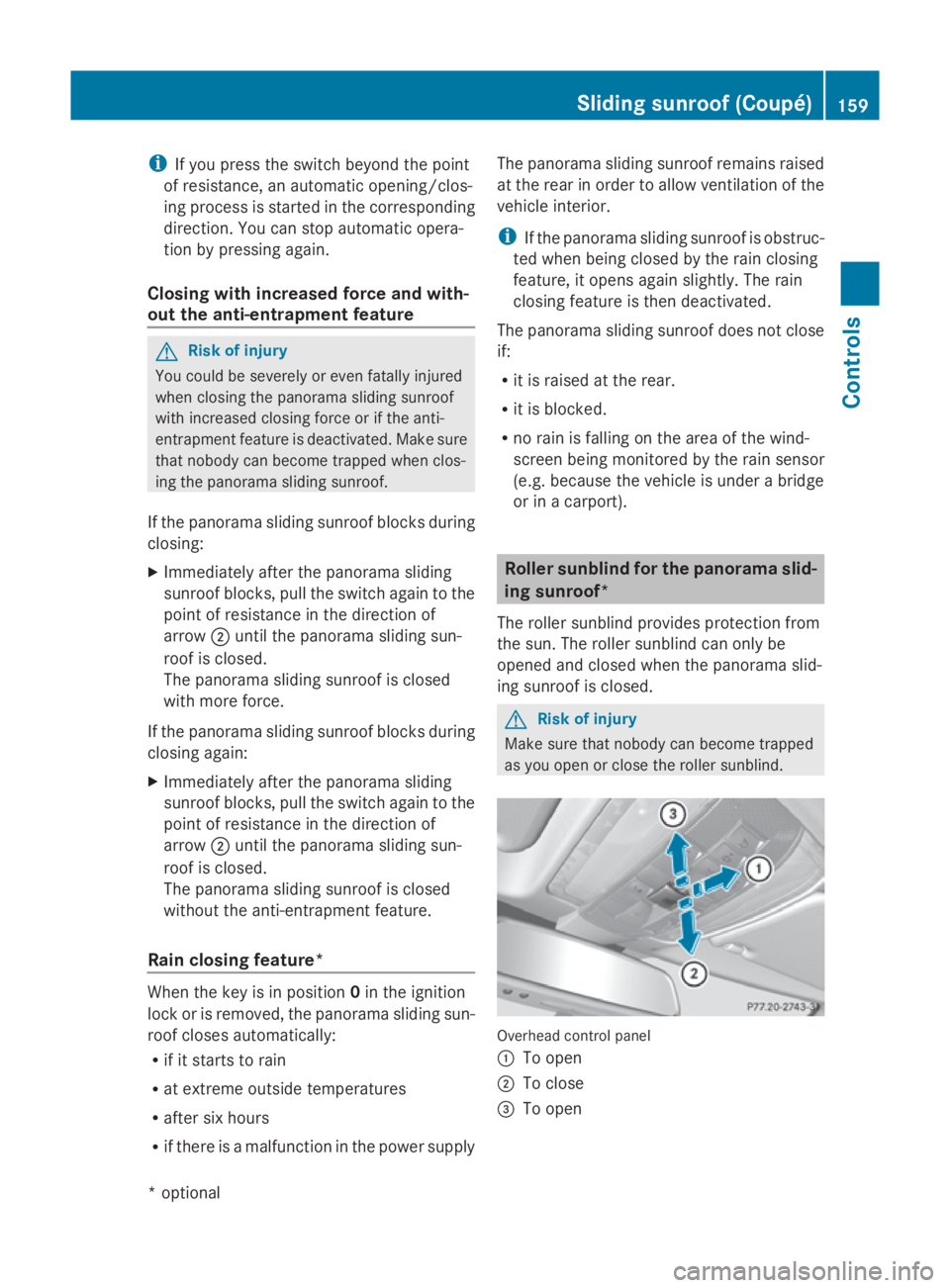
as you open or close the rollers unblind. Overhea
dcontrol panel
0046 To open
0047 To close
008A To open Sliding sunroof (Coupé)
159Controls
*optional
207_AKB; 2; 3, en-GB
mkalafa
,V ersion: 2.11.8.1
2009-07-23T10:23:49+02:00
-Seite 159 Z
Page 163 of 313
X
Turn the key to position 1or 2in the ignition
lock.
X Pull or push the switch in the corresponding
direction.
i If you press the switch beyond the point
of resistance, an automatic opening/clos-
ing process is started in the corresponding
direction .You can stop automatic opera-
tion by pressing again.
Resetting the panorama sliding sunroof
and the roller sunblind Reset the panorama sliding sunroof and the
roller sunblind if the panorama sliding sunroof
or the roller sunblind does not close
smoothly.
X Turn the key to position 1or 2in the ignition
lock.
X Pull the switch repeatedly to the point of
resistanc einthe direction of arrow 0047until
the panorama sliding sunroof is fully
closed.
X Keep the switch pulled for an additional
second.
X Pull the switch repeatedly to the point of
resistanc einthe direction of arrow 0047until
the roller sunblind is fully closed.
X Keep the switch pulled for an additional
second.
X Check that the panorama sliding sunroof
and the roller sunblind can be fully opened
again.
X If this is not the case, consult aqualified
specialist workshop. Soft top (Cabriolet)
Opening and closing the soft top
You can open or close the soft top either
when the vehicle is stationary or when driving
up to aspeed of 40 m/h.
If there is astron ghead wind, it may not be
possible to close the soft top fully. In this case, reduce speed or stop in order to close
the soft top fully.
For safety reasons, Mercedes-Benz recom-
mends that you only open or close the soft
top when the vehicle is stationary. G
Risk of accident and injury
Only drive with the soft top fully open or
closed.
If the soft top does not open or close fully, the
soft-top hydraulics are depressurised and the
soft top is lowered:
R after about seven minutes if the ignition is
switched on
R immediately if the ignition is switched off
Aw arning tones ounds shortly beforehand.
The Top being opened message appears in
the multifunction display.
Lock the soft top again before driving on. Oth-
erwise, the unlocked soft top could open dur-
ing the journey and cause you to lose control
of your vehicle. You or other persons could be
injured as aresult.
! Never sit on the soft-top compartment
cover and do not store any heavy objects
on it. You will otherwise damage the soft
top and soft-top compartment cover of the
vehicle.
! The soft top swings upwards when it is
opened or closed. In order to avoid dam-
aging the soft top or other parts of the vehi-
cle when opening or closing the soft top,
observe the following:
R there must be sufficient clearance above
the vehicle.
R the boot separator must be closed and
must not be pushed upwards by the load.
R there must not be any object sonthe
soft-top compartment cover. 160
Soft top (Cabriolet)Controls
207_AKB; 2; 3, en-GB
mkalafa,
Version: 2.11.8.1 2009-07-23T10:23:49+02:00-Seite 160
Page 168 of 313
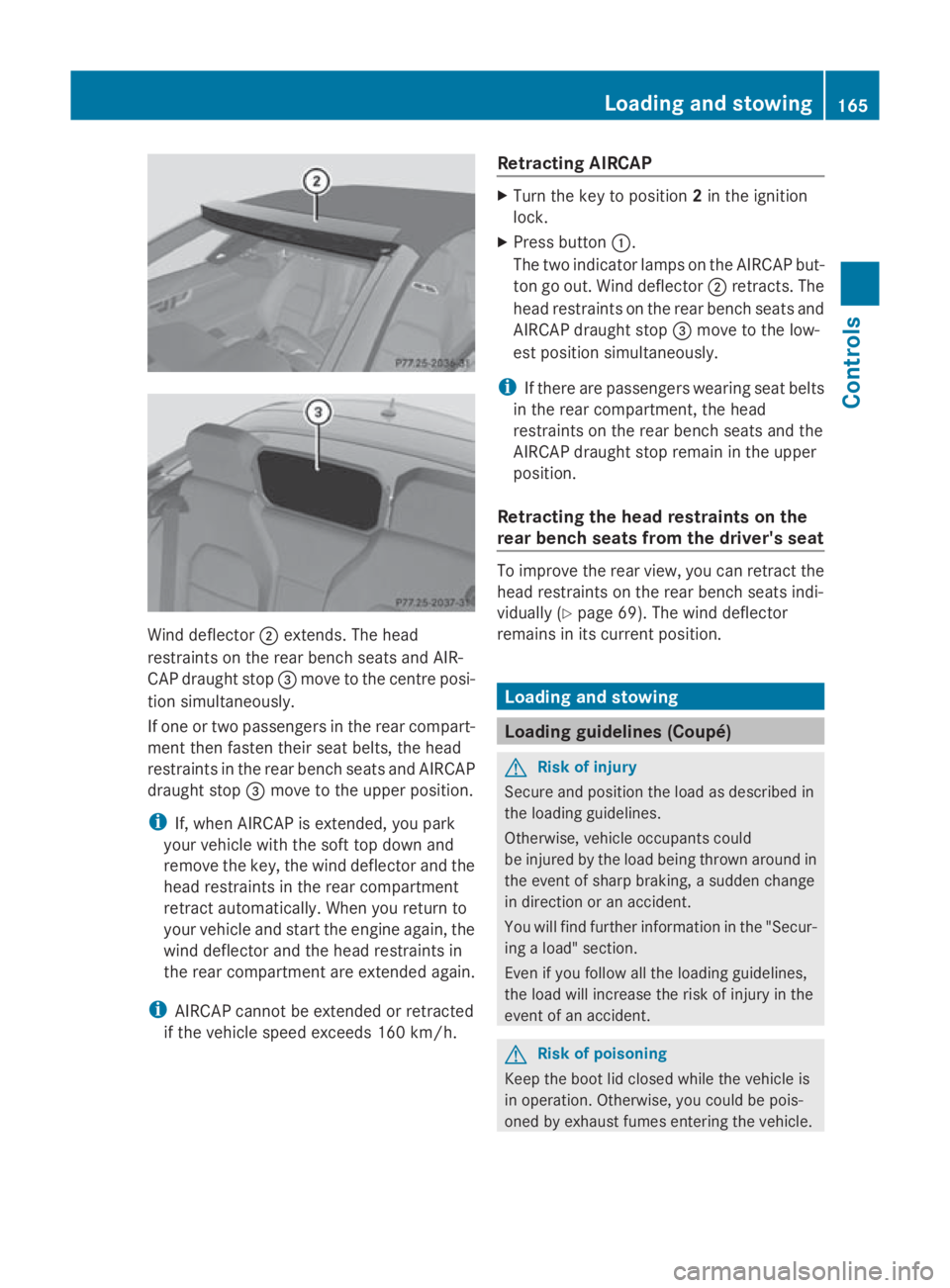
Wind deflector
0047extends. The head
restraints on the rear bench seats and AIR-
CAP draught stop 008Amove to the centre posi-
tion simultaneously.
If one or two passengers in the rear compart-
ment then fasten their seat belts, the head
restraints in the rear bench seats and AIRCAP
draught stop 008Amove to the upper position.
i If, when AIRCAP is extended, you park
your vehicle with the soft top down and
remove the key, the wind deflector and the
head restraints in the rear compartment
retract automatically. When you return to
your vehicle and start the engine again, the
wind deflector and the head restraints in
the rear compartment are extended again.
i AIRCAP cannot be extended or retracted
if the vehicle speed exceeds 160 km/h. Retracting AIRCAP X
Turn the key to position 2in the ignition
lock.
X Press button 0046.
The two indicato rlamps on the AIRCAP but-
ton go out. Wind deflector 0047retracts. The
head restraints on the rear bench seats and
AIRCAP draught stop 008Amove to the low-
est position simultaneously.
i If there are passengers wearing seat belts
in the rear compartment ,the head
restraints on the rear bench seats and the
AIRCAP draught stop remain in the upper
position.
Retracting the head restraints on the
rear bench seats from the driver's seat To improve the rear view, you can retract the
head restraints on the rear bench seats indi-
vidually (Y
page 69). The wind deflector
remains in its curren tposition. Loading and stowing
Loading guidelines (Coupé)
G
Risk of injury
Secure and position the load as described in
the loading guidelines.
Otherwise, vehicle occupant scould
be injured by the load being thrown around in
the event of sharp braking, asudden change
in direction or an accident.
You will find further information in the "Secur-
ing aload" section.
Even if you follow all the loading guidelines,
the load will increase the risk of injury in the
event of an accident. G
Risk of poisoning
Keep the boot lid closed while the vehicle is
in operation .Otherwise, you could be pois-
oned by exhaust fumes entering the vehicle. Loading and stowing
165Controls
207_AKB; 2; 3, en-GB
mkalafa, Version: 2.11.8.1 2009-07-23T10:23:49+02:00-Seite 165 Z
Page 185 of 313
X
Lower the bonnet and let it fall from a
heightofa pproximately 20 cm.
X Check that the bonnet has engage dprop-
erly.
i If the bonnet can be raiseds lightly, it is
not properl yengaged. Open it again and
close it with alittle more force. Engine oil
Depending on driving style, the vehicle con-
sumes up to 0.8 loil per 1,000 km. The oil
consumption may be highert han this when
the vehicle is new or if you frequently drive at
high engine speeds.
Checking the engine oil level Before checking the engine oil level the fol-
lowing conditions for the vehicle shouldbe
met:
R
the vehicle shouldbep arked on level
ground.
R the engine shouldbes witched off for at
least five minutes if the engine is at normal
operating temperature.
R the engine shouldbes witched off for at
least 30 minutes if the engine is not at
operating temperature (i.e. if you only start
the engine briefly).
Depending on the engine, the oil dipstick may
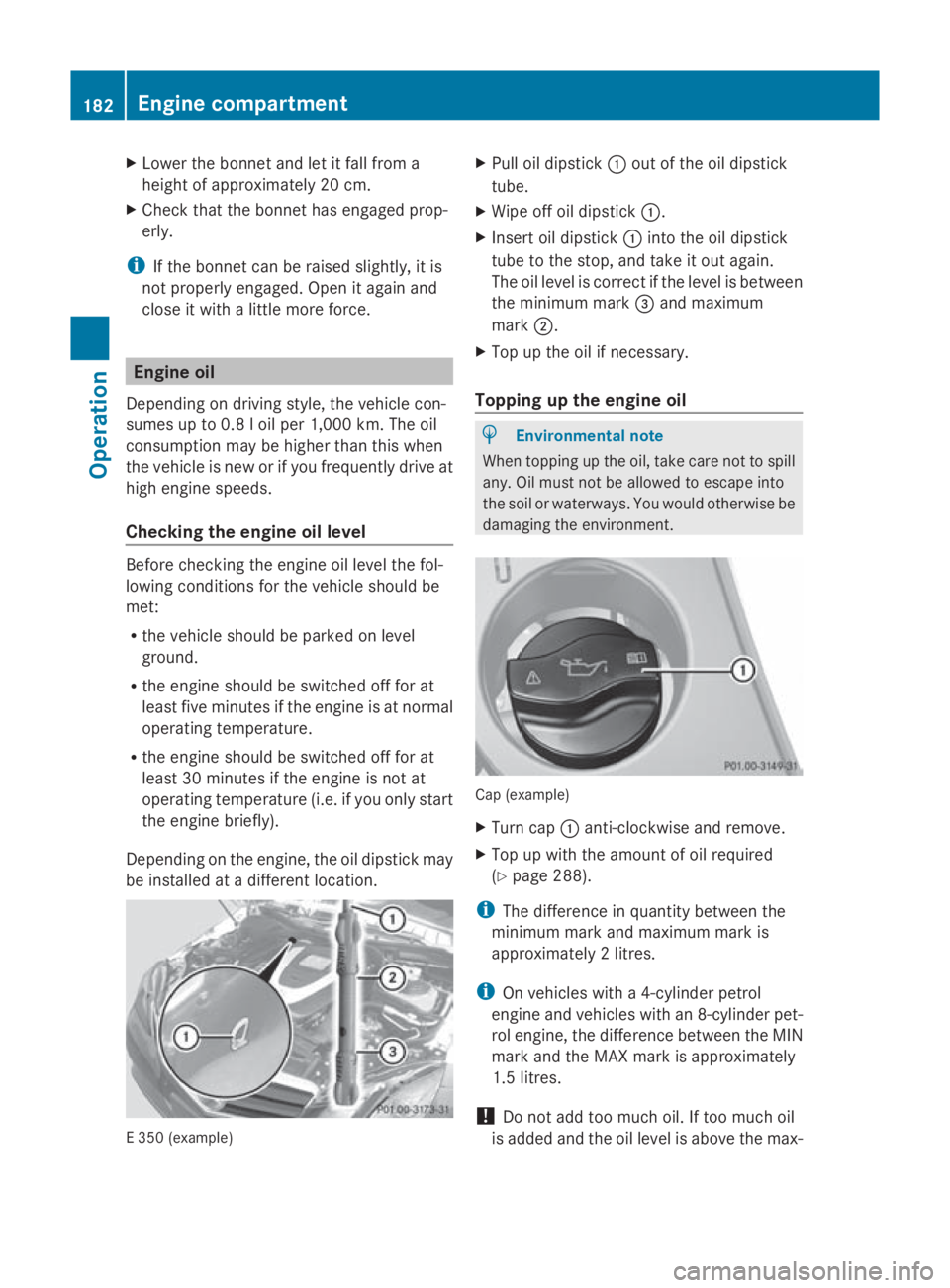
be installed at adifferent location. E3
50 (example) X
Pullo il dipstick 0046out of the oil dipstick
tube.
X Wipe off oil dipstick 0046.
X Insert oil dipstick 0046into the oil dipstick
tube to the stop, and take it out again.
The oil level is correct if the level is between
the minimum mark 008Aand maximum
mark 0047.
X Top up the oil if necessary.
Topping up the engine oil H
Environmental note
When topping up the oil, take care not to spill
any. Oil must not be allowed to escape into
the soil or waterways. You would otherwis ebe
damaging the environment. Cap (example)
X Turn cap 0046anti-clockwise and remove.
X Top up with the amount of oil required
(Y page 288).
i The difference in quantity betwee nthe
minimum mark and maximu mmark is
approximately 2litres.
i On vehicle switha4-cylinder petrol
engine and vehicle swith an 8-cylinder pet-
rol engine, the difference betwee nthe MIN
mark and the MAX mark is approximately
1.5 litres.
! Do not add too much oil. If too much oil
is added and the oil level is above the max- 182
Engine compartmentOperation
207_AKB; 2; 3, en-GB
mkalafa
,V ersion: 2.11.8.1
2009-07-23T10:23:49+02:00
-Seite 182
Page 193 of 313
Once you have fitted the winter tyres:
X
Check the tyre pressures (Y page 186).
X Restart the tyre pressure loss warning sys-
tem (Y page 187). G
Risk of accident
If you fit the spare wheel* when driving with
winter tyres, bear in mind that driving stability
will be impaired owing to unstable cornering
characteristics caused by the different tyres.
You should therefore adapty our driving style
and drive carefully.
Have the spare wheel* replaced at the near-
est qualified specialist workshop which has
the necessary specialist knowledge and tools
to carry out the work required. Mercedes-
Benz recommends that you use aMercedes-
Benz Service Centre for this purpose. In par-
ticular, work relevant to safety or on safety-
related systems must be carried out at aquali-
fied specialist workshop. Snow chains
For safety reasons, Mercedes-Benz recom-
mends that you only use snow chains which
have been speciallya pproved for your vehicle
by Mercedes-Benz,ora re ofacorresponding
standard of quality.
If you intend to fit snow chains, pleaseb ear
the following points in mind:
R you may not attach snow chains to all
wheel-tyre combinations; see the "Tyres
and wheels" section in the "Technical data"
chapter.
R snow chains must not be fitted to emer-
gency spare wheels, e.g. a"Minispare"
emergency spare wheel.
R Fit snow chains only in pairs and only to the
rear wheels. Comply with the manufactur-
er's installation instructions.
Do not exceed the maximum permissible
speed of 50 km/h.
i You may wish to deactivate ESP ®
when
pulling awayw ith snow chains fitted (Y
page 54). This way,y ou can allowthe
wheels to spin in acontrolled manner, ach-
ieving an increased driving force (cutting
action). Winter driving
G
Risk of accident
Do not shift down for additional engine brak-
ing on aslippery road surface. This could
cause the drive wheels to lose their grip and
the vehicle could skid.
You should drive particularly carefully on slip-
pery road surfaces. Avoid sudden accelera-
tion, steering and braking manoeuvres.
If the vehicle threatens to skid or cannot be
stopped when moving at low speed:
X Vehicles with manual transmission: engage
neutral.
X Vehicles with automatic transmission*:
shift the selector lever to N.
X Try to bring the vehicle under control by
using corrective steering. Driving tips
Rolling with the engines
witchedoff G
Risk of accident
Never switch the engine off while the vehicle
is in motion.
There is no power assistance for the steering
and the service brake when the engine is not
running.
You will require considerably more effort to
steer and brake and you could therefore lose
control of the vehicle and cause an accident. 190
Driving tipsOperation
*o
ptional
207_AKB;2;3,e
n-GB
mkalafa, Version: 2.11.8.1 2009-07-23T10:23:49+02:00-Seite 190
Page 194 of 313
Brakes
G
Ris
kofa ccident
Do not change down for additional engine
braking on aslipper yroads urface. Thi scould
cause the drive wheels to lose thei rgripa nd
the vehicl ecould skid. G
Ris
kofa ccident
Make sure tha tothe rroa du sers are not
endangere dbyyourb raking.
Downhil lgradients On long and stee
pdownhil lstretches ,espe-
ciall yift he vehicl eisladen or towing atrailer,
yo um usts hift to alower gearing oodtime or,
on vehicles with automatic transmission*,
select shift range 1,2or 3.
i Thisalsoa pplies if youhavea ctivated
cruis econtrol, SPEEDTRONIC or DIS-
TRONIC PLUS*.
Thi sw illu se the braking effect of the engine,
so less braking will be required to maintain
the speed .Thisr elieves the load on the brake
system and prevents the brakes from over-
heating and wearing too quickly. If yo uneed
additional braking ,depress the brake pedal
repeatedly rather tha ncontinuously.
Heavy and light loads If the brakes have been subjected to
aheavy
load ,don ot stop the vehicl eimmediately, but
drive on for ashort while. Thi sallow sthe air-
flo wtoc oolthe brakes more quickly. G
Ris
kofa ccident
Never depress the brake peda lcontinuously
whil ethe vehicl eisinmotion, e.g .neve rcause
the brakes to ru bbyapplyingconstant slight
peda lpressure. Thi scauses the brake system
to overheat, increases the braking distance
and can lead to the brakes failing completely.
If the brakes have been used onl ymoderately,
yo us houl doccasionall ytest thei reffective-
ness .Todot his, brake more firmly from a highe
rspeed .Thisi mprove sthe gri pofthe
brakes.
Wet roads If driving in heavy rain for
aprolonged period
of time withou tbraking ,ther em aybe a
delaye dreactio nfrom the brakes when brak-
ing for the first time .Thism ayalso occu rafter
the vehicl ehasbeen washed.
Yo uh avetod epress the brake peda lmore
firmly .Maintain agreate rdistance from the
vehicl einfront.
After driving on awetroa dorh aving the vehi-
cle washed, brake firmly whil epayin gatten-
tio ntot he traffic conditions. Thi swaythe
brake discs will become warm, drying more
quickly, which will protect them against cor-
rosion.
Limite dbraking performanc eonsalt
treate droads G
Ris
kofa ccident
The laye rofsaltont he brake discs and the
brake pads/lining smaycause adelay in the
braking effect, resulting in asignificantly lon-
ger braking distance, which could lead to an
accident.
To avoid thi sdanger ,you should:
R occasionall ybrake carefully, withou tput-
ting othe rroa du sers at risk, when yo uare
driving on salte droads. Thi shelps to
remove any salt tha tmayhave started to
buil dupont he brake discs and the brake
pads/linings.
R maintain agreate rdistance to the vehicle
ahea dand drive with particula rcare.
R carefull yapply the brakes at the end of a
trip and immediatel yaftercommencing a
new trip ,sothats altr esidue sare removed
from the brake discs. Driving tips
191Operation
*optional
207_AKB; 2; 3, en-GB
mkalafa,
Version: 2.11.8.1 2009-07-23T10:23:49+02:00-Seite 191 Z
Page 204 of 313
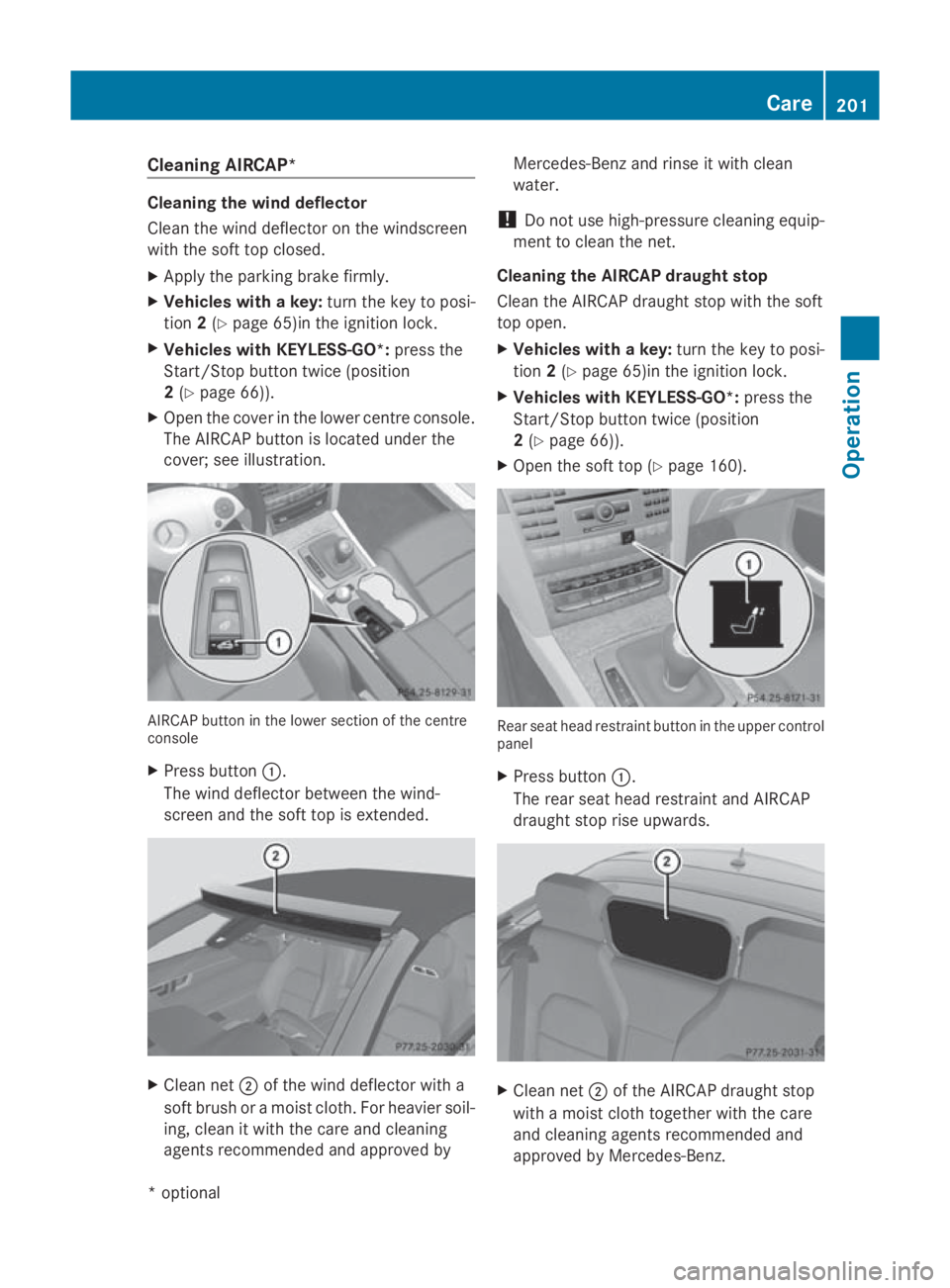
Cleaning AIRCAP*
Cleaning th
ewind deflector
Clean th ewind deflecto ronthewindscreen
wit hthe softtop closed.
X Apply th eparking brak efirmly.
X Vehicles with akey: turnthe keyt op osi-
tion 2(Y page 65)in th eignition lock.
X Vehicles with KEYLESS-GO*: pressthe
Start/Sto pbutto ntwice (position
2 (Y page 66)).
X Open th ecover in th elower centr econsol e.
The AIRCAP butto nislocate dunde rthe
cover ;see illustration. AIRCAP butto
ninthelower sectio nofthecentre
console
X Press button 0046.
The wind deflecto rbetween th ewind-
scree nand th esoftt op is extended. X
Clean net 0047of th ewind deflecto rwitha
sof tbrus horam oistcloth .For heavier soil-
ing ,clean it wit hthe car eand cleaning
agents recommended and approved by Mercedes-Ben
zand rinse it wit hclean
water.
! Do no tuse high-pressur ecleanin gequip-
men ttoc lean th enet.
Cleaning th eAIRCAP draught stop
Clean th eAIRCAP draught stop wit hthe soft
to po pen.
X Vehicles with akey: turnthe keyt op osi-
tion 2(Y page 65)in th eignition lock.
X Vehicles with KEYLESS-GO*: pressthe
Start/Sto pbutto ntwice (position
2 (Y page 66)).
X Open th esoftt op ( Ypage 160). Rear seat head restraint butto
nintheupper control
panel
X Press button 0046.
The rear seat head restraint and AIRCAP
draught stop ris eupwards. X
Clean net 0047of th eAIRCAP draught stop
wit ham oistcloth together wit hthe care
and cleanin gagents recommended and
approved by Mercedes-Benz. Care
201Operation
*optional
207_AKB
;2;3,en-GB
mkalafa ,V ersion: 2.11.8.1
2009-07-23T10:23:49+02:00
-Seite 201 Z
Page 212 of 313
Tex
tmessages G
Ris
kofa ccident and injury
If work relevant to safety is carrie doutincorrectly ,thisc ould impai rthe operating safety of your
vehicle. Yo ucould lose contro lofthe vehicl eand cause an accident. In addition, the safety
system smayno longe rbeabletop rotect yo uorothers as the yaredesigne dtodo.
Alway shavem aintenance work carrie doutataq uali fied specialis tworkshop .The workshop must
have the necessary specialis tknowledg eand tool stocarry ou tthe work required .Mercedes-
Benz recommends tha tyou useaM ercedes-Benz Service Centre for thi spurpose. In particular,
work relevant to safety or on safety-relate dsystem smustbec arriedoutataq uali fied specialist
workshop. Display messages Possible causes/consequence
sand 0050
0050Solutions 120 km/h Maximum
speed
exceeded
The maximum spee
dhasbeen exceeded 39
.
X Driv emores lowly. Adaptive
Main-beam
Assist inopera‐
tive
Adaptive Highbea
mAssist* is faulty.
X Visi taq ualified specialis tworkshop. Active
bonnet malfunc‐
tio
nSee
Owner's
Manual The active bonnet functio
n(pedest rianp rotection) is not
active du etoamalfunction.
X Visi taq ualified specialis tworkshop. Auxiliary
battery malfunc‐
tion The auxiliary battery for the automatic transmission is no lon-
ge
rb eing charged.
X Visi taq ualified specialis tworkshop. P Select
Par
k(P) Yo
uh aves witched off the engine with the Start/Stop but-
ton* and opene dthe driver's door.
Yo ua ttempte dtolockt he vehicle.
Aw arnin gtone also sounds.
X Mov ethe selecto rlev er to P. 39
Onl yfor certai ncountries. Displa
ymessages
209Practical advice
*optional
207_AKB; 2; 3, en-GB
mkalafa
,V ersion: 2.11.8.1
2009-07-23T10:23:49+02:00
-Seite 209 Z
Page 220 of 313
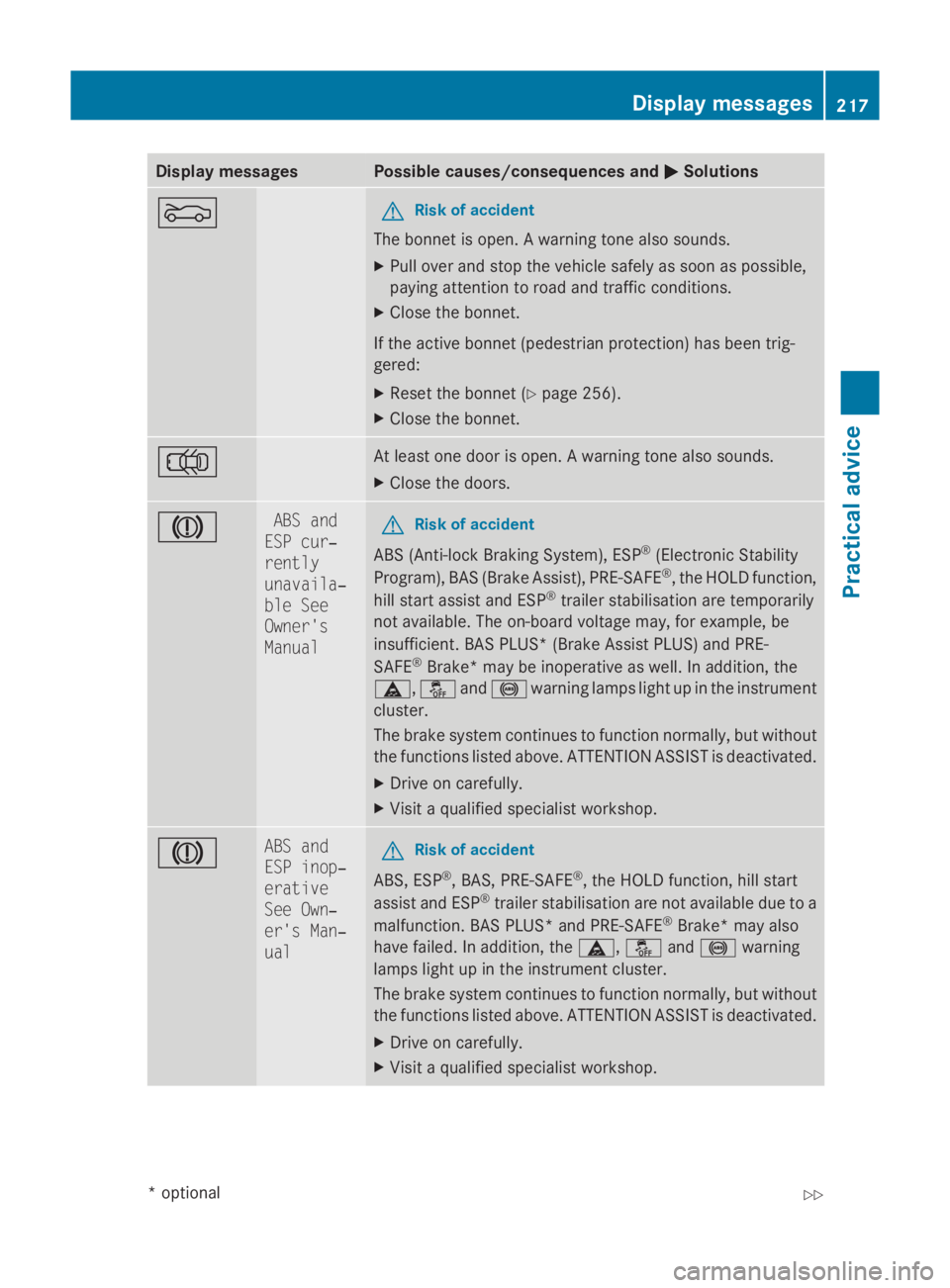
Display messages Possible causes/consequences and
0050
0050 Solutions 0083 G
Risk of accident
The bonne tisopen.Aw arnin gtonea lso sounds.
X Pull ove rand stop th evehicl esafely as soo naspossible,
payin gattention to roa dand traffic conditions.
X Clos ethe bonnet.
If th eactive bonne t(pedestrian protection )has been trig-
gered:
X Rese tthe bonne t(Ypage 256).
X Clos ethe bonnet. 0048 At leas
tone doo riso pen.Aw arnin gtonea lso sounds.
X Clos ethe doors. 004D ABS and
ESP cur‐
rently
unavaila‐
ble See
Owner's
Manual G
Risk of accident
AB S(Anti-l ockB raking System), ESP ®
(Electronic Stability
Program), BA S(Brak eA ssist) ,PRE-SAFE ®
,t he HOLD function,
hill start assist and ESP ®
trailer stabilisation are temporarily
no ta vailable. The on-boar dvoltag emay, fo rexample, be
insufficient. BA SPLUS* (Brak eAssistP LUS) and PRE-
SAFE ®
Brake *may be inoperative as well. In addition ,the
00C6 ,00C7 and0031 warnin glamp sligh tupint heinstrument
cluster.
The brak esystem continues to function normally, but without
th ef unction slisted above. ATTENTION ASSIST is deactivated.
X Drive on carefully.
X Visit aqualified specialist workshop. 004D ABS and
ESP inop‐
erative
See Own‐
er'
sM an‐
ual G
Risk of accident
ABS, ESP ®
,B AS ,PRE-SAFE ®
,t he HOLD function ,hill start
assist and ESP ®
trailer stabilisation are no tavailable due to a
malfunction .BAS PLUS* and PRE-SAFE ®
Brake *may also
hav efailed. In addition ,the 00C6 ,00C7 and0031 warning
lamp sligh tupint heinstrumen tcluster.
The brak esystem continues to function normally, but without
th ef unction slisted above. ATTENTION ASSIST is deactivated.
X Drive on carefully.
X Visit aqualified specialist workshop. Display
messages
217Practical advice
*optional
207_AKB; 2; 3, en-GB
mkalafa
,V ersion: 2.11.8.1
2009-07-23T10:23:49+02:00
-Seite 217 Z
Page 221 of 313
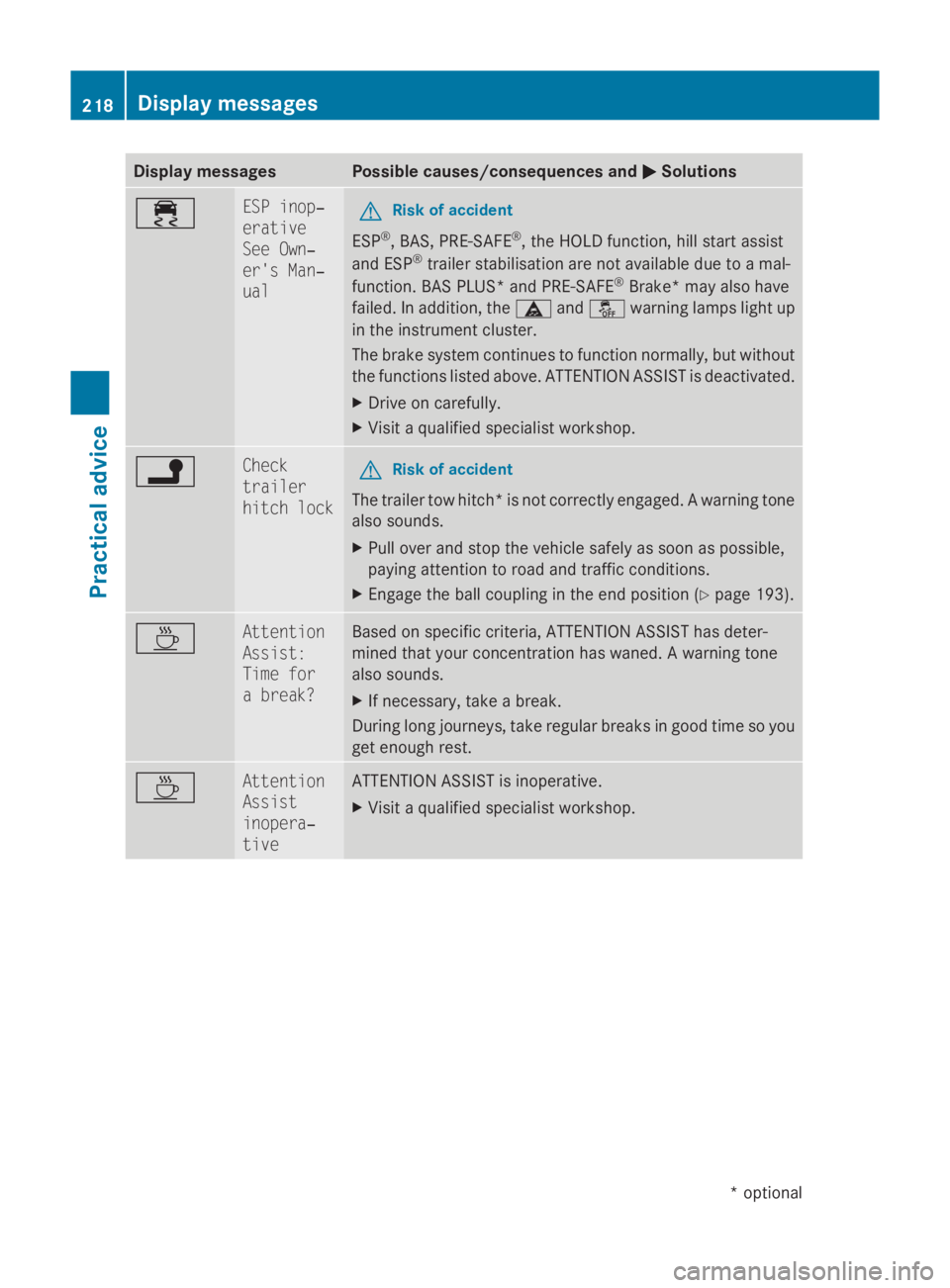
Display messages Possible causes/consequences and
0050
0050Solutions 00F2 ESP inop‐
erative
See Own‐
er'
sM an‐
ual G
Risk of accident
ESP ®
,B AS ,PRE-SAFE ®
,t he HOLD function ,hill start assist
and ESP ®
trailer stabilisation are no tavailable due to amal-
function .BAS PLUS* and PRE-SAFE ®
Brake *may also have
failed. In addition ,the 00C6 and00C7 warnin glamp sligh tup
in th einstrument cluster.
The brak esystem continues to function normally, but without
th ef unction slisted above. ATTENTION ASSIST is deactivated.
X Drive on carefully.
X Visit aqualified specialist workshop. 0078 Check
trailer
hitch lock
G
Risk of accident
The trailer to whitch *isn otcorrectl yengaged. Awarnin gtone
also sounds.
X Pull ove rand stop th evehicl esafely as soo naspossible,
payin gattention to roa dand traffic conditions.
X Engage th eball couplin gintheendp osition (Y page 193). 00AF Attention
Assist:
Tim
ef or
ab reak? Based on specific criteria, ATTENTION ASSIST has deter-
mined that your concentration has waned. Awarnin gtone
also sounds.
X If necessary, tak eabreak.
Durin glon gjou rneys, tak eregular breaks in goo dtimesoy ou
get enough rest. 00AF Attention
Assist
inopera‐
tive ATTENTION ASSIST is inoperative.
X
Visit aqualified specialist workshop. 218
Display
messagesPractical advice
*optional
207_AKB; 2; 3, en-GB
mkalafa
,V ersion: 2.11.8.1
2009-07-23T10:23:49+02:00
-Seite 218