transmission MERCEDES-BENZ E-CLASS COUPE 2009 Service Manual
[x] Cancel search | Manufacturer: MERCEDES-BENZ, Model Year: 2009, Model line: E-CLASS COUPE, Model: MERCEDES-BENZ E-CLASS COUPE 2009Pages: 313, PDF Size: 7.76 MB
Page 193 of 313
Once you have fitted the winter tyres:
X
Check the tyre pressures (Y page 186).
X Restart the tyre pressure loss warning sys-
tem (Y page 187). G
Risk of accident
If you fit the spare wheel* when driving with
winter tyres, bear in mind that driving stability
will be impaired owing to unstable cornering
characteristics caused by the different tyres.
You should therefore adapty our driving style
and drive carefully.
Have the spare wheel* replaced at the near-
est qualified specialist workshop which has
the necessary specialist knowledge and tools
to carry out the work required. Mercedes-
Benz recommends that you use aMercedes-
Benz Service Centre for this purpose. In par-
ticular, work relevant to safety or on safety-
related systems must be carried out at aquali-
fied specialist workshop. Snow chains
For safety reasons, Mercedes-Benz recom-
mends that you only use snow chains which
have been speciallya pproved for your vehicle
by Mercedes-Benz,ora re ofacorresponding
standard of quality.
If you intend to fit snow chains, pleaseb ear
the following points in mind:
R you may not attach snow chains to all
wheel-tyre combinations; see the "Tyres
and wheels" section in the "Technical data"
chapter.
R snow chains must not be fitted to emer-
gency spare wheels, e.g. a"Minispare"
emergency spare wheel.
R Fit snow chains only in pairs and only to the
rear wheels. Comply with the manufactur-
er's installation instructions.
Do not exceed the maximum permissible
speed of 50 km/h.
i You may wish to deactivate ESP ®
when
pulling awayw ith snow chains fitted (Y
page 54). This way,y ou can allowthe
wheels to spin in acontrolled manner, ach-
ieving an increased driving force (cutting
action). Winter driving
G
Risk of accident
Do not shift down for additional engine brak-
ing on aslippery road surface. This could
cause the drive wheels to lose their grip and
the vehicle could skid.
You should drive particularly carefully on slip-
pery road surfaces. Avoid sudden accelera-
tion, steering and braking manoeuvres.
If the vehicle threatens to skid or cannot be
stopped when moving at low speed:
X Vehicles with manual transmission: engage
neutral.
X Vehicles with automatic transmission*:
shift the selector lever to N.
X Try to bring the vehicle under control by
using corrective steering. Driving tips
Rolling with the engines
witchedoff G
Risk of accident
Never switch the engine off while the vehicle
is in motion.
There is no power assistance for the steering
and the service brake when the engine is not
running.
You will require considerably more effort to
steer and brake and you could therefore lose
control of the vehicle and cause an accident. 190
Driving tipsOperation
*o
ptional
207_AKB;2;3,e
n-GB
mkalafa, Version: 2.11.8.1 2009-07-23T10:23:49+02:00-Seite 190
Page 194 of 313
Brakes
G
Ris
kofa ccident
Do not change down for additional engine
braking on aslipper yroads urface. Thi scould
cause the drive wheels to lose thei rgripa nd
the vehicl ecould skid. G
Ris
kofa ccident
Make sure tha tothe rroa du sers are not
endangere dbyyourb raking.
Downhil lgradients On long and stee
pdownhil lstretches ,espe-
ciall yift he vehicl eisladen or towing atrailer,
yo um usts hift to alower gearing oodtime or,
on vehicles with automatic transmission*,
select shift range 1,2or 3.
i Thisalsoa pplies if youhavea ctivated
cruis econtrol, SPEEDTRONIC or DIS-
TRONIC PLUS*.
Thi sw illu se the braking effect of the engine,
so less braking will be required to maintain
the speed .Thisr elieves the load on the brake
system and prevents the brakes from over-
heating and wearing too quickly. If yo uneed
additional braking ,depress the brake pedal
repeatedly rather tha ncontinuously.
Heavy and light loads If the brakes have been subjected to
aheavy
load ,don ot stop the vehicl eimmediately, but
drive on for ashort while. Thi sallow sthe air-
flo wtoc oolthe brakes more quickly. G
Ris
kofa ccident
Never depress the brake peda lcontinuously
whil ethe vehicl eisinmotion, e.g .neve rcause
the brakes to ru bbyapplyingconstant slight
peda lpressure. Thi scauses the brake system
to overheat, increases the braking distance
and can lead to the brakes failing completely.
If the brakes have been used onl ymoderately,
yo us houl doccasionall ytest thei reffective-
ness .Todot his, brake more firmly from a highe
rspeed .Thisi mprove sthe gri pofthe
brakes.
Wet roads If driving in heavy rain for
aprolonged period
of time withou tbraking ,ther em aybe a
delaye dreactio nfrom the brakes when brak-
ing for the first time .Thism ayalso occu rafter
the vehicl ehasbeen washed.
Yo uh avetod epress the brake peda lmore
firmly .Maintain agreate rdistance from the
vehicl einfront.
After driving on awetroa dorh aving the vehi-
cle washed, brake firmly whil epayin gatten-
tio ntot he traffic conditions. Thi swaythe
brake discs will become warm, drying more
quickly, which will protect them against cor-
rosion.
Limite dbraking performanc eonsalt
treate droads G
Ris
kofa ccident
The laye rofsaltont he brake discs and the
brake pads/lining smaycause adelay in the
braking effect, resulting in asignificantly lon-
ger braking distance, which could lead to an
accident.
To avoid thi sdanger ,you should:
R occasionall ybrake carefully, withou tput-
ting othe rroa du sers at risk, when yo uare
driving on salte droads. Thi shelps to
remove any salt tha tmayhave started to
buil dupont he brake discs and the brake
pads/linings.
R maintain agreate rdistance to the vehicle
ahea dand drive with particula rcare.
R carefull yapply the brakes at the end of a
trip and immediatel yaftercommencing a
new trip ,sothats altr esidue sare removed
from the brake discs. Driving tips
191Operation
*optional
207_AKB; 2; 3, en-GB
mkalafa,
Version: 2.11.8.1 2009-07-23T10:23:49+02:00-Seite 191 Z
Page 195 of 313
New brak
epads/linings For safety reasons, Mercedes-Benz recom-
mend
stha tyou onl yhaveb rake pads/linings
fitted to your vehicl ewhich have been
approved for Mercedes-Benz vehicles or
which correspond to an equivalent quality
standard. Brake pads/lining swhich have not
been approved for Mercedes-Benz vehicles or
which ar enot of an equivalent quality could
affec tyou rv ehicle' soperating safety. G
Ris
kofa ccident
New brake pads/lining sonlyr each their opti-
mu mb raking effect after several hundred kil-
ometres of driving. Before thi soptimum brak-
ing effect is reached, yo ushoul dcompensate
for the reduced braking effect by applying
greate rpressure when braking .Thisa lso
applie safter the brake discs or the brake
pads/lining shaveb eenr eplaced. Tyre grip
G
Ris
kofa ccident
Whil ethe vehicl ecan be full ycontrolle data
certai nspeed on dry roads ,you must reduce
your spee donwetor icy roads to achieve the
same roa dsafety .Otherwise, yo ucould cause
an accident.
Pa yp articula rattentio ntothe roa dconditions
at temperatures around freezing point.
If ice ha sformed on the roa dsurface (e.g.
fro mf og), athinf ilmofw ater rapidl yforms on
the ice when yo ubrake, considerabl yreduc-
ing tyr egrip. Drive with particula rcareins uch
weather conditions. Driving on we
troads
If water ha saccumulate dtoacertaindepth
on the roa dsurface, there is adangerofa qua-
planing occurring, eve nif:
R yo ud rive at lo wspeeds
R the tyres have adequate trea ddepth For thi
sreason, do not drive in tyr eruts, and
brake carefully. Driving on flooded roads
If yo uhavetod rive on stretche sofroadon
which water ha scollected ,pleas ebearin
mind that:
R the maximum permissibl estill water depth
is 25 cm.
R yo us houl ddrive no faste rtha natw alking
pace.
! Bea rinm indt hatv ehicles travelling in
front or in the opposite directio ncreate
waves .Thism aycause the maximum per-
missibl ewater depth to be exceeded.
Failur etoo bserve these note smayresult
in damage to the engine ,electrica lsys tems
and transmission. Driving abroad
Points to remember
An extensive Mercedes-Benz Service network
is also availabl einother countries .The
Service Hotline's current telephone numbers
for us ewheny ou area broa da reto be found
in the "Service24h" chapte rofthe Service
Booklet.
Onl ylow -octan efuelisa vailable in certain
countries.
Yo uc an find furthe rinformation abou tfuel
grade son(Ypage 178). Symmetrical dipped beam
If your journey take syou to countries where
vehicles ar edriven on the opposite side of the
roa dtot he country in which the vehicl eis
registered, your headlamps must be switched
to symmetrical dipped beam .Thisp revents
oncoming traffi cfromb eing dazzled.
Have the headlamps converte dasclose as
possibl etothe borde rbefor ed riving in these 192
Driving ab
roadOperation
207_AKB; 2; 3, en-GB
mkalafa, Version: 2.11.8.1 2009-07-23T10:23:49+02:00-Seite 192
Page 198 of 313
Coupling up
atrailer G
Ris
kofi njury
Do no tdisconnect atrailer wit hanengaged
overrun brake. Otherwise, your han dcould
become trapped between th ebumpe rand
trailer drawbar.
! Do no tdisconnect atrailer wit han
engaged overrun brake. Otherwise, your
vehicle could be damaged by th erebound-
ing of th eoverrun brake.
X Positio nthe trailer leve lbehin dthe vehicle.
X Couple up th etrailer.
X Establish th eelectrical connection
between th evehicle and th etrailer.
Driving tips G
Ris
kofa ccident
If the Check traile rhitch locking
mechanism message appear sinthemulti-
function display while th evehicle is in motion,
pull ove rimmediately and check whether the
ball couplin giscorrectly engaged.
i Observ ethe note sonE SP®
trailer stabi-
lisation (Y page 55).
In Germany, th emaximum permissible speed
for vehicle/trailer combinations depends on
th et ype of trailer and is either 80 km/h or
10 0k m/ h. In som ecountries ,higher maxi-
mum speeds are permissible for vehicle/
trailer combinations .Before beginnin gthe
journey, check th etrailer' sdocuments to see
what th emaximum permitted spee dis.
For certain Mercedes-Ben zvehicles, th emax-
imum permissible rear axle load is increased
when towing atrailer. Refer to th e"Technical
data" sectio ntofindo ut whether this applies
to your vehicle .Ifyou utilise any of th eadded
maximum rear axle load when towing atrailer,
th ev ehicle/trailer combinatio nmay not
excee damaximum spee dof100km/h for
reason sconcernin gthe operatin gpermit. This also applies in countries in whic
hthe
permissible maximum spee dfor vehicle/
trailer combinations is abov e100 km/h. G
Ris
kofa ccident
Always observ ethe maximum spee dpermit-
te dinG ermany for vehicle/traile rcombina-
tions ,eveninc ountries wher ehigher speeds
are permitted. This lower sthe riskofana cci-
dent.
When towing atrailer, your vehicle's handling
characteristic swill be different in comparison
to when driving without atrailer.
The vehicle/trailer combination:
R is heavier
R is restricted in its acceleratio nand gradi-
ent-climbin gcapability
R has an increased braking distance
R is affected mor ebystron gc rosswinds
R demands mor esensitive steering
R consumes mor efuel
On lon gand steep downhill gradients ,you
must selec talower gear in good time, or on
vehicle switha utomatic transmission*, select
shif trange 1,2or 3.
i This also applies if you have activated
cruise control, SPEEDTRONI CorDIS-
TRONIC PLUS*.
This will use th ebraking effect of th eengine,
so less braking will be required to maintain
th es peed. This relieves th eload on th ebrake
system and prevents th ebrakes from over-
heating and wearin gtoo quickly. If you need
additional braking ,depress th ebrak epedal
repeatedly rather than continuously. G
Ris
kofa ccident
Never depress th ebrak epedal continuously
while th evehicle is in motion ,e.g.n ever cause
th eb rakes to rub by applyin gconstant slight
pedal pressure .This causes th ebrak esystem
to overheat, increases th ebraking distance
and can lead to th ebrakes failin gcompletely. Trailer towing*
195Operation
*o
ptional
207_AKB
;2;3,en-GB
mkalafa ,V ersion: 2.11.8.1
2009-07-23T10:23:49+02:00
-Seite 195 Z
Page 202 of 313
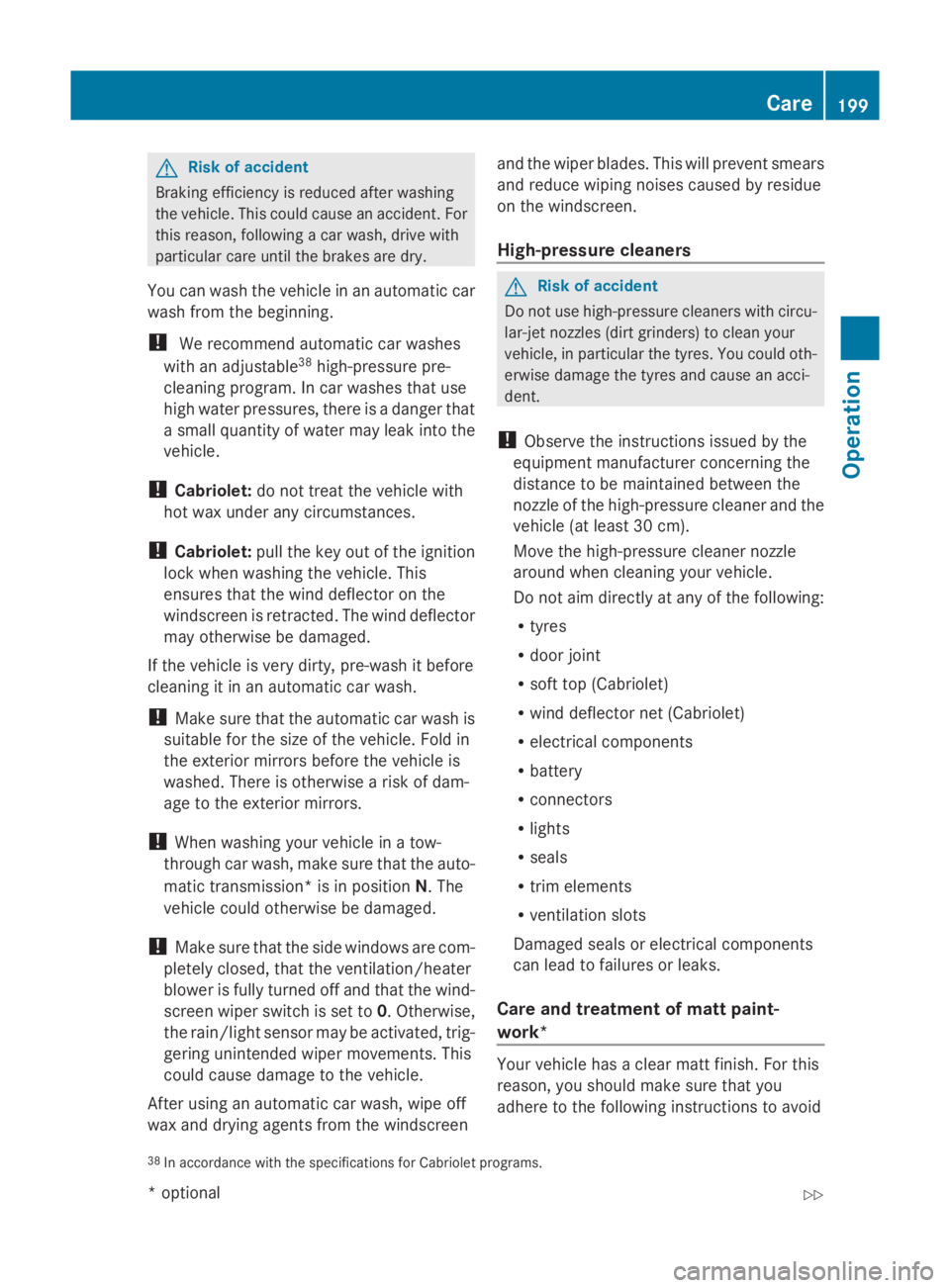
G
Risk of accident
Braking efficiency is reduce dafterw ashing
the vehicle .Thisc ould cause an accident. For
this reason, following acar wash, drive with
particula rcare unti lthe brakes are dry.
You can wash the vehicle in an automatic car
wash from the beginning.
! We recommend automatic car washes
with an adjustable 38
high-pressure pre-
cleaning program. In car washe sthat use
hig hw ater pressures, there is adanger that
as mall quantity of water may leak into the
vehicle.
! Cabriolet: do not treatthe vehicle with
hot wa xunder any circumstances.
! Cabriolet: pull the key ou tofthe ignition
lock whe nwashing the vehicle .This
ensures that the wind deflector on the
windscreen is retracted. The wind deflector
may otherwise be damaged.
If the vehicle is very dirty, pre-wash it before
cleaning it in an automatic car wash.
! Make sure that the automatic car wash is
suitabl efor the size of the vehicle .Fold in
the exterior mirrors before the vehicle is
washed. There is otherwise ariskofd am-
ag etot he exterior mirrors.
! Whe nwashing your vehicle in atow-
through car wash, make sure that the auto-
mati ctransmission* is in position N.The
vehicle could otherwise be damaged.
! Make sure that the sid ewindow sare com-
pletel yclosed, that the ventilation/heater
blower is fully turne doff and that the wind-
scree nwiper switch is set to 0.Otherwise,
the rain/light senso rmay be activated, trig-
gering unintende dwiper movements. This
could cause damag etothe vehicle.
After using an automatic car wash, wipe off
wa xa nd drying agents from the windscreen and the wiper blades. Thi
swillp revent smears
and reduce wiping noises caused by residue
on the windscreen.
High-pressure cleaners G
Risk of accident
Do not us ehigh-pressure cleaners with circu-
lar-jet nozzle s(dirt grinders )toclean your
vehicle ,inparticula rthe tyres. You could oth-
erwise damag ethe tyre sand cause an acci-
dent.
! Observe the instructions issue dbythe
equipment manufacturer concerning the
distance to be maintained between the
nozzle of the high-pressure cleane rand the
vehicle (a tleast 30 cm).
Move the high-pressure cleane rnozzle
around whe ncleaning your vehicle.
Do not ai mdirectl yata ny of the following:
R tyres
R doo rjoint
R soft top (Cabriolet)
R wind deflector net (Cabriolet)
R electrical components
R battery
R connectors
R lights
R seals
R trim elements
R ventilation slots
Damaged seals or electrical components
can lead to failures or leaks.
Care and treatmen tofmatt paint-
work* You
rvehicle ha saclear matt finish. For this
reason, yo ushoul dmake sure that you
adhere to the following instructions to avoid
38 In accordance with the specifications for Cabriole tprograms. Care
199Operation
*optional
207_AKB
;2;3,en-GB
mkalafa ,V ersion: 2.11.8.1
2009-07-23T10:23:49+02:00
-Seite 199 Z
Page 212 of 313
Tex
tmessages G
Ris
kofa ccident and injury
If work relevant to safety is carrie doutincorrectly ,thisc ould impai rthe operating safety of your
vehicle. Yo ucould lose contro lofthe vehicl eand cause an accident. In addition, the safety
system smayno longe rbeabletop rotect yo uorothers as the yaredesigne dtodo.
Alway shavem aintenance work carrie doutataq uali fied specialis tworkshop .The workshop must
have the necessary specialis tknowledg eand tool stocarry ou tthe work required .Mercedes-
Benz recommends tha tyou useaM ercedes-Benz Service Centre for thi spurpose. In particular,
work relevant to safety or on safety-relate dsystem smustbec arriedoutataq uali fied specialist
workshop. Display messages Possible causes/consequence
sand 0050
0050Solutions 120 km/h Maximum
speed
exceeded
The maximum spee
dhasbeen exceeded 39
.
X Driv emores lowly. Adaptive
Main-beam
Assist inopera‐
tive
Adaptive Highbea
mAssist* is faulty.
X Visi taq ualified specialis tworkshop. Active
bonnet malfunc‐
tio
nSee
Owner's
Manual The active bonnet functio
n(pedest rianp rotection) is not
active du etoamalfunction.
X Visi taq ualified specialis tworkshop. Auxiliary
battery malfunc‐
tion The auxiliary battery for the automatic transmission is no lon-
ge
rb eing charged.
X Visi taq ualified specialis tworkshop. P Select
Par
k(P) Yo
uh aves witched off the engine with the Start/Stop but-
ton* and opene dthe driver's door.
Yo ua ttempte dtolockt he vehicle.
Aw arnin gtone also sounds.
X Mov ethe selecto rlev er to P. 39
Onl yfor certai ncountries. Displa
ymessages
209Practical advice
*optional
207_AKB; 2; 3, en-GB
mkalafa
,V ersion: 2.11.8.1
2009-07-23T10:23:49+02:00
-Seite 209 Z
Page 223 of 313
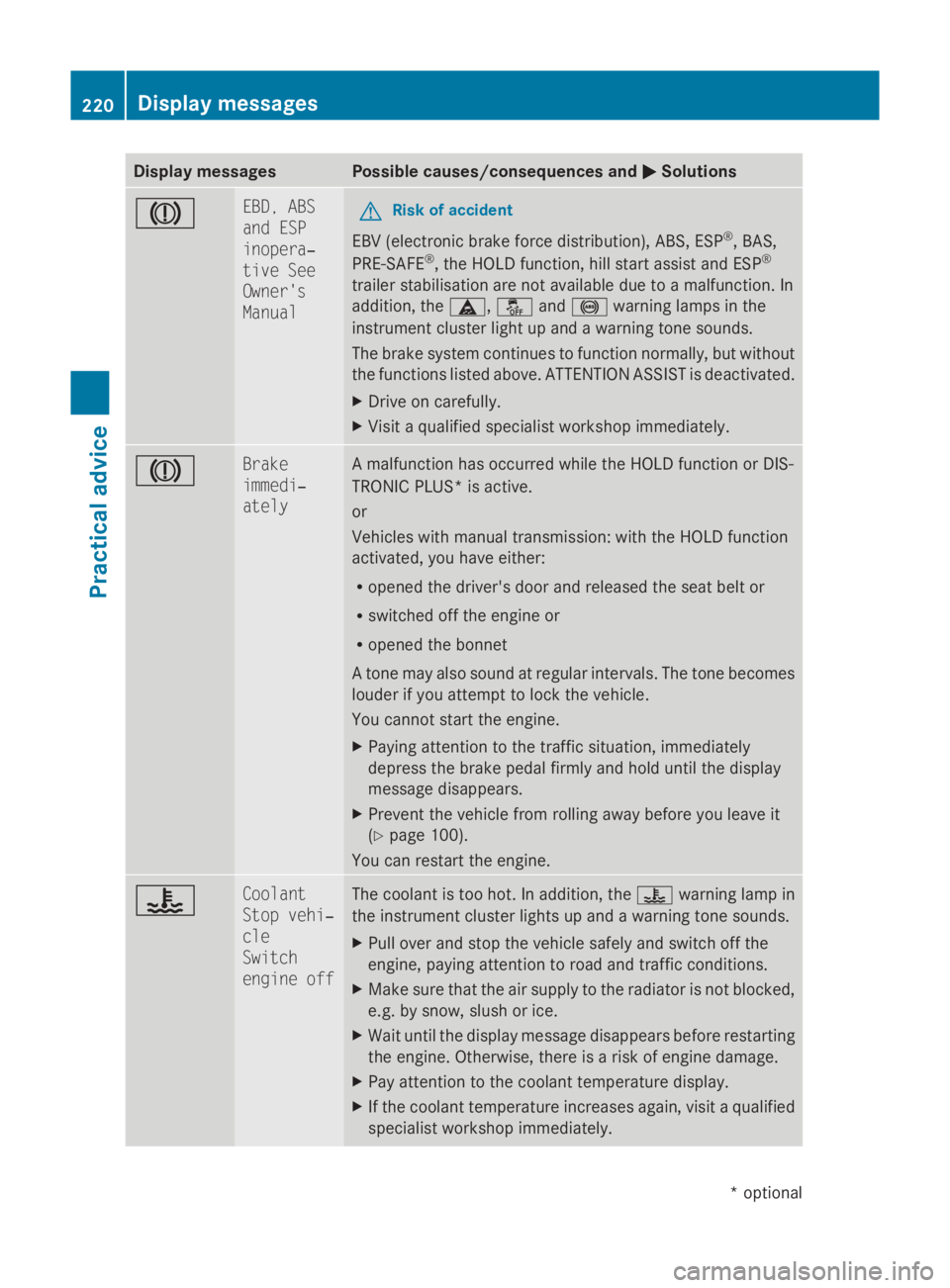
Display messages Possible causes/consequences and
0050
0050Solutions 004D EBD
,A BS
and ESP
inopera‐
tiv eS ee
Owner's
Manual G
Risk of accident
EB V( electronic brak eforce distribution), ABS, ESP ®
,B AS,
PRE-SAFE ®
,t he HOLD function ,hill start assist and ESP ®
trailer stabilisation are no tavailable due to amalfunction .In
addition ,the 00C6 ,00C7 and0031 warnin glamp sint he
instrumen tcluster ligh tupandaw arnin gtones ounds.
The brak esystem continues to function normally, but without
th ef unction slisted above. ATTENTION ASSIST is deactivated.
X Drive on carefully.
X Visit aqualified specialist workshop immediately. 004D Brake
immedi‐
ately Am
alfunction has occurred while th eHOLDf unction or DIS-
TRONIC PLUS* is active.
or
Vehicles wit hmanual transmission: wit hthe HOLD function
activated, you hav eeither:
R opened th edriver's doo rand release dthe seat belt or
R switched of fthe engin eor
R opened th ebonnet
At onem ay also soun datregular intervals. The tone becomes
loude rifyou attemp ttolockt he vehicle.
You canno tstart th eengine.
X Payin gattention to th etraffic situation ,immediately
depress th ebrak epedal firmly and hold until th edisplay
message disappears.
X Preven tthe vehicl efromr ollin gaway before you leav eit
( Ypage 100).
You can restar tthe engine. 00AE Coolant
Sto
pv ehi‐
cle
Switch
engine off The coolan
tistoohot .Ina ddition ,the 00AE warnin glamp in
th ei nstrument cluster lights up and awarnin gtones ounds.
X Pull ove rand stop th evehicl esafely and switch of fthe
engine, payin gattention to roa dand traffic conditions.
X Mak esuret hatthe air supply to th eradiato risnotblocked,
e.g. by snow, slus horice.
X Wait until th edisplay message disappear sbefore restarting
th ee ngine. Otherwise ,the re is ariskofe ngined amage.
X Pay attention to th ecoolan ttem perature display.
X If th ecoolan ttem perature increase sagain ,visit aqualified
specialist workshop immediately. 220
Display
messagesPractical advice
*optional
207_AKB; 2; 3, en-GB
mkalafa
,V ersion: 2.11.8.1
2009-07-23T10:23:49+02:00
-Seite 220
Page 246 of 313
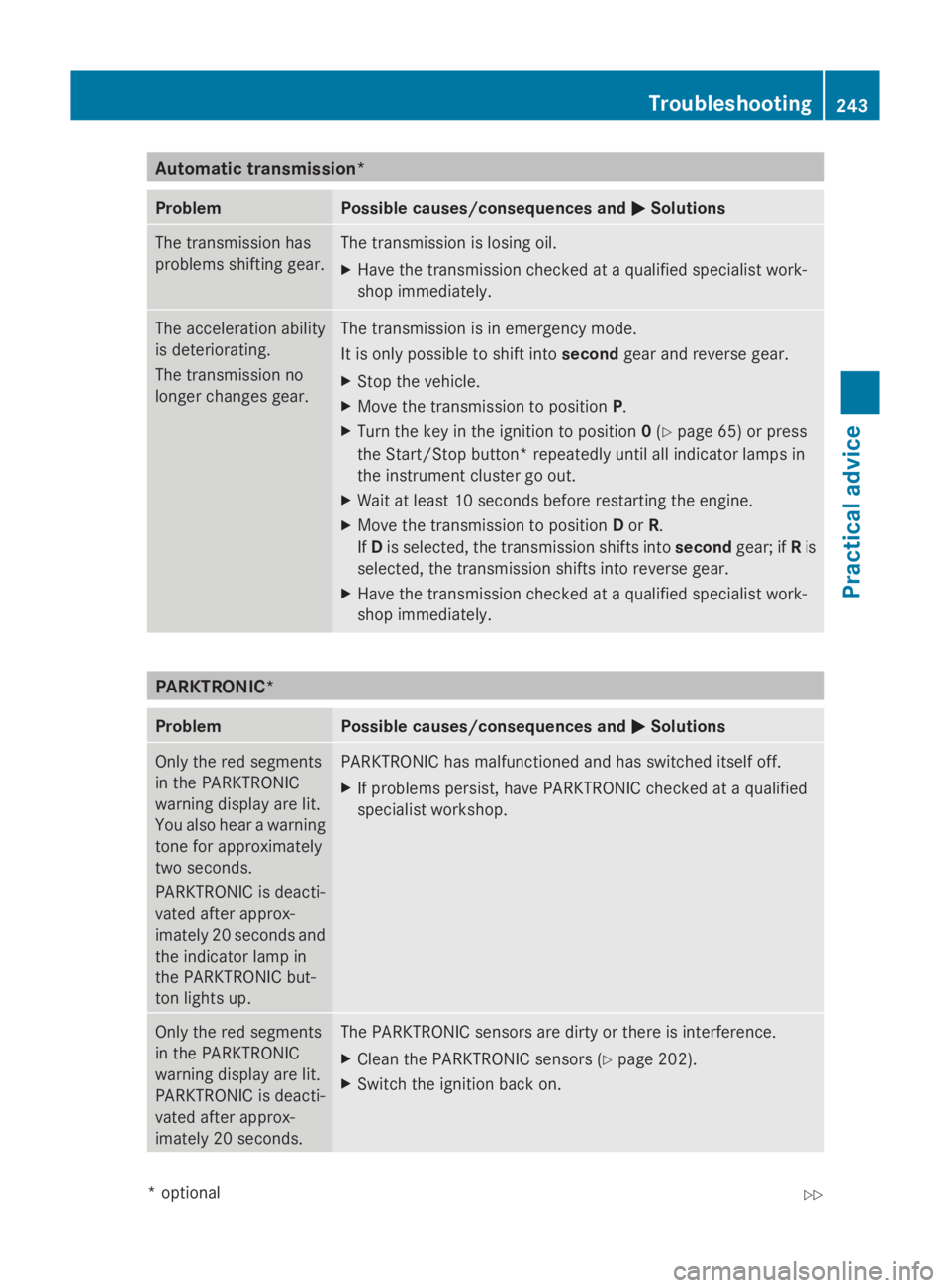
Automati
ctransmission* Problem Possible causes/consequences and
0050
0050Solutions The transmission has
problem
sshifting gear. The transmission is losing oil.
X
Hav ethe transmission checke dataqualified specialist work-
sho pimmediately. The acceleration ability
is deteriorating.
The transmission no
longer changes gear. The transmission is in emergenc
ymode.
It is only possible to shif tinto second gear and revers egear.
X Stop th evehicle.
X Mov ethe transmission to position P.
X Turn th ekeyin th eignition to position 0(Y page 65 )orpress
th eS tart/Sto pbutton* repeatedly until all indicator lamp sin
th ei nstrumen tcluste rgoo ut.
X Wait at least 10 seconds before restarting th eengine.
X Mov ethe transmission to position Dor R.
If D is selected, th etransmission shifts into secondgear;ifRis
selected, th etransmission shifts int orevers egear.
X Hav ethe transmission checke dataqualified specialist work-
sho pimmediately. PARKTRONIC*
Problem Possible causes/consequences and
0050 0050Solutions Only th
ered segments
in th ePARKTRONIC
warning display are lit.
You also hear awarning
tone for approximately
two seconds.
PARKTRONI Cisdeacti-
vated after approx-
imately 20 seconds and
th ei ndicator lamp in
th eP ARKTRONI Cbut-
to nl ights up. PARKTRONI
Chas malfunctioned and has switched itself off.
X If problem spersist, hav ePARKTRONI Cchecked ataq ualified
specialist workshop. Only th
ered segments
in th ePARKTRONIC
warning display are lit.
PARKTRONI Cisdeacti-
vated after approx-
imately 20 seconds. The PARKTRONI
Csensor sare dirt yorthere is interference.
X Clean th ePARKTRONI Csensor s(Ypage 202).
X Switc hthe ignition bac kon. Troubleshooting
243Practical advice
*optional
207_AKB; 2; 3, en-GB
mkalafa,
Version: 2.11.8.1 2009-07-23T10:23:49+02:00-Seite 243 Z
Page 266 of 313
Replacing the wiper blades
G
Ris
kofa ccident
The windscreen will not longer be wiped prop-
erl yift he wiper blades are worn. Thi scould
prevent yo ufrom observing the traffic condi-
tions ,thereby causing an accident. Replace
the wiper blades twice ayear, ideall yinspring
and autumn. G
Ris
kofa ccident
The wiper arm scould star tmoving and cause
an injury if yo uleave the windscreen wipers
switched on.
Remove the key from the ignition lock before
replacing the wiper blades.
! To avoid damaging the windscreen wiper
blades, make sure that yo utouch only the
wiper arm of the windscreen wiper. To remove
X Remove the key from the ignition lock or
turn the key to position 0(KEYLESS-GO).
X Fol dthe wiper arm away from the wind-
screen unti litengages.
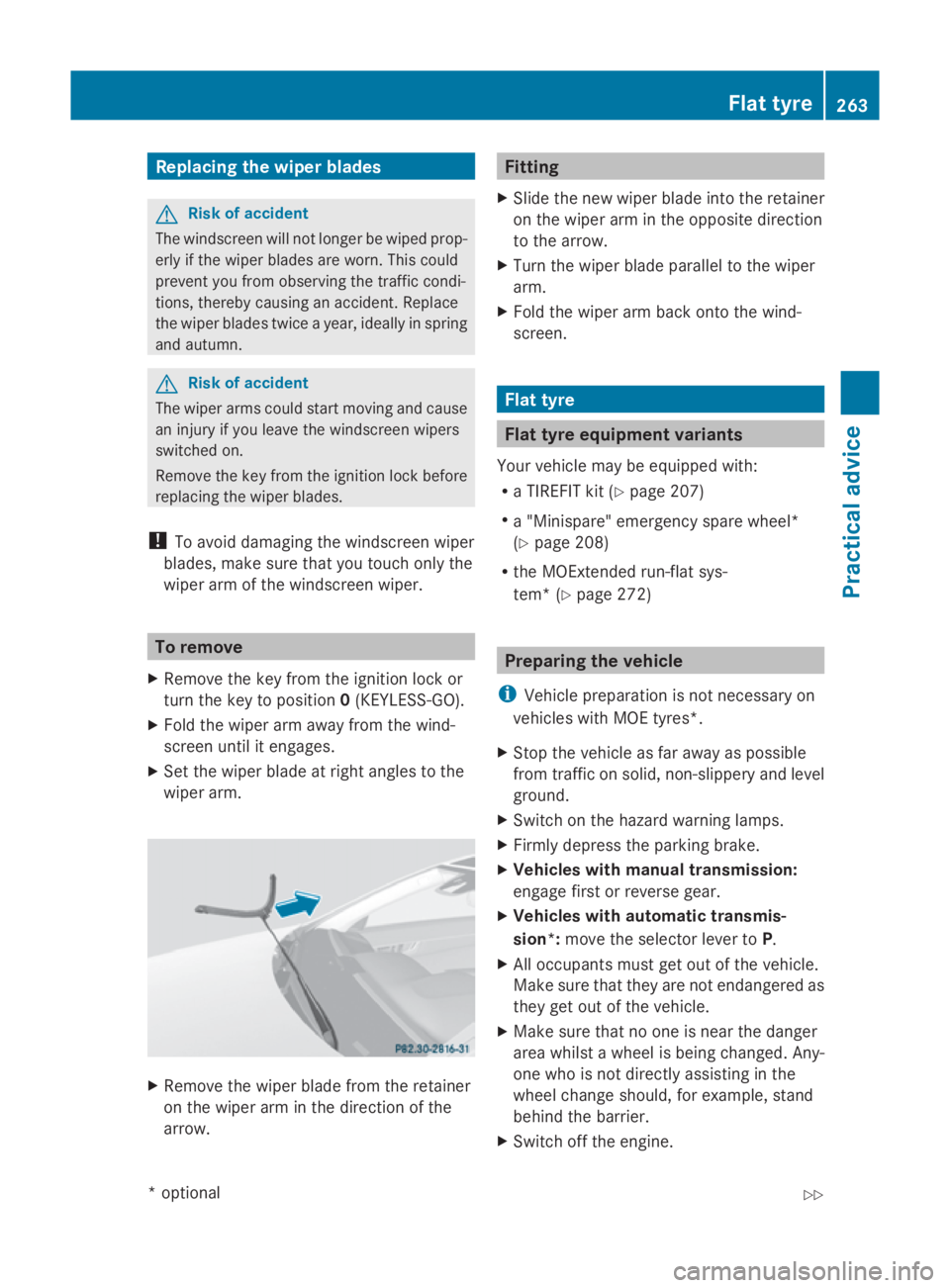
X Set the wiper blad eatright angle stothe
wiper arm. X
Remove the wiper blad efrom the retainer
on the wiper arm in the direction of the
arrow. Fitting
X Slide the new wiper blad einto the retainer
on the wiper arm in the opposite direction
to the arrow.
X Turn the wiper blad eparalle ltot he wiper
arm.
X Fol dthe wiper arm back onto the wind-
screen. Flat tyre
Flat tyre equipmen
tvariants
Your vehicl emay be equipped with:
R aT IREFIT kit (Y page 207)
R a" Minispare" emergency spare wheel*
(Y page 208)
R the MOExtended run-flat sys-
tem* (Y page 272) Preparing the vehicle
i Vehicl epreparation is not necessary on
vehicles with MOE tyres*.
X Stop the vehicl easfar away as possible
from traffic on solid ,non-slipper yand level
ground.
X Switch on the hazard warning lamps.
X Firmly depres sthe parking brake.
X Vehicles with manual transmission:
engage firs torreverse gear.
X Vehicles with automati ctransmis-
sion*: move the selector lever to P.
X All occupants mus tget ou tofthe vehicle.
Make sure that they are not endangered as
they get ou tofthe vehicle.
X Make sure that no one is nea rthe danger
are aw hilst awheel is being changed .Any-
one wh oisnot directl yassisting in the
wheel change should, for example, stand
behind the barrier.
X Switch off the engine. Flat tyre
263Practical advice
*optional
207_AKB; 2; 3, en-GB
mkalafa
,V ersion: 2.11.8.1
2009-07-23T10:23:49+02:00
-Seite 263 Z
Page 278 of 313
i
Remove th ekeyif you park th evehicle
and do no trequire any electrical consum-
ers .The vehicl ewill then use ver ylittle
energy, thus conservin gthe battery.
i If th ebattery is discharged, you mus tuse
th ee mergenc ykey elemen ttounlockthe
vehicle. Disconnecting th
ebattery G
Ris
kofa ccident
If th ebattery is disconnected:
R theb rak eboostin geffec twill no tbea vail-
able. Greate rbrakin gforce will then be
require dand brak epedal travel will be lon-
ger .Ifn eces sary, depress th ebrak epedal
wit hm aximum force.
R thet ransmission is locke dinposition Pon
vehicles wit hautomati ctransmission*
! Always disconnect th ebattery in the
order described below. Never mix up the
terminal clam pdisconnection/connection
order and never mix up th eterminal
clamps. You may otherwise damag ethe
vehicl eelectronics.
X Firmly depress th eparkin gbrak eand on
vehicles wit hautomatic transmission*,
shift th etransmission to position P.
X Switc hoff all electrical consumer s(e.g.
radio, blower, etc.).
X Turn th ekeyto0(Y page 65 )inthe ignition
lock and remove it or make sure tha tno
ignition positio nhasbeen selecte dwith
KEYLESS GO *.In the instrument cluster, all
of the indicator lampsm ust be out.
X Open the bonnet. X
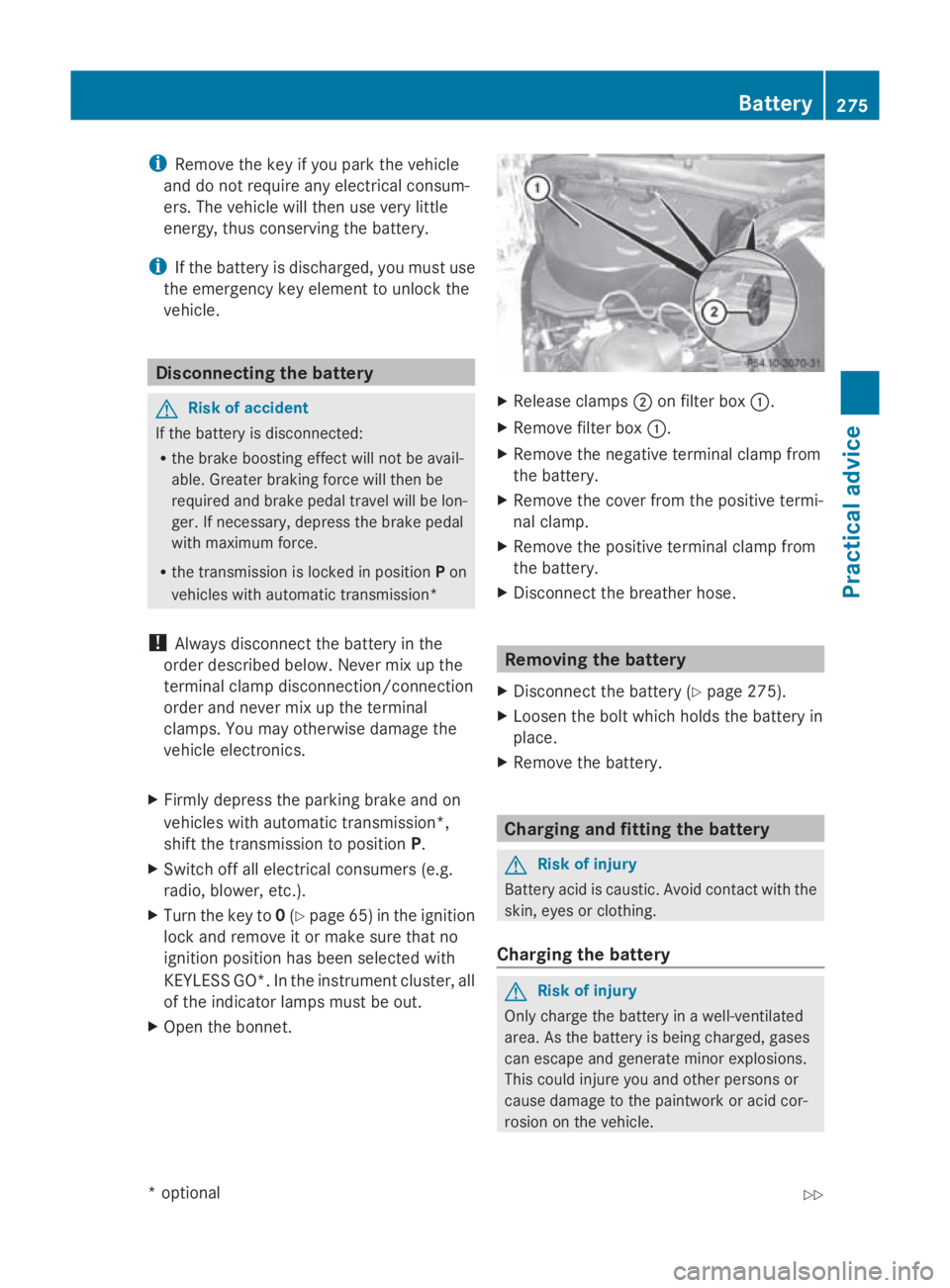
Release clamps 0047on filter box 0046.
X Remove filter box 0046.
X Remove the negative terminal clamp from
the battery.
X Remove the cover from the positive termi-
nal clamp.
X Remove the positive terminal clamp from
the battery.
X Disconnect the breather hose. Removing the battery
X Disconnect the battery ( Ypage 275).
X Loosen the bolt which holds the battery in
place.
X Remove the battery. Charging and fitting the battery
G
Risk of injury
Battery acid is caustic. Avoid contact with the
skin, eyesorc lothing.
Charging the battery G
Risk of injury
Only charge the battery in awell-ventilated
area.Ast he battery is being charged, gases
can escape and generate minor explosions.
This could injure you and other persons or
cause damage to the paintwork or acid cor-
rosion on the vehicle. Battery
275Practical advice
*optional
207_AKB; 2; 3, en-GB
mkalafa
,V ersion: 2.11.8.1
2009-07-23T10:23:49+02:00
-Seite 275 Z