brake MERCEDES-BENZ E-CLASS COUPE 2011 Owners Manual
[x] Cancel search | Manufacturer: MERCEDES-BENZ, Model Year: 2011, Model line: E-CLASS COUPE, Model: MERCEDES-BENZ E-CLASS COUPE 2011Pages: 353, PDF Size: 8.42 MB
Page 316 of 353
Transporting the vehicle
The towing eyes or trailer tow hitch can be
used to pull the vehicl eonto atrailer or trans-
porter if yo uwishtot ransport it.
X Vehicle swithm anual transmission:
shift to neutral.
X Vehicle switha utomatic transmission:
tur nthe key to position 2in the ignition
lock.
X Move the selector lever to N.
As soon as the vehicle is loaded:
X Prevent the vehicle from rolling away by
applying the parking brake.
X Vehicles with manualt ransmission:
shift to first gear or reverse gear.
X Vehicles with automatic transmission:
move the selector lever to P.
X Turn the key in the ignition lock to position
0 and remove the key from the ignition
lock.
X Secure the vehicle.
! Only lash the vehicle down by the wheels
or wheel rims, not by parts of the vehicle
such as axle or steering components. Oth-
erwise, the vehicle could be damaged. Tow-starting (emergency engine
starting)
When tow-starting, it is important that you
observe the safety instructions (Y page 310)
and the legal requirements in each respective
country.
! Vehicles with automatic transmission
must not be tow-started. The transmission
may otherwise be damaged.
Before tow-starting the following conditions
must be fulfilled:
R the battery is connected.
R the engine has cooled down.
R the catalytic converters have cooled down. X
Switch on the hazard warning lamps
(Y page 117).
X Fit the towing eye (Y page 311).
X Secure the rigid towing bar or the towing
rope.
X Depress and hold the brake pedal.
X Turn the key to position 2in the ignition
lock.
X Depress the clutch pedal and keep it
depressed.
X Shift to neutral.
X Release the brake pedal.
X Tow-start the vehicle.
X Engage second gear.
X Release the clutch pedal slowly;don ot
operate the accelerator pedal while doing
so.
The engine is started.
X Depress the clutch pedal and shift to neu-
tral.
X Stop at asuitable place.
X Apply the parking brake.
X Remove the rigid towing bar or towing rope.
X Remove the towing eye (Y page 312).
X Switch off the hazard warning lamps. Electrical fuses
Important safety notes
The fuses in your vehicle serve to close down
faulty circuits. If afuse blows ,all th ecom po-
nent sont hecircuit and their function sstop
operating. G
WARNING
Only use fuses that have been approve dfor
Mercedes-Ben zvehicles and which have the
correct fuse ratin gfor the systems con-
cerned. Do not attempt to repair or bridge
faulty fuses. Otherwise, acircuit overload
could cause afire. Have the cause traced and
rectified at aqualified specialist workshop,
e.g. aMercedes-Benz Service Centre. Electrical fuses
313Breakdown assistance Z
Page 317 of 353
Blow
nfuses must be replace dwith fuses of
the same rating, which you can recognise by
the colour and value. The fuse ratings are lis-
ted in the fuse allocation chart. AMercedes-
BenzS ervice Centr ewill be happy to advise
you.
If the newly inserted fuse also blows, have the
cause traced and rectified at aqualified spe-
cialist workshop, e.g. aMercedes-Benz
Service Centre.
! Only use fuses that have been approved
for Mercedes-Benz vehicles and which
have the correct fuse ratin gfor the system
concerned. Otherwise, componentsors ys-
tems could be damaged. Befor
echanging afuse
X Park the vehicle and apply the parking
brake.
X Switc hoff all electrical consumers.
X Remove the key from the ignition lock.
The fuses are located in various fuse boxes:
R fuse box on the driver's side of the dash-
board
R fuse box in the engin ecompartment on the
left-hand side of the vehicle, when viewed
in the direction of travel
R fuse box in the boot on the right-hand side
of the vehicle, when viewed in the direction
of travel
The fuse allocation chart is located in the
vehicle tool kit (Y page 295)inthe stowage
compartment under the boot floor. Dashboar
dfuse box
! Do not use apointed objec tsuch as a
screwdriver to open th ecover in th edash-
board. You could damag ethe dashboard or
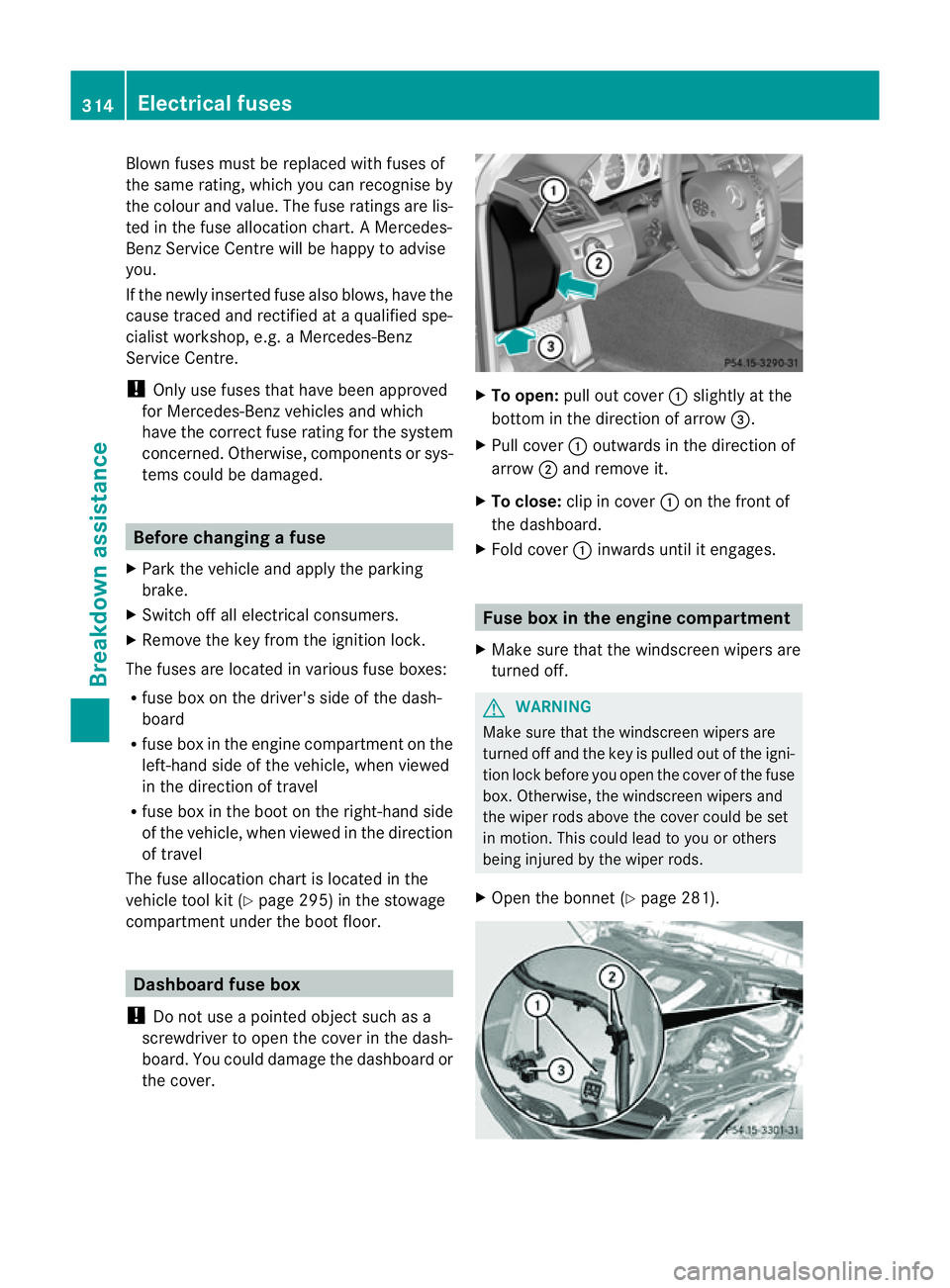
the cover. X
To open: pull out cover :slightly at the
botto mint hedirection of arrow =.
X Pull cover :outwards in th edirection of
arrow ;and remove it.
X To close: clip in cover :on th efront of
th ed ashboard.
X Fol dc over : inwards until it engages. Fuse box in th
eengine compartment
X Mak esure that th ewindscree nwipers are
turned off. G
WARNING
Make sure that the windscreen wipers are
turned off and the key is pulled out of the igni-
tion lock befor eyou open the cover of the fuse
box. Otherwise, the windscreen wipers and
the wiper rods above the cover could be set
in motion. This could lead to you or others
being injured by the wiper rods.
X Open the bonnet (Y page 281).314
Electrical fusesBreakdown assistance
Page 321 of 353
Useful information
i This Owner's Manual describes all models
and all standard and optional equipment
available to your vehicle at the time of pub-
lication of the Owner's Manual. Country-
specific deviation sare possible. Please
not ethat your vehicle may not be equipped
with all feature sdescribed. This also
applies to safety-relevan tsystems and
functions.
i Pleas ereadt he information on qualified
specialist workshop s(Ypage 22). Important safet
ynotes G
WARNING
Tyres, wheels or accessories whic hhaven ot
been approved by Mercedes-Ben zfor your
vehicle or are not used as they should be, can
impair driving safety. As aresult, you could
cause an accident .Before purchasing and
using them, enquire about their suitability,
legal stipulations and factory recommenda-
tion sataM ercedes-Benz Service Centre.
Modification work on the brake system and
wheels is not permitted, nor is the use of
spacer plates or brake dust shields. This inva-
lidates the General Operatin gPermit for the
vehicle.
i Further information about tyres and
wheels can be obtained from any
Mercedes-Benz Service Centre. Operation
Notes on driving
R While driving, pay attention to vibrations,
noises and unusual handling characteris-
tics ,e.g. pulling to one side. This may indi-
cate that the wheels or tyres are damaged.
If you suspect that atyre is defective,
reduce your speed immediately. Stop the vehicle as soon as possible to chec
kthe
wheels and tyres for damage. Hidden tyre
damage could also be causing the unusual
handling characteristics. If you find no
signs of damage, have the wheels and tyres
examined at aqualified specialist work-
shop, e.g. aMercedes-Ben zService
Centre.
R When parkin gyour vehicle, make sure that
the tyres do not get deformed by the kerb
or other obstacles. If it is necessary to drive
over kerbs, speed humps or similar eleva-
tions, try to do so slowly and at an obtuse
angle. Otherwise, the tyres, particularly the
sidewalls, can get damaged. Notes on regularly inspecting wheels
and tyres
R Regularly chec kthe wheels and tyres of
your vehicle for damage (e.g. cuts, punctu-
res, tears, bulges on tyres and deformation,
cracksors evere corrosion on wheels), at
least every 14 days, as well as after driving
off-road or on rough roads. Damaged
wheels can cause aloss of tyre pressure.
R Regularly check the tyre tread depth and
the condition of the tread across the whole
width of the tyre (Y page 319). If neces-
sary, turn the front wheels to full lock in
order to inspect the inner side of the tyre
surface.
R All wheels must have avalve cap to protect
the valve against dirt and moisture. Do not
fit anything onto the valve (such as tyre
pressure monitorings ystems) other than
the standard valve cap or other valve caps
approved by Mercedes-Ben zfor your vehi-
cle.
R Regularly check the pressure of all the tyres
including the emergenc yspare wheel or the
spare wheel, particularly prior to long trips,
and correc tthe pressure as necessary
(Y page 321). 318
OperationWheels and tyres
Page 327 of 353
the work required
.Mercedes-Benz recom-
mend stha tyou use aMercedes-Benz Service
Centre for this purpose. In particular, work
relevant to safety or on safety-related sys-
tems must be carried out at aqualified spe-
cialist workshop.
The wheels could work loose if they are not
tightened to atorque of 130 Nm.
For safety reasons, Mercedes-Benz recom-
mends that you only use wheel bolts of the
correc tsize which have been approved for
Mercedes-Ben zvehicles.
The wear patterns on the fron tand rea rtyres
differ ,dependin gontheoperatin gconditi ons.
Interchange th ewheels befor eaclear wear
pattern ha sforme dont he tyres. Front tyres
typicall ywearm ore on the shoulder sand the
rea rtyre sint he centre.
On vehicle sthat have the same size front and
rea rwheels, you can interchange the wheels
every 5000 km to 10,000 km depending on
the degree of tyre wear. Do not reverse the
direction of tyre rotation.
Cleant he contact surfaces of the wheel and
the brake disc thoroughly every time awheel
is interchanged. Check the tyre pressure and,
if necessary, restart the tyre pressure loss
warning system or the tyre pressure monitor.
! On vehicles fitted with atyre pressure
monitor, electronic components are loca-
ted in the wheel.
Tyre-fitting tools should not be applied in
the area of the valve, as this could damage
the electronic components.
Always have the tyres changed at aquali-
fied specialist workshop, e.g. aMercedes-
Benz Service Centre. Direction of rotation
Tyres with aspecified direction of rotation
have additional benefits, e.g. if there is arisk
of aquaplaning. You will only gain these ben-
efits if the correct direction of rotation is
observed. An arrow on the sidewall of the tyre indicates
its correct direction of rotation.
You may fit an emergency spare wheel/spare
wheel against the direction of rotation.
Observe the time restriction on use as well as
the speed limitation specified on the emer-
gency spare wheel/spare wheel.
Storing wheels
Storew heels that are not being used in acool,
dry and preferably dark place. Protect the
tyres against oil, grease, petrol and diesel. Cleaningt
he wheels G
WARNING
Do not use high-pressure cleaners with circu-
lar-jet nozzles (dirt grinders) to clean your
vehicle, in particular the tyres. You could oth-
erwise damage the tyres and cause an acci-
dent. Wheel and tyrec
ombinations Please bear the following in mind
! For safety reasons, Mercedes-Ben zrec-
ommends that you only use tyres and
wheels which have been approved by
Mercedes-Benzs pecifically for your vehi-
cle.
These tyres have been specially adapted
for use with the contro lsystems ,suc has
AB SorE SP®
,a nd are marke dasfollows:
R MO =Mercedes-BenzO riginal
R MOE =Mercedes-BenzO riginal Extended
(tyres with run-flat characteristics)
R MO1 =Mercedes-BenzO riginal (only cer-
tain AMG tyres)
Mercedes-Benz Original Extended tyres
may only be usedonw heels that have been
specifically approved by Mercedes-Benz.
Only use tyres, wheels or accessories tes-
ted and approved by Mercedes-Benz. Cer- 324
Wheel and tyre combinationsWheels and tyres
Page 333 of 353
Useful information
i This Owner's Manual describes all models
and all standard and optional equipment
available to your vehicle at the time of pub-
lication of the Owner's Manual. Country-
specific deviation sare possible. Please
not ethat your vehicle may not be equipped
with all feature sdescribed. This also
applies to safety-relevan tsystems and
functions.
i Pleas ereadt he information on qualified
specialist workshop s(Ypage 22). Note
sont hetechnical data
i The technical dat awas determined in
accordance wit hECDirectives .Alldata
applies to th evehicle's standard equip-
ment. Therefore, th edatam ay differ for
vehicles wit hoptional equipment. You can
obtain further information from a
Mercedes-Ben zServi ce Centre.
You can fin dtechnic al dataonthe Internet at:
http://www.mercedes-benz.com Genuin
eMercedes-Ben zparts
Mercedes-Ben ztests genuine parts and con-
version parts and accessories which have
been specifically approved for your vehicle for
their reliability, safety and suitability. Despite
ongoin gmarket research ,Mercedes-Benz is
unable to evaluate other parts. Mercedes-
Benzt herefore accepts no responsibility for
the use of such parts in Mercedes-Ben zvehi-
cles, even if they have been independently or
officially approved.
In Germany and some other countries, certain
parts are only officially approved for installa-
tion or modification if they comply with legal
requirements. All genuine Mercedes-Benz
parts meet this requirement .The use of non- approved parts may invalidate the vehicle's
general operating permit. This is the case if:
R
they cause achange of the vehicle type
from that for which the vehicle's general
operating permit was granted.
R other road users could be endangered.
R the emission or noise levels are adversely
affected. G
WARNING
Driving safety may be impaired if non-
approved parts, tyres and wheels or safety-
relevant accessories are used.
This could lead to malfunctions in safety-rel-
evant systems, e.g. the brake system. This
could cause you to lose control of your vehicle
and cause an accident.
For this reason, Mercedes-Ben zrecommends
that you use genuine Mercedes-Benz parts or
parts of equal quality. Only use tyres, wheels
and accessories that have been specifically
approved for your vehicle.
! Airbags and seat belt tensioners, as well
as control units and sensor sfor these
restraint systems may be installed in the
following areas of your vehicle:
R doors
R door pillars
R door sills
R seats
R dashboard
R instrument cluster
R centre console
Do not install accessories such as audio
systems in these areas. Do not carry out
repairs or welding. You could impair the
operatin gefficiency of the restraint sys-
tems.
Have aftermarket accessories installed at
aq ualified specialist workshop. Mercedes-
Benz recommends that you use a
Mercedes-Benz Service Centr efor this pur-
pose. 330
Genuine Mercedes-Benz partsTechnical data
Page 336 of 353
Vehicl
eidentificatio nplates Vehicl
eidentificatio nplate with vehi-
cl ei dentificatio nnumber (VIN) and
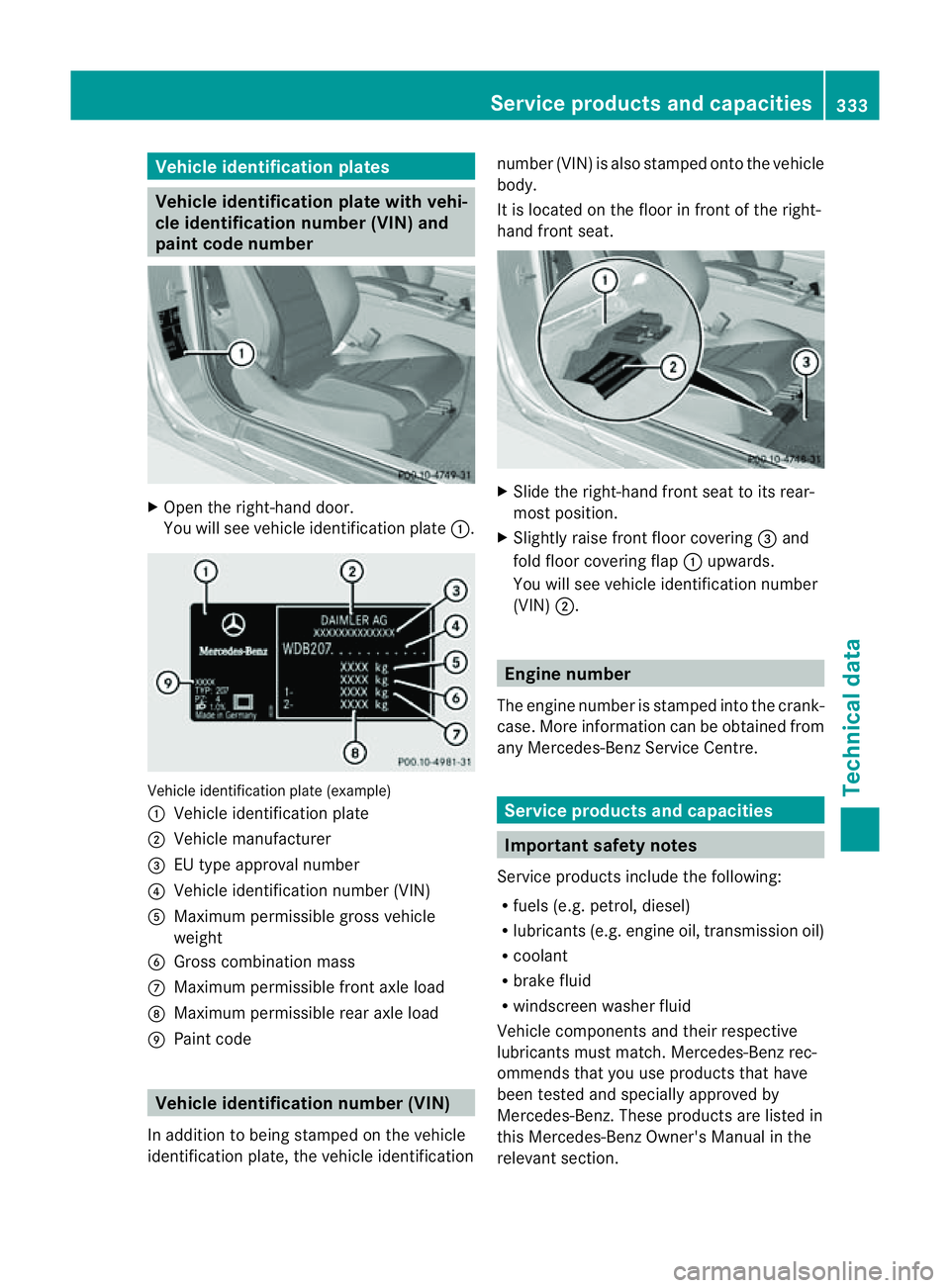
pain tcode number X
Open th eright-han ddoor.
You will see vehicle identification plate :.Vehicle identification plat
e(example)
: Vehicle identification plate
; Vehicle manufacturer
= EU type approval number
? Vehicle identification number (VIN)
A Maximum permissible gross vehicle
weight
B Gros scombinatio nmass
C Maximum permissible fron taxle load
D Maximu mpermissible rear axle load
E Paint code Vehicle identification number (VIN)
In addition to being stamped on the vehicle
identification plate, the vehicle identification number (VIN) is also stamped ontot
he vehicle
body.
It is located on the floor in fron tofthe right-
hand fron tseat. X
Slide the right-hand fron tseat to its rear-
most position.
X Slightly raise fron tfloor covering =and
fold floor coverin gflap :upwards.
You will see vehicle identification number
(VIN) ;. Engine number
The engine number is stamped int othe crank-
case. More information can be obtained from
any Mercedes-Ben zServic eCentre. Service products and capacities
Important safety notes
Servic eproducts include the following:
R fuels (e.g .petrol, diesel)
R lubricant s(e.g. engin eoil, transmission oil)
R coolant
R brake fluid
R windscreen washer fluid
Vehicle componentsa nd their respective
lubricant smust match. Mercedes-Benzr ec-
ommends that you use product sthat have
been tested and specially approved by
Mercedes-Benz.T hese productsare listed in
this Mercedes-BenzO wner's Manual in the
relevant section. Service products and capacities
333Technical data Z
Page 339 of 353
Vehicl
emodel Capacity including
oilf ilter 39 E2
0040
E2 5040 5.5 l
E3
0040
E3 5040
E2 20 CDI 40
E2 50 CDI 40 6.5 l
E3
50 CDI 40 8.0 l
E5
0040 Additives
!
Do not us eaddit ivesine ngine oil. This
could damag ethe engine.
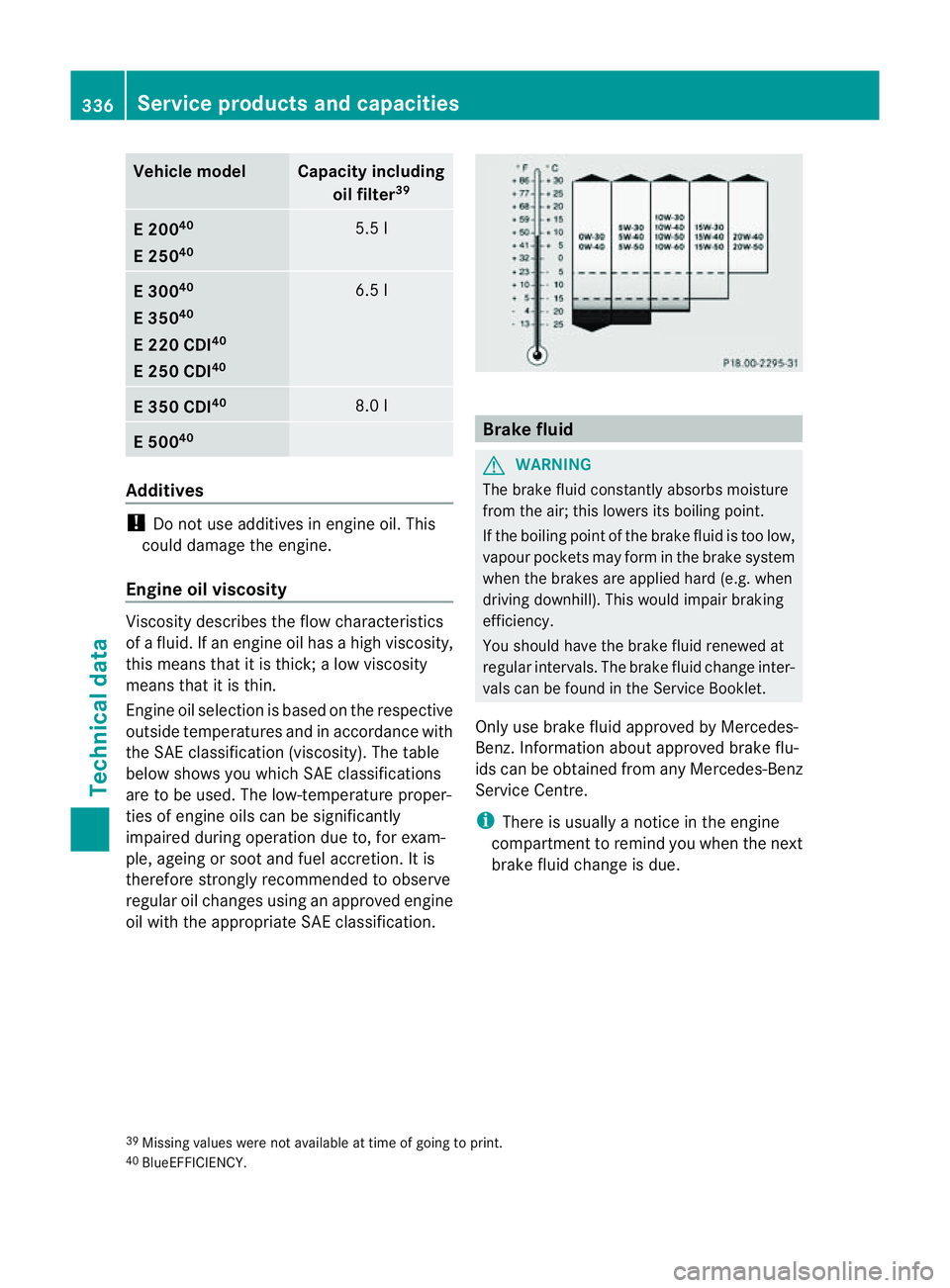
Engine oi lviscosity Viscosity describe
sthe flo wcharacteristics
of afluid .Ifane ngine oi lhas ah ighv iscosity,
thi sm eans tha titisthick;alow viscosity
means that it is thin.
Engine oil selection is based on the respective
outside temperatures and in accordance with
the SAE classification (viscosity). The table
below shows you which SAE classifications
are to be used. The low-temperature proper-
ties of engine oils can be significantly
impaired during operation due to, for exam-
ple, ageing or soot and fuel accretion. It is
therefore strongly recommended to observe
regularo il changes using an approved engine
oil with the appropriate SA Eclassification. Brake fluid
G
WARNING
The brak efluid constantly absorb smoisture
fro mt he air; this lowers its boiling point.
If the boiling point of the brake fluid is too low,
vapour pockets may form in the brake system
when the brakes are applied hard (e.g. when
driving downhill). This would impair braking
efficiency.
You should have the brake fluid renewed at
regular intervals. The brake fluid change inter-
vals can be found in the Service Booklet.
Only use brake fluid approved by Mercedes-
Benz.I nformation about approved brake flu-
ids can be obtained from any Mercedes-Benz
Service Centre.
i There is usually anotic eint he engine
compartmenttor emind you when the next
brake fluid change is due.
39 Missing values were not availabl eattime of going to print.
40 BlueEFFICIENCY. 336
Service product
sand capacitiesTechnical data
Page 347 of 353
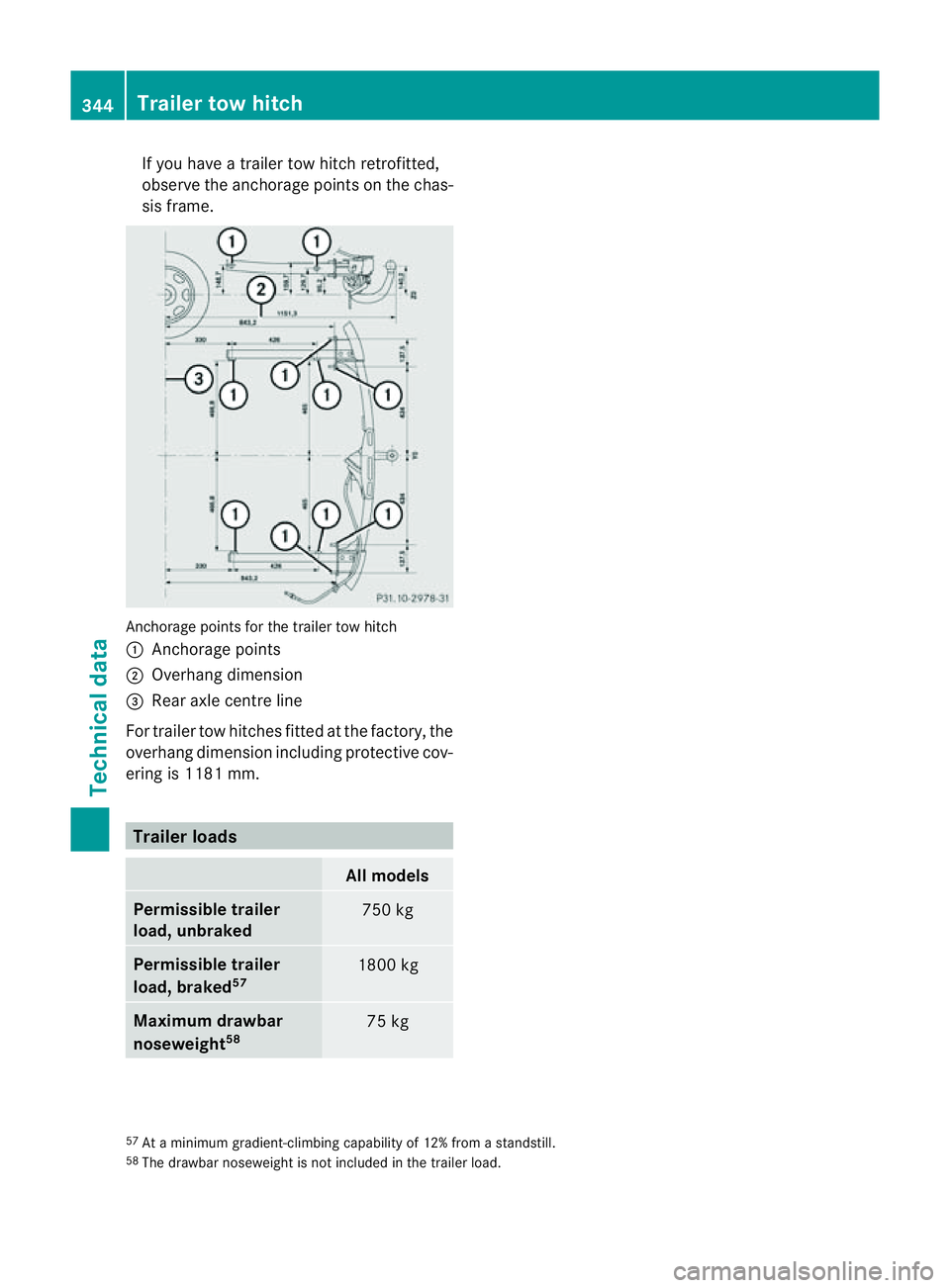
If you have
atrailert ow hitch retrofitted,
observe the anchorage points on the chas-
sis frame. Anchorage points for the trailer tow hitch
:
Anchorage points
; Overhang dimension
= Reara xle centre line
For traile rtow hitches fitted at the factory, the
overhang dimension including protective cov-
ering is 1181 mm. Trailer loads
All models
Permissible trailer
load, unbraked
750 kg
Permissible trailer
load, braked
57 1800 kg
Maximu
mdrawbar
noseweight 58 75 kg
57
At am inimum gradient-climbing capability of 12% from astandstill.
58 The drawbar noseweight is not included in the trailer load. 344
Trailer tow hitchTechnical data
Page 348 of 353
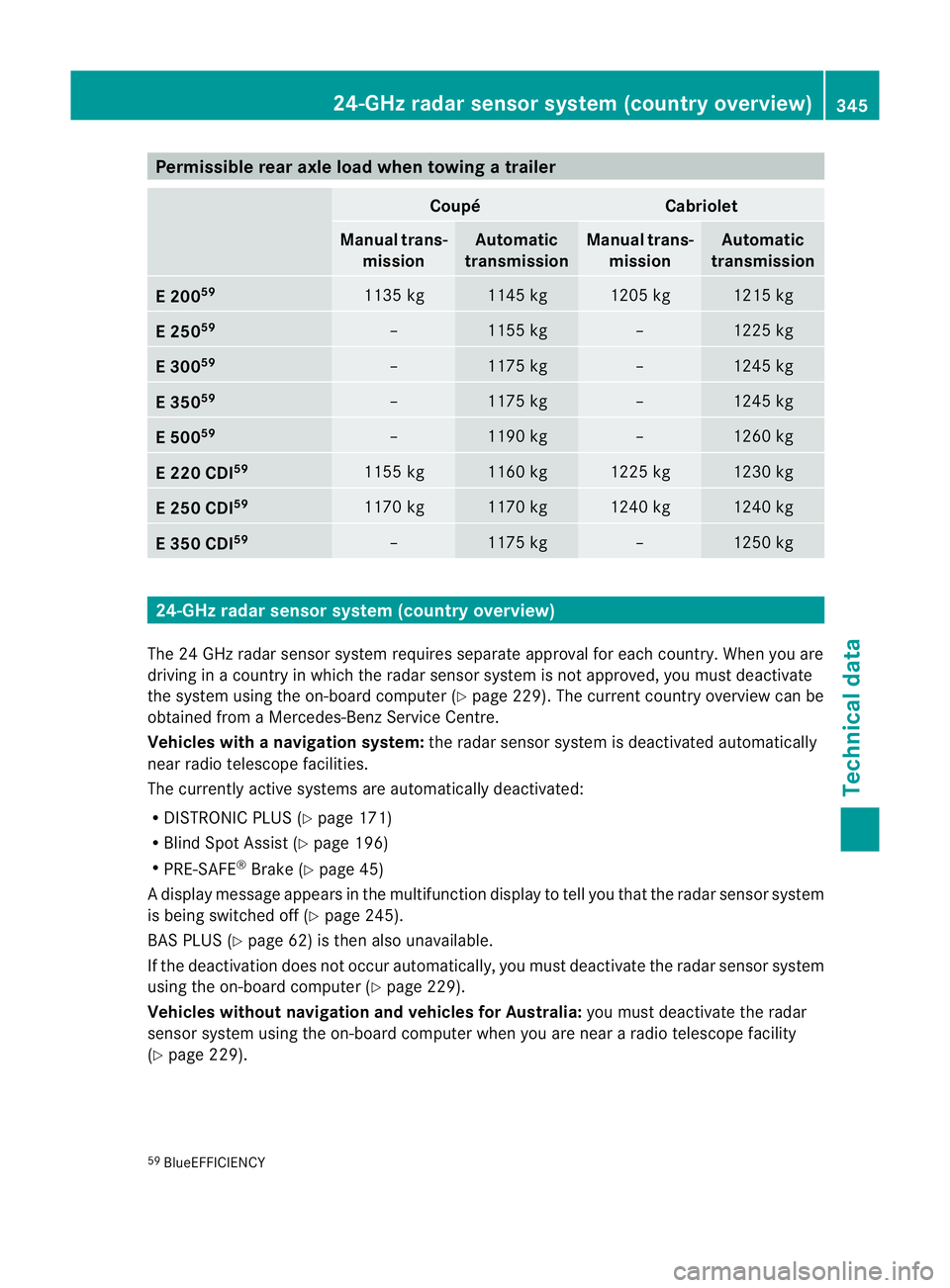
Permissible rear axle load when towing
atrailer Coupé Cabriolet
Manual trans-
mission Automatic
transmission Manual trans-
mission Automatic
transmission E2
0059 1135 kg 1145 kg 1205 kg 1215 kg
E2
5059 – 1155 kg – 1225 kg
E3
0059 – 1175 kg – 1245 kg
E3
5059 – 1175 kg – 1245 kg
E5
0059 – 1190 kg – 1260 kg
E2
20 CDI 59 1155 kg 1160 kg 1225 kg 1230 kg
E2
50 CDI 59 1170 kg 1170 kg 1240 kg 1240 kg
E3
50 CDI 59 – 1175 kg – 1250 kg
24-GHz radar sensor syste
m(coun try overview)
Th e24G Hz radar sensor system requires separate approval for each country. When you are
driving in acountry in whic hthe radar sensor system is no tapproved, you must deactivate
the system using the on-board computer (Y page 229). The currentcountry overview can be
obtaine dfrom aMercedes-Benz Service Centre.
Vehicles with anavigation system: the radar sensor system is deactivated automatically
near radio telescope facilities.
The currently active systems are automatically deactivated:
R DISTRONI CPLUS (Y page171)
R Blind Spot Assist (Y page196)
R PRE-SAFE ®
Brake (Y page45)
Ad isplay message appears in the multifunction display to tell you that the radar sensor system
is being switched off (Y page 245).
BA SP LUS (Y page 62) is the nalso unavailable.
If the deactivation does not occur automatically, you must deactivat ethe radar sensor system
using the on-board computer (Y page 229).
Vehicles withou tnavigation and vehicles for Australia: you must deactivate the radar
sensor system using the on-board computer whe nyou are near aradio telescope facility
(Y page 229).
59 BlueEFFICIENCY 24-GHz radar sensor system (countryo
verview)
345Technical data Z