warning light MERCEDES-BENZ E-Class COUPE 2013 C207 User Guide
[x] Cancel search | Manufacturer: MERCEDES-BENZ, Model Year: 2013, Model line: E-Class COUPE, Model: MERCEDES-BENZ E-Class COUPE 2013 C207Pages: 372, PDF Size: 12.69 MB
Page 40 of 372
Useful information
i This Operator's Manual describes all
models and all standard and optional
equipment of your vehicle available at the
time of publication of the Operator's
Manual. Country-specific differences are
possible.
Please note that your vehicle may
not be equipped with all features
described. This also applies to safety-
related systems and functions.
i Read the information on qualified
specialist workshops: ( Y page 24).Panic alarm
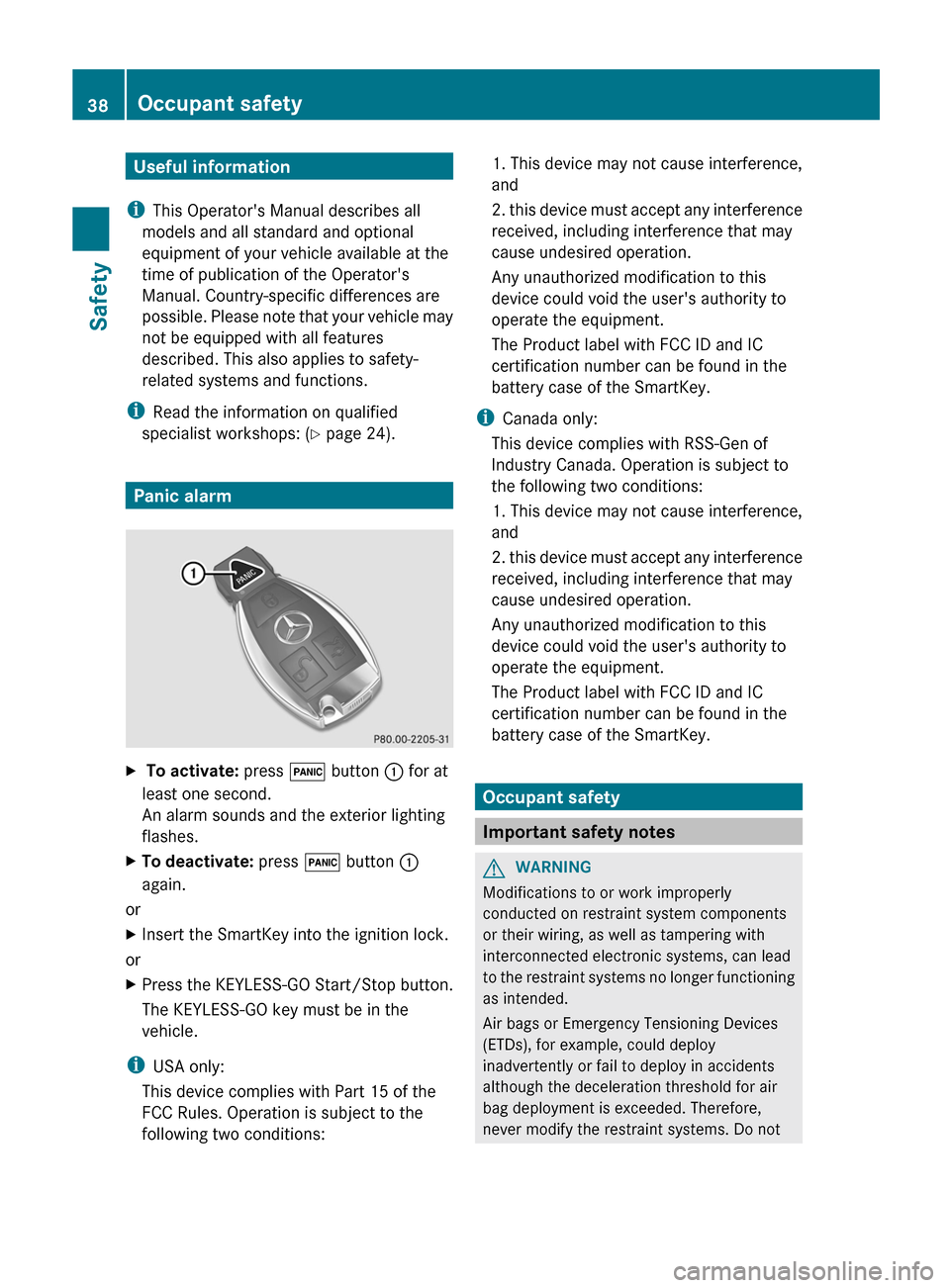
X
To activate: press ! button : for at
least one second.
An alarm sounds and the exterior lighting
flashes.
X To deactivate: press ! button :
again.
or
X Insert the SmartKey into the ignition lock.
or
X Press the KEYLESS-GO Start/Stop button.
The KEYLESS-GO key must be in the
vehicle.
i USA only:
This device complies with
Part 15 of the
FCC Rules. Operation is subject to the
following two conditions: 1. This device may not cause interference,
and
2.
this device must accept any interference
received, including interference that may
cause undesired operation.
Any unauthorized modification to this
device could void the user's authority to
operate the equipment.
The Product label with FCC ID and IC
certification number can be found in the
battery case of the SmartKey.
i Canada only:
This device complies with RSS-Gen of
Industry Canada. Operation is subject to
the following two conditions:
1. This device may not cause interference,
and
2. this device must accept any interference
received, including interference that may
cause undesired operation.
Any unauthorized modification to this
device could void the user's authority to
operate the equipment.
The Product label with FCC ID and IC
certification number can be found in the
battery case of the SmartKey. Occupant safety
Important safety notes
G
WARNING
Modifications to or work improperly
conducted on restraint system components
or their wiring, as well as tampering with
interconnected electronic systems, can lead
to
the restraint systems no longer functioning
as intended.
Air bags or Emergency Tensioning Devices
(ETDs), for example, could deploy
inadvertently or fail to deploy in accidents
although the deceleration threshold for air
bag deployment is exceeded. Therefore,
never modify the restraint systems. Do not 38
Occupant safety
Safety
Page 41 of 372

tamper with electronic components or their
software.
In this section, you will learn the most
important facts about the restraint system
components of the vehicle.
The restraint system consists of:
R seat belts
R child restraint systems
R LATCH-type (ISOFIX) child seat anchors
Additional protection is provided by:
R SRS (Supplemental Restraint System)
R NECK-PRO head restraints
R PRE-SAFE ®
R Cabriolet: roll bar
R air bag system components with:
-PASSENGER
AIR BAG OFF indicator lamp
- front-passenger seat with Occupant
Classification System (OCS)
The different air bag systems work
independently of each other. The protective
functions of the system work in conjunction
with each other. Not all air bags are deployed
in an accident.
i See "Children in the vehicle" for
information on infants and children
traveling with you in the vehicle restraint
systems for infants and children
(Y page 58). SRS (Supplemental Restraint System)
Introduction SRS consists of:
R
6 SRS warning lamp
R Air bags
R Air bag control unit with crash sensors
R Emergency Tensioning Devices
R Belt force limiters
SRS reduces the risk of occupants coming
into contact with the vehicle's interior in the
event of an accident. It can also reduce the effect of the forces to which occupants are
subjected during an accident.
SRS warning lamp
G
WARNING
The SRS self-check has detected a
malfunction if the 6 SRS indicator lamp:
R does not light up at all
R does not go out after approximately four
seconds after the engine is started
R lights
up after the engine is started or while
the vehicle is in motion
For your safety, Mercedes-Benz strongly
recommends that you have the system
checked as soon as possible at a qualified
specialist workshop. SRS may otherwise fail
to activate when it is needed in the event of
an accident, which could lead to serious or
fatal injuries. SRS might also be activated
unexpectedly and unnecessarily, which could
also result in injury.
In addition, work carried out improperly on
SRS may render SRS inoperative or cause
unintended air bag deployment. Work on the
SRS system should only be carried out by
qualified specialist personnel. Consult a
qualified specialist workshop.
If it is necessary to modify an air bag system
to accommodate a person with disabilities,
contact an authorized Mercedes-Benz Center
for details. USA only: for further information,
contact our Customer Assistance Center at
1-800-FOR-MERCedes (1-800-367-6372).
SRS functions are checked regularly when
you switch on the ignition and when the
engine is running. Therefore, malfunctions
can be detected in good time.
The 6 SRS warning lamp in the instrument
cluster lights up when the ignition is switched
on. It goes out no later than a few seconds
after the engine is started.
The SRS components are in operational
readiness when the SRS 6 indicator lamp
goes out while the engine is running. Occupant safety
39
Safety Z
Page 44 of 372
Failure to follow these instructions can result
in severe injuries to you or other occupants.
If
you sell your vehicle, it is important that you
make the buyer aware of this safety
information. Be sure to give the buyer this
Operator's Manual. G
WARNING
Accident research shows that the safest place
for
children in an automobile is in a rear seat.
A side impact air bag related injury may occur
if occupants, especially children, are not
properly seated or restrained when next to a
side impact air bag which needs to deploy
rapidly in a side impact in order to do its job.
To help avoid the possibility of injury, please
follow these guidelines:
(1) Always sit as upright as possible and use the seat belts properly.
Make sure that children 12 years
old
and under use an appropriately
sized child restraint, infant
restraint, or booster seat
recommended for the size and
weight of the child.
(2) Always wear seat belts properly.
If the air bags are deployed, you will hear a
bang,
and a small amount of powder may also
be released. Only in rare cases will the bang
affect your hearing. The powder that is
released generally does not constitute a
health hazard. The 6 SRS warning lamp
lights up.
The air bags are deployed if the air bag control
unit detects the need for deployment. Only in
the event of such a situation will the air bags
provide their supplemental protection.
If the driver and front passenger do not wear
their seat belts, it is not possible for the air
bags to provide their supplemental
protection.
In the event of other types of impacts and
impacts below air bag deployment
thresholds, the air bags will not deploy. The
driver and passengers will then be protected to the extent possible by a properly fastened
seat
belt. A properly fastened seat belt is also
needed to provide the best possible
protection in a rollover.
Air bags provide additional protection; they
are not, however, a substitute for seat belts.
All vehicle occupants must fasten their seat
belts regardless of whether your vehicle is
equipped with air bags or not.
It is important for your safety and that of your
passengers to have deployed air bags
replaced and to have any malfunctioning air
bags repaired. This will help to make sure the
air bags continue to perform their protective
function for the vehicle occupants in the
event of a crash.
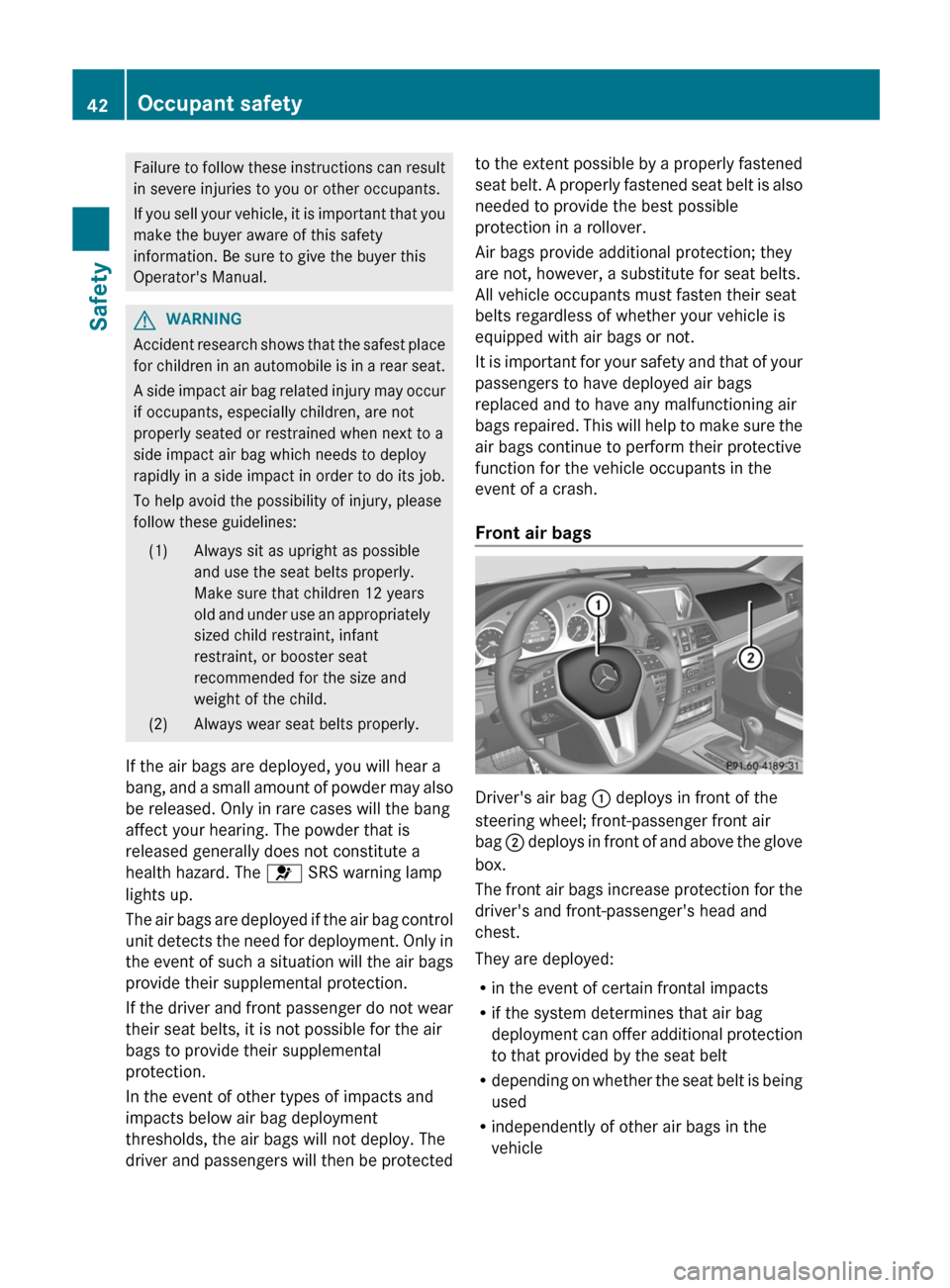
Front air bags Driver's air bag
: deploys in front of the
steering wheel; front-passenger front air
bag ;
deploys in front of and above the glove
box.
The front air bags increase protection for the
driver's and front-passenger's head and
chest.
They are deployed:
R in the event of certain frontal impacts
R if the system determines that air bag
deployment can offer additional protection
to that provided by the seat belt
R depending on whether the seat belt is being
used
R independently of other air bags in the
vehicle42
Occupant safety
Safety
Page 45 of 372
If the vehicle overturns, the front air bags are
generally
not deployed. If the system detects
high vehicle deceleration in a longitudinal
direction, the front air bags are deployed.
If a child restraint system is installed to the
front-passenger seat and the 4
PASSENGER AIRBAG OFF indicator lamp
does not light up on the center console:
R a child restraint system without
transponders for air bag deactivation
system is installed or
R a child restraint system with transponders
is not properly installed.
Your vehicle has adaptive, two-stage front air
bags. In the event of a collision, the air bag
control unit evaluates the vehicle
deceleration. In the first deployment stage,
the front air bag is filled with enough
propellant gas to reduce the risk of injuries.
The front air bag is fully deployed if a second
deployment threshold is exceeded within a
few milliseconds.
The deployment of the front-passenger front
air bag is also influenced by the weight
category of the front passenger, which is
determined by the Occupant Classification
System (OCS) ( Y page 46).
The lighter the passenger side occupant, the
higher the vehicle deceleration rate required
(predicted at the start of the impact) for
second-stage inflation of the front-passenger
front air bag. In the second stage, the front
air bags are inflated with the maximum
amount of propellant gas available.
The front air bags are not deployed in
situations where a low impact severity is
predicted. You will then be protected by the
fastened seat belt. Front-passenger front air bag will only deploy
if:
R
the system, based on the OCS weight
sensor readings, has detected that the
front-passenger seat is occupied.
R the 45
indicator lamp on the center
console is not lit (Y page 46).
R the air bag control unit predicts a high
impact severity.
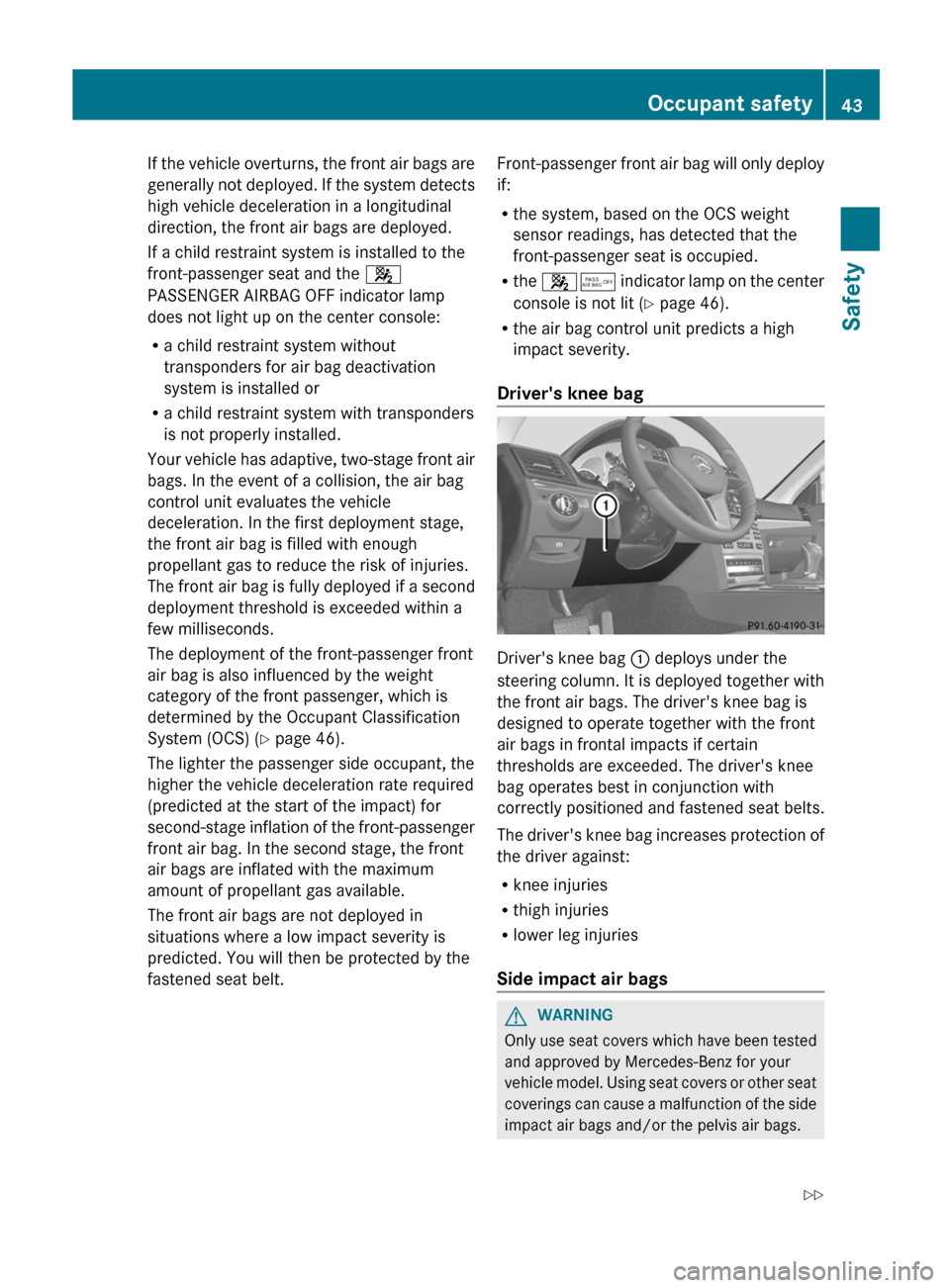
Driver's knee bag Driver's knee bag : deploys under the
steering
column. It is deployed together with
the front air bags. The driver's knee bag is
designed to operate together with the front
air bags in frontal impacts if certain
thresholds are exceeded. The driver's knee
bag operates best in conjunction with
correctly positioned and fastened seat belts.
The driver's knee bag increases protection of
the driver against:
R knee injuries
R thigh injuries
R lower leg injuries
Side impact air bags G
WARNING
Only use seat covers which have been tested
and approved by Mercedes-Benz for your
vehicle
model. Using seat covers or other seat
coverings can cause a malfunction of the side
impact air bags and/or the pelvis air bags. Occupant safety
43
Safety
Z
Page 50 of 372
bag is deactivated. Should the
45
indicator lamp not illuminate or go out while
the restraint is installed, please check
installation. Periodically check the
45 indicator lamp while driving to
make sure that the 45 indicator
lamp is illuminated. If the 45
indicator lamp goes out or remains out, do
not transport a child on the front-passenger
seat until the system has been repaired.
A child in a rear-facing child restraint on the
front-passenger seat will be seriously
injured or even killed if the front-passenger
front air bag inflates.
R If you place a child in a forward-facing child
restraint on the front-passenger seat:
-move the seat as far back as possible
- use the proper child restraint
recommended for the age, size and
weight of the child
- secure child restraint with the vehicle's
seat belt according to the child seat
manufacturer's instructions
R For children larger than the typical 12-
month-old child, the front-passenger front
air bag may or may not be activated. G
WARNING
If the red 6 SRS warning lamp in the
instrument cluster and the 45
indicator lamp light up simultaneously, the
OCS is malfunctioning. The front passenger
front air bag will be deactivated in this case.
Have the system checked by qualified
technicians as soon as possible. Contact an
authorized Mercedes-Benz Center.
Only
have the seat repaired or replaced at an
authorized Mercedes-Benz Center.
In order to ensure proper operation of the air
bag system and OCS:
R Sit with the seat belt properly fastened in a
position that is as upright as possible with
your back against the seat backrest.
R When seated, a passenger should not
position him/herself in such a way as to cause the passenger's weight to be lifted
from
the seat cushion as this may result in
the OCS being unable to correctly
approximate the passenger's weight
category.
R Read and observe all warnings in this
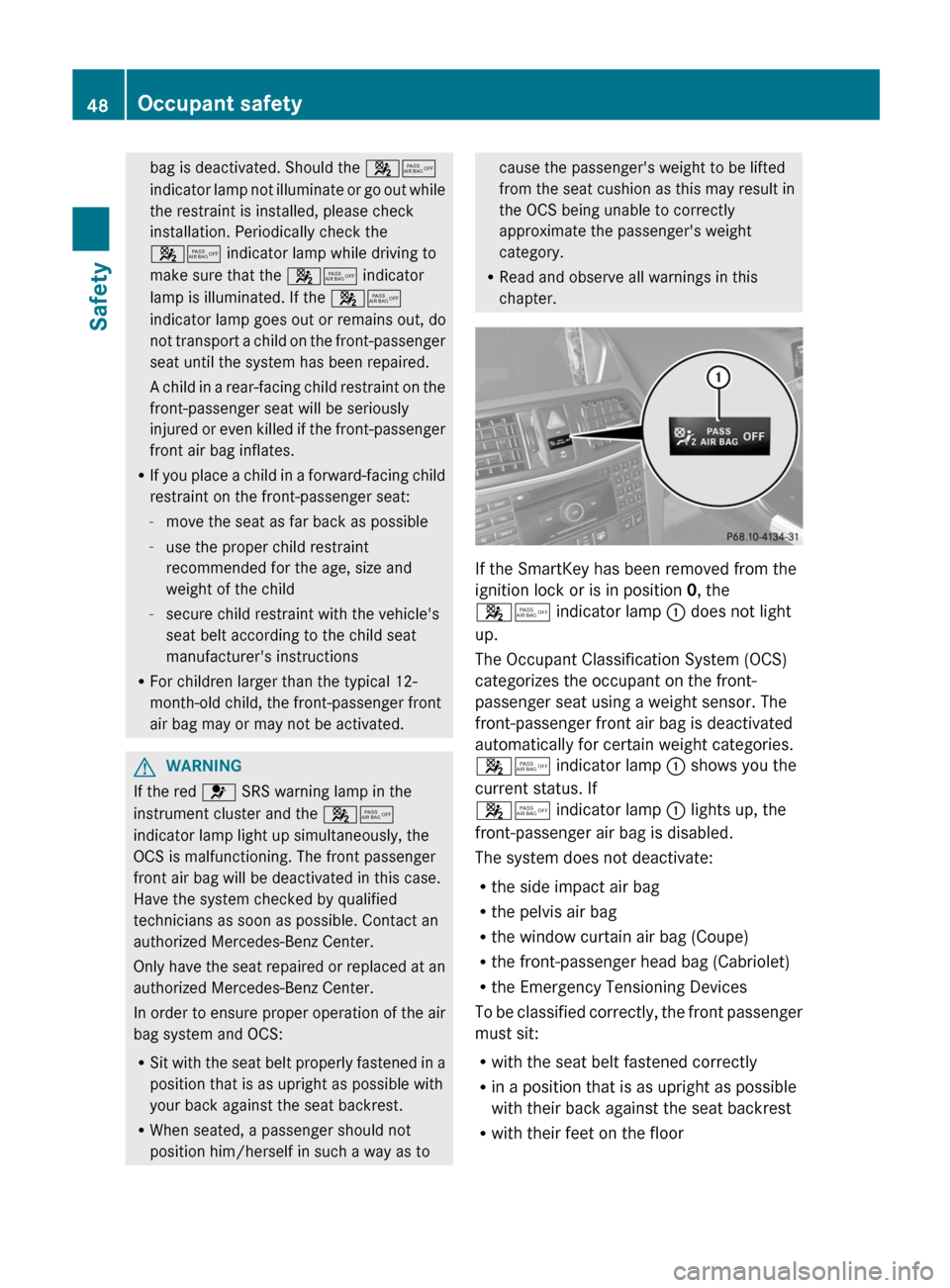
chapter. If the SmartKey has been removed from the
ignition lock or is in position 0, the
45 indicator lamp
: does not light
up.
The Occupant Classification System (OCS)
categorizes the occupant on the front-
passenger seat using a weight sensor. The
front-passenger front air bag is deactivated
automatically for certain weight categories.
45 indicator lamp : shows you the
current status. If
45 indicator lamp : lights up, the
front-passenger air bag is disabled.
The system does not deactivate:
R the side impact air bag
R the pelvis air bag
R the window curtain air bag (Coupe)
R the front-passenger head bag (Cabriolet)
R the Emergency Tensioning Devices
To
be classified correctly, the front passenger
must sit:
R with the seat belt fastened correctly
R in a position that is as upright as possible
with their back against the seat backrest
R with their feet on the floor48
Occupant safety
Safety
Page 51 of 372
The OCS weight sensor reading is affected if
the occupant's weight is transferred, e.g. by
leaning on the armrest.
If
the front-passenger seat, the seat cover or
the seat cushion are damaged, have the
necessary repair work carried out at a
qualified specialist workshop.
For safety reasons, Mercedes-Benz
recommends that you only use seat
accessories that have been approved by
Mercedes-Benz.
Both the driver and the front passenger
should always observe the 45
indicator lamp to determine whether or not
the front passenger is positioned correctly.
Also observe the air bag display messages,
which appear in the instrument cluster
(Y page 235).
If the driver's air bag deploys, this does not
mean that the front-passenger front air bag
will also deploy.
The OCS may have detected that the seat:
R is empty or occupied by the weight of a
typical child up to twelve months old,
seated in a child restraint system
R is occupied by a small individual, such as a
young teenager or a small adult
R is occupied by a child in a child restraint
system whose weight is greater than that
of a typical twelve month old child.
These are examples of when the OCS
deactivates the front-passenger front air bag.
Deactivation takes place although the
collision fulfills the criteria for deploying the
driver's air bag.
For further information, see "Air bag display
messages" ( Y page 235).
System self-test G
WARNING
If the 4 5 indicator lamp does not
illuminate,
the system is not functioning. You
must contact an authorized Mercedes-Benz Center before seating any child on the front
passenger seat.
G
WARNING
Never place anything between seat cushion
and
child seat (e.g. a pillow), since it reduces
the effectiveness of the OCS. The underside
and rear side child restraint system must be
placed entirely on the seat cushion and the
backrest of the front-passenger seat
backrest.
If necessary, adjust the tilt of the passenger
seat backrest.
An incorrectly mounted child seat could cause
injuries to the child in case of an accident,
instead of increasing protection for the child.
Follow the manufacturer's instructions for
installation of child restraint systems.
The 45 indicator lamp lights up:
R if you turn the SmartKey in the ignition lock
to position 1 or 2
R if you press the KEYLESS-GO Start/Stop
button once or twice on vehicles with
KEYLESS-GO
R if an adult is seated properly on the front-
passenger seat and the OCS classifies the
occupant as an adult
The 45 indicator lamp goes out
after approximately six seconds.
If the seat is not occupied and the OCS
detects that the front-passenger seat is
empty, the 45 indicator lamp will
continue to light up. The 45 front-
passenger front air bag warning lamp then
stays lit continuously.
For more information about the OCS, see
"Problems with the Occupant Classification
System" ( Y page 50). Occupant safety
49
Safety Z
Page 52 of 372
Problems with the Occupant Classification System
G
WARNING
If the 45 indicator lamp illuminates and remains illuminated when the weight of a typical
adult or someone larger than a small individual has been detected on the passenger seat, do not
allow any occupant to use the passenger seat until the system has been repaired. G
WARNING
If the 45 indicator lamp does not illuminate or remains out with the weight of a typical
12-month-old
child in a standard child restraint or less, or is unoccupied, on the front-passenger
seat, do not transport a child on the front-passenger seat until the system has been repaired. Problem Possible causes/consequences and
M SolutionsThe 45
indicator
lamp lights up
and stays on.
The person on the
front-passenger seat:
R has the weight of a
typical adult
R has been determined
by the system not to
be a child The OCS is malfunctioning.
X
Have the OCS checked as soon as possible at a qualified
specialist workshop.
X Observe the additional display messages in the multifunction
display
(Y page 235). Problem Possible causes/consequences and
M SolutionsThe 45
indicator
lamp does not
light up and/or does
not stay on.
The front-passenger
seat is:
R unoccupied
R occupied with a
weight up to that of a
typical twelve-
month-old child in a
standard child
restraint system The OCS is malfunctioning.
X
Make sure there is nothing between the seat cushion and the
child seat.
X Check the installation of the child restraint system.
X Make sure that no objects are applying additional weight onto
the seat.
X If the 45 indicator lamp remains off, have the OCS
checked
as soon as possible at a qualified specialist workshop.
Do not transport a child on the front-passenger seat as long as
the OCS is not functioning.
X Observe the additional display messages in the multifunction
display
(Y page 235). 50
Occupant safety
Safety
Page 55 of 372
If the seat belts are not released:
X
Move the backrest or seat back slightly, but
only when the vehicle is stationary.
The belt pretensioning is reduced and the
locking mechanism is released.
More information about seat belt adjustment,
a convenience function integrated into PRE-
SAFE ®
, can be found under "Seat belt
adjustment" (Y page 56). Seat belts
Important safety notes G
WARNING
Always fasten your seat belt before driving off.
Always make sure all of your passengers are
properly
restrained. You and your passengers
should always wear seat belts.
Failure to wear and properly fasten and
position your seat belt greatly increases your
risk of injuries and their likely severity in an
accident.
If you are ever in an accident, your injuries can
be considerably more severe without your
seat belt properly buckled. Without your seat
belt buckled, you are much more likely to hit
the interior of the vehicle or be ejected from
it. You can be seriously injured or killed.
In the same crash, the possibility of injury or
death is lessened if you are properly wearing
your seat belt. The air bags can only protect
as intended if the occupants are properly
wearing their seat belts. G
WARNING
Never ride in a moving vehicle with the seat
backrest
in an excessively reclined position as
this can be dangerous. You could slide under
the seat belt in a collision. If you slide under
it, the seat belt would apply force at the
abdomen or neck. That could cause serious
or even fatal injuries. The seat backrest and
seat belt provide the best restraint when the
wearer is in a position that is as upright as possible and the seat belt is properly
positioned on the body.
G
WARNING
Never let more people ride in the vehicle than
there are seat belts available. Make sure
everyone riding in the vehicle is correctly
restrained with a separate seat belt. Never
use
a seat belt for more than one person at a
time. G
WARNING
Always have damaged seat belts or seat belts
that have been subjected to a load in an
accident replaced and the anchorages
checked.
Only use seat belts that have been approved
by Mercedes-Benz.
Never tamper with seat belts. This can result
in the unintended deployment of the
Emergency Tensioning Devices or the failure
to deploy when necessary.
Do not bleach or dye seat belts, as this may
severely weaken them. In the event of a
collision, they may be unable to provide
adequate protection.
Have all work carried out only by qualified
technicians. Consult a qualified specialist
workshop.
The use of seat belts and infant and child
restraint systems is required by law in:
R all 50 states
R U.S. territories
R the District of Columbia
R all Canadian provinces
Even where this is not required by law, all
vehicle occupants should correctly fasten
their seat belts before starting the journey.
i See "Children in the vehicle"
(Y page 58) for further information on
infants
and children traveling in the vehicle
as well as on child restraint systems. Occupant safety
53
Safety Z
Page 59 of 372
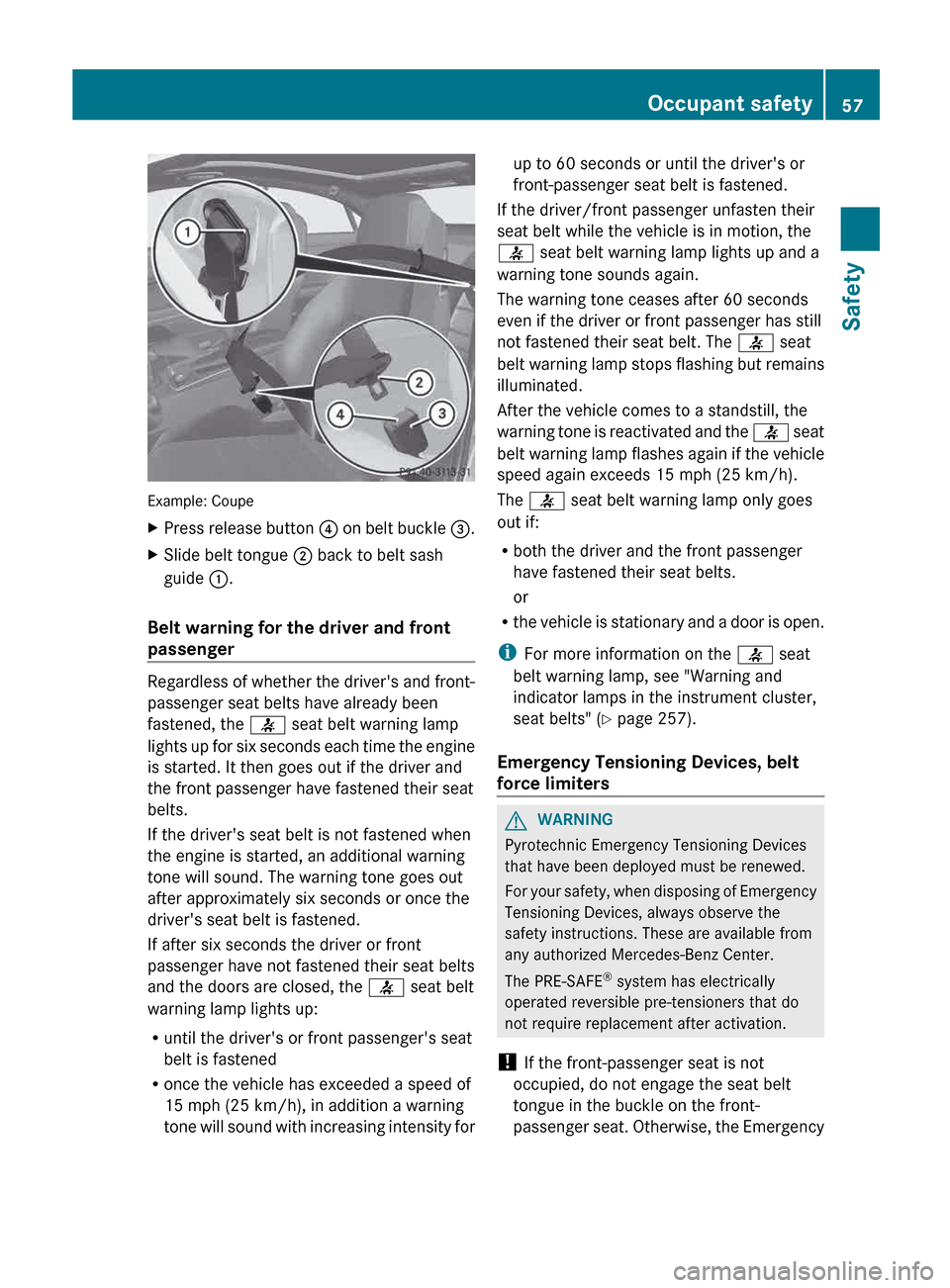
Example: Coupe
X
Press release button ? on belt buckle =.
X Slide belt tongue ; back to belt sash
guide :.
Belt warning for the driver and front
passenger Regardless of whether the driver's and front-
passenger seat belts have already been
fastened, the 7 seat belt warning lamp
lights
up for six seconds each time the engine
is started. It then goes out if the driver and
the front passenger have fastened their seat
belts.
If the driver's seat belt is not fastened when
the engine is started, an additional warning
tone will sound. The warning tone goes out
after approximately six seconds or once the
driver's seat belt is fastened.
If after six seconds the driver or front
passenger have not fastened their seat belts
and the doors are closed, the 7 seat belt
warning lamp lights up:
R until the driver's or front passenger's seat
belt is fastened
R once the vehicle has exceeded a speed of
15 mph (25 km/h), in addition a warning
tone will sound with increasing intensity for up to 60 seconds or until the driver's or
front-passenger seat belt is fastened.
If the driver/front passenger unfasten their
seat belt while the vehicle is in motion, the
7 seat belt warning lamp lights up and a
warning tone sounds again.
The warning tone ceases after 60 seconds
even if the driver or front passenger has still
not fastened their seat belt. The 7 seat
belt
warning lamp stops flashing but remains
illuminated.
After the vehicle comes to a standstill, the
warning tone is reactivated and the 7 seat
belt warning lamp flashes again if the vehicle
speed again exceeds 15 mph (25 km/h).
The 7 seat belt warning lamp only goes
out if:
R both the driver and the front passenger
have fastened their seat belts.
or
R the vehicle is stationary and a door is open.
i For more information on the 7 seat
belt warning lamp, see "Warning and
indicator lamps in the instrument cluster,
seat belts" ( Y page 257).
Emergency Tensioning Devices, belt
force limiters G
WARNING
Pyrotechnic Emergency Tensioning Devices
that have been deployed must be renewed.
For
your safety, when disposing of Emergency
Tensioning Devices, always observe the
safety instructions. These are available from
any authorized Mercedes-Benz Center.
The PRE-SAFE ®
system has electrically
operated reversible pre-tensioners that do
not require replacement after activation.
! If the front-passenger seat is not
occupied, do not engage the seat belt
tongue in the buckle on the front-
passenger seat. Otherwise, the Emergency Occupant safety
57
Safety Z
Page 60 of 372
Tensioning Device could be triggered in the
event of an accident.
The seat belts are equipped with Emergency
Tensioning Devices and belt force limiters.
The
ETDs tighten the seat belts in an accident,
pulling them close against the body.
The ETDs do not correct incorrect seat
positions or incorrectly fastened seat belts.
The ETDs do not pull vehicle occupants back
towards the backrest.
If the seat belt is also equipped with a seat
belt force limiter and this is triggered, the
force exerted by the seat belt on the vehicle
occupant is reduced.
When triggered, seat belt force limiters help
to reduce the peak force exerted by the seat
belt on the vehicle occupant.
The belt force limiters for the front seats are
synchronized with the front air bags, which
take on a part of the deceleration force. This
results in the force exerted on the occupant
being distributed over a greater area.
The ETDs can only be activated when:
R the ignition is switched on.
R the restraint systems are operational; see
"SRS warning lamp" ( Y page 39).
R
R the belt tongue is engaged in the buckle on
each of the lap-shoulder belts in the front.
R the front-passenger seat is occupied and
the belt tongue is engaged in the buckle on
the front-passenger side.
The ETDs on the seats in the rear
compartment are triggered independently of
the lock status of the seat belts.
The ETDs are triggered depending on the type
and severity of an accident:
R if, in the event of a head-on or rear-end
collision, the vehicle decelerates or
accelerates rapidly in a longitudinal
direction during the initial stages of the
impact
R if, in the event of a side impact, on the side
opposite the impact the vehicle decelerates or accelerates rapidly in a
lateral direction
R Cabriolet:
in certain situations if the vehicle
overturns and the system determines that
it can provide additional protection
If the ETDs are deployed, you will hear a bang,
and a small amount of powder may also be
released. Only in rare cases will the bang
affect your hearing. The powder that is
released generally does not constitute a
health hazard. The 6 SRS warning lamp
lights up.
Automatic comfort-fit feature The front seat belts have an automatic
comfort-fit
feature. The automatic comfort-fit
feature reduces the retraction force of the
seat belts. This results in increased seat belt
comfort. Children in the vehicle
Child restraint systems
Important safety notes G
WARNING
According to accident statistics, children are
safer when properly restrained in the rear
seating positions than in the front seating
position. Thus, we strongly recommend that
children
be placed in the rear seats whenever
possible. Regardless of seating position,
children 12 years old and under must be
seated and properly secured in an appropriate
infant restraint, toddler restraint, or booster
seat recommended for the size and weight of
the child.
The infant or child restraint must be properly
secured with the vehicle's seat belt, the seat
belt and top tether strap, or lower anchors and
top tether strap, fully in accordance with the
child seat manufacturer's instructions.
Occupants, especially children, should always
sit as upright as possible, wear the seat belt
properly and use an appropriately sized infant 58
Children in the vehicle
Safety